Plant Reproduction
5. Germination and Early Growth
Learning outcomes
- I can define germination as the beginning of growth from a seed.
- I can identify the conditions required for successful germination.
- I can describe the stages of seed germination.
- I can explain how seedlings obtain energy during early growth.
- I can analyze factors that affect seedling development and survival.


What Is Germination?
A seed contains a living plant embryo.
For a period of time, the embryo may remain inactive or grow extremely slowly. When environmental conditions become suitable, the embryo begins active growth.
This process is called:
germination
Germination is the beginning of growth of a new plant from a seed.
The basic sequence is:
dormant seed → water uptake → metabolism increases → radicle emerges → shoot emerges → leaves develop → seedling
Germination therefore marks the transition from a relatively inactive seed to an actively growing young plant.
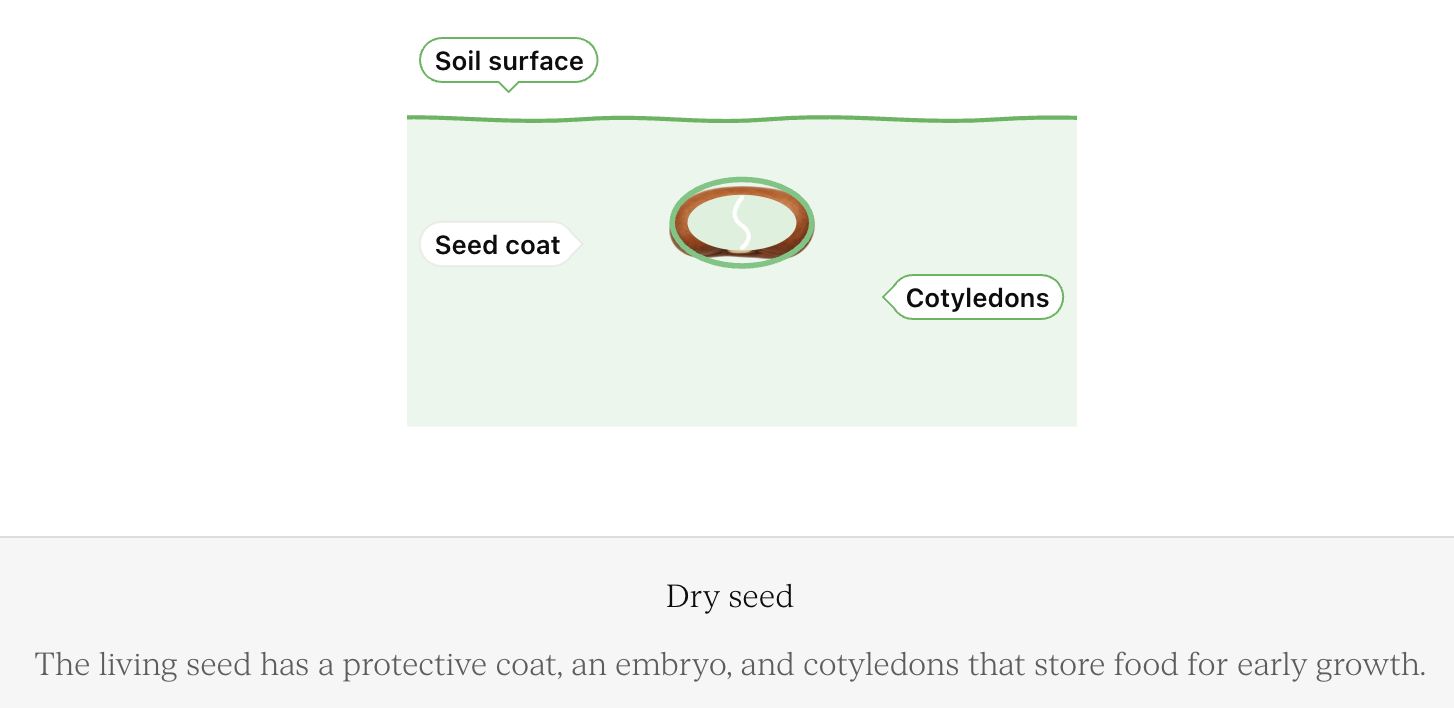
A Seed Is Alive
A dry seed may appear lifeless, but a viable seed contains a:
living embryo
Its metabolic activity is usually extremely low.
This allows many seeds to survive periods when conditions are unsuitable for growth.
Depending on the species, seeds may survive:
- cold
- drought
- seasonal changes
- long periods without suitable growing conditions
When appropriate conditions return, growth can begin.
What Is Seed Dormancy?
A seed that is alive but temporarily not growing may be:
dormant
Dormancy prevents some seeds from germinating immediately after they are produced.
This can be extremely useful.
For example, a seed produced shortly before winter may survive better if it remains dormant until:
warmer conditions return
Dormancy helps coordinate germination with conditions that give the seedling a greater chance of survival.
What Does a Seed Contain?
A typical seed contains:
- an embryo
- a food supply
- a protective seed coat
Within the embryo are structures that will develop into the new plant.
Important structures include:
- radicle – embryonic root
- plumule – embryonic shoot
- cotyledon(s) – seed leaves that may store or absorb nutrients


Each structure has an important role during germination.
Conditions Required for Germination
Most seeds require three major conditions:
water
oxygen
suitable temperature
Notice something important:
light is not a universal requirement for germination.
Some seeds are affected by light, but many can germinate underground where little or no light reaches them.
Water
Water is essential for germination.
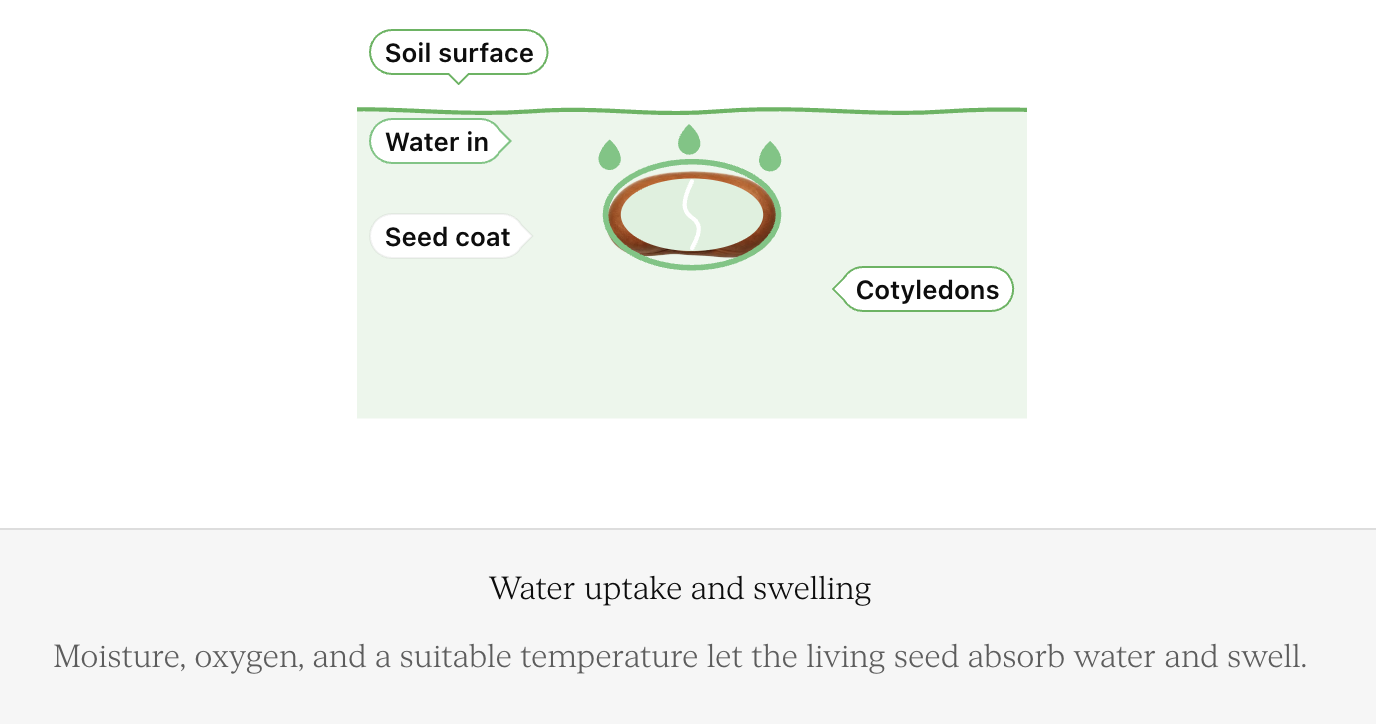
A dry seed absorbs water through a process called:
imbibition
As water enters the seed:
- the seed swells
- the seed coat softens
- cells become hydrated
- enzymes become active
- stored food can begin to be broken down
- metabolic reactions increase


Without sufficient water, these processes cannot proceed normally.
Why Does the Seed Swell?
Water enters the tissues of the seed.
The tissues increase in volume, causing the seed to:
swell
Eventually, pressure from the growing embryo helps break through the:
seed coat
This allows the radicle to emerge.
Water therefore acts as one of the main triggers that changes the seed from a relatively inactive state to an actively growing one.
Oxygen
Germinating seeds also require:
oxygen
Why?
Because growing cells need:
energy
Most of this energy is supplied through:
aerobic respiration
The embryo uses stored food and oxygen to release energy.
That energy is needed for:
- cell division
- active transport
- protein synthesis
- growth
- development
Respiration During Germination
Before leaves are functioning, the seedling cannot depend on photosynthesis for its immediate energy needs.
Instead, stored nutrients are broken down.
For example, stored carbohydrates can ultimately supply glucose for respiration:
glucose + oxygen → carbon dioxide + water + energy
The released energy supports growth.
Therefore:
stored food + oxygen → respiration → energy → growth
Why Can Waterlogged Soil Be a Problem?
Seeds need water.
But too much water can also cause problems.
In waterlogged soil, spaces that normally contain air become filled with:
water
This can reduce the amount of oxygen available to the seed.
Less oxygen means:
less aerobic respiration
and therefore potentially:
less energy available for growth
This explains why a seed may fail to germinate successfully in severely waterlogged soil even though plenty of water is available.
Suitable Temperature
Seeds also require a suitable:
temperature
Germination depends on many chemical reactions controlled by:
enzymes
Temperature affects enzyme activity.
At very low temperatures:
metabolic reactions occur slowly
At suitable temperatures:
enzymes function effectively
At excessively high temperatures:
enzymes and cells may be damaged


Different plant species have different optimum temperature ranges.
Does a Seed Need Light?
A common misconception is:
all seeds need light to germinate.
They do not.
Many seeds germinate:
underground
However, light becomes extremely important after the shoot emerges and leaves develop.
At that stage, the seedling begins relying increasingly on:
photosynthesis
Some species do have seeds whose germination is stimulated or inhibited by light, so the exact requirement depends on the species.
The Three Main Requirements
For most seeds, remember:
W + O + T
Water
Oxygen
Temperature
These three factors allow the embryo to resume active growth.
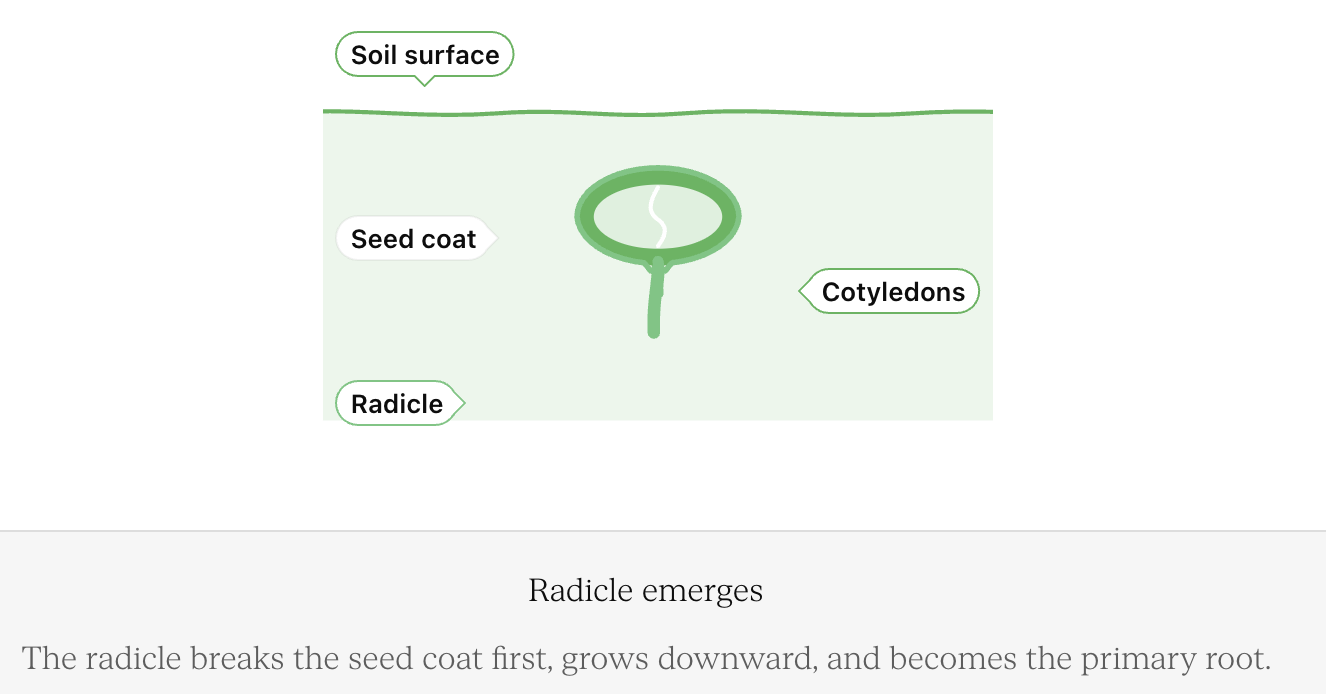
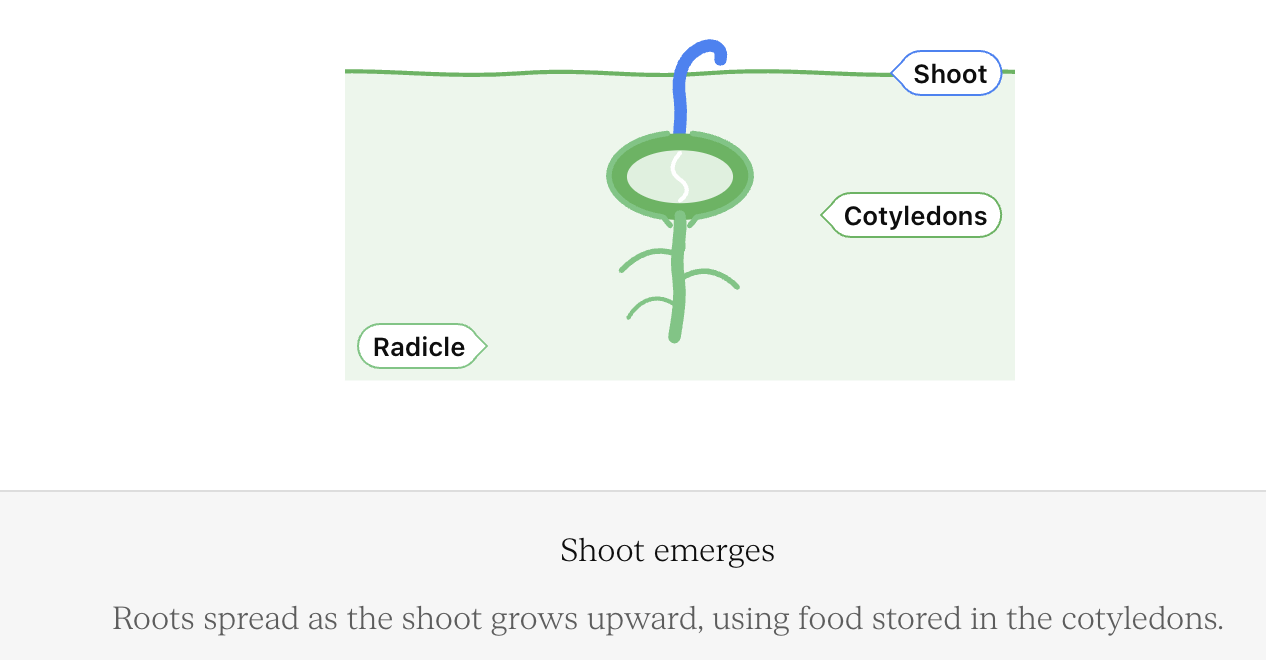
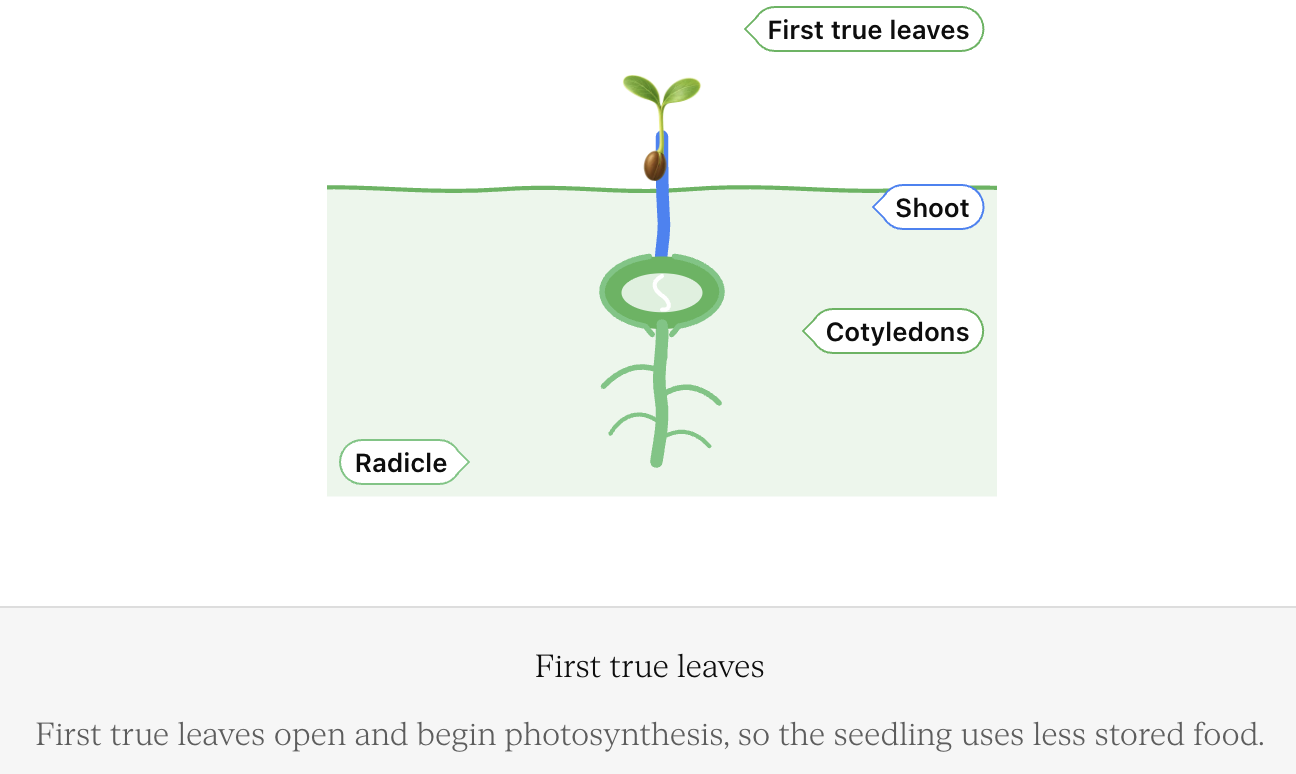
The visualization below lets you trace these requirements through the major stages of germination.
Stage 1: Water Is Absorbed
The first major step is:
water uptake
The dry seed absorbs water and swells.
This activates enzymes and increases metabolic activity.
Stored nutrients begin to become available to the embryo.
Stage 2: Respiration Increases
As enzymes become active, stored food is mobilized.
The embryo uses these nutrients during:
respiration
Respiration releases the energy needed for:
growth and cell division
At this stage, the seed is still completely dependent on:
stored resources
Stage 3: The Seed Coat Breaks
As the embryo grows and the seed swells, the:
seed coat
eventually splits.
The first major embryonic structure to emerge is usually the:
radicle


Stage 4: The Radicle Emerges
The radicle is the embryonic root.
It normally grows:
downward
into the soil.
The radicle develops into the plant's root system.
This is useful because the developing seedling quickly needs access to:
- water
- mineral ions
- physical anchorage
Why Does the Root Usually Appear First?
A young plant cannot survive long without:
water
Developing roots early allows the seedling to begin absorbing water from its surroundings.
Roots also anchor the plant into the soil.
Therefore, early root development provides both:
resources + stability
Stage 5: The Root System Develops
The radicle grows longer and may begin producing:
lateral roots
Later, root hairs develop.
Root hairs greatly increase:
surface area
This improves the plant's ability to absorb:
water and mineral ions


Stage 6: The Shoot Begins to Grow
The embryonic shoot begins growing upward.
The:
plumule
develops into the shoot system.
Eventually, the shoot pushes toward or above the soil surface.
The young plant is now becoming a:
seedling
How Does the Shoot Know Which Direction to Grow?
Young plants respond to environmental stimuli.
Roots generally show growth responses that help them grow into the soil.
Shoots generally grow toward conditions where they can eventually receive:
light
These directional growth responses improve the plant's chances of obtaining the resources it needs.
Stage 7: Leaves Develop
Once the shoot reaches the light, leaves begin to expand.


At first, these may include:
cotyledons
Later, the plant develops:
true leaves
The development of functioning leaves creates a major change in how the young plant obtains its energy resources.
How Does a Seedling Obtain Energy Before Leaves Develop?
Before photosynthesis is established, the embryo depends on:
stored food in the seed
Depending on the species, nutrients may be stored in:
- cotyledons
- endosperm
These nutrients can include:
- carbohydrates
- lipids
- proteins
They are broken down and used during respiration.
Stored Food and Respiration
The seedling does not simply "eat" the stored food directly.
Large storage molecules are broken into smaller molecules.
These molecules can then be:
- transported
- used to build new cells
- used during respiration
Respiration releases the energy needed for early growth.
Therefore:
stored nutrients → smaller molecules → respiration → energy
A Seedling Initially Depends on the Parent Plant's Investment
The food stored inside a seed was produced by the:
parent plant
The parent invested resources in the seed before it was dispersed.
Those resources allow the embryo to begin growing before it can manufacture enough of its own food.
A seed therefore acts as both:
a protective structure
and:
an early-life resource package
The Transition to Photosynthesis
Once leaves develop and receive light, the seedling can begin carrying out significant:
photosynthesis
Photosynthesis produces glucose from carbon dioxide and water using light energy.
The plant becomes increasingly:
independent of the seed's stored food
This transition is critical for survival.
Stored Food vs Photosynthesis
| Early Germination | Established Seedling |
|---|---|
| Depends heavily on stored nutrients | Produces glucose by photosynthesis |
| Leaves absent or poorly developed | Functional leaves present |
| Seed reserves decrease | Photosynthetic production increases |
| Respiration uses stored resources | Respiration increasingly uses plant-produced glucose |
The seedling must successfully make this transition before its stored resources are exhausted.
What Happens to the Cotyledons?
In some plants, cotyledons remain below the soil.
In others, they emerge above the soil.
They may:
- provide stored nutrients
- transfer nutrients to the embryo
- temporarily photosynthesize
As the true leaves develop, the cotyledons often:
shrink and eventually fall away
Their stored resources have been used.


What Is a Seedling?
A seedling is a young plant that has developed from a germinated seed.
A seedling usually has:
- young roots
- a young stem
- developing leaves
- limited energy reserves
This makes the seedling stage one of the most vulnerable periods in a plant's life.
Factors Affecting Seedling Survival
Once germination has occurred, many environmental factors affect whether the seedling survives.
Important factors include:
- light
- water
- temperature
- mineral availability
- oxygen
- soil conditions
- competition
- disease
- herbivory
A seed may germinate successfully but still fail to become a mature plant.
Light and Seedling Growth
Once leaves develop, light becomes essential for:
photosynthesis
Insufficient light reduces the plant's ability to produce glucose.
A seedling growing in deep shade may:
- become tall and weak
- develop pale leaves
- have reduced growth
- eventually die


Etiolation
A plant growing in insufficient light may become:
etiolated
An etiolated seedling often has:
- a long thin stem
- small leaves
- pale or yellow colouring
This growth pattern can help a buried seedling reach light.
However, if light is never reached, the seedling eventually runs out of:
stored energy
Water and Seedling Growth
After germination, water remains essential.
Plants require water for:
- photosynthesis
- transport
- maintaining cell turgor
- chemical reactions
- cooling through transpiration
Too little water can cause:
wilting
and eventually death.
Can Too Much Water Harm Seedlings?
Yes.
Waterlogged soil may contain too little:
oxygen
Roots require oxygen for aerobic respiration.
Poorly aerated soil can therefore reduce root function.
Excess water can also encourage some:
fungal diseases
Healthy growth requires an appropriate balance.
Temperature and Seedling Development
Temperature affects:
- enzyme activity
- respiration
- photosynthesis
- water loss
- growth rate
Low temperatures may slow growth.
Extremely high temperatures may:
- increase water loss
- damage cells
- disrupt enzyme function
Different species are adapted to different temperature ranges.
Mineral Ions
As roots develop, seedlings begin absorbing mineral ions from the soil.
Important mineral nutrients include:
nitrate ions
needed for producing amino acids and proteins.
magnesium ions
needed for producing chlorophyll.
Other minerals contribute to:
- cell structure
- enzyme function
- growth
- metabolism


Competition
A seedling rarely grows alone.
It may compete with nearby plants for:
- light
- water
- mineral ions
- space
Competition can reduce the resources available to each individual.
This explains one major advantage of:
seed dispersal
Dispersal can reduce competition between seedlings and their parent plant.
Seed Depth
The depth at which a seed is located can influence survival.
If a seed is too close to the surface, it may:
- dry out
- be eaten
- experience large temperature changes
If it is buried too deeply, the shoot may use too much stored energy before reaching:
light
Seed size and species influence the depth from which successful emergence is possible.
Seed Size and Early Growth
Larger seeds often contain:
greater stored food reserves
This can allow seedlings to survive longer before becoming fully photosynthetic.
Smaller seeds require fewer resources for the parent plant to produce and may be easier to disperse.
This creates a biological trade-off:
many small seeds vs fewer large seeds
Neither strategy is universally better.
Soil Type
Soil affects several conditions important for seedlings.
Good soil can provide:
- water
- mineral ions
- oxygen around roots
- physical support
Very compacted soil can make it difficult for:
roots to grow
Poorly drained soil can reduce:
oxygen availability
Very sandy soil may lose:
water rapidly
Herbivores
Young seedlings are attractive food sources for many animals.
They may be eaten by:
- insects
- snails
- slugs
- mammals


Because seedlings are small, losing even a few leaves can greatly reduce their ability to:
photosynthesize
Disease
Seedlings can also be affected by:
- fungi
- bacteria
- other pathogens
A group of diseases called damping-off can kill young seedlings, particularly under overly wet conditions.
Good growing conditions can reduce some disease risks.
Analyzing Germination Experiments
Germination provides an excellent opportunity for scientific investigation.
For example, suppose seeds are placed under four conditions:
| Group | Water | Oxygen | Suitable Temperature |
|---|---|---|---|
| A | Yes | Yes | Yes |
| B | No | Yes | Yes |
| C | Yes | Very limited | Yes |
| D | Yes | Yes | Very cold |
Which group would be expected to germinate most successfully?
Group A
Why?
Because it has all three major conditions required for germination.
Testing the Importance of Water
A simple investigation could compare:
Group A: seeds on moist material
Group B: seeds on dry material
Keep other variables the same:
- seed type
- temperature
- light conditions
- number of seeds
- time
If the moist seeds germinate while the dry seeds do not, the evidence supports the conclusion that:
water is required for germination
Testing Temperature
Seeds can be placed at different temperatures while keeping other conditions constant.
For example:
- low temperature
- moderate temperature
- high temperature
Students can record:
percentage germination
over several days.
A graph can then show how temperature affects germination.
Measuring Germination Success
If 20 seeds are tested and 16 germinate:
germination percentage = (number germinated ÷ total number of seeds) × 100
Therefore:
(16 ÷ 20) × 100 = 80%
Germination percentage allows different treatments to be compared fairly.
Germination Rate
Scientists may also investigate:
how quickly seeds germinate
Two groups might eventually reach the same germination percentage but at different rates.
For example:
Group A: most seeds germinate by Day 3
Group B: most seeds germinate by Day 7
Both may eventually have similar success, but Group A has a:
faster germination rate
Why Use Many Seeds?
Using only one seed would produce weak evidence.
That seed might:
- be damaged
- be infertile
- contain a disease
- behave unusually
Using many seeds increases:
reliability
Repeating an investigation also improves confidence in the results.
Germination and Agriculture
Farmers depend on successful germination to establish crops.
Important considerations include:
- soil moisture
- planting depth
- soil temperature
- seed quality
- oxygen availability
- timing of planting


Poor conditions during germination can reduce the number of plants that become established.
Germination and the Plant Life Cycle
Germination connects one generation of plants to the next.
The sequence can be viewed as:
seed
↓
germination
↓
seedling
↓
mature plant
↓
flower
↓
pollination
↓
fertilization
↓
seed formation
↓
seed dispersal
↓
seed
The cycle can then begin again.
Germination Is Not the Same as Seedling Growth
These terms describe related but different stages.
Germination
is the beginning of active growth from the seed.
Seedling growth
occurs after germination as the young plant develops roots, stems, and leaves.
Therefore:
germination → seedling development
Germination Is Not Photosynthesis
A seed can begin germinating before it has:
green leaves
Early growth is powered primarily by:
stored food
Photosynthesis becomes increasingly important once functional leaves develop.
Common Misconception: Seeds Need Soil to Germinate
Many seeds can germinate without soil if they receive:
- water
- oxygen
- suitable temperature
For example, seeds can germinate on:
moist paper towel
Soil becomes important for longer-term growth because it normally provides:
- water
- mineral ions
- support
Common Misconception: Seeds Need Fertilizer to Germinate
Seeds normally contain the nutrients needed for:
initial growth
Fertilizer is therefore not one of the basic requirements for germination.
Mineral nutrients become increasingly important as the seedling grows.
Common Misconception: Seeds Need Light to Germinate
Light is not a universal requirement for germination.
Many seeds germinate underground.
However, light becomes extremely important once leaves develop because it is required for:
photosynthesis
Common Misconception: More Water Means Better Germination
Seeds require water.
But excessive water can reduce oxygen availability.
Therefore:
too little water → germination fails
but:
too much water → oxygen may become limited
Successful germination requires:
suitable conditions, not simply maximum amounts of every resource.
Common Misconception: The Shoot Emerges First
Usually, the first major structure to emerge is the:
radicle
The root develops early so the plant can obtain water and become anchored.
The shoot follows.
Remember:
root first → shoot next → leaves develop
Check Your Understanding
1. Define germination.
2. Name the three main environmental conditions required by most seeds for germination.
3. Explain why a germinating seed requires oxygen.
4. Why is water necessary for germination?
5. What is the radicle, and what does it become?
6. Explain how a seedling obtains energy before its leaves are functioning.
7. Explain how the seedling's source of glucose changes once leaves develop.
8. A student completely submerges seeds in water. Explain why germination might be poor even though plenty of water is available.
9. Predict how growing seedlings in complete darkness would affect their development.
10. Explain why a successfully germinated seed does not necessarily become a mature plant.
Key Terms
- Germination: Beginning of active growth of an embryo from a seed.
- Seed: Structure containing and protecting a plant embryo.
- Embryo: Young developing plant within a seed.
- Dormancy: Period in which a viable seed remains inactive or has greatly reduced growth.
- Imbibition: Uptake of water by a dry seed.
- Seed coat: Protective outer covering of a seed.
- Testa: Another term for the seed coat.
- Radicle: Embryonic root.
- Plumule: Embryonic shoot.
- Cotyledon: Seed leaf that may store or absorb nutrients.
- Endosperm: Nutrient-rich tissue supporting the embryo in many seeds.
- Respiration: Cellular process that releases usable energy from organic molecules.
- Seedling: Young plant developing after germination.
- Photosynthesis: Process by which plants use light energy to produce glucose.
- Etiolation: Pale, elongated growth produced when a plant develops without sufficient light.
- Germination percentage: Percentage of tested seeds that successfully germinate.
- Competition: Interaction in which organisms require the same limited resources.
- Viable seed: Seed containing a living embryo capable of germination under appropriate conditions.
Key Takeaways
- Germination is the beginning of active growth from a seed.
- A viable seed contains a living embryo.
- Dormancy allows seeds to survive periods when conditions are unsuitable for growth.
- Most seeds require water, oxygen, and a suitable temperature for successful germination.
- Water activates metabolism and causes the seed to swell.
- Oxygen is required for aerobic respiration.
- Suitable temperature allows enzyme-controlled reactions to proceed effectively.
- Light is not a universal requirement for germination.
- The radicle is usually the first major structure to emerge.
- The radicle develops into the root system.
- The plumule develops into the shoot.
- Early growth is supported by food stored in the cotyledons or endosperm.
- Stored nutrients are used during respiration to release energy for growth.
- Once functional leaves develop, photosynthesis becomes increasingly important.
- Seedlings must successfully transition from stored food to photosynthesis.
- Seedling survival depends on factors including light, water, temperature, mineral nutrients, soil conditions, competition, herbivores, and disease.
- Too little water prevents germination, while excessive water can reduce oxygen availability.
- A seed can germinate successfully without soil, but soil usually becomes important for continued growth.
- Germination success can be investigated scientifically by controlling variables and measuring germination percentage or rate.
- Successful germination does not guarantee survival to adulthood.
- The central sequence is seed → water uptake → increased respiration → radicle → shoot → leaves → photosynthesis → established seedling.