Plant Reproduction
4. Seed Formation and Dispersal
Learning outcomes
- I can explain how seeds develop following fertilization.
- I can identify the major structures of a seed.
- I can describe the function of fruits in seed dispersal.
- I can compare different methods of seed dispersal.
- I can explain how seed dispersal increases the chances of plant survival.


From Fertilization to Seed
Fertilization begins an important new stage in the life cycle of a flowering plant.
During fertilization:
male gamete + female gamete → zygote
The zygote is the first cell of the new plant.
Following fertilization, several parts of the flower change:
zygote → embryo
ovule → seed
ovary → fruit
These changes allow the developing plant to be protected, supplied with nutrients, and eventually dispersed away from its parent.
The Sequence After Fertilization
The major events can be summarized as:
fertilization
↓
zygote forms
↓
zygote divides by mitosis
↓
embryo develops
↓
ovule develops into a seed
↓
ovary often develops into a fruit
↓
seed matures
↓
seed is dispersed
↓
seed may germinate
This links reproduction directly to the beginning of the next generation.
The Plant Life Cycle
Seed formation and dispersal are not isolated events. They are part of a repeating life cycle.
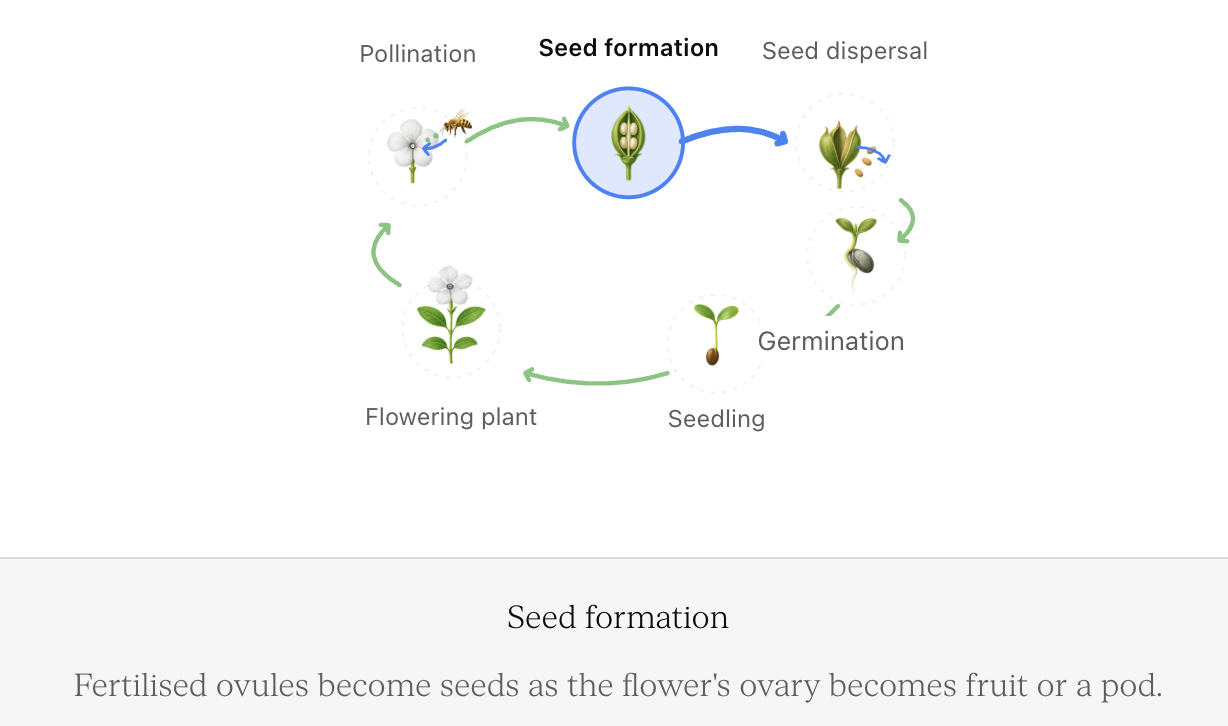
A seed that successfully germinates can eventually become a mature flowering plant capable of producing another generation of seeds.
How Does a Seed Form?
Before fertilization, an ovule contains the female reproductive structures.
After fertilization, the ovule begins changing into a:
seed
Inside it, the zygote repeatedly divides by:
mitosis
The cells then grow and differentiate.
Eventually they form a young plant called the:
embryo


The Embryo
The embryo is the young developing plant inside a seed.
It develops from the:
zygote
The embryo contains structures that will eventually develop into parts of the mature plant.
These include an embryonic:
- root
- shoot
- stem region
- one or more seed leaves
The embryo is alive, although its growth may temporarily become extremely slow while the seed is dormant.
Major Structures of a Seed
Although seeds vary considerably among plant species, a typical seed contains three major components:
1. Embryo
2. Food store
3. Seed coat


Each has an important function.
The Seed Coat
The outer protective layer of the seed is the:
seed coat
It is also called the:
testa
The seed coat develops from tissues surrounding the original ovule.
Its functions include protecting the embryo from:
- physical damage
- excessive water loss
- some microorganisms
- unsuitable environmental conditions
The seed coat allows the embryo to survive while waiting for suitable conditions for germination.
The Embryonic Root
The embryonic root is called the:
radicle
During germination, the radicle is usually the first major structure to emerge from the seed.
It develops into the plant's:
root system
This allows the young plant to begin absorbing:
water and mineral ions
from the soil.
The Embryonic Shoot
The young shoot develops into the above-ground portion of the plant.
The embryonic shoot includes a region often called the:
plumule
It eventually produces structures such as:
- stem
- leaves
- growing shoot


Cotyledons
Cotyledons are embryonic seed leaves.
Depending on the plant, they may:
- store food
- absorb nutrients from endosperm
- become temporary photosynthetic structures after germination
Flowering plants can broadly be grouped according to the number of cotyledons in the embryo.
Many plants have:
one cotyledon
while others have:
two cotyledons
Food for the Embryo
A germinating seed initially cannot rely fully on photosynthesis.
Why?
Because it may not yet have:
developed green leaves
The seed therefore contains or has access to stored nutrients.
These can include:
- carbohydrates
- proteins
- lipids
The developing seedling uses these substances for:
respiration and growth
Endosperm
In many flowering plants, nutrients are stored in tissue called:
endosperm
Endosperm forms as a result of the second fertilization event characteristic of flowering plants.
It can provide nutrients to the embryo during:
- seed development
- germination
- early seedling growth
In other plants, much of the stored food may eventually be contained in large cotyledons.
Why Does a Seed Need Stored Food?
A seedling needs energy immediately after germination.
But its leaves may not yet be able to carry out enough:
photosynthesis
Stored food can be broken down during:
respiration
to release energy.
Therefore:
stored nutrients → respiration → energy → growth
Once leaves develop and receive light, photosynthesis becomes increasingly important.
From Ovary to Fruit
While the ovule develops into a seed, the:
ovary
usually develops into a:
fruit
This gives us one of the most important relationships in plant reproduction:
ovule → seed
ovary → fruit


What Is a Fruit?
In botanical terms, a fruit is a structure that develops from the ovary of a flower after fertilization.
This means some structures we commonly call vegetables are botanically fruits.
Examples include:
- tomatoes
- peppers
- cucumbers
- pumpkins
- beans
They develop from flower ovaries and contain seeds.
Why Do Plants Produce Fruits?
Fruits have two major reproductive functions:
protecting seeds
and:
helping disperse seeds
The fruit surrounds the developing seeds while they mature.
Later, the fruit may help move those seeds away from the parent plant.
What Is Seed Dispersal?
Seed dispersal is the movement of seeds away from the parent plant.
Seeds can be dispersed by:
- wind
- animals
- water
- gravity
- explosive mechanisms
Different fruits and seeds have structures adapted to different dispersal methods.


Why Is Seed Dispersal Important?
Imagine that every seed produced by a large tree simply fell directly beneath it.
The seedlings would compete intensely with:
- the parent plant
- their siblings
- other nearby plants
They would compete for:
- light
- water
- mineral ions
- space
Seed dispersal reduces this competition.
Benefits of Seed Dispersal
Moving away from the parent plant can increase the chance of reaching:
a suitable place to grow
Seed dispersal can:
- reduce competition with the parent
- reduce competition among seedlings
- allow plants to colonize new areas
- spread offspring across different environments
- reduce the risk that one local event destroys all offspring
Therefore:
dispersal increases the chances that at least some offspring survive.
Dispersal by Wind
Some seeds and fruits are adapted to travel through the:
air
Wind-dispersed seeds are often:
- small
- lightweight
- winged
- hairy
- parachute-shaped


Two familiar examples are:
dandelions
and:
maples
Dandelion Seeds
Dandelion fruits have a lightweight structure with many fine hairs.
This acts somewhat like a:
parachute
The hairs increase air resistance and allow the structure to remain airborne longer.
Therefore:
low mass + large air-catching structure → greater chance of wind dispersal
Some seeds can travel considerable distances before reaching the ground.
Winged Seeds and Fruits
Maples produce winged fruits commonly called:
samaras
As they fall, they rotate.
This spinning motion slows their descent and allows wind to carry them farther from the parent tree.


This is a good example of how:
shape affects movement
Advantages of Wind Dispersal
Wind dispersal can:
- move seeds away from the parent
- require no animal
- carry some seeds considerable distances
- distribute large numbers of seeds
However, wind direction is:
uncontrolled
Most seeds do not land in an ideal location.
Animal Dispersal
Animals disperse seeds in several different ways.
Two important mechanisms are:
external transport
and:
internal transport
External Animal Dispersal
Some fruits have:
- hooks
- barbs
- spines
- sticky surfaces
These structures attach to:
fur or feathers


The animal carries the fruit or seed away.
Eventually it:
- falls off
- is rubbed off
- is removed during grooming
The seed has then been transported to a new location.
Burrs and Hooks
Burdock is a classic example.
Its fruits contain tiny hooks that can catch onto:
- fur
- feathers
- clothing
This biological design famously contributed to the development of:
hook-and-loop fasteners
It is an example of humans learning from biological structures.
Internal Animal Dispersal
Some plants produce:
fleshy fruits
These fruits encourage animals to eat them.
Examples include many:
- berries
- cherries
- apples
- figs


The fruit provides food to the animal.
The animal provides:
seed transport
How Does Eating Fruit Disperse Seeds?
An animal eats a fruit.
The soft fruit tissue is digested.
Some seeds resist digestion and pass through the digestive system.
Later, they are deposited:
away from the parent plant
The droppings may also contain nutrients that can benefit the young plant.
Fruit Colour and Animal Dispersal
Many fleshy fruits change colour as they ripen.
For example:
green → red
or:
green → purple
or:
green → orange
Bright colours can make ripe fruits easier for animals to detect.
This helps ensure that animals eat fruits when the seeds inside are:
mature enough for dispersal
Fruit Taste and Seed Dispersal
Plants often invest energy in producing fruits containing:
- sugars
- water
- pigments
- scents
Why invest so much energy?
Because attractive fruits can encourage animals to:
eat the fruit and transport the seeds
The fruit is effectively part of the plant's dispersal strategy.
Advantages of Animal Dispersal
Animal dispersal can transport seeds:
- away from the parent
- over long distances
- into new habitats
Unlike wind, animals may also travel along predictable routes or visit suitable habitats.
However, plants depend on:
animals interacting with the fruit or seed
Dispersal by Water
Plants living near:
- rivers
- lakes
- wetlands
- oceans
may use water for seed or fruit dispersal.
Their fruits or seeds often have structures that help them:
float


One famous example is the:
coconut
Coconut Dispersal
Coconuts have:
- a tough outer covering
- fibrous material
- internal spaces that help them float
A coconut can fall into water and be carried away by:
- currents
- tides
- rivers
If it reaches a suitable location, the seed may eventually germinate.
Advantages of Water Dispersal
Water can carry seeds:
considerable distances
This is especially useful for plants living near waterways or coastlines.
However, success depends on the seed eventually reaching:
a suitable place for germination
A seed remaining in unsuitable water indefinitely cannot establish a normal terrestrial seedling.
Explosive Dispersal
Some plants do not depend directly on wind, water, or animals.
Instead, their fruits:
burst open
and throw seeds away from the parent plant.
This is called:
explosive dispersal
or:
ballistic dispersal


How Explosive Dispersal Works
As some fruits dry, tension develops in their walls.
Eventually:
fruit wall splits suddenly
↓
stored elastic energy is released
↓
seeds are thrown outward
Plants such as balsams and some legumes use forms of this strategy.
Advantages of Explosive Dispersal
Explosive dispersal:
- does not require animals
- does not require strong wind
- can move seeds away from the parent
However, the dispersal distance is often:
more limited
than some wind-, water-, or animal-based methods.
Dispersal by Gravity
Gravity is one of the simplest dispersal mechanisms.
A mature fruit or seed:
falls from the plant
Examples include many large fruits and nuts.


This process is sometimes called:
barochory
Gravity may act alone or as the first step in another dispersal process.
Gravity Can Work with Animals
Consider an acorn.
It may first:
fall from an oak tree
Then an animal such as a squirrel may:
carry and bury it
If the animal does not recover the acorn, it may eventually:
germinate
Therefore, seeds can experience more than one dispersal mechanism.
Comparing Seed Dispersal Methods
| Method | Typical Adaptation | Example | Main Advantage | Limitation |
|---|---|---|---|---|
| Wind | Lightweight, wings or hairs | Dandelion, maple | Can travel far | Direction unpredictable |
| External animal | Hooks or sticky surfaces | Burdock | Animal carries seed | Depends on animal contact |
| Internal animal | Fleshy attractive fruit | Berries | Potential long-distance movement | Seed must survive feeding/digestion |
| Water | Buoyant, waterproof fruit | Coconut | Can travel long distances | Requires suitable water routes |
| Explosion | Fruit builds tension | Balsam | Independent of animals | Usually shorter range |
| Gravity | Heavy fruit or seed | Acorn | Simple and reliable | Often remains near parent |
Structure and Function
Seed and fruit structures are closely related to:
how they are dispersed
Consider the following relationships:
hairs → catch air
wings → slow falling and increase movement
hooks → attach to animals
fleshy fruit → attract animals
fibrous covering → help flotation
spring-loaded pod → throw seeds
Each is an example of:
structure supporting function
Predicting Dispersal from Structure
Suppose you discover an unfamiliar seed with:
two large papery wings
A reasonable prediction is:
wind dispersal
Why?
The wings increase interaction with moving air.
Another Prediction
Suppose a fruit has:
- bright colour
- sweet smell
- soft flesh
- several hard seeds
A reasonable prediction is:
animal dispersal
The fruit appears adapted to encourage an animal to eat it.
Another Prediction
Suppose a fruit has:
- a waterproof outer layer
- fibrous material
- low density
A reasonable prediction is:
water dispersal
These characteristics would help it float.
Why Not Drop Every Seed Beside the Parent?
Imagine 100 seedlings growing immediately underneath one tree.
They would compete for the same limited resources.


Competition would occur for:
light
because the parent may shade them.
Competition would occur for:
water and minerals
because roots occupy the same soil.
Competition would also occur for:
space
Seed dispersal reduces these pressures.
Colonizing New Habitats
Dispersal also allows plants to reach:
new locations
For example, a seed carried by a bird might reach an area where no members of that plant species currently grow.
If conditions are suitable:
seed germinates → plant grows → plant reproduces
The species has begun colonizing a new area.
Spreading Risk
Seed dispersal also spreads offspring across different locations.
Suppose all seeds remain in one small area.
A single event such as:
- fire
- flooding
- disease
- grazing
- severe drought
could destroy most or all of them.
If seeds are dispersed over a wider area:
not all offspring experience the same conditions
This can increase the probability that some survive.
Dispersal Does Not Guarantee Survival
Most dispersed seeds do not become mature plants.
A seed may land:
- on rock
- in deep water
- in dense shade
- in extremely dry soil
- where it is eaten
- where temperatures are unsuitable
Dispersal therefore increases opportunities.
It does not guarantee success.
Plants often compensate by producing:
many seeds
The Trade-Off Between Seed Number and Size
Plants have different reproductive strategies.
Some plants produce:
huge numbers of small seeds
Each seed receives relatively few resources.
Other plants produce:
fewer, larger seeds
Each seed contains more stored resources.


Both strategies can be successful.
Small Seeds
Small seeds may have advantages such as:
- lower production cost per seed
- large numbers produced
- easier wind transport
However, they may contain:
smaller nutrient reserves
This can make early seedling establishment more challenging.
Large Seeds
Large seeds can contain:
greater food reserves
This may support seedlings for longer during early growth.
However:
- they require more resources to produce
- fewer may be produced
- they may be harder to disperse by wind
Again, reproduction involves:
trade-offs
Seed Dormancy
A mature seed does not necessarily germinate immediately.
Some seeds enter:
dormancy
During dormancy:
- metabolism remains very low
- growth is temporarily suspended
- the embryo remains alive
Dormancy allows seeds to wait until environmental conditions become more favourable.
Why Is Dormancy Useful?
Imagine a seed produced shortly before winter.
Immediate germination might expose a delicate seedling to:
- freezing temperatures
- limited light
- low water availability
Remaining dormant may allow germination to occur:
later, under better conditions
Dormancy therefore increases the probability of successful establishment.
Germination
When suitable conditions are available, a seed may:
germinate
Germination is the beginning of active growth of the embryo.
Most seeds require suitable:
- water
- oxygen
- temperature
Some species also respond to:
- light
- darkness
- fire
- chemical signals


 F_UMfHfdDZSNNl6Gwa9TPz1eXaG8LlnYni1HRQ0cYIkqEqHZ_-wpTjS?purpose=fullsize">
Water and Germination
Water is absorbed by the seed.
This causes tissues to:
rehydrate
Water also allows:
- enzymes to become active
- stored food to be broken down
- chemical reactions to occur
The seed may swell and the seed coat eventually breaks.
Oxygen and Germination
The growing embryo requires energy.
Energy is released through:
aerobic respiration
Therefore, the germinating seed requires:
oxygen
Stored nutrients + oxygen allow respiration to supply ATP for growth.
Temperature and Germination
Enzymes control many reactions during germination.
These enzymes function effectively only within suitable temperature ranges.
If temperatures are:
too low
reactions may proceed very slowly.
If temperatures are:
too high
enzymes and cells may be damaged.
The Radicle Emerges
One of the first visible signs of germination is usually the emergence of the:
radicle
The radicle grows downward and develops into the:
root
This is useful because the seedling quickly needs access to:
water and minerals
The Shoot Emerges
The embryonic shoot then grows.
Eventually it reaches the light and develops:
leaves
Once leaves begin photosynthesizing effectively, the young plant becomes less dependent on:
stored food in the seed
The cycle has moved from seed to independent seedling.
Seed Formation to Germination
The complete sequence is:
fertilization
↓
zygote
↓
embryo
↓
seed
↓
dispersal
↓
dormancy, if present
↓
germination
↓
seedling
↓
mature plant
↓
flowers
↓
pollination and fertilization
↓
new seeds
This demonstrates why plant reproduction is described as a:
life cycle
Seed Dispersal and Evolution
Dispersal adaptations have evolved because they influence reproductive success.
A plant whose seeds are dispersed successfully may produce more surviving offspring.
Over many generations, characteristics that improve dispersal can become more common.
Examples include:
- aerodynamic wings
- hooks
- fleshy fruits
- buoyant coverings
- explosive pods
Seed dispersal is therefore closely connected to:
natural selection
Seed Dispersal and Ecosystems
Seed dispersal can influence the distribution of entire plant populations.
Animals that move seeds can affect:
- forest regeneration
- plant diversity
- colonization of disturbed habitats
- movement of plants across landscapes

Animals that disperse seeds therefore play important ecological roles.
Human Movement of Seeds
Humans also move seeds.
Sometimes this is deliberate:
- agriculture
- gardening
- forestry
- habitat restoration
Sometimes it is accidental.
Seeds can travel on:
- clothing
- vehicles
- agricultural equipment
- transported soil
- cargo
Human movement can allow plants to reach locations they could never reach naturally.
Common Misconception: The Seed Develops from the Ovary
Remember:
ovule → seed
ovary → fruit
The ovary does not normally become the seed.
Common Misconception: The Seed Is the Embryo
The embryo is only:
one part of the seed
A seed normally contains:
embryo + food supply + protective seed coat
The seed is therefore a complete survival and dispersal structure.
Common Misconception: Fruits Are Only Food
For humans and animals, fruits may be food.
For the plant, a fruit has an important reproductive role:
protecting and dispersing seeds
The fact that an animal eats the fruit can actually help the plant reproduce.
Common Misconception: All Seeds Are Dispersed by Wind
Wind is only one method.
Seeds can also be dispersed by:
- animals
- water
- gravity
- explosive mechanisms
The structure of a seed or fruit often provides clues about its dispersal method.
Common Misconception: Seeds Germinate Immediately
Many seeds remain dormant.
They may wait:
- days
- months
- years
before suitable conditions trigger germination.
Dispersal and germination are therefore:
different stages
of the plant life cycle.
Check Your Understanding
1. What does an ovule become after fertilization?
2. What does the ovary usually become?
3. Name the three major components of a typical seed.
4. Explain the function of the seed coat.
5. Why does a germinating seed require stored food?
6. A seed has a large feathery structure and very little mass. Predict its likely dispersal method and explain your reasoning.
7. Explain how eating a fleshy fruit can help a plant disperse its seeds.
8. Give one advantage and one limitation of wind dispersal.
9. Why does dispersing seeds away from the parent plant reduce competition?
10. Explain how seed dispersal can increase the chance that a plant species survives environmental change.
Key Terms
- Seed: Reproductive structure containing a plant embryo, protective covering, and stored nutrients or access to a nutrient supply.
- Embryo: Young developing plant inside a seed.
- Zygote: Cell produced by the fusion of male and female gametes.
- Seed coat: Protective outer covering of a seed.
- Testa: Another name for the seed coat.
- Cotyledon: Embryonic seed leaf that may store or absorb nutrients.
- Radicle: Embryonic root.
- Plumule: Embryonic shoot.
- Endosperm: Nutrient-rich tissue supporting the developing embryo in many flowering plants.
- Fruit: Structure usually developing from the ovary and containing seeds.
- Seed dispersal: Movement of seeds away from the parent plant.
- Wind dispersal: Movement of seeds or fruits by air currents.
- Animal dispersal: Movement of seeds by animals, either externally or internally.
- Water dispersal: Movement of seeds or fruits by water.
- Explosive dispersal: Release of seeds when a fruit suddenly bursts open.
- Gravity dispersal: Movement of fruits or seeds when they fall from the parent plant.
- Dormancy: Period during which a viable seed remains inactive or has greatly reduced growth.
- Germination: Resumption of active growth of the embryo to form a seedling.
- Seedling: Young plant developing after germination.
Key Takeaways
- Seed development begins after fertilization.
- The zygote develops into an embryo through cell division and differentiation.
- The fertilized ovule develops into a seed.
- The ovary commonly develops into a fruit.
- A typical seed contains an embryo, a food supply, and a protective seed coat.
- The radicle develops into the root, while the embryonic shoot develops into the above-ground parts of the plant.
- Stored nutrients support respiration and growth before the seedling can photosynthesize effectively.
- Fruits protect developing seeds and can help with their dispersal.
- Seeds can be dispersed by wind, animals, water, gravity, and explosive mechanisms.
- Wind-dispersed seeds are often lightweight and have wings or hairs.
- Animal-dispersed seeds may have hooks or occur inside attractive fleshy fruits.
- Water-dispersed fruits often contain adaptations that help them float.
- Explosive fruits mechanically throw seeds away from the parent plant.
- Seed dispersal reduces competition between offspring and the parent plant.
- Dispersal can allow plants to colonize new habitats.
- Spreading seeds across different locations reduces the chance that all offspring are destroyed by the same local event.
- Dispersal does not guarantee survival; many seeds land in unsuitable environments.
- Seed dormancy allows some plants to delay germination until conditions improve.
- Germination generally requires suitable water, oxygen, and temperature.
- Seed structure and fruit structure are closely related to dispersal strategy.
- The central sequence is fertilization → embryo development → seed formation → dispersal → germination → seedling → mature plant.