Plant Reproduction
2. Pollination
Learning outcomes
- I can define pollination as the transfer of pollen from anther to stigma.
- I can distinguish between self-pollination and cross-pollination.
- I can identify common pollinating agents such as insects, birds, wind, and water.
- I can explain how flower adaptations increase pollination success.
- I can evaluate the advantages and disadvantages of different pollination strategies.


What Is Pollination?
Pollination is the transfer of pollen:
from anther → stigma
The anther is part of the male reproductive structure of a flower.
The stigma is part of the female reproductive structure.
Pollination brings pollen into the correct position for the next stages of sexual reproduction.
It is important to remember:
pollination is pollen transfer, not fertilization.
Where Does Pollen Come From?
Pollen is produced in the:
anthers
The anthers are part of the:
stamens
A stamen consists of:
anther + filament


When an anther matures, pollen becomes available for transfer.
Where Does Pollen Go?
For successful pollination, pollen must reach a:
stigma
The stigma is usually adapted to receive and retain pollen.
Depending on the plant, it may be:
- sticky
- rough
- exposed
- feathery
These structures increase the probability that pollen reaching the flower will remain on the stigma.
Pollination Is a Transfer Process
The essential process is simple:
anther
↓
pollen released
↓
pollen transported
↓
stigma
But pollen cannot travel deliberately between flowers.
Plants depend on pollinating agents to move it.
These can include:
- insects
- birds
- wind
- water
- other animals
Pollination and Fertilization Are Different
These two processes are often confused.
Pollination
Transfer of pollen from anther to stigma.
Fertilization
Fusion of male and female gametes.
Therefore:
pollination → pollen-tube growth → fertilization
Pollination must normally occur before fertilization can take place.
What Happens After Pollination?
When a compatible pollen grain lands on the stigma, it can:
1. Attach to the stigma
↓
2. Germinate
↓
3. Produce a pollen tube
↓
4. Grow through the style
↓
5. Reach an ovule
↓
6. Allow the male gamete to reach the female gamete
↓
7. Fertilization can occur
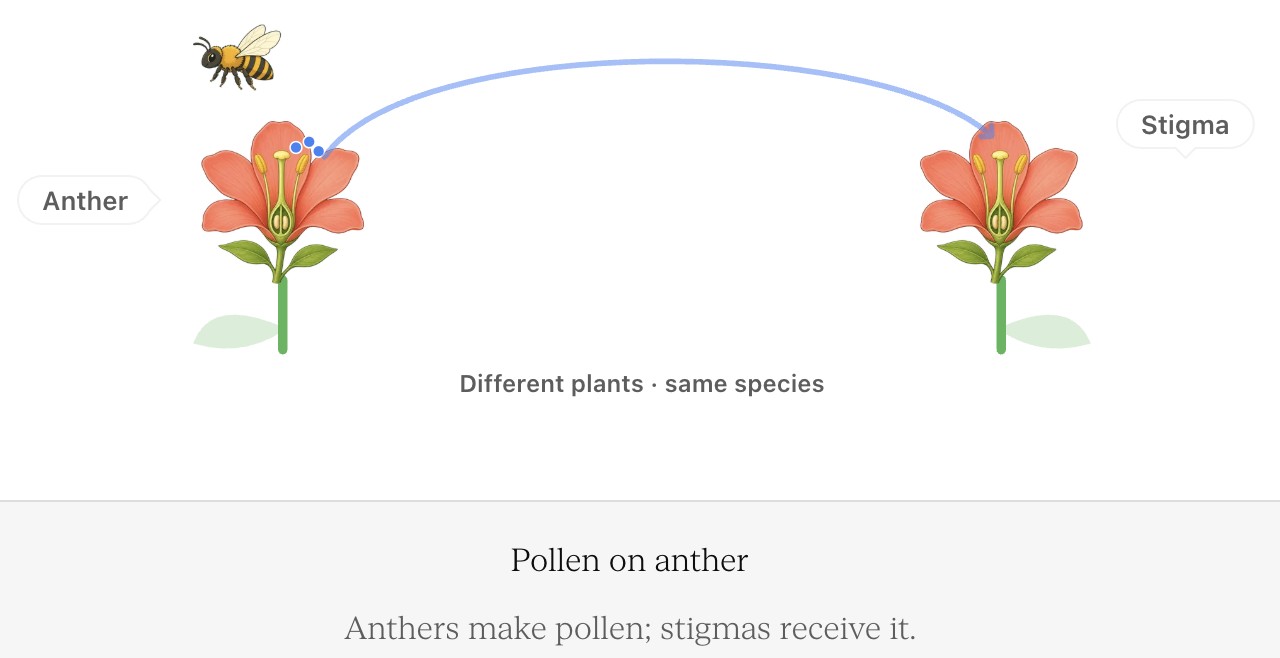
The visualization below lets you trace pollen transfer and compare self- and cross-pollination.
Two Major Types of Pollination
Pollination can be classified as:
self-pollination
or:
cross-pollination
The difference depends on where the pollen originates.
Self-Pollination
Self-pollination occurs when pollen is transferred:
- from an anther to a stigma of the same flower
or
- between flowers on the same plant
For example:
Flower A on Plant 1 → Flower B on Plant 1
This is still considered self-pollination because both flowers belong to the same individual plant.


Advantages of Self-Pollination
Self-pollination can be useful because reproduction does not depend as strongly on:
- another plant being nearby
- a pollinator visiting another plant
- pollen travelling a long distance
This can be especially useful when:
- plants are isolated
- pollinators are scarce
- environmental conditions are unpredictable
Self-pollination can therefore provide:
reproductive assurance
Disadvantages of Self-Pollination
A major disadvantage is:
lower genetic variation
Self-pollination repeatedly combines genetic material from the same individual.
This can result in offspring that are genetically more similar.
Lower genetic diversity can make a population less able to respond to:
- environmental changes
- new diseases
- changing pests
- other selection pressures
Cross-Pollination
Cross-pollination occurs when pollen is transferred:
from one plant → another plant of the same species
For example:
Flower on Plant A → Flower on Plant B


The plants must normally be sufficiently genetically compatible for successful fertilization to follow.
Advantages of Cross-Pollination
Cross-pollination combines genetic material from:
different individuals
This generally increases:
genetic variation
Greater variation can increase the chance that some individuals in a population possess characteristics that help them survive environmental changes.
This is important for:
evolution by natural selection
Disadvantages of Cross-Pollination
Cross-pollination is less certain.
The plant may depend on:
- suitable pollinators
- wind
- appropriate weather
- another compatible plant nearby
- successful pollen transfer
Plants may also invest considerable resources in:
- nectar
- petals
- scent
- large amounts of pollen
Therefore, cross-pollination can offer genetic benefits while also carrying greater uncertainty.
Comparing Self- and Cross-Pollination
| Feature | Self-Pollination | Cross-Pollination |
|---|---|---|
| Number of plants involved | One | Usually two |
| Pollen travels far? | Usually not | Often farther |
| Dependence on another plant | Low | Higher |
| Genetic variation | Generally lower | Generally higher |
| Reliability | Can be relatively reliable | More dependent on pollen transfer |
| Evolutionary advantage | Reproduction when isolated | Greater genetic diversity |
Neither strategy is universally "better."
Its usefulness depends on:
the species + environment + availability of pollinators + population structure
Pollinating Agents
A pollinating agent is something that carries pollen from anther to stigma.
Major pollinating agents include:
insects
birds
wind
water
Other animals, including bats and some mammals, can also act as pollinators.
Different pollinating agents favour different flower adaptations.
Insect Pollination
Insects are extremely important pollinators.
Common insect pollinators include:
- bees
- butterflies
- moths
- beetles
- flies


As an insect visits a flower, pollen may stick to its body.
When it visits another flower, some pollen may contact the stigma.
Adaptations for Insect Pollination
Insect-pollinated flowers commonly have:
- brightly coloured petals
- distinctive scents
- nectar
- nectar guides
- sticky or rough pollen
- sticky stigmas
- reproductive structures positioned to contact visiting insects
These features increase the chance that insects will:
visit → collect pollen → visit another flower → deposit pollen
Colour
Colour can help flowers stand out from their surroundings.
Different pollinators perceive colours differently.
For example, many insects can detect:
ultraviolet patterns
that humans cannot see.
Some flowers have ultraviolet markings that guide insects toward:
nectar and reproductive structures
Scent
Some flowers produce scents that attract pollinators.
A scent can signal:
food is available here
Flowers pollinated by different animals can produce very different scents.
Not every flower smells pleasant to humans.
Some flowers attract flies or beetles using odours that resemble:
- decaying material
- fermented substances
The important factor is whether the scent attracts the appropriate pollinator.
Nectar
Nectar is a sugar-rich liquid produced by many flowers.
It acts as a:
reward
for pollinators.
The animal receives food.
The plant receives:
pollen transport
This creates a relationship in which both organisms can benefit.
Pollen Adaptations for Insects
Insect-carried pollen is often:
- relatively heavy
- sticky
- rough or textured
These characteristics help pollen attach to:
- insect hairs
- legs
- bodies


The plant therefore does not need to rely entirely on random movement through the air.
Bird Pollination
Birds also pollinate many flowering plants.
Important bird pollinators include:
- hummingbirds
- sunbirds
- honeyeaters
Bird-pollinated flowers are often adapted differently from insect-pollinated flowers.
Adaptations for Bird Pollination
Bird-pollinated flowers often have:
- bright colours
- tubular shapes
- strong flower structures
- large amounts of nectar
- reproductive structures positioned to contact the bird


Red, orange, and other vivid colours are common in many bird-pollinated flowers.
Strong scent may be less important for bird pollination than for some insect pollination systems.
How Bird Pollination Works
A bird inserts its beak into a flower to reach:
nectar
Its head or beak may contact the:
anthers
Pollen sticks to the bird.
At another flower, the bird contacts the:
stigma
Pollen is transferred.
The flower's shape helps position the animal correctly.
Wind Pollination
Some plants do not depend on animals at all.
Instead, they release pollen into:
moving air
Wind-pollinated plants include many:
- grasses
- cereal crops
- trees
Wind pollination is based much more heavily on:
probability
than precise animal transport.


Adaptations for Wind Pollination
Wind-pollinated flowers often have:
- small or absent petals
- dull colours
- little scent
- little or no nectar
- exposed anthers
- long flexible filaments
- large feathery stigmas
- huge quantities of lightweight pollen
These features make sense because the plant does not need to attract an animal.
Why Are Wind-Pollinated Flowers Often Dull?
Bright petals require resources to produce.
If a plant depends on wind rather than animals:
attracting pollinators is unnecessary
Therefore, investing heavily in:
- large petals
- nectar
- strong scents
may provide little advantage.
Resources can instead be invested in:
producing and dispersing pollen
Why Are Wind-Pollinated Anthers Exposed?
Exposed anthers make it easier for moving air to:
pick up pollen
Long filaments may allow the anthers to move in the wind.
This helps release pollen into the atmosphere.
Why Are Their Stigmas Feathery?
A feathery stigma has:
large surface area
This increases the probability of capturing airborne pollen.
Therefore:
large surface area → greater chance of pollen capture
This is another clear example of:
structure supporting function
Why Produce So Much Pollen?
Wind is relatively inefficient.
A pollen grain might:
- land on the ground
- land on another species
- be washed away
- travel far from other plants
Only a small proportion may reach a compatible stigma.
Therefore:
wind-pollinated plants compensate by producing enormous quantities of pollen.
Advantages of Wind Pollination
Wind pollination does not require:
animal pollinators
This can be advantageous where pollinators are:
- scarce
- seasonal
- unreliable
Wind can also carry pollen over considerable distances.
Disadvantages of Wind Pollination
Wind pollination is relatively imprecise.
Large quantities of pollen are:
wasted
Success can also depend strongly on:
- wind conditions
- plant density
- flowering time
- weather
Rain, for example, can interfere with airborne pollen movement.
Water Pollination
Pollination by water is much less common than pollination by insects or wind.
It occurs in some:
aquatic plants
Pollen may move:
- across the water surface
- through the water
until it reaches a female flower or stigma.


Adaptations for Water Pollination
Water-pollinated species may have adaptations that allow pollen to:
- float
- remain viable in water
- travel with currents
- contact reproductive structures efficiently
Because water pollination is relatively uncommon, the exact adaptations vary considerably between species.
Advantages and Disadvantages of Water Pollination
Possible advantages include:
- no dependence on animal pollinators
- effective transport in suitable aquatic environments
Possible disadvantages include:
- dependence on water movement
- potentially unpredictable pollen direction
- loss of pollen away from suitable flowers
As with wind pollination, large numbers of pollen grains may not reach their intended destination.
Other Animal Pollinators
Flowers can also be pollinated by animals such as:
- bats
- small mammals
- lizards in some ecosystems
Bat-pollinated flowers, for example, may be:
- large
- strongly scented
- pale coloured
- open at night
- rich in nectar


These adaptations match the behaviour and senses of the pollinator.
Pollination Strategies Reflect the Environment
A successful flower does not need to be:
beautiful to humans
It needs to successfully transfer pollen.
A flower's characteristics reflect pressures such as:
- which pollinators are available
- when those pollinators are active
- local climate
- wind conditions
- competition with other flowers
- energy required to produce nectar and petals
Specialist Pollination
Some flowers depend strongly on one or a small number of pollinator species.
This is called a more:
specialized pollination relationship
Advantages can include:
- precise pollen transfer
- less pollen waste
- reduced transfer to the wrong plant species
However, there is also risk.
If the pollinator population declines:
plant reproduction may decline
Generalist Pollination
Other flowers can be visited by many different pollinator species.
This is a more:
generalized strategy
Possible advantages include:
- less dependence on one pollinator
- more opportunities for pollen transfer
However, pollen transfer may sometimes be:
less precise
Different strategies involve different biological trade-offs.
Evaluating Pollination Strategies
We should avoid saying one pollination strategy is simply "best."
Instead, evaluate it based on:
- reliability
- energy cost
- pollen waste
- dependence on other organisms
- genetic variation
- environmental conditions
For example:
self-pollination
can be reliable but produces less genetic variation.
animal cross-pollination
can be precise but depends on pollinator availability.
wind pollination
does not require animals but wastes large quantities of pollen.
Strategy Comparison
| Strategy | Major Advantage | Major Limitation |
|---|---|---|
| Self-pollination | Reproduction possible when isolated | Lower genetic variation |
| Insect pollination | Relatively targeted pollen transfer | Depends on insect activity |
| Bird pollination | Effective targeted transport | Depends on suitable birds |
| Wind pollination | No animal required | Large pollen wastage |
| Water pollination | Works in some aquatic habitats | Limited to suitable environments |
The success of each strategy depends on:
context
Pollination and Genetic Diversity
Cross-pollination usually increases genetic variation because genetic material comes from:
different individuals
Variation matters because environments change.
For example, if a disease appears, individuals in a genetically varied population may respond differently.
Some may possess characteristics that improve survival and reproduction.
Therefore:
cross-pollination → increased genetic mixing → increased variation
Pollination and Agriculture
Pollination is extremely important in food production.
Many crop plants benefit from animal pollination.
Pollinators help produce:
- fruits
- seeds
- nuts
- vegetables


Farmers may therefore manage habitats or pollinators to increase successful pollination.
Hand Pollination
Humans can sometimes transfer pollen manually.
This is called:
hand pollination
A person may use:
- a small brush
- cotton swab
- direct flower-to-flower contact
to move pollen.
Hand pollination may be useful when:
- natural pollinators are limited
- plants are grown indoors
- controlled breeding is required
However, it can require substantial:
time and labour
Pollination in Plant Breeding
Plant breeders may deliberately control pollination.
They can choose:
Plant A as one parent
and:
Plant B as another parent
Pollen is transferred in a controlled way.
The resulting offspring can then be examined for desirable characteristics such as:
- disease resistance
- fruit quality
- yield
- drought tolerance
Pollination is therefore important in both natural reproduction and agriculture.
Pollination Networks
In an ecosystem, one pollinator species may visit many plant species.
Likewise, one plant may receive visits from several pollinators.
This creates a:
pollination network
Changes in one species can therefore affect others.
For example, a major decline in a pollinator population may reduce reproductive success in plants that depend heavily on it.
Pollination and Flowering Time
Flowers must be available when their pollinators are active.
For example, a flower adapted for a particular bee species gains little benefit if it blooms months before that bee becomes active.
Therefore:
flowering time + pollinator activity
must overlap sufficiently for successful pollination.
Environmental changes that alter timing can potentially disrupt this relationship.
Pollination and Weather
Weather can strongly influence pollination.
Heavy rain can:
- reduce insect activity
- wash pollen away
- interfere with wind dispersal
Strong winds may:
- increase pollen movement in wind-pollinated plants
- reduce activity of some flying pollinators
Temperature can influence:
- flowering
- pollen development
- pollinator activity
Pollination therefore depends on interactions between:
plants + animals + environment
Common Misconception: Pollination Means a Bee Visits a Flower
A bee visiting a flower does not automatically mean successful pollination occurred.
Successful pollination requires:
pollen to reach a suitable stigma
The insect is simply the:
pollinating agent
Common Misconception: All Pollination Uses Animals
Many plants use:
wind
Some aquatic plants use:
water
Animal pollination is common, but it is only one strategy.
Common Misconception: Pollen Is Produced by the Stigma
Pollen is produced by the:
anther
The stigma:
receives pollen
Remember:
anther → pollen → stigma
Common Misconception: Self-Pollination Means One Flower Only
Self-pollination can occur:
within one flower
or:
between different flowers on the same plant
The important point is that the pollen and stigma belong to the same individual plant.
Common Misconception: Cross-Pollination Is Always Better
Cross-pollination generally increases genetic variation.
However, it also requires successful transfer between different plants.
Self-pollination can provide reliable reproduction when:
- plants are isolated
- pollinators are scarce
Each strategy therefore has:
advantages and disadvantages
Common Misconception: Wind Pollination Is Ineffective
Wind pollination is less targeted than animal pollination.
However, it is extremely successful for many plant species.
Grasses and many important crop plants have reproduced successfully using wind pollination for millions of years.
A strategy should be judged by whether it works effectively in the organism's environment.
Check Your Understanding
1. Define pollination.
2. Explain the difference between self-pollination and cross-pollination.
3. Name four possible pollinating agents.
4. Explain why insect-pollinated flowers often have sticky pollen.
5. Why do wind-pollinated flowers often have large, feathery stigmas?
6. A flower has small petals, no scent, exposed anthers, and produces huge amounts of lightweight pollen. Identify its likely pollinating agent and explain your reasoning.
7. Give one advantage and one disadvantage of self-pollination.
8. Explain why cross-pollination can increase genetic variation.
Key Terms
- Pollination: Transfer of pollen from anther to stigma.
- Pollen: Structure containing or producing the male gametes of flowering plants.
- Anther: Part of the stamen that produces pollen.
- Stigma: Part of the carpel that receives pollen.
- Stamen: Male reproductive structure of a flower.
- Carpel: Female reproductive structure of a flower.
- Self-pollination: Transfer of pollen within the same plant.
- Cross-pollination: Transfer of pollen between different plants of the same species.
- Pollinating agent: Organism or environmental mechanism that transfers pollen.
- Pollinator: Animal that transfers pollen between flowers.
- Nectar: Sugar-rich liquid produced by some flowers to attract pollinators.
- Nectar guide: Flower marking that helps direct pollinators toward nectar and reproductive structures.
- Pollen tube: Tube growing from a pollen grain toward an ovule after successful pollination.
- Fertilization: Fusion of male and female gametes.
- Genetic variation: Differences in genetic information among individuals.
- Adaptation: Inherited characteristic that increases survival or reproductive success in a particular environment.
Key Takeaways
- Pollination is the transfer of pollen from anther to stigma.
- Pollination occurs before fertilization.
- Self-pollination involves pollen transfer within the same plant.
- Cross-pollination involves pollen transfer between different plants of the same species.
- Self-pollination can provide reliable reproduction when plants or pollinators are scarce.
- Cross-pollination generally produces greater genetic variation.
- Plants depend on pollinating agents because they cannot move pollen deliberately between flowers themselves.
- Important pollinating agents include insects, birds, wind, water, and other animals.
- Insect-pollinated flowers commonly use colour, scent, nectar, and sticky pollen to improve pollination success.
- Bird-pollinated flowers are often brightly coloured, sturdy, nectar-rich, and shaped to contact visiting birds.
- Wind-pollinated flowers commonly have exposed anthers, feathery stigmas, and large quantities of lightweight pollen.
- Water pollination occurs in some aquatic plants.
- Flower structures reflect the method by which pollen is transported.
- Different pollination strategies involve trade-offs between reliability, genetic variation, energy investment, and pollen waste.
- No single pollination strategy is best in every environment.
- Successful pollination depends on interactions among flower structure, pollinating agents, other plants, and environmental conditions.
- The central idea is: successful reproduction requires pollen to move from anther to a suitable stigma, and flowering plants have evolved many different ways to make that transfer happen.