Displacement Reactions
5. Reduction as Gain of Electrons
Learning outcomes
- I can define reduction as the gain of electrons.
- I can identify substances that undergo reduction.
- I can explain reduction using electron-transfer models.
- I can relate oxidation and reduction within the same reaction.
- I can apply reduction concepts to displacement reactions.
Reduction as Gain of Electrons
Reduction is the gain of electrons.
When a particle gains one or more negatively charged electrons, its charge becomes less positive.
For example:
Cu²⁺ + 2e⁻ → Cu
A Cu²⁺ ion gains two electrons and becomes a neutral copper atom.
Therefore:
Cu²⁺ has been reduced.
A useful memory aid is:
OIL RIG
Oxidation Is Loss
Reduction Is Gain
of electrons.
Recognizing Reduction
Look for electrons on the reactant side of a half-equation.
For example:
Ag⁺ + e⁻ → Ag
The silver ion gains one electron.
Therefore:
Ag⁺ is reduced.
Another example:
Fe²⁺ + 2e⁻ → Fe
The iron ion gains two electrons.
Therefore:
Fe²⁺ is reduced.
The general pattern for simple metal ions is:
positive metal ion + electron(s) → metal atom
Why Gaining Electrons Reduces Positive Charge
Electrons have a negative charge.
Suppose a Cu²⁺ ion gains two electrons:
Cu²⁺ + 2e⁻ → Cu
Initially:
charge = +2
Two negative charges are added:
+2 + 2(−1) = 0
The result is a neutral copper atom.
Therefore:
electron gain → charge becomes less positive
This gives us another way to recognize reduction.
Recognizing Reduction from Charge
Consider:
Ag⁺ → Ag
The charge changes:
+1 → 0
The silver ion has become less positive.
It must have gained one electron:
Ag⁺ + e⁻ → Ag
Therefore:
Ag⁺ is reduced.
Now consider:
Mg²⁺ → Mg
The charge changes:
+2 → 0
Therefore:
Mg²⁺ + 2e⁻ → Mg
The magnesium ion has gained two electrons and has been reduced.
Reduction Half-Equations
A reduction half-equation shows the gain of electrons.
For example:
Cu²⁺ + 2e⁻ → Cu
This tells us:
- one Cu²⁺ ion reacts
- it gains two electrons
- one neutral Cu atom forms
Because electrons appear on the left-hand side, they are being gained.
Therefore:
reduction has occurred.
Checking the Charge
Half-equations must conserve charge.
Consider:
Cu²⁺ + 2e⁻ → Cu
Left:
+2 + 2(−1) = 0
Right:
0
Charge is balanced.
This is a useful method for determining how many electrons are needed.
Example: Silver
Silver ions have a charge of +1.
Start with:
Ag⁺ → Ag
To reduce the charge from +1 to 0, one electron must be gained:
Ag⁺ + e⁻ → Ag
Therefore:
Ag⁺ is reduced.
Example: Iron
Suppose Fe²⁺ forms iron metal.
Start with:
Fe²⁺ → Fe
Two electrons must be gained:
Fe²⁺ + 2e⁻ → Fe
Therefore:
Fe²⁺ is reduced.
Example: Aluminium
Suppose Al³⁺ forms aluminium metal.
The charge changes:
+3 → 0
Therefore three electrons must be gained:
Al³⁺ + 3e⁻ → Al
Al³⁺ is reduced.
Oxidation and Reduction Together
Reduction does not occur independently in a redox reaction.
If one particle gains electrons, another particle must supply them.
Consider:
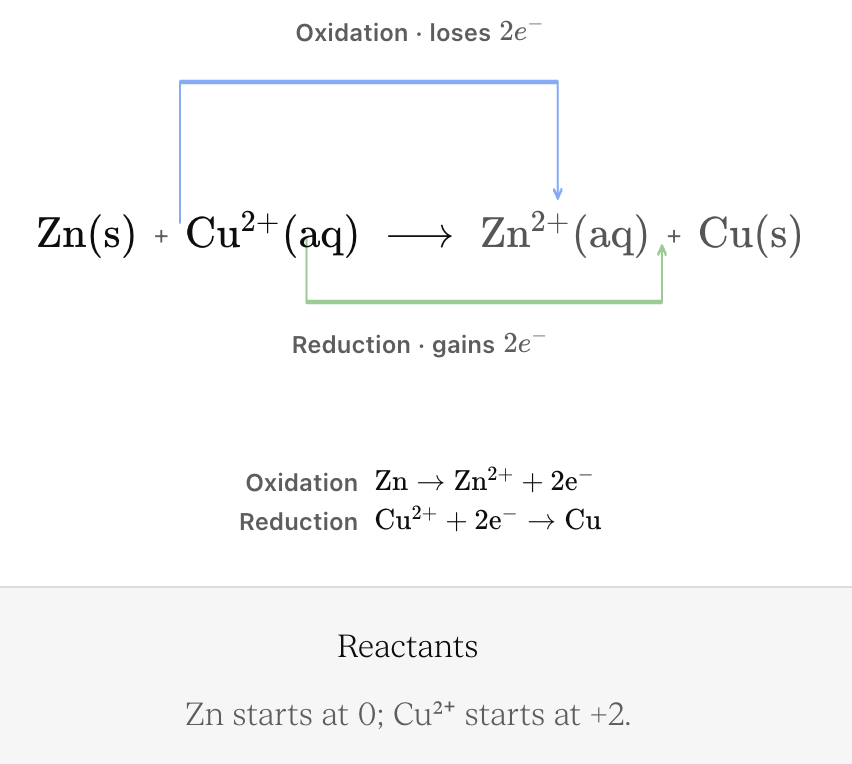
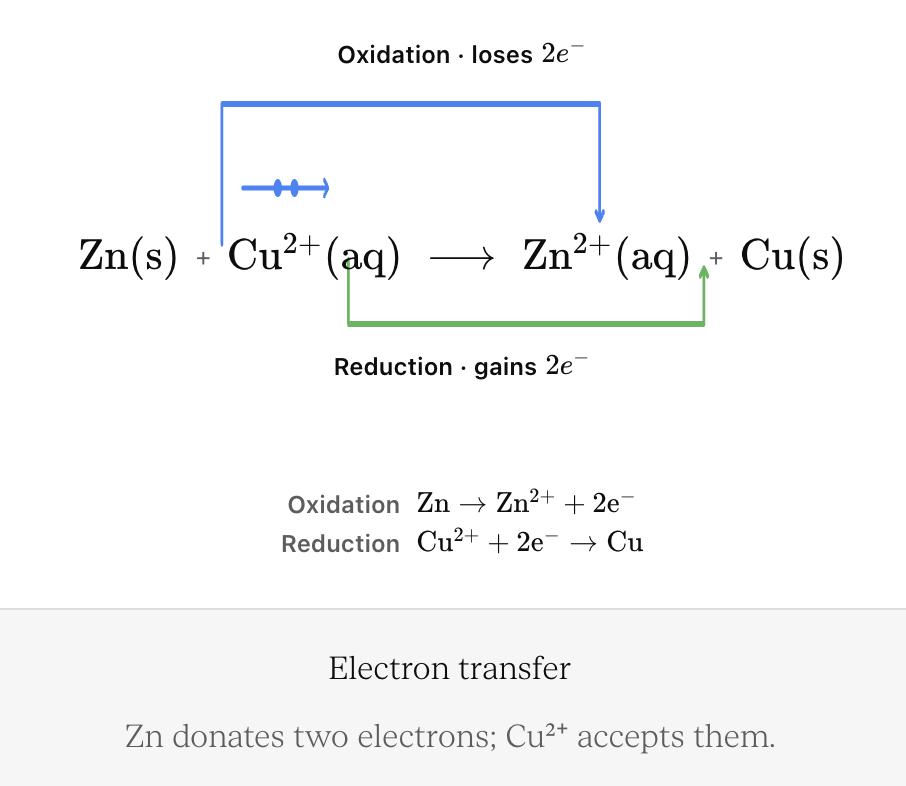
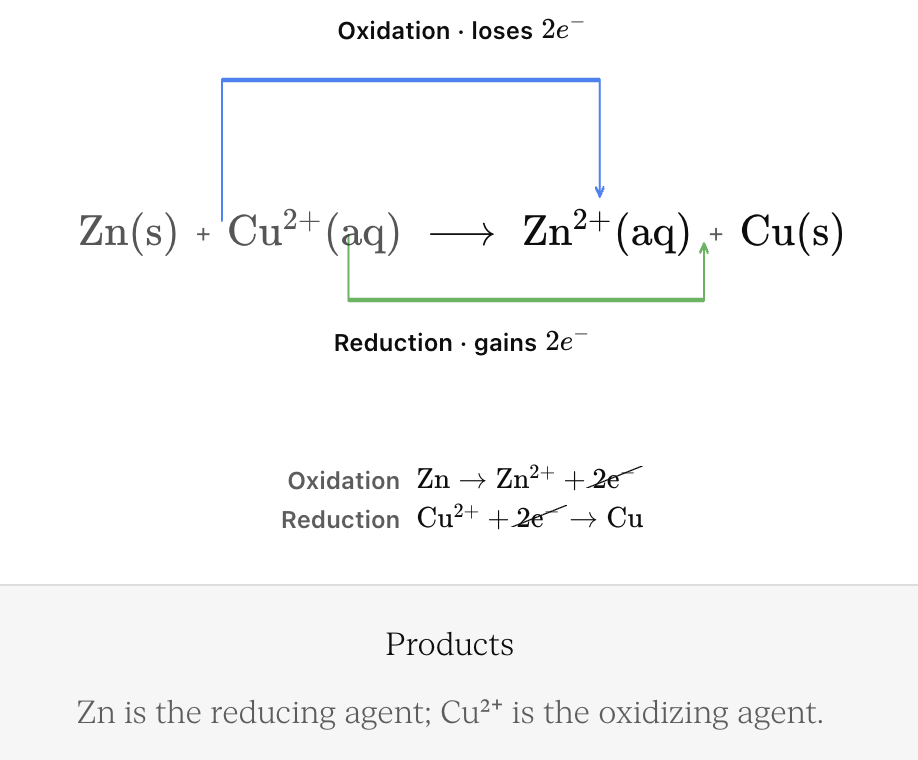
Zn + Cu²⁺ → Zn²⁺ + Cu
Zinc loses electrons:
Zn → Zn²⁺ + 2e⁻
Copper ions gain those electrons:
Cu²⁺ + 2e⁻ → Cu
Therefore:
Zn is oxidized
and:
Cu²⁺ is reduced
The electrons are transferred:
Zn → electrons → Cu²⁺
This connection between oxidation and reduction is the basis of redox chemistry.
Oxidation and Reduction Compared
| Oxidation | Reduction |
|---|---|
| Loss of electrons | Gain of electrons |
| Electrons on right | Electrons on left |
| Often atom → positive ion | Often positive ion → atom |
| Charge becomes more positive | Charge becomes less positive |
| Oxidation state increases | Oxidation state decreases |
| Electron donor | Electron acceptor |
Remember:
OIL RIG
Reduction in Displacement Reactions
Metal displacement reactions provide clear examples of reduction.
Consider:
Zn + CuSO₄ → ZnSO₄ + Cu
At the particle level:
Zn + Cu²⁺ → Zn²⁺ + Cu
Copper changes:
Cu²⁺ → Cu
Its charge decreases:
+2 → 0
Therefore it must gain two electrons:
Cu²⁺ + 2e⁻ → Cu
So:
Cu²⁺ is reduced.


What Happens to Zinc?
While Cu²⁺ is being reduced, zinc undergoes the opposite process.
Zn → Zn²⁺ + 2e⁻
Zinc loses two electrons.
Therefore:
Zn is oxidized.
The two processes fit together:
Zn → Zn²⁺ + 2e⁻
Cu²⁺ + 2e⁻ → Cu
Notice:
electrons lost = electrons gained
Magnesium and Copper Sulfate
Consider:
Mg + CuSO₄ → MgSO₄ + Cu
At the particle level:
Mg + Cu²⁺ → Mg²⁺ + Cu
Magnesium:
Mg → Mg²⁺ + 2e⁻
Copper:
Cu²⁺ + 2e⁻ → Cu
Therefore:
Mg is oxidized
and:
Cu²⁺ is reduced.
Iron and Copper Sulfate
Iron is more reactive than copper.
Therefore:
Fe + CuSO₄ → FeSO₄ + Cu
At the particle level:
Fe + Cu²⁺ → Fe²⁺ + Cu
Iron loses electrons:
Fe → Fe²⁺ + 2e⁻
Copper ions gain them:
Cu²⁺ + 2e⁻ → Cu
Therefore:
Cu²⁺ is reduced.
Copper and Silver Nitrate
Copper is more reactive than silver.
Therefore copper can displace silver:
Cu + 2AgNO₃ → Cu(NO₃)₂ + 2Ag
At the particle level:
Cu + 2Ag⁺ → Cu²⁺ + 2Ag
Copper loses two electrons:
Cu → Cu²⁺ + 2e⁻
Two silver ions gain those electrons:
2Ag⁺ + 2e⁻ → 2Ag
Therefore:
Ag⁺ is reduced.


Why Are Two Silver Ions Needed?
Each Ag⁺ ion needs one electron:
Ag⁺ + e⁻ → Ag
But one copper atom releases two electrons:
Cu → Cu²⁺ + 2e⁻
Therefore two Ag⁺ ions are needed:
2Ag⁺ + 2e⁻ → 2Ag
The electrons balance:
2 electrons lost = 2 electrons gained
Reduction and the Reactivity Series
Consider this simplified reactivity order:
Mg > Zn > Fe > Cu > Ag
In a displacement reaction, the more reactive metal generally loses electrons.
The ions of the less reactive metal gain electrons.
For example:
Zn + Cu²⁺ → Zn²⁺ + Cu
Since:
Zn > Cu
zinc loses electrons and Cu²⁺ gains them.
Therefore:
Zn is oxidized
Cu²⁺ is reduced
Reduction as Electron Acceptance
A substance that gains electrons is an electron acceptor.
For:
Zn + Cu²⁺ → Zn²⁺ + Cu
Zn supplies the electrons.
Cu²⁺ accepts them.
Therefore:
Zn = electron donor
Cu²⁺ = electron acceptor
The electron acceptor undergoes:
reduction
Electron-Transfer Models
An electron-transfer model may represent the process as:
Zn ──2e⁻──→ Cu²⁺
This means:
- electrons leave Zn
- electrons move to Cu²⁺
- Zn is oxidized
- Cu²⁺ is reduced
When interpreting such a model, follow the electron arrow.
Electrons leaving → oxidation
Electrons arriving → reduction
Particle Models
Particle diagrams can show reduction even when individual electrons are not drawn.
Suppose a diagram shows:
Before
Zn atoms
Cu²⁺ ions
After
Zn²⁺ ions
Cu atoms
Focus on copper:
Cu²⁺ → Cu
The positive copper ions have become neutral copper atoms.
Therefore they must have gained electrons:
Cu²⁺ + 2e⁻ → Cu
This is reduction.
What to Look for in a Particle Diagram
For the simple metal reactions studied here, look for:
positive metal ions disappearing
and:
neutral atoms of that metal appearing
For example:
Cu²⁺ → Cu
Ag⁺ → Ag
Fe²⁺ → Fe
Each change indicates:
electron gain → reduction
Worked Particle Example
Suppose a diagram contains:
Before
8 Zn atoms
8 Cu²⁺ ions
After
5 Zn atoms
3 Zn²⁺ ions
5 Cu²⁺ ions
3 Cu atoms
Three Cu²⁺ ions have become Cu atoms.
Each copper ion gains two electrons:
Cu²⁺ + 2e⁻ → Cu
Therefore:
3 × 2 = 6 electrons
were gained by copper ions.
At the same time, three Zn atoms supplied those six electrons.
Evidence for Reduction
We usually cannot observe individual electrons directly.
Instead, we observe evidence of the resulting chemical changes.
Possible evidence includes:
- a new metal forming
- a coating appearing
- solution colour changing
- ions disappearing from solution
- crystals growing
These observations can then be explained using an electron-transfer model.
Formation of Copper
During:
Zn + Cu²⁺ → Zn²⁺ + Cu
reddish-brown copper may appear on the zinc.
At the particle level:
Cu²⁺ ions become Cu atoms
At the electron level:
Cu²⁺ + 2e⁻ → Cu
Therefore the formation of copper provides evidence that Cu²⁺ has been reduced.
Why the Blue Colour Fades
Cu²⁺ ions are responsible for the blue colour of many aqueous copper(II) solutions.
During reduction:
Cu²⁺ + 2e⁻ → Cu
Cu²⁺ ions are removed from the solution.
Therefore:
Cu²⁺ concentration decreases
and the blue colour may become less intense.
This visible change provides evidence for the underlying particle-level reaction.
Formation of Silver
During:
Cu + 2Ag⁺ → Cu²⁺ + 2Ag
silver metal may appear as crystals on the copper.
At the particle level:
Ag⁺ ions → Ag atoms
At the electron level:
Ag⁺ + e⁻ → Ag
Therefore the formation of silver is evidence that Ag⁺ ions have been reduced.
From Observation to Explanation
Suppose you observe silver crystals forming on a piece of copper.
A complete explanation would be:
Copper atoms lose electrons:
Cu → Cu²⁺ + 2e⁻
Silver ions gain those electrons:
2Ag⁺ + 2e⁻ → 2Ag
The silver atoms form visible solid silver.
Therefore:
copper is oxidized
and:
silver ions are reduced.
This connects:
observation → particles → electrons
Worked Example: Identify the Reduced Substance
Consider:
Mg + Zn²⁺ → Mg²⁺ + Zn
Which substance is reduced?
Look for the species becoming less positive:
Zn²⁺ → Zn
Write the half-equation:
Zn²⁺ + 2e⁻ → Zn
Therefore:
Zn²⁺ is reduced.
Worked Example: Zinc and Copper
Consider:
Zn + Cu²⁺ → Zn²⁺ + Cu
Which substance is reduced?
Copper changes:
Cu²⁺ → Cu
Therefore:
Cu²⁺ + 2e⁻ → Cu
Answer
Cu²⁺ is reduced.
Worked Example: Copper and Silver
Consider:
Cu + 2Ag⁺ → Cu²⁺ + 2Ag
Silver changes:
Ag⁺ → Ag
Therefore:
Ag⁺ + e⁻ → Ag
Answer
Ag⁺ is reduced.
Worked Example: Number of Electrons
An Fe³⁺ ion becomes a neutral Fe atom.
How many electrons must it gain?
Charge change:
+3 → 0
Therefore:
Fe³⁺ + 3e⁻ → Fe
Answer
3 electrons
The iron ion has been reduced.
Worked Example: Reading Charge Changes
A particle changes:
X²⁺ → X
What happened?
The charge decreased:
+2 → 0
Therefore two negative electrons must have been gained:
X²⁺ + 2e⁻ → X
So:
X²⁺ was reduced.
Worked Example: Aluminium and Copper Ions
Consider aluminium reacting with Cu²⁺.
Aluminium oxidation:
Al → Al³⁺ + 3e⁻
Copper reduction:
Cu²⁺ + 2e⁻ → Cu
The electrons must balance.
The lowest common multiple of 3 and 2 is 6.
Oxidation:
2Al → 2Al³⁺ + 6e⁻
Reduction:
3Cu²⁺ + 6e⁻ → 3Cu
Overall:
2Al + 3Cu²⁺ → 2Al³⁺ + 3Cu
Therefore:
Al is oxidized
and:
Cu²⁺ is reduced.
Reduction and Oxidation States
Reduction can also be recognized using oxidation states.
During reduction:
oxidation state decreases
For example:
Cu²⁺ → Cu
changes:
+2 → 0
Therefore copper has been reduced.
For silver:
Ag⁺ → Ag
changes:
+1 → 0
Again, reduction has occurred.
Three Ways to Recognize Reduction
For the simple reactions studied here, reduction can usually be identified in three connected ways.
Electron method
electrons are gained
Charge method
particle becomes less positive
Oxidation-state method
oxidation state decreases
For example:
Cu²⁺ + 2e⁻ → Cu
Electron method:
2 electrons gained
Charge method:
+2 → 0
Oxidation-state method:
+2 → 0
All three show:
Cu²⁺ is reduced.
Reduction Beyond Displacement Reactions
Reduction is important in many chemical processes.
Examples include:
- metal extraction
- batteries
- electrochemical cells
- electrolysis
- corrosion reactions
- fuel cells
- biological electron-transfer reactions
For example, some metal ores contain positive metal ions. Producing the metal requires those ions to gain electrons.
A simplified representation is:
metal ion + electrons → metal
Therefore metal production often involves:
reduction
Reduction in Metal Extraction
Suppose Cu²⁺ ions are converted into copper metal.
The reduction is:
Cu²⁺ + 2e⁻ → Cu
Similarly:
Fe³⁺ + 3e⁻ → Fe
These equations show the central idea behind reduction:
positive ions gain electrons and become less positive.
The industrial chemistry may involve additional substances and reactions, but electron gain remains the defining feature.
Common Mistakes
Reduction Is Loss of Electrons
Incorrect.
Reduction = gain of electrons.
Reduction Means a Substance Gets Smaller
Incorrect.
The word "reduction" refers to the gain of electrons and decrease in oxidation state, not physical size.
Electrons Appear on the Right in a Reduction Half-Equation
Incorrect.
Electrons are reactants during reduction:
Cu²⁺ + 2e⁻ → Cu
A Positive Ion Becoming Neutral Is Oxidation
Incorrect.
For:
Cu²⁺ → Cu
electrons must be gained.
Therefore it is reduction.
The More Reactive Metal Ion Is Always Reduced
Incorrect.
In a typical metal displacement reaction, the more reactive metal atom loses electrons, while ions of the less reactive metal gain them.
Reduction Happens Without Oxidation
Not in a redox reaction.
The electrons gained during reduction must come from another substance that is oxidized.
A Metal Deposit Means That Metal Was Oxidized
Usually the opposite in these displacement reactions.
If metal ions gain electrons and form solid metal:
Mⁿ⁺ + ne⁻ → M
the metal ions have been reduced.
Check Your Understanding
- Define reduction in terms of electrons.
- What does the "RIG" part of OIL RIG mean?
- Complete:
Cu²⁺ + ____ → Cu
- Has Cu²⁺ been oxidized or reduced?
- Write the reduction half-equation for Ag⁺.
- How many electrons must Fe²⁺ gain to become Fe?
- Write the reduction half-equation for Fe²⁺.
- How many electrons must Al³⁺ gain to become Al?
- Why does gaining electrons make a positive ion less positive?
- Where do electrons appear in a reduction half-equation?
- In Zn + Cu²⁺ → Zn²⁺ + Cu, which substance is reduced?
- Which substance supplies the electrons?
- In Mg + Zn²⁺ → Mg²⁺ + Zn, which substance is reduced?
- Write its reduction half-equation.
- In Cu + 2Ag⁺ → Cu²⁺ + 2Ag, which substance is reduced?
- Why are two Ag⁺ ions reduced for each copper atom oxidized?
- What happens to oxidation state during reduction?
- A particle changes from +2 to 0. How many electrons has it gained?
- A particle changes from +3 to 0. How many electrons has it gained?
- How can a particle diagram provide evidence of reduction?
- What does the formation of copper metal from Cu²⁺ tell you?
- Why can the blue colour of copper sulfate become less intense during a displacement reaction?
- Explain why oxidation and reduction must occur together.
- What is an electron acceptor?
- Which species is the electron acceptor in Zn + Cu²⁺ → Zn²⁺ + Cu?
- How does the reactivity series help predict which metal ion will be reduced?
- Explain the difference between oxidation and reduction.
- How can metal extraction involve reduction?
- Why is the formation of silver crystals from Ag⁺ an example of reduction?
- Explain a displacement reaction using both oxidation and reduction half-equations.
Key Terms
Reduction — Gain of electrons by a substance.
Electron — Negatively charged subatomic particle transferred during redox reactions.
Reduction half-equation — Equation showing a species gaining electrons.
Electron acceptor — Substance that gains electrons and is therefore reduced.
Oxidation — Loss of electrons.
Electron donor — Substance that loses electrons and is oxidized.
Redox reaction — Reaction in which oxidation and reduction occur together.
Electron transfer — Movement of electrons from one reacting species to another.
Metal ion — Positively charged particle that can gain electrons to form a neutral metal atom.
Displacement reaction — Reaction in which a more reactive element replaces a less reactive element in a compound.
Oxidation state — Number used to track electron changes during redox reactions.
Half-equation — Equation representing either the oxidation or reduction part of a redox reaction.
Reactivity series — Arrangement of metals according to their relative chemical reactivity.
Key Takeaways
- Reduction is the gain of electrons.
- Remember:
OIL RIG
Oxidation Is Loss
Reduction Is Gain
- Positive metal ions can be reduced by gaining electrons.
- For example:
Cu²⁺ + 2e⁻ → Cu
- Electrons appear on the reactant side of a reduction half-equation.
- Gaining negatively charged electrons makes a particle less positive.
- Reduction can be recognized by:
- electron gain
- decreasing positive charge
- decreasing oxidation state
- In a displacement reaction, the ions of the less reactive metal are typically reduced.
- For:
Zn + Cu²⁺ → Zn²⁺ + Cu
zinc is oxidized:
Zn → Zn²⁺ + 2e⁻
and Cu²⁺ is reduced:
Cu²⁺ + 2e⁻ → Cu
- Oxidation and reduction always occur together in a redox reaction.
- The number of electrons lost must equal the number gained.
- The substance that loses electrons is the electron donor.
- The substance that gains electrons is the electron acceptor.
- Particle diagrams can show reduction when positive ions disappear and neutral atoms appear.
- Formation of a solid metal from dissolved metal ions can provide visible evidence of reduction.
- Reduction is important in displacement reactions, metal extraction, batteries, electrochemistry, and many biological processes.
The essential pattern is:
POSITIVE METAL ION
↓
gains electron(s)
↓
becomes less positive
↓
NEUTRAL METAL ATOM
↓
REDUCTION
For example:
Cu²⁺ + 2e⁻ → Cu
And in a complete redox reaction:
Zn → Zn²⁺ + 2e⁻ — oxidation
Cu²⁺ + 2e⁻ → Cu — reduction
So:
electrons lost by oxidation = electrons gained by reduction.