Displacement Reactions
2. Reactivity and Competition
Learning outcomes
- I can identify evidence that electrons are transferred during reactions.
- I can explain how electron transfer occurs in displacement reactions.
- I can relate electron movement to chemical change.
- I can describe the connection between reactivity and electron loss.
- I can interpret particle-level diagrams showing electron transfer.
Reactivity and Competition
Chemical reactions between metals and metal ions can be understood as a competition for electrons.
In a displacement reaction, a more reactive metal transfers electrons to ions of a less reactive metal.
For example:
Zn + Cu²⁺ → Zn²⁺ + Cu
During this reaction:
Zn loses electrons
and:
Cu²⁺ gains electrons
The electrons do not disappear. They are transferred from one particle to another.
This gives us a deeper explanation for the reactivity series:
More reactive metals generally lose electrons more readily than less reactive metals.
Reactivity and Electron Loss
Metals form positive ions by losing electrons.
For example:
Na → Na⁺ + e⁻
Mg → Mg²⁺ + 2e⁻
Al → Al³⁺ + 3e⁻
Zn → Zn²⁺ + 2e⁻
A metal's reactivity is closely related to how readily its atoms undergo this electron loss in chemical reactions.
For metals:
greater tendency to lose electrons → generally greater reactivity
This is why the reactivity series can be used to predict displacement reactions.
The Reactivity Series
A simplified reactivity series is:
Most reactive
Potassium
Sodium
Lithium
Calcium
Magnesium
Aluminium
Zinc
Iron
Hydrogen
Copper
Silver
Gold
Least reactive
Metals near the top generally lose electrons more readily than metals lower in the series.
Therefore:
Mg > Zn > Fe > Cu
means magnesium is more reactive than zinc, zinc is more reactive than iron, and iron is more reactive than copper.
Competition Between Metals
Suppose zinc metal is placed into copper sulfate solution.
The important particles are:
Zn atoms
and:
Cu²⁺ ions
The sulfate ions are spectators.
The reaction is:
Zn + Cu²⁺ → Zn²⁺ + Cu
Why does this happen?
Because zinc has a greater tendency to lose electrons than copper.
Zinc effectively wins the competition to exist as the positive ion.
Following the Electrons
Consider the zinc-copper reaction carefully.
A zinc atom becomes a zinc ion:
Zn → Zn²⁺ + 2e⁻
The zinc atom has lost two electrons.
Those electrons are accepted by a copper ion:
Cu²⁺ + 2e⁻ → Cu
The copper ion becomes a neutral copper atom.
Put the two changes together:
Zn → Zn²⁺ + 2e⁻
Cu²⁺ + 2e⁻ → Cu
Overall:
Zn + Cu²⁺ → Zn²⁺ + Cu
The electrons lost by zinc are exactly equal to the electrons gained by copper.
Conservation of Charge
Electrons cannot simply disappear during a chemical reaction.
If one substance loses electrons, another substance must gain them.
In:
Zn → Zn²⁺ + 2e⁻
two electrons are released.
Therefore, another species must accept those two electrons:
Cu²⁺ + 2e⁻ → Cu
This is why oxidation and reduction always occur together.
Oxidation
Oxidation is the loss of electrons.
For zinc:
Zn → Zn²⁺ + 2e⁻
Zinc loses electrons.
Therefore:
zinc is oxidized
Another example:
Mg → Mg²⁺ + 2e⁻
Magnesium is oxidized.
Reduction
Reduction is the gain of electrons.
For copper:
Cu²⁺ + 2e⁻ → Cu
Copper ions gain electrons.
Therefore:
Cu²⁺ is reduced
Another example:
2Ag⁺ + 2e⁻ → 2Ag
Silver ions are reduced.
OIL RIG
A useful memory aid is:
OIL RIG
Oxidation Is Loss
Reduction Is Gain
of electrons.
So whenever you see electron transfer, ask:
Who loses electrons? → oxidized
Who gains electrons? → reduced
Redox Reactions
A reaction involving electron transfer is called a redox reaction.
The name combines:
REDuction + OXidation = REDOX
Every metal displacement reaction is a redox reaction because one substance loses electrons while another gains them.
For example:
Mg + Cu²⁺ → Mg²⁺ + Cu
Magnesium:
loses electrons → oxidation
Copper ions:
gain electrons → reduction
Evidence of Electron Transfer
We usually cannot see individual electrons moving during a normal classroom reaction.
Instead, we use chemical evidence.
Suppose zinc is placed into copper sulfate.
Possible observations include:
- zinc begins to dissolve
- reddish-brown copper appears
- the blue copper sulfate solution becomes less intense
- the solution may become warmer
These observations show that new substances are forming.
At the particle level, we explain the change through electron transfer.


From Observation to Particle Explanation
Consider the observation:
Copper metal appears on the zinc.
This tells us that Cu²⁺ ions have changed into Cu atoms.
For that to happen:
Cu²⁺ + 2e⁻ → Cu
The Cu²⁺ ions must have gained electrons.
Where did the electrons come from?
The zinc:
Zn → Zn²⁺ + 2e⁻
So the visible formation of copper provides evidence of the underlying redox process.
Why the Zinc Disappears
During:
Zn + Cu²⁺ → Zn²⁺ + Cu
zinc atoms leave the solid metal and enter the solution as Zn²⁺ ions.
Therefore, the zinc metal gradually becomes smaller.
At the particle level:
solid Zn atoms → dissolved Zn²⁺ ions
The loss of solid zinc is evidence that zinc atoms are being chemically changed.
Why the Blue Colour Fades
Cu²⁺ ions give many copper(II) solutions their characteristic blue colour.
During the reaction:
Cu²⁺ + 2e⁻ → Cu
Cu²⁺ ions are removed from the solution.
Therefore:
Cu²⁺ concentration decreases
and the blue colour becomes less intense.
This visible observation can be connected directly to the particle-level electron transfer.
Magnesium Competing with Copper
Consider magnesium placed into copper sulfate solution.
Magnesium is more reactive than copper.
The reaction is:
Mg + Cu²⁺ → Mg²⁺ + Cu
Separate the electron changes:
Mg → Mg²⁺ + 2e⁻
Cu²⁺ + 2e⁻ → Cu
Magnesium loses electrons.
Copper ions gain electrons.
Therefore:
Mg is oxidized
and:
Cu²⁺ is reduced
Why Magnesium Wins
Compare:
Mg > Cu
Magnesium atoms have a greater tendency to lose electrons during chemical reactions.
Therefore magnesium can supply electrons to Cu²⁺.
The Cu²⁺ ions accept those electrons and become copper atoms.
So the displacement:
Mg + Cu²⁺ → Mg²⁺ + Cu
occurs spontaneously under suitable conditions.
What Happens If We Reverse the Situation?
Suppose copper metal is placed into magnesium sulfate.
The important particles would be:
Cu
and:
Mg²⁺
For a displacement reaction to occur, copper would need to lose electrons:
Cu → Cu²⁺ + 2e⁻
while magnesium ions gained them:
Mg²⁺ + 2e⁻ → Mg
But magnesium is more reactive than copper.
Copper does not readily displace magnesium.
Therefore:
Cu + Mg²⁺ → no reaction
under normal aqueous conditions.
The Competition Rule
For two metals:
Metal A + Metal B ions
ask:
Which metal is more reactive?
If Metal A is more reactive:
Metal A loses electrons
and:
Metal B ions gain electrons
Therefore:
A + Bⁿ⁺ → Aⁿ⁺ + B
with the exact number of electrons depending on the ion charges.
Iron and Copper
Iron is above copper in the reactivity series.
Therefore:
Fe > Cu
When iron is placed into a solution containing Cu²⁺:
Fe + Cu²⁺ → Fe²⁺ + Cu
Electron changes:
Fe → Fe²⁺ + 2e⁻
Cu²⁺ + 2e⁻ → Cu
Iron loses electrons.
Copper ions gain electrons.
Therefore:
iron is oxidized
copper ions are reduced
Copper and Silver
Copper is more reactive than silver.
Therefore:
Cu > Ag
Copper can displace silver ions.
The overall ionic equation is:
Cu + 2Ag⁺ → Cu²⁺ + 2Ag
Now follow the electrons.
Oxidation:
Cu → Cu²⁺ + 2e⁻
Reduction:
2Ag⁺ + 2e⁻ → 2Ag
Again:
electrons lost = electrons gained


Why Two Silver Ions Are Needed
Each silver ion has a charge of:
Ag⁺
It needs one electron:
Ag⁺ + e⁻ → Ag
But one copper atom produces two electrons:
Cu → Cu²⁺ + 2e⁻
Therefore two silver ions are needed to accept the two electrons:
2Ag⁺ + 2e⁻ → 2Ag
So:
Cu + 2Ag⁺ → Cu²⁺ + 2Ag
This shows why balancing electron transfer is important.
Electron Transfer Must Balance
Consider aluminium forming Al³⁺:
Al → Al³⁺ + 3e⁻
Now suppose Cu²⁺ ions gain electrons:
Cu²⁺ + 2e⁻ → Cu
We cannot simply combine one of each because:
3 electrons lost ≠ 2 electrons gained
We need a common number of electrons.
The lowest common multiple of 3 and 2 is 6.
Therefore:
2Al → 2Al³⁺ + 6e⁻
and:
3Cu²⁺ + 6e⁻ → 3Cu
Combine them:
2Al + 3Cu²⁺ → 2Al³⁺ + 3Cu
Now:
6 electrons lost = 6 electrons gained
Particle-Level Interpretation
A particle diagram might show metal atoms surrounded by metal ions in solution.
To interpret it, ask four questions:
- Which neutral atoms disappear?
- Which positive ions appear?
- Which positive ions disappear?
- Which neutral atoms appear?
For example:
Before
Zn atoms present
Cu²⁺ ions present
After
fewer Zn atoms
Zn²⁺ ions present
fewer Cu²⁺ ions
Cu atoms present
This tells us:
Zn → Zn²⁺
and:
Cu²⁺ → Cu
Therefore electrons were transferred from zinc to copper ions.
Reading Charge Changes
Changes in charge provide strong evidence for electron transfer.
Neutral atom → positive ion
Example:
Mg → Mg²⁺
The particle became more positive.
It must have lost electrons.
Therefore:
oxidation
Positive ion → neutral atom
Example:
Cu²⁺ → Cu
The particle became less positive.
It must have gained electrons.
Therefore:
reduction
A Useful Charge Rule
Electrons have a negative charge.
Therefore:
losing electrons → particle becomes more positive
and:
gaining electrons → particle becomes less positive
For example:
Fe → Fe²⁺
Iron lost two negative charges.
Ag⁺ → Ag
Silver gained one negative charge.
This is a useful way to interpret particle diagrams even when electron arrows are not shown.
Interpreting Electron Arrows
In particle diagrams, an arrow marked:
e⁻
usually represents electron movement.
Suppose a diagram shows:
Zn → e⁻ → Cu²⁺
The arrow should be interpreted as:
electrons move from zinc atoms to copper ions
The zinc is:
oxidized
The copper ions are:
reduced
The direction of electron transfer is always:
electron donor → electron acceptor
Electron Donors and Acceptors
A substance that loses electrons acts as an electron donor.
A substance that gains electrons acts as an electron acceptor.
For:
Zn + Cu²⁺ → Zn²⁺ + Cu
Zinc is the:
electron donor
Cu²⁺ is the:
electron acceptor
So:
Zn → electrons → Cu²⁺
Reactivity as a Competition
Suppose we have:
Zn metal + Cu²⁺ ions
There is a competition over which metal exists as:
- neutral atoms
- positive ions
Because zinc is more reactive:
Zn prefers to form Zn²⁺ more strongly than Cu prefers to form Cu²⁺ under these conditions.
Therefore zinc loses electrons.
Copper ions gain them.
The products are:
Zn²⁺ + Cu
Comparing Several Metals
Consider:
Mg > Zn > Fe > Cu > Ag
If magnesium is placed into solutions containing ions of any metal below it, magnesium can usually displace those metals under appropriate aqueous conditions.
For example:
Mg + Zn²⁺ → Mg²⁺ + Zn
Mg + Fe²⁺ → Mg²⁺ + Fe
Mg + Cu²⁺ → Mg²⁺ + Cu
Mg + 2Ag⁺ → Mg²⁺ + 2Ag
In every case:
Mg loses electrons
because magnesium is the more reactive metal.
Predicting Electron Direction
Suppose zinc reacts with iron ions.
From the reactivity series:
Zn > Fe
Therefore electrons move:
from Zn to Fe ions
Zinc is oxidized.
Iron ions are reduced.
The more reactive metal is normally the electron donor in a displacement reaction.
Worked Example: Zinc and Copper
Reaction:
Zn + Cu²⁺ → Zn²⁺ + Cu
Step 1: Identify the more reactive metal
Zinc.
Step 2: Determine which substance loses electrons
Zinc:
Zn → Zn²⁺ + 2e⁻
Step 3: Determine which substance gains electrons
Copper ions:
Cu²⁺ + 2e⁻ → Cu
Step 4: Identify oxidation and reduction
Zn = oxidized
Cu²⁺ = reduced
Step 5: Identify electron direction
Zn → Cu²⁺
Worked Example: Iron and Copper
Reaction:
Fe + Cu²⁺ → Fe²⁺ + Cu
Iron changes:
Fe → Fe²⁺ + 2e⁻
Copper changes:
Cu²⁺ + 2e⁻ → Cu
Therefore:
Fe loses electrons
Cu²⁺ gains electrons
So:
Fe is oxidized
Cu²⁺ is reduced
Worked Example: Copper and Silver
Reaction:
Cu + 2Ag⁺ → Cu²⁺ + 2Ag
Copper:
Cu → Cu²⁺ + 2e⁻
Silver:
2Ag⁺ + 2e⁻ → 2Ag
Therefore:
Cu is oxidized
Ag⁺ is reduced
Electron direction:
Cu → Ag⁺
Worked Example: Will Electrons Transfer?
Consider:
Cu + Zn²⁺
From the reactivity series:
Zn > Cu
Copper is less reactive.
Therefore copper will not normally displace zinc.
So:
Cu + Zn²⁺ → no reaction
There is no spontaneous displacement electron transfer under these conditions.
Worked Example: Reading a Particle Diagram
Imagine a diagram showing:
Before
10 Mg atoms
10 Cu²⁺ ions
After
6 Mg atoms
4 Mg²⁺ ions
6 Cu²⁺ ions
4 Cu atoms
What happened?
Four Mg atoms became Mg²⁺ ions:
Mg → Mg²⁺ + 2e⁻
Four Cu²⁺ ions became Cu atoms:
Cu²⁺ + 2e⁻ → Cu
Each magnesium atom lost two electrons.
Each copper ion gained two electrons.
Total electrons transferred:
4 × 2 = 8 electrons
From Macroscopic to Particle-Level Evidence
Chemists often connect three levels of explanation.
Macroscopic level
What we observe:
- metal coating
- colour change
- metal dissolving
- temperature change
Particle level
What atoms and ions are doing:
Zn atoms become Zn²⁺
Cu²⁺ becomes Cu atoms
Electron level
What causes the charge changes:
electrons move from Zn to Cu²⁺
A strong chemical explanation connects all three levels.
Example of a Complete Explanation
Question:
Why does zinc displace copper from copper sulfate?
Strong answer:
Zinc is more reactive than copper and therefore has a greater tendency to lose electrons. Zinc atoms lose two electrons and become Zn²⁺ ions. Cu²⁺ ions gain those electrons and become copper atoms. As a result, zinc replaces copper in the solution.
This explanation connects:
reactivity → electron transfer → particle change → observable reaction
Connection to Ionic Bonding
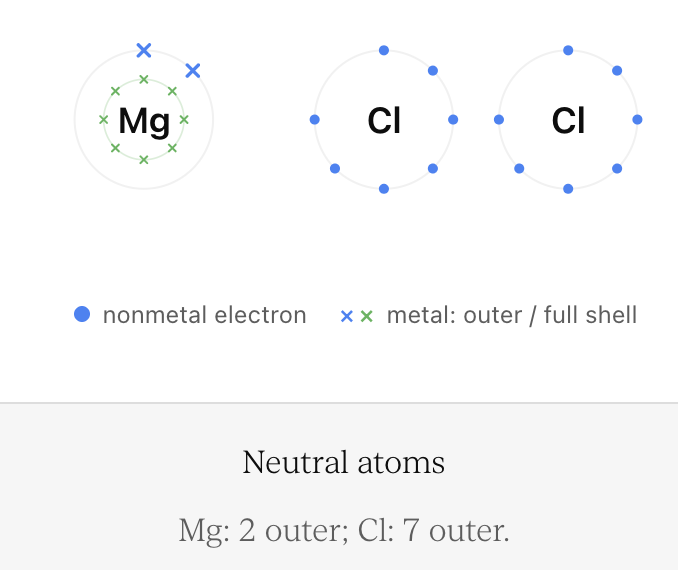
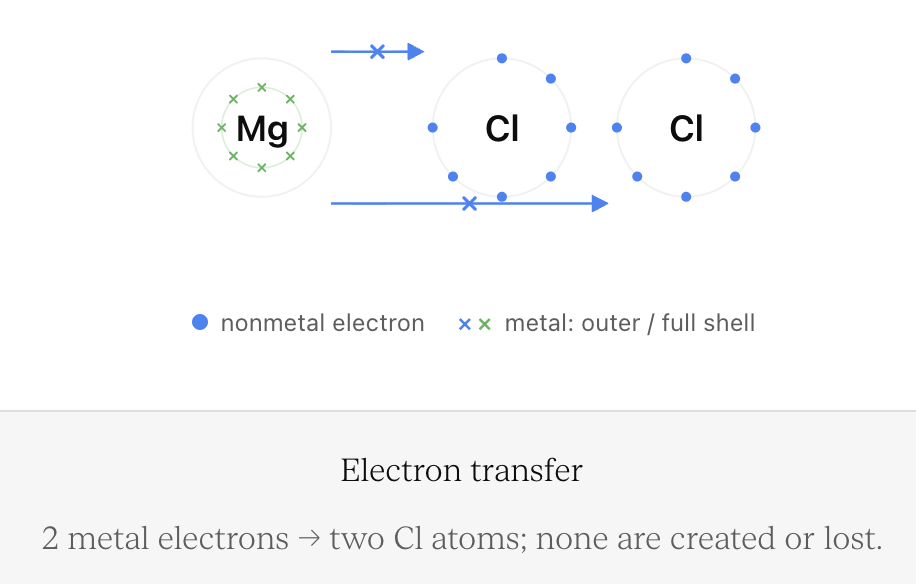
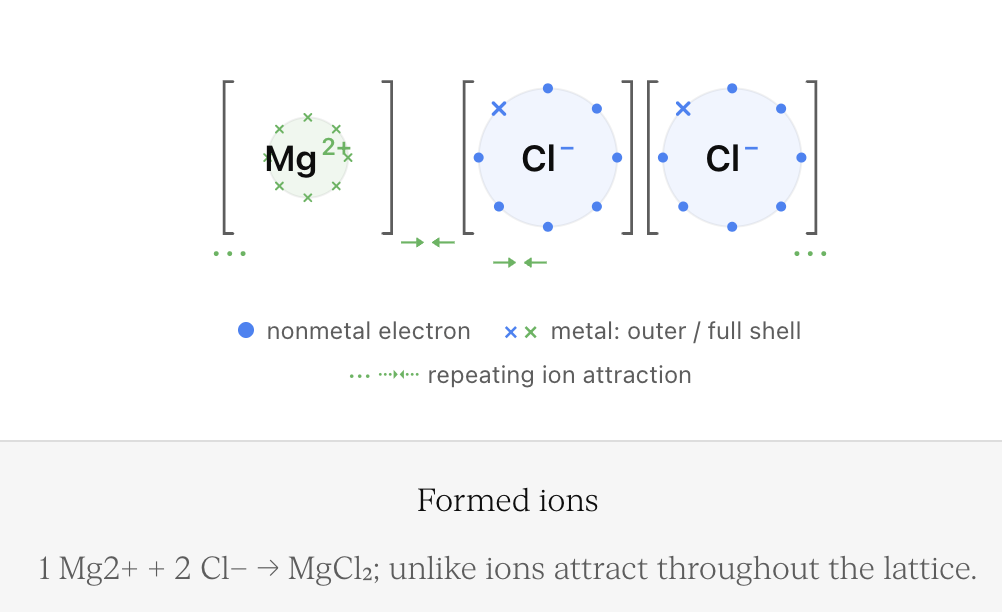
Electron transfer also occurs during the formation of ionic compounds.
For example, when magnesium reacts with chlorine:
Mg → Mg²⁺ + 2e⁻
The electrons are accepted by chlorine atoms.
The resulting positive and negative ions attract each other.