Chemical Analysis and Applications
1. Empirical Formulae
Learning outcomes
- I can define an empirical formula.
- I can determine empirical formulae from percentage composition data.
- I can determine empirical formulae from mass data.
- I can explain the difference between empirical and molecular formulae.
- I can solve empirical formula problems involving experimental data.
Empirical Formulae
An empirical formula shows the simplest whole-number ratio of atoms of each element in a compound.
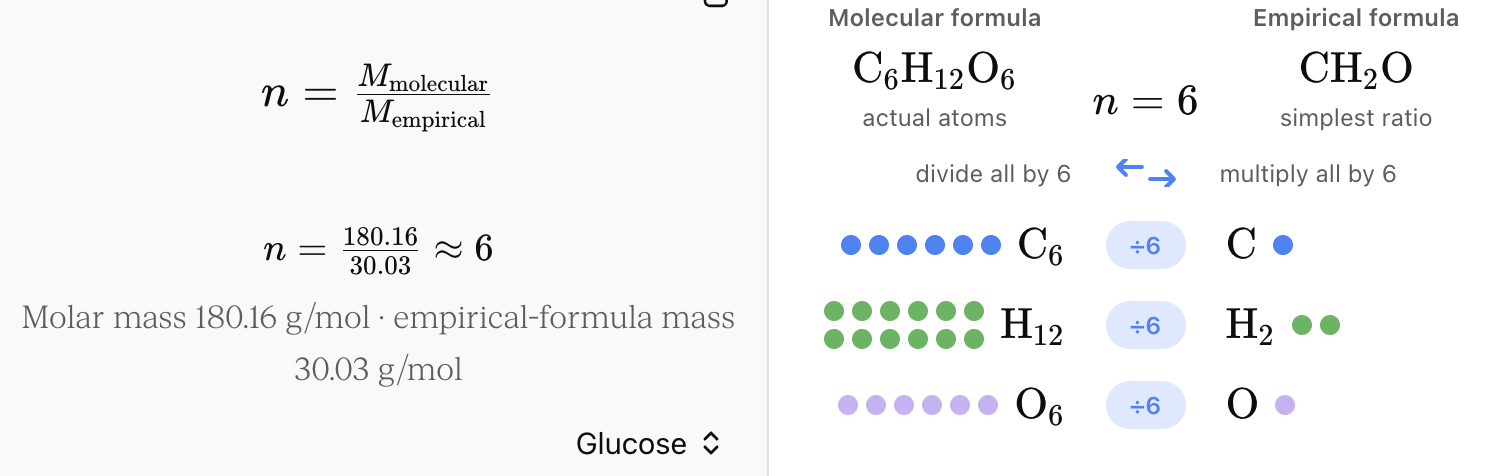
For example, glucose has the molecular formula:
C₆H₁₂O₆
The ratio of carbon : hydrogen : oxygen atoms is:
6 : 12 : 6
Divide all three numbers by 6:
1 : 2 : 1
Therefore, the empirical formula is:
CH₂O
The empirical formula does not necessarily show the actual number of atoms in one molecule. It shows their simplest ratio.


Empirical Formula vs. Molecular Formula
The molecular formula gives the actual number of atoms of each element in one molecule.
The empirical formula gives the simplest whole-number ratio.
For example:
| Substance | Molecular Formula | Empirical Formula |
|---|---|---|
| Hydrogen peroxide | H₂O₂ | HO |
| Ethene | C₂H₄ | CH₂ |
| Benzene | C₆H₆ | CH |
| Glucose | C₆H₁₂O₆ | CH₂O |
| Water | H₂O | H₂O |
Sometimes the empirical and molecular formulae are identical.
For water:
H₂O
The subscripts 2 and 1 cannot be simplified further.
Therefore:
molecular formula = H₂O
and:
empirical formula = H₂O
Here is an interactive comparison of how molecular and empirical formulae are related:
Why Do We Use Empirical Formulae?
Chemical experiments can often determine the relative quantities of elements in a compound.
For example, an experiment might tell us that a compound contains:
- 40.0% carbon
- 6.7% hydrogen
- 53.3% oxygen
From this information, we can determine the ratio of moles of atoms.
That ratio allows us to determine the empirical formula.
The general pathway is:
mass or percentage → moles → simplest mole ratio → empirical formula
The Basic Method
Most empirical formula calculations follow four main steps.
Find the mass of each element
The question may provide:
- actual masses
- percentage composition
- experimental measurements
Convert each mass to moles
Use:
n = m/M
where:
- n = amount in moles
- m = mass in grams
- M = molar mass in g/mol
Find the simplest mole ratio
Divide every mole value by the smallest number of moles.
Convert the ratio to whole numbers
Use the resulting whole numbers as the subscripts in the empirical formula.
A useful memory aid is:
MASS → MOLES → DIVIDE → WHOLE NUMBERS → FORMULA
Why We Convert Mass to Moles
An empirical formula represents the ratio of atoms, not the ratio of their masses.
Different atoms have different masses.
For example:
12 g carbon = 1 mol C
but:
1 g hydrogen ≈ 1 mol H
Therefore, a compound containing 12 g carbon and 1 g hydrogen contains approximately equal numbers of carbon and hydrogen atoms.
Its ratio is approximately:
C : H = 1 : 1
not:
12 : 1
This is why we must convert masses to moles before finding the formula.
Empirical Formula from Mass Data
Suppose a compound contains:
- 24 g carbon
- 4 g hydrogen
Find the empirical formula.
Convert carbon to moles
n(C) = 24 / 12
n(C) = 2 mol
Convert hydrogen to moles
n(H) = 4 / 1
n(H) = 4 mol
Write the mole ratio
C : H = 2 : 4
Divide by the smallest value
Divide both by 2:
C : H = 1 : 2
Write the formula
CH₂
Answer
Empirical formula = CH₂
Worked Example: Magnesium Oxide
A sample contains:
- 2.4 g Mg
- 1.6 g O
Use:
Ar(Mg) = 24
Ar(O) = 16
Calculate moles of Mg
n = 2.4 / 24
= 0.10 mol
Calculate moles of O
n = 1.6 / 16
= 0.10 mol
Find the ratio
Mg : O = 0.10 : 0.10
Divide by 0.10:
1 : 1
Empirical formula
MgO
Worked Example: Iron Oxide
An iron oxide contains:
- 11.2 g Fe
- 4.8 g O
Use:
Ar(Fe) = 56
Ar(O) = 16
Iron
n(Fe) = 11.2 / 56
= 0.20 mol
Oxygen
n(O) = 4.8 / 16
= 0.30 mol
Ratio
Fe : O = 0.20 : 0.30
Divide by 0.20:
1 : 1.5
We cannot use 1.5 as a subscript in an empirical formula.
Multiply both numbers by 2:
2 : 3
Answer
Fe₂O₃
This is an important example because the first division does not always produce whole numbers.
Dealing with Decimal Ratios
Sometimes dividing by the smallest mole value gives a ratio such as:
1 : 1.5
or:
1 : 1.33
or:
1 : 1.25
Do not simply round these values to the nearest whole number.
Instead, multiply all parts of the ratio by a suitable small integer.
Common patterns include:
| Decimal Ratio | Approximate Fraction | Multiply By |
|---|---|---|
| 1.5 | 3/2 | 2 |
| 1.33 | 4/3 | 3 |
| 1.67 | 5/3 | 3 |
| 1.25 | 5/4 | 4 |
| 1.75 | 7/4 | 4 |
For example:
1 : 1.5
multiply by 2:
2 : 3
Similarly:
1 : 1.33
multiply by 3:
3 : 4
Do Not Round Too Quickly
Suppose your calculated ratio is:
1 : 1.49
This is probably intended to represent:
1 : 1.5
not:
1 : 1
Small differences often result from:
- experimental uncertainty
- rounded atomic masses
- measurement uncertainty
Use chemical reasoning when interpreting the numbers.
However, a value such as:
1.05
is reasonably close to:
1
The goal is to identify the most reasonable simple whole-number ratio.
Empirical Formula from Percentage Composition
Percentage composition problems use the same method.
A useful shortcut is to imagine that you have:
100 g of the compound
Then:
percentage = mass in grams
For example:
40% carbon becomes:
40 g C
6.7% hydrogen becomes:
6.7 g H
53.3% oxygen becomes:
53.3 g O
This makes the calculation much easier.
Worked Example: Percentage Composition
A compound contains:
- 40.0% C
- 6.7% H
- 53.3% O
Determine its empirical formula.
Assume:
100 g compound
Therefore:
- C = 40.0 g
- H = 6.7 g
- O = 53.3 g
Convert carbon to moles
n(C) = 40.0 / 12.0
= 3.33 mol
Convert hydrogen to moles
n(H) = 6.7 / 1.0
= 6.7 mol
Convert oxygen to moles
n(O) = 53.3 / 16.0
= 3.33 mol
Find the ratio
C : H : O
3.33 : 6.7 : 3.33
Divide everything by 3.33:
1 : 2.01 : 1
Approximately:
1 : 2 : 1
Answer
CH₂O
Another Percentage Example
A compound contains:
- 52.2% C
- 13.0% H
- 34.8% O
Assume a 100 g sample.
Therefore:
- C = 52.2 g
- H = 13.0 g
- O = 34.8 g
Convert to moles
Carbon:
52.2 / 12 = 4.35 mol
Hydrogen:
13.0 / 1 = 13.0 mol
Oxygen:
34.8 / 16 = 2.175 mol
Divide by the smallest
Smallest = 2.175
Carbon:
4.35 / 2.175 = 2
Hydrogen:
13.0 / 2.175 ≈ 6
Oxygen:
2.175 / 2.175 = 1
Ratio:
2 : 6 : 1
Answer
C₂H₆O
A Three-Element Example
A compound contains:
- 27.3% C
- 72.7% O
Assume:
100 g
Therefore:
27.3 g C
72.7 g O
Calculate moles:
C = 27.3 / 12 = 2.275 mol
O = 72.7 / 16 = 4.544 mol
Divide by the smallest:
C = 2.275 / 2.275 = 1
O = 4.544 / 2.275 ≈ 2
Answer
CO₂
Experimental Determination of Empirical Formulae
Empirical formulae can be determined experimentally by measuring how much of each element combines.
A classic example is the formation of magnesium oxide.
Magnesium reacts with oxygen:
magnesium + oxygen → magnesium oxide
Symbolically:
2Mg + O₂ → 2MgO
A student can measure:
- the mass of the empty crucible
- the mass of the crucible + magnesium
- the mass of the crucible + magnesium oxide after heating
From these measurements, the masses of magnesium and oxygen can be determined.


Finding Masses from Experimental Data
Suppose:
mass of crucible = 25.60 g
mass of crucible + Mg = 28.00 g
mass of crucible + MgO = 29.60 g
First find the mass of magnesium:
28.00 − 25.60 = 2.40 g Mg
Then find the mass of magnesium oxide:
29.60 − 25.60 = 4.00 g MgO
The oxygen mass is:
4.00 − 2.40 = 1.60 g O
Now calculate moles.
Mg:
2.40 / 24 = 0.100 mol
O:
1.60 / 16 = 0.100 mol
Ratio:
1 : 1
Answer
MgO
Why Heat to Constant Mass?
In experiments such as the magnesium oxide investigation, the sample may be:
- heated
- cooled
- weighed
- reheated
- cooled
- weighed again
This continues until the mass no longer changes significantly.
This is called heating to constant mass.
A constant mass provides evidence that the reaction is complete.
If heating causes the mass to increase again, more oxygen may still be reacting with the magnesium.
Experimental Errors
Experimental empirical formulae are not always perfect.
Suppose the true ratio should be:
1 : 1
but the experiment produces:
1 : 0.92
This may result from experimental error.
Possible sources include:
- incomplete reaction
- loss of product
- contamination
- inaccurate measurements
- side reactions
- material escaping during heating
Scientists must evaluate whether their calculated ratio is reasonably consistent with a simple whole-number ratio.
Example: Finding an Empirical Formula from Combustion Data
A compound contains only carbon and hydrogen.
A sample contains:
- 3.6 g C
- 0.6 g H
Calculate moles.
Carbon:
3.6 / 12 = 0.30 mol
Hydrogen:
0.6 / 1 = 0.60 mol
Ratio:
0.30 : 0.60
Divide by 0.30:
1 : 2
Answer
CH₂
This tells us the simplest ratio but not necessarily the actual molecular formula.
The compound could potentially have a molecular formula such as:
C₂H₄
C₃H₆
C₄H₈
and so on.
Empirical Formula Does Not Identify a Compound Uniquely
Consider:
CH₂O
This is an empirical formula.
Possible molecular formulae include:
CH₂O
C₂H₄O₂
C₃H₆O₃
C₆H₁₂O₆
All of these reduce to:
CH₂O
Therefore, knowing the empirical formula alone is not always enough to identify a compound.
Additional information, such as the molar mass, may be required.
From Empirical Formula to Molecular Formula
Suppose the empirical formula is:
CH₂O
First calculate the empirical formula mass:
C:
1 × 12 = 12
H:
2 × 1 = 2
O:
1 × 16 = 16
Total:
12 + 2 + 16 = 30 g/mol
Suppose the actual molecular molar mass is:
180 g/mol
Calculate:
180 / 30 = 6
Therefore, multiply every subscript in CH₂O by 6:
C₆H₁₂O₆
Molecular formula
C₆H₁₂O₆
Another Molecular Formula Example
The empirical formula of a compound is:
CH
Empirical formula mass:
12 + 1 = 13 g/mol
The molecular molar mass is:
78 g/mol
Calculate:
78 / 13 = 6
Multiply the empirical formula by 6:
C₆H₆
Answer
Molecular formula = C₆H₆
When Empirical and Molecular Formulae Are the Same
Suppose the empirical formula is:
H₂O
Its empirical formula mass is:
18 g/mol
If the molecular molar mass is also:
18 g/mol
then:
18 / 18 = 1
Therefore, the molecular formula is simply:
H₂O
No multiplication is needed.
Percentage Composition from an Empirical Formula
We can also work in the opposite direction.
Suppose a compound has empirical formula:
CH₂O
Formula mass:
12 + 2 + 16 = 30
Carbon percentage:
(12 / 30) × 100 = 40.0%
Hydrogen percentage:
(2 / 30) × 100 ≈ 6.7%
Oxygen percentage:
(16 / 30) × 100 ≈ 53.3%
This matches the composition used in our earlier example.
Worked Example with a Decimal Ratio
A compound contains:
- 1.2 g C
- 0.30 g H
Calculate moles:
C:
1.2 / 12 = 0.10 mol
H:
0.30 / 1 = 0.30 mol
Ratio:
0.10 : 0.30
Divide by 0.10:
1 : 3
Answer
CH₃
Worked Example Requiring Multiplication
A compound contains:
- 5.6 g Fe
- 2.4 g O
Calculate moles:
Fe:
5.6 / 56 = 0.10 mol
O:
2.4 / 16 = 0.15 mol
Divide by 0.10:
1 : 1.5
Multiply both by 2:
2 : 3
Answer
Fe₂O₃
Never round:
1 : 1.5
to:
1 : 2
That would incorrectly produce FeO₂.
Worked Example with a 1.33 Ratio
Suppose a calculation gives:
C : H = 1 : 1.33
Recognize:
1.33 ≈ 4/3
Multiply the entire ratio by 3:
3 : 4
Therefore:
C₃H₄
The important step is multiplying every value in the ratio, not just the decimal value.
Percentage Data Must Total Approximately 100%
If all elements in the compound are listed, their percentages should add to approximately:
100%
For example:
40.0 + 6.7 + 53.3 = 100.0%
Small differences may occur because percentages have been rounded.
If the total is very different from 100%, check whether:
- an element is missing
- the data were copied incorrectly
- the question provides only partial composition information
Finding a Missing Percentage
Suppose a compound contains:
- 48.0% carbon
- 8.0% hydrogen
- the remainder oxygen
Find the oxygen percentage:
100 − 48.0 − 8.0
= 44.0% oxygen
You can then proceed with the usual empirical formula calculation.
Worked Example: Missing Percentage
A compound contains:
- 40.0% sulfur
- 60.0% oxygen
Use:
Ar(S) = 32
Ar(O) = 16
Assume 100 g.
S:
40.0 / 32 = 1.25 mol
O:
60.0 / 16 = 3.75 mol
Divide by 1.25:
S : O = 1 : 3
Answer
SO₃
Experimental Example: Metal Oxide
A metal oxide is produced by reacting:
5.40 g aluminium
with oxygen.
The final oxide has a mass of:
10.20 g
Find the empirical formula.
Find oxygen mass
10.20 − 5.40 = 4.80 g O
Calculate aluminium moles
Use:
Ar(Al) = 27
n(Al) = 5.40 / 27
= 0.200 mol
Calculate oxygen moles
n(O) = 4.80 / 16
= 0.300 mol
Divide by the smallest
Al : O = 0.200 : 0.300
Divide by 0.200:
1 : 1.5
Multiply by 2:
2 : 3
Answer
Al₂O₃
Experimental Example: Copper Oxide
A sample contains:
6.35 g Cu
and reacts with:
1.60 g O
Use:
Ar(Cu) = 63.5
Ar(O) = 16.0
Copper:
6.35 / 63.5 = 0.100 mol
Oxygen:
1.60 / 16.0 = 0.100 mol
Ratio:
1 : 1
Answer
CuO
Empirical Formulae and Ionic Compounds
For ionic compounds, the formula already represents the simplest whole-number ratio of ions.
For example:
NaCl
represents:
Na⁺ : Cl⁻ = 1 : 1
and:
CaCl₂
represents:
Ca²⁺ : Cl⁻ = 1 : 2
We do not normally speak of a molecular formula for ionic compounds because they form extended ionic lattices rather than discrete molecules.


Empirical Formulae and Experimental Evidence
Empirical formula calculations illustrate an important feature of chemistry:
We can use macroscopic measurements such as mass to determine information about particles that are far too small to observe individually.
A balance might tell us that two elements combined in certain masses.
Atomic masses allow us to convert those measurements to moles.
Mole ratios then reveal the relative numbers of atoms.
So:
measured mass → moles → atomic ratio → chemical formula
This is an excellent example of how experimental evidence can reveal microscopic chemical structure.
A Reliable Problem-Solving Method
For almost every empirical formula problem, follow this sequence:
Write the elements
Keep the elements in the same order throughout the calculation.
Write the masses
If percentages are given, assume a 100 g sample.
Divide by atomic mass
Calculate:
moles = mass / molar mass
Divide by the smallest mole value
This produces the simplest relative ratio.
Examine the decimals
If necessary:
- ×2 for approximately 0.5
- ×3 for approximately 0.33 or 0.67
- ×4 for approximately 0.25 or 0.75
Write the empirical formula
Use the whole-number ratios as subscripts.
A Calculation Table Can Help
For example:
| Element | Mass (g) | Ar | Moles | ÷ Smallest | Ratio |
|---|---|---|---|---|---|
| C | 40.0 | 12 | 3.33 | 1.00 | 1 |
| H | 6.7 | 1 | 6.70 | 2.01 | 2 |
| O | 53.3 | 16 | 3.33 | 1.00 | 1 |
Therefore:
CH₂O
This format can make multi-element calculations easier to organize.
Common Mistakes
Using the Mass Ratio as the Formula
If a compound contains:
24 g C
and:
4 g H
do not use:
24 : 4 = 6 : 1
The empirical formula is based on the mole ratio, not the mass ratio.
Always convert:
mass → moles
first.
Multiplying Instead of Dividing by Atomic Mass
Use:
n = m/M
not:
n = m × M
Forgetting the 100 g Assumption
For percentage composition problems, assuming:
100 g compound
allows percentages to be treated directly as grams.
For example:
32% oxygen → 32 g oxygen
Rounding 1.5 to 2
A ratio of:
1 : 1.5
should not be rounded to:
1 : 2
Instead multiply by 2:
2 : 3
Rounding Too Early
Keep several decimal places during intermediate calculations.
Early rounding can turn a recognizable ratio into an incorrect one.
Forgetting to Divide Every Value
If the mole amounts are:
0.20 : 0.40 : 0.60
divide all values by 0.20:
1 : 2 : 3
Forgetting to Multiply Every Ratio
If the result is:
1 : 1.5 : 1
multiply every number by 2:
2 : 3 : 2
not:
1 : 3 : 1
Assuming Empirical Formula Means Molecular Formula
An empirical formula of:
CH₂O
does not automatically mean the molecule is CH₂O.
Its molecular formula could be:
C₂H₄O₂
C₃H₆O₃
C₆H₁₂O₆
or another whole-number multiple.
Using the Wrong Experimental Mass
In a metal oxide experiment:
mass of oxygen = mass of oxide − mass of metal
Do not use the total oxide mass as the oxygen mass.
Key Terms
Empirical formula — The chemical formula showing the simplest whole-number ratio of atoms of each element in a compound.
Molecular formula — The formula showing the actual number of atoms of each element in one molecule.
Percentage composition — The percentage by mass contributed by each element in a compound.
Mole ratio — The relative numbers of moles of substances or elements.
Relative atomic mass (Ar) — The average mass of an atom relative to 1/12 of the mass of carbon-12.
Molar mass — The mass of one mole of a substance, usually expressed in g/mol.
Formula mass — The sum of the relative atomic masses represented by a chemical formula.
Whole-number ratio — A ratio expressed using integers such as 1:2, 2:3, or 3:4.
Constant mass — A mass that remains unchanged after repeated heating, cooling, and weighing, suggesting a reaction or drying process is complete.
Percentage by mass — The fraction of a compound's total mass contributed by a particular element, expressed as a percentage.
Experimental data — Measurements obtained during an investigation and used to determine quantities such as masses and mole ratios.
Key Takeaways
- An empirical formula gives the simplest whole-number ratio of atoms in a compound.
- A molecular formula gives the actual number of atoms in a molecule.
- The empirical and molecular formulae may be the same, but they do not have to be.
- Empirical formulae are based on mole ratios, not mass ratios.
- The main calculation pathway is:
MASS → MOLES → DIVIDE BY SMALLEST → WHOLE-NUMBER RATIO → FORMULA
- Convert mass to moles using:
n = m/M
- For percentage composition problems, assuming a 100 g sample allows percentages to be treated as masses in grams.
- Divide all mole values by the smallest mole value.
- Ratios such as 1.5, 1.33, and 1.25 should usually be converted to whole numbers by multiplying the entire ratio.
- Do not round fractional ratios too aggressively.
- Experimental measurements can be used to determine empirical formulae.
- For an oxide experiment:
mass of oxygen = mass of oxide − mass of original element
- Experimental uncertainty may produce ratios that are close to, but not exactly, whole numbers.
- More than one molecular compound can have the same empirical formula.
- Molecular molar mass can be used with an empirical formula to determine a molecular formula.
The central strategy is:
MASS → MOLES → RATIO → FORMULA
Check Your Understanding
Basic Concepts
1. Define an empirical formula.
2. Explain the difference between an empirical formula and a molecular formula.
3. Determine the empirical formula corresponding to C₂H₄.
4. Determine the empirical formula corresponding to C₆H₁₂O₆.
5. Determine the empirical formula corresponding to H₂O₂.
6. Why is the empirical formula of H₂O still H₂O?
7. Explain why empirical formula calculations use mole ratios rather than mass ratios.
Empirical Formula from Mass
8. A compound contains 12 g C and 2 g H. Determine its empirical formula.
9. A compound contains 2.4 g Mg and 1.6 g O. Determine its empirical formula.
10. A compound contains 5.6 g Fe and 2.4 g O. Determine its empirical formula.
11. A compound contains 2.7 g Al and 2.4 g O. Determine its empirical formula.
12. A compound contains 6.35 g Cu and 1.60 g O. Determine its empirical formula.
13. A compound contains 3.1 g P and 4.0 g O. Determine its empirical formula. Use Ar(P) = 31.
Percentage Composition
14. A compound contains 40.0% C, 6.7% H, and 53.3% O. Determine its empirical formula.
15. A compound contains 27.3% C and 72.7% O. Determine its empirical formula.
16. A compound contains 40.0% S and 60.0% O. Determine its empirical formula.
17. A compound contains 43.7% P and 56.3% O. Determine its empirical formula.
18. Explain why it is convenient to assume a 100 g sample when percentage composition is given.
Decimal Ratios
19. A mole ratio is calculated as 1 : 1.5. What whole-number ratio should be used?
20. A ratio is 1 : 1.33. What whole-number ratio is most likely?
21. A ratio is 1 : 1.25. What should you multiply the entire ratio by?
22. Explain why a ratio of 1 : 1.5 should not simply be rounded to 1 : 2.
Experimental Data
23. A student heats 2.40 g Mg and produces 4.00 g MgO. Calculate the mass of oxygen that reacted.
24. Use the data from Question 23 to determine the empirical formula.
25. A student reacts 5.40 g Al with oxygen and obtains 10.20 g aluminium oxide. Determine the mass of oxygen that reacted.
26. Use the data from Question 25 to determine the empirical formula.
27. Explain why a sample may be heated repeatedly until constant mass is reached.
28. Give two experimental errors that could affect an empirical formula calculation.
Molecular and Empirical Formulae
29. The empirical formula is CH₂O and the molecular molar mass is 180 g/mol. Determine the molecular formula.
30. The empirical formula is CH and the molecular molar mass is 78 g/mol. Determine the molecular formula.
31. The empirical formula is NO₂ and the molecular molar mass is 92 g/mol. Determine the molecular formula.
32. The empirical formula is CH₂ and the molecular molar mass is 56 g/mol. Determine the molecular formula.
33. Explain why two different compounds can have the same empirical formula.
Analysis and Application
34. A student obtains mole values of 0.20 mol C, 0.40 mol H, and 0.20 mol O. Determine the empirical formula.
35. A student obtains a ratio of 1.00 : 1.49. Explain how this ratio should be interpreted.
36. A student uses the masses of two elements directly as subscripts in a chemical formula. Explain why this method is incorrect.
37. A compound contains 48.0% C, 8.0% H, and the remainder O. Calculate the percentage of oxygen and then determine the empirical formula.
38. An oxide is formed from 7.00 g of a metal. The final oxide mass is 9.00 g. Explain the steps you would use to determine the empirical formula if the atomic mass of the metal were known.
39. A student obtains an experimental mole ratio of Mg : O = 1.00 : 0.91 instead of exactly 1 : 1. Give possible experimental reasons for the difference and state the most reasonable empirical formula.
40. Explain how measurements made with a laboratory balance can ultimately be used to determine the simplest ratio of atoms in a chemical compound.