Energy in Systems
3. Energy Flow in Systems
Learning outcomes
- I can identify the energy stores and transfer pathways present within a system.
- I can construct and interpret energy flow diagrams for complex systems.
- I can track energy transfers through multiple stages of a process.
- I can explain how energy is conserved within a system.
- I can analyze the flow of energy in mechanical, electrical, and thermal systems.
Energy Flow in Systems
An energy system is a group of objects or processes that we choose to study together. Energy may be stored within the system, transferred between different stores, or transferred between the system and its surroundings.
Understanding energy flow means being able to answer four questions:
- Where is the energy initially stored?
- How is the energy transferred?
- Where does the energy go?
- How much remains in useful and less useful stores?
The central principle is the conservation of energy:
Energy cannot be created or destroyed. It can only be transferred between stores.


Energy Stores
Energy can be associated with different stores.
Important energy stores include:
| Energy Store | Description | Example |
|---|---|---|
| Kinetic | Energy associated with motion | Moving car |
| Gravitational potential | Energy associated with position in a gravitational field | Water behind a dam |
| Elastic potential | Energy associated with deformation | Stretched spring |
| Chemical | Energy associated with chemical substances | Fuel, food, batteries |
| Thermal | Energy associated with the internal energy of matter | Hot water |
| Magnetic | Energy associated with magnetic interactions | Two magnets |
| Electrostatic | Energy associated with electric charges | Charged objects |
| Nuclear | Energy associated with atomic nuclei | Nuclear fuel |
Energy can move from one store to another through different transfer pathways.
Energy Transfer Pathways
There are four main ways energy can be transferred:
Mechanical Work
Energy is transferred when a force causes displacement.
Examples:
- lifting an object
- pushing a cart
- stretching a spring
- a motor turning a wheel
Electrical Work
Energy is transferred when charges move through a potential difference.
Examples:
- battery powering a motor
- mains electricity powering a heater
- generator supplying a circuit
Heating
Energy is transferred because of a temperature difference.
Examples:
- hot water heating a cup
- a stove heating a pan
- friction heating machine parts
Waves
Energy can be transferred by waves.
Examples:
- sunlight
- sound
- infrared radiation
- microwaves
It is important to distinguish between an energy store and a transfer pathway.
For example:
thermal = store
heating = transfer pathway
Energy Stores Versus Transfer Pathways
Consider a falling object.
The object begins with energy in its:
gravitational potential store
As it falls, energy is transferred mechanically into its:
kinetic store
So we might describe the process as:
gravitational potential store → mechanical transfer → kinetic store
The energy has moved between stores.
Energy Flow Diagrams
An energy flow diagram shows where energy starts, how it is transferred, and where it ends.
A simple battery-powered motor might be represented as:
chemical store in battery → electrical transfer → kinetic store of motor
Some energy is also transferred into:
thermal stores of motor and surroundings
and:
sound
A more complete flow is therefore:
chemical store → electrical transfer → kinetic store + thermal stores + sound transfer
Energy Flow in a Flashlight
Consider a battery-powered flashlight.
Energy begins in the:
chemical store of the battery
It is transferred electrically to the lamp:
chemical store → electrical transfer
The lamp then transfers energy mainly by:
- visible electromagnetic waves
- heating
So the complete sequence is approximately:
chemical store → electrical transfer → light waves + thermal stores
The light is the desired output.
Heating of the lamp and surroundings is generally an unwanted transfer.
Energy Flow in an Electric Motor
An electric motor receives energy electrically.
Energy flow:
electrical transfer → kinetic store of rotating components
Some energy also enters:
thermal stores
because of:
- electrical resistance
- friction
- vibration
Energy may also leave through sound waves.
Therefore:
electrical input → useful mechanical output + thermal transfers + sound


Tracking Energy Quantitatively
Energy flow diagrams can also include numerical values.
Suppose a motor receives:
1000 J
of electrical energy.
The energy transfers are:
800 J → useful mechanical energy
150 J → thermal energy
50 J → sound and vibration
Check conservation:
1000 = 800 + 150 + 50
1000 J = 1000 J
All the input energy has been accounted for.
Conservation of Energy
The total energy of a closed system remains constant.
A useful energy accounting relationship is:
initial energy + energy transferred into system = final energy + energy transferred out of system
In a simpler machine:
total input energy = total output energy
For example:
500 J input = 350 J useful + 150 J dissipated
The machine may be only 70% efficient, but energy is still completely conserved.
Energy Does Not Disappear
Suppose a moving bicycle slows down and stops.
Its kinetic energy decreases.
Where did the energy go?
Energy may have been transferred into:
- thermal stores of the brakes
- thermal stores of the tyres
- thermal stores of the road
- thermal stores of the surrounding air
- sound waves
The bicycle has lost kinetic energy, but the energy has not ceased to exist.
It has been transferred and dispersed.
Multi-Stage Energy Transfers
Many systems involve several energy transfers rather than a single transformation.
Consider an electric vehicle.
A simplified sequence might be:
chemical store in battery
↓
electrical transfer
↓
motor
↓
mechanical transfer
↓
kinetic store of vehicle
At each stage, some energy may also be transferred into thermal stores.


Worked Example: Electric Vehicle
Suppose a battery provides:
1000 kJ
of energy.
The motor receives:
950 kJ
after electrical losses.
The motor provides:
850 kJ
The wheels transfer:
800 kJ
into useful vehicle motion.
We can track the losses.
Electrical stage:
1000 − 950 = 50 kJ
Motor stage:
950 − 850 = 100 kJ
Drivetrain stage:
850 − 800 = 50 kJ
Total dissipated energy:
50 + 100 + 50 = 200 kJ
Useful output:
800 kJ
Check:
1000 = 800 + 200
Energy is conserved.
Energy Flow Through Several Devices
Consider:
battery → motor → generator → lamp
Suppose:
Battery output = 1000 J
Motor output = 800 J
Generator output = 600 J
Lamp useful output = 300 J
At each stage, energy is transferred into less useful forms.
Motor
Input = 1000 J
Output = 800 J
Dissipated:
200 J
Generator
Input = 800 J
Output = 600 J
Dissipated:
200 J
Lamp
Input = 600 J
Useful output = 300 J
Dissipated:
300 J
Total:
300 J useful + 700 J dissipated = 1000 J input
Mechanical Energy Flow
Mechanical systems commonly involve transfers between:
- kinetic stores
- gravitational potential stores
- elastic potential stores
- thermal stores
Consider a roller coaster.
At the top of a hill, much of its mechanical energy is stored gravitationally.
As it descends:
gravitational potential → kinetic
As it climbs:
kinetic → gravitational potential
Friction and air resistance continually transfer some mechanical energy into thermal stores.


Roller Coaster Example
Suppose a roller coaster has:
500 kJ
of gravitational potential energy at the top of a hill.
At the bottom:
450 kJ is kinetic energy.
Therefore:
50 kJ
has been transferred into other stores.
Energy flow:
500 kJ gravitational potential
↓
450 kJ kinetic + 50 kJ thermal/sound
Energy conservation:
500 = 450 + 50
Pendulum Energy Flow
A pendulum continuously transfers energy between gravitational potential and kinetic stores.
At the highest point:
gravitational potential = maximum
kinetic = minimum
As it falls:
gravitational potential → kinetic
At the lowest point:
kinetic = maximum
As it rises:
kinetic → gravitational potential
In a real pendulum, air resistance and friction gradually transfer energy into thermal stores.
As a result, the pendulum eventually stops.
Spring Energy Flow
A compressed spring contains energy in its:
elastic potential store
When released:
elastic potential → kinetic
For example:
compressed spring → moving toy car
In a real system, some energy is also transferred into:
- thermal stores
- sound
- vibration
Therefore, not all elastic potential energy becomes useful kinetic energy.
Electrical Energy Flow
Electrical systems often transfer energy between many different components.
Consider:
battery → wires → motor → fan
Energy begins in the chemical store of the battery.
It is transferred electrically through the circuit.
The motor transfers energy mechanically to the fan.
The fan transfers energy to the surrounding air.
So:
chemical → electrical transfer → mechanical transfer → kinetic store of air
Some energy is also dissipated thermally and through sound.
Electrical Heating
Consider an electric kettle.
Energy flow:
electrical transfer → thermal store of heating element → thermal store of water
The intended output is an increase in the thermal energy of the water.
Some energy also increases the thermal energy of:
- kettle body
- surrounding air
- nearby surfaces
These transfers reduce the efficiency of heating the water.


Thermal Energy Flow
Thermal energy naturally transfers from regions at higher temperature to regions at lower temperature.
Energy can be transferred thermally through:
- conduction
- convection
- radiation
These mechanisms help explain energy movement in thermal systems.
Conduction
Conduction transfers energy through interactions between particles, particularly in solids.
For example:
hot pan → metal handle
Particles in the hotter region transfer energy to neighboring particles.
Metals are generally good thermal conductors.
Materials such as:
- foam
- wool
- plastic
- trapped air
are poorer thermal conductors and are often used as insulation.
Convection
Convection transfers energy through the bulk movement of fluids.
Fluids include:
- liquids
- gases
For example, when water is heated:
- warmer water expands and becomes less dense
- it rises
- cooler, denser water sinks
- convection currents develop
These currents help distribute thermal energy.
Radiation
Energy can also be transferred by electromagnetic waves.
Thermal radiation is mainly infrared radiation at everyday temperatures.
Unlike conduction and convection, radiation does not require matter.
This is how energy from the Sun can reach Earth through space.
Solar Energy Flow
Energy from the Sun originates from nuclear processes.
A simplified pathway is:
nuclear store in Sun → electromagnetic waves → Earth
Solar radiation can then:
- heat Earth's surface
- drive atmospheric circulation
- drive the water cycle
- provide energy for photosynthesis
- generate electricity using solar cells
A single original energy source can therefore produce many different energy pathways.


Energy Flow in a Solar Panel System
Consider:
Sun → solar panel → battery → motor
Energy pathway:
nuclear processes in Sun
↓
electromagnetic radiation
↓
electrical transfer from solar panel
↓
chemical store in battery
↓
electrical transfer
↓
kinetic store through motor
At each stage, some energy is transferred into thermal stores.
This is a good example of a multi-stage energy system.
Energy Flow in a Hydroelectric System
A hydroelectric power station involves several stages.
Water stored high behind a dam has:
gravitational potential energy
As it falls:
gravitational potential → kinetic
The moving water turns a turbine:
kinetic → mechanical transfer
The turbine drives a generator:
mechanical → electrical transfer
Electricity can then power homes and industries.


Hydroelectric Example
Suppose water begins with:
10 MJ
of gravitational potential energy.
The turbine receives:
9 MJ
The generator produces:
8 MJ
of electrical energy.
Loss before turbine:
10 − 9 = 1 MJ
Generator/turbine system loss:
9 − 8 = 1 MJ
Useful electrical output:
8 MJ
Total dissipated:
2 MJ
Check:
10 MJ = 8 MJ + 2 MJ
Energy Flow in a Fossil-Fuel Power Station
A simplified sequence is:
chemical store in fuel
↓
thermal store of hot gases/steam
↓
mechanical transfer to turbine
↓
electrical transfer from generator
This system contains several energy conversion stages.
At each stage, some energy is transferred into:
- thermal stores of surroundings
- sound
- vibration
The final electrical output is therefore less than the original chemical energy input.
Energy Flow in a Wind Turbine
Wind contains kinetic energy.
A wind turbine transfers energy through the following sequence:
kinetic store of moving air
↓
mechanical transfer to turbine blades
↓
kinetic store of rotating turbine
↓
mechanical transfer to generator
↓
electrical transfer
Some energy remains in the moving air, while some is transferred into thermal stores and sound.
Energy Flow in the Human Body
The human body is also an energy system.
Energy begins in the:
chemical store of food
Through cellular respiration, this energy becomes available for:
- movement
- maintaining body temperature
- electrical activity in nerves
- building molecules
- cellular processes
During exercise:
chemical store → mechanical transfer → kinetic stores
Large amounts of energy also enter thermal stores.
This is why body temperature rises during exercise.
Useful and Less Useful Energy
Energy conservation does not mean that all energy remains equally useful.
Suppose:
1000 J chemical energy
becomes:
250 J useful mechanical energy
and:
750 J thermal energy
All 1000 J still exists.
However, the dispersed thermal energy may be much harder to use again.
This is why we often describe energy as being:
dissipated
rather than destroyed.
Sankey Diagrams
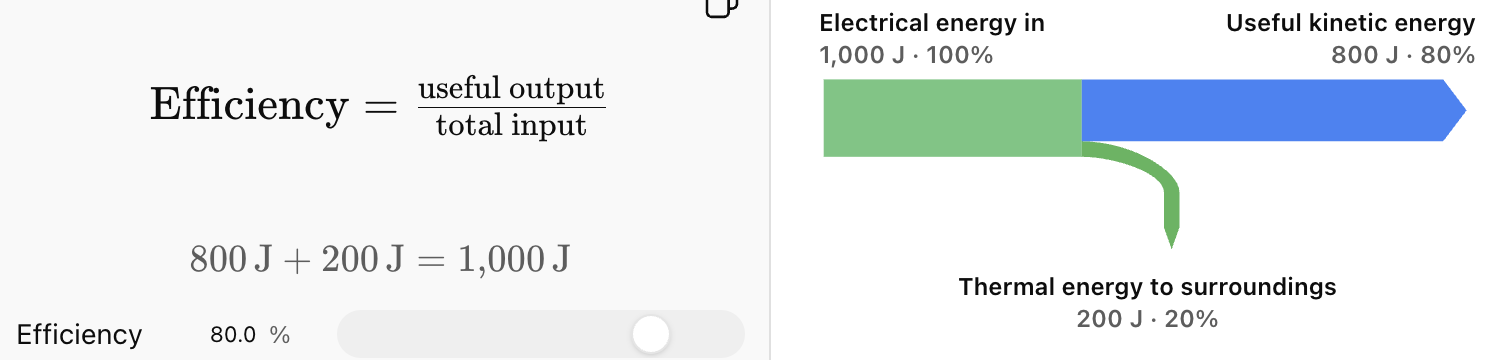
A Sankey diagram represents energy flow using arrows.
The width of each arrow represents the amount of energy being transferred.
For example, consider an electric motor:
Input:
1000 J electrical energy
Outputs:
800 J useful mechanical energy
200 J dissipated energy
A Sankey diagram makes the useful and dissipated portions easy to compare visually.
Interpreting Sankey Diagrams
Suppose a Sankey diagram shows:
Input = 500 J
Useful output = 350 J
Dissipated output = 150 J
Check:
500 = 350 + 150
Efficiency:
efficiency = 350/500 × 100
efficiency = 70%
Sankey diagrams therefore show both:
- conservation of energy
- efficiency of energy transfer
Complex Energy Flow Diagram
Consider an electric train powered by a power station.
A simplified sequence might be:
chemical or nuclear energy source
↓
thermal transfer
↓
mechanical transfer through turbine
↓
electrical transfer through generator and grid
↓
electrical transfer to train motor
↓
mechanical transfer
↓
kinetic store of train
At every stage, some energy may be dissipated.
This means the efficiency of the whole system depends on all stages.
Overall Efficiency
Suppose a system has three stages.
Stage 1 efficiency:
80%
Stage 2:
90%
Stage 3:
75%
Convert to decimals:
0.80 × 0.90 × 0.75
= 0.54
Overall efficiency:
54%
If the initial input is:
1000 J
the final useful output is:
1000 × 0.54
= 540 J
Therefore:
460 J
has been transferred into other forms across the complete system.
Tracking Energy Through Multiple Stages
Another way is to calculate each stage separately.
Initial energy:
1000 J
After Stage 1:
1000 × 0.80 = 800 J
After Stage 2:
800 × 0.90 = 720 J
After Stage 3:
720 × 0.75 = 540 J
Final useful energy:
540 J
This approach makes it easier to see where energy is being dissipated.
Energy Flow and System Boundaries
When analyzing energy, we must define the system boundary.
For example, consider a car.
If the system is only the engine, energy transferred into the cooling system leaves our chosen system.
If the system includes:
- engine
- radiator
- coolant
- surrounding air
then that same energy is still inside the larger system for some period.
Therefore, whether energy is described as entering or leaving depends partly on how the system is defined.
Open and Closed Systems
A closed system can exchange energy with its surroundings but does not exchange matter.
An open system can exchange both energy and matter with its surroundings.
Many real systems are open.
For example, a car engine receives:
- fuel
- oxygen
and releases:
- exhaust gases
- thermal energy
- sound
- mechanical energy
System boundaries help scientists keep track of these transfers.
Energy Accounting
A useful way to analyze a system is to create an energy account.
Ask:
What energy enters?
What energy leaves?
What energy remains stored?
For example:
Input:
2000 J
Useful output:
1300 J
Thermal output:
500 J
Sound:
100 J
Energy remaining stored:
100 J
Check:
2000 = 1300 + 500 + 100 + 100
The energy account balances.
Worked Example: Battery-Powered Lift
A battery supplies:
5000 J
to an electric motor.
Electrical losses:
400 J
Motor losses:
600 J
The remaining energy lifts a load.
Useful energy:
5000 − 400 − 600
= 4000 J
If the load has a mass of:
100 kg
and:
g = 10 N/kg
then:
ΔEₚ = mgΔh
4000 = 100 × 10 × Δh
Δh = 4 m
The energy flow analysis allows us to predict the physical result.
Worked Example: Spring Launcher
A compressed spring stores:
250 J
of elastic potential energy.
When released:
200 J
becomes kinetic energy of the projectile.
The remaining:
50 J
is dissipated through:
- friction
- sound
- vibration
- thermal transfers
Efficiency:
efficiency = 200/250 × 100
efficiency = 80%
Energy flow:
250 J elastic → 200 J kinetic + 50 J dissipated
Worked Example: Electric Heater
An electric heater receives:
3000 W
of electrical power.
Suppose:
2700 W
heats the intended room.
The remaining:
300 W
is transferred elsewhere.
Efficiency:
efficiency = 2700/3000 × 100
efficiency = 90%
Over 60 seconds:
Input energy:
E = Pt
E = 3000 × 60
E = 180,000 J
Useful transfer:
2700 × 60 = 162,000 J
Other transfers:
300 × 60 = 18,000 J
Check:
180,000 = 162,000 + 18,000
Energy Flow and Power
Energy tells us how much has been transferred.
Power tells us how quickly energy is transferred.
Recall:
P = E/t
Two machines might transfer the same total amount of energy but at different rates.
For example:
Machine A:
1000 J in 10 s
P = 100 W
Machine B:
1000 J in 2 s
P = 500 W
Both transfer the same energy, but Machine B transfers it much faster.
Energy Flow in Transportation
A vehicle can involve many energy transfers.
For a gasoline vehicle:
chemical store in fuel
↓
thermal transfer during combustion
↓
mechanical transfer through engine
↓
mechanical transfer through transmission
↓
kinetic store of vehicle
Energy is also transferred into:
- thermal stores
- exhaust gases
- air
- tyres
- road
- sound


Braking Energy Flow
During conventional braking:
kinetic store of vehicle → thermal stores of brakes and surroundings
With regenerative braking:
kinetic store → electrical transfer → chemical store in battery
Some energy is still dissipated, but part can be recovered.
This changes the energy flow through the system and can improve overall efficiency.
Comparing Energy Systems
When comparing systems, consider:
- initial energy store
- transfer pathways
- useful output
- dissipated energy
- number of conversion stages
- efficiency of each stage
- overall efficiency
- system boundaries
A system with many conversion stages may lose useful energy at each stage.
Therefore, simplifying energy-transfer chains can sometimes improve overall efficiency.
Improving Energy Flow
Engineers attempt to direct as much energy as possible toward the desired output.
Methods include:
- reducing friction
- improving insulation
- reducing electrical resistance
- using efficient motors
- reducing air resistance
- recovering waste heat
- regenerative braking
- reducing unnecessary conversion stages
The goal is not to prevent energy conservation—it is always conserved.
The goal is to prevent energy from becoming dispersed into less useful stores too early.
Common Mistakes
Saying Energy Is Created
Energy is not created by:
- batteries
- generators
- engines
- solar panels
These devices transfer or convert energy.
Saying Energy Is Destroyed
Energy that becomes less useful still exists.
It has been transferred or dissipated.
Calling Electricity an Energy Store
In the energy-stores model, electricity is better described as an energy transfer pathway.
Energy is transferred electrically between stores.
Calling Heating an Energy Store
Heating is a transfer pathway.
Thermal energy is associated with a store.
Calling Light an Energy Store
Light is electromagnetic radiation transferring energy.
It is a transfer pathway, not a stored form of energy in this model.
Ignoring Less Useful Outputs
If:
1000 J enters
and only:
700 J useful output
is identified, the remaining:
300 J
must still be accounted for.
Thinking Efficiency Changes Conservation of Energy
A 40%-efficient machine does not destroy 60% of the energy.
The other 60% is transferred into less useful forms.
Adding Efficiencies
For multiple stages, do not add efficiencies.
For example:
80% + 90% ≠ 170%
Convert to decimals and multiply:
0.80 × 0.90 = 0.72
Overall efficiency:
72%
Confusing Energy and Power
Energy is measured in:
joules
Power is measured in:
watts
Power describes the rate of energy transfer.
Check Your Understanding
- What is an energy store?
- Name five different energy stores.
- Name the four main energy transfer pathways.
- Explain the difference between a thermal energy store and heating.
- Is electrical transfer an energy store or a transfer pathway?
- Describe the energy flow in a battery-powered flashlight.
- Describe the energy flow in an electric motor.
- A motor receives 1000 J and produces 750 J of useful mechanical energy. Where must the remaining energy go?
- Calculate the amount of dissipated energy in Question 8.
- Calculate the efficiency of the motor.
- Explain how conservation of energy applies to a machine that is only 60% efficient.
- A roller coaster begins with 800 kJ of gravitational potential energy and has 700 kJ of kinetic energy at the bottom. Calculate the energy transferred into other stores.
- Describe the main energy transfers in a pendulum.
- Describe the main energy transfers in a spring launcher.
- Describe the energy flow through a hydroelectric power station.
- Describe the energy flow through a wind turbine.
- Describe the energy flow from the Sun to a solar-powered motor.
- A hydroelectric system receives 20 MJ of gravitational potential energy and produces 16 MJ of electrical energy. Calculate the energy dissipated.
- Calculate the efficiency of the system in Question 18.
- What information does a Sankey diagram show?
- Why must the widths of the output arrows in a Sankey diagram account for the input energy?
- A system receives 500 J and produces 300 J useful output, 150 J thermal output, and 50 J sound. Show that energy is conserved.
- A system contains stages with efficiencies of 80% and 90%. Calculate the overall efficiency.
- A system contains three stages with efficiencies of 90%, 80%, and 75%. Calculate its overall efficiency.
- If 2000 J enters the system in Question 24, calculate the final useful output.
- Explain why a system with many energy-conversion stages may have a lower overall efficiency.
- What is meant by a system boundary?
- Explain why changing the system boundary can change how we describe an energy transfer.
- Describe the difference between an open and a closed system.
- Explain the statement: "Energy is conserved, but it can become less useful."
Key Terms
System — Object or collection of objects chosen for analysis.
System boundary — Imaginary boundary separating a system from its surroundings.
Surroundings — Everything outside the chosen system.
Energy store — Way in which energy is associated with a system.
Kinetic store — Energy associated with motion.
Gravitational potential store — Energy associated with position in a gravitational field.
Elastic potential store — Energy associated with deformation of an elastic object.
Chemical store — Energy associated with chemical substances and their interactions.
Thermal store — Energy associated with the internal energy of matter.
Nuclear store — Energy associated with atomic nuclei.
Magnetic store — Energy associated with magnetic interactions.
Electrostatic store — Energy associated with electric-charge interactions.
Energy transfer pathway — Process by which energy moves between stores or systems.
Mechanical work — Energy transfer caused by a force acting through a displacement.
Electrical work — Energy transfer involving moving charges through a potential difference.
Heating — Energy transfer resulting from a temperature difference.
Radiation — Transfer of energy through electromagnetic waves.
Energy flow diagram — Representation showing how energy moves through a system.
Sankey diagram — Energy-flow diagram in which arrow widths represent quantities of energy.
Conservation of energy — Principle stating that energy cannot be created or destroyed.
Dissipation — Transfer and spreading of energy into less useful stores.
Efficiency — Fraction of total input transferred into useful output.
Power — Rate of energy transfer.
Open system — System that can exchange both matter and energy with its surroundings.
Closed system — System that can exchange energy but not matter with its surroundings.
Key Takeaways
- Energy can be stored in kinetic, gravitational, elastic, chemical, thermal, magnetic, electrostatic, and nuclear stores.
- Energy moves between stores through transfer pathways.
- The main transfer pathways are mechanical work, electrical work, heating, and waves.
- Energy stores and energy transfer pathways are not the same thing.
- Energy flow diagrams show where energy begins, how it moves, and where it ends.
- Complex systems can involve several energy-transfer stages.
- Energy must be accounted for at every stage.
- Energy cannot be created or destroyed.
- A decrease in useful energy does not mean energy has disappeared.
- Dissipated energy has been transferred into less useful stores, commonly thermal stores in the surroundings.
- Mechanical systems commonly involve kinetic, gravitational potential, elastic potential, and thermal stores.
- Electrical systems transfer energy electrically between different stores and devices.
- Thermal systems transfer energy through conduction, convection, and radiation.
- Sankey diagrams visually represent useful and dissipated energy transfers.
- The total energy represented by the outputs must equal the total input when all transfers are included.
- Efficiency describes the fraction of input energy reaching the desired useful output.
- Multi-stage systems can lose useful energy at every stage.
- Overall efficiency is found by multiplying the decimal efficiencies of individual stages.
- System boundaries determine what is considered inside or outside the system.
- Power describes how quickly energy flows through a system.
- Engineers improve systems by directing more of the input energy toward the intended output and reducing unwanted transfers.
The central principle is:
total energy before = total energy after
Energy may move through many stores and pathways, but every joule must ultimately be accounted for.