Energy in Systems
2. Friction and Energy Losses
Learning outcomes
- I can explain how friction affects the motion of objects and systems.
- I can describe how energy is dissipated through friction and air resistance.
- I can identify useful and wasted energy transfers in real-world situations.
- I can analyze the impact of friction on the efficiency of machines and transportation systems.
- I can suggest methods for reducing unwanted energy losses.
Friction and Energy Losses
Friction is a force that opposes relative motion, or the tendency for relative motion, between surfaces in contact.
Friction plays an important role in almost every mechanical system. Sometimes friction is useful: it allows us to walk, grip objects, brake vehicles, and transfer forces between tyres and roads. In other situations, friction is unwanted because it reduces motion and causes mechanical energy to be transferred into thermal energy.
Examples of friction include:
- tyres interacting with a road
- brake pads rubbing against a brake disc
- gears contacting one another
- bearings rotating inside machines
- shoes gripping the ground
- an object sliding across a table
- moving parts inside an engine


How Friction Affects Motion
Friction acts in a direction that opposes relative motion between surfaces.
Imagine pushing a box across a floor.
Your applied force acts forward.
Friction acts in the opposite direction.
If:
applied force > friction
there is a resultant force forward and the box accelerates.
If:
applied force = friction
the resultant force is zero. If the box is already moving, it continues at constant velocity.
If the applied force is removed, friction produces a resultant force opposite the motion, causing the box to slow down.
Eventually, the box stops.
Friction and Newton's Laws
Friction does not automatically mean that an object must slow down.
Consider a car traveling at constant velocity.
The engine provides a forward driving force.
Friction, rolling resistance, and air resistance act against the motion.
If:
driving force = total resistive force
then:
resultant force = 0 N
According to Newton's First Law, the car continues at constant velocity.
To accelerate:
driving force > resistive forces
To slow down:
resistive forces > driving force
Friction and Energy
Friction affects both forces and energy transfers.
When surfaces move against one another, mechanical energy is often transferred into thermal energy.
For example, rub your hands together quickly.
Your hands become warmer.
The kinetic energy associated with the movement has been transferred partly into thermal energy.
The energy has not disappeared.
It has been dissipated.
Energy Dissipation
Energy dissipation occurs when energy is transferred into less useful forms and spreads into the surroundings.
Friction commonly causes:
mechanical energy → thermal energy
Other unwanted transfers may include:
mechanical energy → sound
and:
mechanical energy → vibration
Once thermal energy has spread throughout the surroundings, it is usually difficult to recover and use for mechanical work.
Conservation of Energy
Friction does not violate conservation of energy.
Suppose a moving object initially has:
500 J kinetic energy
Friction causes it to stop.
The final kinetic energy is:
0 J
It might appear that 500 J has disappeared.
It has not.
Instead:
500 J kinetic energy → approximately 500 J thermal energy in the object and surroundings
Total energy is still conserved.
Worked Example: Sliding Object
A box initially has:
800 J
of kinetic energy.
After sliding across a rough floor, it has:
250 J
of kinetic energy.
Energy dissipated:
800 − 250 = 550 J
Approximately:
550 J
has been transferred into other forms, mainly thermal energy.
Work Done Against Friction
When an object moves against friction, work is done against the frictional force.
Recall:
W = Fd
where:
- W = work done
- F = force
- d = distance moved in the direction of the force
For a constant frictional force, the magnitude of the energy dissipated can be calculated using:
energy dissipated = friction force × distance
Worked Example: Friction
A box experiences a frictional force of:
40 N
while moving:
5 m
across a floor.
Energy dissipated:
E = Fd
E = 40 × 5
E = 200 J
Approximately 200 J of mechanical energy is transferred into thermal energy.
Worked Example: Longer Distance
A machine component experiences a frictional force of:
25 N
and moves:
20 m
Energy dissipated:
E = Fd
E = 25 × 20
E = 500 J
If the same frictional force acts over twice the distance, twice as much energy is dissipated.
Friction and Mechanical Energy
Mechanical energy includes:
- kinetic energy
- gravitational potential energy
- elastic potential energy
Without dissipative forces, these energy stores can transform into one another while total mechanical energy remains constant.
With friction:
mechanical energy decreases
because some of it is transferred into thermal energy and other forms.
However:
total energy remains conserved
This distinction is extremely important.
Example: Object Sliding Down a Ramp
Suppose an object begins with:
1000 J gravitational potential energy
At the bottom of a rough ramp it has:
750 J kinetic energy
The remaining:
1000 − 750 = 250 J
has been dissipated.
Energy transfer:
1000 J gravitational potential
becomes:
750 J kinetic + 250 J thermal/sound
The system still contains the full 1000 J of energy.
Friction and Efficiency
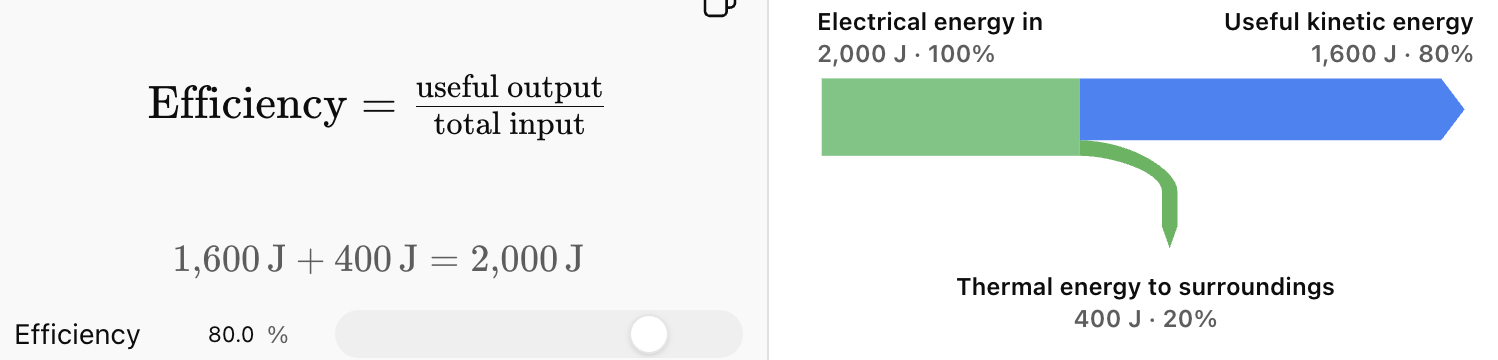
Friction often reduces the efficiency of machines because some of the input energy is transferred into unwanted thermal energy.
Suppose a motor receives:
2000 J
of electrical energy.
It provides:
1600 J
of useful mechanical energy.
The remaining:
400 J
is transferred mainly through:
- friction
- electrical resistance
- sound
- vibration
Efficiency:
efficiency = useful output / total input × 100
efficiency = 1600/2000 × 100
efficiency = 80%
The more energy dissipated through unwanted processes, the lower the efficiency.