Mechanical Energy
3. Elastic Potential Energy
Learning outcomes
- I can define elastic potential energy as energy stored when an object is stretched or compressed.
- I can describe situations in which elastic potential energy is stored and released.
- I can explain how elastic potential energy depends on deformation and spring stiffness.
- I can recall and use the equation Ee = ½kx2
- I can calculate elastic potential energy in springs and other elastic systems.
Elastic Potential Energy
Elastic potential energy is energy stored when an elastic object is stretched or compressed.
When a force changes the shape of an elastic object, work is done on the object and energy is transferred into its elastic potential energy store.
When the object is released, this stored energy can be transferred into other forms, especially kinetic energy.
Examples include:
- a stretched spring
- a compressed spring
- a stretched elastic band
- a drawn bow
- a trampoline
- a bungee cord
- a spring-loaded toy
- a pole used in pole vaulting


Elastic Deformation
An object undergoes deformation when its shape or size changes.
A spring can be:
stretched → extension
or:
compressed → compression
If the object returns to its original shape when the force is removed, the deformation is elastic.
For example:
normal spring → stretch → release → normal spring
Energy can be stored while the spring is deformed and released when it returns toward its original shape.
Elastic and Inelastic Deformation
Not all deformation is elastic.
Elastic deformation
The object returns to its original shape when the force is removed.
Examples:
- slightly stretched spring
- elastic band
- trampoline spring
Inelastic deformation
The object does not completely return to its original shape.
Examples:
- permanently bent wire
- crushed metal can
- overstretched spring
The elastic potential energy equation applies most simply when the object behaves elastically and follows Hooke's law.
Natural Length
The natural length of a spring is its length when it is neither stretched nor compressed.
The deformation, x, is measured from this natural position.
For a stretched spring:
extension = stretched length − natural length
For a compressed spring:
compression = natural length − compressed length
For energy calculations, x represents the magnitude of the deformation.
The Elastic Potential Energy Equation
For an ideal spring obeying Hooke's law:
Eₑ = ½kx²
where:
- Eₑ = elastic potential energy in joules (J)
- k = spring constant in newtons per metre (N/m)
- x = extension or compression in metres (m)
This equation tells us that elastic potential energy depends on:
- the stiffness of the spring
- the amount of deformation
Spring Constant
The spring constant, k, measures the stiffness of a spring.
A large value of k means:
stiffer spring
A small value of k means:
less stiff spring
For example:
Spring A:
k = 50 N/m
Spring B:
k = 500 N/m
Spring B is much stiffer.
It requires a greater force to produce the same extension.
Hooke's Law
For an ideal spring within its elastic region:
F = kx
where:
- F = force in newtons (N)
- k = spring constant in N/m
- x = extension or compression in metres
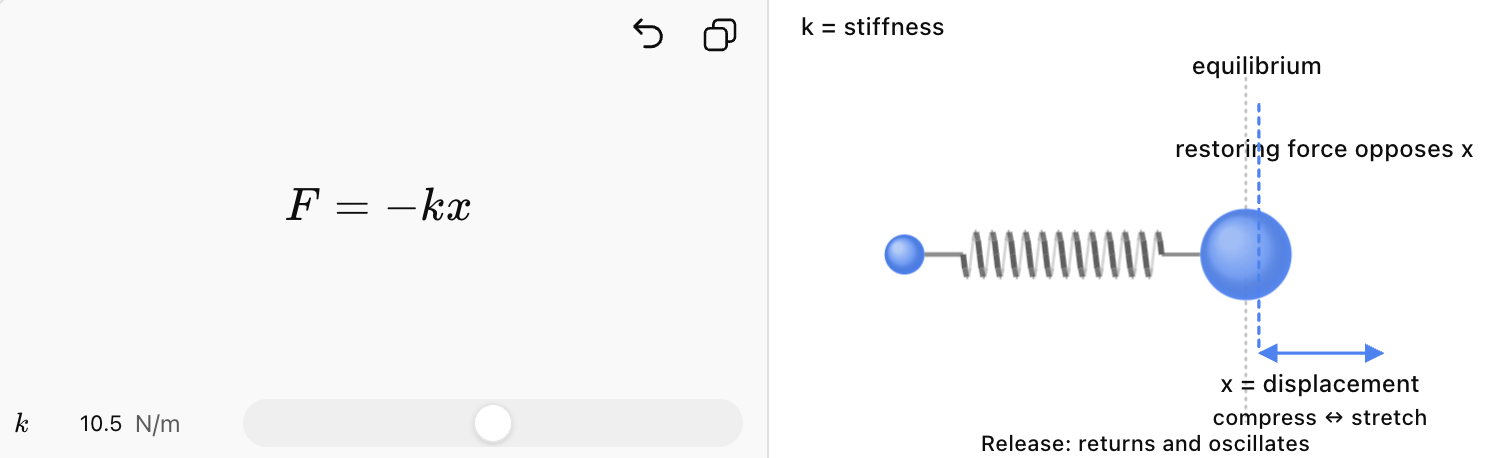
The restoring force itself acts in the direction opposite to the deformation, which can be represented more fully as:
F = −kx
The negative sign indicates direction.
For many introductory magnitude calculations, we simply use:
F = kx
Connecting Hooke's Law and Elastic Energy
As a spring stretches, the force required to stretch it increases.
At:
x = 0
the stretching force is:
F = 0
At maximum extension x:
F = kx
The average force during the stretch is therefore:
F_average = ½kx
Work done is:
work = average force × distance
Therefore:
Eₑ = ½kx × x
which gives:
Eₑ = ½kx²
This is why the factor ½ appears in the elastic potential energy equation.
Force-Extension Graph
For a spring obeying Hooke's law, force is directly proportional to extension.
A force-extension graph is therefore a straight line through the origin.
The gradient is:
gradient = F/x = k
So the gradient represents the spring constant.
The area under the force-extension graph represents the work done stretching the spring, which equals the elastic potential energy stored.
Because the area is triangular:
area = ½ × base × height
Therefore:
Eₑ = ½ × x × F
Since:
F = kx
we obtain:
Eₑ = ½kx²
Worked Example: Stretched Spring
A spring has:
k = 200 N/m
and is stretched:
x = 0.10 m
Calculate the elastic potential energy.
Eₑ = ½kx²
Eₑ = 0.5 × 200 × 0.10²
Square the extension:
0.10² = 0.01
Therefore:
Eₑ = 0.5 × 200 × 0.01
Eₑ = 1 J
The spring stores 1 J of elastic potential energy.
Worked Example: Compressed Spring
A spring has a spring constant of:
k = 500 N/m
It is compressed by:
x = 0.20 m
Calculate the stored elastic potential energy.
Eₑ = ½kx²
Eₑ = 0.5 × 500 × 0.20²
Eₑ = 0.5 × 500 × 0.04
Eₑ = 10 J
The compressed spring stores 10 J.
A compressed spring can store elastic potential energy just as a stretched spring can.


How Spring Stiffness Affects Energy
Consider two springs stretched by the same amount.
Spring A
k = 100 N/m
x = 0.20 m
Eₑ = 0.5 × 100 × 0.20²
Eₑ = 2 J
Spring B
k = 200 N/m
x = 0.20 m
Eₑ = 0.5 × 200 × 0.20²
Eₑ = 4 J
Doubling the spring constant doubles the stored energy when extension remains constant.
Therefore:
k × 2 → Eₑ × 2
Elastic potential energy is directly proportional to the spring constant.
How Deformation Affects Energy
The effect of extension or compression is much stronger because x is squared.
Suppose:
Eₑ = ½kx²
If the deformation doubles:
x → 2x
then:
Eₑ = ½k(2x)²
Since:
(2x)² = 4x²
the stored energy becomes four times greater.
Therefore:
deformation × 2 → elastic energy × 4
Comparing Different Deformations
For the same spring:
| Deformation | Relative Elastic Energy |
|---|---|
| x | Eₑ |
| 2x | 4Eₑ |
| 3x | 9Eₑ |
| 4x | 16Eₑ |
| 5x | 25Eₑ |
This is a squared relationship.
It is similar to the relationship between speed and kinetic energy.
Worked Example: Doubling Extension
A spring stores 5 J when stretched by a certain distance.
What happens if the extension is doubled?
Since:
Eₑ ∝ x²
then:
new Eₑ = 2² × 5
new Eₑ = 4 × 5
new Eₑ = 20 J
Doubling the extension increases the stored energy from 5 J to 20 J.
Worked Example: Tripling Compression
A compressed spring stores 8 J.
The compression is increased to three times its original value.
new Eₑ = 3² × 8
new Eₑ = 9 × 8
new Eₑ = 72 J
Tripling the deformation produces nine times the elastic potential energy.
Why Deformation Has Such a Large Effect
The equation contains:
x²
This means that elastic potential energy does not increase linearly with extension.
For example:
x = 0.10 m → x² = 0.0100 m²
x = 0.20 m → x² = 0.0400 m²
Although extension doubled, x² became four times larger.
This explains why highly stretched or compressed elastic systems can store much more energy.
Converting Centimetres to Metres
Extension is often given in centimetres.
Before using:
Eₑ = ½kx²
convert x to metres.
Remember:
100 cm = 1 m
Therefore:
x in metres = x in centimetres ÷ 100
For example:
5 cm = 0.05 m
20 cm = 0.20 m
35 cm = 0.35 m
Worked Example: Extension in Centimetres
A spring has:
k = 400 N/m
and is stretched by:
5 cm
First convert:
5 cm = 0.05 m
Then:
Eₑ = 0.5 × 400 × 0.05²
Eₑ = 0.5 × 400 × 0.0025
Eₑ = 0.5 J
The spring stores 0.5 J.
Worked Example: Larger Spring
A spring with:
k = 800 N/m
is compressed by:
15 cm
Convert:
15 cm = 0.15 m
Calculate:
Eₑ = 0.5 × 800 × 0.15²
Eₑ = 400 × 0.0225
Eₑ = 9 J
The spring stores 9 J.
Rearranging the Equation
Starting with:
Eₑ = ½kx²
we can rearrange it to calculate other quantities.
Finding the Spring Constant
Multiply by 2:
2Eₑ = kx²
Therefore:
k = 2Eₑ/x²
Worked Example: Finding k
A spring stores 16 J when stretched by 0.40 m.
Calculate its spring constant.
k = 2Eₑ/x²
k = (2 × 16)/(0.40²)
k = 32/0.16
k = 200 N/m
Finding Extension
Starting with:
Eₑ = ½kx²
Multiply by 2:
2Eₑ = kx²
Divide by k:
x² = 2Eₑ/k
Take the square root:
x = √(2Eₑ/k)
Worked Example: Finding Extension
A spring has:
k = 250 N/m
and stores:
Eₑ = 5 J
Calculate its extension.
x = √(2Eₑ/k)
x = √((2 × 5)/250)
x = √0.04
x = 0.20 m
The spring is stretched by 0.20 m, or 20 cm.
Energy Transfers in a Spring
When you stretch a spring:
chemical energy in muscles → elastic potential energy
When the spring is released:
elastic potential energy → kinetic energy
In a real system, some energy may also be transferred into:
- thermal energy
- sound
Therefore, not all stored elastic energy necessarily becomes useful kinetic energy.
Spring-Loaded Toy
Imagine compressing a spring inside a toy launcher.
While compressing the spring:
work is done on spring → elastic potential energy increases
When released:
elastic potential energy → kinetic energy of projectile
If the spring stores 20 J, the projectile could theoretically gain up to 20 J of kinetic energy if energy losses were negligible.
Elastic Energy and Kinetic Energy
If energy losses are negligible:
elastic potential energy lost = kinetic energy gained
Therefore:
½kx² = ½mv²
This can be used to connect spring deformation with the speed of a launched object.
Worked Example: Spring Launcher
A spring stores 10 J of elastic potential energy.
It launches a 0.20 kg object.
Ignoring energy losses:
Eₖ = 10 J
Using:
Eₖ = 0.5mv²
10 = 0.5 × 0.20 × v²
10 = 0.10v²
v² = 100
v = 10 m/s
The object leaves with a speed of 10 m/s.
Elastic Energy and Gravitational Potential Energy
Elastic potential energy can also be transferred into gravitational potential energy.
For example, a spring can launch an object upward.
The energy transfer might be:
elastic potential → kinetic → gravitational potential
Ignoring losses:
½kx² = mgΔh
at the maximum height, if the object momentarily stops.
Worked Example: Spring Launching Upward
A spring stores 20 J.
It launches a 0.50 kg object vertically upward.
Ignoring energy losses:
elastic energy = gained gravitational potential energy
20 = mgΔh
Using:
g = 10 N/kg
20 = 0.50 × 10 × Δh
20 = 5Δh
Δh = 4 m
The stored elastic energy could raise the object approximately 4 m above its starting point under these simplified conditions.
Bows and Arrows
When an archer pulls back a bowstring, the bow bends.
Energy is transferred from the archer into the elastic potential energy store of the bow.
When released:
elastic potential energy → kinetic energy of arrow


A greater deformation can store more energy, but only while the bow remains within its safe operating range.
Trampolines
When a person lands on a trampoline:
kinetic energy → elastic potential energy
The trampoline stretches.
As it returns toward its original shape:
elastic potential energy → kinetic energy
The person accelerates upward.
Some energy is transferred to:
- thermal energy
- sound
so the system is not perfectly efficient.


Bungee Jumping
A bungee jump involves several energy transfers.
Initially:
gravitational potential energy
As the jumper falls:
gravitational potential → kinetic
As the cord stretches:
kinetic + gravitational potential → elastic potential
At maximum extension, the cord contains substantial elastic potential energy.
The jumper then rebounds as some of that energy is transferred back into kinetic and gravitational potential energy.
Pole Vaulting
A pole vaulter runs toward the bar with kinetic energy.
As the pole bends:
kinetic energy → elastic potential energy
As the pole straightens:
elastic potential energy → kinetic + gravitational potential energy
This helps raise the athlete over the bar.


Vehicle Suspension
Vehicle suspension systems use springs.
When a wheel passes over a bump:
- the spring compresses
- elastic potential energy is stored
- the spring then expands
However, a vehicle also contains dampers or shock absorbers.
These reduce repeated bouncing by transferring mechanical energy into thermal energy.
Without damping, the vehicle could continue oscillating for much longer.
Elastic Limit
Springs do not behave elastically under all conditions.
The elastic limit is the point beyond which an object may no longer return completely to its original shape.
If a spring is stretched too far:
- it may become permanently deformed
- Hooke's law may no longer apply
- the simple elastic energy equation may no longer accurately describe its behaviour
Therefore, the equation:
Eₑ = ½kx²
is most appropriate when the spring behaves according to Hooke's law.
Limit of Proportionality
The limit of proportionality is the point beyond which force is no longer directly proportional to extension.
Before this point:
F ∝ x
and:
F = kx
After this point, the force-extension graph begins to curve.
The spring constant can no longer be treated as constant in the same simple way.
Force-Extension Graph Beyond the Linear Region
In the Hooke's law region:
force-extension graph = straight line
Beyond the limit of proportionality:
graph becomes curved
The elastic energy stored is still related to the area under the force-extension graph, but the simple equation:
Eₑ = ½kx²
may no longer apply.
This is an important limitation of the equation.
Comparing Energy Equations
Three important mechanical energy equations are:
Kinetic Energy
Eₖ = ½mv²
Depends on:
- mass
- speed²
Gravitational Potential Energy
ΔEₚ = mgΔh
Depends on:
- mass
- gravitational field strength
- vertical height change
Elastic Potential Energy
Eₑ = ½kx²
Depends on:
- spring stiffness
- deformation²
Notice the similarity:
Eₖ ∝ v²
and:
Eₑ ∝ x²
Both contain a squared quantity.
Graph of Elastic Energy Against Extension
Since:
Eₑ ∝ x²
a graph of elastic potential energy against extension is curved.
At:
x = 0
Eₑ = 0
As x increases, Eₑ increases more and more rapidly.
Therefore:
extension × 2 → energy × 4
extension × 3 → energy × 9
Graph of Elastic Energy Against Spring Constant
If extension remains constant:
Eₑ ∝ k
Therefore, a graph of elastic potential energy against spring constant is a straight line through the origin.
Double k:
double Eₑ
Triple k:
triple Eₑ
Percentage Changes
Suppose extension increases by 20%.
New extension:
1.2x
Because:
Eₑ ∝ x²
the new energy is:
(1.2)²Eₑ
= 1.44Eₑ
Therefore, a 20% increase in extension produces a 44% increase in elastic potential energy.
Another Percentage Example
Suppose extension decreases by 50%.
New extension:
0.5x
Therefore:
new Eₑ = (0.5)²Eₑ
new Eₑ = 0.25Eₑ
Halving the extension reduces the stored elastic potential energy to 25% of its original value.
Common Mistakes
Forgetting to Square the Extension
Incorrect:
Eₑ = ½kx
Correct:
Eₑ = ½kx²
Squaring the Spring Constant
Incorrect:
Eₑ = ½k²x
Only x is squared.
Forgetting the ½
Incorrect:
Eₑ = kx²
Correct:
Eₑ = ½kx²
Using Centimetres Instead of Metres
If:
x = 20 cm
use:
x = 0.20 m
before calculating.
Using the Total Length of the Spring
x is the change from the natural length, not the total spring length.
For example:
Natural length = 30 cm
Stretched length = 40 cm
Then:
x = 40 − 30 = 10 cm
or:
x = 0.10 m
Assuming Doubling Extension Doubles Energy
Incorrect:
x × 2 → Eₑ × 2
Correct:
x × 2 → Eₑ × 4
because x is squared.
Confusing Force with Energy
Force is measured in:
newtons (N)
Energy is measured in:
joules (J)
Confusing k with Kinetic Energy
In the elastic energy equation:
k = spring constant
It does not mean kinetic energy.
Assuming the Equation Works for Any Amount of Stretching
The equation:
Eₑ = ½kx²
assumes the spring follows Hooke's law.
If the spring is stretched beyond its proportional or elastic behaviour, the simple equation may no longer apply.
Check Your Understanding
- Define elastic potential energy.
- Give four examples of systems that can store elastic potential energy.
- What is meant by elastic deformation?
- Explain the difference between elastic and inelastic deformation.
- State the equation for elastic potential energy.
- State the units of Eₑ, k, and x.
- What does the spring constant tell us about a spring?
- Calculate the elastic potential energy stored in a spring with k = 100 N/m stretched by 0.20 m.
- A spring has k = 300 N/m and is compressed by 0.10 m. Calculate the stored energy.
- A spring is stretched by 5 cm. What value of x should be used in the equation?
- A spring has k = 500 N/m and is stretched by 8 cm. Calculate the stored elastic energy.
- Explain what happens to stored energy if the spring constant doubles while extension remains constant.
- Explain what happens to stored energy if extension doubles.
- What happens to elastic potential energy if extension triples?
- A spring stores 4 J at extension x. How much energy would it store at extension 2x?
- A spring stores 6 J at extension x. How much would it store at extension 3x?
- A spring stores 18 J when stretched by 0.30 m. Calculate its spring constant.
- A spring with k = 400 N/m stores 8 J. Calculate its extension.
- Explain how a bow stores and releases elastic potential energy.
- Describe the energy transfers involved when someone uses a trampoline.
- Describe the energy transfers during a bungee jump.
- Explain how a pole vault demonstrates elastic energy storage.
- What does the area under a force-extension graph represent?
- Explain why the equation Eₑ = ½kx² contains the factor ½.
- What is the limit of proportionality?
- Why might Eₑ = ½kx² become inaccurate for a severely stretched spring?
- Compare the effect of doubling speed on kinetic energy with doubling extension on elastic potential energy.
- A spring launcher stores 25 J. Ignoring losses, how much kinetic energy could be transferred to the projectile?
- A spring transfers 40 J to a 0.50 kg projectile. Calculate the projectile's speed, ignoring energy losses.
- Explain why elastic potential energy is useful in mechanical systems.
Key Terms
Elastic potential energy — Energy stored when an elastic object is stretched or compressed.
Deformation — Change in the shape or size of an object.
Elastic deformation — Deformation that disappears when the deforming force is removed.
Inelastic deformation — Permanent deformation that remains after the force is removed.
Extension — Increase in an object's length compared with its natural length.
Compression — Decrease in an object's length compared with its natural length.
Natural length — Length of an elastic object when no deforming force acts on it.
Spring constant (k) — Measure of the stiffness of a spring, measured in N/m.
Hooke's law — Relationship stating that force is proportional to extension for an ideal spring within its proportional region.
Restoring force — Force produced by an elastic object that acts toward its equilibrium position.
Equilibrium position — Position of an elastic system when it is not displaced from its normal state.
Limit of proportionality — Point beyond which force is no longer directly proportional to extension.
Elastic limit — Point beyond which an object may become permanently deformed.
Force-extension graph — Graph showing how the force applied to an elastic object changes with its deformation.
Work done — Energy transferred when a force causes displacement.
Joule (J) — SI unit of energy.
Newton (N) — SI unit of force.
Energy transfer — Movement of energy between stores or systems.
Key Takeaways
- Elastic potential energy is stored when an elastic object is stretched or compressed.
- Springs, elastic bands, bows, trampolines, bungee cords, and flexible poles can store elastic potential energy.
- For an ideal spring obeying Hooke's law, elastic potential energy is calculated using Eₑ = ½kx².
- Eₑ is measured in joules.
- k is the spring constant and is measured in N/m.
- x is the extension or compression measured from the object's natural position.
- x must be expressed in metres when using standard SI units.
- A larger spring constant means a stiffer spring.
- Doubling the spring constant doubles the elastic energy if deformation remains constant.
- Elastic potential energy depends on the square of the deformation.
- Doubling extension produces four times the elastic potential energy.
- Tripling extension produces nine times the elastic potential energy.
- Halving extension reduces the stored energy to one-quarter.
- The area under a force-extension graph represents the work done and therefore the elastic potential energy stored.
- Elastic potential energy can be transferred into kinetic energy when a spring or other elastic object is released.
- Elastic energy can also be transferred into gravitational potential energy.
- Real systems also transfer some energy into thermal energy and sound.
- Hooke's law only applies over the region in which force is proportional to extension.
- If an elastic object is stretched too far, it may become permanently deformed.
- The simple equation Eₑ = ½kx² should therefore be used only when the spring behaves appropriately.
The central relationship is:
Eₑ = ½kx²
So:
spring constant × 2 → elastic energy × 2
but:
extension × 2 → elastic energy × 4
and:
extension × 3 → elastic energy × 9
Like kinetic energy, elastic potential energy contains a squared quantity, so relatively small increases in deformation can produce much larger increases in stored energy.