Mechanical Energy
2. Gravitational Potential Energy
Learning outcomes
- I can define gravitational potential energy as energy stored due to position in a gravitational field.
- I can explain how mass, height, and gravitational field strength affect gravitational potential energy.
- I can recall and use the equation ΔEp = mgΔh.
- I can calculate changes in gravitational potential energy for objects raised or lowered vertically.
- I can relate changes in gravitational potential energy to real-world systems such as roller coasters, dams, and falling objects.
Gravitational Potential Energy
Gravitational potential energy is energy associated with an object's position in a gravitational field.
When an object is raised, energy is transferred to its gravitational potential energy store. When the object falls, that energy can be transferred to other energy stores, particularly kinetic energy.
Examples include:
- a book on a shelf
- water stored behind a dam
- a roller coaster at the top of a hill
- a raised weight
- a climber on a mountain
- a ball held above the ground
The higher an object is raised, the greater the change in its gravitational potential energy.


What Determines Gravitational Potential Energy?
Near Earth's surface, the change in gravitational potential energy depends on three quantities:
- mass
- gravitational field strength
- change in vertical height
The relationship is:
ΔEₚ = mgΔh
where:
- ΔEₚ = change in gravitational potential energy in joules (J)
- m = mass in kilograms (kg)
- g = gravitational field strength in newtons per kilogram (N/kg)
- Δh = change in vertical height in metres (m)
For many school calculations on Earth:
g = 9.8 N/kg
Sometimes questions use the approximation:
g = 10 N/kg
Always use the value provided in the question when one is given.
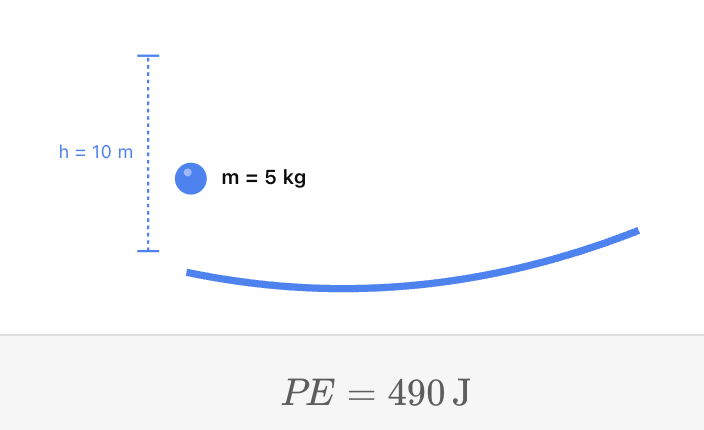
Understanding Δ
The Greek letter Δ (delta) means change in.
Therefore:
Δh = final height − initial height
and:
ΔEₚ = final gravitational potential energy − initial gravitational potential energy
If an object moves upward:
Δh is positive
so:
ΔEₚ is positive
If an object moves downward:
Δh is negative
so:
ΔEₚ is negative
Raising an Object
Suppose an object moves from:
2 m → 7 m
Then:
Δh = 7 − 2
Δh = +5 m
Its gravitational potential energy increases.
If the object instead moves from:
7 m → 2 m
then:
Δh = 2 − 7
Δh = −5 m
Its gravitational potential energy decreases.
The important quantity is the change in height, not simply the final height.
Worked Example: Raising a Box
A 5 kg box is lifted vertically by 3 m.
Use:
g = 9.8 N/kg
ΔEₚ = mgΔh
ΔEₚ = 5 × 9.8 × 3
ΔEₚ = 147 J
The gravitational potential energy increases by:
147 J
Worked Example: Using g = 10 N/kg
A 12 kg object is raised 4 m.
Use:
g = 10 N/kg
ΔEₚ = mgΔh
ΔEₚ = 12 × 10 × 4
ΔEₚ = 480 J
The object's gravitational potential energy increases by 480 J.
How Mass Affects Gravitational Potential Energy
Consider two objects raised through the same height in the same gravitational field.
Object A
Mass = 2 kg
Height change = 5 m
Using g = 10 N/kg:
ΔEₚ = 2 × 10 × 5 = 100 J
Object B
Mass = 4 kg
Height change = 5 m
ΔEₚ = 4 × 10 × 5 = 200 J
Doubling the mass doubles the change in gravitational potential energy.
Therefore:
mass × 2 → ΔEₚ × 2
Gravitational potential energy is directly proportional to mass.
How Height Affects Gravitational Potential Energy
Now keep mass constant.
A 3 kg object is raised by 2 m:
ΔEₚ = 3 × 10 × 2 = 60 J
Raise the same object by 4 m:
ΔEₚ = 3 × 10 × 4 = 120 J
Doubling the height change doubles the change in gravitational potential energy.
Therefore:
height × 2 → ΔEₚ × 2
This is different from kinetic energy, where doubling speed produces four times the kinetic energy.
Comparing Kinetic and Gravitational Potential Energy
For kinetic energy:
Eₖ = 0.5mv²
Speed is squared.
Therefore:
speed × 2 → Eₖ × 4
For gravitational potential energy near Earth's surface:
ΔEₚ = mgΔh
Height is not squared.
Therefore:
height × 2 → ΔEₚ × 2
This distinction is important.
Gravitational Field Strength
The symbol g represents gravitational field strength.
Near Earth's surface:
g ≈ 9.8 N/kg
This means that every kilogram of mass experiences approximately 9.8 N of gravitational force.
Recall the equation for weight:
W = mg
Therefore:
ΔEₚ = mgΔh
can also be written as:
ΔEₚ = WΔh
So the change in gravitational potential energy equals:
weight × vertical height change
Worked Example Using Weight
A crate has a weight of 300 N and is lifted vertically 2.5 m.
ΔEₚ = WΔh
ΔEₚ = 300 × 2.5
ΔEₚ = 750 J
The crate gains 750 J of gravitational potential energy.
Why g Matters
Gravitational field strength is not the same everywhere.
Different planets and moons have different values of g.
For the same object raised through the same height:
stronger gravitational field → greater change in gravitational potential energy
weaker gravitational field → smaller change in gravitational potential energy
This is because more work must be done against a stronger gravitational force.
Mass and Weight Are Different
Mass describes the amount of matter in an object.
Unit:
kilogram (kg)
Weight is the gravitational force acting on an object.
Unit:
newton (N)
The relationship is:
W = mg
Mass remains the same when an object travels to another planet, but its weight can change because gravitational field strength changes.
Worked Example: Different Gravitational Fields
A 10 kg object is raised 5 m.
On Earth
Use:
g = 9.8 N/kg
ΔEₚ = 10 × 9.8 × 5
ΔEₚ = 490 J
In a gravitational field of 2 N/kg
ΔEₚ = 10 × 2 × 5
ΔEₚ = 100 J
The same object gains less gravitational potential energy because the gravitational field is weaker.
Lowering an Object
When an object is lowered, its gravitational potential energy decreases.
Suppose a 6 kg object moves downward by 4 m.
Using:
g = 10 N/kg
The height change is:
Δh = −4 m
Therefore:
ΔEₚ = 6 × 10 × (−4)
ΔEₚ = −240 J
The negative sign means the gravitational potential energy has decreased by 240 J.
What Happens to the Lost Energy?
When gravitational potential energy decreases, the energy does not disappear.
It is transferred elsewhere.
For a freely falling object:
gravitational potential energy → kinetic energy
If air resistance is significant:
gravitational potential energy → kinetic energy + thermal energy
Energy is conserved.
Falling Objects
Imagine a ball held above the ground.
Before release:
- gravitational potential energy is relatively high
- kinetic energy is zero if the ball is stationary
As it falls:
- gravitational potential energy decreases
- kinetic energy increases
Immediately before impact:
- gravitational potential energy relative to the ground is lower
- kinetic energy is greater


Energy Conservation During a Fall
Ignoring air resistance:
decrease in gravitational potential energy = increase in kinetic energy
Therefore:
−ΔEₚ = ΔEₖ
For example, if an object loses:
500 J of gravitational potential energy
it gains:
500 J of kinetic energy
assuming no energy is transferred to the surroundings.
Worked Example: Falling Object
A 2 kg object falls through 10 m.
Use:
g = 9.8 N/kg
Change in gravitational potential energy:
ΔEₚ = 2 × 9.8 × (−10)
ΔEₚ = −196 J
The object loses 196 J of gravitational potential energy.
Ignoring air resistance, it gains 196 J of kinetic energy.
Connecting GPE and Kinetic Energy
Recall:
Eₖ = 0.5mv²
and:
ΔEₚ = mgΔh
For an object falling from rest with negligible air resistance:
lost gravitational potential energy = gained kinetic energy
Therefore:
mgΔh = 0.5mv²
This relationship can be used to calculate the speed of a falling object without directly using acceleration equations.
Worked Example: Finding Speed from Energy
A ball falls 5 m from rest.
Ignore air resistance and use:
g = 9.8 N/kg
Energy conservation gives:
mgΔh = 0.5mv²
Mass appears on both sides, so it cancels:
gΔh = 0.5v²
Substitute:
9.8 × 5 = 0.5v²
49 = 0.5v²
v² = 98
v ≈ 9.9 m/s
Notice that the mass was not required.
Ignoring air resistance, objects falling from the same height reach the same speed regardless of mass.
Choosing a Reference Height
Gravitational potential energy is usually measured relative to a chosen reference level.
For example, we might choose:
- the floor
- ground level
- the bottom of a hill
- the lowest point of a roller coaster
as:
h = 0
What usually matters physically is the change in gravitational potential energy, not the absolute value.
Example: Shelf Heights
A 4 kg book moves from a shelf 1 m above the floor to a shelf 3 m above the floor.
The change in height is:
Δh = 3 − 1
Δh = 2 m
Using g = 9.8 N/kg:
ΔEₚ = 4 × 9.8 × 2
ΔEₚ = 78.4 J
A common mistake would be to use 3 m rather than the 2 m change in height.
Vertical Height Matters
The equation uses vertical height change, not the total distance traveled.
Imagine carrying a box up a long ramp.
Suppose:
Ramp distance = 10 m
Vertical height gained = 3 m
For gravitational potential energy, use:
Δh = 3 m
not:
10 m


Different Paths to the Same Height
Suppose identical objects are moved from the same starting height to the same final height.
Object A is lifted vertically.
Object B moves up a ramp.
Object C follows a curved path.
If all three have the same:
- mass
- starting height
- final height
then they have the same change in gravitational potential energy.
The path does not matter for ΔEₚ.
Only the vertical height difference matters.
Rearranging the Equation
Starting with:
ΔEₚ = mgΔh
we can rearrange the equation to find other quantities.
Finding Mass
m = ΔEₚ/(gΔh)
Finding Height Change
Δh = ΔEₚ/(mg)
Finding Gravitational Field Strength
g = ΔEₚ/(mΔh)
Worked Example: Finding Height
A 20 kg object gains 1960 J of gravitational potential energy.
How high was it raised?
Use:
Δh = ΔEₚ/(mg)
Δh = 1960/(20 × 9.8)
Δh = 1960/196
Δh = 10 m
The object was raised 10 m.
Worked Example: Finding Mass
An object gains 1500 J of gravitational potential energy when raised 5 m.
Use:
g = 10 N/kg
m = ΔEₚ/(gΔh)
m = 1500/(10 × 5)
m = 1500/50
m = 30 kg
Roller Coasters
Roller coasters provide an excellent example of energy transfer.
At the top of a hill:
- gravitational potential energy is high
- kinetic energy may be relatively low
As the coaster moves downhill:
gravitational potential energy → kinetic energy
The coaster speeds up.
At the bottom:
- gravitational potential energy is lower
- kinetic energy is greater


Why the First Roller-Coaster Hill Is Often High
The first major hill gives the coaster a large gravitational potential energy store.
As the coaster descends, this energy can be transferred into kinetic energy.
However, some energy is continuously transferred to the surroundings through:
- friction
- air resistance
- sound
Therefore, without additional energy input, later hills usually cannot be higher than the initial hill.
Hydroelectric Dams
Water stored high behind a dam has gravitational potential energy.
When the water is released:
gravitational potential energy → kinetic energy of water
The moving water turns turbines:
kinetic energy → rotational kinetic energy
The generator then transfers energy electrically.
A simplified pathway is:
gravitational potential → kinetic → mechanical → electrical


Why Dam Height Matters
From:
ΔEₚ = mgΔh
greater height means more gravitational potential energy for the same mass of water.
Therefore, a larger vertical drop can provide more energy per kilogram of water.
This height difference is often called the head in hydroelectric systems.
Pumped Hydroelectric Storage
Gravitational potential energy can also be used to store energy.
When excess electricity is available:
electricity → pumps → water moved uphill
The water gains gravitational potential energy.
Later:
water moves downhill → turbines → electricity
A simplified sequence is:
electrical energy → gravitational potential energy → electrical energy
This is called pumped hydroelectric storage.
Cranes and Lifting
A crane transfers energy when it raises a load.
Suppose a crane lifts a 2000 kg load through 15 m.
Using:
g = 9.8 N/kg
ΔEₚ = 2000 × 9.8 × 15
ΔEₚ = 294,000 J
or:
294 kJ
At least this much energy must be transferred to the gravitational potential energy store of the load.
Real cranes require more energy because they are not 100% efficient.
Elevators
An elevator also demonstrates gravitational potential energy.
When an elevator rises:
electrical energy → gravitational potential energy + other energy transfers
When it descends:
gravitational potential energy decreases
Some modern elevator systems can recover part of this energy using regenerative systems.
Human Body and GPE
When you climb stairs, your body gains gravitational potential energy.
Suppose a 60 kg person climbs vertically 4 m.
Using:
g = 9.8 N/kg
ΔEₚ = 60 × 9.8 × 4
ΔEₚ = 2352 J
or approximately:
2.35 kJ
The person's body must transfer at least this much energy mechanically to increase gravitational potential energy.
Because the body is not perfectly efficient, the chemical energy used is greater.
GPE and Mountains
Climbing a mountain increases gravitational potential energy.
For a 70 kg climber gaining 1000 m of vertical height:
ΔEₚ = 70 × 9.8 × 1000
ΔEₚ = 686,000 J
ΔEₚ = 686 kJ
This represents the increase in gravitational potential energy of the climber alone.
Gravitational Potential Energy Beyond Earth's Surface
The equation:
ΔEₚ = mgΔh
works well near Earth's surface when gravitational field strength is approximately constant.
Over very large distances, however, g changes significantly.
For satellites, planets, and spacecraft, a more general gravitational potential energy equation is required.
For ordinary near-Earth calculations, however:
ΔEₚ = mgΔh
is an excellent approximation.
Graph of GPE Against Height
For constant mass and gravitational field strength:
ΔEₚ ∝ Δh
Therefore, a graph of gravitational potential energy against height is a straight line.
If height doubles:
GPE doubles
If height triples:
GPE triples
This differs from kinetic energy against speed, which produces a curved relationship because speed is squared.
Graph of GPE Against Mass
For constant height and gravitational field strength:
ΔEₚ ∝ m
The graph is again a straight line.
Doubling the mass doubles the gravitational potential energy change.
Real-World Comparison
Imagine two roller-coaster cars at the same height.
Car A
Mass = 500 kg
Car B
Mass = 1000 kg
Car B has twice the mass.
Therefore, at the same height:
Car B has twice the gravitational potential energy relative to the same reference level.
If both descend the same vertical distance, Car B loses twice as much gravitational potential energy.
Common Mistakes
Using the Total Height Instead of the Change in Height
If an object moves from 4 m to 10 m:
Incorrect:
Δh = 10 m
Correct:
Δh = 10 − 4 = 6 m
Using Distance Instead of Vertical Height
If an object moves 20 m along a ramp but rises only 5 m:
Use:
Δh = 5 m
Forgetting Mass Must Be in Kilograms
Convert grams to kilograms first.
500 g = 0.500 kg
Confusing Mass and Weight
Mass is measured in:
kg
Weight is measured in:
N
Remember:
W = mg
Confusing g with Mass
In:
ΔEₚ = mgΔh
g represents gravitational field strength, not grams.
Forgetting the Sign of Δh
Moving upward:
Δh > 0
Moving downward:
Δh < 0
Assuming Gravitational Potential Energy Disappears During a Fall
Energy is transferred.
Typically:
gravitational potential → kinetic
with some energy possibly transferred thermally because of air resistance.
Using Horizontal Distance
Moving horizontally at the same height does not change gravitational potential energy.
If:
Δh = 0
then:
ΔEₚ = 0
Check Your Understanding
- Define gravitational potential energy.
- State the equation for the change in gravitational potential energy.
- What does Δ mean?
- State the units for mass, gravitational field strength, height, and energy.
- Calculate the GPE gained by a 5 kg object raised 6 m. Use g = 9.8 N/kg.
- Calculate the GPE gained by a 20 kg object raised 3 m. Use g = 10 N/kg.
- A 500 g ball is raised 4 m. Calculate its increase in GPE using g = 9.8 N/kg.
- Explain what happens to GPE when mass doubles.
- Explain what happens to GPE when height doubles.
- An object moves from 3 m above the ground to 11 m above the ground. What is Δh?
- A 10 kg object moves from 12 m to 5 m. Calculate ΔEₚ using g = 9.8 N/kg.
- What does a negative value of ΔEₚ mean?
- An object gains 980 J of GPE when raised 5 m. Calculate its mass.
- A 25 kg object gains 4900 J of GPE. Calculate the height through which it was raised.
- A ramp is 12 m long but raises an object vertically by 3 m. Which value should be used for Δh?
- Explain why different paths to the same final height produce the same change in GPE.
- Describe the energy transfers as a ball falls.
- Explain how a roller coaster demonstrates transfers between GPE and kinetic energy.
- Explain how a hydroelectric dam uses gravitational potential energy.
- A 1000 kg roller-coaster car descends 20 m. Calculate the GPE lost using g = 9.8 N/kg.
- Ignoring friction, how much kinetic energy would the coaster gain?
- Explain why later roller-coaster hills are usually lower than the first major hill.
- Explain why water stored higher behind a dam has greater potential to generate energy.
- Describe how pumped hydroelectric storage stores energy.
- Compare the effects of doubling height on GPE with doubling speed on kinetic energy.
Key Terms
Gravitational potential energy (GPE) — Energy associated with an object's position in a gravitational field.
Energy store — A way of describing where energy is held within a physical system.
Joule (J) — SI unit of energy.
Mass — Measure of the amount of matter in an object, measured in kilograms.
Weight — Gravitational force acting on an object.
Gravitational field — Region in which an object with mass experiences a gravitational force.
Gravitational field strength (g) — Gravitational force per unit mass, measured in N/kg.
Height — Vertical position relative to a chosen reference level.
Change in height (Δh) — Difference between final and initial vertical position.
Delta (Δ) — Symbol meaning "change in."
Reference level — Chosen position from which height or gravitational potential energy is measured.
Energy transfer — Movement of energy between energy stores or systems.
Kinetic energy — Energy associated with motion.
Conservation of energy — Principle that energy cannot be created or destroyed, although it can be transferred between stores.
Head — Vertical height difference available to water in a hydroelectric system.
Pumped hydroelectric storage — Energy-storage system that uses electricity to pump water uphill and later recovers energy as the water flows downhill.
Key Takeaways
- Gravitational potential energy is associated with position in a gravitational field.
- Raising an object increases its gravitational potential energy.
- Lowering an object decreases its gravitational potential energy.
- Near Earth's surface, the change in gravitational potential energy is calculated using ΔEₚ = mgΔh.
- Mass must normally be measured in kilograms.
- Height must be the vertical change in height, not the total distance traveled.
- Gravitational field strength near Earth's surface is approximately 9.8 N/kg.
- Some school problems approximate g as 10 N/kg.
- Doubling mass doubles the change in gravitational potential energy.
- Doubling height doubles the change in gravitational potential energy.
- A stronger gravitational field produces a greater change in gravitational potential energy for the same mass and height.
- Moving upward produces a positive ΔEₚ.
- Moving downward produces a negative ΔEₚ.
- When an object falls, gravitational potential energy can be transferred into kinetic energy.
- Air resistance can transfer some energy to thermal stores in the object and surroundings.
- Energy is conserved during these transfers.
- Roller coasters continually transfer energy between gravitational potential and kinetic energy stores.
- Water stored behind a dam possesses gravitational potential energy that can ultimately be transferred into electrical energy.
- Pumped hydroelectric systems use gravitational potential energy to store energy.
- The equation ΔEₚ = mgΔh is most appropriate near Earth's surface, where g can be treated as approximately constant.
The central relationship is:
ΔEₚ = mgΔh
So:
mass × 2 → ΔEₚ × 2
height × 2 → ΔEₚ × 2
gravitational field strength × 2 → ΔEₚ × 2
Unlike kinetic energy, none of these quantities is squared. Gravitational potential energy near Earth's surface therefore changes linearly with mass, gravitational field strength, and vertical height.