Light Waves
5. Colour and Optical Instruments
Learning outcomes
- I can explain how white light is dispersed into a spectrum.
- I can distinguish between reflection and absorption of light.
- I can describe how the human eye forms images.
- I can explain how microscopes and telescopes use lenses.
- I can identify applications of optical instruments.
first
Reflection can also occur when waves travel from one material into another and their speed changes. When a wave enters a different medium, such as light moving from air into water or sound travelling through different materials, its speed may change due to differences in density or stiffness of the medium. This change in wave speed can cause part or all of the wave to be reflected at the boundary between the two materials.
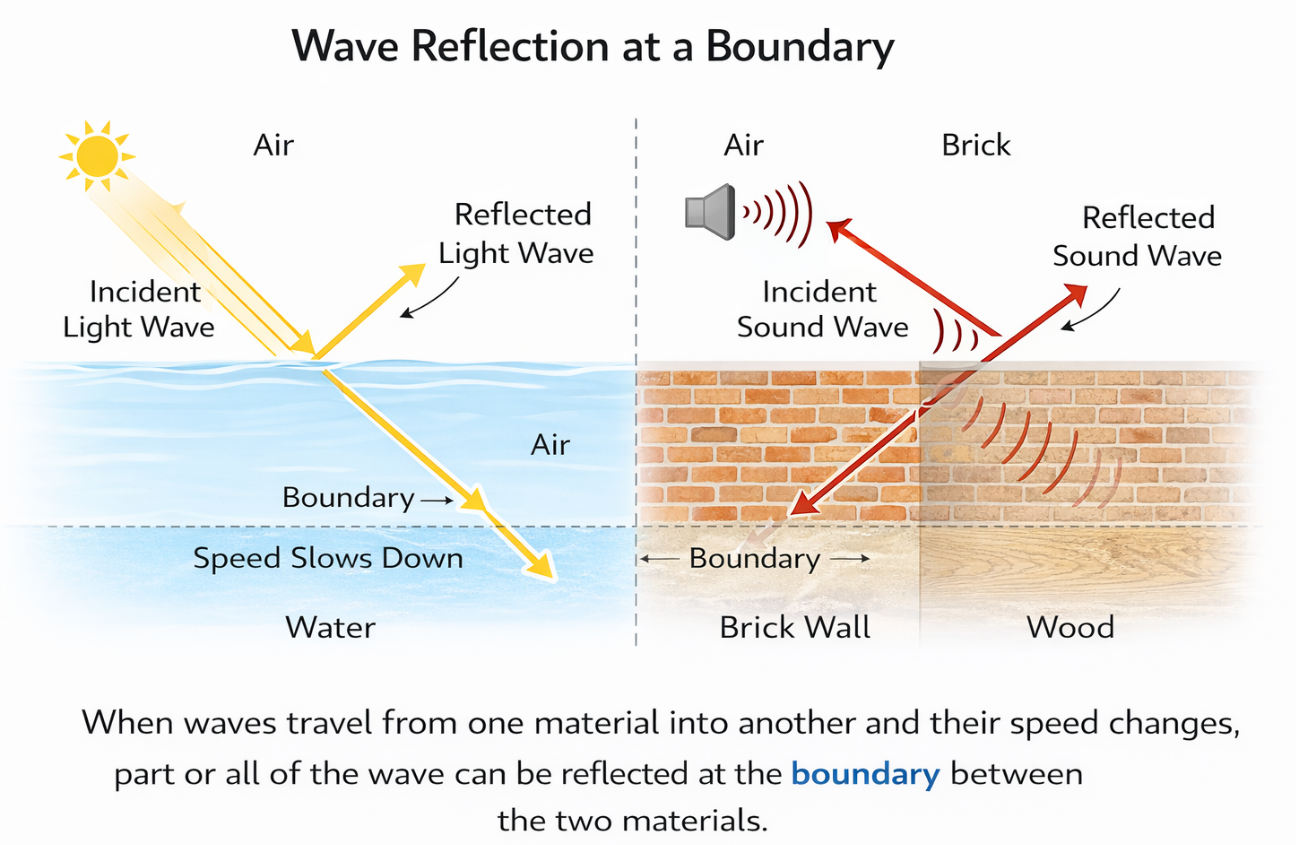
Understanding wave properties and how waves reflect helps explain many everyday phenomena, such as echoes, reflections in mirrors, and the behaviour of light and sound when they travel through different substances.
Worksheets: Wave Properties 3, 1, 2
To determine the speed of light in a medium, we usually use the concept of refractive index. The refractive index tells us how much light slows down when it enters a material.
Relationship Between Speed and Refractive Index
The key equation is:
Where:
-
n = refractive index of the medium
-
c = speed of light in a vacuum (
)
-
v = speed of light in the medium
Rearranging the equation to find the speed in the medium:
Example
Suppose light enters water, which has a refractive index of about 1.33.
So the speed of light in water is approximately:
Another Example: Glass
Typical refractive index of glass ≈ 1.5
Important Idea
When light enters a medium:
-
Speed decreases
-
Frequency stays the same
-
Wavelength decreases
This change in speed is what causes refraction (bending of light).
Snell's Law:
n1sinθ = n2sinθ
Use the PHeT and
- Set n1 = 1.60
- For the second material, choose "Mystery B"
Summative Lab Report:
- Review the Lab Report Overview
- Review your Formative Lab Feedback
- Before you begin the lab, make a hypothesis about n2.


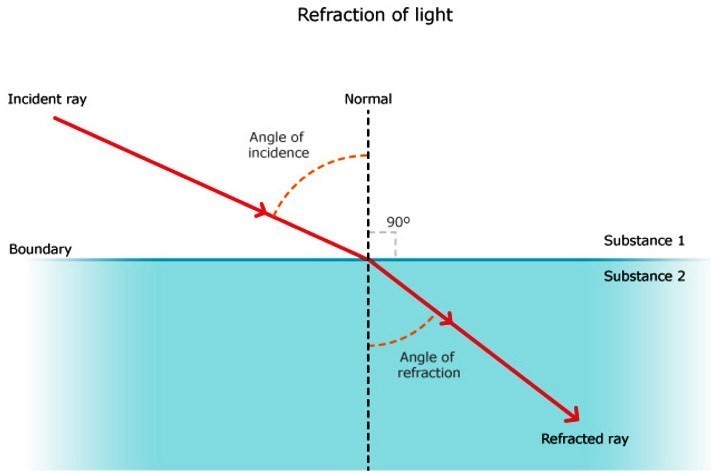
When light travels from one material (medium) to another, its speed changes, and this usually causes the light to change direction. This process is called refraction. Refraction occurs because light travels at different speeds in different media, such as air, water, or glass. When light enters a new medium at an angle (not along the normal), the change in speed causes the light ray to bend at the boundary between the two media.
The refractive index of a material describes how much the material slows light down compared to its speed in a vacuum. It is defined as the ratio of the speed of light in a vacuum to the speed of light in the material. A higher refractive index means light travels more slowly in that medium and bends more when entering it. For example, glass has a higher refractive index than air, so light slows down and changes direction more when entering glass from air.
The relationship between the angles and refractive indices when light passes between two media is described by Snell’s Law:
where
n1 and
n2 are the refractive indices of the first and second media,
θ1 is the angle of incidence, and
θ2 is the angle of refraction. This law can be used to calculate unknown angles or refractive indices when light passes from one medium to another.
Light does not always bend in the same way. When light enters a medium with a higher optical density (higher refractive index), such as from air into glass or water, it slows down and bends toward the normal. The angle of refraction is smaller than the angle of incidence. When light enters a medium with a lower optical density (lower refractive index), such as from glass into air, it speeds up and bends away from the normal, making the angle of refraction larger than the angle of incidence.
Being able to predict how light bends requires comparing the refractive indices of the two media. If the second medium has a larger refractive index, expect bending toward the normal; if it has a smaller refractive index, expect bending away from the normal. This understanding, together with Snell’s Law, allows accurate prediction and calculation of the path of light as it moves between different materials.
Worksheet: Refraction 1
Learning Outcomes
- Understand the conditions and applications of total internal reflection.
- Critical angle: .
- Applications: Fiber optics and light guides.
Total Internal Reflection (TIR): Conditions and Applications
Total Internal Reflection (TIR) is a special optical phenomenon where a light ray completely reflects inside a medium instead of refracting into another medium. This principle is widely used in fiber optics, diamonds, and mirages.
What is Total Internal Reflection?
TIR occurs when:
- Light travels from a denser medium (higher refractive index) to a less dense medium (lower refractive index).
- The angle of incidence is greater than the critical angle (), so no refraction occurs—only reflection.
Example:
- A laser inside water can reflect completely at the water-air boundary.
- Diamonds sparkle because of TIR inside them.
Conditions for Total Internal Reflection
(a) Light Moves from a Denser to a Less Dense Medium
- TIR occurs only if (higher to lower refractive index).
- Examples:
- Water to Air (,)
- Glass to Air (,)
- Diamond to Air (,)
(b) The Angle of Incidence Exceeds the Critical Angle
- The critical angle () is the angle where light just refracts along the boundary ().
- If, TIR occurs.
where:
- = refractive index of the denser medium.
- = refractive index of the less dense medium.
Example Calculation (Water to Air)
If light hits at more than
, total internal reflection occurs.
3. Applications of Total Internal Reflection
(a) Optical Fibers & Internet Cables
- TIR is used in fiber optics to transmit light signals over long distances.
- Light reflects entirely inside the fiber with almost no loss.
- Used in:
- High-speed internet & telecommunications
- Endoscopes in medical imaging
- Military communication systems
Example:
- Fiber optic cables send phone & internet signals by bouncing light inside a glass fiber.
(b) Diamonds & Jewelry
- Diamonds sparkle intensely due to their high refractive index ().
- The critical angle is very small (), so light is trapped and reflected multiple times before escaping.
Result:
- More internal reflections = Brighter sparkle in diamonds.
(c) Mirage Formation & Atmospheric Refraction
- Mirages occur in deserts & hot roads due to TIR of light in air layers.
- On hot surfaces, warm air has a lower refractive index than cool air above it.
- Light bends and reflects back upwards, creating an illusion of water.
Example:
- Seeing a "water puddle" on a hot highway that disappears when approached.
(d) Periscopes & Binoculars
- Periscopes use TIR mirrors to change light direction.
- Binoculars & telescopes use prisms with TIR to enhance image brightness.
Example:
- Submarines use periscopes with TIR to see above water.
4. Summary of Total Internal Reflection
| Condition | Requirement |
|---|---|
| Medium Change | Light must travel from denser to less dense medium (). |
| Angle of Incidence | Must be greater than the critical angle (). |
| Critical Angle Formula |
| Application | How TIR is Used |
|---|---|
| Optical Fibers | Data transmission via light reflection. |
| Diamonds | Internal reflections create sparkle. |
| Mirages | Light bends due to hot/cold air layers. |
| Periscopes & Binoculars | TIR redirects light for vision enhancement. |
Key Takeaways
- Total Internal Reflection keeps light trapped inside a medium, leading to practical applications in optics and technology.
- Used in fiber optics, diamonds, mirages, and optical instruments like periscopes.
- Critical angle calculations determine when TIR occurs.
- TIR is the secret behind high-speed internet, sparkling diamonds, and mirages!
Activities:
- Demonstrate total internal reflection with a laser and a water-filled tube.
- Research project on fiber optics.
Assessment: Reflection essay on the importance of total internal reflection.
Content Objective:
-
Explain how light behaves when it enters a new medium
-
Describe the direction that light will refract based on the density of the new medium
Language Objectives:
-
Use the steps of the scientific method to write a lab report investigation of refraction using the phet simluation
Relevant Vocabulary from prior lessons
-
Incident Ray, Reflected Ray, Angle of Incidence, the Normal, medium,
Your Task:
Design an investigation using the Phet simulation on Refraction (use the intro tab)
Research Question: How does the Index of Refraction affect the angle of refraction for a ray of light hitting the surface of a new medium?
Background Information:
Variables:
- Independent Variable: Angle of Incidence
- Dependent Variable: Angle of Refraction
You will complete the following sections in a document to submit for formative feedback:
- Hypothesis
- Variables
- Procedure
- Observations
- Analysis
- Conclusion
*Notes:
- Index of refraction = the density of the material. The higher the index number, the more dense the substance is.
- Use the lab report templates in the "Lab Report Resources" section of the Content Library
- MAXIMUM PAGES: 3 (single spaced)
Complete this investigation over the next two classes
FEEDBACK:
- Research Question
- It is not worded so it could be answered with "yes" or "no"
- It includes the independent variable
- It includes details of how the independent variable will be changed
- It includes the dependent variable
- The dependent variables is measurable (details of how to measure are included i.e. units or measuring tool)
- There is context in your research question (ex. The simulation is mentioned)
- Prediction
- It is written in the format "if…then…because…"
- The independent variable is detailed enough that I know what specifically is changing
- The dependent variables is detailed enough that I know what specifically you're measuring
- There is scientific reasoning to explain your idea
- The scientific reasoning is detailed
- Variables
- The independent variable is listed correctly
- The independent variable is described completely using numbers and units (if applicable)
- The dependent variable is listed correctly
- There are at least three controlled variables
- The controlled variables include details of how it is controlled
- The controlled variables are detailed enough that I can clearly know how you will control them in the experiment.
- Procedure
- It is organized in numbered steps
- There are clear steps about how to change the independent variable
- There are clear steps about how to measure the dependent variable
- All controlled variables are present in the steps of your procedure
- It is detailed enough that I can clearly copy every step you took
- It includes steps that say "repeat steps #-#" instead of repeating instructions over and over unnecessarily
- It includes information about what data to collect and how
- Observations
- The table has a clear and detailed title
- The table has clear and detailed headings that describe the groups
- The tables has clear units (where appropriate)
- The table only has numbers in the boxes
- Analysis
- The graph has a clear and detailed title
- The graph is a scatter plot (use a scatter plot when your IV and DV are numbers-based)
- The scatter plot graph has a line of best fit
- The graph includes unit (where appropriate)
- The axis titles are clearly labelled
- Conclusion
- The purpose of the experiment is re-stated
- The hypothesis is re-stated
- The conclusion describes whether the data supported or did not support the hypothesis
- The conclusion does not say the hypothesis was "right" or that anything was "proven"
- The conclusion includes scientific reasoning to explain what was observed
- Numbers from the data are used to support the conclusion