Basics of Gravitational Fields
4. Inverse-Square Law
Learning Outcomes
- I can explain the inverse-square relationship in gravitation.
- I can predict how gravitational force changes with distance.
- I can calculate force changes when distance is doubled or halved.
- I can interpret graphs showing inverse-square relationships.
- I can apply the inverse-square law to planetary and satellite systems.
Inverse-Square Law
Gravity becomes weaker as objects move farther apart, but it does not decrease in a simple one-to-one way. If the distance between two objects doubles, the gravitational force does not become half as large — it becomes one-quarter as large.
This relationship is known as the inverse-square law.


Learning Targets
- I can explain the inverse-square relationship in gravitation.
- I can predict how gravitational force changes with distance.
- I can calculate force changes when distance is doubled or halved.
- I can interpret graphs showing inverse-square relationships.
- I can apply the inverse-square law to planetary and satellite systems.
1. What Is an Inverse-Square Relationship?
Newton's Law of Universal Gravitation is:
F = Gm₁m₂ / r²
The important part for this topic is:
F ∝ 1/r²
This means that gravitational force is inversely proportional to the square of the distance between the centres of two objects.
As distance increases:
Gravitational force decreases.
As distance decreases:
Gravitational force increases.
The word square is especially important because distance appears as r², not simply r.
2. Why "Inverse-Square"?
There are two parts to the name.
Inverse means that when one quantity increases, the other decreases.
Square means that the distance is multiplied by itself.
For example:
2² = 4
3² = 9
4² = 16
5² = 25
Therefore, if the distance becomes twice as large, the gravitational force becomes 1/4 as large.
If the distance becomes three times as large, the force becomes 1/9 as large.
If the distance becomes four times as large, the force becomes 1/16 as large.
3. The Basic Pattern
The inverse-square relationship produces a very useful pattern:
| Distance | Gravitational Force |
|---|---|
| r | F |
| 2r | F/4 |
| 3r | F/9 |
| 4r | F/16 |
| 5r | F/25 |
So:
Distance × 2 → Force ÷ 4
Distance × 3 → Force ÷ 9
Distance × 4 → Force ÷ 16
This pattern allows us to solve many gravitational problems without using the full gravitation equation.


4. Doubling the Distance
Suppose two objects attract each other with a gravitational force of 100 N.
Their distance is doubled.
Because:
2² = 4
the gravitational force becomes:
100 N ÷ 4 = 25 N
Therefore:
Original force = 100 N
Distance doubled → New force = 25 N
The force is now one-quarter of the original force.
5. Tripling the Distance
Suppose the original gravitational force is:
180 N
The distance is tripled.
Because:
3² = 9
the force becomes:
180 N ÷ 9 = 20 N
Therefore:
Distance × 3 → Force ÷ 9
The new gravitational force is:
20 N
6. Halving the Distance
The inverse-square law also works when objects move closer together.
Suppose the distance is halved.
The new distance is:
r/2
Because the distance is squared, the force changes by:
2² = 4
But because the objects are moving closer rather than farther apart, the force becomes four times greater.
Therefore:
Distance ÷ 2 → Force × 4
For example:
Original force:
50 N
Distance is halved:
50 N × 4 = 200 N
New gravitational force:
200 N
7. What If the Distance Becomes One-Third?
Suppose the distance becomes one-third of its original value.
The objects are now three times closer.
The gravitational force becomes:
3² = 9 times greater
Therefore:
Distance ÷ 3 → Force × 9
If the original force was:
20 N
then:
20 N × 9 = 180 N
The new force is:
180 N
8. A Useful Rule
When the distance changes by a factor, square that factor to determine how the gravitational force changes.
Moving farther apart
Distance × n → Force ÷ n²
Moving closer together
Distance ÷ n → Force × n²
For example:
| Change in Distance | Change in Force |
|---|---|
| × 2 | ÷ 4 |
| × 3 | ÷ 9 |
| × 4 | ÷ 16 |
| ÷ 2 | × 4 |
| ÷ 3 | × 9 |
| ÷ 4 | × 16 |
This table is worth remembering.
9. Why Distance Has Such a Large Effect
The square in the equation means that gravitational force decreases very rapidly at first as distance increases.
Imagine two objects moving from:
1 m apart → 2 m apart
The force drops to:
1/4
Move them to:
3 m apart
The force is now:
1/9
At:
10 m apart
the force is only:
1/100
of the force at 1 m.
So even a relatively modest increase in distance can produce a large decrease in gravitational attraction.
10. The Inverse-Square Graph
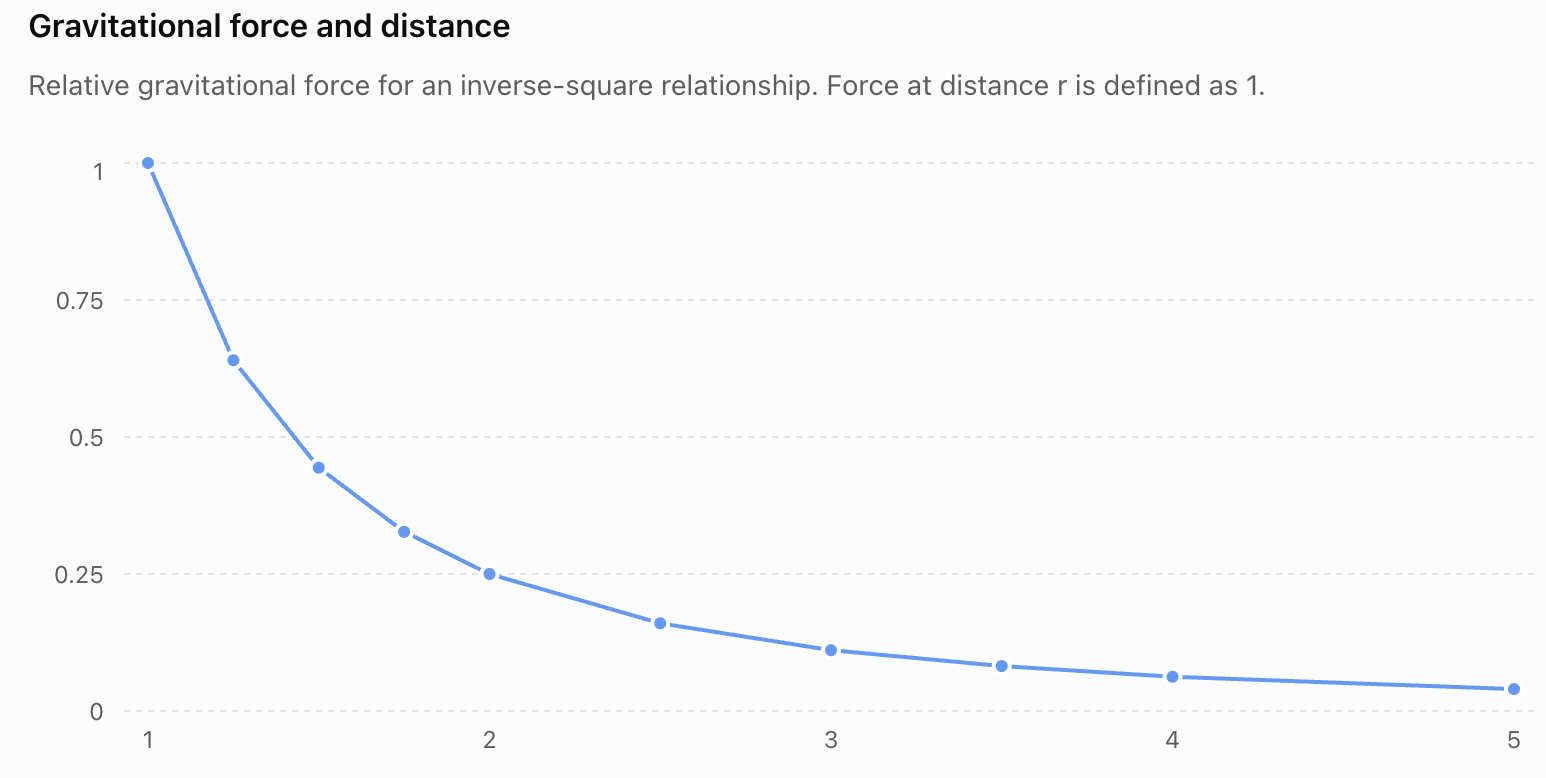
If gravitational force is plotted against distance, the graph is curved, not a straight line.
The general shape looks like this: