Basics of Gravitational Fields
2. Newton's Law of Gravitation
Learning Outcome
- I can state Newton's Law of Universal Gravitation.
- I can identify the variables that affect gravitational force.
- I can explain how mass influences gravitational attraction.
- I can calculate gravitational force between two objects.
- I can apply Newton's Law of Gravitation to real-world situations.
- Mathematical formulation: \( F = G \frac{m_1m_2}{r^2} \)
- Units and dimensions of G
Newton's Law of Universal Gravitation
Gravity is one of the fundamental forces of nature. It keeps us on Earth's surface, holds the Moon in orbit around Earth, keeps planets orbiting the Sun, and influences the motion of stars and galaxies.
Newton's Law of Universal Gravitation describes the gravitational attraction between any two objects that have mass.


Learning Targets
- I can state Newton's Law of Universal Gravitation.
- I can identify the variables that affect gravitational force.
- I can explain how mass influences gravitational attraction.
- I can calculate gravitational force between two objects.
- I can apply Newton's Law of Gravitation to real-world situations.
1. Universal Gravitation
In 1687, Isaac Newton published a mathematical description of gravity.
Newton proposed that every object with mass attracts every other object with mass.
This means that:
- Earth attracts you.
- You attract Earth.
- Earth attracts the Moon.
- The Moon attracts Earth.
- The Sun attracts the planets.
- Two ordinary objects in a classroom also attract each other.
The gravitational attraction between everyday objects is usually far too small for us to notice.
Gravity becomes much more noticeable when at least one of the objects has a very large mass, such as a planet, moon or star.
2. Newton's Law of Universal Gravitation
Newton's Law of Universal Gravitation states:
The gravitational force between two objects is directly proportional to the product of their masses and inversely proportional to the square of the distance between their centres.
In simpler terms:
- Larger masses → stronger gravitational force
- Greater distance → weaker gravitational force
The equation is:
F = Gm₁m₂ / r²
Where:
- F = gravitational force, measured in newtons (N)
- G = universal gravitational constant
- m₁ = mass of the first object, measured in kilograms (kg)
- m₂ = mass of the second object, measured in kilograms (kg)
- r = distance between the centres of the two objects, measured in metres (m)
The universal gravitational constant is:
G = 6.67 × 10⁻¹¹ N m²/kg²
This very small value helps explain why the gravitational attraction between ordinary objects is so weak.
3. Visualizing the Law
The relationship between mass, distance and gravitational force is easier to understand when you can change the variables.
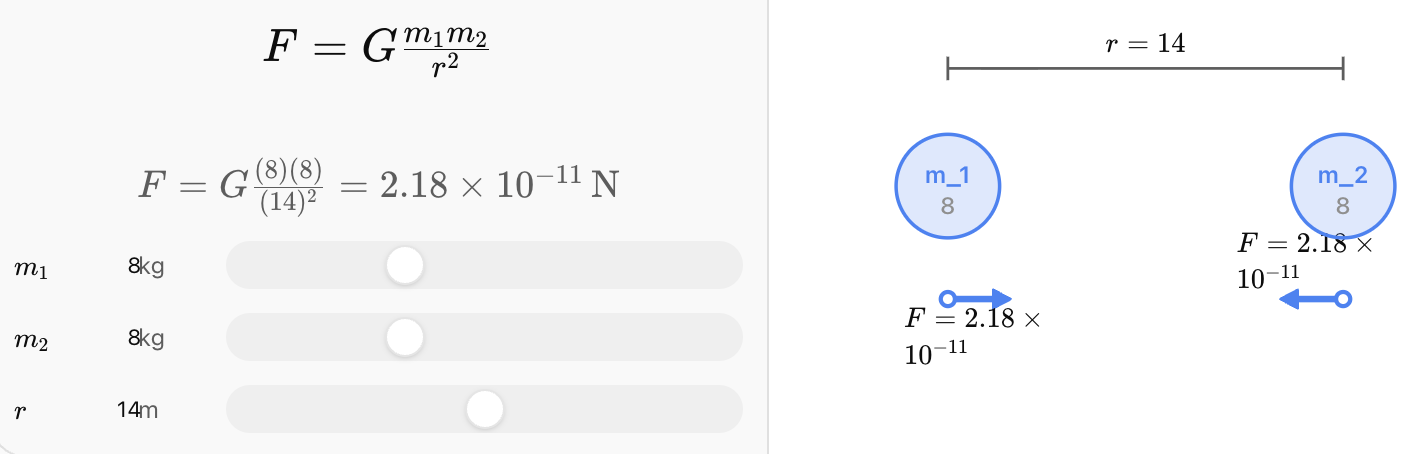
Notice that the gravitational forces act toward each other.
Gravity is an attractive force.
Each object pulls on the other.
4. What Affects Gravitational Force?
There are two main factors:
1. Mass
Increasing either mass increases the gravitational force.
2. Distance
Increasing the distance between the objects decreases the gravitational force.
We can summarize this as:
More mass → more gravitational attraction
More distance → less gravitational attraction


5. How Mass Affects Gravity
Look at the mass part of the equation:
m₁ × m₂
The gravitational force is directly proportional to both masses.
Suppose the mass of one object doubles while everything else stays the same.
The gravitational force also doubles.
For example:
Original:
m₁ = 10 kg
m₂ = 20 kg
Their mass product is:
10 × 20 = 200
Now double m₁:
m₁ = 20 kg
m₂ = 20 kg
Their mass product becomes:
20 × 20 = 400
The mass product doubled, so the gravitational force also doubles.
6. Changing Both Masses
Suppose both masses double.
Original mass product:
m₁ × m₂
After doubling both:
2m₁ × 2m₂ = 4m₁m₂
Therefore:
Doubling both masses makes the gravitational force 4 times greater.
Similarly:
Tripling one mass → force × 3
Tripling both masses → force × 9
Halving one mass → force × ½
This direct relationship makes the effect of mass relatively straightforward to predict.
7. How Distance Affects Gravity
Distance has an even more dramatic effect because the distance is squared.
The equation contains:
r²
This means gravity follows an inverse-square relationship.
If the distance between two objects doubles:
Distance × 2 → gravitational force ÷ 4
If the distance triples:
Distance × 3 → gravitational force ÷ 9
If the distance becomes four times greater:
Distance × 4 → gravitational force ÷ 16
So gravitational attraction becomes much weaker as objects move farther apart.
8. The Inverse-Square Relationship
The inverse-square relationship can be summarized:
| Distance | Gravitational Force |
|---|---|
| r | F |
| 2r | F/4 |
| 3r | F/9 |
| 4r | F/16 |
| 5r | F/25 |
This is because:
Force ∝ 1 / r²
A common mistake is to think that doubling the distance halves the force.
It does not.
Doubling the distance makes the force one-quarter as large.


9. Distance Means Centre to Centre
In Newton's equation, r is the distance between the centres of mass of the objects.
For spherical objects such as planets, we normally measure from the centre of one object to the centre of the other.
This is particularly important when working with planets.
If an object is on Earth's surface, its distance from Earth's centre is approximately Earth's radius.
It is not zero.


10. Calculating Gravitational Force
The equation is:
F = Gm₁m₂ / r²
A useful method is:
Step 1: Write down the known quantities.
Step 2: Convert all values into SI units.
Step 3: Square the distance.
Step 4: Multiply the two masses.
Step 5: Multiply by G.
Step 6: Divide by r².
Step 7: Give the answer in newtons (N).
11. Worked Example 1
Two objects have masses:
m₁ = 100 kg
m₂ = 200 kg
Their centres are:
r = 2.0 m apart
Calculate their gravitational attraction.
Use:
G = 6.67 × 10⁻¹¹ N m²/kg²
Substitute:
F = (6.67 × 10⁻¹¹ × 100 × 200) / 2²
Calculate the distance squared:
2² = 4
Calculate the numerator:
6.67 × 10⁻¹¹ × 20,000 = 1.334 × 10⁻⁶
Now divide:
F = (1.334 × 10⁻⁶) / 4
F = 3.335 × 10⁻⁷ N
So:
F ≈ 3.34 × 10⁻⁷ N
This is an extremely small force, which explains why we do not notice gravitational attraction between ordinary objects.
12. Worked Example 2 — Changing Distance
Two objects exert a gravitational force of 80 N on each other.
Their separation is doubled.
What is the new force?
Doubling distance means:
Force ÷ 2²
Therefore:
Force ÷ 4
So:
80 N ÷ 4 = 20 N
The new gravitational force is:
20 N
No values for mass or G were needed because we could use the inverse-square relationship.
13. Worked Example 3 — Changing Mass
Two objects attract each other with a gravitational force of 50 N.
The mass of one object is tripled while the other mass and distance remain unchanged.
Because force is directly proportional to mass:
50 N × 3 = 150 N
The new force is:
150 N
14. Worked Example 4 — Changing Several Variables
Suppose both masses double and the distance between them also doubles.
Effect of the masses:
2 × 2 = 4 times stronger
Effect of the distance:
2² = 4 times weaker
Therefore:
4 ÷ 4 = 1
The gravitational force remains unchanged.
This shows why it is important to consider all variables before predicting the change in gravitational force.
15. Earth and You
Earth attracts every object near its surface.
This gravitational force is what we call an object's weight.
For an object near Earth's surface:
Weight = mass × gravitational field strength
or:
W = mg
Near Earth's surface:
g ≈ 9.8 N/kg
So a 60 kg person has a weight of approximately:
W = 60 × 9.8
W = 588 N
Newton's Law of Gravitation provides the deeper explanation for why this gravitational field exists.


16. Earth and the Moon
Earth and the Moon attract each other gravitationally.
Earth pulls on the Moon.
The Moon also pulls on Earth.
These forces are equal in magnitude and opposite in direction.
The Moon does not simply fly away because Earth's gravitational attraction continually changes the direction of its motion.
Gravity therefore plays a central role in maintaining the Moon's orbit.


17. Why Doesn't the Moon Crash Into Earth?
The Moon is attracted toward Earth by gravity.
However, the Moon is also moving sideways at high speed.
Without gravity, it would move approximately in a straight line.
Gravity continuously pulls the Moon toward Earth, changing the direction of its velocity.
The result is an orbit.
One way to think about an orbit is that the Moon is continually falling toward Earth while also moving sideways fast enough to keep missing it.
18. The Sun and the Planets
The Sun contains about 99.8% of the mass of the Solar System.
Its enormous mass produces a strong gravitational attraction.
The Sun's gravity keeps:
- Mercury
- Venus
- Earth
- Mars
- Jupiter
- Saturn
- Uranus
- Neptune
in orbit.
Each planet also attracts the Sun.


Gravity therefore helps determine the structure and motion of the entire Solar System.
19. Gravity on Other Planets
An object's mass does not change simply because it travels to another planet.
Its weight can change because the gravitational field strength is different.
For example, the Moon has much less mass than Earth.
Its gravitational field at the surface is therefore weaker.
An astronaut on the Moon:
- Has the same mass as on Earth
- Has less weight than on Earth
This is why astronauts can jump much higher on the Moon.


20. Gravity and Satellites
Artificial satellites rely on gravity in the same way as natural moons.
A satellite has forward velocity while gravity pulls it toward Earth.
This produces an orbit.
Satellites are used for:
- GPS
- Weather forecasting
- Communication
- Television
- Mapping
- Scientific research
- Earth observation


Newton's Law of Gravitation allows scientists and engineers to calculate the gravitational forces acting on spacecraft and satellites.
21. Gravity Between Everyday Objects
Imagine two students standing one metre apart.
Both students exert gravitational forces on each other.
However, their masses are tiny compared with Earth's mass.
Because G is also extremely small, their gravitational attraction is far too weak to notice.
This explains why we experience Earth's gravitational attraction strongly but do not feel ourselves being pulled noticeably toward nearby people, desks or buildings.
22. Equal and Opposite Forces
Suppose Earth pulls on an astronaut with a gravitational force of 700 N.
How strongly does the astronaut pull on Earth?
700 N
The forces are equal in magnitude and opposite in direction.
Earth accelerates the astronaut noticeably because the astronaut has a relatively small mass.
The astronaut also accelerates Earth, but Earth's mass is enormous, so Earth's acceleration is unimaginably small.
This is consistent with Newton's Third Law.
23. Real-World Applications
Newton's Law of Universal Gravitation helps explain and predict:
Planetary orbits – planets moving around stars.
Moon orbits – moons moving around planets.
Artificial satellites – communication, GPS and weather satellites.
Spacecraft trajectories – predicting spacecraft motion.
Tides – largely caused by gravitational interactions involving Earth, the Moon and the Sun.
Weight – gravitational attraction between an object and a planet.
Stars and galaxies – gravity influences the formation and motion of astronomical structures.


24. Common Mistakes
Mistake 1 — Using surface-to-surface distance
The distance in Newton's equation is normally measured:
centre to centre
not surface to surface.
Mistake 2 — Forgetting to square the distance
Incorrect:
F = Gm₁m₂ / r
Correct:
F = Gm₁m₂ / r²
Mistake 3 — Thinking doubling distance halves the force
Doubling distance makes the force:
1/4 as large
because:
2² = 4
Mistake 4 — Confusing mass and weight
Mass is measured in kilograms.
Weight is a gravitational force measured in newtons.
Mistake 5 — Thinking only large objects exert gravity
Every object with mass produces gravitational attraction.
Large astronomical objects simply produce forces large enough to have obvious effects.
Mistake 6 — Thinking Earth pulls harder on the Moon than the Moon pulls on Earth
The gravitational forces are equal in magnitude.
Their accelerations are different because their masses are different.
25. Key Terms
Gravity – the attractive interaction between objects with mass.
Universal gravitation – the principle that every mass attracts every other mass.
Gravitational force – the attractive force between masses.
Mass – a measure of the amount of matter in an object.
Weight – the gravitational force acting on an object.
Universal gravitational constant (G) – the constant used in Newton's gravitational equation.
Inverse-square law – a relationship in which a quantity decreases with the square of the distance.
Orbit – the curved path of one object around another due to gravity and its motion.
Satellite – an object that orbits another object.
26. Check Your Understanding
1. State Newton's Law of Universal Gravitation.
2. What two main variables determine the strength of gravitational attraction?
3. What happens to gravitational force if one object's mass doubles?
4. What happens if both masses double?
5. What happens to gravitational force if the distance doubles?
6. What happens if the distance triples?
7. Why is gravitational attraction between two people difficult to notice?
8. Two objects attract each other with a force of 40 N. One mass doubles. What is the new force?
9. Two objects attract each other with a force of 100 N. Their separation doubles. What is the new force?
10. Explain why the Moon remains in orbit around Earth.
11. Explain why an astronaut's mass remains the same on the Moon but their weight decreases.
12. Earth pulls on a satellite with a force of 5000 N. What gravitational force does the satellite exert on Earth?
Key Takeaways
- Every object with mass attracts every other object with mass.
- Newton's Law of Universal Gravitation is represented by F = Gm₁m₂ / r².
- Gravitational force increases when either object's mass increases.
- Gravitational force decreases as distance increases.
- Gravity follows an inverse-square relationship with distance.
- Doubling the distance makes gravitational force one-quarter as large.
- The distance used in the equation is measured between the centres of the objects.
- Gravitational force is measured in newtons (N).
- The gravitational forces two objects exert on each other are equal in magnitude and opposite in direction.
- Newton's law explains phenomena ranging from weight and falling objects to moons, satellites and planetary orbits.