2. Translational Speed and Kinetic Energy

Learning outcomes
  • I can explain that gas particles are in constant random motion.
  • I can describe translational motion as the movement of particles from one location to another.
  • I can relate particle speed to temperature.
  • I can explain the relationship between average translational kinetic energy and absolute temperature.
  • I can predict how changes in temperature affect the motion and energy of gas particles.

Translational Speed and Kinetic Energy

Constant Random Motion

Gas particles are in constant random motion.

At any instant, particles are moving:

  • at different speeds
  • in different directions
  • through different parts of the container

They repeatedly collide with other particles and with the walls of their container. These collisions continually change their directions of motion.

This constant motion is one of the central ideas of the kinetic molecular theory of gases.

https://images.openai.com/static-rsc-4/_anDj6E7UX83oXS-fSKwDnmtH3jt1z66kEsqKbiz2zDdXgv2tK2c6Yv-9WvNOOSKyigCuSPWvQkwDNOVYKfv9j2QDmtIMRwTs4fUh09SuiTf30-ySiwpFFgoUVuXX-q2rG3EAqBD9cu13BMImKYqU1vKEEagQ_H4TsDvQF5_WWhYCBBVDtzRx5LNb12-Z4lF?purpose=fullsize
 
https://images.openai.com/static-rsc-4/BB8fgjUdy7ltMno7iuK_KJOoKUT9QqgisRDC8PAtWRol0S1iP0Iey-XsZQsP_NJocsXItZk2hGGFYEhnF1swHD0NqeIN6RWb3O7U8MWJ-leXaDsGeeNmJCYx-86IoTpY6ohwMPHPQ-4lY9JzAaHs7uYAAbzsavLFyp4yBNyM_R5hUR3Uvoue7fICe-58pQTU?purpose=fullsize
 
https://images.openai.com/static-rsc-4/n-5EEX_pUZ00dcrXS3AcsIlF1FkyySYzo7jxECbcA4guSalStCiEJMWuiZ5nEy-R0Wp9uE3MvV7STvMuaGnIHVXKyFgbRxYpJ04qY6uixVGFRIQl1xX0pQnYscnhvLfeeyPi1Wa3waemZShPHhbkRcwFTEqdpplp793Kx2Y5zafr6Xqx1Nhti-CU9BDrTLrF?purpose=fullsize
 
7

Translational Motion

Translational motion means movement from one location to another.

For example, a gas particle travelling from one side of a container to the other is undergoing translational motion.

This is different from other possible types of molecular motion, such as:

  • rotation
  • vibration

For studying ideal gases, translational motion is especially important because it is directly related to gas temperature and pressure.


Three-Dimensional Motion

Gas particles do not simply move left and right.

They move randomly in three dimensions.

A particle might move:

  • upward
  • downward
  • forward
  • backward
  • sideways
  • in any combination of these directions

Between collisions, the ideal gas model treats a particle as moving approximately in a straight line.

After a collision, its direction may change.

https://images.openai.com/static-rsc-4/6J659qsr5iHP2-HIghzComlMUXbUTKWymlDb2VCUuh-XySciLzVe3aU-FclzHJ4GnJaVOJqHoG6YJMf9oHjM3QeNM7sXF6h8SZxwNBclablySBlBIEsSXYV-pn_wzDTgCVx9I4P68RfwhpF7bVLbZgE73eRmeM_7yeIVpi6GADzLOhVQ9f_DZbQ09SVhxlB6?purpose=fullsize
 
https://images.openai.com/static-rsc-4/S8g4QPy-q_iz5LiH7xKoeIyeNQckQuMiD9zi6yC5Dd2HbV4cCDW5U3QDEwdilEarYa43DHnbHsAek-HLOP2D2SrgqiSjrzNs8EWHflH_H2jf6-3aj55_K1q1nZuYPzrM9BkflTxdf27IMytaa-mwEKQ0TuojZR414Y-uwDfzvFSDqrAtavUBqdaBc8ecp7V8?purpose=fullsize
 
https://images.openai.com/static-rsc-4/X-DtF2WykUF4COFtmtR1ACS-led9g6YHjHm2Mys8HWS11dwz7yxyJ8b5qj-KhTR2E2IUH1YgViXW868VYHp1xvrDvckZrG9onelkQhi7_q8IesbhWh_ExlAD0DlPabPEsq92vzJIB2Xjr9EMVWQSFPQvpfkriSZhgWOElWLwb7iNNoYMdJPy4H12GUhEIPej?purpose=fullsize
 
6

Translational Speed

Speed describes how quickly a particle changes position.

For an individual particle:

speed = distance/time

Gas particles typically move extremely quickly.

Even at ordinary temperatures, individual molecules may travel hundreds of metres per second.

However, because they continually collide and change direction, a molecule does not simply travel in a straight line across a room at that speed.

Its overall path is extremely complicated.


Speed Is Not the Same as Velocity

Speed tells us how fast a particle is moving.

Velocity includes both:

  • speed
  • direction

Because gas particles constantly change direction, their velocities constantly change.

In a gas that is stationary overall, there is no preferred direction of motion.

Particles may have large individual velocities even though the average velocity of the whole sample is approximately zero.

This is an important distinction.


Gas Particles Have Different Speeds

At a particular temperature, gas particles do not all move at exactly the same speed.

Instead, there is a distribution of speeds.

Some particles are:

  • relatively slow
  • near the average
  • relatively fast
https://images.openai.com/static-rsc-4/eQ5u7ERpn9b69ImTUOteX4z7BrLTn7YkD-pDVAskFDj5kJPgo4U11FENlyvT3ZA2qaoTHi8vE_Aqn3jnDxk29uEeL59WMh5JHVwrVN8XtYctDMuzvkYNnkSODGQdisOEs0D8OhsEUvmmp6L-5C6K-Zjwsh48dTonP4i8lDtMlya9OTs9i4tmeyObytLbZYT3?purpose=fullsize
 
https://images.openai.com/static-rsc-4/Qze3KkvA-r2On7u4dh_3Rrr3D5aYFGLSpxVeiu5B2R1oMB4FaOSnQOjZV2N7DbMSJWbRtSR-QqZSK49bdWAGH2g44AsWyc7LTYNItFyzWOZTyCp_uxHzPnk0nwJscGG-tOg-KGE3tTUjQT9-ZmB1CjWtu6WkwbSOu3csbU7RHthpb-URTzWX3KwoTZvM1i3z?purpose=fullsize
 
https://images.openai.com/static-rsc-4/0MkfT-OJceC8JkeEFrE9_1cT7ZLgPK_NLw1EMTWqtHf_KaCBR2k7DlIvuCBQQD80r3Jdm_eTkO_RXDk5D2osvrvw9K8ma4udkDTrZMSueZaqCQ9Fx1Oeenjd6YczsKOecPbi9rf30RiFT8IYKP_kiGErtqPaKe439-FrYPzT0GwLdj6MTMbDyXRq9M_pGeIP?purpose=fullsize
 
5

Collisions continually transfer kinetic energy between particles.

A particle that is fast at one moment may lose energy in a collision and become slower.

Another particle may gain energy and become faster.

The distribution therefore continually changes at the microscopic level.


Translational Kinetic Energy

Because gas particles are moving, they possess translational kinetic energy.

For one particle:

KE = ½mv²

where:

  • KE = translational kinetic energy
  • m = mass of the particle
  • v = speed of the particle

The equation shows that kinetic energy depends on both mass and speed.
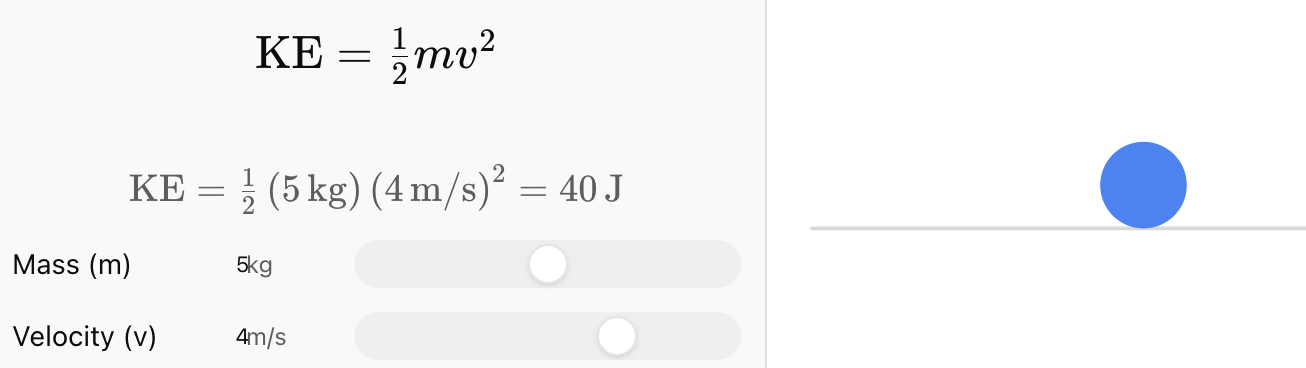
Why Speed Has a Large Effect

Notice that speed is squared:

KE ∝ v²

If the speed of a particle doubles:

KE_new = ½m(2v)²

KE_new = ½m(4v²)

Therefore:

KE_new = 4KE_original

Doubling speed produces four times the kinetic energy for the same particle.


Worked Example

A particle has mass:

m = 4.0 × 10⁻²⁶ kg

and speed:

v = 500 m/s

Calculate its translational kinetic energy.

Use:

KE = ½mv²

KE = ½(4.0 × 10⁻²⁶)(500)²

KE = ½(4.0 × 10⁻²⁶)(250,000)

KE = 5.0 × 10⁻²¹ J

The energy of a single molecule is extremely small because the particle's mass is extremely small.

A macroscopic gas, however, contains an enormous number of particles.


Temperature and Particle Motion

Temperature is directly connected to particle motion.

When a gas is heated:

temperature increases

↓

average translational kinetic energy increases

↓

particles generally move faster

When a gas is cooled:

temperature decreases

↓

average translational kinetic energy decreases

↓

particles generally move more slowly

https://images.openai.com/static-rsc-4/JYQbtpb2pBuPjoFx0Cf0WHyfoelKGTwzNLalRf2yXwp-VQX5FO0DOThi-QaI4Xr0Dg6IioGTzwPQyITewcnYmNysUZ-VdkNR9sy1AsmsBfRJfqGDLPYYGs0eXYJKovhxeT5GcbQNUBKnClSjJpUdRWUWqd-JqTCUWaj2nsEAI9EjTdEbWIMJ9HlcyieJtT8W?purpose=fullsize
 
https://images.openai.com/static-rsc-4/e9uw43ODlusFTGR7cBMfrX5ox2nfa5m2A_pOJFzM4IGsSnKXFTbu6xrXJfqGvXSo5qtni0FDd8RYFN90WF5KCJQ3JZm61Nv38wPkC4Hx2J-GrEzG6AphKx9Zd-AlSdNUw5hh8F1j8gBmXOdduAC3hSc17YZBJGDHYBLphtjQcvVdD0zs54TZPtlNf9CDcjqt?purpose=fullsize
 
https://images.openai.com/static-rsc-4/yasytPCH9eD4C1SlycGJPA4jySKsLDem5MENbM9Dr9rOPieamOUMh86Gu4Fdxxm7j-cRUAUET10r8abdnRA8ZVUidhwS96x6_DV6yk1aHbf-O6xrQUsCO_4a0BN-KpwPdAbuxIZNKxO41USLzeoIGDKHZxaMT2RjexVzsJW9tLgAjKTvmKmo-bD2tYXI6aER?purpose=fullsize
 
7

Average Translational Kinetic Energy

Temperature does not tell us the kinetic energy of one particular particle.

Instead, it is related to the average translational kinetic energy of the enormous collection of particles.

For a monatomic ideal gas particle:

average KE = 3/2 k_B T

where:

  • average KE = average translational kinetic energy per particle
  • k_B = Boltzmann constant
  • T = absolute temperature in K

The Boltzmann constant is:

k_B = 1.38 × 10⁻²³ J/K

The key relationship is:

average KE ∝ T


Absolute Temperature

The relationship between temperature and average kinetic energy requires the kelvin scale.

Kelvin temperature begins at absolute zero.

0 K = −273.15°C

Convert Celsius to kelvin using:

T(K) = T(°C) + 273.15

For example:

27°C ≈ 300 K

127°C ≈ 400 K

The kelvin scale is essential because average translational kinetic energy is proportional to absolute temperature, not Celsius temperature.


Temperature Is Not Particle Speed

A common shortcut is to say:

"temperature measures how fast particles move."

This is useful as a starting idea, but it is not completely precise.

More accurately:

temperature is related to the average translational kinetic energy of particles.

Because:

KE = ½mv²

temperature is related to particle speeds, but particle mass also matters.

Different gases at the same temperature can have different typical molecular speeds.


Same Temperature, Same Average Translational Kinetic Energy

Consider helium and oxygen gases at the same temperature.

The particles have very different masses.

However, if both gases behave ideally:

their particles have the same average translational kinetic energy.

This follows from:

average KE = 3/2 k_B T

The equation contains temperature but not particle mass.

Therefore, at the same temperature:

average KE_He = average KE_O₂

But this does not mean they have the same average speed.


Lighter Particles Move Faster

Since:

KE = ½mv²

two particles with the same kinetic energy but different masses must have different speeds.

A lighter particle must move faster to have the same kinetic energy as a heavier particle.

Therefore, at the same temperature:

lighter gas particles generally have higher characteristic speeds

than heavier gas particles.

https://images.openai.com/static-rsc-4/5n2rGQrJZbvBo5jMKfN7Z3gMhecxQVaFppulk-f-ja61L8eG95KG1fDaolk9SmmH-l-QEq1C30Wd4Cu4GMWzipyH4iN0E5AWmrEmkk-WEkK4Kat0cV0QvWEXk0QGjU2BGPuzZCApliqCCJ2vbHMya1scUqsp2sV-VI9QUZtNABrvAGMWgzvRf0T0Af3X3Bo3?purpose=fullsize
 
https://images.openai.com/static-rsc-4/PMpmz1tbZ_kg2iBhxn1LsbNAp5OCN1HmKhgu-nt4uPGmwOIIh7k_Q9WOW64dPK9Qvp0TUdStzT4P7LlXZ8eNpGDQCXgMrg4MotaREXGkx2JgfRQ4UiRqk7KzPTOQGdj5iMP-R_HeVGE8-fPAbgjC9p8S6urrqEMavkm5enIK-RLLAz1nGOpkNFdjmFLNLVnO?purpose=fullsize
 
https://images.openai.com/static-rsc-4/iDxv7OyS1_f4XXp1wEXtv7hSQwMMqHNWqiAh9yj6pPbgEWiBgYEtALpyjRbNK_JMXOudX_9QkPMLgR8sHM1Oz3GOSy8pHk8p5FteUtTJrvpX-fjBN8DLM7z0tGLFr8zXnxeS4WFdYrNy-PQg3-MSKvA-9FPh0fZhW74dLtD-8_K5uGhrQz7R0ZV2Xcef-40D?purpose=fullsize
 
6

Example: Helium and Oxygen

Helium atoms have much less mass than oxygen molecules.

Suppose both gases are at:

300 K

Their average translational kinetic energies are the same because their temperatures are the same.

However:

helium particles move faster on average than oxygen molecules

because helium particles have less mass.

This is an important application of the kinetic-energy equation.


What Happens When Temperature Doubles?

Because:

average KE ∝ T

if absolute temperature doubles:

average KE doubles

For example:

300 K → 600 K

means:

average translational KE doubles

However, particle speed does not double.


Temperature and Speed

Since:

KE ∝ v²

and:

average KE ∝ T

we can combine these ideas to obtain, for particles of the same gas:

typical speed ∝ √T

This means speed increases with the square root of absolute temperature.

Therefore:

300 K → 600 K

does not make typical particle speed twice as large.

Instead:

v_new/v_old = √(600/300)

v_new/v_old = √2

v_new ≈ 1.41v_old

So doubling absolute temperature increases a characteristic particle speed by about 41%, not 100%.


Worked Example: Changing Temperature

A gas is heated from:

200 K to 800 K

Compare the average translational kinetic energies.

Since:

average KE ∝ T

KE₂/KE₁ = 800/200

KE₂/KE₁ = 4

The average translational kinetic energy becomes four times as large.

Now compare characteristic particle speeds:

v₂/v₁ = √(800/200)

v₂/v₁ = √4

v₂/v₁ = 2

The characteristic speed doubles.


Celsius Can Be Misleading

Suppose a gas is heated from:

20°C to 40°C

It may look as though the temperature has doubled.

But convert to kelvin:

20°C ≈ 293 K

40°C ≈ 313 K

The absolute temperature has only increased by about:

313/293 ≈ 1.07

So the average translational kinetic energy increases by only about 7%, not 100%.

Always use kelvin when comparing temperature ratios.


Speed Distribution and Temperature

Heating a gas changes the entire distribution of particle speeds.

At higher temperature:

  • the average kinetic energy is greater
  • characteristic speeds are greater
  • more particles have very high speeds
  • the speed distribution becomes broader
https://images.openai.com/static-rsc-4/tA-_llx7HIswBJfppb08Jt5r64RR7GTyauRbwa-C_2vEuNG8Msj983guxLtYBgPXWYJbIXBktcO1FXih-lFn08fdGfT1lsYsYL63Y3wsfdyFk14Dk7KIjjjH2WDIhZf3DKmJLrB3rTdSg0QTg8L8wvxK5ZHIxEqXCcpQrz8iY3TdVfX4urYtmBFdqQl4gttQ?purpose=fullsize
 
https://images.openai.com/static-rsc-4/Fk1QwLAoQ7vWNFHDPMTWuUgPXwFywiUtER_2H3fLkeqGKTdrcbvifInac0pdPC9odsAnDrH2BnHURpOKpnyx-T8ZF-ylrt9D7_LqGFY-n4gPeI3u-7JXLt4CxwqHmFr-ZkPNpO6orLDBDV9iGVSSJhg3tltPKgsCR9Eu6cctETOli9CpVh6lUNmopvVPFdUM?purpose=fullsize
 
https://images.openai.com/static-rsc-4/iDxv7OyS1_f4XXp1wEXtv7hSQwMMqHNWqiAh9yj6pPbgEWiBgYEtALpyjRbNK_JMXOudX_9QkPMLgR8sHM1Oz3GOSy8pHk8p5FteUtTJrvpX-fjBN8DLM7z0tGLFr8zXnxeS4WFdYrNy-PQg3-MSKvA-9FPh0fZhW74dLtD-8_K5uGhrQz7R0ZV2Xcef-40D?purpose=fullsize
 
5

The particles still do not all move at the same speed.

Instead, the distribution shifts toward higher speeds.


Cooling a Gas

Cooling produces the opposite effect.

As temperature decreases:

  • average translational kinetic energy decreases
  • characteristic particle speeds decrease
  • fewer particles have very high speeds

The particles continue moving randomly as long as the gas remains above absolute zero.


Absolute Zero

Absolute zero is:

0 K

or approximately:

−273.15°C

In the simplified classical kinetic model:

T → 0 K → average translational kinetic energy → 0

Absolute zero therefore represents the lower limit of the thermodynamic temperature scale.

Modern quantum physics makes the behavior of matter near absolute zero more complicated than the simple classical particle model suggests, but the classical relationship remains extremely useful for ordinary gases.


Particle Speed and Gas Pressure

Particle speed also helps explain gas pressure.

Gas pressure results from particles colliding with container walls.

If a gas in a rigid container is heated:

  • temperature increases
  • average kinetic energy increases
  • particles move faster
  • wall collisions occur more frequently
  • momentum changes during collisions become greater

Therefore:

pressure increases

if volume and number of particles remain constant.

https://images.openai.com/static-rsc-4/gPVhomVqzdZXIvv7ON96fM2AdzCpfK2dNNeeXi2VF_hAoBVkZrh__mQwohC7mOUoPIAt0VImZHqZ1Zsv44mN0-6HsrLQXz94tycAUj44KlMrHRrQiTsuAp4lCFHlk8RgbrTHWo6DCx85xSGbZEuhVip1TvO8F71hJc6gSDBGnwrng7NDGtghUPj17LWkf_i6?purpose=fullsize
 
https://images.openai.com/static-rsc-4/e9uw43ODlusFTGR7cBMfrX5ox2nfa5m2A_pOJFzM4IGsSnKXFTbu6xrXJfqGvXSo5qtni0FDd8RYFN90WF5KCJQ3JZm61Nv38wPkC4Hx2J-GrEzG6AphKx9Zd-AlSdNUw5hh8F1j8gBmXOdduAC3hSc17YZBJGDHYBLphtjQcvVdD0zs54TZPtlNf9CDcjqt?purpose=fullsize
 
https://images.openai.com/static-rsc-4/9VxVVfTHtiPA489BKGe-i_NxO7rz1pcBb7Veu8QIyErzWbetvT_lUCU_7PpLEZmGsVGWOjtGspVdIy0f6JG4i81kMA28WGPH-MYiBD9ixCAuBVzQzMYWLa7FakycaWUTpxSt67S1CEq1WnIjw016wwe7fziQ9ury5eL5KqhBKKF8xwpyFdsu4G5KfRtX69Su?purpose=fullsize
 
9

Particle Speed and Diffusion

Gas particles spread through random motion.

This process is called diffusion.

Higher temperatures produce greater characteristic particle speeds.

Therefore, diffusion generally occurs faster at higher temperatures.

For example, gases and vapors tend to spread more rapidly when their particles have greater kinetic energy.


Particle Speed and Evaporation

The same general particle-energy idea helps explain evaporation.

Particles in a liquid have a range of kinetic energies.

Some surface particles have enough energy to escape from the liquid.

At higher temperatures:

  • average kinetic energy is greater
  • more particles have sufficiently high energy
  • evaporation generally occurs more rapidly

This connects the distribution of particle energies to observable thermal behavior.


Brownian Motion

Evidence for microscopic random motion can be seen through Brownian motion.

Small visible particles suspended in a fluid may appear to move randomly.

https://images.openai.com/static-rsc-4/lG-_BpJA-FiY9pOnhg5PODrj7WB6Ekb655u0z8EwRtOTusfoRmSllhGHdsZg-Z2KKKEKcEX4fG_CdxCaIpWmi029kUV1lYO4FMB3NhGIy9-zn_BwPUT-GXC2oqC08GtnxUvUiaYh2HdwV4ohq7x2CgGtN20JiXUVu2qVTTRqB-0EQdUYGoHI_qL4_vSF2Ttc?purpose=fullsize
 
https://images.openai.com/static-rsc-4/U0pEtbQzhSqUyJBbNcRXbF51EHHz7q7zDK49BJP6n0T4EiWDTIBSxHxro3K0L-IxiuWIwErWOm8dVRbvhqNTXG-KHBB0EQZaYXvhbKYKkbCrPhbhtYtxfQjMwDFEHIHQzptbm0dVNDmit004j6dFktH-gzTdzSjg-9UuZhKAnC2YOq5_5dnkmgMFZquiz44L?purpose=fullsize
 
https://images.openai.com/static-rsc-4/pzL1pplH-df7kcQ__ySE2_Rn43HQj0AH3eDkJtf9uMFJAmUeUAgBbqpBNrQil0iGoMpFim3BfABtjka9njDchxj6rJCtlknNXWW7DihsOzaL-EsBOnzpepDBCTG1teBOG7jX-NQq2pJPQZIDA2C_T7osUlCanXNr0HBENw16ahzN5FPRBBCtA1IF_gLsoTdo?purpose=fullsize
 
6

The visible particles are being struck unevenly by much smaller, rapidly moving molecules.

Brownian motion provided important evidence for the particle model of matter.


From Microscopic Motion to Macroscopic Temperature

Temperature is a macroscopic quantity—we measure it for an entire sample.

Translational kinetic energy describes microscopic particles.

Kinetic theory connects the two:

microscopic particle motion

↓

average translational kinetic energy

↓

macroscopic temperature

This connection is one of the fundamental ideas of thermal physics.


Predicting the Effect of Temperature Changes

A useful reasoning chain is:

When temperature increases:

T ↑

↓

average KE ↑

↓

characteristic particle speed ↑

↓

particles move more rapidly

This can lead to:

  • more frequent wall collisions
  • increased pressure at constant volume
  • faster diffusion
  • faster evaporation
  • expansion if the gas is free to expand

When temperature decreases:

T ↓

↓

average KE ↓

↓

characteristic particle speed ↓

↓

particle motion becomes slower on average


Worked Example: Comparing Two Gases

Gas A is at:

250 K

Gas B is the same gas at:

500 K

Average Kinetic Energy

KE_B/KE_A = 500/250

KE_B/KE_A = 2

Gas B's particles have twice the average translational kinetic energy.

Characteristic Speed

v_B/v_A = √(500/250)

v_B/v_A = √2

v_B/v_A ≈ 1.41

The characteristic particle speed is about 1.41 times greater, not twice as great.


Common Mistakes

Mistake: "Gas particles move only when the gas is heated."
Gas particles are already in constant motion. Heating increases their average kinetic energy.

Mistake: "All gas particles at the same temperature have the same speed."
Particles have a distribution of speeds.

Mistake: "Temperature is directly proportional to particle speed."
Temperature is directly proportional to average translational kinetic energy. Characteristic speed is proportional to √T for a given gas.

Mistake: "Doubling temperature doubles particle speed."
Doubling absolute temperature doubles average kinetic energy but increases characteristic speed by √2.

Mistake: "Different gases at the same temperature have the same average speed."
They have the same average translational kinetic energy in the ideal-gas model, but lighter particles generally move faster.

Mistake: "40°C is twice as hot as 20°C."
Temperature ratios involving kinetic energy must use kelvin.

Mistake: "Average velocity and average speed mean the same thing."
In a stationary gas, average velocity can be approximately zero because directions cancel, while average speed is definitely greater than zero.


Key Terms

Translational motion — movement of a particle from one location to another.

Random motion — particle movement without a preferred overall direction.

Speed — rate at which distance is travelled.

Velocity — rate of displacement, including direction.

Translational kinetic energy — energy associated with a particle's movement from one location to another.

Average kinetic energy — mean translational kinetic energy of particles in a sample.

Absolute temperature — temperature measured from absolute zero using the kelvin scale.

Absolute zero — lowest limit of thermodynamic temperature, 0 K.

Boltzmann constant — constant connecting the microscopic energy scale of particles to absolute temperature.

Speed distribution — range of different particle speeds present within a gas.

Diffusion — spreading of particles due to random motion.

Brownian motion — random movement of microscopic visible particles caused by collisions with molecules in a surrounding fluid.


Key Takeaways

  • Gas particles are in constant random translational motion.
  • Translational motion means movement from one location to another.
  • Gas particles travel approximately in straight lines between collisions in the ideal-gas model.
  • Particles continually change direction because of collisions.
  • Gas particles at one temperature do not all have the same speed.
  • Translational kinetic energy is calculated using KE = ½mv².
  • Absolute temperature is directly proportional to the average translational kinetic energy of ideal gas particles.
  • For a monatomic ideal gas particle, average KE = 3/2 k_B T.
  • Temperature comparisons involving kinetic energy must use kelvin.
  • Increasing temperature increases average translational kinetic energy.
  • Decreasing temperature decreases average translational kinetic energy.
  • Doubling absolute temperature doubles average translational kinetic energy.
  • Characteristic particle speed is proportional to √T for the same gas.
  • Doubling absolute temperature therefore does not double particle speed.
  • Different ideal gases at the same temperature have the same average translational kinetic energy.
  • Lighter particles generally move faster than heavier particles at the same temperature.
  • Increased particle speed can affect pressure, diffusion and other observable gas behavior.
  • Kinetic theory connects microscopic particle motion with the macroscopic quantity we call temperature.

Check Your Understanding

  1. What is meant by translational motion?
  2. Why is the motion of gas particles described as random?
  3. Do all particles in a gas move at the same speed? Explain.
  4. Write the equation for the translational kinetic energy of one particle.
  5. How does kinetic energy change if a particle's speed doubles?
  6. What happens to the average translational kinetic energy of a gas when its absolute temperature increases?
  7. A gas is heated from 300 K to 600 K. By what factor does its average translational kinetic energy change?
  8. For the same change from 300 K to 600 K, by approximately what factor does a characteristic particle speed change?
  9. Why must kelvin rather than Celsius be used when comparing temperature ratios?
  10. Helium and oxygen are both at 300 K. Compare their average translational kinetic energies.
  11. Which particles generally move faster at the same temperature: helium atoms or oxygen molecules? Explain.
  12. Explain why heating a gas in a rigid container can increase its pressure.
  13. How does increasing temperature affect the distribution of particle speeds?
  14. Explain how kinetic molecular theory connects the microscopic motion of particles with the macroscopic quantity of temperature.