Gas Laws and Kinetic Theory
2. Translational Speed and Kinetic Energy
Learning outcomes
- I can explain that gas particles are in constant random motion.
- I can describe translational motion as the movement of particles from one location to another.
- I can relate particle speed to temperature.
- I can explain the relationship between average translational kinetic energy and absolute temperature.
- I can predict how changes in temperature affect the motion and energy of gas particles.
Translational Speed and Kinetic Energy
Constant Random Motion
Gas particles are in constant random motion.
At any instant, particles are moving:
- at different speeds
- in different directions
- through different parts of the container
They repeatedly collide with other particles and with the walls of their container. These collisions continually change their directions of motion.
This constant motion is one of the central ideas of the kinetic molecular theory of gases.


Translational Motion
Translational motion means movement from one location to another.
For example, a gas particle travelling from one side of a container to the other is undergoing translational motion.
This is different from other possible types of molecular motion, such as:
- rotation
- vibration
For studying ideal gases, translational motion is especially important because it is directly related to gas temperature and pressure.
Three-Dimensional Motion
Gas particles do not simply move left and right.
They move randomly in three dimensions.
A particle might move:
- upward
- downward
- forward
- backward
- sideways
- in any combination of these directions
Between collisions, the ideal gas model treats a particle as moving approximately in a straight line.
After a collision, its direction may change.


Translational Speed
Speed describes how quickly a particle changes position.
For an individual particle:
speed = distance/time
Gas particles typically move extremely quickly.
Even at ordinary temperatures, individual molecules may travel hundreds of metres per second.
However, because they continually collide and change direction, a molecule does not simply travel in a straight line across a room at that speed.
Its overall path is extremely complicated.
Speed Is Not the Same as Velocity
Speed tells us how fast a particle is moving.
Velocity includes both:
- speed
- direction
Because gas particles constantly change direction, their velocities constantly change.
In a gas that is stationary overall, there is no preferred direction of motion.
Particles may have large individual velocities even though the average velocity of the whole sample is approximately zero.
This is an important distinction.
Gas Particles Have Different Speeds
At a particular temperature, gas particles do not all move at exactly the same speed.
Instead, there is a distribution of speeds.
Some particles are:
- relatively slow
- near the average
- relatively fast


Collisions continually transfer kinetic energy between particles.
A particle that is fast at one moment may lose energy in a collision and become slower.
Another particle may gain energy and become faster.
The distribution therefore continually changes at the microscopic level.
Translational Kinetic Energy
Because gas particles are moving, they possess translational kinetic energy.
For one particle:
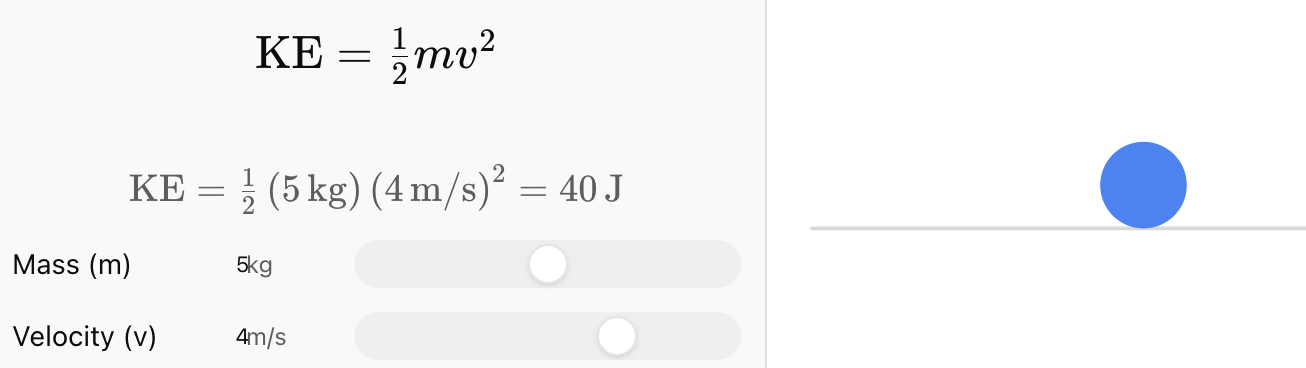
KE = ½mv²
where:
- KE = translational kinetic energy
- m = mass of the particle
- v = speed of the particle
The equation shows that kinetic energy depends on both mass and speed.