Gas Laws and Kinetic Theory
1. Kinetic Molecular Theory
Learning outcomes
- I can describe the main assumptions of the kinetic molecular theory of gases.
- I can explain how gas pressure results from particle collisions.
- I can relate temperature to the average kinetic energy of gas particles.
- I can explain why gases are compressible and expand to fill their containers.
- I can use the particle model to explain the behavior of gases.
Kinetic Molecular Theory
What Is the Kinetic Molecular Theory?
The kinetic molecular theory (KMT) is a particle model used to explain the behavior of gases.
Instead of thinking of a gas as a continuous substance, KMT describes it as an enormous number of tiny particles moving constantly and randomly.
The model helps explain:
- gas pressure
- temperature
- expansion
- compression
- diffusion
- changes in pressure when gases are heated or cooled


The Main Assumptions of Kinetic Molecular Theory
For an ideal gas, the kinetic molecular theory makes several simplifying assumptions.
Gas particles are extremely small
Individual particles occupy very little volume compared with the total volume of the gas.
Most of the space in a gas is therefore empty space.
Gas particles move continuously
Particles are in constant, rapid and random motion.
They travel in approximately straight lines between collisions.
Particles collide
Gas particles collide with:
- other gas particles
- the walls of their container
Collisions are elastic
In an idealized elastic collision, the total kinetic energy of the colliding particles is conserved.
Particles may exchange kinetic energy during a collision, but the total is unchanged.
Attractive and repulsive forces are negligible
Ideal gas particles are assumed not to attract or repel each other significantly except during collisions.
Temperature is related to average kinetic energy
The average translational kinetic energy of gas particles depends on the gas's absolute temperature.
These assumptions form the basis of the ideal-gas particle model.
The Particle Model of a Gas
Gas particles are much farther apart than particles in solids or liquids.
They move freely throughout their container.
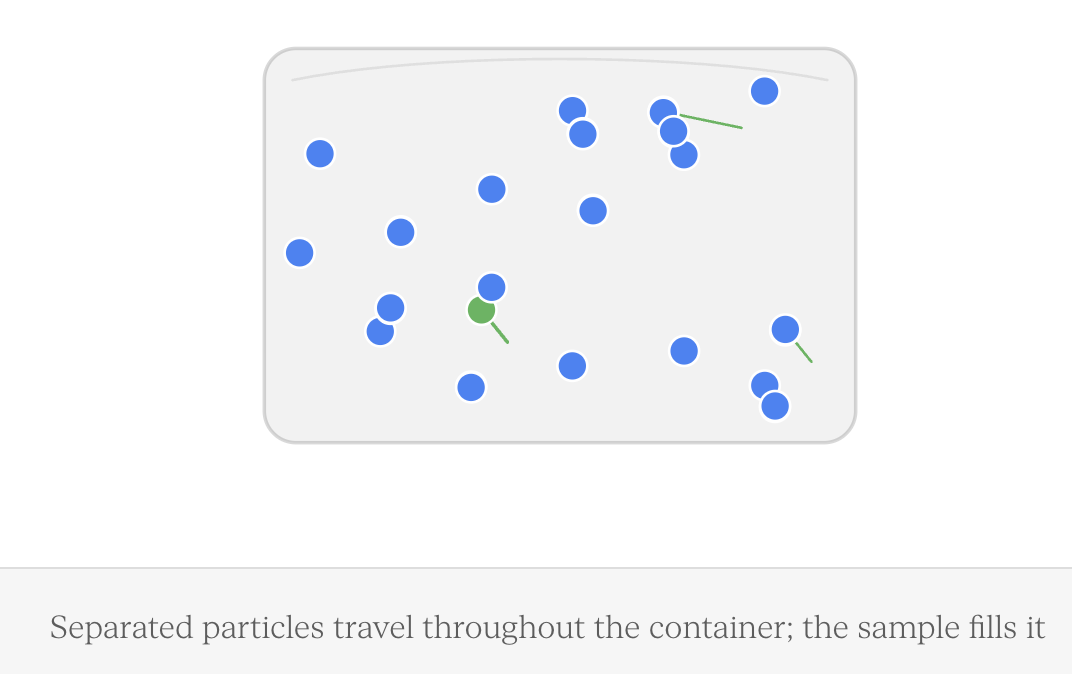
This particle arrangement explains many familiar gas properties.
| Property | Particle Explanation |
|---|---|
| No fixed shape | Particles move freely |
| No fixed volume | Particles spread throughout container |
| Compressible | Large spaces exist between particles |
| Low density | Particles are widely separated |
| Produces pressure | Particles collide with container walls |
| Diffuses | Particles move randomly and mix |
Gas Particles Are in Constant Motion
Gas particles never simply sit still.
They move:
- rapidly
- randomly
- in many different directions
Between collisions, an ideal gas particle travels approximately in a straight line.
After a collision, its direction may change.
A sample of gas therefore contains enormous numbers of particles continually moving and colliding.

What Is Gas Pressure?
Pressure is force acting per unit area.
p = F/A
Gas pressure is produced by collisions between gas particles and the walls of their container.
Every time a particle strikes a wall and rebounds, its momentum changes.
The wall exerts a force on the particle.
By Newton's Third Law, the particle exerts a force on the wall.
One collision produces an extremely small force.
But a container may experience billions upon billions of particle collisions.
Together, these collisions produce measurable gas pressure.
Pressure at the Particle Level
Imagine gas trapped inside a balloon.
Particles constantly strike the inner surface of the balloon.
Each collision exerts a tiny force.
The combined effect of these collisions creates an outward pressure on the balloon.
The surrounding atmosphere also produces pressure on the outside.
The balloon's size depends partly on the balance of these forces and the tension in the rubber.


Increasing the Number of Particles
Suppose more gas particles are added to a rigid container without changing its volume significantly.
There are now more particles available to strike the walls.
Therefore:
more particles → more wall collisions → greater pressure
if temperature and volume are otherwise unchanged.
This explains why pumping additional air into a fixed-volume container increases its pressure.
Temperature and Particle Motion
Temperature has a precise meaning in kinetic molecular theory.
The absolute temperature of a gas is directly related to the average translational kinetic energy of its particles.
For an individual particle:
KE = ½mv²
where:
- KE = kinetic energy
- m = particle mass
- v = particle speed
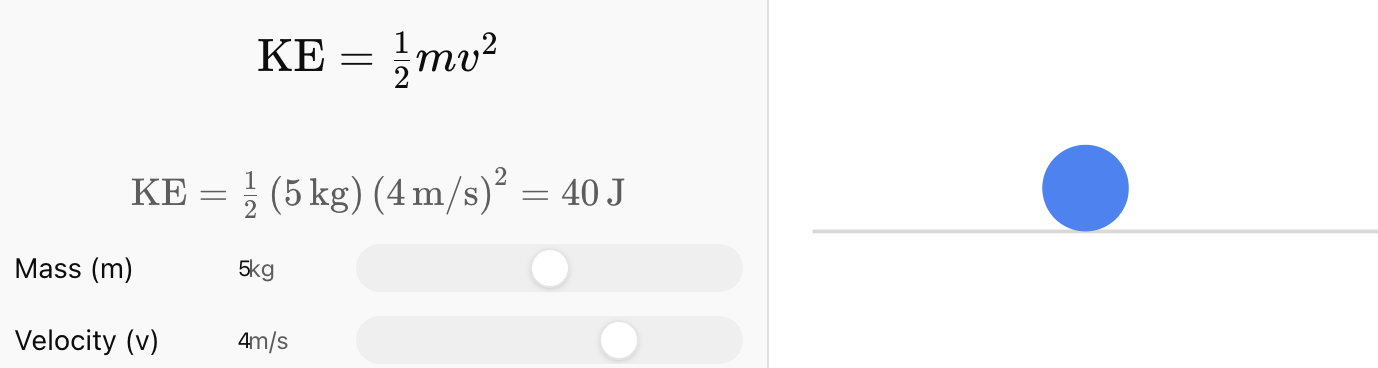
Increasing particle speed has a particularly strong effect because speed is squared.
Temperature and Average Kinetic Energy
For an ideal gas:
average kinetic energy ∝ absolute temperature
Therefore:
higher temperature → greater average kinetic energy
and:
lower temperature → lower average kinetic energy
Temperature must be measured using the kelvin scale when using this proportional relationship.
What Happens When a Gas Is Heated?
Suppose gas is trapped in a rigid sealed container.
When the gas is heated:
temperature increases
↓
average kinetic energy increases
↓
particles move faster on average
↓
particles collide with the walls more frequently
and
collisions involve greater momentum changes
↓
pressure increases


This provides a particle-level explanation for why heating a gas at constant volume increases its pressure.
What Happens When a Gas Is Cooled?
Cooling produces the opposite effect.
temperature decreases
↓
average kinetic energy decreases
↓
particles move more slowly on average
↓
wall collisions become less frequent and less forceful
↓
pressure decreases
provided the container's volume remains constant.
Particles Do Not All Move at the Same Speed
Temperature describes the average kinetic energy of the particles.
It does not mean every particle has exactly the same speed or kinetic energy.
At any moment:
- some particles move relatively slowly
- many have intermediate speeds
- some move very rapidly
Collisions continually redistribute kinetic energy between particles.
Therefore, a gas contains a distribution of particle speeds.
Why Gases Are Compressible
One of the most important properties of gases is that they can be compressed significantly.
Why?
Because gas particles are separated by relatively large distances.
Most of a gas's volume is empty space between particles.


When a gas is compressed:
container volume decreases
but the particles themselves do not need to become much smaller.
Instead:
the spaces between the particles decrease
This is very different from most solids and liquids, where particles are already packed relatively close together.
Compressing a Gas
Imagine air trapped inside a sealed syringe.
When the plunger is pushed inward:
- the number of particles remains approximately constant
- the available volume decreases
- particles travel shorter distances before hitting the walls
- collisions with the walls become more frequent
If temperature remains constant:
volume decreases → pressure increases
This is the particle explanation behind Boyle's law.
Why Gases Fill Their Containers
A gas has no fixed shape and no fixed volume.
Gas particles move freely in all directions.
If gas is released into a larger container, particles continue moving randomly until they are distributed throughout the available space.
Therefore:
a gas expands to fill its entire container
The particles are not deliberately moving toward empty regions.
Their random motion naturally spreads them throughout the available volume.
Gas Expansion
Suppose a partition separates two halves of a container.
One side contains gas.
The other side is empty.
When the partition is removed, gas particles move into the empty region.
Eventually, particles become distributed throughout the entire container.
This demonstrates why gases expand spontaneously into available space.
Diffusion
Diffusion is the net spreading of particles from regions of higher concentration toward regions of lower concentration as a result of random particle motion.
A familiar example is perfume released in one part of a room.
Eventually, the smell can be detected farther away.


The perfume particles:
- move randomly
- collide with air molecules
- gradually spread throughout the room
Diffusion is therefore strong evidence for the constant random motion of particles.
Temperature and Diffusion
Increasing temperature generally increases the average kinetic energy of gas particles.
Particles therefore move faster on average.
This tends to increase the rate of diffusion.
Therefore:
higher temperature → faster particle motion → generally faster diffusion
Gas Density
Gas density is:
ρ = m/V
Gases usually have much lower densities than solids and liquids because their particles are widely separated.
If a fixed mass of gas expands:
volume increases
so:
density decreases
If the same gas is compressed:
volume decreases
so:
density increases
Heating a Gas in a Flexible Container
Now consider gas inside a flexible balloon rather than a rigid container.
When heated:
- particles gain average kinetic energy
- particles move faster
- collisions initially exert greater pressure
- the balloon can expand
As the balloon expands, the particles have more space.
A new balance may eventually be established between internal pressure, external pressure and the balloon's elastic forces.
This demonstrates why the result of heating a gas depends on whether its volume is allowed to change.
Heating Air and Convection
Kinetic molecular theory also helps explain convection.
Suppose air is heated and allowed to expand.
The particles move faster and the gas expands.
If approximately the same mass occupies a larger volume:
ρ = m/V
so density decreases.
The warmer, less-dense air may rise through surrounding cooler, denser air.
This contributes to convection currents.


Hot-Air Balloons
A hot-air balloon provides a practical example.
Air inside the balloon is heated.
The air:
- gains average kinetic energy
- expands
- becomes less dense than the surrounding cooler air
The surrounding denser air produces a buoyant force on the balloon.
If the buoyant force is sufficiently large, the balloon rises.
Kinetic theory therefore connects microscopic particle behavior with a large-scale observable effect.
Gas Pressure in a Tire
Air inside a tire contains particles moving rapidly and colliding with the tire walls.
These collisions create pressure.
If the tire becomes hotter:
temperature increases → average kinetic energy increases → pressure tends to increase
if the tire's volume does not change much.
This is why tire pressure can change with temperature.
Aerosol Cans
Aerosol cans contain gases under pressure.
If an aerosol can is strongly heated:
- gas temperature increases
- particle kinetic energy increases
- collisions with the container become more frequent and forceful
- internal pressure can increase substantially
This is why pressurized containers carry warnings about exposure to excessive heat.
Gas in a Piston
Consider gas trapped beneath a movable piston.
The particles collide with the piston and exert pressure.
If the gas is heated:
- average kinetic energy increases
- particles move faster
- the force on the piston increases
If the piston can move, it may rise.
The gas then expands.
This is an important principle in:
- engines
- turbines
- compressors
- heat engines
Microscopic particle motion can therefore produce macroscopic mechanical motion.
Atmospheric Pressure
The atmosphere consists of enormous numbers of moving gas particles.
These particles collide with:
- Earth's surface
- buildings
- people
- other objects
These collisions contribute to atmospheric pressure.
At sea level, atmospheric pressure is roughly:
101 kPa
We normally do not notice this enormous pressure because forces from atmospheric pressure act in many directions and pressures inside our bodies help balance external pressure.
Pressure Acts in All Directions
Gas particles move randomly in all directions.
They therefore collide with all surfaces of a container.
Gas pressure consequently acts:
- upward
- downward
- sideways
- in every other direction
This is why an inflated balloon pushes outward over its entire surface.
Ideal Gases and Real Gases
The kinetic molecular theory described here is an idealized model.
Real gas particles:
- have finite size
- can attract and repel each other
- do not behave perfectly ideally under all conditions
The ideal-gas approximation works especially well when:
- pressure is relatively low
- temperature is relatively high
Under these conditions, particles are generally far apart and intermolecular forces have less effect.
At very high pressures or low temperatures, real gases can deviate significantly from ideal behavior.
Connecting Microscopic and Macroscopic Properties
One of the strengths of kinetic molecular theory is that it connects invisible particle behavior with properties that can be measured.
| Macroscopic Observation | Particle Explanation |
|---|---|
| Gas has pressure | Particles collide with container walls |
| Heating increases pressure at constant volume | Particles move faster and collisions become more frequent/forceful |
| Gas can be compressed | Large spaces exist between particles |
| Gas fills container | Particles move randomly throughout available space |
| Gas diffuses | Constant random particle motion spreads particles |
| Gas expands when heated | Faster particles can produce expansion if boundaries can move |
| Warm gas can become less dense | Expansion increases volume for the same mass |
This connection between the microscopic and macroscopic worlds is central to thermal physics.
A Particle Explanation Strategy
When asked to explain gas behavior using kinetic molecular theory, think about four questions:
How are the particles arranged?
Are they close together or far apart?
How are the particles moving?
Has their average speed changed?
How often are they colliding?
Has the collision rate changed?
What happens during collisions with the walls?
Has the momentum change or force changed?
This approach can explain many gas-law situations without simply memorizing formulas.
Worked Example: Heating a Sealed Container
A rigid sealed container contains gas at 300 K.
The gas is heated.
Explain why the pressure increases.
Step 1: Temperature
Temperature increases.
Step 2: Kinetic Energy
The average kinetic energy of the particles increases.
Step 3: Particle Motion
Particles move faster on average.
Step 4: Collisions
Particles collide with the container walls more frequently and with greater momentum changes.
Step 5: Pressure
The average force exerted on the walls increases.
Therefore:
gas pressure increases.
Worked Example: Compressing a Gas
A student pushes the plunger of a sealed syringe inward slowly while keeping temperature approximately constant.
Explain why pressure increases.
The number of particles remains constant, but the volume decreases.
The particles have less distance to travel between wall collisions.
Therefore, collisions with the walls occur more frequently.
The average force exerted on the walls increases.
Therefore:
pressure increases as volume decreases.
Common Mistakes
Mistake: "Gas particles expand when a gas expands."
The particles themselves do not significantly increase in size. The average spacing between particles increases.
Mistake: "Gas pressure is caused by particles pushing continuously on the walls."
Gas pressure results from enormous numbers of particle collisions with the walls.
Mistake: "Higher temperature means there are more particles."
Temperature is related to the average kinetic energy of the particles, not the number of particles.
Mistake: "All particles at one temperature move at the same speed."
Gas particles have a range of speeds. Temperature relates to their average kinetic energy.
Mistake: "There is no empty space in a gas."
Most of the volume of an ideal gas consists of space between particles.
Mistake: "Gas particles stop moving when pressure decreases."
Particles continue moving as long as the temperature is above absolute zero.
Mistake: "Heating always increases pressure."
Heating increases pressure strongly when volume is fixed. If the gas can expand, some of the effect appears as increased volume instead.
Key Terms
Kinetic molecular theory (KMT) — model explaining gas behavior in terms of constantly moving microscopic particles.
Ideal gas — theoretical gas whose particles follow the assumptions of kinetic molecular theory.
Kinetic energy — energy an object or particle possesses because of its motion.
Random motion — particle movement with constantly changing directions and no preferred overall direction.
Elastic collision — collision in which total kinetic energy is conserved.
Gas pressure — force per unit area produced by particle collisions with surfaces.
Absolute temperature — temperature measured from absolute zero using the kelvin scale.
Average kinetic energy — average energy of motion of the particles in a sample.
Compression — reduction in the volume occupied by a gas.
Expansion — increase in the volume occupied by a gas.
Diffusion — net spreading of particles resulting from their random motion.
Density — mass per unit volume, calculated using ρ = m/V.
Idealization — simplified representation used to make a physical system easier to understand and analyze.
Key Takeaways
- Kinetic molecular theory explains gases using the motion and collisions of microscopic particles.
- Gas particles are extremely small compared with the distances between them.
- Most of the volume of a gas is empty space between particles.
- Gas particles move continuously and randomly.
- Ideal gas particles travel approximately in straight lines between collisions.
- Collisions are treated as elastic in the ideal-gas model.
- Gas pressure results from particles colliding with container walls.
- Increasing the collision frequency or momentum change can increase pressure.
- Absolute temperature is directly related to the average translational kinetic energy of gas particles.
- Heating a gas increases its particles' average kinetic energy.
- Gas particles do not all move at exactly the same speed.
- Gases are highly compressible because there are large spaces between their particles.
- Gases expand to fill containers because particles move freely and randomly through the available space.
- Diffusion results from constant random particle motion.
- Heating a gas at constant volume generally increases its pressure.
- Compressing a gas at constant temperature increases its pressure.
- Kinetic molecular theory connects microscopic particle behavior to observable properties such as pressure, volume, temperature and density.
Check Your Understanding
- State four assumptions of the kinetic molecular theory of gases.
- How does the spacing between particles in a gas compare with that in a solid or liquid?
- Explain how gas particles produce pressure on the walls of a container.
- What happens to the average kinetic energy of gas particles when temperature increases?
- Why must kelvin be used when relating temperature directly to average kinetic energy?
- Do all gas particles at the same temperature move at exactly the same speed? Explain.
- Why are gases much more compressible than most liquids and solids?
- Explain why a gas expands to fill its container.
- Use kinetic molecular theory to explain why heating a gas in a rigid container increases its pressure.
- Explain why compressing a gas in a sealed syringe increases its pressure.
- Why does diffusion generally occur faster at higher temperatures?
- Explain how heating the air inside a hot-air balloon can cause the air to become less dense.
- A sealed tire becomes warmer during a long journey. Predict what happens to its pressure and explain your answer using particle theory.
- Explain why real gases may behave differently from the ideal-gas model at high pressures or low temperatures.