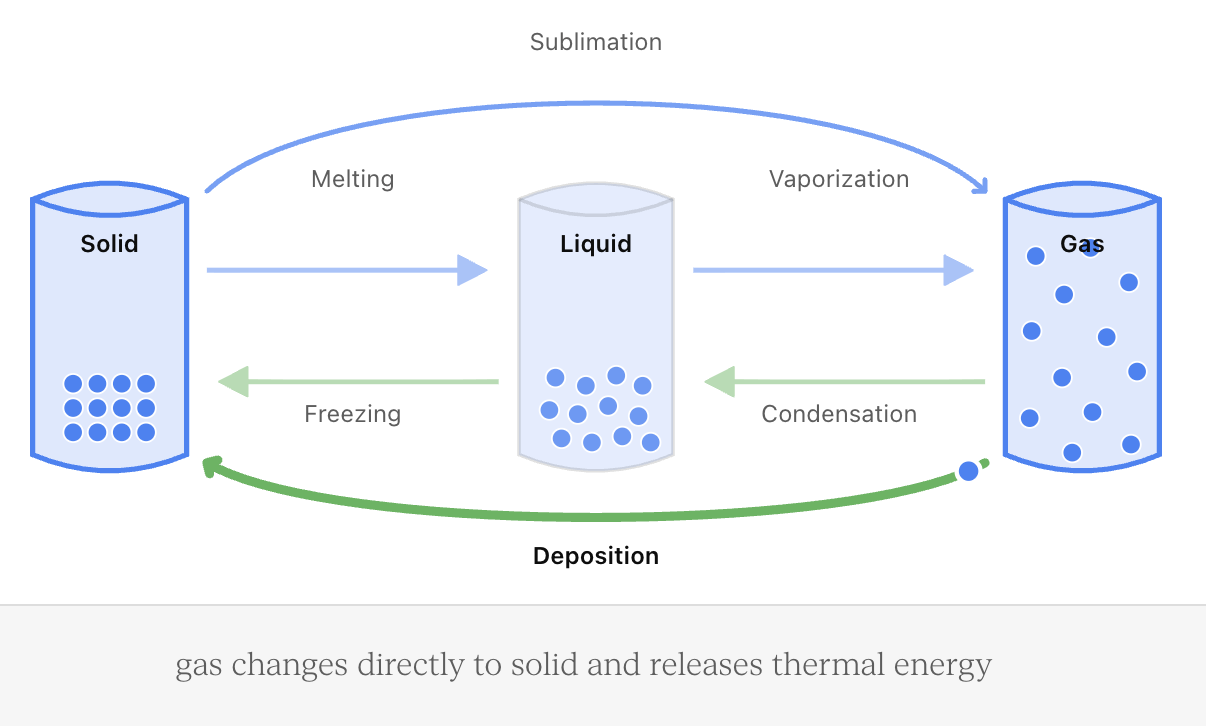
2. Latent Heat and Phase Changes

Learning outcomes
  • I can distinguish between sensible heating and latent heating.
  • I can explain why temperature remains constant during a phase change.
  • I can describe the processes of melting, freezing, boiling, condensation, sublimation, and deposition.
  • I can calculate the energy required for a phase change using latent heat.
  • I can relate evaporation and condensation to latent heat transfer.

Latent Heat and Phase Changes

Sensible Heating and Latent Heating

When thermal energy is transferred to or from a substance, two different things can happen:

  • its temperature can change
  • its state can change

These processes are described as sensible heating and latent heating.

Sensible heating occurs when energy transfer changes the temperature of a substance without changing its state.

For example:

20°C liquid water → 60°C liquid water

The water remains liquid, but its temperature increases.

The energy transferred can be calculated using:

Q = mcΔT

Latent heating occurs when energy is transferred during a change of state without changing the temperature.

For example:

0°C ice → 0°C liquid water

Energy is absorbed, but the temperature remains constant while the ice melts.

https://images.openai.com/static-rsc-4/FAd0KuMAKeLnrbtPEbYH-F0aZpxMUqpZKeukkY26C_24VfpZgDnrO8tZd7HUTEun9AHBE8QQZWwGAv0MHVv-r4rakXPfPs56vjxod3DU-8YMxuSAWUJZJCxny2tCji-zVSvHkYO3gKoacXkx01E5oVdHhb1QGriBBEV9RLqgXToPphpMUaelutA3zlwJpkM5?purpose=fullsize
 
https://images.openai.com/static-rsc-4/GF2Y-CMc6tCZq1DgRxY2O_7P1IMBpAOChHCkljel8byk1jgCEQGP9xIjMMAP47H-0E5mAUipgDA5In1ysZGT7N4F1dhMpqrbe4nb64QaYVL-6xvAk2_bKuYlAZmHrOUepP0wyvaLk5lyGaxni7pTMZvcraHhGQIJdiIZR9vS8wnnVNBgnBchovba3x0qI_AT?purpose=fullsize
 
https://images.openai.com/static-rsc-4/2vH0gzCbRtyG2FSulr3ojJME7_T8HMLF0mNosVdLhQLyiPpwL0ktrSkZ6DwVUhpTdtwVgkrpX9_FDfUgmnMQL-DlD7opUqA-JevSH1zORofyp1qQxBDwJTjHXofFDTnUewsyFVn4VLWSVG6BDFuWWmKfpJRMhHP8YyanCAbSFqycHrg4UIZBByoZzEuCy6sm?purpose=fullsize
 
8

Why Temperature Remains Constant During a Phase Change

Temperature is related to the average kinetic energy of particles.

During ordinary heating within a single state:

energy added → average kinetic energy increases → temperature increases

During a phase change, however, the transferred energy is used mainly to change the potential energy associated with interactions between particles.

For example, when a solid melts, energy is required to overcome some of the forces holding particles in their fixed arrangement.

Therefore:

energy is transferred

but:

average kinetic energy does not increase significantly

so:

temperature remains constant during the phase change for a pure substance at constant pressure.

Once the phase change is complete, further energy transfer can again increase the temperature.


Changes of State

Matter can change between solid, liquid and gas.

The six major changes are:

Phase change Change
Melting Solid → Liquid
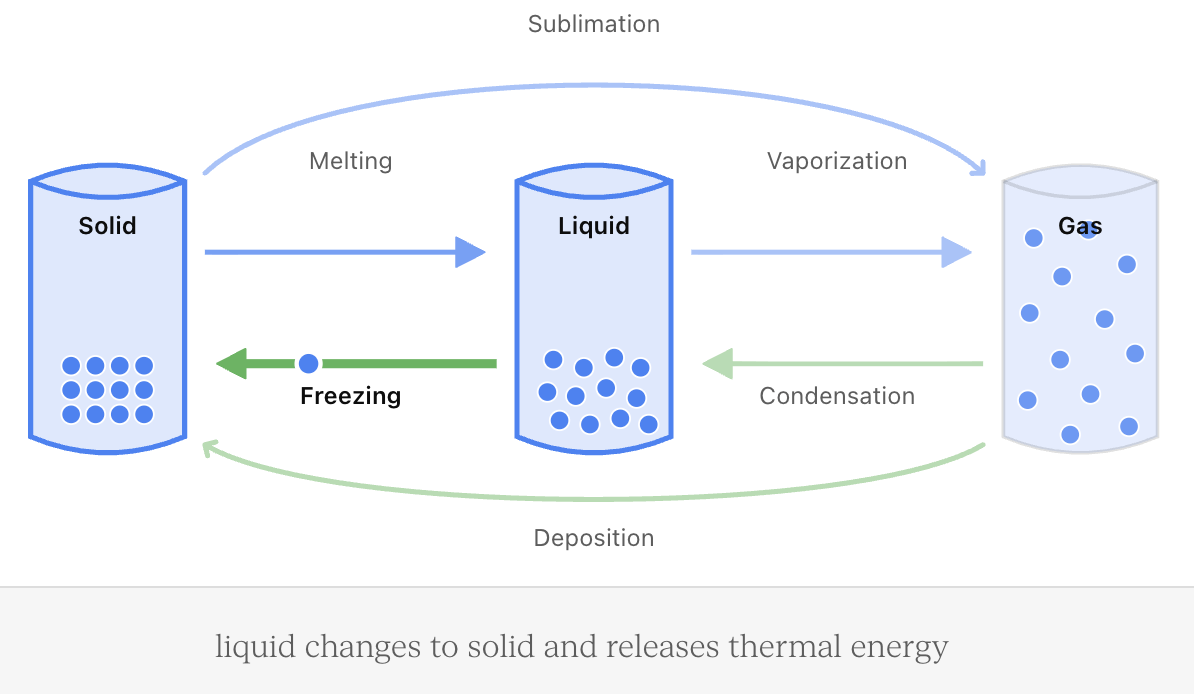
Freezing Liquid → Solid
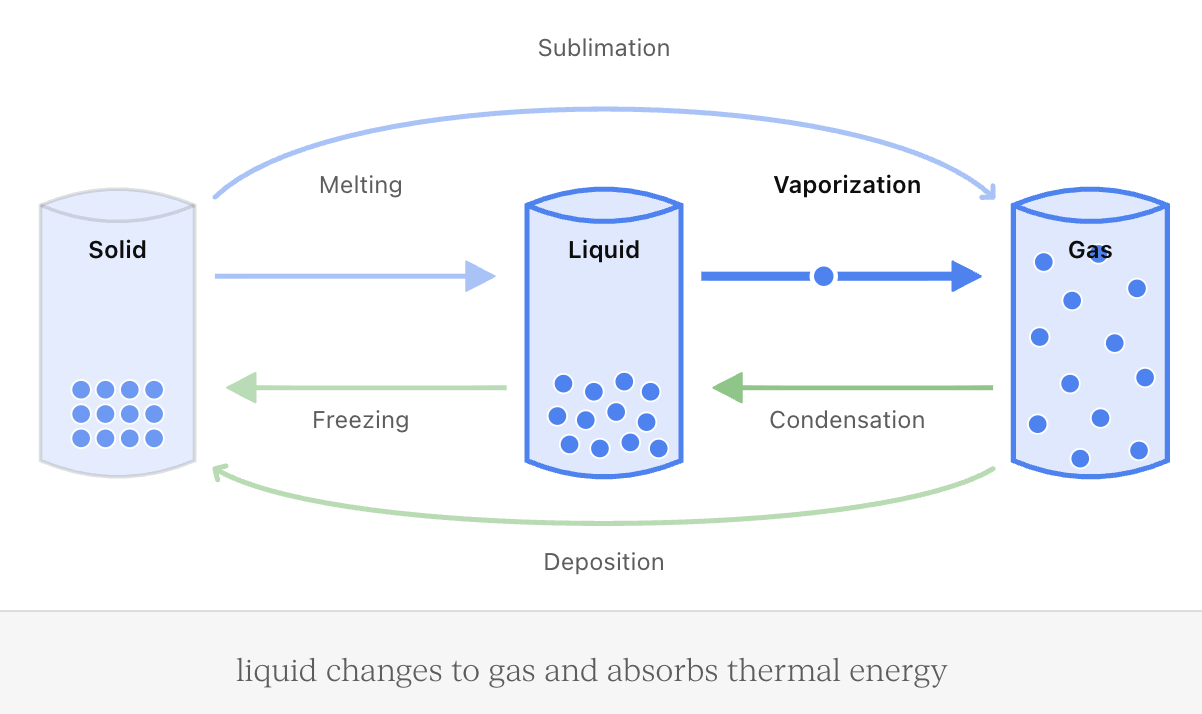
Vaporization Liquid → Gas
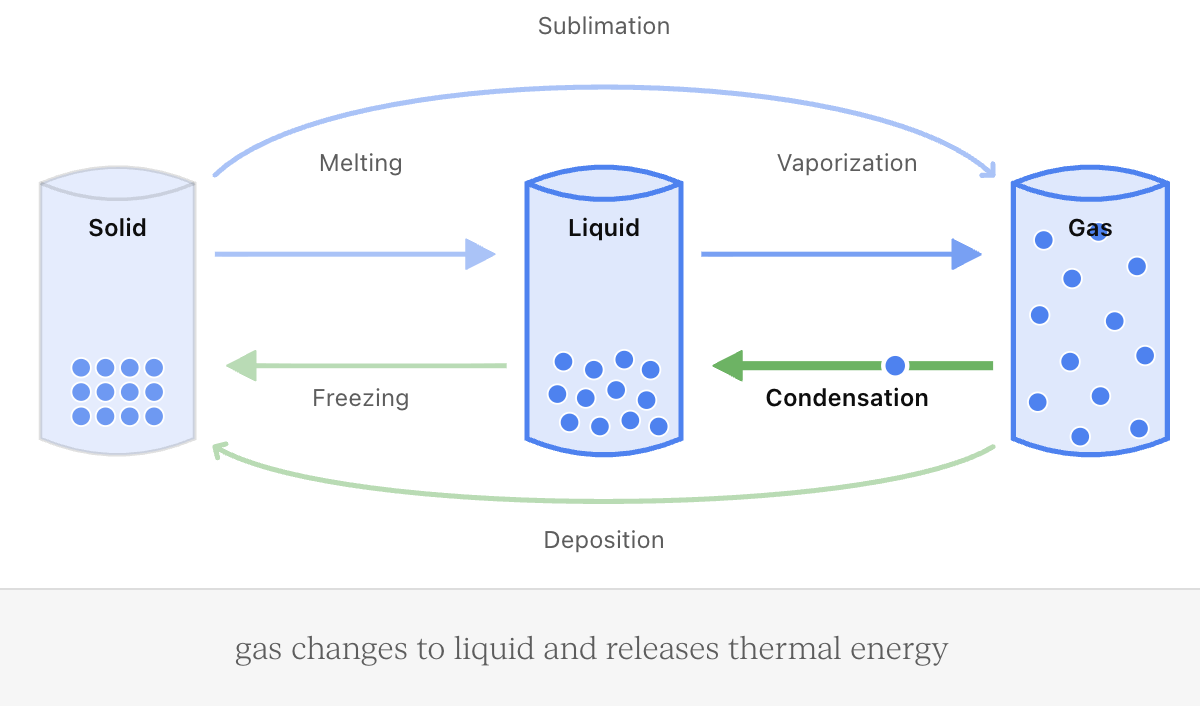
Condensation Gas → Liquid
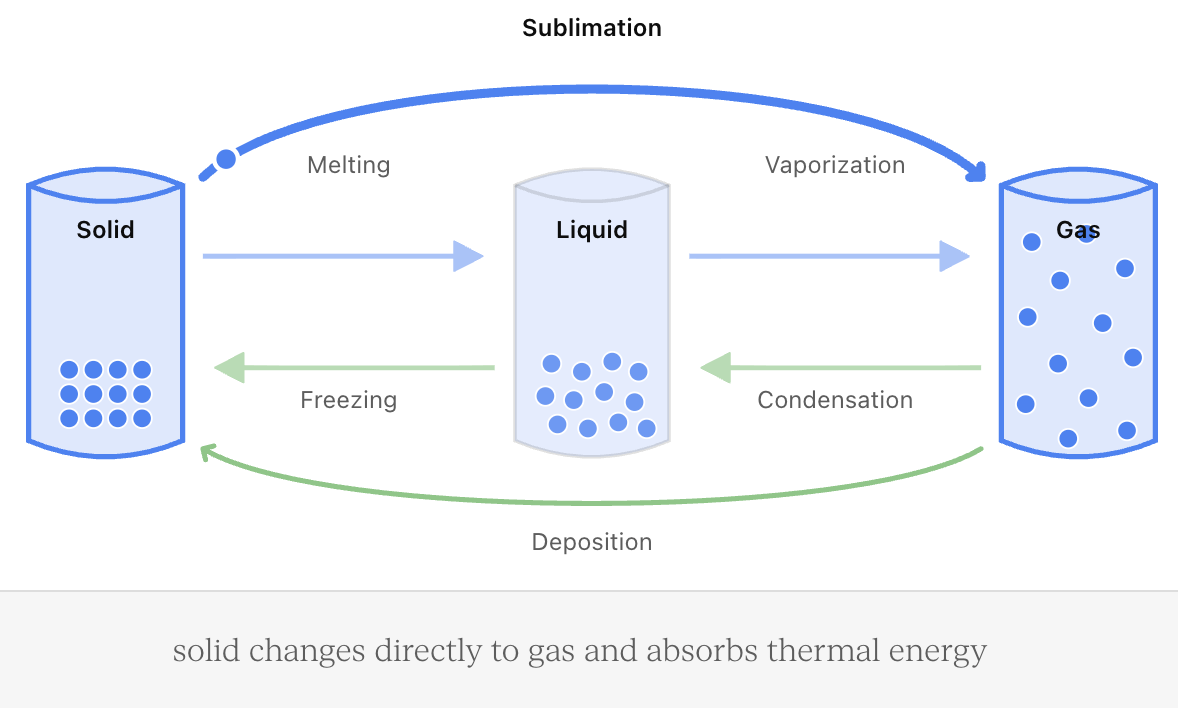
Sublimation Solid → Gas
Deposition Gas → Solid

The complete cycle can be explored here:
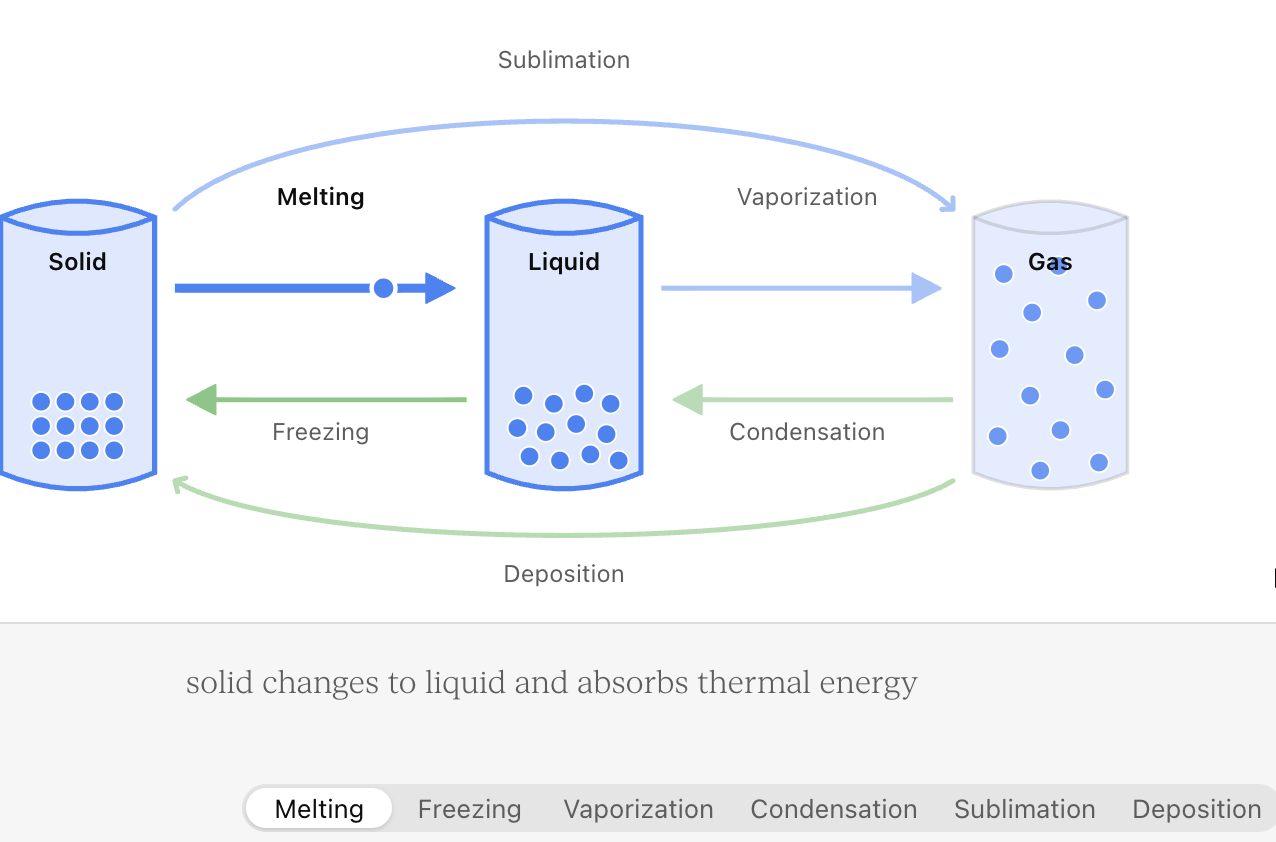
Some changes require energy to be absorbed, while others release energy to the surroundings.


Melting

Melting is the change:

solid → liquid

During melting, the substance absorbs energy.

In a solid, particles vibrate around relatively fixed positions. As energy is supplied, particle motion increases until the melting temperature is reached.

During melting itself, additional energy helps overcome interactions maintaining the solid structure.

The particles become able to move past one another, forming a liquid.

https://images.openai.com/static-rsc-4/g0KwK2zOTBVx7rUc2mZLLUYWDN6-BTRdsO3P6jPF3cxgbMBu5c97ESjaSxapnDVuvF2LgqxHdoM6zGYpMnX5AZELyym4hWWln3IqYp-FFyPfRJ9OwJ9XSnXKlNpbkiVvs8oKb_9Xt3r5qpxnfDbpWa7gnwKgehWDl8BtRGb2yoPKJxg9UUdVR-js7qJKRB8Z?purpose=fullsize
 
https://images.openai.com/static-rsc-4/1J5zy7-DvljgzuMXSj0zlzMSlg83nE32npn28fgMlJ7qFuh7dRzBksw4HrJQIeY9QXbOWiU0vONBAFFSIkFdNUZzfBcwqHATMpWhmRHcraVHe-HVhDjAFmqyTcM5IvxNX-7RqJYHhhXbIsvLARvucwaZBK6-ufW0pAcH-RAEUdlhRRgZGHzImF48SwWKxXPF?purpose=fullsize
 
https://images.openai.com/static-rsc-4/Xqs03qtk2au15nV1vLR1jHjLAaQmvE_GEa3_mA41rqOyBoKAV2yzXXXI8wdqVpjL570W3XrUCLsXTUd3QGAAzvoNB9XrRD3x6n6fIjL1zHHHkVccvd93HXwZICGseK0sOdV3HuLMxXLP6bkou3_Npg5EC2wSPsqQJ_LWJ8cu6zhEkkoYlujfwwAyHXRQyj7I?purpose=fullsize
 
9

For pure water at standard atmospheric pressure, melting occurs at approximately:

0°C

During the melting process:

temperature remains approximately 0°C until the ice has melted

even though energy continues to enter the system.


Freezing

Freezing is the reverse process:

liquid → solid

During freezing, energy is transferred from the substance to the surroundings.

Particles become more organized into the structure of the solid.

For pure water at standard atmospheric pressure:

liquid water at 0°C → ice at 0°C

The temperature remains approximately constant while freezing occurs.

This means freezing water releases energy even though its temperature is not decreasing during the actual phase change.


Boiling

Boiling is a form of vaporization in which:

liquid → gas

throughout the liquid.

At the boiling point, bubbles of vapor form inside the liquid and rise to the surface.

Energy supplied during boiling is used to separate particles and move them into the gas phase.

https://images.openai.com/static-rsc-4/JH4kVgA9DH8ppV95mUI4SnrbhyNEqDHTTyOaH9jh88MwrcxjXezbqh22n9sIvIriaRCzRlfC5isxrG5CSnasTZ0o7wCy10UuElCp1VMq7rLj1TzGUqK0dbpoAI5JgL_V8chS_iiBKx7rvtWE1YlBKn1oeVIY9k4uF0X7cCPXDJdkU1qHjM-u80MXodXhs8hX?purpose=fullsize
 
https://images.openai.com/static-rsc-4/-XkEcwFVG74a1OuxNfJLyuTZU6rC2hsVE5e3L2NWcjT4KD-WZ9iFUx0UpYx0tOf1bjbEoDLEOZsz4mmZf_PN5svEAbWe6x6MieL7Bx9LNNV8uDjwNXKLBvtcquwNjgPFFYngYEKz7EPCzKnz82yuxr2e0sRJFOPcWwEMngE25ET2la2A3TN4-rXuaPsv9W6K?purpose=fullsize
 
https://images.openai.com/static-rsc-4/5cA4HDVC2AboU-iMZlHgiOGWdxm1Ff87TttQIOog3m1jqLAzK51qgBdTiY7smyh_pS8OJNI8BJQ-i4G8xhfUiG18xyqFlCUqvssEWr3Ceeaq44z9MqdysGZpRuE2EmrLWo_-bmYuV6UNsrXCBv65TD5b5J17r2YR6xA0GK4qCXqqnkBU_iXeyVn_eM3aCyv2?purpose=fullsize
 
8

At standard atmospheric pressure, pure water boils at approximately:

100°C

Once boiling begins, continuing to supply energy does not necessarily make the liquid water hotter.

Instead, the energy converts more liquid into vapor.

Only after all the liquid has vaporized can additional heating increase the temperature of the vapor.


Condensation

Condensation is the reverse of vaporization:

gas → liquid

During condensation, particles move closer together and energy is released to the surroundings.

For example, water vapor can condense into droplets on a cold surface.

The water vapor releases latent heat as it condenses.

This is important in:

  • cloud formation
  • weather systems
  • refrigerators
  • air conditioners
  • distillation
https://images.openai.com/static-rsc-4/445mMcrZbx6fRvWhZhVrYVfhfv9Ct7G-ms7rNou2BCdKhysTupViTUQWfnU4hGEMonuBqPjUV2y1xeErP8zW_UDtLqoCI3b1b3Rpbtxn93vU5SJiuanm1yuo1J_SCW28Bmd1uMUzNirnUxjY7uSB8BB3AQWtWBuMh52D4_RT02qHV38y0bkH43NSk5azpzHJ?purpose=fullsize
 
https://images.openai.com/static-rsc-4/pgyYP8KeIEy4sqEHChtvkct3l-c76cAE0Ztvahvn9n3ot1771y8x16KUaOQEKzGtzRUExo8i3v7IATnuGukzTE2hOti624FQKWDt6EQAykDwrdWqYhN70DZf3FqjladXZUrFMIVT554ed_G5E40eOYBK_0a2W339_xbtNyfoaJU_iMZe-KY4-4Q_7UF0XNG7?purpose=fullsize
 
https://images.openai.com/static-rsc-4/38L0uymS9J9F18iJfZRfJjAl7q1etLrbMxrYeLN_L2KSzHsS-d_tLdi8wDmJkwXx5MCcQcPh1qU-_svUdZcnyNC98FBovacnbalyOvaoicFafgfxgYDkqDXksZkq45IYJYpBr9Zm4cKrOqIUDY6Z3Iew0g1HYfOhJqgTi3YXDOwNX8QvC2b1dapsdrcfmBo3?purpose=fullsize
 
7

Sublimation

Sublimation occurs when a substance changes directly from:

solid → gas

without first becoming liquid.

Examples include:

  • dry ice
  • some solid air fresheners
  • iodine under suitable conditions
  • ice and snow slowly disappearing in cold, dry conditions

During sublimation, the substance absorbs energy.

Dry ice is solid carbon dioxide. At ordinary atmospheric pressure, it sublimates rather than melting into liquid carbon dioxide.


Deposition

Deposition is the reverse of sublimation:

gas → solid

without passing through the liquid state.

During deposition, energy is released.

A familiar example is frost.

Under suitable conditions, water vapor in the air can form ice directly on a cold surface.

water vapor → ice

https://images.openai.com/static-rsc-4/k06OTKGz5fgZlg516_JHNuQ0D3n8UCzKZ1MZJx35ezD-VmgkjDxF8b7dDKKlgAGDm1BQ58ETIDGt0Ie0qPqh2JTd0A9wetJCqhl8KLnfGpGmzLzqCJPpgUuF5Fk3o0NPeCv685SluEomRx8txVf9ojNyl8nv67-yhO3zdTVuAz7qJHc-eIRga1VwWs22-0dj?purpose=fullsize
 
https://images.openai.com/static-rsc-4/1meUNnGjjEYWsbWjd7ER8cbgS1W07fMM9ENQtxq95BT_6_2ygt2rv_youNLK6qeQy8ImoqVl7sPoSZcMlBy1xTQnYKDBrwq2n0s3sAMBxEP-TbdJ5fIy-lDgVEGw1dvrl-WLgRy0vLOYacz3N9FL4FO2_nYaMHhiPY3K9rxvOoHbFmFkKAB2tWW3RhuWVUm9?purpose=fullsize
 
https://images.openai.com/static-rsc-4/zGV-DV-NYhXD3sRlWgD9sHKR15KbFJBAHi_wsWG7Twt4VKOU87xzw0YpxxwNwugVUBDrSzpGrioGmnvKUOS4tyM78IHB_6Hw7yAr7lCMQOowpPI4_YPrpSgJJ86qFhnXDYLj163dhG-peMLxuhkkPonFpNyrx5euRtX3BlNxCCoEQdK7Z32SBwwV6lQDUzWU?purpose=fullsize
 
7

Energy Absorbed and Released

The six phase changes can be divided according to the direction of energy transfer.

Energy Absorbed

These changes require the substance to gain energy:

solid → liquid
melting

liquid → gas
vaporization

solid → gas
sublimation

The particles become less strongly bound and generally more widely separated.

Energy Released

These changes release energy:

gas → liquid
condensation

liquid → solid
freezing

gas → solid
deposition

The particles form stronger interactions as they move into more condensed states.


What Is Latent Heat?

The word latent means hidden.

Latent heat refers to energy transferred during a phase change without a corresponding temperature change.

The energy required for a phase change depends on:

  • the mass of the substance
  • the substance involved
  • the type of phase change

The relationship is:

Q = mL

where:

  • Q = energy transferred, in J
  • m = mass, in kg
  • L = specific latent heat, in J/kg

Specific Latent Heat

Specific latent heat is the energy required to change the state of 1 kg of a substance without changing its temperature.

There are different types of specific latent heat.

Specific Latent Heat of Fusion

The specific latent heat of fusion is associated with:

solid ↔ liquid

For water:

L_f ≈ 334,000 J/kg

This means approximately 334,000 J is required to melt 1 kg of ice at 0°C without changing its temperature.

Specific Latent Heat of Vaporization

The specific latent heat of vaporization is associated with:

liquid ↔ gas

For water near its normal boiling point:

L_v ≈ 2,260,000 J/kg

A much larger amount of energy is required to vaporize water than to melt the same mass.


Worked Example: Melting Ice

Calculate the energy required to melt 2.0 kg of ice at 0°C.

For water:

L_f = 334,000 J/kg

Use:

Q = mL

Q = 2.0 × 334,000

Q = 668,000 J

Therefore:

Q = 668,000 J

or:

Q = 668 kJ

Notice that the ice remains at approximately 0°C during the melting process.


Worked Example: Boiling Water

Calculate the energy required to convert 0.50 kg of water at 100°C completely into steam at 100°C.

Use:

L_v = 2,260,000 J/kg

Q = mL

Q = 0.50 × 2,260,000

Q = 1,130,000 J

Therefore:

Q = 1.13 × 10⁶ J

or:

Q = 1.13 MJ

This large value explains why converting liquid water into vapor requires substantial energy.


Worked Example: Finding Mass

A heater transfers 167,000 J of energy to ice at its melting point.

If:

L_f = 334,000 J/kg

calculate the mass of ice melted.

Rearrange:

m = Q/L

Substitute:

m = 167,000 / 334,000

m = 0.50 kg

Therefore, 0.50 kg of ice melts.


Heating Curves

A heating curve shows how the temperature of a substance changes as energy is supplied.

https://images.openai.com/static-rsc-4/aA5M98xIjM80w6-9gIS27YMx5IMQnvgq8DXZq7pDJDjTVAe8wLp0Od04q1WJUGuDL8D7eBiKnI_XRSp2Spu5pV1cxbeFE4wHNamegydnJqAs-GJ3fMPT6TLf-KZlqz31Sv61MC_VMhKVT3KT8D51346ske_RT-2KXltslf_q2dIbBs5o9AaSxGsI2t3zgMk7?purpose=fullsize
 
https://images.openai.com/static-rsc-4/0OS5WAnS-CM5KrpWRAHcisi_OiDVTsz7xPsejsIh0yI13PUPWqcmBbZIfoLYc_HNuxDAgsFvj1WIBFWDP5XDHOorYecjD34mxQcgdKglit-9UiGK2WuRybNt4y3y_1bIKJPWW3lo_3WpOBtpnShzUGFnybOCDHhh3MuXYtWwZ5GYb7OUiqvQud7-1Uxd0Qul?purpose=fullsize
 
https://images.openai.com/static-rsc-4/cmIJHWrTAm1FTx5q-loekdrTE79u9xWlLqmcEnWhw7MZmF3vI9SWxNOqg9TOBB7lhqel9CAzHzZphT01v42VZfb4UfW1d7LxfCRw6uqx_wBvmVvAt0kiYjNaMaLKBdTbQuN_BtHkt8YB5iYsa8ghOK_O4ODjfaVnOuyl0JuhKQknmQb0GmB93IbQpIjwookp?purpose=fullsize
 
7

A typical heating curve contains sloping and flat regions.

Sloping Regions

The substance remains in one state.

Energy increases the average kinetic energy of the particles.

Therefore:

temperature increases

This is sensible heating.

The energy can be calculated using:

Q = mcΔT

Flat Regions

A phase change is occurring.

Energy changes the arrangement and interactions of particles rather than increasing their average kinetic energy.

Therefore:

temperature remains constant

This is latent heating.

The energy can be calculated using:

Q = mL


Multi-Stage Heating Problems

Some problems require both specific heat capacity and latent heat.

Suppose ice at −10°C is heated until it becomes liquid water at 20°C.

There are three stages.

Heating the Ice

ice at −10°C → ice at 0°C

Use:

Q₁ = mc_iceΔT

Melting the Ice

ice at 0°C → water at 0°C

Use:

Q₂ = mL_f

Heating the Water

water at 0°C → water at 20°C

Use:

Q₃ = mc_waterΔT

The total energy is:

Q_total = Q₁ + Q₂ + Q₃

This approach is essential whenever a problem crosses one or more phase changes.


Evaporation and Latent Heat

Evaporation occurs when energetic particles escape from the surface of a liquid.

To escape, these particles require energy.

This energy is associated with the latent heat of vaporization.

When higher-energy particles escape:

  • energy leaves the liquid
  • the average kinetic energy of the remaining particles decreases
  • the liquid cools

This is evaporative cooling.

https://images.openai.com/static-rsc-4/B2A9a0WC51iO4L1vauRL-QQYP-g0e4MNx53PmBJR5-uscTdKCCvEvYldt8MkOknbKxmZ7o_bpcGRN91d-Y2jtGWOmZG8R92FJQjQZpnubX8gwyGUQq5-P_pgfhZqRHzvNjcuYhyZgywn17D0KOirKTJ1FMVkUc980ODSWaeadghG_dypUEExGw-jB7QUVYWV?purpose=fullsize
 
https://images.openai.com/static-rsc-4/2RCF2qVZ4LYBDRLBDc0L2Gc2egg1efL2D-1SiKwiTVELnR032S2g7gbBecZZ5Uemct798wqnjsqvs7ED6fLtm6Z8wCd5S7Tef7nFio8ravJdhp4aUqOBPfUFKBEh2jM9lBqhIapmzokkSRkj-jK2CWnCf0XvEuHTuOFRRhYPMdZ8NMeWpXLGtvvlhbmRx62C?purpose=fullsize
 
https://images.openai.com/static-rsc-4/eU8sBkoBaSaBAlvRJSCsDm6RNQGxj4kvrjMa1fe6Dmub_yw3mzvvI3O04W0nmeL3V5UResN1nDCru0FXv455AGMLFoZ4yxv2SA_GDW_xurSrbrTZ3Wr8kZBt8g--pbaZ5ltn4ymbmwdL5eQABwnXuj71jN_Y-oB30DWeuE4M5KMjkFw-oN8pBTZ2bEHE2CHe?purpose=fullsize
 
7

Sweating and Latent Heat

Sweating is an important application of latent heat.

Sweat spreads across the skin and evaporates.

The phase change is:

liquid water → water vapor

Energy is required for this change.

That energy is transferred partly from the skin.

Therefore:

skin loses thermal energy → skin cools

The effectiveness of sweating depends on whether the sweat actually evaporates.

Sweat that simply runs off the skin provides much less evaporative cooling.


Why Humidity Matters

Evaporation occurs more slowly when the surrounding air already contains a large amount of water vapor.

Therefore:

high humidity → slower evaporation → less cooling

In dry air, sweat can evaporate more rapidly.

This allows more latent heat to be transferred away from the body.

Wind can also increase evaporation by removing humid air from close to the skin.


Condensation and Latent Heat

Condensation does the opposite of evaporation.

During:

gas → liquid

latent heat is released.

This is extremely important in the atmosphere.

When water vapor condenses to form cloud droplets, energy is released into the surrounding air.

https://images.openai.com/static-rsc-4/cXa5aYilRZrrqNTjcrgfGkbQ4IEnCtmkhFW22O7Du5UB9F_9pc2jiqULk1pcp6vpV-OB9DD9_BKiV5kUJ9g-rYypZOulqYqR7yS2CMBh9M1KYTZRpyOMfFqZTk_PV7htFultULkgPYscnpb1vCiSnfdhgLKNNYbEnfTmLu3RS0i4rN1OpxhNoycJgSXJy2Sm?purpose=fullsize
 
https://images.openai.com/static-rsc-4/CEjaKEQ-M_C3Obm32sCe78cmOj2g7Q2JO1Z2NlAO5X7xm9R8K6k1BHMp27lrKw-b8X-RfiEyYXpBPauXZ99nXTr1B5bUbeYJXJRQMH1-fnNBLlfhB5yiVmhgITFxasJ6GvX8_TyZtIqCkJkYLDsqSnOCT7ddDaRvVm94KHUAQZe8LcBQDoGZD-TAlJOm_Iud?purpose=fullsize
 
https://images.openai.com/static-rsc-4/QwOfbmX73Y_xZl6WDSAHnZeGf733l3sX01G9eDUefZ6bsEY1okll54Vx_6xgcBgp0DG2E009xpHLWlBDiQm3knTzBB-tKFPrs82hAXTVK9bh-KbKkcHvBHhBWE1C1UxeJsxGLNxdCxHO5tmw7R8uonpHr9Xl77GVX2LZonLe-tGUhkFiWst7tlR2ztN4DI6O?purpose=fullsize
 
10

This released energy can contribute to atmospheric convection and the development of powerful weather systems.

Latent heat therefore plays an important role in Earth's weather and climate.


Refrigeration and Air Conditioning

Refrigerators and air conditioners deliberately use evaporation and condensation.

A refrigerant circulates through the system.

Inside the cooled region:

liquid → gas

The refrigerant evaporates and absorbs latent heat.

Outside the cooled region:

gas → liquid

The refrigerant condenses and releases latent heat.

https://images.openai.com/static-rsc-4/MdrRGKMElroMpu93S33eYmmMGujA3tfwcVxVOpf3k4mSv7c7pltsskiw4tHY2-T8z89k5kWBlIB0FuDikipAVSS6xqCzJIHBzW8uHnyt6G_EYjUEGX1KQMWOkUx6JPHOtIjdMUYAyE7J01_WRG_ebpdv6ZUx9ImBb97quJAlTNCQxe0cCFDlEyGxctAkHXgE?purpose=fullsize
 
https://images.openai.com/static-rsc-4/Qouy7_9vuR2KTdWmiwFA4-6u0feQEX_NoZExIV3gtfIGiTWOZWxeGECkyXo3C2UxDXTOSBF0AI-Pawdey9f_qCt_Z2WnkDpki39JSrebUu9LJcZwqxwWfphb1divcDPuMni26w8-GvEpp24z7K-5tp0t4WxSpbCkerNC3P0FM13BSUPiVRLmpGmfz_ua_Hjn?purpose=fullsize
 
https://images.openai.com/static-rsc-4/Rbaw-p-9vxyeU5YapzuuFHqBtRKrE7aeAsAic-eWzGNGQ9I74rCZG25i8VgfnGRxbB321aRkMyn8TqN7lb0zh4UBQdHlqlOFctRRtCn4PhdOodflEtmRLG7UYDtIiXV-YUG5ig0vpH6ScuCoi5PecJlSpxsRyxi48qnQVPau_ELMgjXsnsMTJyRRBxPZrmcR?purpose=fullsize
 
7

A compressor and other components allow this cycle to operate continuously.

This allows thermal energy to be transferred from a cooler region to warmer surroundings using external energy.


Steam and Thermal Energy

Steam can transfer very large amounts of energy because water has a high specific latent heat of vaporization.

When steam condenses:

steam → liquid water

a large quantity of latent heat is released.

This makes steam useful in:

  • industrial heating
  • power stations
  • sterilization
  • some heating systems

It also makes steam burns potentially serious because condensation can transfer substantial energy to the skin.


Melting Ice as a Cooling Method

Ice is effective at keeping food and drinks cold for two reasons.

First, ice is cold.

More importantly, melting ice absorbs substantial latent heat.

At approximately 0°C:

ice + energy → liquid water

The energy used to melt the ice does not initially raise its temperature.

Instead, it changes the state.

This allows ice to absorb a considerable amount of energy while remaining close to 0°C.


Sensible Heat vs Latent Heat

Sensible Heating Latent Heating
Temperature changes Temperature remains constant during the phase change
State remains the same State changes
Mainly changes particle kinetic energy Mainly changes particle potential energy/interactions
Use Q = mcΔT Use Q = mL
Example: water 20°C → 60°C Example: ice 0°C → water 0°C

Both involve energy transfer, but the effect of that energy is different.


Common Mistakes

Mistake: "If energy is being added, temperature must increase."
During a phase change, energy can be absorbed while temperature remains constant.

Mistake: "Particles stop moving during a phase change."
Particles continue moving. The transferred energy is primarily changing their interactions and arrangement.

Mistake: "Latent heat is stored heat that cannot be measured."
Latent heat refers to energy transferred during a phase change without a temperature change.

Mistake: "Boiling and evaporation are identical."
Both involve liquid becoming gas, but boiling occurs throughout the liquid while evaporation occurs at the surface.

Mistake: "Condensation absorbs latent heat."
Condensation releases latent heat.

Mistake: "Use Q = mcΔT during melting."
During the phase change itself, use:

Q = mL

Mistake: "Temperature difference is needed in Q = mL."
There is no ΔT in the latent heat equation because the temperature remains constant during the ideal phase change.


Key Terms

Sensible heating — energy transfer that produces a temperature change without a phase change.

Latent heating — energy transfer associated with a phase change without a temperature change.

Phase change — physical change from one state of matter to another.

Melting — change from solid to liquid.

Freezing — change from liquid to solid.

Vaporization — change from liquid to gas.

Boiling — vaporization occurring throughout a liquid.

Evaporation — vaporization occurring at the surface of a liquid.

Condensation — change from gas to liquid.

Sublimation — direct change from solid to gas.

Deposition — direct change from gas to solid.

Specific latent heat — energy required per kilogram to change the state of a substance without changing its temperature.

Specific latent heat of fusion — energy per kilogram associated with the solid–liquid phase change.

Specific latent heat of vaporization — energy per kilogram associated with the liquid–gas phase change.

Heating curve — graph showing how temperature and state change as energy is supplied.


Key Takeaways

  • Sensible heating changes temperature without changing state.
  • Latent heating changes state without changing temperature during the phase change.
  • Sensible heating calculations use Q = mcΔT.
  • Phase-change calculations use Q = mL.
  • Temperature remains constant during an ideal phase change because energy changes particle interactions and potential energy rather than average kinetic energy.
  • Melting, vaporization and sublimation require energy to be absorbed.
  • Freezing, condensation and deposition release energy.
  • Specific latent heat is measured in J/kg.
  • Water has a large specific latent heat of vaporization, so vaporizing or condensing water transfers substantial amounts of energy.
  • Evaporation removes energy from a liquid and can produce cooling.
  • Sweating uses evaporation and latent heat to cool the body.
  • Condensation releases latent heat and is important in cloud formation and weather.
  • Refrigerators and air conditioners use evaporation and condensation to transfer thermal energy.
  • Multi-stage heating problems may require both Q = mcΔT and Q = mL.

Check Your Understanding

  1. Explain the difference between sensible heating and latent heating.
  2. Why does the temperature of melting ice remain approximately constant even while energy is being supplied?
  3. Identify the phase change: solid → gas.
  4. Which phase changes release energy to the surroundings?
  5. Calculate the energy required to melt 0.75 kg of ice at 0°C if L_f = 334,000 J/kg.
  6. Calculate the energy required to vaporize 0.20 kg of water at 100°C if L_v = 2,260,000 J/kg.
  7. Explain why evaporation causes cooling.
  8. Why is sweating less effective at cooling the body when humidity is high?
  9. Explain why condensation releases energy to the surroundings.
  10. Why can steam transfer a large amount of energy when it condenses?
  11. Explain why ice can keep a drink close to 0°C for a considerable time while it melts.
  12. A sample of ice starts below 0°C and is heated until it becomes liquid water above 0°C. Identify the stages that require Q = mcΔT and the stage that requires Q = mL.