1. Specific Heat Capacity

Learning outcomes
  • I can define specific heat capacity and explain what it represents.
  • I can explain why different substances heat and cool at different rates.
  • I can calculate the thermal energy gained or lost by an object using specific heat capacity.
  • I can identify the factors that affect changes in temperature.
  • I can apply specific heat concepts to everyday situations and scientific problems.

Specific Heat Capacity

What Is Specific Heat Capacity?

Different substances require different amounts of energy to change their temperatures.

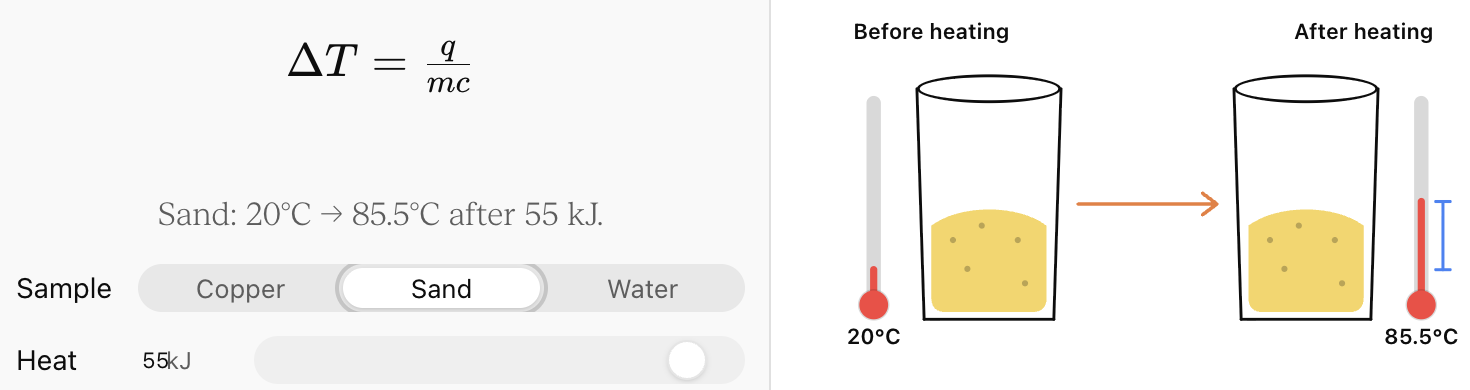
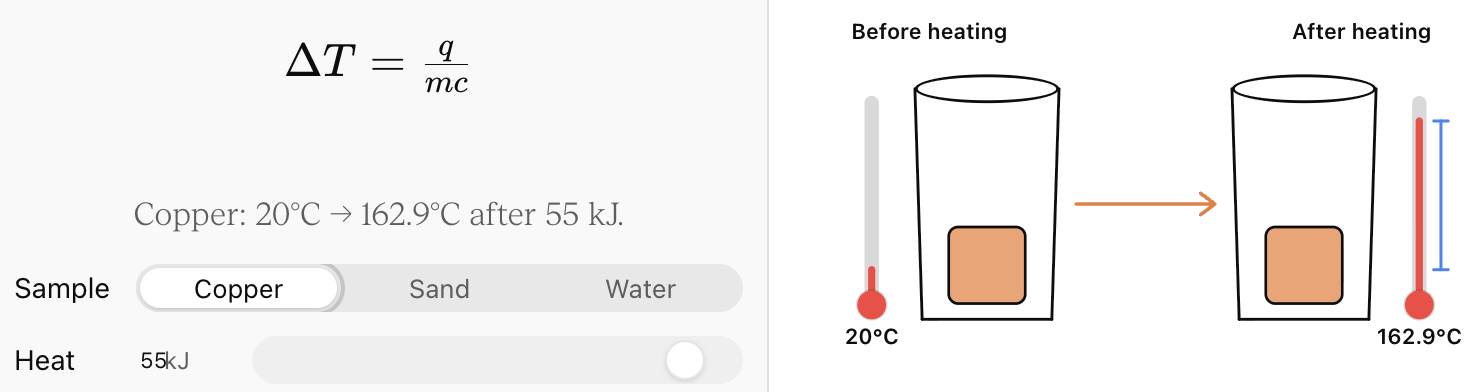
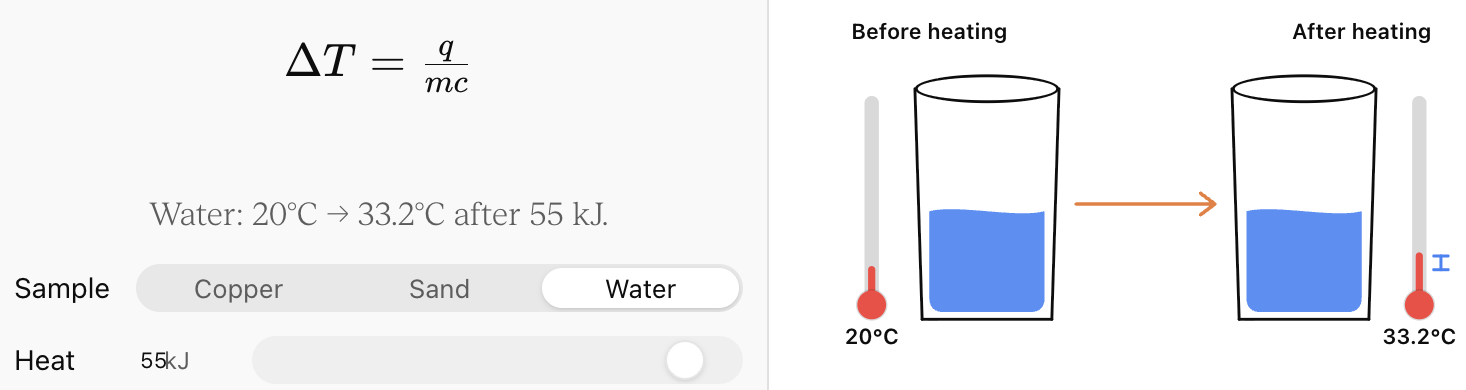
For example, if equal masses of water and metal receive the same amount of thermal energy, the metal will usually experience a much larger temperature increase than the water.

This difference is described using specific heat capacity.

Specific heat capacity is the amount of energy required to raise the temperature of 1 kg of a substance by 1°C (or 1 K).

The symbol for specific heat capacity is:

c

Its SI unit is:

J/(kg·°C) or J/(kg·K)

A material with a high specific heat capacity requires a large amount of energy to change its temperature.

A material with a low specific heat capacity requires less energy to produce the same temperature change.

https://images.openai.com/static-rsc-4/SujYoBlAfeUXPZ5Vu4qpXw6On0rXScqikp4fcMpgbK1Q_B2-XDMob0wGsMMX4lGv3xHA1N_MKeIzVzSGIP3jCb1cGfewwY2O6XZluGqRBmAM2vaRp_r_SKs8mY1MFFHInyb-wiKV8s1PKxcZYVSITu5f_EO9ciN_f4VEx0-vApXnlswBseFJTivkCsggvbna?purpose=fullsize
 
https://images.openai.com/static-rsc-4/4ZwepTbGFqRt6BK9DkghqzjW13kAjWLN8bP_r4_9BjfP_pzegNZ9tOD4Xv3tKGQ8KH6OUYEyEsuoLsT52m2qccusNzu6uVP8lEOi3sT-VAND1Z_sI4h1XCWnyZxtLtl6nadRr4hnY6d5PmYtj-sfFWWZnUKVxpZRcZ-koI5nqqiFsIdxnyQ-u7i22GKt4y6O?purpose=fullsize
 
https://images.openai.com/static-rsc-4/JSozKUUcDQhirO8d-cgoqDAQcrU6LDuHTBWptxEy7wNSRYpz3H5vMSlHcFvfx1oYdis0-oWiuaKqTEwIuj-wRKri8b67HCLkx6VfgL5kcdmh2Ym90G8SGd2fbU5w5akAeJM3AYXmsnq3sClFBMONNvP-OGAbndgvRpwq2F03M8j2lQ845hQ9qQXOoUfxzohm?purpose=fullsize
 
7

Comparing Materials

Approximate specific heat capacities include:

Substance Specific heat capacity, J/(kg·°C)
Water 4200
Aluminium 900
Glass 800
Iron 450
Copper 390
Lead 130

These values show that water has a much higher specific heat capacity than common metals.

For example, approximately 4200 J is required to raise the temperature of 1 kg of water by 1°C.

Only about 390 J is required to raise the temperature of 1 kg of copper by the same amount.

Therefore, if equal masses receive the same amount of energy:

copper temperature changes more

water temperature changes less


Why Different Substances Heat at Different Rates

When energy is transferred into a substance, it increases the substance's internal energy.

Different materials store this energy differently because of differences in:

  • particle structure
  • bonding
  • molecular motion
  • interactions between particles

As a result, the same amount of transferred energy can produce very different temperature changes in different substances.

A high specific heat capacity means:

more energy required for each degree of temperature change

A low specific heat capacity means:

less energy required for each degree of temperature change

This is why a metal pan can become hot relatively quickly while the water inside it warms more slowly.


Calculating Energy Transfer

The thermal energy gained or lost by an object when its temperature changes can be calculated using:

Q = mcΔT

where:

  • Q = thermal energy transferred, in joules (J)
  • m = mass, in kilograms (kg)
  • c = specific heat capacity, in J/(kg·°C)
  • ΔT = temperature change, in °C or K

Temperature change is calculated using:

ΔT = T_final − T_initial

For the magnitude of the energy transferred, we usually use the magnitude of the temperature change.

The same relationship can also be rearranged:

c = Q/(mΔT)

m = Q/(cΔT)

ΔT = Q/(mc)


Exploring the Relationship

The relationship shows that temperature change depends on the energy transferred, mass and specific heat capacity.

For the same amount of energy:

larger mass → smaller temperature change

larger specific heat capacity → smaller temperature change

For the same material and mass:

more energy transferred → larger temperature change


Worked Example: Heating Water

A 2.0 kg sample of water is heated from 20°C to 30°C.

The specific heat capacity of water is:

c = 4200 J/(kg·°C)

First calculate the temperature change:

ΔT = 30 − 20

ΔT = 10°C

Now use:

Q = mcΔT

Q = 2.0 × 4200 × 10

Q = 84,000 J

Therefore:

Q = 84,000 J

or:

Q = 84 kJ

It takes 84 kJ of energy to produce this temperature increase.


Worked Example: Heating Copper

Suppose the same 84,000 J of energy is transferred to 2.0 kg of copper.

For copper:

c = 390 J/(kg·°C)

Use:

ΔT = Q/(mc)

ΔT = 84,000/(2.0 × 390)

ΔT ≈ 108°C

The copper would experience a temperature increase of approximately:

108°C

Compare this with the water, which increased by only 10°C.

This demonstrates the enormous effect of specific heat capacity.


High and Low Specific Heat Capacity

High Specific Heat Capacity

Materials with high specific heat capacity:

  • require more energy to warm
  • release more energy as they cool through the same temperature range
  • tend to experience smaller temperature changes for a given energy transfer

Water is an important example.

Low Specific Heat Capacity

Materials with low specific heat capacity:

  • require less energy to warm
  • require less energy to cool through the same temperature range
  • experience larger temperature changes for a given energy transfer

Many metals have relatively low specific heat capacities.

https://images.openai.com/static-rsc-4/yReb-D_ZxciwiTbXzigyUKf1Are8VYe-XWpwqXXv3cRQff10v8U6pJCgnXJRkrPK40JBVZ1mw0oKOajgMo9phjsnQ-9R2oueVFfpXUbpAwAo6OTAWNEgsO0StgS2XFFUMkIM0w2wwZE029n8gVNreP2CYKF-uwEowRykt9qwyJwLUVUbm5Sbb5GdV3D8YsAT?purpose=fullsize
 
https://images.openai.com/static-rsc-4/SpXMD2J6pfWlbfA6FIj-XAmpmqBfqCFxkxDZbT4BJaCtQlP7skhxy-sXerADGt9M4kU10cFzDESxpV4GG8hO67RB3EAkcDcVvB4g6NHOYI9UyGfZeoZmaJPVcV5JyebS3LhnWebol74k1gOND7PYXV5ZXKbiZvkYDJPn5ANGQgYJGn9cdT-3K_H4eYv9ExPk?purpose=fullsize
 
https://images.openai.com/static-rsc-4/SujYoBlAfeUXPZ5Vu4qpXw6On0rXScqikp4fcMpgbK1Q_B2-XDMob0wGsMMX4lGv3xHA1N_MKeIzVzSGIP3jCb1cGfewwY2O6XZluGqRBmAM2vaRp_r_SKs8mY1MFFHInyb-wiKV8s1PKxcZYVSITu5f_EO9ciN_f4VEx0-vApXnlswBseFJTivkCsggvbna?purpose=fullsize
 
8

Factors Affecting Temperature Change

From:

ΔT = Q/(mc)

we can identify three major factors affecting the temperature change.

Energy Transferred

More energy produces a greater temperature change when mass and material remain constant.

larger Q → larger ΔT

Mass

A larger mass requires more energy to produce the same temperature change.

larger m → smaller ΔT

for the same energy transfer.

Specific Heat Capacity

A material with a larger specific heat capacity requires more energy for the same temperature change.

larger c → smaller ΔT

for the same mass and energy transfer.


Example: Different Masses of Water

Suppose 42,000 J is transferred into two samples of water.

Sample A

m = 1.0 kg

c = 4200 J/(kg·°C)

ΔT = 42,000/(1.0 × 4200)

ΔT = 10°C

Sample B

m = 2.0 kg

ΔT = 42,000/(2.0 × 4200)

ΔT = 5°C

Doubling the mass halves the temperature change when the energy transferred remains the same.


Water and Climate

Water's high specific heat capacity has major effects on Earth's climate.

Oceans can absorb enormous quantities of thermal energy while experiencing relatively small temperature changes.

They can also release large amounts of energy as they cool.

As a result, large bodies of water help moderate temperature changes.

https://images.openai.com/static-rsc-4/_ILlJMlKaXbjK5YpbiIbGKu6c6rai5QjeGtuK3-vr6TUqljSnb223WgGMjfDg-Ts5edhVTSB3WGbMoKPJTCjlD2mWjPfToBm7HK8A9tRYDN8WUG9-jxJJ8Px4AM01KzIlstWoWuzJlLB-STLYVNV72KaearRJNKCk4gGbGjLvCTAfT3A3wd9n7NrApggA365?purpose=fullsize
 
https://images.openai.com/static-rsc-4/EIOPf9NKk9lZED7hoBoLjU0cEVbrt22cahMQz4pY2YvYfvXOn-LLy7KmbAgEeURhL-iD1v0VFLamF7IJqEZzZRJ1aKxQCB_7iBixBKYJ4uM4zYv8g6vyeaeNT5sNA5UGyvHQg8fOXh_C9CmO73aNpc648zzZ2pIYG5og6UmCYqwXp3-0AQjWp69l3CRTrlcW?purpose=fullsize
 
https://images.openai.com/static-rsc-4/Ql6HTu1QJKtqGpx3kZgtC_szZwDoEr2b69VpsCZ_Pn7kGNLoqT1geQpTB-N6_4OyTMArl0x9bKNmr5NnrddjsteJeKj4SY0Fp6X4d9PFAESWExwibNWe8GzjVju31xvygl4xE_FUYWYnA7Ml_vhBBC3eniYGBRPJ8WvnO8XFTJuCKqr6_UD0MaQT00x8ODv9?purpose=fullsize
 
8

Coastal areas often experience smaller temperature variations than inland areas because nearby oceans heat and cool relatively slowly.

Land generally changes temperature more rapidly.


Land and Sea Breezes

Different specific heat capacities also contribute to local wind patterns.

During the day:

  • land warms relatively quickly
  • water warms more slowly
  • air above the warmer land heats and rises
  • cooler air from over the water moves inland

This can produce a sea breeze.

At night:

  • land cools relatively quickly
  • water remains relatively warmer
  • the temperature difference can reverse

This can contribute to a land breeze.

Specific heat capacity therefore connects directly with atmospheric convection.


Water in Heating and Cooling Systems

Water's high specific heat capacity makes it useful as a heat-transfer fluid.

Water can absorb a large amount of energy without undergoing an extreme temperature increase.

It is used in applications such as:

  • heating systems
  • some industrial cooling systems
  • engine cooling systems
  • thermal energy storage
https://images.openai.com/static-rsc-4/FPr6ZI1rnSULJS36rCClysC77WD0r26A3fWFhjJuI1iOHVrx_g8PqEueW1DiwPBsWQQumyWQ0v6_PXqAvPVheeRc2rxYMBPKYUvrXYB4arT2ql3Y_G3Kbml9b5_6xveWff_0PyoBv1GaAJI-IblxsUktvEN-j7G_q2U3EkQ7CsCdz7ZgsWkqxnwRiJZDH5tW?purpose=fullsize
 
https://images.openai.com/static-rsc-4/3AaZ5h2dVjd0X1VnZNaXXasrIkQ1h2pKqbLQ7U0xUV-Hmk1J-0i7UWzyW81ox1ZaSscwwJhCK9fSXLYsQwgbbkdaRzjjsmHf7KwL7VZXdMHRBUbMMmU2EiDZ-gyEd15OVzxzRAMevwNj6XPvDOyTVL1ugawbiWlvdWnNUqA2O1pWdNR_u55J1BDFXthzgVeD?purpose=fullsize
 
https://images.openai.com/static-rsc-4/-jNzLM73y3Bi0uAQW2kusM3msmtX5OywqqLa4rsfnSXCPTI3dm6MEdAtqwWeUkeJdfa8W1AGuwOR_LSp2je-toucyV8ivMzcJ4BDTqqF16-h6YuUBwIcsqzLVnp5jCzBOqX9HgcFI8sZzGSPpOIeQidLn4CmptpYIXLiahjy2bHem9pkmNAr8ZJEtEquacNk?purpose=fullsize
 
6

A useful coolant should be capable of absorbing substantial thermal energy while remaining within a practical temperature range.


Cooking and Specific Heat Capacity

Specific heat capacity also affects cooking.

A metal saucepan has a relatively low specific heat capacity compared with water.

The pan therefore heats relatively quickly.

The water inside requires considerably more energy to produce the same temperature increase.

Once hot, however, the water can store a large quantity of thermal energy.

This is useful when boiling or simmering food because the water's temperature does not change extremely rapidly when relatively small amounts of energy are gained or lost.


The Human Body

Much of the human body consists of water.

Water's high specific heat capacity helps reduce rapid changes in body temperature.

A substantial amount of energy must be transferred to or from the body to produce a large temperature change.

This contributes to maintaining a relatively stable internal temperature.

The body also regulates temperature through mechanisms including:

  • sweating
  • blood circulation
  • changes in metabolic activity
  • changes in blood flow near the skin

Thermal Energy Storage

Materials with high specific heat capacities can be useful for thermal energy storage.

During periods when excess thermal energy is available, a material can absorb energy.

Later, the material can release that energy as it cools.

Water is often useful because it is:

  • inexpensive
  • widely available
  • relatively safe
  • capable of storing substantial thermal energy

Large hot-water tanks can therefore act as thermal energy stores.


Experimental Measurement of Specific Heat Capacity

Specific heat capacity can be measured experimentally.

One common investigation uses:

  • a solid metal block
  • an electrical heater
  • a thermometer or temperature sensor
  • an ammeter
  • a voltmeter
  • insulation
https://images.openai.com/static-rsc-4/KTNeKE5OO4Uy3tXrPTUROe5QVranI4KYrExhdHfF1R5PH-1kbk0ESkzsq_QDpF9FZ_az1LTH_F8Du7ryGKF_c-ZnjEgtiy5bN1EzoFSslOBmkdmzIXAggm-cMrq8R2mmlVW-wMo_Z9lkE34_VuBX_6BUYsOIezrb0t-DUvrCnpsWA-1fSeMSqr6W_yya08kl?purpose=fullsize
 
https://images.openai.com/static-rsc-4/J3PKE1Pq-sXGTDn8-nJUJmZ7egdujYj09jYrC-3b1S5Sm_xYxdsCWQ7ydQqtODr4yBLRmMv2ZX8mOH974BM1W5pfsKJHmAriBS6wRH66spZ5Q-SZA608XbFppKZMHew_0spyWHH37MP_DQWsp5rp2-ctUXZd_8QMP7aXWOlS3HjT2WwSunMK0OML9vQ62CAZ?purpose=fullsize
 
https://images.openai.com/static-rsc-4/6Sqk7C_riK7BXjYauWsGyctNZnnZuMlsw-cXeh7XplQIVwhO4iCGS5yKQIHGBLjdi2UQZg53arjxY_XwNuUmL3TA40IjFvqMDudwDneENIQ3lCd5KKFHaegGwT2Zq6XkdCR99dh1N4hNLNZy86XO5GA4Wud6UlBsFUeNSyrdIrm67ogd2ab5KZC6GUtBCKh6?purpose=fullsize
 
8

If an electrical heater supplies energy, the electrical energy transferred can be estimated using:

Q = Pt

where:

  • Q = energy transferred, in J
  • P = power, in W
  • t = time, in s

If voltage and current are measured:

P = VI

so:

Q = VIt

The specific heat capacity can then be calculated using:

c = Q/(mΔT)


Example: Determining Specific Heat Capacity

A 1.5 kg metal block receives 27,000 J of energy.

Its temperature rises from 20°C to 60°C.

First calculate:

ΔT = 60 − 20

ΔT = 40°C

Use:

c = Q/(mΔT)

c = 27,000/(1.5 × 40)

c = 450 J/(kg·°C)

Therefore:

c = 450 J/(kg·°C)

This value is close to the specific heat capacity of iron.


Energy Loss in Experiments

In a real experiment, not all electrical energy supplied by a heater necessarily enters the sample.

Some energy may be transferred to:

  • the surrounding air
  • the container
  • the thermometer
  • connecting wires
  • other equipment

This can introduce experimental error.

Insulation can reduce these unwanted transfers.

A lid may also help when heating liquids by reducing convection and evaporation from the surface.


Specific Heat Capacity vs Thermal Conductivity

Specific heat capacity should not be confused with thermal conductivity.

Specific Heat Capacity

Describes how much energy is required to change a material's temperature.

Thermal Conductivity

Describes how quickly thermal energy can move through a material.

A material can have:

  • high thermal conductivity and low specific heat capacity
  • low thermal conductivity and high specific heat capacity
  • or other combinations

These properties describe different aspects of thermal behaviour.


Specific Heat Capacity vs Latent Heat

Specific heat capacity applies when energy transfer causes a temperature change without a phase change.

During melting or boiling, energy can be transferred without changing temperature.

That energy is associated with latent heat rather than specific heat capacity.

For example:

heating liquid water from 20°C to 80°C → specific heat capacity

boiling water at constant temperature → latent heat

This distinction is essential when analyzing heating and cooling processes involving phase changes.


Heating Curves

A heating curve shows how temperature changes as energy is supplied.

During regions where the substance remains in one state:

energy transferred → temperature increases

Specific heat capacity determines how steeply temperature changes.

During a phase change:

energy transferred → state changes

while the temperature may remain approximately constant.

https://images.openai.com/static-rsc-4/aA5M98xIjM80w6-9gIS27YMx5IMQnvgq8DXZq7pDJDjTVAe8wLp0Od04q1WJUGuDL8D7eBiKnI_XRSp2Spu5pV1cxbeFE4wHNamegydnJqAs-GJ3fMPT6TLf-KZlqz31Sv61MC_VMhKVT3KT8D51346ske_RT-2KXltslf_q2dIbBs5o9AaSxGsI2t3zgMk7?purpose=fullsize
 
https://images.openai.com/static-rsc-4/4vbPuMifmcJVVxXZGmEbd0Rya3DL-vO9qTHPBSjmN8-ISeZw8_nNGzaX152l3RhYLq5S2rI7TmZrS0jVcZTjmg0Ajt0fY8THeXNmRBXnEFRUYClRMxRmhgTWr3Im2w8EEuqpX0fMA0LwYfpaMScrF6bZPeyMfzB5751DPBZWFs5nNB1GcTltEBLExjIyyvvb?purpose=fullsize
 
https://images.openai.com/static-rsc-4/0OS5WAnS-CM5KrpWRAHcisi_OiDVTsz7xPsejsIh0yI13PUPWqcmBbZIfoLYc_HNuxDAgsFvj1WIBFWDP5XDHOorYecjD34mxQcgdKglit-9UiGK2WuRybNt4y3y_1bIKJPWW3lo_3WpOBtpnShzUGFnybOCDHhh3MuXYtWwZ5GYb7OUiqvQud7-1Uxd0Qul?purpose=fullsize
 
6

This shows why energy transfer and temperature change are not always the same thing.


Common Mistakes

Mistake: "Specific heat capacity is the amount of heat an object contains."
Specific heat capacity is a property describing how much energy is required to change the temperature of a unit mass.

Mistake: "A high specific heat capacity means the material heats quickly."
It means more energy is required to change its temperature, so under comparable heating conditions its temperature generally changes more slowly.

Mistake: "Q = mcT."
The equation uses the change in temperature, not simply the final temperature:

Q = mcΔT

Mistake: "Temperature change is final temperature plus initial temperature."
Use:

ΔT = T_final − T_initial

Mistake: "Mass can be entered in grams."
When c is given in J/(kg·°C), mass must be converted to kilograms.

Mistake: "Specific heat capacity and thermal conductivity mean the same thing."
Specific heat capacity describes energy required for temperature change. Thermal conductivity describes the rate at which energy moves through a material.


Key Terms

Specific heat capacity — energy required to raise the temperature of 1 kg of a substance by 1°C or 1 K.

Thermal energy transfer — transfer of energy caused by thermal processes.

Temperature change — difference between final and initial temperatures.

Mass — amount of matter in an object, measured in kilograms for SI calculations.

Joule (J) — SI unit of energy.

Thermal conductivity — measure of how effectively a material conducts thermal energy.

Thermal equilibrium — condition in which systems have the same temperature and there is no net heat transfer between them.

Thermal energy storage — storing energy by increasing the internal energy of a material for later use.

Latent heat — energy transferred during a phase change without an accompanying temperature change.

Heating curve — graph showing how the temperature or state of a substance changes as energy is supplied.


Key Takeaways

  • Specific heat capacity measures how much energy is required to change the temperature of a substance.
  • Its common SI unit is J/(kg·°C) or J/(kg·K).
  • Materials with high specific heat capacity require more energy for the same temperature change.
  • Water has a particularly high specific heat capacity compared with many common materials.
  • Thermal energy transferred during a temperature change can be calculated using Q = mcΔT.
  • Temperature change depends on the energy transferred, mass and specific heat capacity.
  • Increasing mass reduces the temperature change produced by a fixed amount of energy.
  • Increasing specific heat capacity also reduces the temperature change produced by a fixed amount of energy.
  • Water's high specific heat capacity helps moderate coastal climates and makes water useful in heating and cooling systems.
  • Specific heat capacity and thermal conductivity describe different properties.
  • During a phase change, energy can be transferred without changing temperature, so latent heat must be considered instead.
  • Real experiments must account for unwanted energy transfers to the surroundings.

Check Your Understanding

  1. Define specific heat capacity.
  2. What does it mean if a substance has a high specific heat capacity?
  3. Why does water usually warm more slowly than an equal mass of copper receiving energy at the same rate?
  4. Calculate the energy required to heat 3.0 kg of water from 20°C to 40°C. Use c = 4200 J/(kg·°C).
  5. A 2.0 kg metal block receives 18,000 J and its temperature increases by 20°C. Calculate its specific heat capacity.
  6. Two equal masses receive the same amount of energy. Material A has c = 400 J/(kg·°C), while material B has c = 800 J/(kg·°C). Which experiences the larger temperature change? Explain.
  7. Explain why oceans help reduce extreme temperature changes in coastal areas.
  8. Why is water useful as a coolant?
  9. Explain the difference between specific heat capacity and thermal conductivity.
  10. A 500 g aluminium block has c = 900 J/(kg·°C). Calculate the energy needed to increase its temperature by 30°C.
  11. Why might an experimental value for specific heat capacity differ from the accepted value?
  12. Explain why Q = mcΔT cannot by itself describe the energy required to boil water that is already at its boiling point.