Chemistry 9
| Website: | Young Education |
| Kurs: | CHEMISTRY |
| Buch: | Chemistry 9 |
| Gedruckt von: | Guest user |
| Datum: | Montag, 5. Oktober 2026, 04:03 |
1. Chemistry 9
1. Introduction to Chemistry
- What is Chemistry?
- Definition and importance in everyday life.
- Branches of Chemistry:
- Organic, inorganic, physical, analytical, and biochemistry.
- Safety in the Chemistry Lab:
- Handling chemicals, understanding safety symbols, and proper use of lab equipment.
2. Matter and Its Properties
- States of Matter:
- Solids, liquids, gases, and plasma.
- Classification of Matter:
- Elements, compounds, and mixtures.
- Homogeneous vs. heterogeneous mixtures.
- Physical and Chemical Properties:
- Examples of physical changes (e.g., melting, boiling).
- Examples of chemical changes (e.g., combustion, rusting).
3. Atomic Structure
- Atoms and Subatomic Particles:
- Protons, neutrons, and electrons.
- Atomic number and atomic mass.
- Bohr Model of the Atom:
- Electron shells and energy levels.
- Introduction to Isotopes:
- Definition and examples (e.g., Carbon-12 and Carbon-14).
4. The Periodic Table
- Organization of the Periodic Table:
- Periods and groups.
- Metals, nonmetals, and metalloids.
- Periodic Trends:
- Atomic size, electronegativity, and ionization energy.
- Representative Groups:
- Alkali metals, alkaline earth metals, halogens, and noble gases.
5. Chemical Bonding
- Types of Chemical Bonds:
- Ionic bonds (transfer of electrons between metals and nonmetals).
- Covalent bonds (sharing of electrons between nonmetals).
- Metallic bonds.
- Lewis Dot Structures:
- Representing valence electrons in bonding.
6. Chemical Reactions
- Introduction to Chemical Reactions:
- Reactants and products.
- Writing and balancing chemical equations.
- Types of Reactions:
- Synthesis, decomposition, single replacement, double replacement, and combustion.
- Energy in Reactions:
- Exothermic vs. endothermic reactions.
7. The Mole Concept (Optional for Advanced Units)
- Introduction to the Mole:
- Avogadro’s number and its significance.
- Molar Mass:
- Calculating molar mass from the periodic table.
8. Solutions and Mixtures
- Solutions:
- Solvent, solute, and concentration.
- Methods of Separation:
- Filtration, distillation, and chromatography.
- Acids, Bases, and pH:
- Properties of acids and bases.
- Measuring pH with indicators.
9. Applications of Chemistry
- Chemistry in Everyday Life:
- Household chemicals (e.g., vinegar, baking soda).
- Environmental issues (e.g., pollution, acid rain).
- Sustainable Chemistry:
- Reducing waste and using renewable resources.
10. Practical Laboratory Skills
- Basic Techniques:
- Measuring and mixing substances, using a Bunsen burner, and handling glassware.
- Common Experiments:
- Investigating chemical reactions (e.g., vinegar and baking soda).
- Separation of mixtures (e.g., saltwater evaporation).
- Testing acids and bases with indicators.
Assessment and Review
- Assessments:
- Quizzes, lab reports, and group projects.
- Unit Review:
- Recap of key topics through activities like concept maps, flashcards, or review games.
This structure ensures that Grade 9 students receive a well-rounded introduction to chemistry, preparing them for more advanced topics in higher grades.
2. Periodic Table
1. Structure of the Periodic Table
- Organization by Atomic Number:
- Elements are arranged in order of increasing atomic number (number of protons).
- Example: Hydrogen (1), Helium (2), Lithium (3).
- Periods and Groups:
- Periods: Horizontal rows (7 total). Elements in the same period have the same number of energy levels or shells.
- Groups: Vertical columns (18 total). Elements in the same group have similar chemical properties due to the same number of valence electrons.
2. Element Categories
- Metals, Nonmetals, and Metalloids:
- Metals: Found on the left and center; good conductors of heat and electricity (e.g., copper, iron).
- Nonmetals: Found on the right; poor conductors, often gases or brittle solids (e.g., oxygen, sulfur).
- Metalloids: Properties of both metals and nonmetals (e.g., silicon, boron).
- Representative Groups:
- Alkali Metals (Group 1): Highly reactive, 1 valence electron (e.g., sodium, potassium).
- Alkaline Earth Metals (Group 2): Reactive, 2 valence electrons (e.g., magnesium, calcium).
- Halogens (Group 17): Very reactive nonmetals, 7 valence electrons (e.g., chlorine, fluorine).
- Noble Gases (Group 18): Inert gases, full outer shell of electrons (e.g., helium, neon).
3. Periodic Trends
- Atomic Radius:
- Decreases across a period (more protons pull electrons closer).
- Increases down a group (more electron shells).
- Reactivity:
- Metals: Reactivity increases down a group (e.g., alkali metals).
- Nonmetals: Reactivity decreases down a group (e.g., halogens).
- Ionization Energy:
- Energy required to remove an electron.
- Increases across a period, decreases down a group.
- Electronegativity:
- Tendency of an atom to attract electrons.
- Increases across a period, decreases down a group.
4. Element Information
- Symbols and Atomic Numbers:
- Understand element symbols (e.g., H for hydrogen, O for oxygen).
- Learn how to use atomic number and mass to identify elements.
- Protons, Neutrons, and Electrons:
- Atomic number = Number of protons.
- Electrons = Number of protons in a neutral atom.
- Atomic mass = Sum of protons and neutrons (approximate).
- Valence Electrons:
- Determine chemical bonding and group properties.
5. Importance of Groups and Periods
- Group Similarities:
- Elements in the same group have similar properties due to the same number of valence electrons.
- Example: Group 1 metals all react vigorously with water to produce hydrogen gas.
- Period Properties:
- Trends in physical and chemical properties as you move across a period.
6. Transition Metals and Inner Transition Metals
- Transition Metals (Groups 3–12):
- Known for forming colorful compounds and multiple oxidation states.
- Example: Iron (Fe), Copper (Cu).
- Lanthanides and Actinides:
- Found in separate rows at the bottom of the table.
- Known for their unique magnetic and radioactive properties.
7. Historical Development
- Dmitri Mendeleev’s Contribution:
- Organized elements by increasing atomic mass and grouped by properties.
- Left gaps for undiscovered elements and predicted their properties accurately.
- Modern Periodic Table:
- Organized by atomic number, not atomic mass.
8. Real-World Applications
- Everyday Uses of Elements:
- Metals like aluminum and iron in construction.
- Nonmetals like oxygen and chlorine in life processes and water purification.
- Industrial Applications:
- Noble gases in lighting (e.g., neon lights).
- Halogens in disinfectants and plastics (e.g., fluorine in Teflon).
9. Practical Learning Activities
- Element Research: Assign students elements to research and present, including uses and periodic properties.
- Periodic Table Games: Quizzes or activities to identify trends and locate elements.
- Hands-On Experiments:
- Reactivity of metals (e.g., alkali metals in water).
- Flame tests to observe emission spectra of metal ions.
10. Understanding Periodic Trends in Bonding
- Metallic Bonding: Explains conductivity and malleability of metals.
- Ionic Bonding: Common in compounds formed by metals and nonmetals.
- Covalent Bonding: Observed in nonmetal compounds.
Focusing on these essentials provides a solid foundation for Grade 9 students to understand the periodic table and its significance in chemistry.
3. Naming Compounds
1. Naming Ionic Compounds
Ionic compounds are formed between metals and nonmetals.
Binary Ionic Compounds (Two Elements)
- Name the Metal First: Use its full name.
- Name the Nonmetal Second: Change its ending to "-ide."
Example:
Transition Metals with Variable Charges
- Use Roman numerals to indicate the metal's charge.
- Name the nonmetal with the "-ide" ending.
Example:
2. Naming Covalent (Molecular) Compounds
Covalent compounds are formed between two nonmetals.
- Use prefixes to indicate the number of atoms in each element.
- The second element's name ends with "-ide."
- Omit the prefix "mono-" for the first element if there’s only one atom.
Prefixes:
- 1: Mono-
- 2: Di-
- 3: Tri-
- 4: Tetra-
- 5: Penta-
- 6: Hexa-
- 7: Hepta-
- 8: Octa-
- 9: Nona-
- 10: Deca-
Example:
3. Naming Polyatomic Ionic Compounds
Compounds containing polyatomic ions (groups of atoms with a charge) require the names of the ions.
- Name the metal first.
- Name the polyatomic ion without changing its name.
Common Polyatomic Ions:
- : Nitrate
- : Sulfate
- : Carbonate
- : Hydroxide
- : Ammonium
- : Phosphate
Example:
4. Naming Acids
Acids are compounds that release hydrogen ions () in solution.
Binary Acids (No Oxygen)
- Use the prefix "hydro-" for the nonmetal.
- Add the suffix "-ic acid."
Example:
Oxyacids (Contain Oxygen)
- Do not use "hydro-" in the name.
- Replace "-ate" in the polyatomic ion with "-ic acid."
- Replace "-ite" in the polyatomic ion with "-ous acid."
Example:
5. Writing Formulas from Names
- Determine the Elements and Charges: Identify the symbols and charges of the ions or elements.
- Balance the Charges: Use subscripts to balance the total positive and negative charges.
Example:
6. Recognizing Special Cases
Hydrates: Compounds that include water molecules.
- Use prefixes to indicate the number of water molecules.
- Example: .
Peroxides and Superoxides: Include the term "peroxide" or "superoxide" for compounds like (hydrogen peroxide).
7. Practice with Real-Life Examples
- Table Salt: → Sodium chloride
- Baking Soda: → Sodium bicarbonate
- Water: → Dihydrogen monoxide (or simply water)
Activities for Mastery
- Flashcards: Practice common ions and their charges.
- Naming Games: Match formulas to names and vice versa.
- Hands-On Labs: Use real compounds (e.g., vinegar, baking soda) and identify their names and formulas.
By focusing on these essentials, Grade 9 students will develop a strong foundation in naming compounds and applying these principles in chemistry.
4. Chemical Reactions
- Basics of Chemical Reactions
- Definition: A chemical reaction is a process where substances (reactants) are transformed into new substances (products) with different properties.
- Indicators of a Chemical Reaction:
- Color change
- Formation of a precipitate
- Evolution of gas (bubbling or odor change)
- Temperature change (exothermic or endothermic)
- Light or sound production
- Chemical Equations
- Symbols and Formulas: How elements and compounds are represented (e.g., H₂O, CO₂, NaCl).
- Reactants and Products: Differentiating between substances that start a reaction and those formed.
- Balancing Chemical Equations:
- Law of Conservation of Mass: Mass of reactants = Mass of products.
- Use coefficients to balance atoms on both sides of the equation.
- Example: 2H2 + O2 → 2H2O
- Types of Chemical Reactions
- Synthesis (Combination): A + B → AB
- Decomposition: AB → A + B
- Single Replacement: A + BC → AC + B
- Double Replacement: AB + CD → AD + CB
- Combustion: Hydrocarbon reacts with oxygen to produce carbon dioxide and water.
- Energy Changes in Reactions
- Exothermic Reactions: Release energy (e.g., combustion of fuels).
- Endothermic Reactions: Absorb energy (e.g., photosynthesis).
- Rates of Reaction
- Factors Affecting Reaction Rates:
- Temperature
- Concentration of reactants
- Surface area
- Presence of a catalyst
- Examples: Effervescence of antacid tablets in water at different temperatures.
- Factors Affecting Reaction Rates:
- Acids, Bases, and Neutralization
- Acid-Base Reactions: Acids react with bases to form salt and water.
- Example: HCl + NaOH → NaCl + H2O
- Indicators: Substances like litmus or phenolphthalein to detect pH changes.
- Acid-Base Reactions: Acids react with bases to form salt and water.
- Practical Applications
- Everyday Chemistry:
- Rusting of iron (oxidation reaction).
- Baking (chemical reactions like decomposition of baking soda).
- Combustion in car engines.
- Lab Safety: Proper handling of chemicals and equipment.
- Everyday Chemistry:
- Conservation of Mass and Stoichiometry
- Conservation of Mass: Emphasize how mass is conserved during a reaction.
- Basic Stoichiometry: Introduce the idea of mole ratios in reactions.
- Visual and Experimental Learning
- Hands-On Experiments:
- Mixing vinegar and baking soda to produce carbon dioxide.
- Electrolysis of water to show decomposition.
- Combustion of a candle to demonstrate energy release.
- Visual Aids: Videos or simulations to show molecular changes during reactions.
- Hands-On Experiments:
- Environmental and Real-World Context
- Chemical Reactions in Nature:
- Photosynthesis: 6CO2 + 6H2O → C6H12O6 + 6O2
- Cellular Respiration: C6H12O6 + 6O2 → 6CO2 + 6H2O + Energy
- Sustainability and Chemistry: Importance of reducing harmful reactions (e.g., acid rain, ozone depletion).
- Chemical Reactions in Nature:
Focusing on these essentials provides a solid foundation for Grade 9 students to understand and appreciate chemical reactions, preparing them for more advanced chemistry in higher grades.
5. Problem Solving
For solving math and science word problems, it is helpful to follow a careful process:
- LIST: Read the question and make a list of the important information.
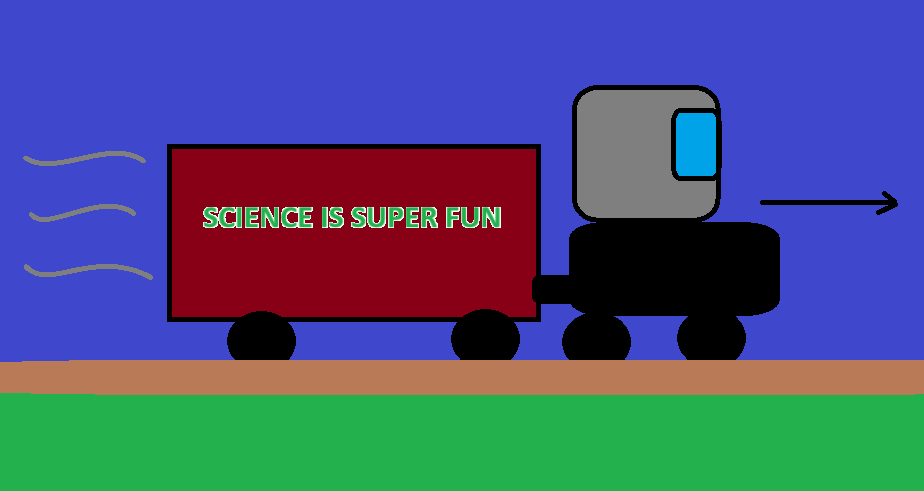
- DIAGRAM: drawing a diagram of the situation may help you to understand the problem more clearly.
- EQUATION: Choose the appropriate equation(s) that you will need to solve the problem.
- SOLVE: replace the variables in the equation with known values from your list. Solve for the unknown.
- CHECK: Check to see that your answer makes sense.
A 4000 kg truck travels in a straight line at 10.0 m/s. What is its momentum?
LIST:
- m = 4000kg
- v = 10m/s
- p = ?
DIAGRAM:
EQUATION:
p = mv
SOLVE:
p = 4000(10)
p = 40,000kg·m/s
CHECK:
Answer is positive, and large, as expected.