Metallic Bonding and Materials
| Website: | Young Education |
| Kurs: | Chemical Bonding and Structure |
| Buch: | Metallic Bonding and Materials |
| Gedruckt von: | Guest user |
| Datum: | Montag, 5. Oktober 2026, 04:04 |
1. Metallic Bonding
Learning outcomes
- I can describe the structure of metallic bonding.
- I can explain the role of delocalized electrons.
- I can compare metallic bonding with ionic and covalent bonding.
- I can explain why metallic bonding is strong.
- I can relate metallic bonding to metal properties.
What Is Metallic Bonding?
Metallic bonding is the type of bonding found in metals and metal alloys.
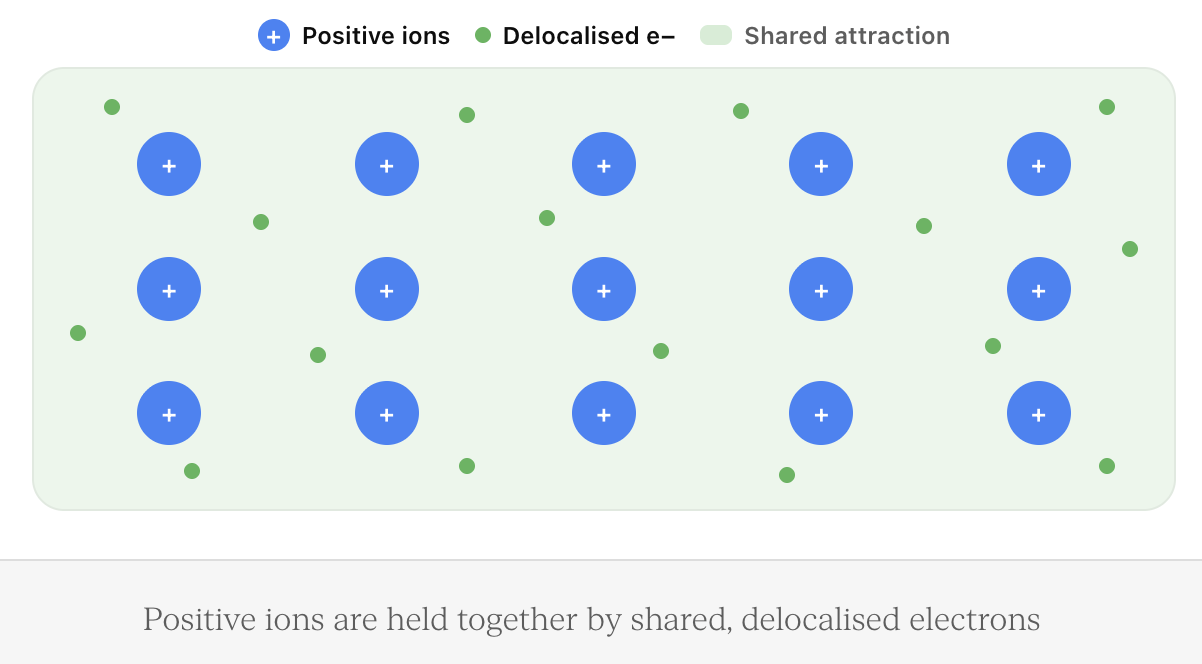
In a solid metal, atoms are packed closely together in a large, repeating structure called a giant metallic lattice.
The outer electrons of the metal atoms become delocalized. This means that they are no longer associated with one particular atom.
The structure can be described as:
a lattice of positive metal ions surrounded by a sea of delocalized electrons
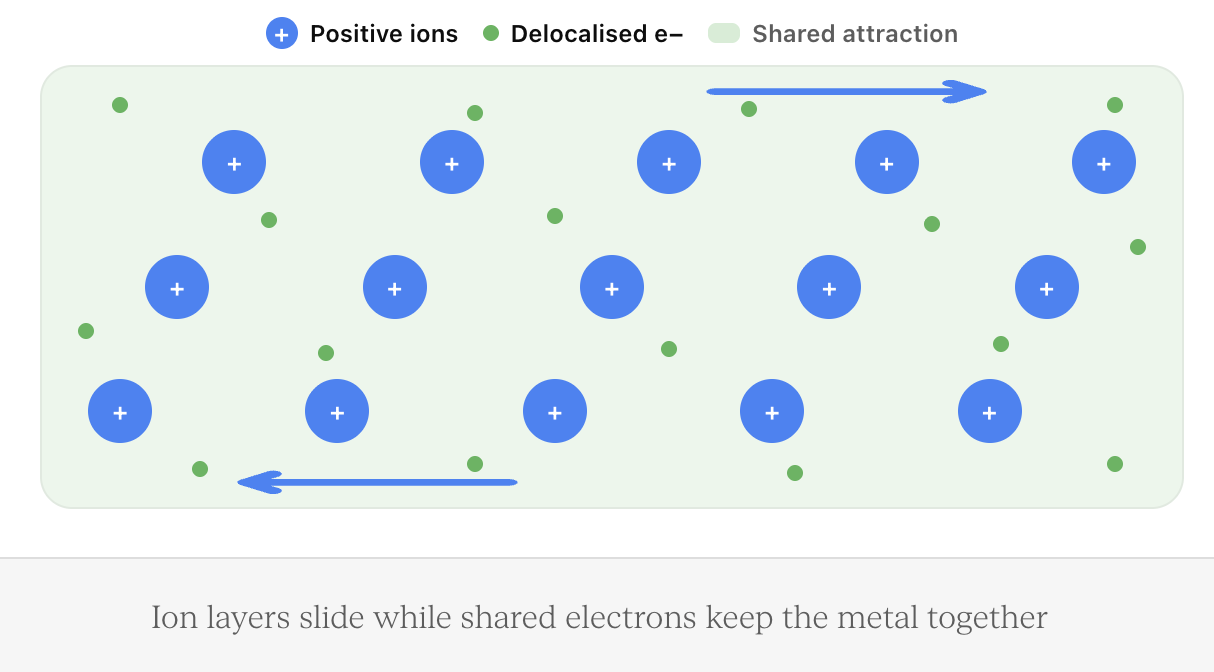
The strong electrostatic attraction between the positive metal ions and the negatively charged delocalized electrons holds the metal together.


2. Conductivity in Metals
Learning outcomes
- I can explain why metals conduct electricity.
- I can describe how electrons move through metals.
- I can explain thermal conductivity in metals.
- I can compare the conductivity of different materials.
- I can relate conductivity to metallic structure.
Why Do Metals Conduct Electricity?
Metals are generally excellent electrical conductors because of their metallic structure.
A metal consists of:
- Positive metal ions arranged in a giant lattice.
- Delocalized electrons that can move throughout the structure.
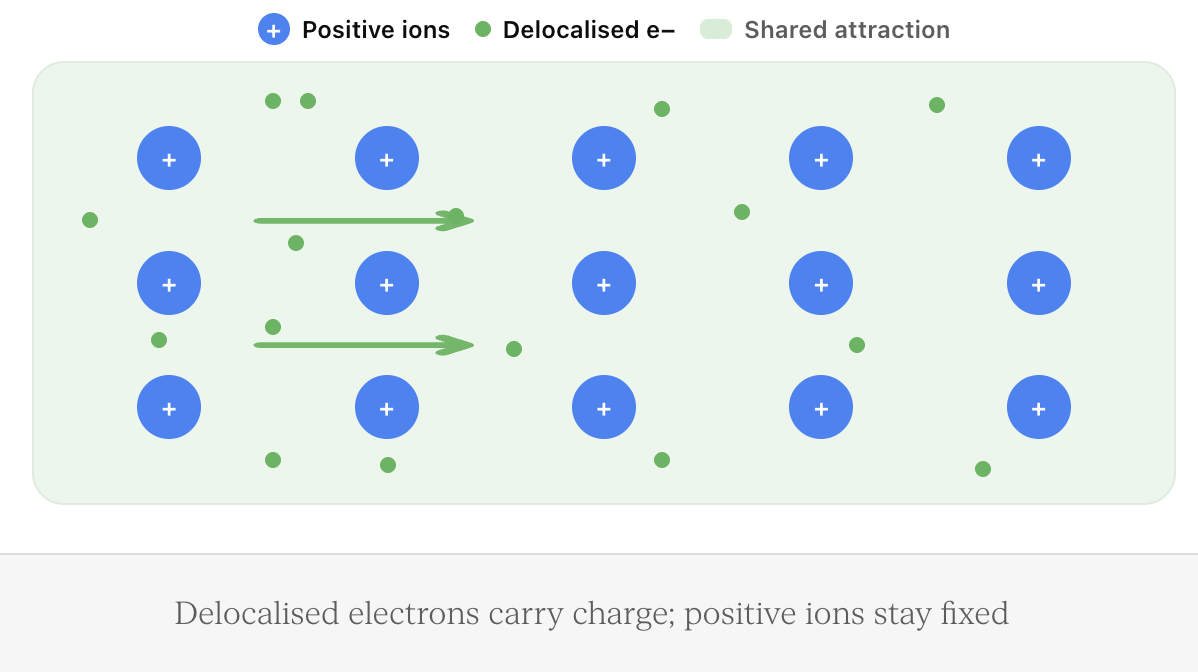
These mobile electrons allow electrical charge to move through the metal.
This gives us the basic relationship:
metallic structure → mobile delocalized electrons → electrical conductivity


Delocalized Electrons
In metallic bonding, the outer electrons of metal atoms become delocalized.
A delocalized electron is not associated with one particular atom.
Instead, it can move throughout the metallic lattice.
The positive metal ions remain in relatively fixed positions while the electrons can move between them.
This is very different from substances in which electrons are tightly localized within particular bonds.
Electrical Current
An electric current is a flow of electrical charge.
In a solid metal, this charge is carried by:
electrons
When there is no potential difference across the metal, the delocalized electrons are already moving, but their motion is random.
There is no overall movement of charge in one direction.
When a potential difference is applied, the electrons gain a small overall drift through the metal.
This produces an electric current.
Electron Flow in a Metal
Imagine connecting a metal wire to a battery.
The battery creates a potential difference across the wire.
The electric field established in the wire causes the delocalized electrons to experience a force.
The electrons develop an overall movement toward the positive terminal.
Therefore:
electron flow is from negative toward positive
in the external metallic circuit.


Conventional Current
By convention, electrical current is described as moving:
from positive to negative
This convention was established before scientists understood that electrons were the moving charge carriers in metals.
Therefore:
electron flow: negative → positive
conventional current: positive → negative
Both descriptions can be used, but they refer to opposite directions.
Electrons Do Not Race Directly Through the Wire
A common misconception is that individual electrons travel extremely rapidly from a battery all the way through a circuit.
The actual average drift velocity of electrons can be quite small.
However, when a circuit is completed, an electric field is established through the conducting material very rapidly.
Electrons throughout the conductor respond to this field.
This is why a lamp can turn on almost immediately even though individual electrons are not racing from the battery to the lamp at the speed of light.
Resistance in Metals
Electrons do not move through a metal completely without interference.
The metal ions in the lattice are vibrating.
As electrons move through the structure, they interact with the lattice and can be scattered.
This opposition to current is associated with:
electrical resistance
A good conductor has relatively low resistance.
A poor conductor has relatively high resistance.
Temperature and Resistance
When a metal becomes hotter:
- Metal ions vibrate more strongly.
- Moving electrons experience more scattering.
- Electron flow becomes more difficult.
For most ordinary metals:
temperature increases → resistance increases
This is an important property of metallic conductors.
Why Wires Can Become Hot
When electrons move through a conductor with resistance, electrical energy can be transferred to the lattice.
The ions vibrate more strongly.
The temperature of the metal increases.
This is called resistive heating or Joule heating.
It is useful in devices such as:
- Electric heaters.
- Toasters.
- Kettles.
- Hair dryers.
However, unwanted resistive heating in electrical cables represents an energy loss.
Electrical Conductivity
Electrical conductivity describes how readily a material allows electric current to flow.
High conductivity means:
charge moves relatively easily
Low conductivity means:
charge movement is strongly restricted
Metals generally have high electrical conductivity because they contain mobile delocalized electrons.
Good Metallic Conductors
Some metals conduct electricity better than others.
Silver is an exceptionally good electrical conductor.
Copper is also an excellent conductor and is widely used in electrical wiring.
Aluminum is another important conductor.


The material chosen for a particular application depends on more than conductivity.
Engineers may also consider:
- Cost.
- Density.
- Strength.
- Corrosion resistance.
- Flexibility.
- Availability.
Why Copper Is Used for Wiring
Copper is widely used for electrical wiring because it combines several useful properties.
It has:
- High electrical conductivity.
- Good ductility.
- Good mechanical strength.
- Good durability.
Ductility allows copper to be drawn into long, thin wires.
Its conductivity allows electrical current to pass with relatively low resistance.
Why Aluminum Is Used in Power Lines
Aluminum is also a good conductor.
It is not as electrically conductive as copper for the same cross-sectional area, but it has a major advantage:
low density
Aluminum is much lighter than copper.
For overhead power transmission, low mass can be extremely important.
Therefore, engineering decisions involve balancing several material properties rather than simply selecting the material with the highest conductivity.
Thermal Conductivity
Metals are generally good thermal conductors as well as electrical conductors.
Thermal conductivity describes how readily thermal energy moves through a material.
There are two important contributors to thermal conduction in metals:
- Mobile delocalized electrons.
- Vibrations of the metallic lattice.
The mobile electrons are particularly effective at transferring energy rapidly through the metal.


How Thermal Energy Moves Through a Metal
Suppose one end of a metal rod is heated.
Particles near the hot end gain energy.
The metal ions vibrate more strongly.
The delocalized electrons also gain energy and move throughout the structure.
These mobile electrons transfer energy through interactions with other electrons and the lattice.
As a result:
thermal energy spreads rapidly through the metal.
Everyday Example: A Metal Spoon
Place a metal spoon in a hot drink.
After a short time, the handle becomes warm.
Thermal energy has traveled from the hot end of the spoon toward the cooler end.
This happens relatively quickly because the metal is a good thermal conductor.


A wooden or plastic spoon behaves differently because these materials are much poorer thermal conductors.
Conductors and Insulators
Materials can be broadly classified according to their electrical conductivity.
Conductors
Allow electrical charge to move relatively easily.
Examples:
- Copper.
- Aluminum.
- Silver.
- Iron.
Insulators
Strongly resist the movement of electrical charge.
Examples:
- Rubber.
- Many plastics.
- Glass.
- Dry wood.
This is why electrical cables often contain:
metal conductor inside + insulating plastic outside
Why Many Nonmetals Do Not Conduct
In many nonmetallic molecular substances, electrons are localized in bonds or around particular atoms.
They are not free to move throughout the entire material.
Therefore, these substances generally cannot carry electrical current easily.
For example, many plastics are good electrical insulators.
This makes them useful for coating electrical wires.
Comparing Metals and Molecular Substances
| Property | Metals | Many Molecular Substances |
|---|---|---|
| Mobile electrons | Yes | Usually no |
| Conduct as solids | Yes | Usually no |
| Thermal conductivity | Usually high | Usually lower |
| Structure | Metallic lattice | Separate molecules |
| Main reason for electrical behavior | Delocalized electrons | Electrons generally localized |
Comparing Metals and Ionic Compounds
Ionic compounds behave differently from metals.
A solid ionic compound contains charged particles, but the ions are locked into fixed lattice positions.
Therefore:
solid ionic compound → usually does not conduct
When the ionic compound is melted or dissolved in water, its ions may become mobile.
Then:
molten or aqueous ionic compound → can conduct


Comparing Charge Carriers
Different conducting materials can use different charge carriers.
Metals
Charge carrier:
electrons
Molten ionic compounds
Charge carriers:
positive and negative ions
Ionic solutions
Charge carriers:
dissolved ions
This distinction is important.
Electrical conductivity does not always require moving electrons.
It requires mobile charged particles.
Graphite: An Important Exception
Carbon is a nonmetal, but graphite can conduct electricity.
In graphite, each carbon atom forms bonds with three other carbon atoms.
Some electrons become delocalized across the layers.
These electrons can move and carry charge.
Therefore, graphite demonstrates that:
electrical conductivity depends on structure and mobile charge carriers, not simply whether an element is classified as a metal.


Diamond: A Useful Comparison
Diamond is also made entirely from carbon.
However, diamond has a very different structure.
Each carbon atom forms four strong covalent bonds.
The electrons are localized in these bonds.
There are no comparable mobile delocalized electrons available to carry charge.
Therefore:
diamond does not normally conduct electricity.
Graphite and diamond demonstrate an important principle:
structure determines properties.
Comparing Graphite and Diamond
| Property | Graphite | Diamond |
|---|---|---|
| Element | Carbon | Carbon |
| Structure | Layered | 3D covalent network |
| Delocalized electrons | Present | Not available in the same way |
| Electrical conductivity | Conducts | Does not normally conduct |
| Main reason | Mobile electrons | Electrons localized in bonds |
The chemical composition is the same.
The structure is different.
Therefore, the physical properties are different.
Conductivity and Metallic Structure
Metallic conductivity can be summarized as:
metal atoms contribute outer electrons
↓
electrons become delocalized
↓
electrons can move throughout the lattice
↓
electrons carry electrical charge
↓
metal conducts electricity
This is the key structure-property relationship.
Thermal Conductivity and Metallic Structure
Similarly:
delocalized electrons gain energy
↓
electrons move through the lattice
↓
energy is transferred rapidly
↓
metal conducts thermal energy
The same structural feature therefore contributes to both:
electrical conductivity
and:
thermal conductivity
Comparing Conductivity Experimentally
Conductivity can be investigated using a simple electrical circuit.
A sample can be placed into a circuit containing:
- A power source.
- Connecting wires.
- An indicator such as a lamp or suitable meter.


Different materials can then be tested.
A better quantitative investigation would measure current and potential difference rather than relying only on lamp brightness.
Comparing Thermal Conductivity Experimentally
Different materials can also be compared for thermal conductivity.
For example, rods of different materials could have one end heated under similar conditions.
The rate at which thermal energy reaches another point on each rod can then be compared.
Important control variables could include:
- Rod length.
- Rod diameter.
- Starting temperature.
- Heating time.
- Distance from the heat source.
A fair comparison requires these variables to be controlled.
Electrical Conductivity and Resistance
Conductivity and resistance are related but different concepts.
A material with high electrical conductivity allows charge to move readily.
A conductor with high resistance opposes current more strongly.
For a particular wire:
longer wire → greater resistance
greater cross-sectional area → lower resistance
Temperature and the material itself also affect resistance.
Why Thin Wires Have Greater Resistance
Imagine electrons moving through a wire.
A thin wire provides a smaller cross-sectional area for charge flow than a thick wire made from the same material.
Therefore:
thinner wire → greater resistance
for wires of the same length and material.
This is important when choosing wires for electrical systems.
Why Long Wires Have Greater Resistance
A longer wire gives moving electrons a longer path through the metallic lattice.
There are more opportunities for interactions that impede the flow of charge.
Therefore:
longer wire → greater resistance
for wires of the same material and cross-sectional area.
Material Matters
Different metals have different electrical conductivities because their electronic structures and interactions between electrons and the lattice differ.
Therefore, two wires with identical:
- Length.
- Diameter.
- Temperature.
can still have different resistances if they are made from different materials.
Real-World Connection: Electrical Cables
A typical electrical cable combines materials with very different properties.
Inside
Copper or aluminum.
Purpose:
conduct electricity
Outside
Plastic or rubber-like insulation.
Purpose:
prevent unwanted movement of charge and protect users


The cable works because each material is chosen for a different property.
Real-World Connection: Cooking Pans
Cooking pans are often made from or incorporate metals because metals transfer thermal energy effectively.
However, handles may be made from:
- Plastic.
- Wood.
- Silicone.
- Other insulating materials.
This reduces thermal energy transfer to the user's hand.
A single product can therefore deliberately combine:
thermal conductors + thermal insulators
Real-World Connection: Heat Sinks
Electronic devices can generate significant thermal energy.
Metal heat sinks are used to transfer this energy away from electronic components.


Metals such as aluminum and copper are useful because of their high thermal conductivity.
Fins increase the surface area available for transferring energy to the surroundings.
Real-World Connection: Power Transmission
Electrical power must often travel over large distances.
Resistance in transmission wires causes energy to be transferred as thermal energy.
This is why conductor material and wire dimensions are important.
Engineers choose materials that balance:
- Conductivity.
- Mass.
- Strength.
- Cost.
- Durability.
Aluminum-based conductors are commonly useful for overhead transmission because they combine good conductivity with relatively low mass.
Worked Example: Copper and Plastic
Question: Why does copper conduct electricity while plastic usually does not?
Copper
Copper has a metallic structure containing mobile delocalized electrons.
These electrons can move through the lattice and carry charge.
Plastic
Electrons in most plastics are localized within chemical bonds.
There are no comparable mobile charge carriers.
Conclusion
Copper conducts well, while plastic acts as an electrical insulator.
Worked Example: Solid NaCl and Copper
Question: Both copper and sodium chloride contain charged particles. Why does copper conduct when solid while NaCl does not?
Copper
Contains mobile delocalized electrons.
Therefore:
conducts when solid
Solid NaCl
Contains Na⁺ and Cl⁻ ions locked into fixed lattice positions.
Therefore:
does not conduct when solid
When NaCl melts, the ions become mobile and the liquid can conduct.
Worked Example: Graphite and Diamond
Both substances contain only carbon atoms.
However:
graphite has mobile delocalized electrons
while:
diamond does not
Therefore:
graphite conducts electricity
while:
diamond does not normally conduct
The difference results from their structures.
Worked Example: Heating a Metal Rod
Suppose one end of a copper rod is heated.
Particles at that end gain energy.
The mobile electrons transfer energy rapidly through the structure, while lattice vibrations also transfer energy.
Therefore, the other parts of the rod become warmer.
This demonstrates:
thermal conductivity
Common Mistakes
Saying Positive Metal Ions Flow Through a Wire
In a solid metal, the ions remain in lattice positions.
The mobile charge carriers are electrons.
Saying Electrons Are Stationary Until a Battery Is Connected
Delocalized electrons are already moving.
Applying a potential difference creates an overall drift.
Confusing Electron Flow with Conventional Current
Electron flow:
negative → positive
Conventional current:
positive → negative
Saying All Nonmetals Are Insulators
Graphite is an important exception because it contains delocalized electrons.
Saying Ionic Compounds Never Conduct
They generally do not conduct when solid, but they can conduct when molten or dissolved because their ions become mobile.
Assuming All Metals Conduct Equally Well
Different metals have different electrical conductivities.
Forgetting About Thermal Conductivity
Metallic structure helps explain both electrical and thermal conduction.
Assuming Conductivity Depends Only on the Material
For an actual wire, resistance also depends on dimensions and temperature.
Check Your Understanding
1. Why do metals conduct electricity?
2. What is a delocalized electron?
3. What particles carry electrical charge through a solid metal?
4. What happens to electrons when a potential difference is applied across a metal?
5. State the direction of electron flow in an external circuit.
6. State the direction of conventional current.
7. Why can a lamp turn on quickly even though electron drift velocity is relatively small?
8. What causes electrical resistance in a metal?
9. Why does the resistance of most metals increase as temperature increases?
10. Explain resistive heating.
11. Why is copper widely used for electrical wiring?
12. Why is aluminum useful for overhead power lines?
13. Explain why metals are generally good thermal conductors.
14. Why does a metal spoon become warm when left in a hot drink?
15. Compare electrical conductors and insulators.
16. Why does solid NaCl not conduct electricity?
17. Why can molten NaCl conduct electricity?
18. What particles carry current through an ionic solution?
19. Why can graphite conduct electricity?
20. Why does diamond not normally conduct electricity?
21. How does increasing wire length affect resistance?
22. How does increasing wire thickness affect resistance?
23. Why are electrical cables made from both a metal and an insulating material?
24. Explain how metallic structure accounts for both electrical and thermal conductivity.
Key Terms
- Electrical conductivity – ability of a material to allow electrical charge to move through it.
- Thermal conductivity – ability of a material to transfer thermal energy.
- Delocalized electron – electron able to move throughout a larger structure rather than belonging to one particular atom or bond.
- Electric current – rate of flow of electrical charge.
- Electron flow – movement of electrons through a conductor.
- Conventional current – conventional direction of positive charge flow, opposite to electron flow in metals.
- Drift velocity – average directed motion of charge carriers caused by an electric field.
- Resistance – opposition to electrical current.
- Conductor – material that allows electrical charge to move relatively easily.
- Insulator – material that strongly resists electrical charge movement.
- Charge carrier – mobile charged particle responsible for electrical conduction.
- Resistive heating – transfer of electrical energy into thermal energy due to resistance.
- Metallic lattice – giant structure of positive metal ions surrounded by delocalized electrons.
Key Takeaways
- Metals conduct electricity because they contain mobile delocalized electrons.
- Positive metal ions remain in relatively fixed lattice positions.
- Delocalized electrons move throughout the metallic structure.
- Applying a potential difference produces an overall drift of electrons.
- Electron flow in an external metallic circuit is from negative toward positive.
- Conventional current is defined in the opposite direction.
- Electrical resistance results from interactions between moving electrons and the metallic structure.
- For most metals, increasing temperature increases resistance.
- Resistance can convert electrical energy into thermal energy.
- Different metals have different electrical conductivities.
- Copper combines high conductivity with excellent ductility and is widely used for wiring.
- Aluminum combines good conductivity with low density and is useful for power transmission.
- Metals are also generally good thermal conductors.
- Mobile electrons contribute strongly to energy transfer through metals.
- Many molecular substances are poor electrical conductors because they lack mobile charged particles.
- Solid ionic compounds generally do not conduct because their ions cannot move.
- Molten or dissolved ionic compounds can conduct because their ions are mobile.
- Graphite is a nonmetal that conducts because it contains delocalized electrons.
- Diamond does not normally conduct because its electrons are localized in covalent bonds.
- Conductivity depends fundamentally on the presence of mobile charge carriers.
- Metallic structure → delocalized electrons → mobile charge → electrical conductivity.
3. Malleability and Ductility
Learning outcomes
- I can define malleability and ductility.
- I can explain why metals can be shaped without breaking.
- I can relate metallic structure to mechanical properties.
- I can identify applications requiring malleability and ductility.
- I can compare metals with brittle materials.


4. Alloys
Learning outcomes
- I can define an alloy.
- I can explain how alloys differ from pure metals.
- I can describe how alloying changes material properties.
- I can identify common alloys and their uses.
- I can explain why alloys are important in engineering.


5. Materials Engineering
Learning outcomes
- I can explain how material properties influence design choices.
- I can compare different metallic materials.
- I can evaluate the suitability of materials for specific applications.
- I can describe how engineers select materials.
- I can relate bonding and structure to engineering performance.
What Is Materials Engineering?
Materials engineering is the study and application of materials so that they can perform particular jobs safely, effectively, and economically.
Engineers do not simply ask:
“Which material is strongest?”
Instead, they ask:
“Which material has the best combination of properties for this application?”
A material might need to be:
- Strong.
- Lightweight.
- Hard.
- Tough.
- Ductile.
- Malleable.
- Conductive.
- Corrosion resistant.
- Heat resistant.
- Affordable.
The choice depends on what the material needs to do.


Structure, Properties, and Performance
A central idea in materials engineering is:
composition → structure → bonding → properties → performance → application
The atoms present in a material and the way they are arranged determine its bonding and structure.
These microscopic features determine observable properties.
Those properties determine whether the material performs well in a particular application.
For example:
metallic bonding → delocalized electrons → high electrical conductivity → useful for electrical wiring
Material Properties
Engineers consider many properties when choosing materials.
Strength
Ability to withstand forces without failing.
Hardness
Resistance to scratching, indentation, or wear.
Toughness
Ability to absorb energy and resist fracture.
Ductility
Ability to undergo significant deformation, especially stretching, before breaking.
Malleability
Ability to be pressed, hammered, or rolled into shape.
Density
Mass per unit volume.
density = mass / volume
Electrical conductivity
Ability to allow electrical charge to move.
Thermal conductivity
Ability to transfer thermal energy.
Corrosion resistance
Ability to resist chemical deterioration.
Melting point
Temperature at which a solid becomes a liquid at a specified pressure.
No Material Is Best at Everything
Materials usually involve trade-offs.
A material may be:
very strong but heavy
or:
lightweight but relatively weak
or:
highly conductive but expensive
or:
hard but brittle
Therefore, engineers rarely select a material based on only one property.
They must decide which properties are most important for the application.
Comparing Metallic Materials
Metals can have very different properties.
Consider:
- Steel.
- Aluminum alloys.
- Copper.
- Titanium alloys.


Each is useful because it provides a different combination of properties.
Steel
Steel is an iron-based alloy containing carbon and often other elements.
Depending on its composition and processing, steel can provide:
- High strength.
- High stiffness.
- Good toughness.
- Good durability.
- Relatively low cost.
Steel is widely used in:
- Buildings.
- Bridges.
- Vehicles.
- Railways.
- Machinery.
- Tools.
Why Steel Is Used in Buildings
A structural material must support large forces.
Steel can provide high strength and stiffness while also being manufactured into:
- Beams.
- Columns.
- Reinforcement.
- Plates.
- Fasteners.


Steel is also widely available and can be joined by techniques such as welding and bolting.
Its combination of properties makes it extremely important in construction.
Limitations of Steel
Steel is not ideal for every application.
Possible disadvantages include:
- Relatively high density.
- Corrosion in some environments.
- Need for protective coatings in some applications.
Engineers may therefore choose another material when low mass or exceptional corrosion resistance is more important.
Aluminum and Aluminum Alloys
Aluminum has a much lower density than steel.
It also has:
- Good corrosion resistance.
- Good thermal conductivity.
- Good electrical conductivity.
- High malleability.
- High ductility.
Pure aluminum is relatively soft, so stronger aluminum alloys are commonly used in engineering.
Why Aluminum Alloys Are Used in Aircraft
Aircraft must be strong enough to withstand significant forces while remaining as light as practical.
Reducing mass can reduce the energy required for flight.
Therefore, an important property is:
strength-to-weight ratio
Aluminum alloys can provide:
useful strength + relatively low density


This makes them useful for many aerospace structures.
Copper
Copper is particularly important because of its excellent:
- Electrical conductivity.
- Thermal conductivity.
- Ductility.
Copper is widely used for:
- Electrical wiring.
- Motors.
- Generators.
- Electronics.
- Plumbing.
- Heat-transfer applications.
Why Copper Is Used for Electrical Wiring
Electrical wiring requires a material that:
- Conducts electricity efficiently.
- Can be drawn into thin wires.
- Can bend without easily breaking.
- Remains reliable during use.
Copper meets these requirements very well.
Its metallic structure contains mobile delocalized electrons.
Therefore:
metallic bonding → delocalized electrons → electrical conductivity
Its ductility allows it to be manufactured into long wires.


Titanium Alloys
Titanium alloys can combine:
- High strength.
- Relatively low density.
- Excellent corrosion resistance.
- Good performance at elevated temperatures.
These properties make titanium alloys useful in demanding applications.
Examples include:
- Aircraft components.
- Aerospace systems.
- Chemical processing equipment.
- Some medical devices.
However, titanium can be significantly more expensive to produce and process than common steels or aluminum alloys.
Comparing Common Engineering Metals
| Material | Important Properties | Example Applications |
|---|---|---|
| Steel | Strong, stiff, tough, relatively economical | Buildings, bridges, vehicles |
| Aluminum alloys | Low density, corrosion resistant, useful strength | Aircraft, vehicles, structures |
| Copper | Excellent electrical and thermal conductivity, ductile | Wiring, motors, heat transfer |
| Titanium alloys | Strong, relatively light, corrosion resistant | Aerospace, demanding engineering components |
The most suitable material depends on the requirements of the application.
Strength Is Not the Same as Hardness
These terms are often confused.
Strength describes a material's ability to withstand applied stress without failing or permanently deforming beyond acceptable limits.
Hardness describes resistance to:
- Scratching.
- Indentation.
- Surface wear.
A material can be strong without being exceptionally hard.
A hard material can also be brittle.
Strength Is Not the Same as Toughness
Toughness describes the ability of a material to absorb energy before fracturing.
Consider two materials.
Material A
Very strong but brittle.
It withstands a large force but then fractures with relatively little deformation.
Material B
Strong and tough.
It can absorb considerable energy and deform before fracture.
For many engineering structures, toughness can be extremely important.
Why Brittleness Matters
A brittle material undergoes relatively little plastic deformation before fracture.
Examples include many:
- Ceramics.
- Glasses.
- Ionic crystalline materials.
Brittle materials can still be very strong under particular types of loading.
However, their tendency to fracture with limited warning must be considered during design.
Ductility and Safety
Ductile materials can undergo substantial deformation before breaking.
This can be valuable in engineering because deformation may occur before complete failure.
For example, a metal structure might:
bend or stretch before fracturing
rather than failing suddenly.
Engineers therefore consider ductility when designing structures exposed to large or changing loads.
Density
Density is particularly important when mass must be minimized.
density = mass / volume
or:
ρ = m/V
Suppose two components have identical volumes.
Material A:
density = 2.7 g/cm³
Material B:
density = 7.8 g/cm³
For the same volume, Material B will have much greater mass.
This can matter enormously in vehicles and aircraft.
Worked Example: Comparing Mass
Two components each have a volume of:
500 cm³
Component A is made from a material with density:
2.7 g/cm³
Mass:
m = ρV
m = 2.7 × 500
m = 1350 g
Component B has density:
7.8 g/cm³
m = 7.8 × 500
m = 3900 g
For the same volume, Component B is:
2550 g heavier
This shows why density matters when engineers are trying to reduce mass.
Strength-to-Weight Ratio
Sometimes strength alone is not the most useful comparison.
Engineers may want a material that provides high strength without excessive mass.
This leads to the idea of:
strength-to-weight ratio
A lightweight material with sufficient strength may outperform a much stronger but much heavier material for certain applications.
This is particularly important in:
- Aircraft.
- Spacecraft.
- Vehicles.
- Bicycles.
- Portable equipment.
Electrical Conductivity
Some designs require electrical current to move efficiently.
In metals, electrical conductivity results mainly from mobile delocalized electrons.
Materials such as copper and aluminum are therefore important electrical conductors.
An engineer designing an electrical cable might consider:
- Conductivity.
- Resistance.
- Density.
- Strength.
- Ductility.
- Cost.
The best conductor is not automatically the best overall engineering choice.
Copper Versus Aluminum Conductors
Copper has excellent electrical conductivity.
Aluminum has lower conductivity for the same cross-sectional area but also has much lower density.
Therefore:
copper is widely used in building wiring and electronics.
aluminum-based conductors are widely used in overhead power transmission where low mass can be particularly valuable.
The engineering choice depends on the complete set of requirements.
Thermal Conductivity
Some applications require thermal energy to move rapidly.
Examples include:
- Cookware.
- Heat exchangers.
- Electronic heat sinks.
Metals such as copper and aluminum have high thermal conductivity.


Other applications require the opposite.
For example, handles on cooking equipment should reduce thermal energy transfer.
Therefore, insulating materials may be chosen instead.
Corrosion Resistance
Materials interact with their environments.
Water, oxygen, salts, acids and other chemicals can damage some metals through corrosion.
Engineers must therefore consider the environment in which a material will operate.
A material used:
indoors in dry conditions
may face very different requirements from one used:
in seawater
Preventing Corrosion
Several approaches can reduce corrosion.
These include:
- Protective coatings.
- Painting.
- Galvanizing.
- Using corrosion-resistant alloys.
- Careful material selection.
- Appropriate design.
Stainless steel, for example, contains chromium that allows a protective oxide layer to form.
Material Selection for a Bridge
Imagine selecting a material for a bridge.
The material must withstand:
- The bridge's own weight.
- Vehicles or pedestrians.
- Wind.
- Temperature changes.
- Repeated loading.
- Environmental exposure.


An engineer may therefore consider:
- Strength.
- Stiffness.
- Toughness.
- Fatigue resistance.
- Corrosion resistance.
- Cost.
- Ease of construction.
- Maintenance requirements.
No single property is enough.
Material Selection for an Aircraft
An aircraft presents different requirements.
Low mass is extremely important.
Materials must also withstand:
- Aerodynamic forces.
- Repeated loading.
- Temperature changes.
- Vibration.
- Environmental exposure.
Therefore, engineers may consider:
strength + low density + fatigue performance + corrosion resistance
Materials may include aluminum alloys, titanium alloys, steels and composite materials depending on the component.
Material Selection for a Saucepan
A saucepan presents another set of requirements.
The base should transfer thermal energy effectively.
The material should also:
- Withstand cooking temperatures.
- Resist corrosion.
- Be durable.
- Be practical to manufacture.
The handle has different requirements.
It should reduce thermal energy transfer to the user's hand.
Therefore, one product may contain several materials because different components perform different jobs.
Material Selection for Electrical Wiring
Consider the requirements of an electrical wire.
The conducting core should have:
- High electrical conductivity.
- Low electrical resistance.
- Good ductility.
- Adequate mechanical strength.
The outer coating should have:
- Low electrical conductivity.
- Flexibility.
- Durability.
Therefore, a typical cable combines:
metal conductor + polymer insulator


This demonstrates that engineers often combine materials rather than searching for one material that performs every function.
Bonding and Engineering Performance
Different types of bonding help explain different material properties.
Metallic bonding
Positive ions surrounded by delocalized electrons.
Helps explain:
- Electrical conductivity.
- Thermal conductivity.
- Malleability.
- Ductility.
Ionic bonding
Strong electrostatic attractions between oppositely charged ions.
Helps explain:
- High melting points.
- Hardness.
- Brittleness.
- Conductivity when molten or dissolved.
Covalent structures
Strong covalent bonds can produce very different properties depending on structure.
For example, giant covalent structures can be extremely strong or hard.
Therefore:
bonding alone is not enough — structure also matters.
Structure Matters
Consider carbon.
Diamond and graphite are both made entirely of carbon atoms.
However, their structures differ dramatically.
Diamond has a three-dimensional covalent network.
Graphite contains layers and delocalized electrons.
As a result, their properties are very different.
This demonstrates:
same element + different structure → different properties
Materials engineering depends heavily on understanding these structure-property relationships.
Processing Matters Too
Material properties are not determined only by chemical composition.
The way a material is processed can also change its structure and properties.
Processing methods include:
- Heating.
- Cooling.
- Rolling.
- Forging.
- Casting.
- Heat treatment.
- Mechanical working.
For example, two pieces of steel with similar compositions can have different properties if they have undergone different processing.
Heat Treatment
Controlled heating and cooling can change the internal structure of some metals and alloys.
This can alter properties such as:
- Hardness.
- Strength.
- Toughness.
- Ductility.
Engineers can therefore modify a material after its chemical composition has already been chosen.
This provides another important relationship:
composition + processing → structure → properties
Manufacturing Requirements
A material may have excellent final properties but still be unsuitable if it is extremely difficult to manufacture.
Engineers may ask:
- Can it be cast?
- Can it be welded?
- Can it be machined?
- Can it be rolled into sheets?
- Can it be drawn into wire?
- Can it be shaped economically?
Manufacturing considerations can strongly influence material selection.
Cost
Engineering designs must usually operate within a budget.
A material with outstanding properties may be technically suitable but economically impractical.
Engineers consider:
- Raw material cost.
- Manufacturing cost.
- Installation cost.
- Maintenance cost.
- Expected lifetime.
- Replacement cost.
A more expensive material may sometimes be worthwhile if it lasts much longer or requires less maintenance.
Environmental Impact
Modern materials engineering also considers environmental effects.
Questions can include:
- How much energy is required to produce the material?
- Can it be recycled?
- How long will the product last?
- How much material is required?
- What environmental effects occur during extraction?
- Can the material be reused?


Material selection therefore involves more than simply mechanical performance.
Life-Cycle Thinking
Engineers can consider the entire life cycle of a product:
raw material extraction
↓
material production
↓
manufacturing
↓
transport
↓
use
↓
maintenance
↓
reuse, recycling, or disposal
A material that initially seems environmentally preferable may have disadvantages elsewhere in its life cycle.
Engineers therefore try to examine the whole system.
A Materials Selection Process
A simplified engineering materials-selection process is:
Identify the purpose
↓
Determine the forces and environmental conditions
↓
Identify required properties
↓
Identify possible materials
↓
Compare their properties
↓
Consider manufacturing
↓
Consider cost and availability
↓
Consider durability and environmental impact
↓
Select and test a suitable material
Material selection is therefore an evidence-based decision.
Worked Example: Bicycle Frame
Suppose an engineer is selecting a material for a bicycle frame.
Important properties could include:
- Strength.
- Low mass.
- Toughness.
- Fatigue resistance.
- Corrosion resistance.
- Manufacturability.
- Cost.
Possible materials might include:
- Steel.
- Aluminum alloys.
- Titanium alloys.
- Composite materials.
There is no universal "best" material.
The choice depends on the intended bicycle, manufacturing method, performance requirements and cost.
Worked Example: Cooking Pan
Suppose an engineer needs to design a cooking pan.
The material should:
- Conduct thermal energy.
- Remain stable at cooking temperatures.
- Resist corrosion.
- Be sufficiently strong.
- Be practical to manufacture.
Aluminum may provide excellent thermal conductivity and low mass.
Stainless steel may provide excellent durability and corrosion resistance.
Some cookware combines layers of different metals to obtain advantages from several materials.
This demonstrates an important strategy:
combine materials to obtain complementary properties.
Worked Example: Suspension Bridge Cable
A suspension bridge cable must support very large tensile forces.
Important properties include:
- High tensile strength.
- Toughness.
- Fatigue resistance.
- Durability.
High-strength steel is commonly suitable because it can be manufactured into strong wires that are combined into large cables.


The material is chosen because its mechanical properties match the forces it must withstand.
Worked Example: Electrical Transmission Line
Suppose an overhead electrical cable must carry current over a long distance.
Important requirements include:
- Good electrical conductivity.
- Low mass.
- Adequate mechanical strength.
- Durability.
- Reasonable cost.
Copper has excellent conductivity.
Aluminum has lower density.
Therefore, aluminum-based conductors can be advantageous when cable mass is especially important.
Again:
the highest value for one property does not automatically determine the engineering choice.
Using Data to Select Materials
Engineers often compare quantitative data.
Suppose three hypothetical materials have these properties:
| Material | Density | Relative Strength | Conductivity | Corrosion Resistance |
|---|---|---|---|---|
| A | High | High | Moderate | Moderate |
| B | Low | Moderate | Good | Good |
| C | Medium | Very high | Low | Excellent |
If designing an electrical cable, conductivity may receive high priority.
If designing a lightweight aircraft component, density and strength may receive greater priority.
If designing equipment for a corrosive environment, corrosion resistance may become critical.
The application determines which properties matter most.
Failure and Safety
Engineers must also consider how a material could fail.
Possible failure mechanisms include:
- Fracture.
- Excessive deformation.
- Fatigue.
- Wear.
- Corrosion.
- Overheating.
A material that performs well initially may still be unsuitable if repeated use causes dangerous failure.
Fatigue
Fatigue is damage caused by repeated cycles of loading and unloading.
For example, an aircraft wing experiences repeated loading during:
- Takeoff.
- Flight.
- Turbulence.
- Landing.
A material may eventually develop cracks even when individual loads are below the level that would cause immediate failure.
Fatigue resistance is therefore important in many engineering designs.
Safety Factors
Engineers normally do not design a component to operate exactly at its predicted failure limit.
A factor of safety provides a margin between normal operating conditions and failure conditions.
This helps account for:
- Unexpected loads.
- Material variation.
- Wear.
- Manufacturing imperfections.
- Uncertainty.
Material properties therefore contribute directly to safe engineering design.
Common Mistakes
Choosing the Strongest Material Automatically
Strength is only one requirement.
Density, cost, corrosion resistance, conductivity and manufacturing requirements may be equally important.
Confusing Hardness and Strength
Hardness describes resistance to surface deformation.
Strength describes resistance to failure or excessive deformation under applied stress.
Confusing Strength and Toughness
A very strong material can still be brittle.
Assuming Lightweight Means Weak
Some materials provide excellent strength-to-weight ratios.
Ignoring the Environment
A material that works well indoors may corrode or degrade rapidly in another environment.
Ignoring Manufacturing
A material must be practical to shape, join and process.
Assuming Pure Metals Are Always Better
Alloys can provide combinations of properties that pure metals cannot.
Looking Only at Initial Cost
Maintenance, lifetime and replacement costs can also matter.
Forgetting About Structure
Material properties arise from atomic bonding and microscopic structure.
Check Your Understanding
1. What is materials engineering?
2. Name five properties engineers might consider when selecting a material.
3. Why is there rarely one "best" material for every application?
4. Distinguish between strength and hardness.
5. Distinguish between strength and toughness.
6. Why can ductility be important for safety?
7. Why is density important in aircraft design?
8. Explain the meaning of strength-to-weight ratio.
9. Why is copper suitable for electrical wiring?
10. Why can aluminum be useful for overhead electrical cables?
11. Give two advantages of steel as a structural material.
12. Give one possible disadvantage of steel.
13. Why are aluminum alloys useful in transportation?
14. Why might titanium alloys be selected for demanding engineering applications?
15. Explain how metallic bonding contributes to electrical conductivity.
16. Explain how metallic structure contributes to ductility.
17. Why can alloying change mechanical properties?
18. How can processing change a material's properties?
19. Why must engineers consider corrosion?
20. What is fatigue?
21. Why might a material with excellent properties still not be selected because of manufacturing considerations?
22. Why is cost important in material selection?
23. What is meant by life-cycle thinking?
24. Explain why different materials might be used for the body and handle of a cooking pan.
25. Describe the main steps engineers could use to select a material for a new product.
Key Terms
- Materials engineering – study and application of relationships between material structure, properties, processing and performance.
- Strength – ability to withstand applied stress without unacceptable failure or deformation.
- Hardness – resistance to scratching, indentation or wear.
- Toughness – ability to absorb energy before fracturing.
- Ductility – ability to undergo substantial deformation, especially stretching, before fracture.
- Malleability – ability to be pressed, hammered or rolled into shape.
- Density – mass per unit volume.
- Electrical conductivity – ability to allow electrical charge to move.
- Thermal conductivity – ability to transfer thermal energy.
- Corrosion resistance – ability to resist chemical deterioration.
- Strength-to-weight ratio – comparison of strength with material weight or density.
- Fatigue – progressive damage caused by repeated loading.
- Factor of safety – design margin between expected operating conditions and failure conditions.
- Life cycle – stages from raw material extraction through manufacture, use and eventual recycling or disposal.
- Trade-off – situation in which improving or prioritizing one characteristic may require accepting a disadvantage in another.
Key Takeaways
- Engineers choose materials according to the requirements of a particular application.
- No single material has the best value for every property.
- Strength, hardness, toughness, ductility and malleability describe different mechanical properties.
- Density is especially important when mass must be minimized.
- Copper is valuable when high electrical conductivity is required.
- Aluminum alloys combine low density with useful strength.
- Steel provides useful combinations of strength, stiffness, toughness and cost.
- Titanium alloys can combine strength, relatively low density and corrosion resistance.
- Bonding and microscopic structure determine many material properties.
- Metallic bonding explains conductivity, malleability and ductility.
- Alloying can modify material structure and therefore change its properties.
- Processing can also alter structure and performance.
- Engineers must consider operating conditions, manufacturing, cost, durability and environmental impact.
- Material selection usually involves trade-offs.
- Different materials can be combined when different parts of a product require different properties.
- Engineers use measurements and material data rather than simply choosing materials by appearance.
- Long-term failure mechanisms such as corrosion and fatigue must be considered.
- Safe designs include margins for uncertainty and unexpected conditions.
- The central idea of materials engineering is to connect structure and bonding to properties, then select materials whose properties match the demands of the design.