Molecular Structure and Intermolecular Forces
| Website: | Young Education |
| Kurs: | Chemical Bonding and Structure |
| Buch: | Molecular Structure and Intermolecular Forces |
| Gedruckt von: | ゲストユーザ |
| Datum: | Montag, 5. Oktober 2026, 03:04 |
1. Molecular Shapes
Learning outcomes
- I can describe how atoms are arranged in molecules.
- I can identify common molecular shapes.
- I can explain how electron pairs influence molecular geometry.
- I can interpret simple molecular models.
- I can relate molecular shape to molecular properties.


2. Polar and Nonpolar Molecules
Learning outcomes
- I can distinguish between polar and nonpolar molecules.
- I can explain how molecular shape affects polarity.
- I can identify polar and nonpolar substances.
- I can relate polarity to molecular interactions.
- I can predict polarity from molecular structure.


 crJi91b9Oj9XExL0Q?purpose=inline" alt="


3. Intermolecular Forces
Learning outcomes
- I can explain the difference between bonds and intermolecular forces.
- I can identify common intermolecular forces.
- I can describe how intermolecular forces affect physical properties.
- I can compare the strengths of different intermolecular attractions.
- I can relate intermolecular forces to everyday phenomena.
Bonds Within Molecules and Forces Between Molecules
To understand the properties of substances, it is important to distinguish between chemical bonds and intermolecular forces.
A chemical bond holds atoms together within a substance. Examples include:
- Covalent bonds
- Ionic bonds
- Metallic bonds
An intermolecular force is an attraction between separate molecules.
For example, in liquid water:
- Strong covalent O–H bonds hold each water molecule together.
- Intermolecular attractions occur between neighboring water molecules.
These are very different interactions.


Intramolecular and Intermolecular
The word intramolecular means:
within a molecule
The word intermolecular means:
between molecules
For water:
Intramolecular: O–H covalent bonds
Intermolecular: attractions between one H₂O molecule and another H₂O molecule
This distinction is especially important when explaining melting and boiling.
Why Intermolecular Forces Matter
Intermolecular forces influence many physical properties, including:
- Melting point
- Boiling point
- Evaporation rate
- Viscosity
- Surface tension
- Solubility
- Physical state at room temperature
In general:
stronger intermolecular forces → more energy required to separate molecules
This often produces:
- Higher boiling points
- Lower evaporation rates
- Greater viscosity
- Greater surface tension
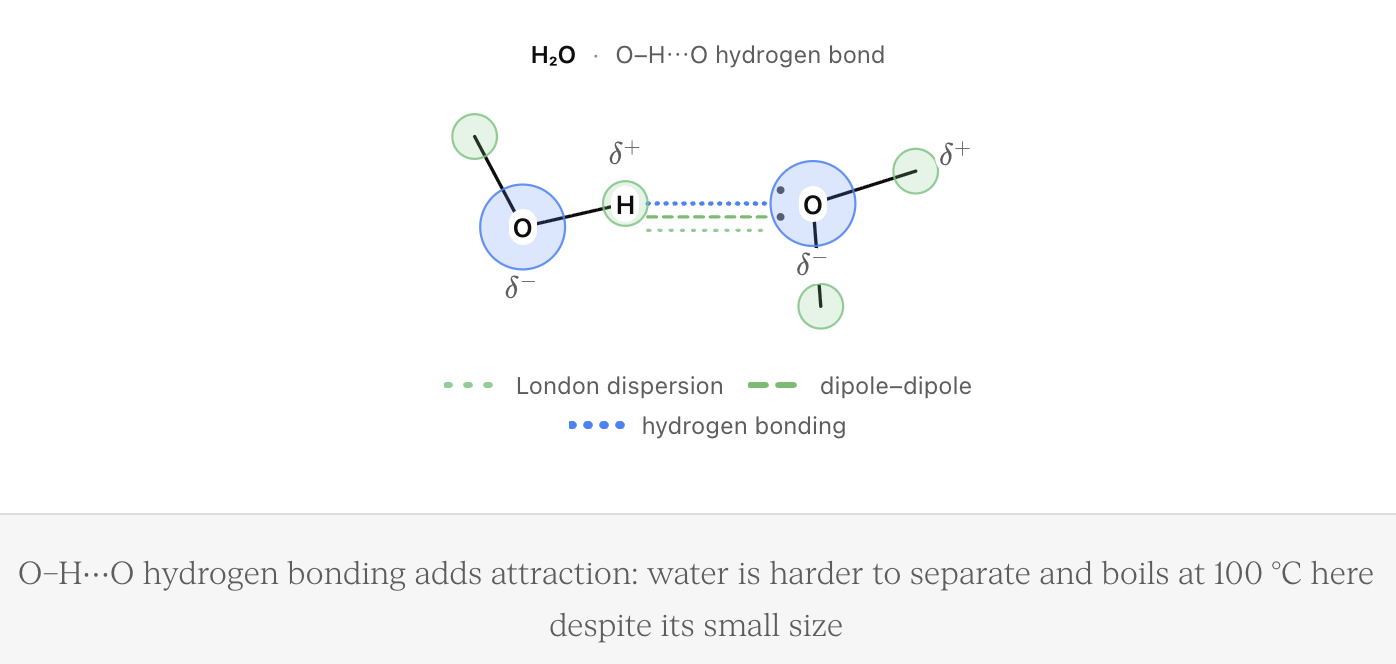
The three important types we will consider are London dispersion forces, dipole-dipole attractions, and hydrogen bonding.
London Dispersion Forces
London dispersion forces are weak intermolecular attractions caused by temporary changes in electron distribution.
Electrons are constantly moving.
At one instant, electrons may become slightly more concentrated on one side of a molecule.
This creates a temporary:
- Slightly negative region
- Slightly positive region
This temporary dipole can cause a neighboring molecule to develop another temporary dipole.
The opposite partial charges then attract.
London Forces Occur in All Molecules
London dispersion forces occur between:
- Nonpolar molecules
- Polar molecules
- Individual atoms such as noble gases
Therefore:
all atoms and molecules can experience London dispersion forces.
For nonpolar molecules, London forces may be the only intermolecular attraction present.
Example: Methane
Methane:
CH₄
is nonpolar.
Therefore, methane molecules do not experience permanent dipole-dipole attractions.
However, temporary changes in their electron clouds create London dispersion forces.
These forces are relatively weak, helping explain why methane has a very low boiling point and exists as a gas under ordinary room conditions.
What Makes London Forces Stronger?
London dispersion forces generally become stronger as:
- The number of electrons increases.
- The electron cloud becomes larger and more easily distorted.
- Molecular size increases.
- The area of contact between molecules increases.
This helps explain why larger molecules often have higher boiling points than smaller molecules of a similar type.
Example: The Halogens
Consider:
F₂
Cl₂
Br₂
I₂
All are nonpolar molecules.
As molecular size and number of electrons increase, London dispersion forces become stronger.
This contributes to the familiar change in physical state:
- F₂ – gas
- Cl₂ – gas
- Br₂ – liquid
- I₂ – solid
The larger molecules experience stronger intermolecular attractions.
Dipole-Dipole Forces
Dipole-dipole forces occur between polar molecules.
A polar molecule has:
- A partially positive region, δ+
- A partially negative region, δ−
The δ+ region of one molecule attracts the δ− region of another.


These attractions are usually stronger than London dispersion forces between similarly sized molecules.
Example: Hydrogen Chloride
Hydrogen chloride:
HCl
is polar.
Chlorine attracts the bonding electrons more strongly than hydrogen.
Therefore:
Hδ+ — Clδ−
The positive end of one HCl molecule can attract the negative end of another.
These are:
dipole-dipole attractions
HCl also experiences London dispersion forces because London forces occur in all molecules.
Molecules Can Have More Than One Type of Attraction
It is important not to think that each substance has only one type of intermolecular force.
For example, polar molecules experience:
London dispersion forces
and:
dipole-dipole attractions
Some molecules also experience hydrogen bonding.
When we classify intermolecular forces, we often focus on the strongest important type present.
Hydrogen Bonding
Hydrogen bonding is a particularly strong type of intermolecular attraction.
It occurs when hydrogen is covalently bonded to a strongly electronegative atom, especially:
- Nitrogen
- Oxygen
- Fluorine
Common examples include:
H₂O
NH₃
HF


Hydrogen Bonding in Water
Water is polar.
The oxygen atom has a partial negative charge:
Oδ−
The hydrogen atoms have partial positive charges:
Hδ+
The partially positive hydrogen of one water molecule is attracted to the partially negative oxygen of another.
This attraction is a:
hydrogen bond
A hydrogen bond acts between molecules.
It is not the same as the covalent O–H bond inside a water molecule.
Comparing the Three Main Intermolecular Forces
For molecules of broadly comparable size, a useful general comparison is:
London dispersion < dipole-dipole < hydrogen bonding
However, this is a general trend, not an absolute ranking for every substance.
Large molecules can have very strong London dispersion forces because they contain many electrons and have highly polarizable electron clouds.
Intermolecular Forces and Boiling
For a liquid to boil, its molecules must separate from one another and enter the gas phase.
This requires energy to overcome intermolecular attractions.
Therefore, substances with stronger intermolecular forces often have:
higher boiling points


The covalent bonds inside the molecules normally remain intact during boiling.
Boiling Does Not Break Molecules Apart
Consider water boiling:
H₂O(l) → H₂O(g)
Liquid water contains H₂O molecules.
Water vapor also contains H₂O molecules.
During boiling:
intermolecular attractions are overcome
but the O–H covalent bonds remain intact.
The molecules separate from one another; the molecules themselves are not normally broken apart.
Melting and Intermolecular Forces
A similar idea applies when many molecular solids melt.
In a solid, particles are held in relatively fixed positions.
As energy is supplied:
- Particle motion increases.
- Intermolecular attractions are increasingly overcome.
- Molecules become able to move past one another.
The substance becomes liquid.
Again, melting generally does not require breaking the covalent bonds inside individual molecules.
Intermolecular Forces and Evaporation
Evaporation occurs when molecules at the surface of a liquid gain enough energy to escape into the gas phase.
If intermolecular forces are weak:
molecules escape more easily
and evaporation tends to occur faster.
If intermolecular forces are strong:
more energy is required
and evaporation tends to be slower.
Everyday Example: Different Liquids Evaporate Differently
Different liquids can evaporate at different rates because their molecules experience different intermolecular attractions.
This is why some volatile liquids disappear quickly when exposed to air while others remain much longer.
Temperature also matters.
At higher temperatures, molecules have greater average kinetic energy, so evaporation generally occurs faster.
Intermolecular Forces and Vapor Pressure
Molecules escaping from a liquid produce vapor above its surface.
Liquids with weaker intermolecular forces generally allow molecules to escape more easily.
They therefore tend to have:
higher vapor pressures
at the same temperature.
Stronger intermolecular forces generally produce:
lower vapor pressures
Intermolecular Forces and Viscosity
Viscosity describes a fluid's resistance to flowing.
A liquid with high viscosity flows relatively slowly.
Examples include:
- Honey
- Syrup
- Some oils
A liquid with low viscosity flows more easily.


Strong intermolecular attractions can contribute to greater viscosity because molecules resist moving past one another.
Molecular size and shape also affect viscosity.
Intermolecular Forces and Surface Tension
Molecules inside a liquid experience attractions from neighboring molecules in many directions.
Molecules at the surface do not have molecules above them.
This creates a net inward attraction and produces surface tension.
Water has relatively high surface tension partly because of hydrogen bonding.


Water Droplets
Water often forms rounded droplets.
Hydrogen bonding causes water molecules to attract one another strongly.
The molecules tend to remain together, and surface tension tends to reduce the surface area.
This contributes to the rounded shape of small water droplets.
Water Striders
Some small insects can move across the surface of water.
They are supported partly by water's surface tension.
Hydrogen bonding between water molecules contributes to this unusually strong surface behavior.
This is a good example of a microscopic molecular interaction producing a visible everyday effect.
Cohesion
Cohesion is attraction between molecules of the same substance.
Water molecules show strong cohesion because they can form hydrogen bonds with one another.
Cohesion contributes to:
- Water droplets
- Surface tension
- Continuous columns of water in plant xylem
Adhesion
Adhesion is attraction between different substances.
Water can be attracted to polar surfaces.
For example, water may adhere to the walls of narrow glass tubes.
The balance between:
cohesion
and:
adhesion
helps explain phenomena such as capillary action.
Capillary Action
Water can rise through very narrow tubes.
This occurs because:
- Water molecules adhere to the tube surface.
- Water molecules cohere to one another.
- Additional molecules are pulled along.


Capillary action contributes to water movement through narrow spaces, including structures in plants.
Intermolecular Forces and Solubility
Whether one substance dissolves in another depends partly on the intermolecular attractions involved.
A useful general guideline is:
like dissolves like
Polar substances often dissolve more readily in polar solvents.
Nonpolar substances often dissolve more readily in nonpolar solvents.
Why Sugar Dissolves in Water
Sugar molecules contain several polar O–H groups.
These groups can interact strongly with water molecules, including through hydrogen bonding.
Water molecules can surround sugar molecules and separate them from one another.
As a result, many sugars dissolve readily in water.
Why Oil Does Not Mix Well with Water
Water is strongly polar.
Most oils are largely nonpolar.
Water molecules interact strongly with one another through hydrogen bonding, while oil molecules interact mainly through London dispersion forces.
Water and oil therefore do not interact favorably enough to mix completely under ordinary conditions.
They tend to form separate layers.


Soap and Intermolecular Forces
Soap molecules contain:
- A water-attracting polar or ionic head.
- A nonpolar hydrocarbon tail.
The nonpolar tail interacts with oils and grease.
The polar head interacts strongly with water.
Soap therefore helps disperse grease in water so that it can be washed away.
This is an everyday application of molecular polarity and intermolecular interactions.
Comparing Similar Molecules
Suppose two molecules have similar sizes.
One is nonpolar and experiences mainly London dispersion forces.
The other is polar and experiences London dispersion plus dipole-dipole attractions.
The polar substance will often have stronger overall intermolecular attractions.
It may therefore have:
- A higher boiling point.
- A lower evaporation rate.
- A higher viscosity.
However, molecular size and shape must also be considered.
Molecular Size Matters
Consider two nonpolar molecules.
If one molecule is much larger and contains many more electrons, its electron cloud is generally more polarizable.
This produces stronger temporary dipoles.
Therefore:
larger molecule → stronger London dispersion forces
in many comparable substances.
This explains why London dispersion forces can become very important in large molecules.
Molecular Shape Matters Too
Molecules with large areas of contact can sometimes experience stronger dispersion attractions than compact molecules of similar mass.
Long molecules can often make more surface contact with neighboring molecules.
Therefore, intermolecular forces depend not only on:
polarity
but also on:
size and shape
Comparing Intermolecular Attractions
| Interaction | Cause | Occurs Between | General Strength |
|---|---|---|---|
| London dispersion | Temporary dipoles | All atoms and molecules | Usually weakest for similar small molecules |
| Dipole-dipole | Permanent molecular dipoles | Polar molecules | Moderate |
| Hydrogen bonding | Strong attraction involving H bonded to N, O, or F | Suitable polar molecules | Relatively strong |
Remember that actual strength depends on the molecules being compared.
Bonds Versus Intermolecular Forces
Consider liquid water.
To convert:
H₂O(l) → H₂O(g)
we mainly overcome:
intermolecular hydrogen bonding
To chemically decompose water into hydrogen and oxygen, we must break:
covalent O–H bonds
Breaking covalent bonds requires much more energy than simply separating water molecules during boiling.
Physical Change Versus Chemical Change
Intermolecular forces help explain the difference between many physical and chemical changes.
Physical change
Examples:
- Melting
- Freezing
- Boiling
- Condensation
The molecules themselves usually remain chemically unchanged.
Chemical change
Chemical bonds are broken and/or formed, producing different substances.
This distinction is fundamental in chemistry.
Real-World Connection: Sweating
Sweating helps cool the body because water evaporates from the skin.
For water molecules to evaporate, they must gain enough energy to overcome intermolecular attractions.
That energy is taken from the surroundings, including the skin.
The remaining surface therefore loses thermal energy.
This contributes to cooling.
Real-World Connection: Cooking
Intermolecular forces influence:
- Boiling of water.
- Evaporation.
- Dissolving ingredients.
- Mixing oils and water.
- Texture and viscosity.
When water boils during cooking, the water molecules separate from one another but remain H₂O molecules.
Real-World Connection: Plants
Water's intermolecular attractions are important in plants.
Hydrogen bonding contributes to strong cohesion between water molecules.
Together with adhesion and other processes, this helps maintain columns of water within xylem vessels.
This contributes to water transport from roots toward leaves.
Real-World Connection: Cleaning
Cleaning often involves interactions among:
- Water.
- Oils.
- Detergents.
- Surfaces.
Detergents help bridge the difference between polar water and nonpolar grease.
Understanding intermolecular forces therefore helps explain why soap and detergent make water more effective at removing oily substances.
Predicting Physical Properties
Suppose Substance A and Substance B have similar molecular sizes.
Substance A has mainly London dispersion forces.
Substance B forms hydrogen bonds.
We would generally predict that Substance B has:
- Stronger intermolecular attractions.
- A higher boiling point.
- Slower evaporation.
This type of reasoning allows molecular structure to be connected to observable physical properties.
Worked Comparison: CH₄ and H₂O
Methane, CH₄
- Nonpolar.
- Mainly London dispersion forces.
- Weak intermolecular attractions.
- Gas at room temperature.
Water, H₂O
- Polar.
- Hydrogen bonding.
- Much stronger intermolecular attractions.
- Liquid at room temperature.
The difference in intermolecular forces helps explain their very different physical properties.
Worked Comparison: HCl and H₂O
HCl
- Polar.
- London dispersion forces.
- Dipole-dipole attractions.
H₂O
- Polar.
- London dispersion forces.
- Dipole-dipole interactions.
- Hydrogen bonding.
Water therefore has especially strong intermolecular attractions compared with many similarly small molecules.
Common Mistakes
Saying Intermolecular Forces Are Bonds Inside Molecules
Intermolecular forces act between separate molecules.
Covalent bonds hold atoms together within molecules.
Saying Boiling Breaks Covalent Bonds
Boiling generally overcomes intermolecular attractions.
The molecules themselves remain intact.
Saying Only Nonpolar Molecules Have London Forces
All atoms and molecules experience London dispersion forces.
Saying Polar Molecules Only Have Dipole-Dipole Forces
Polar molecules also experience London dispersion forces.
Saying Every Molecule Containing Hydrogen Forms Hydrogen Bonds
Hydrogen bonding generally requires hydrogen to be directly bonded to N, O, or F.
CH₄ does not form conventional hydrogen bonds even though it contains hydrogen.
Assuming London Forces Are Always Negligible
They can become very strong in large molecules with many electrons.
Assuming Intermolecular Force Is the Only Factor Affecting Boiling Point
Molecular size, shape and the combination of intermolecular interactions must also be considered.
Check Your Understanding
1. What is the difference between an intramolecular bond and an intermolecular force?
2. Name three important types of intermolecular attraction.
3. What causes London dispersion forces?
4. Do nonpolar molecules experience intermolecular forces? Explain.
5. Why do larger molecules often have stronger London dispersion forces?
6. What type of molecule experiences dipole-dipole attraction?
7. Explain how dipole-dipole attractions form.
8. Which atoms are commonly involved in hydrogen bonding?
9. Explain hydrogen bonding between water molecules.
10. Why does boiling water not normally break O–H covalent bonds?
11. Explain why stronger intermolecular forces generally increase boiling point.
12. How do intermolecular forces affect evaporation?
13. Define viscosity.
14. Explain how intermolecular forces can influence viscosity.
15. What is surface tension?
16. Explain why water has relatively high surface tension.
17. Distinguish between cohesion and adhesion.
18. Explain how intermolecular forces contribute to capillary action.
19. Why do oil and water tend to separate?
20. Explain how soap helps water remove grease.
21. Compare the intermolecular forces in CH₄ and H₂O.
22. Why can London dispersion forces become significant in very large molecules?
23. Predict which would generally evaporate faster: a liquid with weak intermolecular forces or one with strong intermolecular forces. Explain.
24. Explain how intermolecular forces contribute to cooling during sweating.
Key Terms
- Intermolecular force – attraction between separate molecules.
- Intramolecular bond – chemical bond acting within a molecule.
- London dispersion force – attraction resulting from temporary fluctuations in electron distribution.
- Temporary dipole – temporary uneven distribution of charge.
- Dipole-dipole force – attraction between permanent partial charges of polar molecules.
- Hydrogen bond – relatively strong intermolecular attraction involving hydrogen bonded to N, O, or F.
- Polarity – uneven distribution of electrical charge.
- Boiling point – temperature at which a liquid boils at a given pressure.
- Evaporation – escape of particles from the surface of a liquid into the gas phase.
- Vapor pressure – pressure produced by vapor above a liquid in a closed system.
- Viscosity – resistance of a fluid to flowing.
- Surface tension – tendency of a liquid surface to resist being stretched or disrupted.
- Cohesion – attraction between molecules of the same substance.
- Adhesion – attraction between different substances.
- Capillary action – movement of liquid through narrow spaces due partly to cohesive and adhesive forces.
Key Takeaways
- Chemical bonds hold atoms together within substances, while intermolecular forces act between separate molecules.
- Intermolecular forces are generally weaker than covalent bonds.
- Physical changes such as boiling usually overcome intermolecular attractions rather than breaking molecules apart.
- London dispersion forces occur in all atoms and molecules.
- London forces result from temporary changes in electron distribution.
- Larger, more polarizable electron clouds generally produce stronger London dispersion forces.
- Polar molecules can experience dipole-dipole attractions.
- Hydrogen bonding is a particularly strong intermolecular attraction found in suitable molecules containing H bonded to N, O, or F.
- Water forms extensive hydrogen bonds.
- For similarly sized small molecules, a useful general trend is London dispersion < dipole-dipole < hydrogen bonding.
- Actual intermolecular attraction also depends on molecular size and shape.
- Stronger intermolecular forces generally lead to higher boiling points.
- Stronger attractions generally reduce evaporation.
- Intermolecular forces can influence viscosity and surface tension.
- Hydrogen bonding contributes to water's unusually high surface tension.
- Cohesion describes attraction between like molecules, while adhesion describes attraction between different substances.
- Intermolecular forces help explain capillary action.
- Polarity and intermolecular attractions strongly influence solubility.
- Intermolecular forces help explain everyday phenomena including water droplets, evaporation, sweating, cleaning, cooking and water transport in plants.
- Understanding intermolecular forces connects microscopic molecular interactions to the physical properties we can observe and measure.
4. Solubility and "Like Dissolves Like"
Learning outcomes
- I can explain why some substances dissolve while others do not.
- I can relate polarity to solubility.
- I can apply the principle "like dissolves like."
- I can predict solubility based on molecular properties.
- I can explain common examples of solubility.
What Is Solubility?
Solubility describes how well a substance can dissolve in a particular solvent.
When a substance dissolves:
- The substance being dissolved is the solute.
- The substance doing the dissolving is the solvent.
- The resulting mixture is a solution.
For example, when sugar dissolves in water:
sugar = solute
water = solvent
sugar solution = solution
Not every substance dissolves equally well in every solvent. Whether a substance dissolves depends strongly on the molecular properties of both the solute and solvent.


What Happens When a Substance Dissolves?
Particles in a solute are attracted to one another.
Particles in a solvent are also attracted to one another.
For a substance to dissolve, solvent particles must interact strongly enough with the solute particles to separate them and surround them.
We can think about three types of interactions:
- Solute-solute attractions.
- Solvent-solvent attractions.
- Solute-solvent attractions.
Dissolving is favorable when the new solute-solvent interactions are sufficiently favorable compared with the interactions that must be disrupted.
Polarity and Solubility
One of the most useful ways to predict solubility is to consider polarity.
A polar molecule has an uneven distribution of electrical charge.
A nonpolar molecule has a relatively even distribution of charge and no permanent overall dipole.
Polar molecules tend to interact strongly with other polar molecules.
Nonpolar molecules tend to interact more favorably with other nonpolar molecules.
This leads to the useful guideline:
“Like dissolves like.”
What Does “Like Dissolves Like” Mean?
The phrase means:
polar solutes tend to dissolve in polar solvents
and:
nonpolar solutes tend to dissolve in nonpolar solvents
It does not mean that substances must be chemically identical.
Instead, their intermolecular properties should be reasonably compatible.


Water: A Polar Solvent
Water is one of the most important solvents in chemistry and biology.
Water molecules are:
polar
Oxygen attracts bonding electrons more strongly than hydrogen.
As a result:
- Oxygen has a partial negative charge.
- Hydrogen has a partial positive charge.
Water's bent molecular shape prevents these bond dipoles from cancelling.
Therefore:
H₂O is polar.
This allows water to interact strongly with many polar and ionic substances.
Why Sugar Dissolves in Water
Sugar molecules contain several polar regions, including many:
O–H groups
These groups can form strong intermolecular attractions with water molecules, including hydrogen bonds.


Water molecules interact with the sugar molecules and surround them.
Individual sugar molecules can then move throughout the water.
Therefore:
sugar dissolves readily in water.
Dissolving Does Not Mean Disappearing
When sugar dissolves, the sugar has not disappeared.
The sugar molecules are still present.
They have simply become:
- Separated from one another.
- Surrounded by water molecules.
- Distributed throughout the solution.
This is why evaporating the water can leave the sugar behind.
Dissolving is usually a physical process, not the destruction of the solute.
Why Salt Dissolves in Water
Sodium chloride is different from sugar.
NaCl is an ionic compound containing:
Na⁺ ions
and:
Cl⁻ ions
Water is polar.
The partially negative oxygen side of water is attracted to:
Na⁺
The partially positive hydrogen side is attracted to:
Cl⁻


Water molecules surround the separated ions.
This process is called hydration.
Hydration of Ions
Around Na⁺:
The oxygen ends of water molecules tend to point toward the positive ion.
Around Cl⁻:
The hydrogen ends tend to point toward the negative ion.
These ion-dipole attractions help stabilize the ions in solution.
We can represent dissolving sodium chloride as:
NaCl(s) → Na⁺(aq) + Cl⁻(aq)
The symbol:
(aq)
means that the ions are dissolved in water.
Why Oil Does Not Dissolve Well in Water
Most oils consist mainly of nonpolar molecules.
Water is strongly polar.
Water molecules interact strongly with one another through hydrogen bonding.
Oil molecules do not provide similarly favorable interactions with water.
As a result, water molecules tend to remain associated with other water molecules while oil molecules associate with other oil molecules.
The two substances separate.

This is why oil and water normally form separate layers.
Miscible and Immiscible Liquids
When two liquids mix completely, they are described as:
miscible
When they do not mix significantly and form separate layers, they are:
immiscible
For example:
Water and ethanol are miscible.
Water and many oils are largely immiscible.
The intermolecular attractions between the liquids help determine whether they mix.
Nonpolar Solvents
Nonpolar solvents interact well with many nonpolar substances.
Examples of largely nonpolar substances include:
- Oils.
- Waxes.
- Greases.
- Many hydrocarbons.
This explains why a nonpolar solvent may dissolve a greasy substance that water cannot remove effectively.
The principle is again:
like dissolves like
Intermolecular Forces and Dissolving
Different solutes and solvents can interact through different forces.
These include:
- London dispersion forces.
- Dipole-dipole attractions.
- Hydrogen bonding.
- Ion-dipole attractions.
The type and strength of these interactions influence solubility.
For example:
polar + polar
may involve dipole-dipole attractions or hydrogen bonding.
ion + polar
may involve ion-dipole attractions.
nonpolar + nonpolar
may involve London dispersion forces.
Comparing Common Examples
| Solute | Solute Type | Solvent | Solvent Type | Expected Solubility |
|---|---|---|---|---|
| Sugar | Polar | Water | Polar | High |
| NaCl | Ionic | Water | Polar | Often high |
| Oil | Nonpolar | Water | Polar | Low |
| Wax | Nonpolar | Water | Polar | Low |
| Oil | Nonpolar | Nonpolar solvent | Nonpolar | Often higher |
These are useful general predictions, although actual solubility depends on the specific substances involved.
Predicting Solubility
A useful process is:
Identify the solute
↓
Determine whether it is ionic, polar, or nonpolar
↓
Identify the solvent
↓
Determine whether the solvent is polar or nonpolar
↓
Compare their intermolecular interactions
↓
Predict whether significant dissolving is likely
Worked Example: Sugar and Water
Sugar:
polar
Water:
polar
Both can participate in strong intermolecular attractions.
Prediction:
Sugar should dissolve relatively well in water.
Observation:
Sugar does dissolve readily in water.
Worked Example: Oil and Water
Oil:
mostly nonpolar
Water:
polar
The intermolecular interactions are poorly matched.
Prediction:
Oil should have low solubility in water.
Observation:
Oil and water separate into layers.
Worked Example: Wax and Water
Wax consists mainly of long nonpolar hydrocarbon molecules.
Water is polar.
Therefore:
wax has very low solubility in water.
This is why wax coatings can help repel water.
Molecular Structure Matters
It is not always enough to label an entire molecule simply polar or nonpolar.
Some molecules contain:
- Polar regions.
- Nonpolar regions.
The relative sizes of these regions can strongly influence solubility.
A molecule containing a small polar group attached to a very large nonpolar hydrocarbon region may still have low water solubility.
Alcohols as an Example
Many alcohol molecules contain:
–OH
This group is polar and can form hydrogen bonds with water.
However, alcohols may also contain nonpolar hydrocarbon regions.
For small alcohol molecules, the polar –OH group can have a strong influence.
As the nonpolar hydrocarbon region becomes larger, water solubility generally decreases.
This demonstrates that solubility depends on the whole molecular structure.
Soap: A Molecule with Two Personalities
Soap molecules contain:
- A polar or ionic hydrophilic head.
- A nonpolar hydrophobic tail.
Hydrophilic means water-attracting.
Hydrophobic means water-avoiding or poorly interacting with water.


The nonpolar tails interact with grease.
The polar heads interact with water.
This allows soap to help disperse oily substances in water.
Micelles
In water, soap molecules can form structures called micelles.
The nonpolar tails point inward toward grease or other nonpolar substances.
The polar heads face outward toward the surrounding water.
This traps oily material inside structures that can remain dispersed in water.
The grease can then be washed away.
This is a practical application of polarity and solubility.
Solubility and Biological Membranes
Cell membranes contain phospholipids.
Phospholipids also contain:
- Polar heads.
- Nonpolar tails.
In water, they naturally organize into a bilayer.


The polar heads interact with water.
The nonpolar tails group together away from water.
The same principles of polarity and intermolecular attraction therefore help explain the basic structure of cell membranes.
Solubility and Medicines
The solubility of a medicine can influence:
- How it is formulated.
- How easily it dissolves.
- How it moves through watery body fluids.
- How it crosses biological membranes.
- How it can be delivered.
Some molecules contain both polar and nonpolar regions, allowing them to interact with different environments.
Solubility is therefore an important consideration in pharmaceutical chemistry.
Temperature and Solubility
Polarity is not the only factor affecting solubility.
Temperature can also have an important effect.
For many solid solutes dissolved in liquids:
higher temperature → greater solubility
However, this is not true for every substance.
The effect must be determined from experimental evidence or solubility data.
Solubility Curves
A solubility curve shows how the solubility of a substance changes with temperature.


A solubility curve can be used to:
- Compare substances.
- Determine how much solute can dissolve.
- Predict crystallization.
- Analyze the effect of temperature.
Gases and Temperature
Gases often behave differently from many solid solutes.
For many gases dissolved in liquids:
increasing temperature decreases gas solubility.
This is why a warm carbonated drink tends to lose dissolved carbon dioxide more readily than a cold one.
Temperature therefore affects solubility differently depending on the solute.
Pressure and Gas Solubility
Pressure can strongly affect the solubility of gases.
Increasing the pressure of a gas above a liquid generally increases the amount of that gas that can dissolve.
This principle is used in carbonated drinks.
Carbon dioxide is dissolved under elevated pressure.
When the container is opened, pressure decreases and carbon dioxide can escape from the solution as bubbles.


Saturated Solutions
A saturated solution contains the maximum amount of dissolved solute that can remain dissolved under particular conditions.
If additional solute is added, it may remain undissolved.
For example, repeatedly adding sugar to water eventually produces a point where additional sugar remains at the bottom.
The solution has reached its solubility limit under those conditions.
Unsaturated Solutions
An unsaturated solution contains less than the maximum amount of solute that could dissolve under the existing conditions.
Therefore, additional solute may still dissolve.
For example, if a small amount of sugar dissolves completely in a glass of water, the solution may still be capable of dissolving considerably more sugar.
Supersaturated Solutions
Under carefully controlled conditions, a solution can sometimes contain more dissolved solute than would normally remain dissolved at that temperature.
This is called a:
supersaturated solution
Supersaturated solutions are unstable.
Adding a small crystal or disturbing the solution can sometimes trigger rapid crystallization.


Soluble Does Not Mean Infinitely Soluble
A substance described as soluble does not necessarily dissolve in unlimited amounts.
For example, a certain mass of solute may dissolve in:
100 g of water
at a particular temperature.
Once the solubility limit is reached, additional solute remains undissolved.
Therefore, solubility describes an extent of dissolving under specified conditions.
Stirring and Dissolving
Stirring can make a substance dissolve faster because fresh solvent is continually brought into contact with the solute.
However, stirring does not necessarily increase the maximum solubility.
This distinction is important:
rate of dissolving ≠ solubility
One describes how quickly dissolving occurs.
The other describes how much can dissolve.
Crushing a Solute
Crushing a solid into smaller pieces increases its surface area.
This can make it dissolve faster.
However, crushing usually does not change the maximum amount that can eventually dissolve at equilibrium.
Again:
faster dissolving does not necessarily mean greater solubility.
Real-World Example: Making a Drink
When sugar is added to a drink:
- Stirring makes the sugar dissolve faster.
- Warmer liquid may allow more sugar to dissolve, depending on the substance.
- The polarity of water allows strong interactions with the polar regions of sugar molecules.
Several solution concepts therefore operate at the same time.
Real-World Example: Removing Grease
Grease is largely nonpolar.
Water is polar.
Therefore, water alone does not interact strongly with grease.
Soap contains both:
- Nonpolar regions that interact with grease.
- Polar regions that interact with water.
This allows grease to become dispersed and washed away.
Real-World Example: Nail Products and Paints
Some coatings, paints, adhesives, and cosmetic products contain substances that do not dissolve well in water.
Appropriate solvents are chosen based partly on the molecular properties of the materials being dissolved.
This is another practical application of:
like dissolves like
Real-World Example: Vitamins
Some vitamins are relatively water-soluble because they contain polar regions that interact favorably with water.
Others are more soluble in fats because they contain larger nonpolar regions.
This helps explain why vitamins are sometimes described broadly as:
- Water-soluble.
- Fat-soluble.
Their molecular structures influence which environments they interact with most readily.
Predicting Solubility from Structure
Consider a molecule containing:
- Several O–H groups.
- Several polar bonds.
- A relatively small nonpolar region.
It is likely to interact strongly with water.
Therefore, we might predict:
relatively high water solubility
Now consider a molecule consisting almost entirely of:
C–C and C–H bonds
with a long hydrocarbon chain.
It is largely nonpolar.
We would predict:
low water solubility
and greater compatibility with nonpolar substances.
Interpreting a Molecular Model
When predicting solubility from a molecular model, ask:
Does the molecule contain polar bonds?
What is its overall molecular polarity?
Can it form hydrogen bonds?
Does it contain ionic groups?
How large is its nonpolar region?
What type of solvent is being used?
Then compare the possible solute-solvent interactions.
Comparing Solubility and Concentration
These terms are related but different.
Solubility describes how much of a substance can dissolve under particular conditions.
Concentration describes how much solute is actually present in a particular amount of solution.
For example, a solution may be:
- Dilute and unsaturated.
- Concentrated and unsaturated.
- Saturated.
Therefore:
concentration and solubility are not the same thing.
Common Mistakes
Thinking “Like Dissolves Like” Means Identical Substances
It refers mainly to similarities in polarity and intermolecular interactions.
Assuming Every Polar Substance Dissolves Completely in Water
Polarity is important, but molecular size, structure, temperature and other interactions also matter.
Assuming Ionic Compounds Always Dissolve in Water
Many ionic compounds are water-soluble, but some have low solubility because their ionic attractions are too difficult for hydration interactions to overcome sufficiently.
Saying Oil Is Insoluble Because It Is More Dense or Less Dense
Density determines whether one liquid tends to sit above another.
It does not determine whether they dissolve in one another.
Oil and water separate mainly because of their molecular interactions.
Confusing Solubility With Dissolving Rate
A substance can dissolve slowly but still have high solubility.
Assuming Stirring Increases Solubility
Stirring usually increases the rate of dissolving rather than the maximum amount that can dissolve.
Thinking Dissolved Particles Disappear
They remain present but become distributed throughout the solvent.
Check Your Understanding
1. Define solubility.
2. Identify the solute and solvent in a sugar-water solution.
3. Explain what happens to particles when a substance dissolves.
4. What does “like dissolves like” mean?
5. Why do many polar substances dissolve well in water?
6. Explain why sugar dissolves in water.
7. Explain why NaCl can dissolve in water.
8. What is an ion-dipole attraction?
9. Explain why oil does not mix well with water.
10. Distinguish between miscible and immiscible liquids.
11. Predict whether a largely nonpolar wax would dissolve well in water. Explain.
12. Explain why nonpolar substances may dissolve better in nonpolar solvents.
13. How does soap help oil interact with water?
14. What is a micelle?
15. Explain how phospholipids demonstrate interactions between polar and nonpolar regions.
16. Distinguish between a saturated and unsaturated solution.
17. What is a supersaturated solution?
18. Explain why stirring can increase the rate of dissolving without increasing solubility.
19. Why does crushing a solid often make it dissolve faster?
20. Explain the difference between concentration and solubility.
21. Predict whether a molecule containing several O–H groups is likely to interact well with water.
22. Predict whether a long hydrocarbon molecule would have high or low water solubility.
23. Explain why carbonated drinks lose gas more easily after being opened.
24. Explain why “like dissolves like” is useful as a guideline but should not be treated as an absolute rule.
Key Terms
- Solubility – extent to which a solute can dissolve in a particular solvent under specified conditions.
- Solute – substance being dissolved.
- Solvent – substance doing the dissolving.
- Solution – homogeneous mixture containing dissolved solute.
- Polar – having an uneven distribution of electrical charge.
- Nonpolar – having no permanent overall separation of charge.
- Like dissolves like – guideline stating that substances with similar polarity and intermolecular interactions tend to dissolve in one another.
- Miscible – liquids capable of mixing to form a homogeneous solution.
- Immiscible – liquids that do not mix significantly and form separate phases.
- Hydration – surrounding and stabilizing dissolved particles with water molecules.
- Ion-dipole attraction – attraction between an ion and a polar molecule.
- Hydrophilic – interacting favorably with water.
- Hydrophobic – interacting poorly with water.
- Micelle – structure formed by molecules such as soaps with nonpolar regions grouped inward and polar regions interacting with water.
- Saturated solution – solution containing the maximum equilibrium amount of dissolved solute under specified conditions.
- Unsaturated solution – solution containing less than the maximum amount of solute that can dissolve.
- Supersaturated solution – unstable solution containing more dissolved solute than normally remains dissolved at that temperature.
Key Takeaways
- Solubility describes how well a substance dissolves in a particular solvent.
- Dissolving involves interactions between solute and solvent particles.
- Polarity is an important factor controlling solubility.
- “Like dissolves like” is a useful guideline for predicting solubility.
- Polar substances often dissolve well in polar solvents.
- Nonpolar substances often dissolve better in nonpolar solvents.
- Water is a polar solvent.
- Sugar contains polar regions that interact strongly with water.
- Ionic substances can dissolve when polar solvent molecules stabilize their separated ions.
- Water forms ion-dipole attractions with dissolved ions.
- Oil is largely nonpolar and therefore interacts poorly with polar water.
- Miscible liquids mix completely, while immiscible liquids form separate phases.
- Soap molecules contain both polar and nonpolar regions.
- This allows soap to interact with both water and grease.
- Molecular structure, not simply molecular formula, is important when predicting solubility.
- Temperature can affect solubility.
- Pressure is especially important for the solubility of gases.
- Stirring and crushing can increase the rate of dissolving without necessarily changing maximum solubility.
- Solubility and concentration are different concepts.
- Density does not determine whether substances dissolve in one another.
- To predict solubility, compare the polarity and intermolecular interactions of the solute and solvent while also considering molecular structure and conditions.
5. Physical Properties of Molecular Substances
Learning outcomes
- I can explain how intermolecular forces affect melting and boiling points.
- I can describe factors influencing evaporation.
- I can compare the physical properties of molecular substances.
- I can relate molecular structure to physical behaviour.
- I can predict properties from intermolecular interactions.


