Covalent Bonding
| Website: | Young Education |
| Kurs: | Chemical Bonding and Structure |
| Buch: | Covalent Bonding |
| Gedruckt von: | ゲストユーザ |
| Datum: | Montag, 5. Oktober 2026, 03:04 |
1. Sharing Electrons
Learning outcomes
- I can explain how covalent bonds form through electron sharing.
- I can describe why atoms form covalent bonds.
- I can identify atoms that commonly form covalent bonds.
- I can compare covalent and ionic bonding.
- I can explain how covalent bonding leads to stable electron arrangements.
What Is a Covalent Bond?
Atoms can join together in several different ways. One important type of chemical bond is a covalent bond.
A covalent bond forms when two atoms share one or more pairs of electrons.
Covalent bonding usually occurs between non-metal atoms. Instead of one atom giving electrons to another, as happens in ionic bonding, the atoms share electrons.
The shared electrons are attracted to the nuclei of both atoms. This attraction holds the atoms together.
Covalent bond = a shared pair of electrons


Why Do Atoms Form Covalent Bonds?
Atoms form chemical bonds because bonded arrangements are often more stable than separate atoms.
For many main-group atoms, stability is associated with having a full outer electron shell.
For example:
- hydrogen is stable with 2 electrons in its first shell
- carbon has 4 valence electrons and usually forms 4 covalent bonds
- nitrogen has 5 valence electrons and usually forms 3 covalent bonds
- oxygen has 6 valence electrons and usually forms 2 covalent bonds
- fluorine has 7 valence electrons and usually forms 1 covalent bond
By sharing electrons, each atom can count the shared electrons as part of its outer shell.
This can give both atoms a stable electron arrangement without either atom completely losing or gaining electrons.
Example: Hydrogen
A hydrogen atom has one electron.
Its first electron shell can hold a maximum of two electrons, so an individual hydrogen atom does not have a full shell.
When two hydrogen atoms approach each other, each contributes one electron.
The two electrons are shared:
H:H
The shared pair can also be represented by a line:
H — H
The line represents one covalent bond.
Because the electrons are shared, each hydrogen atom effectively has access to two electrons.
The result is a hydrogen molecule:
H2
Both hydrogen atoms now have a stable first electron shell.


Shared Pairs of Electrons
Each covalent bond contains a pair of shared electrons.
Atoms can share more than one pair of electrons.
Single Bond
One shared pair of electrons forms a single covalent bond.
H — H
Double Bond
Two shared pairs form a double covalent bond.
For example, the two oxygen atoms in an oxygen molecule share two pairs of electrons:
O = O
Triple Bond
Three shared pairs form a triple covalent bond.
The two nitrogen atoms in a nitrogen molecule share three pairs:
N ≡ N
Therefore:
- 1 shared pair → single bond
- 2 shared pairs → double bond
- 3 shared pairs → triple bond


Which Atoms Form Covalent Bonds?
Covalent bonds form mainly between non-metal atoms.
Common non-metals that form covalent bonds include:
- hydrogen (H)
- carbon (C)
- nitrogen (N)
- oxygen (O)
- fluorine (F)
- phosphorus (P)
- sulfur (S)
- chlorine (Cl)
These atoms can form bonds with atoms of the same element or with different non-metals.
For example:
| Substance | Formula | Atoms involved |
|---|---|---|
| Hydrogen | H₂ | Hydrogen + hydrogen |
| Oxygen | O₂ | Oxygen + oxygen |
| Nitrogen | N₂ | Nitrogen + nitrogen |
| Water | H₂O | Hydrogen + oxygen |
| Carbon dioxide | CO₂ | Carbon + oxygen |
| Methane | CH₄ | Carbon + hydrogen |
| Ammonia | NH₃ | Nitrogen + hydrogen |
Many covalently bonded substances exist as separate groups of atoms called molecules.
Example: Water
Water provides a good example of how atoms use covalent bonding to achieve stable electron arrangements.
An oxygen atom has 6 valence electrons.
It needs two additional electrons to complete its outer shell.
Each hydrogen atom has 1 electron and needs one additional electron to fill its first shell.
Oxygen therefore shares electrons with two hydrogen atoms.
This produces:
H — O — H
The molecule has two O – H covalent bonds.
Through sharing:
- oxygen achieves a stable outer arrangement
- each hydrogen achieves a stable first shell
The result is a water molecule, H₂O.


Example: Methane
Carbon provides another important example.
A carbon atom has 4 valence electrons. It can form four covalent bonds by sharing electrons with other atoms.
In methane, carbon shares electrons with four hydrogen atoms.
The formula is:
A simple structural representation is:
       H
       |
   H – C – H
       |
       H
Each line represents one shared pair of electrons.
Carbon forms four covalent bonds, giving it a stable outer electron arrangement.
Each hydrogen forms one covalent bond, giving it a stable first shell.


Covalent Bonding vs Ionic Bonding
Covalent and ionic bonding both allow atoms to form more stable electron arrangements, but they do this in different ways.
The most important difference is what happens to the valence electrons.
| Covalent Bonding | Ionic Bonding |
|---|---|
| Electrons are shared | Electrons are transferred |
| Usually occurs between non-metals | Usually occurs between a metal and non-metal |
| Shared electrons hold atoms together. | Oppositely charged ions attract |
| Often produces molecules | Produces positive and negative ions |
| Example: H₂O | Example: NaCl |
Covalent bonding
SHARING electrons
Ionic bonding
TRANSFERRING electrons
This distinction is extremely important.
In a covalent bond, electrons are not completely transferred from one atom to another. They are shared between the bonded atoms.
Comparing Water and Sodium Chloride
Consider two familiar substances.
Water – H₂O
Hydrogen and oxygen are both non-metals.
They share electrons.
Therefore, the bonding is covalent.
Sodium Chloride – NaCl
Sodium is a metal and chlorine is a non-metal.
Sodium transfers an electron to chlorine, producing Na⁺ and Cl⁻ ions.
Therefore, the bonding is ionic.
A useful starting rule is:
non-metal + non-metal → usually covalent
metal + non-metal → usually ionic
Covalent Bonds and Stable Electron Arrangements
The purpose of electron sharing becomes clearer when we look at the outer electron shells.
Consider oxygen.
An oxygen atom has the electron arrangement:
2, 6
Its outer shell contains 6 electrons.
When oxygen forms two covalent bonds, it shares two additional electrons with other atoms. This allows oxygen to achieve an outer-shell arrangement associated with 8 electrons.
This is often described using the octet rule.
The Octet Rule
Many main-group atoms tend to form bonds that give them access to eight electrons in their outer shell.
However, hydrogen is an important exception. Its first shell is full with only two electrons.
The octet rule is a useful introductory model, but it is not a rule that every atom and compound follows.
Real-World Connection
Covalent bonds are found in many substances that are essential to life.
For example:
- water (H₂O) contains covalent bonds
- oxygen (O₂) contains covalent bonds
- carbon dioxide (CO₂) contains covalent bonds
- glucose (C₆H₁₂O₆) contains many covalent bonds
- DNA contains many covalently bonded atoms
- proteins contain networks of covalent bonds
Carbon is particularly important because each carbon atom can form four covalent bonds. This allows carbon atoms to form chains, rings, and complex structures.
This ability is one reason carbon is the foundation of the enormous variety of molecules found in living organisms.


Did You Know?
The electrons in a covalent bond do not necessarily have to be shared equally.
Some atoms attract shared electrons more strongly than others. This property is called electronegativity.
For example, oxygen attracts shared electrons more strongly than hydrogen does. As a result, the electrons in the O–H bonds of water spend more time closer to the oxygen atom.
This unequal sharing gives water many of its unusual and important properties.
You will encounter this idea again when studying polar covalent bonds.
Key Vocabulary
Covalent bond – a chemical bond formed when atoms share a pair of electrons.
Shared pair – two electrons shared between bonded atoms.
Valence electron – an electron in the outermost occupied shell of an atom.
Molecule – a discrete group of atoms held together by covalent bonds.
Single bond – a covalent bond containing one shared pair of electrons.
Double bond – a covalent bond containing two shared pairs of electrons.
Triple bond – a covalent bond containing three shared pairs of electrons.
Stable electron arrangement – a lower-energy electron arrangement often associated, in simple main-group models, with a full outer shell.
Octet rule – the useful introductory idea that many main-group atoms form bonds that give them access to eight outer-shell electrons.
Key Takeaways
- Covalent bonds form when atoms share electrons.
- Covalent bonding usually occurs between non-metal atoms.
- A covalent bond contains a shared pair of electrons.
- Atoms form covalent bonds because bonding can produce a more stable, lower-energy electron arrangement.
- Sharing electrons can allow atoms to achieve a full outer electron shell in simple bonding models.
- One shared pair produces a single bond.
- Two shared pairs produce a double bond.
- Three shared pairs produce a triple bond.
- Covalent bonding involves sharing electrons, while ionic bonding involves electron transfer and attraction between ions.
- Common covalent substances include H₂, O₂, H₂O, CO₂, CH₄, and NH₃.
2. Lewis Structures
Learning outcomes
- I can draw Lewis dot diagrams for atoms and molecules.
- I can identify shared and unshared electron pairs.
- I can represent simple molecules using Lewis structures.
- I can determine the number of covalent bonds in a molecule.
- I can use Lewis structures to explain molecular formation.
Lewis Structures
A Lewis structure, also called a Lewis dot diagram, is a simple way of showing the valence electrons of atoms and how those electrons are arranged when atoms form molecules.
Lewis structures are particularly useful for understanding covalent bonding, because they show which electrons are shared between atoms and which electrons remain as unshared pairs.
What Does a Lewis Dot Diagram Show?
Lewis diagrams focus only on an atom's valence electrons.
Valence electrons are the electrons in the atom's outermost occupied electron shell. These are the electrons involved in chemical bonding.
In a Lewis diagram:
- the element's chemical symbol represents the nucleus and inner electrons
- dots around the symbol represent valence electrons
- each dot represents one electron
For example, carbon has 4 valence electrons, so its Lewis dot diagram contains four dots around C.
Oxygen has 6 valence electrons, while chlorine has 7.


Suggested placement: A diagram comparing the Lewis symbols for C, N, O, F, and Ne works well here because students can see the gradual increase in valence electrons.
Finding Valence Electrons
For the main-group elements, the group number can help us determine the number of valence electrons.
| Group | Valence Electrons |
|---|---|
| 1 | 1 |
| 2 | 2 |
| 13 | 3 |
| 14 | 4 |
| 15 | 5 |
| 16 | 6 |
| 17 | 7 |
| 18 | 8* |
*Helium is an exception because it has only 2 electrons, filling its first shell.
For example:
Carbon → Group 14 → 4 valence electrons
Oxygen → Group 16 → 6 valence electrons
Chlorine → Group 17 → 7 valence electrons
Drawing Lewis Diagrams for Atoms
To draw a Lewis diagram for an atom:
Step 1 – Write the element symbol
For nitrogen:
N
Step 2 – Determine the valence electrons
Nitrogen is in Group 15.
Therefore:
5 valence electrons
Step 3 – Add the electrons as dots
Place one electron on each side of the symbol before pairing electrons.
A simple representation is:
  ••
• N •
  •
Nitrogen therefore has:
- 5 valence electrons
- one electron pair
- three unpaired electrons
Those unpaired electrons can participate in covalent bonding.
What Happens During Covalent Bonding?
A covalent bond forms when atoms share electrons.
The shared electrons are attracted to the nuclei of both atoms, helping hold the atoms together.
A shared pair of electrons forms one covalent bond.
So:
1 shared pair → single bond
2 shared pairs → double bond
3 shared pairs → triple bond
Shared and Unshared Electron Pairs
Not every valence electron has to form a bond.
In a molecule, electron pairs can be classified as either shared pairs or unshared pairs.
Shared Pair
A pair of electrons located between two bonded atoms.
A shared pair forms a covalent bond.
Unshared Pair
A pair of valence electrons that does not participate in bonding.
These are also called lone pairs.
Understanding the difference between bonding pairs and lone pairs is essential when interpreting Lewis structures.
Hydrogen Molecule – H₂
Each hydrogen atom has one valence electron.
Two hydrogen atoms can share their electrons:
H:HThe two electrons between the atoms form one shared pair.
A shared pair can also be represented using a line:
H—HThe line represents one covalent bond.
Each hydrogen now has access to two electrons, filling its first electron shell.
Chlorine Molecule – Cl₂
Each chlorine atom has 7 valence electrons.
Each chlorine needs one more electron to achieve a full outer shell.
Two chlorine atoms can therefore share one pair of electrons:
Cl—ClThe shared pair forms a single covalent bond.
Each chlorine atom also has three lone pairs.


This demonstrates an important idea:
Atoms do not have to transfer electrons to become stable. They can also share them.
Water – H₂O
Water provides a useful example containing more than one bond.
Oxygen has 6 valence electrons.
Each hydrogen has 1 valence electron.
Oxygen shares one electron pair with each hydrogen:
  ••
H—O—H
  ••
The structure contains:
- 2 O—H covalent bonds
- 2 shared electron pairs
- 2 lone pairs on oxygen
Oxygen now has access to eight electrons in its outer shell, while each hydrogen has access to two.


Single, Double, and Triple Bonds
Sometimes atoms must share more than one pair of electrons.
Single Bond
One shared pair:
H—H1 shared pair = 1 covalent bond
Double Bond
Two shared pairs:
O=OEach oxygen atom needs two additional electrons to complete its outer shell.
They therefore share two pairs of electrons.
This forms a double covalent bond.
Triple Bond
Three shared pairs:
N≡NEach nitrogen atom has five valence electrons and needs three more.
The two nitrogen atoms share three electron pairs, producing a triple covalent bond.
So:
| Bond | Shared Electron Pairs | Lines |
|---|---|---|
| Single | 1 | 1 |
| Double | 2 | 2 |
| Triple | 3 | 3 |


Suggested placement: A side-by-side comparison of H₂, O₂, and N₂ makes the progression from single to double to triple bonding particularly clear.
Carbon Dioxide – CO₂
Carbon dioxide contains both carbon and oxygen.
Carbon has 4 valence electrons, while each oxygen has 6.
Carbon needs four more electrons to complete its outer shell. Each oxygen needs two.
The atoms share electrons to form:
   ••   ••
    O=C=O
   ••   ••
Carbon forms a double bond with each oxygen atom.
Therefore, CO₂ contains:
- 2 double bonds
- 4 shared electron pairs
- 2 lone pairs on each oxygen
- no lone pairs on the central carbon
Methane – CH₄
Carbon has four valence electrons and can form four covalent bonds.
In methane, carbon shares one pair of electrons with each of four hydrogen atoms.
    H
    |
  H—C—H
    |
    H
Carbon forms four single covalent bonds.
Each hydrogen obtains a full first shell containing two electrons, while carbon obtains a stable outer arrangement of eight electrons.
Determining the Number of Covalent Bonds
A Lewis structure makes it easy to count covalent bonds.
Remember:
Single line = 1 bond
Double line = 2 bonds
Triple line = 3 bonds
For example:
| Molecule | Structure | Total Covalent Bonds |
|---|---|---|
| H₂ | H—H | 1 |
| H₂O | H—O—H | 2 |
| CH₄ | four C—H bonds | 4 |
| O₂ | O=O | 2 |
| N₂ | N≡N | 3 |
| CO₂ | O=C=O | 4 |
Notice that CO₂ has two connections between atoms, but each connection is a double bond, giving four covalent bonds when bond order is counted.
How Lewis Structures Explain Molecular Formation
Lewis structures help explain why particular molecules form.
Consider oxygen.
An oxygen atom has:
6 valence electrons
It needs:
2 additional electrons
Therefore, oxygen commonly forms two covalent bonds.
Carbon has:
4 valence electrons
It needs:
4 additional electrons
Therefore, carbon commonly forms four covalent bonds.
Nitrogen has:
5 valence electrons
It needs:
3 additional electrons
Therefore, nitrogen commonly forms three covalent bonds.
This gives us a useful introductory pattern:
| Atom | Valence Electrons | Typical Number of Bonds |
|---|---|---|
| H | 1 | 1 |
| C | 4 | 4 |
| N | 5 | 3 |
| O | 6 | 2 |
| F | 7 | 1 |
| Cl | 7 | 1 |
These patterns help us predict the structures of many simple molecules.
Drawing a Lewis Structure Step by Step
Consider ammonia, NH₃.
Step 1 – Count the valence electrons
Nitrogen:
5 electrons
Three hydrogen atoms:
3 × 1 = 3 electrons
Total:
5 + 3 = 8 valence electrons
Step 2 – Choose the central atom
Nitrogen is the central atom.
Step 3 – Form bonds
Nitrogen forms a single bond with each hydrogen.
   H
   |
 H—N—H
Three bonds use 6 electrons.
Step 4 – Place the remaining electrons
There are two electrons remaining.
They form one lone pair on nitrogen:
  ••
 H—N—H
   |
   H
The completed Lewis structure contains:
- 3 single bonds
- 3 shared electron pairs
- 1 lone pair
Reading an Unfamiliar Lewis Structure
Suppose you see:
H—O—Hwith two lone pairs on oxygen.
You should be able to determine that:
- the molecule contains 3 atoms
- oxygen is the central atom
- there are 2 single covalent bonds
- there are 2 shared electron pairs
- oxygen has 2 unshared electron pairs
Lewis structures therefore allow us to interpret how electrons are arranged within a molecule.
Did You Know?
Lewis structures are named after American chemist Gilbert N. Lewis, who introduced the idea of representing valence electrons using dots in 1916.
Lewis structures are simplified models. They do not show the actual three-dimensional shape of molecules, but they provide an extremely useful starting point for understanding bonding, electron pairs, and molecular structure.
Key Terms
Lewis structure – A diagram showing valence electrons and bonding between atoms.
Valence electron – An electron in the outermost occupied electron shell.
Covalent bond – A chemical bond formed when atoms share electrons.
Shared pair – A pair of electrons shared between two bonded atoms.
Lone pair – A pair of valence electrons not involved in bonding.
Single bond – A covalent bond containing one shared electron pair.
Double bond – A covalent bond containing two shared electron pairs.
Triple bond – A covalent bond containing three shared electron pairs.
Key Takeaways
- Lewis diagrams represent valence electrons using dots.
- The periodic table can be used to determine the number of valence electrons in main-group atoms.
- Covalent bonds form when atoms share electrons.
- One shared electron pair forms a single bond.
- Two shared pairs form a double bond.
- Three shared pairs form a triple bond.
- Electron pairs that are not involved in bonding are called lone pairs.
- Lewis structures can be used to determine the number of covalent bonds in a molecule.
- Lewis structures help explain how atoms share electrons to form stable molecules.
- Simple Lewis structures can be used to predict and explain the bonding in molecules such as H₂, Cl₂, H₂O, NH₃, CH₄, O₂, N₂, and CO₂.
3. Single, Double, and Triple Bonds
Learning outcomes
- I can distinguish between single, double, and triple covalent bonds.
- I can explain how bond order affects molecular structure.
- I can identify examples of molecules containing different bond types.
- I can compare bond strength among different covalent bonds.
- I can represent multiple bonds in structural diagrams.
What is a covalent bond?
A covalent bond forms when atoms share a pair of electrons.
Covalent bonding usually occurs between non-metal atoms. The shared electrons are attracted to the nuclei of both bonded atoms, holding the atoms together.
Atoms often share electrons to achieve stable outer electron arrangements similar to those of noble gases.
Depending on how many pairs are shared, the atoms may form:
- A single covalent bond.
- A double covalent bond.
- A triple covalent bond.
Bond order
Bond order describes the number of shared electron pairs between two bonded atoms.
| Bond type | Bond order | Shared electron pairs | Shared electrons | Structural symbol |
|---|---|---|---|---|
| Single bond | 1 | 1 | 2 | — |
| Double bond | 2 | 2 | 4 | = |
| Triple bond | 3 | 3 | 6 | ≡ |
A greater bond order means that more electron density is concentrated between the bonded nuclei.
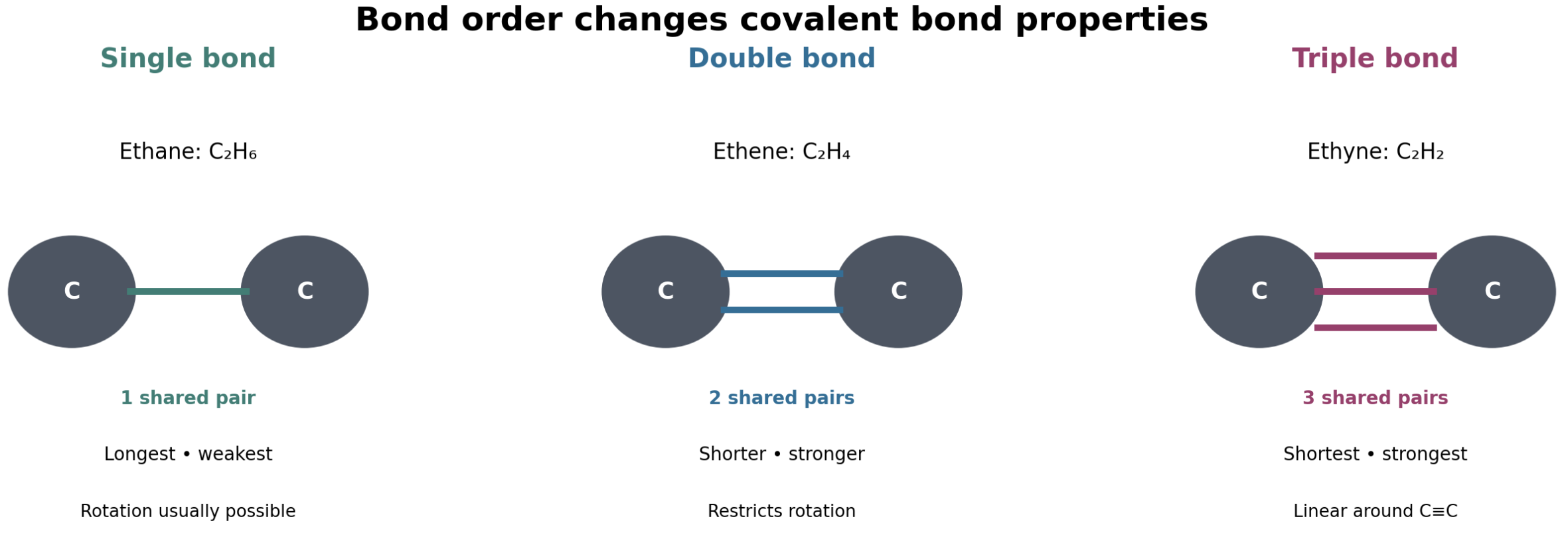
For bonds between the same types of atoms, increasing bond order generally makes the bond shorter and stronger.
Single covalent bonds
A single bond consists of one shared pair of electrons.
It is represented by one line:
A—B
Each line in a structural formula represents one shared electron pair.
Hydrogen
Two hydrogen atoms share one pair of electrons:
H—H
Each hydrogen contributes one electron to the shared pair. Each atom then has access to two electrons in its first shell.
Molecular formula:
H₂
Chlorine
Each chlorine atom has seven valence electrons. Two chlorine atoms share one pair:
Cl—Cl
Each chlorine atom then has access to eight valence electrons.
Molecular formula:
Cl₂


Hydrogen and chlorine are examples of diatomic molecules containing single bonds.
Methane
Carbon has four valence electrons and normally forms four covalent bonds.
In methane, one carbon atom shares an electron pair with each of four hydrogen atoms:
    H
    |
H — C — H
    |
    H
Molecular formula:
CH₄
Methane contains four single C—H bonds.
Its atoms are arranged in a three-dimensional tetrahedral shape around carbon, with bond angles of approximately 109.5°.
A flat structural formula shows the bonding connections but does not fully represent the molecule’s three-dimensional shape.
Ethane
Ethane contains a single bond between two carbon atoms:
CH₃—CH₃
Each carbon forms:
- One C—C single bond.
- Three C—H single bonds.
Molecular formula:
C₂H₆
The single carbon–carbon bond usually allows rotation, so different spatial arrangements can form without breaking the bond.
Double covalent bonds
A double bond consists of two shared electron pairs.
It is represented by two parallel lines:
A=B
A double bond contains four shared electrons.
Oxygen
Each oxygen atom has six valence electrons and needs two more electrons to complete its outer shell.
Two oxygen atoms share two pairs:
O=O
Molecular formula:
O₂
The double bond allows each oxygen atom to achieve a stable outer arrangement.


Oxygen contains one double bond. Carbon dioxide contains two carbon–oxygen double bonds.
Carbon dioxide
A carbon atom needs four additional electrons to complete its outer shell. Each oxygen atom needs two.
Carbon shares two pairs with each oxygen:
O=C=O
Molecular formula:
CO₂
Carbon dioxide contains:
- Two C=O double bonds.
- No single bonds between carbon and oxygen.
- A linear molecular arrangement.
The O—C—O bond angle is 180°.
Ethene
Ethene contains a carbon–carbon double bond:
CH₂=CH₂
Molecular formula:
C₂H₄
Each carbon atom forms:
- Two C—H single bonds.
- One C=C double bond.
The atoms around each double-bonded carbon have an approximately trigonal planar arrangement, with bond angles near 120°.
The double bond also restricts rotation. Rotating one end independently would require disruption of part of the bond.


The restricted rotation around C=C bonds helps explain why some compounds can exist as different geometric isomers.
Triple covalent bonds
A triple bond consists of three shared electron pairs.
It is represented by three lines:
A≡B
A triple bond contains six shared electrons.
Nitrogen
Each nitrogen atom has five valence electrons and needs three more to complete its outer shell.
Two nitrogen atoms share three electron pairs:
N≡N
Molecular formula:
N₂
The N≡N bond is very strong. Considerable energy is required to break it, which contributes to the relatively low reactivity of nitrogen gas under ordinary conditions.


Nitrogen and ethyne are common examples of molecules containing triple bonds.
Ethyne
Ethyne, also called acetylene, contains a carbon–carbon triple bond:
H—C≡C—H
Molecular formula:
C₂H₂
Each carbon forms:
- One C—H single bond.
- One C≡C triple bond.
The arrangement around each triple-bonded carbon is linear, producing a bond angle of 180°.
Acetylene burns in oxygen with a very hot flame and is used in some welding and metal-cutting equipment.
Comparing ethane, ethene, and ethyne
These three hydrocarbons contain two carbon atoms but different carbon–carbon bond orders.
| Molecule | Formula | Carbon–carbon bond | General arrangement around carbon |
|---|---|---|---|
| Ethane | C₂H₆ | C—C | Tetrahedral |
| Ethene | C₂H₄ | C=C | Trigonal planar |
| Ethyne | C₂H₂ | C≡C | Linear |
As carbon–carbon bond order increases:
- Fewer hydrogen atoms can bond to the carbon atoms.
- The carbon–carbon bond becomes shorter.
- The carbon–carbon bond becomes stronger.
- Rotation becomes more restricted.
- The local molecular arrangement changes.
Bond length
Bond length is the average distance between the nuclei of two bonded atoms.
For the same pair of atoms:
Single bond > double bond > triple bond in length
For carbon–carbon bonds, typical average values are approximately:
| Bond | Approximate length |
|---|---|
| C—C | 154 pm |
| C=C | 134 pm |
| C≡C | 120 pm |
One picometre, pm, is:
1 pm = 10⁻¹² m
A higher bond order pulls the bonded nuclei closer together because more electron density lies between them.
Actual bond lengths vary somewhat depending on the rest of the molecule.
Bond strength
Bond strength describes how much energy is required to break a bond.
For the same pair of atoms:
Triple bond > double bond > single bond in strength
Typical carbon–carbon bond energies are approximately:
| Bond | Approximate bond energy |
|---|---|
| C—C | 350 kJ/mol |
| C=C | 610 kJ/mol |
| C≡C | 840 kJ/mol |
A triple bond is stronger than a double bond, and a double bond is stronger than a single bond.
However:
- A double bond is not exactly twice as strong as a single bond.
- A triple bond is not exactly three times as strong.
- Bond energy depends on the atoms and the surrounding molecular structure.
Bond strength and chemical reactions
Strong bonds require more energy to break.
Nitrogen gas contains a strong N≡N triple bond. Breaking this bond requires substantial energy, so nitrogen is relatively unreactive at room temperature.
Unsaturated hydrocarbons such as ethene and ethyne still undergo many addition reactions. Their multiple bonds contain components that are more exposed and can react with other substances.
Therefore, a stronger total bond does not mean that a molecule can never be reactive.
Sigma and pi bonds
A more detailed bonding model describes covalent bonds using sigma bonds and pi bonds.
Single bond
A single bond contains:
- One sigma, σ, bond.
Double bond
A double bond contains:
- One sigma bond.
- One pi, π, bond.
Triple bond
A triple bond contains:
- One sigma bond.
- Two pi bonds.
Sigma bonding occurs directly along the line between the nuclei. Pi bonding occurs through sideways overlap above and below that line.
The pi component explains why rotation around a double bond is restricted. Rotation would disrupt the sideways overlap.
Bond order and molecular structure
Bond order affects molecular structure in several ways.
Rotation
Single bonds often allow rotation.
Double and triple bonds restrict free rotation because rotating the atoms would disrupt pi bonding.
Bond angles
Bonding around carbon often follows these patterns:
- Four single-bond regions: tetrahedral, approximately 109.5°.
- One double bond and two other regions: trigonal planar, approximately 120°.
- One triple bond and one other region: linear, 180°.
Planarity
Atoms around a carbon–carbon double bond tend to lie in the same plane.
Rigidity
Multiple bonds create more rigid parts of molecules. This can influence:
- Molecular shape.
- Biological function.
- Material properties.
- Chemical reactivity.
Structural formulae
A structural formula uses lines to show covalent bonds between atoms.
Examples include:
- H—H
- Cl—Cl
- O=O
- N≡N
- O=C=O
- H—C≡N
- CH₃—CH₃
- CH₂=CH₂
- HC≡CH
Structural formulae provide more bonding information than molecular formulae.
For example, C₂H₆, C₂H₄ and C₂H₂ show the numbers of atoms, but their structural formulae reveal the carbon–carbon bond type.
Lewis structures
A Lewis structure shows:
- Valence electrons.
- Shared bonding pairs.
- Unshared lone pairs.
A line may replace one shared pair of electrons.
Oxygen
..   ..
O = O
..   ..
Each oxygen atom has:
- Two shared electron pairs in the double bond.
- Two lone pairs.
Nitrogen
:N≡N:Each nitrogen atom has:
- Three shared electron pairs.
- One lone pair.
Carbon dioxide
..     ..
O = C = O
..     ..
Each oxygen has two lone pairs. Carbon has no lone pairs in the usual structure.
Drawing a Lewis structure
A useful procedure is:
- Count all available valence electrons.
- Choose the central atom where appropriate.
- Connect atoms using single bonds.
- Complete the outer shells of terminal atoms.
- Place remaining electrons on the central atom.
- Form double or triple bonds if the central atom still lacks a complete outer shell.
- Check the total number of electrons.
Worked example: carbon dioxide
Carbon contributes four valence electrons.
Two oxygen atoms contribute:
2 × 6 = 12 electrons
Total:
4 + 12 = 16 valence electrons
Begin with:
O—C—O
After filling the oxygen outer shells, carbon does not yet have eight electrons around it. Move one lone pair from each oxygen into a shared pair with carbon.
The result is:
O=C=O
The molecule has two double bonds and uses all 16 valence electrons.
Worked example: hydrogen cyanide
Hydrogen cyanide has the formula HCN.
Valence electrons:
- H contributes 1.
- C contributes 4.
- N contributes 5.
Total:
1 + 4 + 5 = 10 electrons
Hydrogen forms only one bond, so the arrangement is:
H—C—N
To complete the outer shells, carbon and nitrogen form a triple bond:
H—C≡N:
The structure contains:
- One H—C single bond.
- One C≡N triple bond.
- One lone pair on nitrogen.
The molecule is linear.
Identifying bond types from a formula
A molecular formula alone may not always show the bond arrangement. A structural or Lewis formula provides more information.
| Molecule | Structural formula | Bond types present |
|---|---|---|
| Hydrogen | H—H | Single |
| Water | H—O—H | Single |
| Oxygen | O=O | Double |
| Nitrogen | N≡N | Triple |
| Carbon dioxide | O=C=O | Double |
| Ethene | CH₂=CH₂ | Single and double |
| Ethyne | H—C≡C—H | Single and triple |
| Hydrogen cyanide | H—C≡N | Single and triple |
Multiple bonds and saturation
Hydrocarbons containing only carbon–carbon single bonds are called saturated hydrocarbons.
Examples include:
- Methane.
- Ethane.
- Propane.
Hydrocarbons containing one or more carbon–carbon double or triple bonds are unsaturated.
Examples include:
- Ethene.
- Propene.
- Ethyne.
Unsaturated compounds can often undergo addition reactions in which atoms are added across the multiple bond.
Real-world connection: ethene and polymers
Ethene contains a C=C double bond:
CH₂=CH₂
During polymerization, the double bond opens and many ethene molecules join to form poly(ethene).
A simplified section of the polymer is:
—CH₂—CH₂—CH₂—CH₂—


Poly(ethene) is used in bags, bottles, containers, pipes and electrical insulation.
The presence of the double bond in ethene allows the monomers to join into long chains.
Real-world connection: nitrogen fixation
Nitrogen gas makes up most of Earth’s atmosphere, but many organisms cannot use N₂ directly.
The strong N≡N triple bond must be broken before nitrogen can form compounds such as ammonia.
Industrial nitrogen fixation uses:
- High pressure.
- Elevated temperature.
- A catalyst.
Biological nitrogen fixation is performed by certain microorganisms using specialized enzymes.
The energy required is related partly to the strength of the nitrogen triple bond.
Common misconceptions
- “A double bond contains two electrons.” It contains two shared pairs, or four shared electrons.
- “A triple bond contains three electrons.” It contains three shared pairs, or six shared electrons.
- “A double bond is twice as strong as a single bond.” It is stronger, but not usually exactly twice as strong.
- “More lines mean a longer bond.” Greater bond order generally produces a shorter bond.
- “Every molecule contains only one type of bond.” Many molecules contain both single and multiple bonds.
- “A molecular formula shows the complete structure.” Different structures can sometimes have the same molecular formula.
- “All single bonds produce a linear molecule.” Molecular geometry depends on all electron regions around an atom.
- “A triple bond means three separate atoms are involved.” It describes three shared pairs between two atoms.
Did you know?
The bond order between two atoms does not always have to be a whole number.
In some molecules and ions, electrons are spread across several bonds. This is called delocalization, and it can produce average bond orders such as 1.5.
Benzene is a familiar example in which all six carbon–carbon bonds have the same intermediate length.
Key terms
- Covalent bond: An electrostatic attraction involving a shared pair of electrons and two nuclei.
- Single bond: A covalent bond containing one shared electron pair.
- Double bond: A covalent bond containing two shared electron pairs.
- Triple bond: A covalent bond containing three shared electron pairs.
- Bond order: Number of shared electron pairs between two bonded atoms.
- Bond length: Average distance between the nuclei of bonded atoms.
- Bond energy: Energy required to break a particular type of bond.
- Structural formula: A representation using lines to show how atoms are bonded.
- Lewis structure: A diagram showing bonding pairs and lone pairs of valence electrons.
- Lone pair: A pair of valence electrons not used in a bond.
- Sigma bond: A covalent bond formed by direct orbital overlap along the line between nuclei.
- Pi bond: A bond formed by sideways orbital overlap.
- Unsaturated compound: A compound containing carbon–carbon multiple bonds.
- Restricted rotation: Limited ability to rotate around a multiple bond.
Key takeaways
- A single bond contains one shared pair, a double bond two and a triple bond three.
- Bond order is represented using one, two or three lines.
- For the same atom pair, higher bond order generally means a shorter, stronger bond.
- Multiple bonds restrict rotation and influence molecular geometry.
- O₂ contains a double bond, while N₂ contains a triple bond.
- Ethane, ethene and ethyne contain different carbon–carbon bond orders.
- Structural and Lewis diagrams reveal bond types more clearly than molecular formulae.
- Bond strength, length and molecular structure all depend on bond order.
4. Molecular Compounds
Learning outcomes
- I can identify common molecular compounds.
- I can distinguish between molecules and ionic compounds.
- I can describe the properties of molecular substances.
- I can explain why many molecular compounds have low melting points.
- I can relate molecular structure to observable properties.
What is a molecular compound?
A molecular compound consists of separate groups of atoms joined by covalent bonds.
Within each molecule:
- Atoms share electron pairs.
- Strong covalent bonds hold the atoms together.
- The molecule has a specific number and arrangement of atoms.
Molecular compounds usually form between non-metal elements.
Examples include:
- Water, H₂O.
- Carbon dioxide, CO₂.
- Methane, CH₄.
- Ammonia, NH₃.
- Hydrogen chloride, HCl.
- Sulfur dioxide, SO₂.
- Ethanol, C₂H₅OH.
- Glucose, C₆H₁₂O₆.
Molecules and compounds
A molecule is a group of two or more atoms held together by covalent bonds.
A compound contains atoms of two or more different elements chemically combined.
Therefore, not every molecule is a compound.
| Substance | Molecule? | Compound? | Explanation |
|---|---|---|---|
| O₂ | Yes | No | Contains only oxygen atoms |
| N₂ | Yes | No | Contains only nitrogen atoms |
| H₂O | Yes | Yes | Contains hydrogen and oxygen |
| CO₂ | Yes | Yes | Contains carbon and oxygen |
| CH₄ | Yes | Yes | Contains carbon and hydrogen |
| NaCl | No discrete molecules | Yes | Contains sodium and chloride ions in a lattice |
Oxygen gas consists of molecules, but it is an element rather than a compound.
Water consists of molecules and is also a compound.
Common molecular compounds


Molecular models show how atoms are connected and arranged in three dimensions.
| Compound | Formula | Main bonds | Shape or structure |
|---|---|---|---|
| Water | H₂O | O—H single bonds | Bent |
| Carbon dioxide | CO₂ | C=O double bonds | Linear |
| Methane | CH₄ | C—H single bonds | Tetrahedral |
| Ammonia | NH₃ | N—H single bonds | Trigonal pyramidal |
| Hydrogen chloride | HCl | H—Cl single bond | Linear |
| Sulfur dioxide | SO₂ | S—O bonding | Bent |
| Ethanol | C₂H₅OH | Mainly single bonds | Multi-atom molecule |
| Glucose | C₆H₁₂O₆ | Mainly single bonds | Ring or chain forms |
The molecular formula shows the number and types of atoms. A structural formula also shows how the atoms are connected.
Molecular substances and ionic compounds
Molecular and ionic compounds contain different particles and structures.
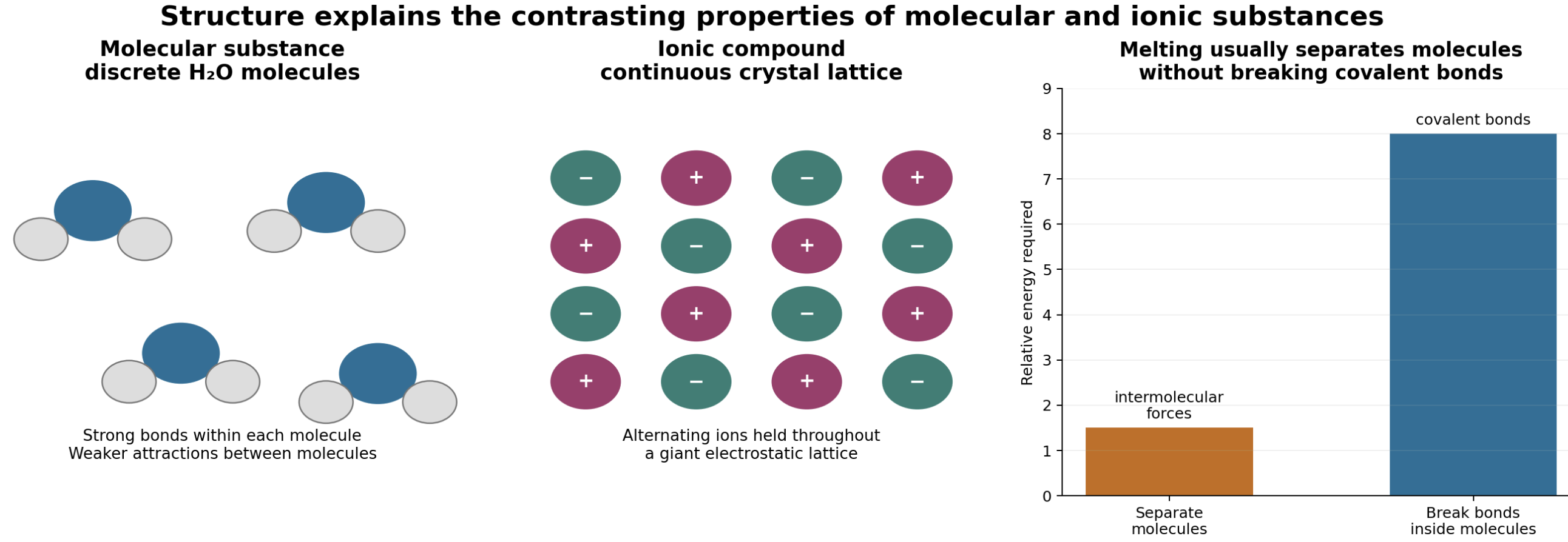
A molecular substance contains separate molecules. An ionic compound contains a repeating arrangement of oppositely charged ions.
How molecular compounds form
Molecular compounds form through electron sharing.
For example, water contains two O—H covalent bonds. Each bond consists of a shared pair of electrons.
A simple structural formula is:
H—O—H
The atoms remain connected as one identifiable H₂O molecule.
How ionic compounds form
Ionic compounds usually form through electron transfer between a metal and a non-metal.
For example, sodium transfers an electron to chlorine:
Na → Na⁺ + e⁻
Cl + e⁻ → Cl⁻
The oppositely charged ions attract one another and form a giant ionic lattice.
Solid sodium chloride does not consist of separate NaCl molecules. Its formula shows the simplest whole-number ratio of ions:
NaCl means Na⁺ : Cl⁻ = 1 : 1


A salt crystal contains a regular lattice of ions, while liquid water contains separate H₂O molecules moving among one another.
Comparing molecular and ionic compounds
| Property | Molecular compounds | Ionic compounds |
|---|---|---|
| Elements commonly involved | Non-metal with non-metal | Metal with non-metal |
| Main particle | Molecule | Positive and negative ions |
| Structure | Separate molecules | Giant ionic lattice |
| Bonding | Covalent bonds within molecules | Electrostatic attraction throughout lattice |
| Typical melting point | Often low | Usually high |
| Electrical conductivity | Usually poor | Conduct when molten or dissolved |
| State at room temperature | Often gas, liquid or low-melting solid | Usually crystalline solid |
| Formula meaning | Actual numbers of atoms in a molecule | Simplest ratio of ions |
These are general patterns. Individual substances may show exceptions depending on their structure.
Intramolecular and intermolecular forces
Two different types of attraction must be distinguished.
Intramolecular bonds
Intramolecular means “within a molecule.”
Strong covalent bonds join the atoms inside each molecule.
For example, water contains strong O—H covalent bonds within each H₂O molecule.
Intermolecular forces
Intermolecular means “between molecules.”
Intermolecular forces attract one molecule to another.
They are usually weaker than the covalent bonds within the molecules.
This difference explains many properties of molecular substances.
Why many molecular compounds have low melting points
When a molecular solid melts:
- The molecules separate and move past one another.
- Intermolecular forces are overcome.
- The covalent bonds inside each molecule usually remain intact.
Because intermolecular forces are often much weaker than covalent bonds, less energy is required to melt many molecular substances.
The melting process usually does not break the molecules into their atoms.
For example, when ice melts:
H₂O(s) → H₂O(l)
The particles remain H₂O molecules. The arrangement and motion of the molecules change.
Why many molecular compounds have low boiling points
Boiling separates molecules from one another to form a gas.
The stronger the intermolecular attractions, the more energy is required and the higher the boiling point.
Many small molecular compounds have relatively weak intermolecular attractions, so they are gases or liquids at room temperature.
Examples include:
- Carbon dioxide: gas.
- Methane: gas.
- Ammonia: gas.
- Water: liquid.
- Ethanol: liquid.
Comparing bond strength and melting point
A molecular substance can contain strong covalent bonds and still have a low melting point.
This is because different forces are involved:
- Covalent bonds hold atoms together within molecules.
- Intermolecular forces hold separate molecules near one another.
When methane boils, the C—H bonds do not break. The CH₄ molecules simply move farther apart.
A low melting point does not mean that the covalent bonds inside a molecule are weak.
Types of intermolecular forces
The strength of intermolecular attractions depends on molecular structure.
London dispersion forces
London dispersion forces occur between all atoms and molecules.
They are especially important in non-polar substances.
Their strength generally increases when molecules:
- Contain more electrons.
- Are larger.
- Have greater surface area in contact with neighbouring molecules.
Permanent dipole–dipole forces
Polar molecules have regions of partial positive and partial negative charge.
The oppositely charged regions of neighbouring molecules attract one another.
These attractions are called permanent dipole–dipole forces.
Hydrogen bonding
Hydrogen bonding is a particularly strong intermolecular attraction that occurs when hydrogen is covalently bonded to:
- Nitrogen.
- Oxygen.
- Fluorine.
Water, ammonia and ethanol can form hydrogen bonds.
Water as an unusual molecular compound
Water is a small molecular compound, but it has a much higher boiling point than many similarly sized molecules.
This is because water molecules form hydrogen bonds with one another.


Hydrogen bonding contributes to several important properties of water:
- It is liquid at ordinary room temperature.
- It has a relatively high boiling point.
- It has a high surface tension.
- It requires substantial energy to evaporate.
- Ice forms an open structure that is less dense than liquid water.
Water still has a much lower melting point than typical ionic compounds such as sodium chloride.
Molecular size and boiling point
Larger molecules often have stronger dispersion forces because they contain more electrons.
Compare the halogens:
| Substance | Formula | State near room temperature |
|---|---|---|
| Fluorine | F₂ | Gas |
| Chlorine | Cl₂ | Gas |
| Bromine | Br₂ | Liquid |
| Iodine | I₂ | Solid |
The particles are all non-polar diatomic molecules, but intermolecular attractions become stronger as molecular size increases.
Although F₂, Cl₂, Br₂ and I₂ are molecules, they are elemental substances rather than molecular compounds.
Molecular shape and intermolecular attractions
Shape affects how closely molecules can approach one another.
Long, relatively straight molecules may have greater surface contact than highly branched molecules of similar mass. Greater contact can strengthen dispersion forces and increase boiling point.
Molecular shape also affects:
- Polarity.
- Packing in a solid.
- Solubility.
- Viscosity.
- Biological activity.
Two substances with the same molecular formula can sometimes have different structures and properties. These substances are called isomers.
Polarity
A covalent bond may be polar if one atom attracts the shared electrons more strongly than the other.
A molecule’s overall polarity depends on:
- The polarity of its bonds.
- Its three-dimensional shape.
- Whether the bond dipoles cancel.
Water
Water has polar O—H bonds and a bent shape. The bond dipoles do not cancel, so water is polar.
Carbon dioxide
Carbon dioxide has polar C=O bonds, but the molecule is linear and symmetrical:
O=C=O
The two bond dipoles cancel, making the molecule non-polar overall.
A molecule can therefore contain polar bonds without being a polar molecule.
Solubility of molecular compounds
A useful general rule is:
Substances tend to dissolve in solvents with similar polarity.
This is sometimes expressed as “like dissolves like.”
Polar molecular compounds
Many polar substances dissolve in polar solvents such as water.
Examples include:
- Ethanol.
- Sugar.
- Some small organic acids.
Non-polar molecular compounds
Non-polar substances often dissolve more readily in non-polar solvents.
Examples include:
- Oils.
- Waxes.
- Many hydrocarbons.
Oil and water do not mix well because their intermolecular attractions differ.


Solubility depends on more than whether a substance is molecular. Polarity, molecular size and the solvent all matter.
Electrical conductivity
Most pure molecular substances do not conduct electricity.
To conduct, a substance needs mobile charged particles.
Molecular substances usually contain:
- Neutral molecules.
- Electrons held within covalent bonds.
- No freely moving ions or delocalized electrons.
Therefore, they are usually poor electrical conductors as solids and liquids.
Important conductivity exceptions
Some molecular compounds react with water to produce ions.
For example, hydrogen chloride consists of HCl molecules as a gas. When dissolved in water, it ionizes:
HCl + H₂O → H₃O⁺ + Cl⁻
The resulting solution conducts electricity because it contains mobile ions.
The conductivity comes from ions in solution, not from intact neutral HCl molecules.
Some molecular substances, such as graphite-like extended structures, require separate explanations because they are not simple molecular substances.
Physical states at room temperature
Many molecular substances are gases, liquids or low-melting solids at room temperature.
Molecular gases
Examples include:
- CO₂.
- CH₄.
- NH₃.
Their molecules experience relatively weak attractions under ordinary conditions.
Molecular liquids
Examples include:
- H₂O.
- Ethanol.
- Bromine, which is molecular but elemental.
Molecular solids
Examples include:
- Ice.
- Sugar.
- Iodine, which is molecular but elemental.
- Many pharmaceutical compounds.
Molecular solids may be soft, brittle, flexible or crystalline depending on their structures and intermolecular forces.
Carbon dioxide
Carbon dioxide is a molecular compound with formula CO₂.
Its structural formula is:
O=C=O
Properties include:
- Colourless gas at room temperature.
- Non-flammable under ordinary conditions.
- Poor electrical conductivity.
- Linear molecular shape.
- Overall non-polar molecule.
- Sublimation of solid CO₂ at atmospheric pressure.


Solid carbon dioxide is called dry ice. It changes directly from solid to gas under ordinary atmospheric pressure.
Methane
Methane has the formula CH₄.
Properties include:
- Colourless gas at room temperature.
- Tetrahedral molecular shape.
- Non-polar overall.
- Low boiling point.
- Poor electrical conductivity.
- Flammable.
Methane’s low boiling point is related to its small size and weak intermolecular attractions.
Ammonia
Ammonia has the formula NH₃.
Properties include:
- Gas at room temperature.
- Pungent smell.
- Polar molecule.
- Trigonal pyramidal shape.
- Hydrogen bonding between molecules.
- High solubility in water.
- Formation of an alkaline solution in water.
Ammonia has a higher boiling point than many similar-sized molecules because of hydrogen bonding.
Ethanol
Ethanol has the formula:
C₂H₅OH
It contains:
- A non-polar carbon-based region.
- A polar O—H region.
- Hydrogen bonding between molecules.
Properties include:
- Liquid at room temperature.
- Miscible with water in all proportions.
- Lower boiling point than water.
- Flammable.
- Ability to dissolve some polar and non-polar substances.
This combination makes ethanol useful as a solvent.
Glucose
Glucose has the molecular formula:
C₆H₁₂O₆
It is a molecular compound with many O—H groups.
Properties include:
- Solid at room temperature.
- Soluble in water.
- Relatively high melting behaviour for a molecular substance.
- Poor electrical conductivity in pure form.
- Important role in cellular respiration.
Its many polar groups allow strong attractions, including hydrogen bonding, with water molecules.
Simple molecular and giant covalent structures
Not every covalently bonded substance consists of separate molecules.
Simple molecular substances
These contain identifiable molecules.
Examples include:
- H₂O.
- CO₂.
- CH₄.
- NH₃.
Their melting and boiling usually involve overcoming intermolecular forces.
Giant covalent structures
These contain continuous networks of covalent bonds rather than separate molecules.
Examples include:
- Diamond.
- Silicon dioxide.
- Graphite.
Giant covalent substances often have very high melting points because many strong covalent bonds must be broken.


The phrase “covalent substance” does not automatically mean low melting point. The distinction between discrete molecules and a giant covalent network is essential.
Relating structure to observable properties
A useful explanation follows this chain:
Structure → particles and forces → energy or mobility → observable property
Example: low boiling point of methane
- Methane consists of small, separate CH₄ molecules.
- Weak dispersion forces act between them.
- Little energy is needed to separate the molecules.
- Methane has a low boiling point and is a gas at room temperature.
Example: water’s relatively high boiling point
- Water consists of polar H₂O molecules.
- Hydrogen bonds form between neighbouring molecules.
- More energy is needed to separate them.
- Water remains liquid at room temperature and boils at a higher temperature than many similar-sized molecules.
Example: poor electrical conductivity
- A molecular liquid contains neutral molecules.
- It has no mobile ions or delocalized electrons.
- Charge cannot move through the substance.
- The liquid does not conduct electricity effectively.
Identifying an unknown substance
Suppose an unknown substance:
- Melts at 18°C.
- Does not conduct electricity as a liquid.
- Consists only of non-metals.
- Evaporates easily.
This evidence suggests a molecular substance because:
- Its melting point is low.
- It lacks mobile charged particles.
- Its atoms are likely joined through covalent bonds.
- Relatively weak intermolecular forces allow easy evaporation.
One property alone may not provide enough evidence. A stronger identification uses several properties together.
Common misconceptions
- “Every molecule is a compound.” O₂ and N₂ are molecules of elements.
- “Ionic compounds consist of molecules.” They normally consist of extended ionic lattices.
- “Molecular substances have weak covalent bonds.” Their low melting points usually result from weak intermolecular forces.
- “Melting breaks covalent bonds.” Melting a simple molecular substance normally separates intact molecules.
- “All molecular compounds are gases.” They can be gases, liquids or solids.
- “All molecular compounds have very low melting points.” Larger molecules and strong intermolecular forces can raise melting points.
- “All polar bonds produce a polar molecule.” Molecular shape determines whether bond dipoles cancel.
- “All substances containing covalent bonds have low melting points.” Giant covalent structures usually have very high melting points.
- “Molecular solutions never conduct electricity.” Some molecular compounds ionize when dissolved.
Did you know?
Many smells come from molecular substances that evaporate easily.
For a substance to reach receptors in the nose, molecules must enter the gas phase and travel through the air. Volatile molecular compounds often have recognizable odours because their intermolecular forces allow them to evaporate at ordinary temperatures.
Key terms
- Molecule: A group of atoms joined by covalent bonds.
- Molecular compound: A substance containing discrete molecules made from different elements.
- Covalent bond: A strong attraction involving a shared electron pair and two nuclei.
- Ionic compound: A substance containing positive and negative ions in a lattice.
- Intermolecular force: An attraction between separate molecules.
- Intramolecular bond: A bond joining atoms within a molecule.
- Polarity: Unequal distribution of electrical charge within a bond or molecule.
- Dipole: A separation of partial positive and partial negative charge.
- Hydrogen bonding: A strong intermolecular attraction involving hydrogen bonded to nitrogen, oxygen or fluorine.
- Dispersion force: An attraction caused by temporary variations in electron distribution.
- Volatility: Tendency of a substance to evaporate.
- Simple molecular structure: A structure consisting of separate molecules.
- Giant covalent structure: A continuous network of covalently bonded atoms.
Key takeaways
- Molecular compounds contain discrete groups of covalently bonded non-metal atoms.
- A molecule may be an element or a compound.
- Ionic compounds contain lattices of positive and negative ions rather than separate molecules.
- Strong covalent bonds act within molecules.
- Weaker intermolecular forces act between molecules.
- Melting and boiling simple molecular substances usually overcome intermolecular forces.
- Molecular size, shape and polarity affect melting point, boiling point and solubility.
- Most molecular substances conduct electricity poorly because they lack mobile charged particles.
- Giant covalent substances have different properties from simple molecular substances.
- Observable properties can be explained by connecting structure, forces and particle behaviour.
5. Covalent Networks
Learning outcomes
- I can describe giant covalent structures.
- I can explain the structures of diamond, graphite, and silicon dioxide.
- I can compare network covalent solids with molecular substances.
- I can explain why some covalent structures are extremely hard.
- I can relate network structures to their uses.
What Is a Covalent Network?
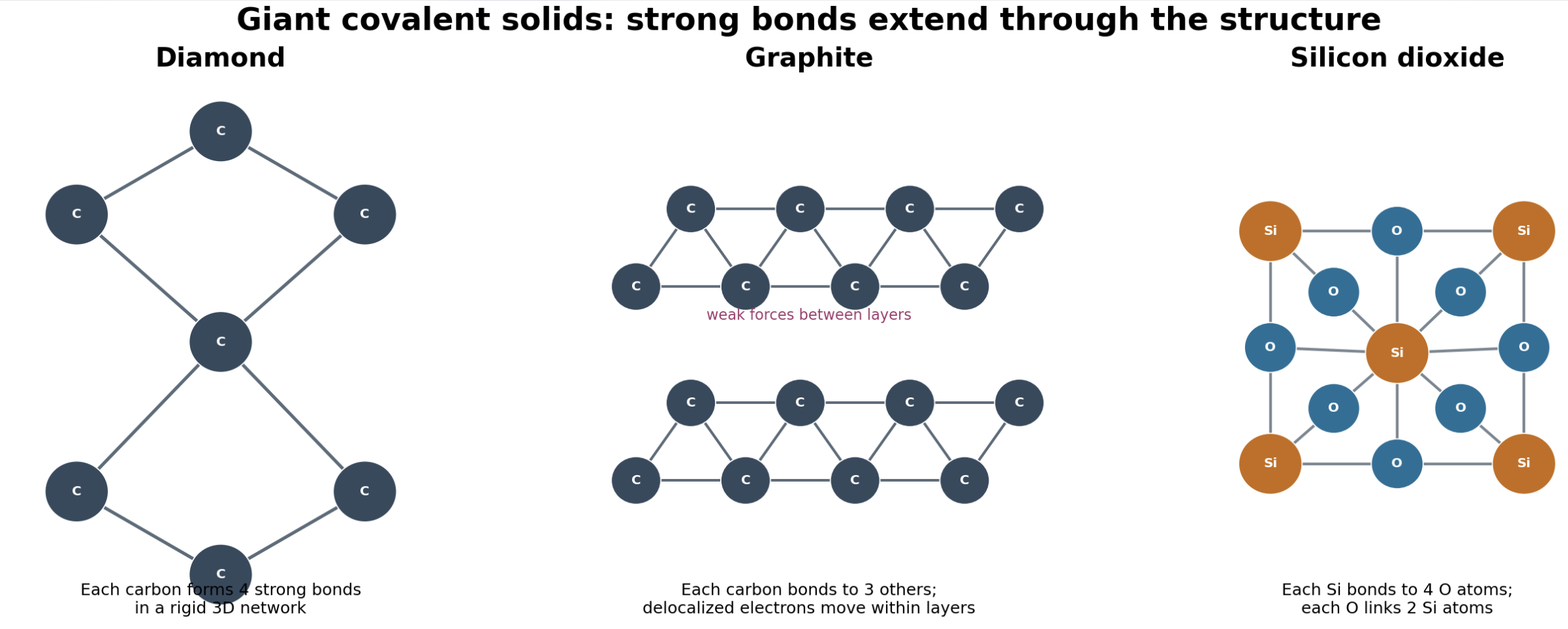
A covalent network, also called a giant covalent structure, is a continuous arrangement of atoms joined by strong covalent bonds.
Unlike a molecular substance, a covalent network does not contain separate, individual molecules. Its covalent bonds extend throughout the entire solid, forming a giant two-dimensional or three-dimensional lattice.
Examples include:
- Diamond
- Graphite
- Graphene
- Silicon dioxide
- Silicon carbide
Because covalent bonds are strong, considerable energy is generally required to break apart these structures.
Structure Determines Properties
The properties of a covalent network depend on:
- How many bonds each atom forms
- The strength of those bonds
- Whether the structure is two-dimensional or three-dimensional
- Whether the structure contains mobile, delocalized electrons
- Whether layers can slide over one another
A useful chain of reasoning is:
Bonding and arrangement → structure → properties → uses
For example:
Four bonds per carbon → rigid 3D network → extreme hardness → cutting tools
Diamond


Diamond is a giant covalent form, or allotrope, of carbon.
Structure of Diamond
In diamond:
- Every carbon atom forms four covalent bonds.
- Each carbon is bonded to four other carbon atoms.
- The bonds point toward the corners of a tetrahedron.
- The bonding continues in every direction, producing a rigid three-dimensional network.
- There are no separate diamond molecules.
A chemical formula of
describes the type of atom present, but it does not mean that diamond consists of individual one-atom molecules.
Properties of Diamond
Extreme hardness
Diamond is extremely hard because:
- Carbon–carbon covalent bonds are strong.
- Every carbon atom is held firmly in a rigid 3D arrangement.
- Scratching or deforming the structure requires many strong bonds to be broken or rearranged.
- There are no weak layers that can slide over one another.
Very high melting or sublimation temperature
A large amount of energy is needed to separate the carbon atoms because strong covalent bonds extend throughout the structure.
Diamond does not behave like an ordinary molecular solid when heated. At atmospheric pressure, it tends to transform or sublime before forming an ordinary liquid.
Electrical insulation
Diamond does not normally conduct electricity because all four outer electrons from each carbon atom are involved in covalent bonds. There are no freely moving charged particles.
High thermal conductivity
Although diamond does not conduct electricity, it transfers thermal energy very effectively through vibrations in its rigid lattice.
Uses of Diamond
Diamond is used in:
- Cutting and drilling tools
- Abrasive powders
- Saw blades
- Polishing equipment
- Heat spreaders in electronics
- Jewellery
Its use in tools is connected to its hardness, while its use in electronics is connected to its ability to transfer heat.
Important: Hardness is resistance to scratching or deformation. It is not the same as toughness. Diamond is extremely hard but can still crack or split along particular planes.
Graphite


Graphite is another allotrope of carbon, but its structure is very different from that of diamond.
Structure of Graphite
In graphite:
- Each carbon atom forms three covalent bonds.
- The carbon atoms form flat sheets of connected hexagonal rings.
- Strong covalent bonds hold the atoms together within each sheet.
- Weak intermolecular attractions act between neighbouring sheets.
- One outer electron from each carbon is delocalized and can move through a sheet.
Graphite is therefore a layered giant covalent structure.
Properties of Graphite
Soft and slippery
The covalent bonds within each layer are strong, but the forces between layers are much weaker. The layers can slide past one another relatively easily.
This makes graphite:
- Soft
- Slippery
- Suitable as a dry lubricant
- Able to leave marks on paper
When a pencil is used, thin layers and particles of graphite are transferred to the paper.
Electrical conductivity
Graphite conducts electricity because it contains delocalized electrons that can move along its layers.
Its conductivity is greater along the layers than across them because the electrons move most easily within the carbon sheets.
High melting temperature
Graphite still has a very high melting or sublimation temperature. Melting it requires strong carbon–carbon covalent bonds within the layers to be overcome—not merely the weak forces between layers.
Uses of Graphite
Graphite is used in:
- Pencil “lead”
- Electrodes
- Batteries
- Motor brushes
- High-temperature crucibles
- Dry lubricants
- Refractory furnace linings
Its applications arise from its combination of electrical conductivity, thermal stability, and layered structure.
Diamond and Graphite Are Both Carbon
Diamond and graphite contain only carbon atoms, but they have dramatically different properties because their atoms are arranged and bonded differently.
| Property | Diamond | Graphite |
|---|---|---|
| Bonds per carbon | 4 | 3 |
| Overall structure | Rigid 3D network | Flat layers |
| Hardness | Extremely hard | Soft and slippery |
| Electrical conductivity | Does not normally conduct | Conducts along its layers |
| Mobile electrons | None | Delocalized electrons present |
| Common uses | Cutting tools and abrasives | Electrodes, pencils and lubricants |
This comparison demonstrates an important chemical principle:
A substance’s properties depend not only on which atoms it contains, but also on how those atoms are bonded and arranged.
Silicon Dioxide


Silicon dioxide,
, is also called silica. It occurs naturally in quartz and is a major component of many types of sand and rock.
Structure of Silicon Dioxide
In silicon dioxide:
- Each silicon atom is covalently bonded to four oxygen atoms.
- The oxygen atoms are arranged approximately tetrahedrally around each silicon atom.
- Each oxygen atom connects two silicon atoms.
- The bonding continues through a three-dimensional network.
- The overall ratio is one silicon atom for every two oxygen atoms.
The formula
represents the simplest whole-number ratio of silicon to oxygen. It does not normally represent a separate, individual
molecule in solid quartz.
Properties of Silicon Dioxide
Silicon dioxide is generally:
- Hard
- Rigid
- Insoluble in water
- An electrical insulator
- Resistant to chemical attack
- High-melting
These properties arise from its extensive network of strong silicon–oxygen covalent bonds.
Uses of Silicon Dioxide
Silicon dioxide is used in:
- Glass
- Ceramics
- Concrete and construction materials
- Optical fibres
- Laboratory glassware
- Electronic and semiconductor components
Quartz has an ordered crystalline network. Ordinary glass also contains a silicon–oxygen network, but its atoms do not have the same long-range repeating order, so it is described as amorphous.
Why Are Some Covalent Networks So Hard?
Hardness depends on how strongly atoms are held in position and whether parts of the structure can move.
Diamond and crystalline silicon dioxide are hard because:
- They contain many strong covalent bonds.
- Their bonds extend through rigid three-dimensional networks.
- Their atoms cannot move without several bonds being stretched, broken, or rearranged.
- They do not contain weakly connected layers.
Graphite is the important exception. It contains strong covalent bonds, but its layers are connected by much weaker attractions. The layers can slide, making graphite soft.
Therefore, it is not enough to say:
“All giant covalent structures are hard.”
A more accurate statement is:
Rigid three-dimensional covalent networks are generally very hard, while layered covalent networks may be soft between their layers.
Network Covalent and Molecular Substances
A molecular substance consists of separate molecules. Strong covalent bonds hold the atoms together inside each molecule, but the forces between different molecules are usually much weaker.
A network covalent substance has covalent bonds extending through the entire structure.
| Feature | Network covalent solid | Molecular substance |
|---|---|---|
| Basic structure | Continuous network of atoms | Separate molecules |
| Forces overcome when melting | Many strong covalent bonds | Mainly weaker intermolecular forces |
| Typical melting point | Very high | Often low or moderate |
| Typical hardness | Often hard | Usually softer |
| Electrical conductivity | Usually low; graphite is an exception | Usually low |
| Examples | Diamond, graphite, | Water, carbon dioxide, methane |
Example: Silicon Dioxide and Carbon Dioxide
Silicon dioxide and carbon dioxide both contain oxygen, but their structures are completely different.
- Solid silicon dioxide is a giant covalent network.
- Carbon dioxide consists of separatemolecules.
- Strong bonds extend throughout silicon dioxide.
- Weak intermolecular attractions exist between carbon dioxide molecules.
- Silicon dioxide is a hard, high-melting solid.
- Carbon dioxide is a gas at room temperature.
This difference is caused by structure and bonding, not simply by the elements present.
Applying Structure–Property Reasoning
Example: Why is diamond used on drill bits?
Structure: Diamond has a rigid, three-dimensional carbon network.
Bonding: Each carbon atom forms four strong covalent bonds.
Property: The structure strongly resists scratching and deformation.
Use: Diamond can cut or grind many other materials.
Example: Why is graphite used in electrodes?
Structure: Graphite contains delocalized electrons within its carbon layers.
Property: These electrons can move and carry electrical charge.
Use: Graphite can conduct current in batteries, electrolysis cells, and electric motors.
Example: Why is graphite used as a lubricant?
Structure: Graphite consists of strongly bonded sheets separated by weak attractions.
Property: The sheets can slide over one another.
Use: Graphite reduces friction between moving surfaces.
Example: Why is silicon dioxide used in glassware?
Structure: Silicon and oxygen form a strong three-dimensional network.
Properties: The material is rigid, heat resistant, and chemically stable.
Use: Silica-based glass can be used for containers, windows, and laboratory equipment.
Common Misconceptions
- “Diamond is one enormous molecule.”
It is more accurate at this level to describe diamond as a continuous giant covalent lattice rather than a collection of separate molecules. - “All carbon substances have the same properties.”
Diamond and graphite are both carbon, but different bonding arrangements give them different properties. - “Graphite is soft because its covalent bonds are weak.”
The bonds inside each layer are strong. Graphite is soft because weak attractions allow entire layers to slide. - “Graphite has free carbon ions.”
Graphite conducts using delocalized electrons, not moving carbon ions. - “Hard materials cannot break.”
Hardness and toughness are different. Diamond resists scratching but can fracture. - “The 2 in means one molecule contains three atoms.”
In network silicon dioxide, the formula shows the overall silicon-to-oxygen ratio rather than describing a separate molecule.
Did You Know?
A single sheet separated from graphite is called graphene. It is only one atom thick, yet it has remarkable strength and conducts electricity effectively. Its properties have led to research into sensors, flexible electronics, composite materials, and energy-storage devices.
Key Terms
- Giant covalent structure: A continuous structure in which atoms are connected by covalent bonds.
- Network covalent solid: Another name for a solid containing a giant covalent network.
- Lattice: A regular or extended arrangement of particles in a solid.
- Tetrahedral arrangement: A geometry in which four bonds point toward the corners of a tetrahedron.
- Allotrope: One of two or more structural forms of the same element.
- Delocalized electron: An electron that is not confined to one bond and can move through part of a structure.
- Intermolecular forces: Attractions acting between separate particles or molecules.
- Hardness: Resistance to scratching or permanent surface deformation.
- Brittleness: The tendency of a material to fracture instead of bending.
- Electrical conductor: A material containing charged particles that can move and carry current.
- Electrical insulator: A material that does not contain easily moving charged particles.
- Silica: The common name for silicon dioxide,.
Key Takeaways
- Giant covalent substances contain strong covalent bonds extending throughout their structures.
- Diamond has four bonds per carbon and forms a rigid 3D network.
- Graphite has three bonds per carbon and forms layers containing delocalized electrons.
- Silicon dioxide forms a 3D network in which each silicon bonds to four oxygen atoms and each oxygen links two silicon atoms.
- Diamond is hard because deforming it requires many strong bonds to be disrupted.
- Graphite is soft because weak attractions allow its layers to slide.
- Network covalent solids generally have much higher melting temperatures than molecular substances.
- A material’s structure determines its properties, and its properties determine its uses.