Ratios and Proportional Reasoning
| Hệ thống: | Young Education |
| Khoá học: | Fractions, Ratios, and Percentages |
| Book: | Ratios and Proportional Reasoning |
| Được in bởi: | Guest user |
| Ngày: | Thứ Sáu, 25 tháng 9 2026, 1:54 AM |
1. Understanding Ratios
Learning outcomes
- I can define and interpret ratios.
- I can write ratios in different forms.
- I can compare quantities using ratios.
- I can represent ratios using diagrams and tables.
- I can explain the meaning of a ratio in context.


2. Simplifying Ratios
Learning outcomes
- I can simplify ratios to their lowest terms.
- I can identify equivalent ratios.
- I can use common factors to simplify ratios.
- I can represent equivalent ratios visually.
- I can verify that simplified ratios represent the same relationship.


3. Rates and Unit Rates
Learning outcomes
- I can define rates and unit rates.
- I can calculate unit rates from real-world data.
- I can compare situations using unit rates.
- I can solve problems involving speed, cost, and efficiency.
- I can explain why unit rates are useful.


4. Proportions
Learning outcomes
- I can identify proportional relationships.
- I can solve proportions using equivalent ratios.
- I can determine missing values in proportional situations.
- I can represent proportions using tables and diagrams.
- I can apply proportional reasoning to solve practical problems.


What Is a Proportion?
A proportion is a statement that two ratios or rates are equivalent.
For example:
2 : 3 = 4 : 6
Both ratios describe the same relationship because:
2 × 2 = 4
and:
3 × 2 = 6
We can also write the proportion using fractions:
2/3 = 4/6
A proportional relationship keeps the same relative relationship between two quantities as the quantities increase or decrease.
Ratios, Rates, and Proportions
These ideas are closely connected.
A ratio compares quantities.
Example:
2 : 5
A rate usually compares quantities with different units.
Example:
120 km : 2 h
A proportion states that two ratios or rates are equivalent.
Example:
2/5 = 6/15


Equivalent Ratios Create Proportions
Consider:
3 : 4
Multiply both terms by 2:
6 : 8
Multiply both terms by 3:
9 : 12
Multiply both terms by 5:
15 : 20
Therefore:
3 : 4 = 6 : 8 = 9 : 12 = 15 : 20
Each pair of equivalent ratios can form a proportion.
What Is a Proportional Relationship?
Two quantities have a proportional relationship when they change by the same scale factor and maintain a constant ratio.
Suppose notebooks cost $3 each.
Then:
1 notebook → $3
2 notebooks → $6
3 notebooks → $9
4 notebooks → $12
5 notebooks → $15
The ratio:
cost / number of notebooks
is always:
3
Therefore, cost and number of notebooks are proportional.
The Constant of Proportionality
A proportional relationship can be written:
y = kx
where:
k
is the constant of proportionality.
For example:
If notebooks cost $3 each:
cost = 3 × number of notebooks
or:
y = 3x
Therefore:
k = 3
The constant of proportionality is also the unit rate.
Identifying Proportional Relationships
Suppose we have:
| Number of Tickets | Cost |
|---|---|
| 1 | $5 |
| 2 | $10 |
| 3 | $15 |
| 4 | $20 |
Calculate:
cost / tickets
For each row:
5/1 = 5
10/2 = 5
15/3 = 5
20/4 = 5
The ratio is constant.
Therefore, the relationship is proportional.


Identifying a Non-Proportional Relationship
Consider:
| Number of Items | Cost |
|---|---|
| 1 | $7 |
| 2 | $11 |
| 3 | $15 |
| 4 | $19 |
Check:
7/1 = 7
11/2 = 5.5
15/3 = 5
19/4 = 4.75
The ratios are not constant.
Therefore, this is not a proportional relationship.
There may be another pattern, but it is not proportional.
Why "Same Increase" Does Not Mean Proportional
In the previous example, the cost increases by:
$4 each time
That is a constant additive change.
However, proportional relationships require a constant multiplicative relationship.
This is an important distinction.
Proportional relationships follow:
y = kx
not:
y = kx + b
when b ≠ 0.
Proportions Using Fractions
A proportion can be written:
a/b = c/d
For example:
3/5 = 12/20
Both fractions simplify to:
3/5
Therefore, they form a proportion.
Solving Proportions by Scaling
Suppose:
3/5 = x/20
Ask:
What multiplies 5 to make 20?
5 × 4 = 20
Apply the same scale factor to the numerator:
3 × 4 = 12
Therefore:
x = 12
So:
3/5 = 12/20


Finding a Missing Denominator
Solve:
4/7 = 12/x
Ask:
What multiplies 4 to make 12?
× 3
Apply the same factor to 7:
7 × 3 = 21
Therefore:
x = 21
Check:
4/7 = 12/21
Both simplify to:
4/7
Finding a Missing Value by Simplifying
Solve:
x/24 = 3/8
We know:
8 × 3 = 24
Therefore:
3 × 3 = 9
So:
x = 9
Check:
9/24 = 3/8
Correct.
Solving with a Unit Rate
Suppose:
5 notebooks cost $15
How much do 8 notebooks cost?
First find the unit rate:
$15 ÷ 5 = $3 per notebook
Then:
8 × $3 = $24
Therefore:
8 notebooks cost $24
Unit rates are often one of the easiest ways to solve practical proportions.
Using Ratio Tables
Suppose:
3 kg of apples cost $12
We can build a ratio table:
| Apples | Cost |
|---|---|
| 1 kg | $4 |
| 2 kg | $8 |
| 3 kg | $12 |
| 4 kg | $16 |
| 5 kg | $20 |


The table helps us see equivalent ratios.
For example:
3 kg : $12 = 5 kg : $20
Scaling Up in a Ratio Table
Suppose a recipe uses:
2 cups flour for 3 batches
How much flour is needed for 12 batches?
Start:
2 cups : 3 batches
Since:
3 × 4 = 12
multiply both quantities by 4:
2 × 4 = 8
Therefore:
8 cups of flour
Scaling Down
Suppose:
12 notebooks cost $30
What is the cost of 4 notebooks?
Since:
12 ÷ 3 = 4
divide the cost by 3:
$30 ÷ 3 = $10
Therefore:
4 notebooks cost $10
Proportional reasoning works when scaling quantities up or down.
Double Number Lines
A double number line can represent a proportional relationship.
Suppose:
2 kg → $6
Then:
1 kg → $3
2 kg → $6
3 kg → $9
4 kg → $12
5 kg → $15


The corresponding values remain aligned because the unit rate stays constant.
Bar Models and Proportions
Suppose:
boys : girls = 2 : 3
and there are:
12 boys
If 2 ratio parts represent 12:
1 part = 12 ÷ 2 = 6
Girls:
3 × 6 = 18


Therefore:
12 boys : 18 girls
simplifies to:
2 : 3
Cross Multiplication
Another method for solving proportions is cross multiplication.
Suppose:
3/5 = x/20
Cross multiply:
3 × 20 = 5 × x
Therefore:
60 = 5x
Divide by 5:
x = 12
This gives the same answer as scaling.
Why Cross Multiplication Works
Start with:
a/b = c/d
Multiply both sides by:
bd
Then:
ad = bc
This creates the cross-product rule.
Therefore, if:
a/b = c/d
then:
a × d = b × c
Cross multiplication is useful, but it is important to understand that it comes from equivalent ratios rather than treating it as an unexplained trick.
Checking Whether Two Ratios Form a Proportion
Do:
4 : 6
and:
10 : 15
form a proportion?
Write:
4/6 = 10/15
Cross products:
4 × 15 = 60
6 × 10 = 60
The cross products are equal.
Therefore:
4/6 = 10/15
and the ratios form a proportion.
A Non-Proportion Example
Compare:
3/4
and:
8/10
Cross products:
3 × 10 = 30
4 × 8 = 32
Since:
30 ≠ 32
the ratios are not equivalent.
Therefore, they do not form a proportion.
Proportions in Recipes
A recipe uses:
2 cups of rice for 5 people
How much rice is needed for 20 people?
Set up:
2/5 = x/20
Since:
5 × 4 = 20
calculate:
2 × 4 = 8
Therefore:
8 cups of rice


Proportions in Maps
A map scale states:
1 cm : 8 km
Two locations are:
6 cm
apart on the map.
Set up:
1 cm / 8 km = 6 cm / x km
Scale:
1 → 6 = ×6
Therefore:
8 × 6 = 48
The actual distance is:
48 km
Proportions in Scale Drawings
A model uses a scale:
1 : 25
A part of the model measures:
8 cm
Actual measurement:
8 × 25 = 200 cm
Therefore:
200 cm = 2 m
Scale drawings are based on proportional relationships.


Proportions and Speed
Suppose a vehicle travels:
180 km in 3 hours
At the same average rate, how far would it travel in 5 hours?
First find the unit rate:
180 ÷ 3 = 60 km/h
Then:
60 × 5 = 300 km
Therefore:
300 km
We can also write:
180/3 = x/5
Solving gives:
x = 300
Proportions and Cost
Suppose:
4 tickets cost $30
How much would 10 tickets cost at the same rate?
Unit price:
$30 ÷ 4 = $7.50
Then:
10 × $7.50 = $75
Therefore:
10 tickets cost $75
This assumes there are no fixed fees, bulk discounts, or other changes to the pricing structure.
Proportions and Currency-Like Conversions
Suppose an illustrative conversion rate is:
1 unit A = 1.5 units B
Then:
4 units A = 6 units B
because:
4 × 1.5 = 6
This is proportional as long as the conversion rate remains constant.
Proportions and Percentages
Percentages are proportions based on 100.
Suppose:
18 out of 24 students
completed an assignment.
Set up:
18/24 = x/100
Simplify:
18/24 = 3/4
And:
3/4 = 75/100
Therefore:
x = 75
So:
75%
completed the assignment.


Finding a Percentage Using a Proportion
What percentage of 80 is 28?
Set up:
28/80 = x/100
Cross multiply:
28 × 100 = 80x
2800 = 80x
x = 35
Therefore:
28 is 35% of 80
Finding a Quantity Using a Percentage Proportion
Find 30% of 70.
Set up:
30/100 = x/70
Cross multiply:
30 × 70 = 100x
2100 = 100x
x = 21
Therefore:
30% of 70 = 21
Proportions in Similar Shapes
Proportions are important in geometry.
If two shapes are similar, corresponding side lengths have equal ratios.
For example:
Small triangle:
3 cm, 4 cm, 5 cm
Larger similar triangle:
6 cm, 8 cm, 10 cm
Each length has been multiplied by:
2


Therefore:
3/6 = 4/8 = 5/10
The corresponding sides are proportional.
Proportions in Science
Proportional reasoning appears throughout science.
Examples include:
- distance and time at constant speed
- mass and volume at constant density
- electrical relationships under suitable conditions
- scale models
- concentrations
- mixtures
- experimental measurements
For example, if a substance has constant density:
density = mass/volume
then mass is proportional to volume.
If the volume doubles, the mass doubles.
Direct Proportion
A direct proportion occurs when one quantity increases or decreases by the same factor as another.
For example:
If one notebook costs $4:
2 notebooks cost $8.
4 notebooks cost $16.
10 notebooks cost $40.
Doubling the number of notebooks doubles the cost.
Tripling the number triples the cost.
This is direct proportion.
The Graph of a Proportional Relationship
A direct proportional relationship has an equation:
y = kx
Its graph is a straight line passing through:
(0, 0)


For example:
y = 3x
gives:
x = 0 → y = 0
x = 1 → y = 3
x = 2 → y = 6
x = 3 → y = 9
x = 4 → y = 12
The constant of proportionality is:
k = 3
Why Must the Graph Pass Through the Origin?
If:
x = 0
then:
y = k(0) = 0
Therefore, every direct proportional relationship contains:
(0, 0)
Suppose a taxi charges:
$5 starting fee + $2 per kilometre
Then:
cost = 2d + 5
At 0 km:
cost = $5
The graph does not pass through the origin.
Therefore, total cost is not directly proportional to distance, even though the cost increases at a constant rate after the starting fee.
Constant Difference vs Constant Ratio
Consider:
2 → 5
4 → 7
6 → 9
8 → 11
The second quantity increases by 2 each time.
But:
5/2 ≠ 7/4 ≠ 9/6
So the relationship is not proportional.
A proportional relationship requires a constant ratio, not merely a constant difference.
Proportional Reasoning Without Formal Equations
Suppose:
6 bottles contain 9 L
How much do 2 bottles contain if the bottles are equal-sized?
Since:
6 → 2
means divide by 3:
9 L ÷ 3 = 3 L
Therefore:
2 bottles contain 3 L
This is proportional reasoning even without writing an equation.
Choosing the Best Method
Different proportion problems may be easier with different methods.
Use scaling when the scale factor is obvious.
Example:
3 : 5 = 12 : 20
Use a unit rate when finding the value for one makes the problem easier.
Example:
$18 for 6 → $3 for 1.
Use a ratio table when several equivalent values are useful.
Use a bar model or double number line when a visual representation helps.
Use cross multiplication when the scale factor is not obvious.
Strong proportional reasoning means choosing an efficient method rather than relying on only one technique.
Worked Example 1
Solve:
5/8 = x/40
Since:
8 × 5 = 40
calculate:
5 × 5 = 25
Therefore:
x = 25
Worked Example 2
Solve:
7/12 = 21/x
Since:
7 × 3 = 21
calculate:
12 × 3 = 36
Therefore:
x = 36
Worked Example 3
Solve:
9/15 = x/35
Simplify:
9/15 = 3/5
Now:
3/5 = x/35
Since:
5 × 7 = 35
calculate:
3 × 7 = 21
Therefore:
x = 21
Worked Example 4
A printer produces:
180 pages in 6 minutes
How many pages will it produce in 15 minutes at the same rate?
Unit rate:
180 ÷ 6 = 30 pages/min
Then:
30 × 15 = 450 pages
Answer:
450 pages
Worked Example 5
A recipe for 4 people requires:
300 g of pasta
How much pasta is needed for 10 people?
Unit amount:
300 ÷ 4 = 75 g/person
Then:
75 × 10 = 750 g
Answer:
750 g
Worked Example 6
A map uses:
2 cm : 15 km
A road measures:
7 cm
on the map.
Set up:
2/15 = 7/x
Cross multiply:
2x = 105
x = 52.5
Therefore:
actual distance = 52.5 km
Worked Example 7
Determine whether the relationship is proportional.
| x | y |
|---|---|
| 2 | 8 |
| 4 | 16 |
| 6 | 24 |
| 10 | 40 |
Calculate:
8/2 = 4
16/4 = 4
24/6 = 4
40/10 = 4
The ratio is constant.
Therefore:
y = 4x
and the relationship is proportional.
Worked Example 8
Determine whether this relationship is proportional.
| x | y |
|---|---|
| 1 | 4 |
| 2 | 6 |
| 3 | 8 |
| 4 | 10 |
Check:
4/1 = 4
6/2 = 3
8/3 ≈ 2.67
10/4 = 2.5
The ratio is not constant.
Therefore, the relationship is not proportional.
Worked Example 9: Practical Comparison
Machine A produces:
120 items in 4 hours
Machine B produces:
175 items in 5 hours
Machine A:
120 ÷ 4 = 30 items/hour
Machine B:
175 ÷ 5 = 35 items/hour
Using unit rates makes the production rates directly comparable.
Worked Example 10: Multi-Step Proportion
A drink mixture uses:
concentrate : water = 2 : 7
You want to make:
27 L
of drink.
Total ratio parts:
2 + 7 = 9
One part:
27 ÷ 9 = 3 L
Concentrate:
2 × 3 = 6 L
Water:
7 × 3 = 21 L
Check:
6 + 21 = 27 L
and:
6 : 21 = 2 : 7


Checking a Proportion
After solving, verify that the two ratios are equivalent.
Suppose:
4/7 = 12/21
Simplify:
12/21 = 4/7
Correct.
Or use cross products:
4 × 21 = 84
7 × 12 = 84
Therefore, the proportion is correct.
Checking Reasonableness
Suppose:
5 notebooks cost $20
How much should 15 notebooks cost?
15 notebooks is:
3 times
as many notebooks.
Therefore, the cost should also be:
3 times
as large.
$20 × 3 = $60
If a calculation produced $6 or $600, the answer would clearly be unreasonable.
Common Mistakes
Mistake 1: Changing only one part of a ratio
Incorrect:
2 : 3 → 4 : 3
Correct:
2 : 3 → 4 : 6
Both quantities must scale by the same factor.
Mistake 2: Mixing up corresponding quantities
If comparing kilograms with dollars, keep kilograms aligned with kilograms and dollars aligned with dollars.
Mistake 3: Assuming every increasing relationship is proportional
A relationship can increase without maintaining a constant ratio.
Mistake 4: Looking only for a constant difference
Proportional relationships require a constant ratio.
Mistake 5: Assuming every straight-line relationship is proportional
A proportional graph must be a straight line through the origin.
Mistake 6: Cross multiplying incorrectly
For:
a/b = c/d
the correct relationship is:
ad = bc
Mistake 7: Using proportional reasoning when the rate changes
If prices include fixed fees, changing discounts, or different rates at different levels, the relationship may not be proportional.
Mistake 8: Forgetting units
A practical answer should include the appropriate unit:
$24
48 km
750 g
rather than only the numerical value.
Did You Know?
Proportional reasoning is one of the most widely used mathematical ideas.


It is used in:
- recipes
- maps
- scale drawings
- shopping
- currency conversions
- percentages
- speed calculations
- science experiments
- chemistry
- engineering
- construction
- photography
- similar shapes
- probability
- data analysis
Proportional reasoning also provides an important bridge from arithmetic into algebra.
Key Terms
- Proportion: Statement that two ratios or rates are equivalent.
- Proportional relationship: Relationship in which two quantities maintain a constant ratio.
- Equivalent ratios: Ratios describing the same proportional relationship.
- Scale factor: Number used to multiply or divide corresponding quantities.
- Unit rate: Rate expressed per one unit.
- Constant of proportionality: Constant ratio connecting two proportional quantities.
- Ratio table: Table containing equivalent ratios.
- Double number line: Visual representation of two proportional quantities.
- Bar model: Diagram showing quantities as proportional parts.
- Cross multiplication: Method for solving or checking proportions using cross products.
- Cross product: Product obtained by multiplying diagonally across two ratios written as fractions.
- Direct proportion: Relationship in which one quantity changes by the same factor as another.
- Origin: Point (0, 0) on a coordinate graph.
Key Equations and Rules
A proportion can be written:
a/b = c/d
For equivalent ratios:
ad = bc
A direct proportional relationship can be written:
y = kx
where:
k = y/x
and k is the constant of proportionality.
Proportion Problem-Solving Strategy
Step 1: Identify the two related quantities.
Step 2: Decide whether the relationship is proportional.
Step 3: Keep corresponding quantities in the same order.
Step 4: Write equivalent ratios or create a table or diagram.
Step 5: Look for an easy scale factor.
Step 6: If useful, find the unit rate.
Step 7: If necessary, use cross multiplication.
Step 8: Calculate the missing value.
Step 9: Include the correct units.
Step 10: Verify that the ratios are equivalent and the answer is reasonable.
Key Takeaways
- A proportion states that two ratios or rates are equivalent.
- Proportional relationships maintain a constant ratio.
- Equivalent ratios can be created by multiplying or dividing corresponding quantities by the same non-zero scale factor.
- Missing values can often be found by scaling up or down.
- Unit rates provide another powerful way to solve proportional problems.
- Ratio tables organize equivalent ratios.
- Bar models and double number lines provide visual representations of proportional relationships.
- Cross multiplication can solve proportions when the scale factor is not obvious.
- Cross multiplication works because the ratios are equivalent.
- In a proportional relationship, y/x remains constant.
- The constant ratio is called the constant of proportionality.
- Direct proportional relationships can be represented by y = kx.
- A graph of a direct proportional relationship is a straight line through the origin.
- A constant additive change does not automatically mean a relationship is proportional.
- Proportional reasoning should only be used when the relationship actually maintains a constant rate or ratio.
- Proportions are useful in percentages, recipes, maps, scale drawings, speed, shopping, science, and many other practical situations.
- A useful question to ask is:
If one quantity changes by a certain factor, does the other quantity change by the same factor?
5. Real-World Applications of Ratios
Learning outcomes
- I can use ratios in maps, recipes, and scale drawings.
- I can solve problems involving mixtures and comparisons.
- I can apply ratios to sports and statistics.
- I can interpret ratio information from graphs and tables.
- I can explain how ratios help solve real-world problems.


Why Are Ratios Useful?
Ratios allow us to compare quantities and describe how they are related.
In real life, we rarely use ratios only to simplify numbers such as:
12 : 18 = 2 : 3
Instead, ratios help us answer practical questions such as:
- How much of each ingredient should a recipe use?
- How far apart are two places on a map?
- How large should a scale model be?
- How should substances be mixed?
- How can athletes with different numbers of attempts be compared?
- How can data from different-sized groups be compared?
Ratios are useful because they describe a relationship that can be scaled up or down.
Ratios in Recipes
Recipes are one of the most familiar applications of ratios.
Suppose a pancake recipe uses:
flour : milk = 2 : 3
This means that for every:
2 parts flour
we use:
3 parts milk
The size of each "part" can change.
For example:
2 cups flour : 3 cups milk
4 cups flour : 6 cups milk
6 cups flour : 9 cups milk
All represent the same ratio:
2 : 3
Scaling a Recipe Up
Suppose a recipe for 4 people requires:
rice : vegetables = 3 : 2
If we double the recipe for 8 people, multiply both quantities by 2:
3 × 2 : 2 × 2
= 6 : 4
The relationship remains:
3 : 2
Scaling a recipe works because all ingredients are changed by the same scale factor.
Scaling a Recipe Down
Suppose a recipe uses:
600 g flour
300 g sugar
The ratio is:
600 : 300
Simplify:
2 : 1
If we want to make half as much:
300 g flour
150 g sugar
The ratio remains:
300 : 150 = 2 : 1
The quantities changed, but the proportions did not.
Finding a Missing Ingredient
A drink recipe uses:
juice : water = 2 : 5
If we use 8 cups of juice, how much water is needed?
Start:
2 : 5
The juice increased from:
2 → 8
Scale factor:
×4
Therefore:
5 × 4 = 20
Answer:
20 cups of water


Ratios and Total Amounts
Suppose fruit punch contains:
juice : water = 3 : 7
You want to make:
20 L
of punch.
Total ratio parts:
3 + 7 = 10
One part:
20 ÷ 10 = 2 L
Juice:
3 × 2 = 6 L
Water:
7 × 2 = 14 L
Check:
6 + 14 = 20 L
Therefore:
6 L juice and 14 L water
Ratios in Mixtures
Ratios are widely used when substances need to be combined in particular proportions.
Examples include:
- drinks
- paint
- concrete
- cleaning solutions
- fertilizers
- fuels
- laboratory solutions
- alloys


A mixture ratio tells us how much of each component should be used relative to the others.
Mixing Paint
Suppose a paint color requires:
blue : yellow = 3 : 2
If we use:
12 cups of blue paint
then:
3 → 12
Scale factor:
×4
Yellow paint:
2 × 4 = 8 cups
Therefore:
12 cups blue : 8 cups yellow
The ratio simplifies back to:
3 : 2
Three-Part Mixtures
Ratios can contain more than two quantities.
Suppose a mixture uses:
A : B : C = 2 : 3 : 5
If we need:
50 L
altogether, first find the total number of parts:
2 + 3 + 5 = 10 parts
One part:
50 ÷ 10 = 5 L
Therefore:
A:
2 × 5 = 10 L
B:
3 × 5 = 15 L
C:
5 × 5 = 25 L
Check:
10 + 15 + 25 = 50 L
Concentration and Ratios
Ratios can describe how concentrated a mixture is.
Consider:
Mixture A:
concentrate : water = 1 : 4
Mixture B:
concentrate : water = 1 : 8
Mixture A contains more concentrate relative to the amount of water.


This illustrates an important point:
Ratios help us compare relative amounts, not simply total quantities.
Ratios on Maps
Maps represent very large real-world distances on much smaller surfaces.
A map scale describes the relationship between:
distance on the map : actual distance
For example:
1 cm : 5 km
means:
1 cm on the map represents 5 km in reality.


Calculating Actual Distance from a Map
Suppose a map uses:
1 cm : 8 km
Two towns are:
6 cm
apart on the map.
Calculate:
6 × 8 = 48 km
Therefore:
actual distance = 48 km
Calculating Map Distance
Suppose:
1 cm : 10 km
Two locations are actually:
75 km
apart.
Calculate:
75 ÷ 10 = 7.5 cm
Therefore, their distance on the map should be:
7.5 cm
Ratio Scales
Maps sometimes use scales such as:
1 : 100,000
This means:
1 unit on the map represents 100,000 of the same units in reality.
For example:
1 cm : 100,000 cm
Since:
100,000 cm = 1 km
the scale can also be interpreted as:
1 cm : 1 km
Units are extremely important when working with map scales.
Another Map Scale Example
Suppose a map uses:
1 : 50,000
A road measures:
8 cm
on the map.
Actual distance:
8 × 50,000 = 400,000 cm
Convert:
400,000 cm = 4,000 m = 4 km
Therefore:
actual distance = 4 km
Scale Drawings
A scale drawing represents an object using dimensions that are proportional to the real object.
Scale drawings are used in:
- architecture
- engineering
- construction
- product design
- maps
- floor plans
- technical drawings


For example:
1 cm : 2 m
means every 1 cm on the drawing represents 2 m in reality.
Floor Plan Example
A floor plan uses:
1 cm : 2 m
A room measures:
4 cm × 3 cm
on the plan.
Actual length:
4 × 2 = 8 m
Actual width:
3 × 2 = 6 m
Therefore, the real room measures:
8 m × 6 m
Scale Models
Models also use ratios.
Suppose a model car has a scale of:
1 : 20
This means:
1 unit on the model represents 20 of the same units on the real car.


If the model is:
22 cm long
then the actual car would be:
22 × 20 = 440 cm
Convert:
440 cm = 4.4 m
Finding the Size of a Model
A real aircraft is:
36 m long
A model is built at:
1 : 100
Convert:
36 m = 3600 cm
Model length:
3600 ÷ 100 = 36 cm
Therefore:
model length = 36 cm
Scale Factors
The number used to enlarge or reduce quantities proportionally is called the scale factor.
Suppose:
Small drawing length = 5 cm
Actual length = 20 cm
Scale factor:
20 ÷ 5 = 4
Therefore, every measurement on the drawing must be multiplied by:
4
to find the corresponding actual measurement.
Scale Factors and Similar Shapes
Scale factors are also important in geometry.
Suppose a small rectangle measures:
3 cm × 5 cm
A larger similar rectangle uses a scale factor of:
4
New dimensions:
3 × 4 = 12 cm
5 × 4 = 20 cm


All corresponding lengths are multiplied by the same factor.
Comparing Quantities Using Ratios
Ratios allow us to compare groups even when the groups have different sizes.
Suppose:
Class A has:
12 laptops for 24 students.
Class B has:
15 laptops for 25 students.
Class A:
12 : 24 = 1 : 2
This means:
0.5 laptops per student
Class B:
15 : 25 = 3 : 5
This means:
0.6 laptops per student
Converting to a common form makes the comparison easier.
Ratios in Shopping
Suppose two packages contain:
Package A:
6 bottles for $12
Package B:
10 bottles for $18
Calculate the cost per bottle.
Package A:
$12 ÷ 6 = $2.00 per bottle
Package B:
$18 ÷ 10 = $1.80 per bottle


Rates and ratios help us compare packages of different sizes.
Ratios in Sports
Sports statistics frequently involve ratios and rates.
Examples include:
- successful shots : attempts
- wins : losses
- goals : games
- assists : games
- hits : attempts
- points : minutes played
Ratios allow performance to be compared even when athletes have participated different amounts.
Successful Shots
Player A makes:
18 shots from 30 attempts
Success ratio:
18 : 30
Simplify:
3 : 5
Success fraction:
18/30 = 0.60
Success percentage:
60%
Player B makes:
24 shots from 40 attempts
Ratio:
24 : 40 = 3 : 5
Percentage:
60%


Although the players made different numbers of shots, their success rates are equivalent.
Comparing Athletes Fairly
Suppose:
Player A:
15 goals in 20 games
Player B:
18 goals in 30 games
Looking only at total goals gives incomplete information.
Calculate goals per game.
Player A:
15 ÷ 20 = 0.75 goals/game
Player B:
18 ÷ 30 = 0.60 goals/game
The ratio provides another way of comparing performance relative to opportunities.
Context still matters: opponents, playing time, role, and other factors may also be relevant.
Win-Loss Ratios
Suppose a team has:
18 wins and 12 losses
Win-to-loss ratio:
18 : 12
Simplify:
3 : 2
This means that proportionally, the team recorded:
3 wins for every 2 losses
However, this does not mean the team literally followed a repeating pattern of three wins and two losses.
A ratio describes the overall relationship.
Ratios and Statistics
Ratios are widely used to summarize data.
Suppose a survey contains:
120 people who chose A
80 people who chose B
The ratio:
A : B = 120 : 80
Simplify:
3 : 2
This means that for every 3 responses for A, there were proportionally 2 responses for B.
Converting Statistical Ratios to Fractions
Suppose:
A : B = 3 : 2
Total parts:
3 + 2 = 5
Fraction choosing A:
3/5
Fraction choosing B:
2/5
Convert to percentages:
3/5 = 60%
2/5 = 40%
Ratios, fractions, decimals, and percentages can often describe the same data in different ways.
Ratios in Tables
Tables are useful for displaying proportional data.
Suppose a factory produces 40 components every 2 hours.
| Time |
Components |
|---|---|
| 2 | 40 |
| 4 | 80 |
| 6 | 120 |
| 8 | 160 |
| 10 | 200 |
The ratio remains:
40 components : 2 hours
Simplify to the unit rate:
20 components : 1 hour
or:
20 components/hour


Reading Ratio Information from a Table
Consider:
| Distance (km) | Time |
|---|---|
| 60 | 1 |
| 120 | 2 |
| 180 | 3 |
| 240 | 4 |
Calculate:
distance/time
For each row:
60/1 = 60
120/2 = 60
180/3 = 60
240/4 = 60
The ratio is constant.
Therefore, the table represents a proportional relationship with an average rate of:
60 km/h
Spotting a Non-Proportional Table
Consider:
| Items | Cost |
|---|---|
| 1 | $6 |
| 2 | $10 |
| 3 | $14 |
| 4 | $18 |
Check:
6/1 = 6
10/2 = 5
14/3 ≈ 4.67
18/4 = 4.5
The ratios are not equal.
Therefore, the relationship is not proportional.
The table may follow another pattern, but it does not maintain a constant ratio.
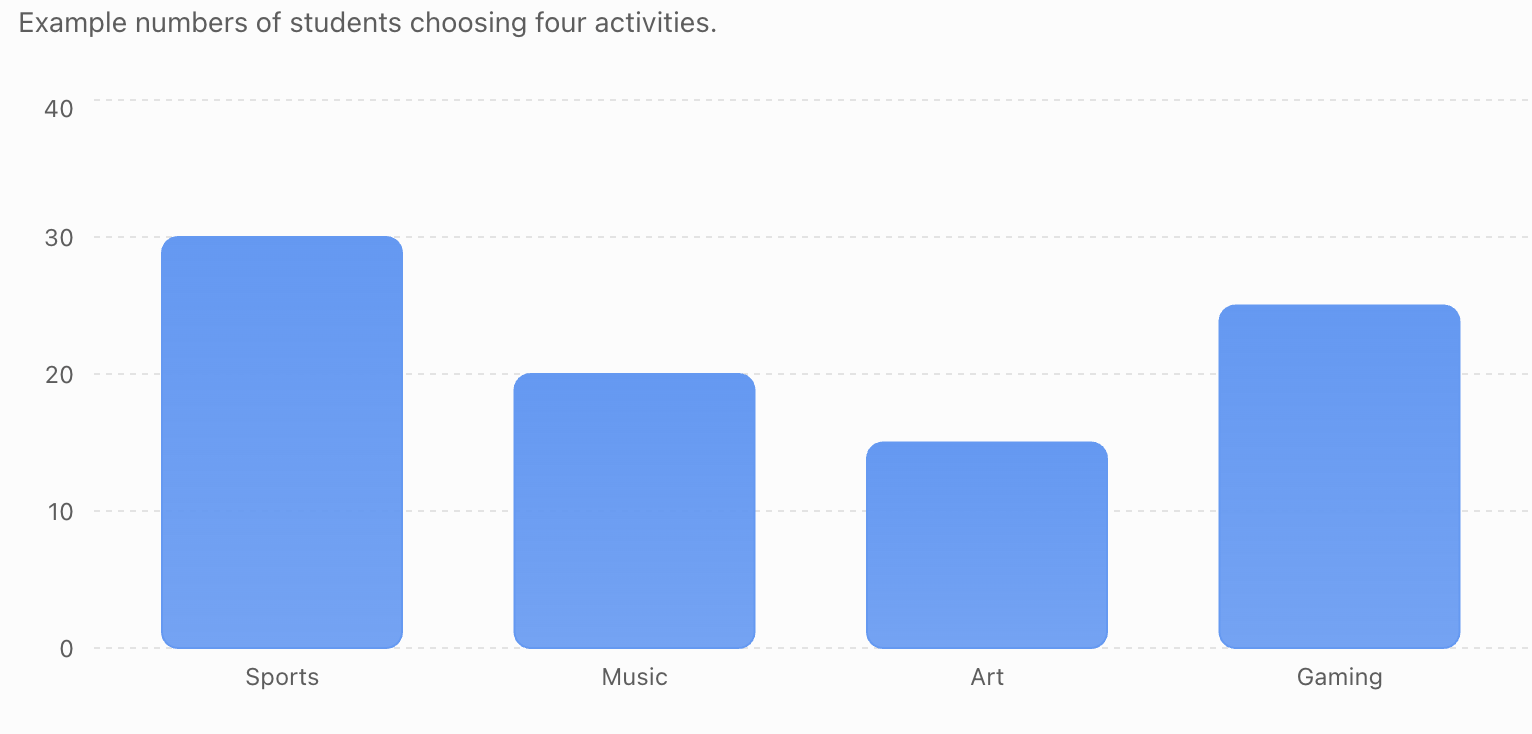
Ratios in Bar Graphs
Graphs can also communicate ratios.
Consider this illustrative survey of preferred after-school activities:
Illustrative activity preferences