Understanding Fractions

Site: Young Education
Cursus: Fractions, Ratios, and Percentages
Boek: Understanding Fractions
Afgedrukt door: Гість-користувач
Datum: vrijdag, 25 september 2026, 03:19

1. What Are Fractions?

Learning outcomes
  • I can define a fraction as a part of a whole or a part of a set.
  • I can identify the numerator and denominator of a fraction.
  • I can represent fractions using diagrams, models, and number lines.
  • I can explain the meaning of common fractions in real-life situations.
  • I can recognize fractions greater than, less than, or equal to one.
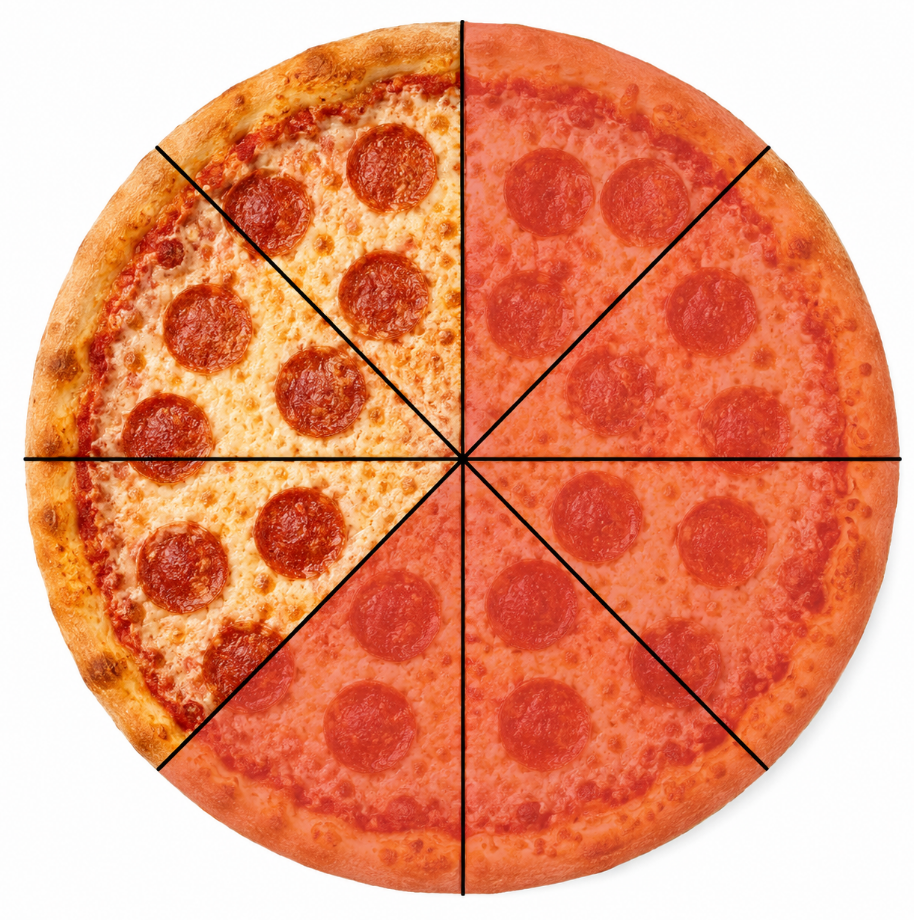
Understanding Fractions

Fractions are one of the most useful ideas in mathematics. They help us describe parts of objects, groups, distances, time, and many other real-world situations.


What is a Fraction?

A fraction represents part of a whole or part of a set.

A fraction has two numbers:

\( \frac{numerator}{denominator} \)​

For example:

\( \frac{3}{4} \)

​
  • Numerator (3): tells how many parts are being considered.
  • Denominator (4): tells how many equal parts make up the whole.

Think of it this way:

Numerator = How many you have.
Denominator = How many make the whole.


Part of a Whole

When one object is divided into equal parts, each part is a fraction of the whole.

Example:

A pizza is cut into 8 equal slices.

  • Eating 1 slice means you ate 1/8.
  • Eating 4 slices means you ate 4/8, which is also 1/2.
  • Eating 8 slices means you ate the whole pizza (8/8 = 1).


Part of a Set

Fractions can also describe part of a group of objects.

Example:

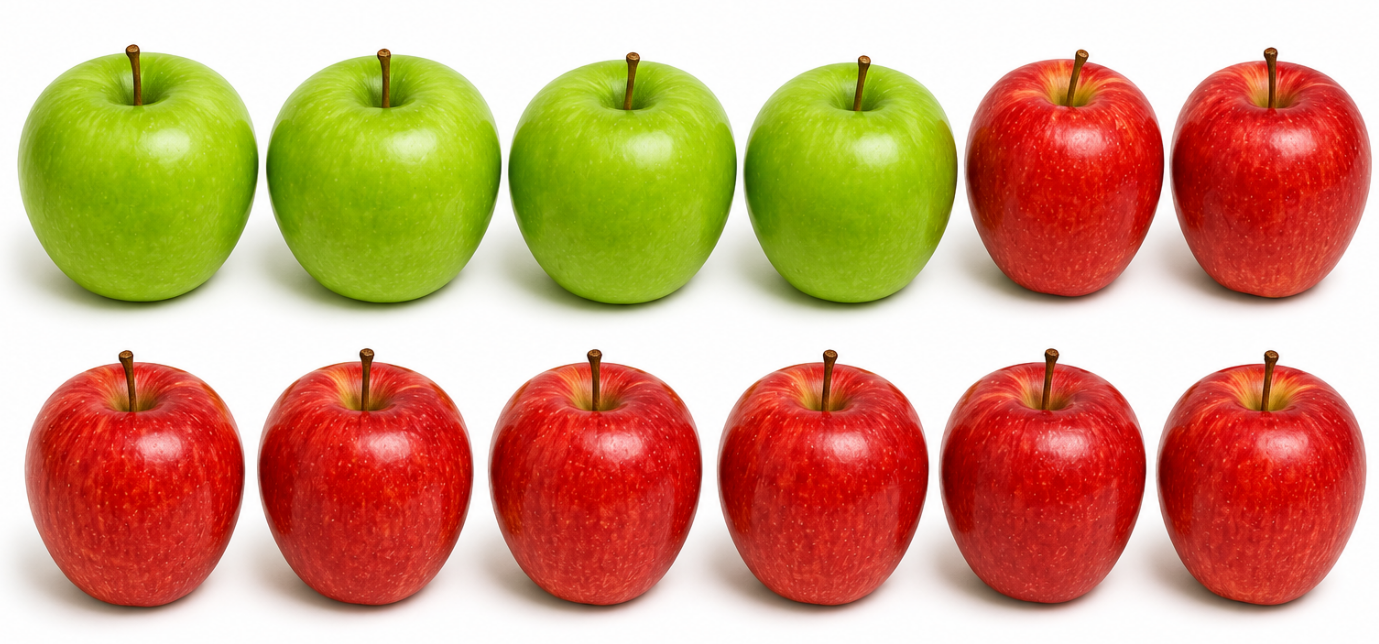
There are 10 apples.

If 4 are green, then:

\( \frac{4}{10} \)​

of the apples are green.

The denominator is the total number of objects, and the numerator is the number you are describing.


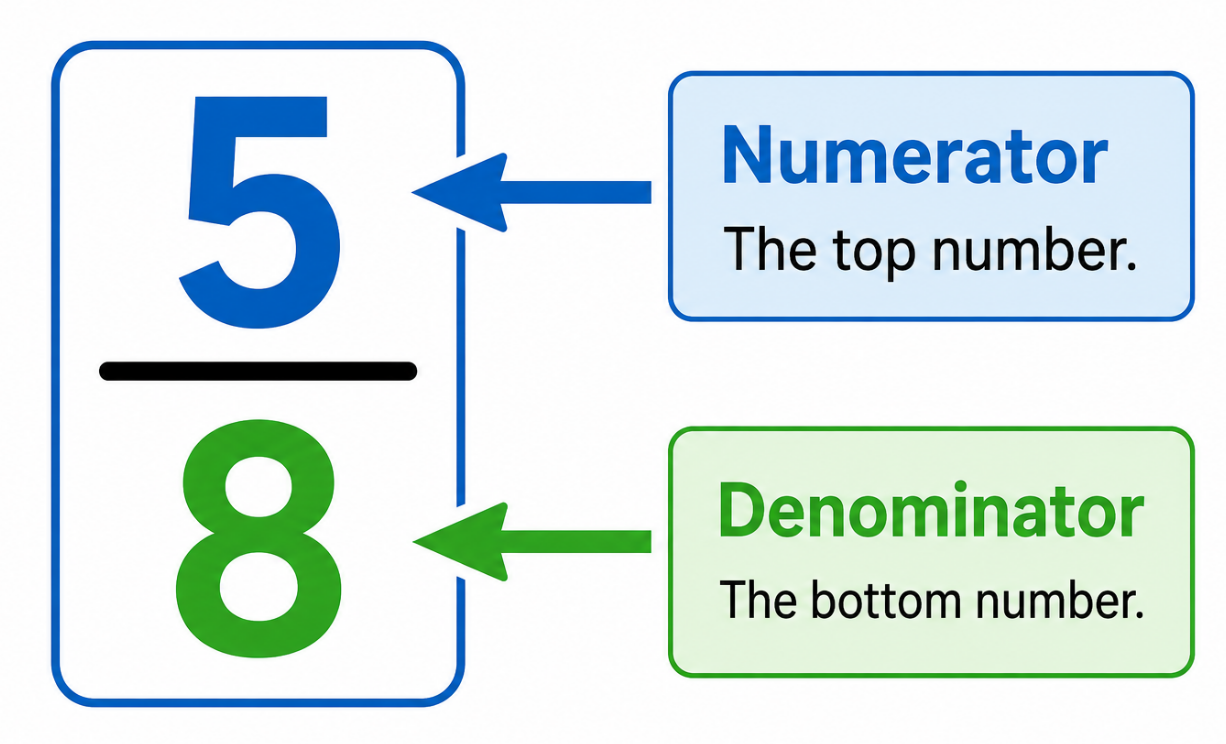
Numerator and Denominator

Every fraction has two important parts.

Example:

\( \frac{5}{8} \)​

  • 5 = numerator
  • 8 = denominator
Part Meaning
Numerator Number of parts chosen
Denominator   Total equal parts in the whole

The denominator must represent equal-sized parts.

For example:

  • Dividing a chocolate bar into 6 equal pieces creates sixths.
  • Dividing it into unequal pieces does not create sixths.


Representing Fractions

Fractions can be shown in many different ways.

1. Fraction Circles

Shade part of a circle.

Example:

  • Half the circle shaded = 1/2
  • Three quarters shaded = 3/4

2. Fraction Bars

Bars divided into equal sections.

Example:

 
■■■■□□□□
4/8
 

3. Sets of Objects

Example:

⭐⭐⭐⭐☆☆☆☆

4 out of 8 stars are filled.

\( \frac{4}{8} \)​


4. Number Lines

Fractions also represent numbers between whole numbers.

Example:

 
0 ----|----|----|---- 1
1/4 2/4 3/4
 

Fractions have exact positions on a number line.


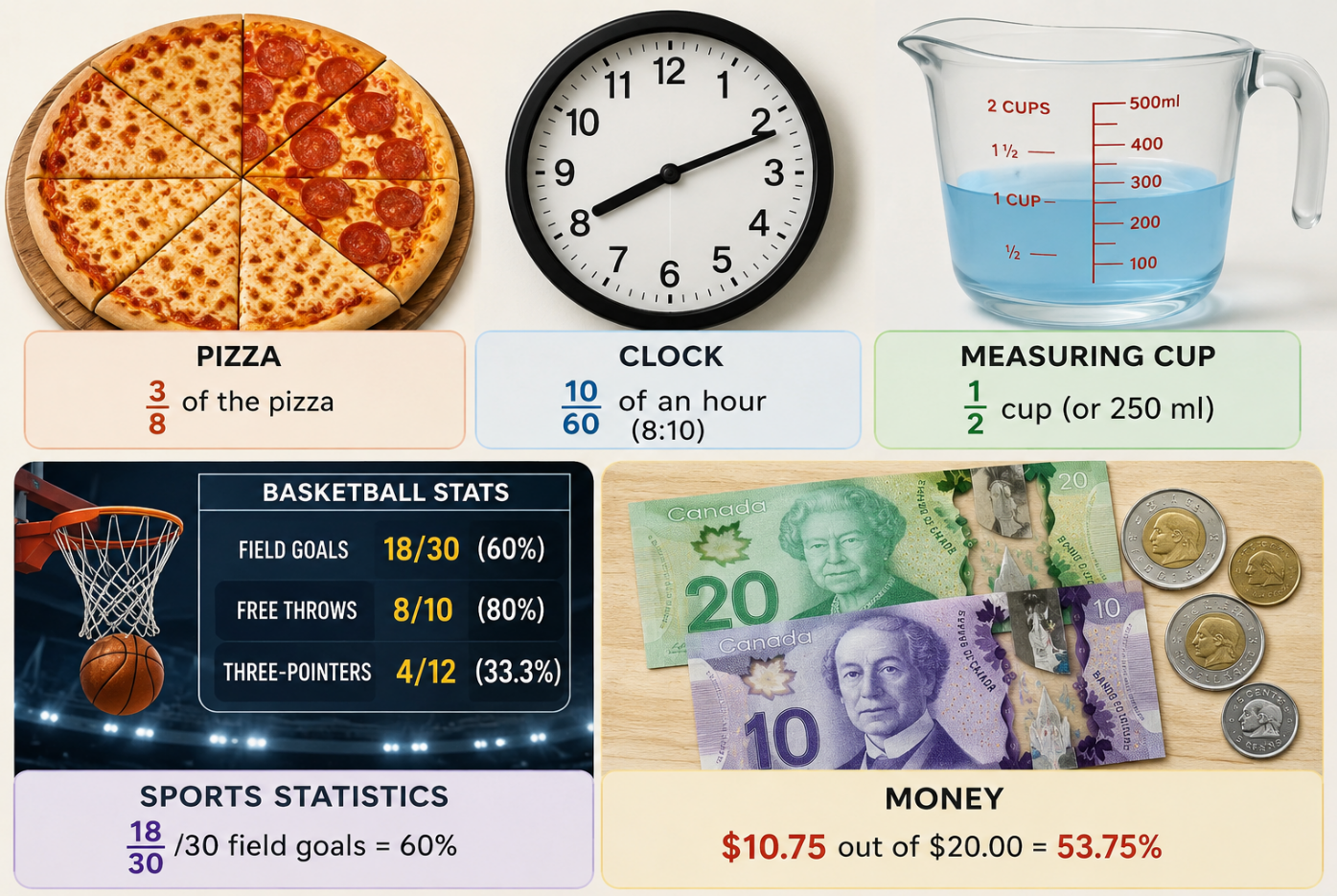
Fractions in Everyday Life

Fractions appear everywhere.

Food

  • Half a sandwich
  • Quarter of a pizza
  • Three quarters of a chocolate bar

Time

  • Half an hour = 30 minutes
  • Quarter of an hour = 15 minutes

Money

  • Spending half your allowance
  • Saving one quarter of your money

Sports

A basketball player makes:

8 out of 10 shots.

\( \frac{8}{10} \)​


Fractions Compared with One

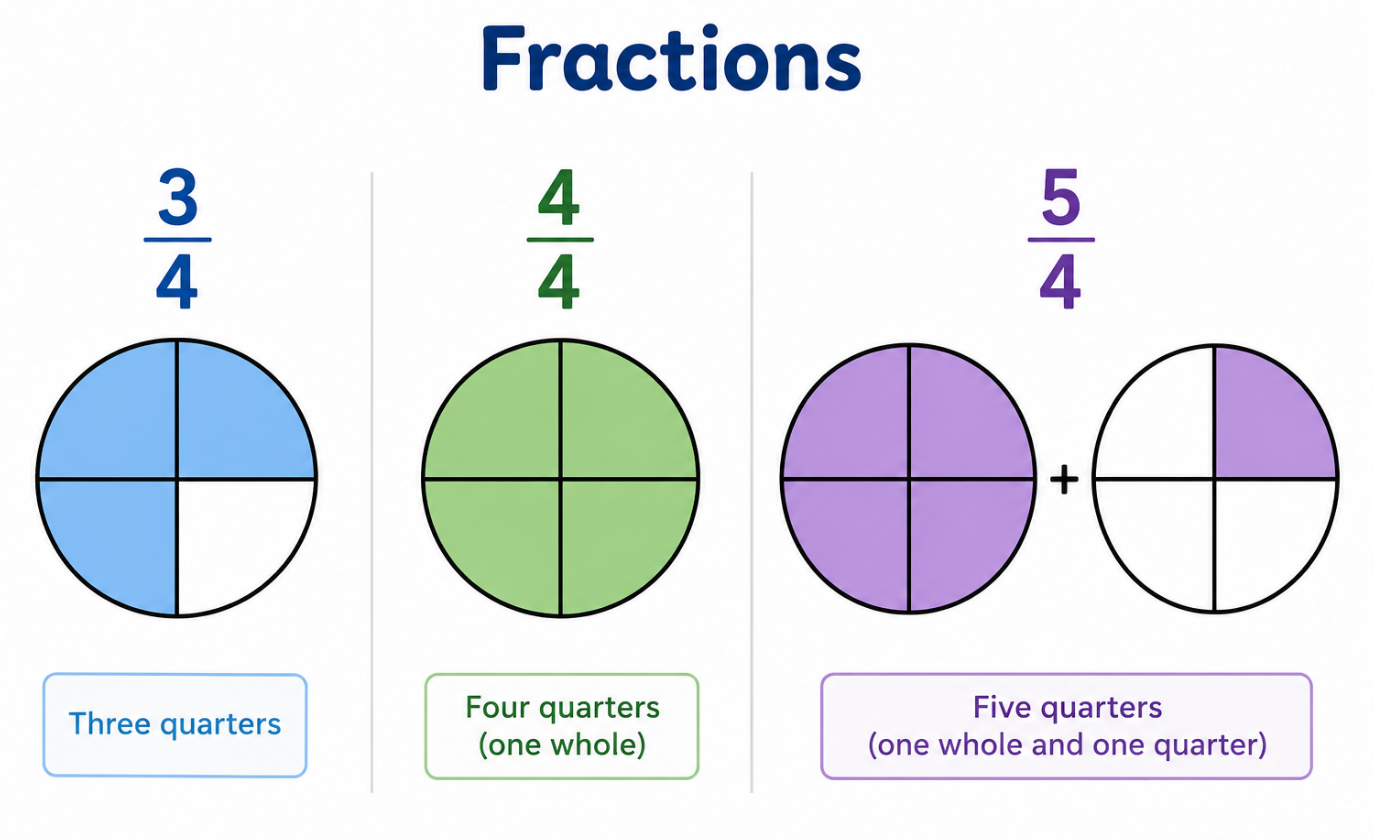
Fractions can be less than one, equal to one, or greater than one.

Less Than One

The numerator is smaller than the denominator.

Examples:

\( \frac{1}{4}, \frac{2}{5}, \frac{7}{8} \)​

These represent only part of a whole.


Equal to One

The numerator equals the denominator.

Examples:

\( \frac{5}{5} = 1 \

\( \frac{9}{9} = 1 

This represents one complete whole.


Greater Than One

The numerator is larger than the denominator.

Examples:

\( \frac{5}{4} \)

\( \frac{7}{3} \)​​

These represent more than one whole.

For example:

\( \frac{5}{4} = 1 \frac{1}{4} \)​

This means one whole plus one extra quarter.


Key Vocabulary

Word Meaning
Fraction A number representing part of a whole or part of a set
Numerator The top number showing how many parts are considered
Denominator The bottom number showing the total equal parts
Whole One complete object or complete set
Equal Parts Parts that are exactly the same size
Number Line   A line used to show the position of numbers
Part of a Set A fraction describing some objects in a group

Summary

  • A fraction represents part of a whole or part of a set.
  • The numerator tells how many parts are being considered.
  • The denominator tells how many equal parts make the whole.
  • Fractions can be shown using circles, bars, sets of objects, and number lines.
  • Fractions are used every day in cooking, sports, shopping, time, and measurement.
  • Fractions may be less than one, equal to one, or greater than one depending on the relationship between the numerator and denominator.


2. Equivalent Fractions

Learning outcomes
  • I can identify fractions that represent the same value.
  • I can generate equivalent fractions by multiplying or dividing the numerator and denominator by the same number.
  • I can simplify fractions to their lowest terms.
  • I can use visual models to demonstrate equivalent fractions.
  • I can explain why equivalent fractions have the same value.

Introduction

At first glance, the fractions 1/2, 2/4, and 4/8 may look different, but they all represent exactly the same amount.

Fractions that represent the same value are called equivalent fractions.

Understanding equivalent fractions is an important skill because it helps us compare fractions, simplify answers, perform calculations, and solve real-world problems involving parts of a whole.

https://images.openai.com/static-rsc-4/1gmNF_2Z50PTWX3c07N51vuaUzZcXMhWa-CIaLZ-H6pEI4jdTVfyX8-4CGT39AxRZcOt6Pr6tKhT7pzAlriHfBnXyc5O5-nMgIj4vc3rN3QnaakHXlboxnPHLQpwmGzWO2vKvUB6W06JyDa79yE39MPVk7ImzIczvNX2C_WaEmFWUQW029Ong5sMm3rO8WQo?purpose=fullsize
https://images.openai.com/static-rsc-4/n3rz3bWuJnu1OHu_3EPOKbRAE0_0bFoJy2-XWDKOGxkS7LFxpptWsJiNmCHXb9wSMaMEjyPdbHzpDhTV0_zrD5u0rimLENsIAI1UB5vSEugyKv3dLaOhrR36UwzhMcdmqSNfG_g6e1vVf-Sz2BCA_on0rkWgSorhrRAp93WqtK79WIFRQQIdpAkO6Xgacc1n?purpose=fullsize
https://images.openai.com/static-rsc-4/M-9SKn5LccGS-g_Lrcfpjh1ywffeEVJOTCYBuaoIHk0BqrUUbnxwzpi5n0sT-VtqnhKbX86RN-iWrk2s63Sij-_A7v8tIviKYU4zxbhbXy2P9MNznhyEFHWy7cOKhKJdSIKgzwVksBUIgaCHjn5r29odCpM80plAGi-INPEiSeQgXgxisL_3l4hIy7Qo03Re?purpose=fullsize
5

What Are Equivalent Fractions?

Equivalent fractions are fractions that have different numerators and denominators but represent the same value.

For example:

\( \frac{1}{2} = \frac{2}{4} = \frac{4}{8} \)

Although the numbers are different, each fraction represents one-half.


Why Are They Equivalent?

Imagine a chocolate bar.

If it is divided into:

  • 2 equal pieces and you eat 1 piece, you have eaten 1/2.
  • 4 equal pieces and you eat 2 pieces, you have still eaten 1/2.
  • 8 equal pieces and you eat 4 pieces, you have still eaten 1/2.

The size of each piece changes, but the total amount eaten remains the same.

https://images.openai.com/static-rsc-4/l5qFDt19u9LJvZ4-NoxEfSAqPJcIuDk5mRki6hJTvaTUvRwtXFd2F3gD0uBHSPYJRsxcE53zGAj5g703Nef8EPI6u8yVyi1HlH2f6cfx1rrd8cI8Pj2AjNF2FL1G4vKcJkkn04QijhZKKPKmtN5eAaP8x_Fv0nhihTpfO8XZ63Bq-dIMRd-kBs_4wrp7-jFZ?purpose=fullsize
https://images.openai.com/static-rsc-4/n3rz3bWuJnu1OHu_3EPOKbRAE0_0bFoJy2-XWDKOGxkS7LFxpptWsJiNmCHXb9wSMaMEjyPdbHzpDhTV0_zrD5u0rimLENsIAI1UB5vSEugyKv3dLaOhrR36UwzhMcdmqSNfG_g6e1vVf-Sz2BCA_on0rkWgSorhrRAp93WqtK79WIFRQQIdpAkO6Xgacc1n?purpose=fullsize
https://images.openai.com/static-rsc-4/aRWUASog4vFe1dYrdJUn41EOKnLooaDq4XSvbioG3Kaaht6mbHS3cv4dHpQ2Kxl_yRgy_XcDSK49W-FTFMY82HzUDn1n-NKxqASpG0vWm9n3gZtJeFED9POMwU7jsn-NxfYPJyInzKBU1ocbq7Q5dNSrXDFRuTaZbFzIk4QmPMfJ3bc1Lg7LdMPqoinu_owe?purpose=fullsize
5

Generating Equivalent Fractions

To create an equivalent fraction:

Multiply both the numerator and denominator by the same number.

Example 1

 
\( \frac{3}{5} \)​

Multiply both numbers by 2.

\( \frac{3}{5} = \frac{3 \times 2}{5 \times 2} = \frac{6}{8} \)


Example 2

Multiply by 3.

\( \frac{4}{7} = \frac{12}{21} \)

The value has not changed because both parts of the fraction were multiplied by the same number.


Simplifying Fractions

We can also work backwards.

To simplify a fraction:

Divide the numerator and denominator by the same number.

Example:

\( \frac{12}{16} \)

​

Both numbers are divisible by 4.

\( \frac{12 \div4 }{16 \div4 } = \frac{3}{4} \)

The fraction 3/4 is in its lowest terms.


Lowest Terms

A fraction is in lowest terms when:

  • the numerator and denominator have no common factors except 1.

Examples:

Fraction    Lowest Terms
6/8 3/4
15/20 3/4
12/18 2/3
18/24 3/4

Always simplify your final answers whenever possible.


Using Visual Models

Pictures help us understand why fractions are equivalent.

A fraction circle, fraction bar, or shaded rectangle can show that different fractions represent the same amount.

For example:

  • 1 out of 2 parts shaded
  • 2 out of 4 parts shaded
  • 4 out of 8 parts shaded

Each diagram shades exactly half of the whole.

https://images.openai.com/static-rsc-4/SxMpirBC8IzrAMzlpjCZocIMkXhrOM3aIQplH43HDOzwvwhp-qN8nizspMdCCtbZgbE81hJek4fGoYUgBKb3i3_-kcoPfLPGW4cAstmw1Q85NgTgmA5gBEk2GuQFElaTE-owlPqY1Zc2GOP-oANrCjXfZUPBJGn1iu8aaHEWog-aihn83Z2ZHZnpfibH5olH?purpose=fullsize
https://images.openai.com/static-rsc-4/9-0djaV8hn0HEF_3qno1gbOEZVGmFbaeJWvIPJw4yt2DWTH5QBpr-aXW9wUX3sSW5oWFmWHOwGcK3cVI4z1CQpMn-3f-dl3CbC2vXtXy_6K1h_yptZFs8rio4gL6UQJU0rNMqMo4vWqTZjv-x2867YUbk973sltSaSM3qX4_Y1vGQxzLedRkaELd3FnC4t87?purpose=fullsize
https://images.openai.com/static-rsc-4/aRWUASog4vFe1dYrdJUn41EOKnLooaDq4XSvbioG3Kaaht6mbHS3cv4dHpQ2Kxl_yRgy_XcDSK49W-FTFMY82HzUDn1n-NKxqASpG0vWm9n3gZtJeFED9POMwU7jsn-NxfYPJyInzKBU1ocbq7Q5dNSrXDFRuTaZbFzIk4QmPMfJ3bc1Lg7LdMPqoinu_owe?purpose=fullsize
6

Recognizing Equivalent Fractions

Sometimes you can recognize equivalent fractions without calculating.

Examples:

Fraction   Equivalent Fraction
1/2 2/4
2/3 4/6
3/5 6/10
4/7 8/14
5/8 10/16

Look for a common multiplication or division pattern.


Why Multiplying Both Numbers Works

A fraction represents division.

For example:

\( \frac{1}{2} = 1 \div 2 \)

If we multiply both numbers by 2:

\( \frac{2}{4} = 2 \div 4 \)

Both divisions still give:

0.5

Since the value does not change, the fractions are equivalent.


Common Mistakes

Do not multiply or divide only one part of the fraction.

Incorrect:

\( \frac{3}{5} = \frac{6}{5} \)

The value has changed.

Correct:

\( \frac{3}{5} = \frac{6}{10} \)

Always perform the same operation on both the numerator and denominator.


Real-World Applications

https://images.openai.com/static-rsc-4/zI1U8uF7kDcfnVzxxjBfDJuHFzafvyCtvsUJbXGdA61A8PqYEM6DUry8IdxebOTZiF8mTUjIxhfLnE33dez5eTwedG9M_kXM6XUMtNwxYXK3focc5NpCyAd1xK109iC__cwdk33OsPikaRr6iAIVwY7LZkUWs6MBFHIwmDvyensg-wfzYnt9Ssdxw04Lo3hv?purpose=fullsize
https://images.openai.com/static-rsc-4/PyvTUOLSlMqeo2TB0AEwBKJ_XIRDdQijsRlAcol8KIgvMvf4wIqGIAWtMMt2lMKW4SGg1WAgumFMPDHc57U0CMSdVhnB9GZz1u7L-ozlhL9Y9jKM3nlrlRYkkMlXHVtruGaERg4qAhVhDa9JOKCmxqOZ79vAoitkp3dAz3eIqKk0ocg0bA4JdnQ1Et5CPkse?purpose=fullsize
https://images.openai.com/static-rsc-4/vkq9zSsNqP2kO65qkJLdw_3F0ys5XN2t7gFwWrmXykfpTWw7B1Eu2W5gFXWFb5dlLw94FyeMuRZoRXkdygzA8URcl4MO0h0CQCpEAFcS4IEgYXx64NxYEahQMMZBhkBbWKjMdI_mbTNNM46sEbpTDLAUm_HHSGSb8RBh_fyd7inxwoH5aReyxO_gVzdgZhEi?purpose=fullsize
4

Equivalent fractions are useful in many everyday situations, including:

  • Cooking and baking
  • Measuring ingredients
  • Construction and carpentry
  • Sharing food fairly
  • Reading rulers and measuring tapes
  • Mathematics and science calculations

Worked Examples

Example 1

Find an equivalent fraction for:

\( \frac{2}{5} \)

​

Multiply by 3.

\( \frac{2}{5} = \frac{6}{15} \)


Example 2

Simplify:

\( \frac{18}{24} \)

​

Divide by 6.

\( \frac{3}{4} \)

​

Example 3

Are these fractions equivalent?

\( \frac{3}{6} \ and \ \frac{1}{2} \)

​

Simplify:

\( \frac{3}{6} = \frac{1}{2} \)

Answer:

Yes.


Example 4

Find the missing number.

\( \frac{4}{7} = \frac{12}{?} \)

Since 4 × 3 = 12,

Multiply the denominator by 3.

7 × 3 = 21

Answer:

21


Example 5

Write 8/12 in lowest terms.

Both numbers divide by 4.

\( \frac{8}{12} = \frac{2}{3} \)


Did You Know?

Ancient Egyptian mathematicians often wrote fractions differently from the way we do today. They preferred to express most fractions as sums of unit fractions (fractions with a numerator of 1), such as 1/2 + 1/6 instead of 2/3. Modern notation is much simpler and makes calculations with equivalent fractions much easier.


Key Terms

Term Definition
Equivalent Fractions     Fractions that have different numerators and denominators but represent the same value.
Numerator The top number of a fraction, showing how many parts are considered.
Denominator The bottom number of a fraction, showing how many equal parts make up the whole.
Simplify To write a fraction in its lowest terms by dividing the numerator and denominator by the same number.
Lowest Terms A fraction whose numerator and denominator have no common factors other than 1.
Common Factor A number that divides exactly into two or more numbers.

Key Takeaways

  • Equivalent fractions represent the same value even though they look different.
  • Multiply or divide both the numerator and denominator by the same number to generate equivalent fractions.
  • Simplifying a fraction means writing it in its lowest terms.
  • Visual models help show why equivalent fractions have the same value.
  • Equivalent fractions are used in everyday situations such as cooking, measuring, construction, and mathematics.
  • Understanding equivalent fractions prepares you for comparing, adding, subtracting, multiplying, and dividing fractions.


3. Comparing and Ordering Fractions

Learning outcomes
  • I can compare fractions with the same denominator.
  • I can compare fractions with the same numerator.
  • I can use common denominators to compare fractions.
  • I can place fractions in order from least to greatest or greatest to least.
  • I can justify my comparisons using diagrams, number lines, or calculations.

https://images.openai.com/static-rsc-4/BaZMOTo6cWKhwxj8EILoFgmaRzZFDkPLJMRrgAaWDDAWO5XlJEaRqZMSC7wILfQJtVVLxTyv21-T-r8RrSkvDEQEIblK0zOLjywHbt0aXaGzy7Mmc5J3orCb0_QAO8Z4Rmz8QHRSPDt37-TLxB1AIOc5CI74XCc3dJzZjpdnMFUjOxqK2KhHIrLaIT2KdFu3?purpose=fullsize
 
https://images.openai.com/static-rsc-4/nGdzZSyeVDHO6-oMBgl97EpKyipS023tqPM6_tt45AOYQyI6ZdVfbBO7RyDQ44oZKPLyY8iRbWkmq_Z2e3zWIjXBxXhnHrZAxxLKhMNSrEQLZAbdYPNn4ELs8s0Qc6Aq95pmzZH18_nUPpVWHW37Llx_g1boNJusbgDTOuDnnws-6-IIEZsKGDwG0DaKLgIa?purpose=fullsize
 
https://images.openai.com/static-rsc-4/SAa29YtrfUnE4GhPH2yZqWXjRt9cax4U1iY4pAdDP70H_jSJB4DVyyoxovCaC4W-AvX3HTiSKEu98Js9n0tVK_tSLv8lNbgiKDULn3IsKCG81eo0kuKHHZcvJRV1map6FwnVadj4IUK_Ks3g4shaDMsKpLd9s5n6yi2YhFC-Adq6I_tsCBKRRoDI-OQVNhe_?purpose=fullsize
 
7

What Does It Mean to Compare Fractions?

To compare fractions means to determine which fraction represents the greater or smaller quantity.

For example:

3/8 and 5/8

Both fractions describe eighths.

Since five eighths represents more pieces than three eighths:

5/8 > 3/8

We can also write:

3/8 < 5/8

Fractions can be compared using several methods, including:

  • numerators
  • denominators
  • common denominators
  • number lines
  • fraction bars or circles
  • calculations

The best method depends on the fractions being compared.


Comparison Symbols

Three mathematical symbols are especially important.

> means greater than

< means less than

= means equal to

For example:

3/4 > 1/4

2/5 < 4/5

1/2 = 2/4

A useful way to remember the inequality symbols is that the wide opening faces the greater number.


Comparing Fractions with the Same Denominator

When two fractions have the same denominator, their pieces are the same size.

Consider:

3/7 and 5/7

https://images.openai.com/static-rsc-4/mZ5NYFKucKiQCPWL27AWLLInvQAmDu7DPd5V_jV0oTR_BDdD4o4wcI2KiOIWEv_27h_blf_lZ7adxLj5qLsKg7U4-Cxppty-RKZ3VTlCHVQzhkdTArdN9kcUAgkzEEpDkjaeFUmnUu7a6a2REqXvcGbElbDntgZVMpG_rRnxPOCP70evK118_m9ebnTDDa6L?purpose=fullsize
 
https://images.openai.com/static-rsc-4/ucSt9c-hgbHBH6edDAeKTKWV2XXBpAwdsi7lAZbPG7sbKhxcpG687WH7b43nZcl4a0XZHSlOGdWTOS__PPRkPS3f19Cr1pjcGgGE-MW5CO_Ert6km09KFcKVisGf5ymbICc5mDo0lG8kNFT0JDAdOyqNi6eTesVR5ydnMpuU4gNLC_qMw3SooftNr9Iszgfa?purpose=fullsize
 
https://images.openai.com/static-rsc-4/iWfau56drjR9NbwsuGSCvqlgROIAvLUATI1e1gwykuRn9BoTdtVE_r3t9m03XA4JV7WnhBkn5JHzsp-2Ebpv659KfUFiSQpWBMPxneEp99KxzJTCSKYWaHEdPiHZ6RmGbs3mLdUsvhCujYeN8evzXNbnowwmqeHL3kqMT6p2G0ffnpC553x4R4nV1VDV3wNH?purpose=fullsize
 

Both fractions describe sevenths.

3/7 contains three pieces.

5/7 contains five pieces.

Therefore:

3/7 < 5/7

When the denominators are the same:

The fraction with the greater numerator is greater.


Why This Works

Suppose two identical pizzas are each divided into eight equal slices.

One person has:

3/8

Another has:

6/8

https://images.openai.com/static-rsc-4/1VJjHOc0T08be93mTj8-rmbIGGT72tbId2FDkGcgyAmGsKqMUtGUlcDkieciBIqPjZumKSns4n8TN7ksCaxv6c1zjde-ZMmma3AmV92K1La-dkJi_Ck7JPoFVU_hzZUwFjhtiYK9kceh6iSonMwh3Ez384UMgC4qtcvXWVkbJb3lmliNx2H_O1sXXmevf9Wm?purpose=fullsize
 
https://images.openai.com/static-rsc-4/rKJXNDuc_xdqHVDqdmK1q5PyZ2NSFN3nur7Ezp0J4Qs0Xg3mGnx3MMZo3TXUaLYQPdyS-7FCFNaVfCFk6cOm77gqaRol2wI1qOKoYyokXe6s5-R7kM4TDaxcBi7Yi5es703YJcRga5aIC8xA4Gk54k_ac7SgVsAY9_M9FPIBVmYAoe9qwNo6pzSAugCSbyED?purpose=fullsize
 
https://images.openai.com/static-rsc-4/I9hXoeNzg1Y5Nwj_ltPwW7Ed4uXpXr0Xybv209HfKB7fP1BXS1iKUbFQPeKm-UmQhTx7RlLZuXbZmHch5fYAzLZJRjGMvWdi3lJfwIX_lHgse95nrbkLcIHQFmgN3NaNMXOLRpCkqp4Uzv-MOBVufl_VOUfwPaZEqe6rr8OVDdNIO7SNtldj_EhAOPJyw9XS?purpose=fullsize
 

The slices are the same size.

The person with six slices has more pizza than the person with three slices.

Therefore:

6/8 > 3/8

The denominator tells us the size of each piece.

When the denominator is already the same, we only need to compare how many pieces there are.


Example: Same Denominator

Compare:

7/10 and 4/10

The denominators are both 10.

Compare the numerators:

7 > 4

Therefore:

7/10 > 4/10


Comparing Fractions with the Same Numerator

Fractions can also have the same numerator but different denominators.

Consider:

1/3 and 1/5

Both fractions contain one piece.

However, the pieces are not the same size.

https://images.openai.com/static-rsc-4/pk_FfXQX7WIl5KTjnuLZmxy6G0VaxmOJgDjPPj3oF4C56Aoyg0MidvMS4PwLkDM1TErTEYc4WEmjqLPdBHDuOzId77K9nsVggwEZ1m2jh8XPDZwwEY4kCsW9RdimT_PnAfekPV2QQL0io5Ut_m_pzpX17aUK-YXs8RjHOeiiUDszBdmP4IfAj5TvIH-rQyoq?purpose=fullsize
 
https://images.openai.com/static-rsc-4/jsNPr2oRJt_uY7e0RKcwc_aMFdcH6Jz2E_aasmObIb3SKZNdRFPjmG2rLAvheHWfsA_z7oRroV69R9VrAQWEK4MhStOSJwKgLe6oONHG6WVO2DLv1ZaMrJGNbkf-OLJwiXibQUfQt5yBvS1qv3uU2GHdRdc036ago_Mhbo1lzD78aWfuNAqB2fyLmWqC2y09?purpose=fullsize
 
https://images.openai.com/static-rsc-4/7qcI61Ds-ro7rbz8cXFDr0D56rYdyafGG7ZD_GNOWkOrryHvRScBO7G8-XrP4213IzV9Sj_KtGnxDdFkoZdu0QX2OYA7X9Ux0HARt_LK1qqp7C2gCjRcyb-JKtZTT6RJKMU_EMTN7U5AM0C3iqkLwnkmHoJ2O6jX2UyNpW2-COFyxc_k_0WXus2YOlywS6JS?purpose=fullsize
 

If a whole is divided into three equal pieces, each piece is relatively large.

If the same whole is divided into five equal pieces, each piece is smaller.

Therefore:

1/3 > 1/5

When numerators are the same:

The fraction with the smaller denominator is greater.


Why a Larger Denominator Can Mean a Smaller Fraction

This idea can seem surprising at first.

Imagine sharing one pizza.

If the pizza is divided between 2 people, each person gets:

1/2

If it is divided between 4 people, each gets:

1/4

If it is divided between 8 people, each gets:

1/8

https://images.openai.com/static-rsc-4/TgcmkQk00tF3EdrMA0gDY38F2dhoZfj5Fu7QY8zgnAwTHLHgFYeTFGBs7dzUmZi0KL1Y_USIP5yutGaveeiEeasvgvztty9pQ_jdRuieqzIdizP5qk4p23HRMEsbU9YngFzsLU5tETWWrp_76gU06g2AQAzArxEP9t-XwlA_e98lN6EvRHHu-a1se2jftB6D?purpose=fullsize
 
https://images.openai.com/static-rsc-4/iVPx4rntaKN-OyZh01IrJaO0310WDsO04csGnfWMKesaCMnpgMrWiG3FeVLUXuthjP8aQ2lTssUpFFI9hkv-m3TOQKuvC8Gha3QonnN4jiQDWk2-Suag44-mtWgzvMhybN65m9cs0grsRxO0CRsIImQ4fkdvjJepUGNeWgHZB1bO-B--inPQFNaWm7aGtgpc?purpose=fullsize
 
https://images.openai.com/static-rsc-4/wGjVtJTIykXtK5gqk4uCMv1tupe7qrs80-tycYFyQNa2BSgpYoDo-14JhFEIkoLcvGEtiuGAjZ_FlOdnAVmdKYXH3VWK0lPv6J36PgHbJa_U-u_Z-2XS8oc7TnZODb_jCXGe3J-h-mHa8Vt602sWH7uYjPCNJpnk_NwJuWuJkQX7zqgHc8sd6z37jI-YO4eh?purpose=fullsize
 
6

Therefore:

1/2 > 1/4 > 1/8

The more equal pieces a whole is divided into, the smaller each individual piece becomes.


Example: Same Numerator

Compare:

3/5 and 3/8

The numerators are both 3.

Since fifths are larger pieces than eighths:

3/5 > 3/8

Another way to think about it:

If you receive three pieces, you would rather receive three fifths than three eighths because each fifth is larger.


Comparing Fractions with Different Numerators and Denominators

Consider:

2/3 and 3/5

Now both the numerators and denominators are different.

We need another method.

One reliable method is to find a common denominator.

The denominators are:

3 and 5

The least common denominator is:

15

Convert:

2/3 = 10/15

3/5 = 9/15

Now compare:

10/15 > 9/15

Therefore:

2/3 > 3/5

https://images.openai.com/static-rsc-4/pkdGzZXY097BYBbwRnCQzhTJotSuTnMP7ofqm0guI1WlO-AKr5qsNTwR-7_lUkISXTbTrfGTFLZoTg3Iffm1GQhByPcNHGHl9R_moR_JlJTbYE7rYurqDo_gupESC0yh182QjiwkGWwAiN6vxTGql7a6nyyZqO3qLqRltexTfC9i9lUDWGRgHnIGE00CbN7j?purpose=fullsize
 
https://images.openai.com/static-rsc-4/JnX3H6DUO8EwklKlmU9s6fWX81b6TSUdJ4I0EXlTltJ0jN5yQBgxC9cIhP_C5_R_cCY2kLCiwYL166w0rpnDrrNe2zwJ0w5Ily5z15zl2EWjUhAReB4yEQQ7zU80laVQPDEcrDfK3edjNuwyFPVU2hfXqe37n7QMrSPVjyqvFccR2yw7qQ0UacyP3mA2suSZ?purpose=fullsize
 
https://images.openai.com/static-rsc-4/CQ5QmDl9KJDu_m_eujWhH3uvDXFoRrZM9Hms6-R4bUvsPM57Oz4vo2kD_32Kg9GbW-v71D-I9b2jps9MbBC67D2YeDQqjfhfrOxFZoi-FMKLmflOevBA067LVWae1Xg7p30uy3QJYBOPewNuVNHqyaNMdDZr6yfxxNZm1z3-oc5JWIfaEeJvvbNfqgq7rx0q?purpose=fullsize
 

Using Common Denominators

Finding a common denominator turns fractions into equal-sized pieces.

For example, compare:

3/4 and 5/8

The least common denominator is:

8

Convert:

3/4 = 6/8

Now compare:

6/8 and 5/8

Since:

6 > 5

we know:

3/4 > 5/8


Equivalent Fractions Help Us Compare

Equivalent fractions represent the same value.

For example:

1/2 = 2/4 = 3/6 = 4/8

https://images.openai.com/static-rsc-4/siK3E6lp2QuFS45RC8LYk_VNAsUvme2S6NPfa8D00fPLdZKXLaeY3_5vuUD_vVVwJtCv7wvk8BTIWSRVU8Z_kcTHfgfGA-M4YnJFD19j6jq4bTr-CiVHXRvZY-jiCw2feNFVMICrLlKKkb4njVG6IS4-xJAOGM9V_9T03qXoICXgZRDa3AqpswQHHA1_NplM?purpose=fullsize
 
https://images.openai.com/static-rsc-4/imtHBN92F9g9G4gjOtgL_xJh-5Ltj4ZqCO77ysp79eOFXSwIh2iPuWPtSZR4I8gEV7IFP_h50Og30Tm-vqD2DDFvk8LrhBnxLRkOWg4-bF23s8f5pxbmQoHVFe8f-Z6opgF1ej6foUDBjjsJxifBKDxN3F4Lhe_Mj7plL7450k3-2o5exl8jT6gSN2_qgfTg?purpose=fullsize
 
https://images.openai.com/static-rsc-4/ceNQDcAL4St8Wtp5lo0SQGdkr7UnIl-2QRkERywoFVs579XKOQ3cgsNlQoYEmQKf3M7qaT6MUj3CqSSlVNDQdQu7wt3MpYj-HYkYzKvu7tlRqcjx2pe2MHq--122U3-RaTrKySWeK57aCrhe_AgMIxmthKJtW6s_WgdkPWRIvYH3Q8hustO2pxu4lZdSK1m4?purpose=fullsize
 
4

Changing 1/2 into 4/8 does not change its value.

It simply expresses the fraction using eighths.

Equivalent fractions allow us to compare quantities using equal-sized pieces.


Worked Example 1

Compare:

5/6 and 3/4

Find the LCD of 6 and 4.

LCD = 12

Convert:

5/6 = 10/12

3/4 = 9/12

Compare:

10/12 > 9/12

Therefore:

5/6 > 3/4


Worked Example 2

Compare:

2/5 and 3/7

The LCD of 5 and 7 is 35.

Convert:

2/5 = 14/35

3/7 = 15/35

Therefore:

2/5 < 3/7

The fractions are quite close, but the common denominator makes the comparison clear.


Using Fraction Bars

Fraction bars are a useful visual method for comparing fractions.

https://images.openai.com/static-rsc-4/BaZMOTo6cWKhwxj8EILoFgmaRzZFDkPLJMRrgAaWDDAWO5XlJEaRqZMSC7wILfQJtVVLxTyv21-T-r8RrSkvDEQEIblK0zOLjywHbt0aXaGzy7Mmc5J3orCb0_QAO8Z4Rmz8QHRSPDt37-TLxB1AIOc5CI74XCc3dJzZjpdnMFUjOxqK2KhHIrLaIT2KdFu3?purpose=fullsize
 
https://images.openai.com/static-rsc-4/SAa29YtrfUnE4GhPH2yZqWXjRt9cax4U1iY4pAdDP70H_jSJB4DVyyoxovCaC4W-AvX3HTiSKEu98Js9n0tVK_tSLv8lNbgiKDULn3IsKCG81eo0kuKHHZcvJRV1map6FwnVadj4IUK_Ks3g4shaDMsKpLd9s5n6yi2YhFC-Adq6I_tsCBKRRoDI-OQVNhe_?purpose=fullsize
 
https://images.openai.com/static-rsc-4/xzT1vrNpFLBUaZRJ655qOZ5xnOhlCtGPeJUQephCAj-5SLnYC1pcjwjMvQuObswgFYDPumyUq26n9M982XBuHrnubs84Cpvy5jitKLNRec03SOwBx8FdKuJQ0LjscNi9oPpqeFjL3sX0SrivKu4G157xw3KAwK5VdP7tu2p8ip12ScnjhX9RSJgTxmRvvP4p?purpose=fullsize
 
6

Suppose we compare:

1/2 and 3/4

A fraction bar showing 1/2 will extend halfway across the whole.

A fraction bar showing 3/4 will extend farther.

Therefore:

1/2 < 3/4

Visual models are particularly useful for explaining why one fraction is greater than another.


Using Fraction Circles

Fraction circles provide another way to compare fractions.

Consider:

2/3 and 1/2

https://images.openai.com/static-rsc-4/AYpJ-GXoaiIBcy3fEW4Ph_TDkQWo1fnukWzUoFYPinEFNixDSGk0aiKuHKc3zH7YGY_cbF_OWzcCojYepoMVcuQI36L9YbejOZh3szyb8MjV1lUp-lk2Gt2Uvyfh6x9j3xnumjEPhIk_8HjCQpU-zPc9vyjqWknrxIFT1alAj-fQd8ZCxTQ3EEYjPEAyjoSF?purpose=fullsize
 
https://images.openai.com/static-rsc-4/MnVzayZYmalCQODctxTvfdgwI-E4KVUm6btk78CW_8FEpor-b7DbgojaMcLw9H1-hIzAytmFMbAJHUTx-_Ryg2RK9_hVeoO6niYvaRo2JGRVfmh-VxTfUHHhhUeUdUE5A4m4pOqf2Hdf_kzPradfv3ydEabDaMW1TwMqLvaBSY6I9qMkMJ0MJLYGV4Tw3yHK?purpose=fullsize
 
https://images.openai.com/static-rsc-4/jDf1y07OLLQ_7bAqiEKKxkL5POUBbaDIY2RkSQCNpXeX97i-MgtijvXFo7d-_NlLaTDBxxC4hKMAFrYl723o3ZsH_R01A_dd1hzfi18hmj0xoiDAj-oP_c_8guONTz2K7G-jha613jFQzwOlFHq0uLki2aeNCahk3rApgESLx-zGtAxnXfblCfSyVjCkz70F?purpose=fullsize
 

Two thirds covers more of the whole circle than one half.

Therefore:

2/3 > 1/2

This provides a visual justification without needing calculations.


Comparing Fractions on a Number Line

Fractions can also be compared by placing them on a number line.

On a number line:

Numbers farther to the right are greater.

Numbers farther to the left are smaller.

For example:

1/4 < 1/2 < 3/4

because 1/4 appears first, followed by 1/2, then 3/4.


Benchmark Fractions

Sometimes we can compare fractions using familiar benchmark fractions.

Useful benchmarks include:

0

1/2

1

For example, compare:

3/8 and 5/7

3/8 is less than 1/2 because:

3/8 < 4/8

5/7 is greater than 1/2 because half of 7 is 3.5 and 5 is greater than 3.5.

Therefore:

3/8 < 5/7

We did not need to calculate a common denominator.


Comparing Fractions to One Half

Determining whether a fraction is greater or less than 1/2 is often useful.

For example:

3/8

Half of 8 is 4.

Since:

3 < 4

we know:

3/8 < 1/2

Now consider:

5/8

Since:

5 > 4

we know:

5/8 > 1/2

https://images.openai.com/static-rsc-4/HUtl43Hxz9C6vsm4FuuR0ZRxsfs9nnNnivaL_ZkytdtgnPkHNgLA_Rz_U3B7OkALaSKu1xGqHGadbG1BOgKpiZOSxaB7Pjo1PjS1NLPm5SekQCiZ_VK3FQeqkJlK2goX2ui_3cSaLWYi3WsqapkRRtDQGcs3XkZNNxgTMVDHN31258HyVkwzmBiquicIW0JR?purpose=fullsize
 
https://images.openai.com/static-rsc-4/M8vWXDnFwe6DzupFPd-2oLLCt9wju6v63Ll0mQMe7BQr1uB_TTYHSpaBEbs4xGYgxtMohrTmid0fOQm6vH4QBFNrXU9iotRaZW8tX5UQLkA4VBfkhSzmC7PprQgE8osLoy21osZkH3eFDtpi5yKO4Ly5z3pvTsNSdBcKd7hDgWVFQ5YGioC_kkRAq9TXjmlS?purpose=fullsize
 
https://images.openai.com/static-rsc-4/KobFKuVQWVsE-QI47oqesBSqRlHuprySvLqf04zjmRaHaWyee4UIJY66qSgX1RaL6VMT5KS1WehhkMFF7k1opcyIzmfZ4-Ck0tfXgnpD1uPJcjDOWVPXXkkIPZmgvHtRyahuTmVymIm4Gkb9C8zhQfV2M6l6w5FN1r4PHfhrWrLvH98y7S5vfDbdoYUciA2_?purpose=fullsize
 
5

Comparing Fractions Close to One

Another useful strategy is to look at how much is missing from one whole.

Compare:

7/8 and 5/6

7/8 is missing:

1/8

5/6 is missing:

1/6

Since:

1/8 < 1/6

7/8 is closer to one.

Therefore:

7/8 > 5/6

This can sometimes be faster than finding a common denominator.


Cross Multiplication as a Comparison Method

Another calculation method is cross multiplication.

Compare:

3/4 and 5/7

Multiply diagonally:

3 × 7 = 21

4 × 5 = 20

Since:

21 > 20

we know:

3/4 > 5/7

This works because it is effectively comparing the fractions after scaling them to a common denominator.

For learners who are still developing their understanding of fractions, common denominators and visual models are often better for explaining why the comparison works.


Ordering Fractions

Sometimes we need to compare more than two fractions.

To order fractions means to arrange them according to their value.

Fractions may be ordered:

least to greatest

or:

greatest to least

https://images.openai.com/static-rsc-4/F07Y9YIhUtiY2o-_M3j966VRGoRmQfXVWLcl0-_iYhYoefBSM7OMDTydgON0NyQfvII96BPvPR5QNAEdAqKccBMp7yz16t96D7MnC2pDJqlxfiOnkKvFoj47JMp1_nBq4pw1T3sOIic-MohcmlHySoD4Tp4nWJ-42gN37Ql4gfMODMixzx3r3DA7wCTmflN7?purpose=fullsize
 
https://images.openai.com/static-rsc-4/kXEx5tZB7OT3FxvFpTpaS4XRF5MOzdIEyOqpot7mb4HyY4dtPppsJIKRyLClZ6WrM_jmhrtbDDoSc5NuivbcLhXcx3PEVDzlC72XGuUVQFGQ1-mSLfKUGeoZ21gRLSDyeMHpBi2dYj5qMrMzBAIchX3-8GTScHiWN2o5stgqLB25bi1RaVl3CWjhFL0dKxXW?purpose=fullsize
 
https://images.openai.com/static-rsc-4/uX2DEukNGTUfEMgwCEVWiSdpLJrOzHxvWqsVBkSCPlLetldUYG7aIsFwX1rOG_5zH0Hwuai-WzvlkbGCvXvIDWClniA-tXgU4r5uaV3aHgYTkgB0zk6K5KMHGaYkLEDAxgo-uvFfWJKw13zSgusOUozRhTcaa3iAdJMS-CxsxvfoqZNHggPmXUTLGpaXjtQR?purpose=fullsize
 
5

Ordering Fractions with the Same Denominator

Order from least to greatest:

7/9, 2/9, 5/9, 1/9

Because the denominators are all 9, compare the numerators.

1 < 2 < 5 < 7

Therefore:

1/9 < 2/9 < 5/9 < 7/9


Ordering Fractions with the Same Numerator

Order from least to greatest:

2/3, 2/8, 2/5, 2/10

The numerators are all 2.

Remember:

larger denominator → smaller pieces

Therefore:

2/10 < 2/8 < 2/5 < 2/3


Ordering Fractions Using Common Denominators

Order from least to greatest:

1/2, 2/3, 3/4

Find a common denominator.

The LCD of 2, 3, and 4 is:

12

Convert:

1/2 = 6/12

2/3 = 8/12

3/4 = 9/12

Now compare:

6 < 8 < 9

Therefore:

1/2 < 2/3 < 3/4


Worked Example 3: Ordering Several Fractions

Order from least to greatest:

3/4, 2/5, 5/6, 1/2

The LCD of 4, 5, 6, and 2 is:

60

Convert:

3/4 = 45/60

2/5 = 24/60

5/6 = 50/60

1/2 = 30/60

Now arrange:

24/60 < 30/60 < 45/60 < 50/60

Therefore:

2/5 < 1/2 < 3/4 < 5/6


Ordering from Greatest to Least

The same process works in reverse.

Suppose we need to order:

1/3, 3/4, 2/5

from greatest to least.

LCD = 60

Convert:

1/3 = 20/60

3/4 = 45/60

2/5 = 24/60

Now arrange from largest numerator to smallest:

45 > 24 > 20

Therefore:

3/4 > 2/5 > 1/3


Using a Number Line to Order Fractions

A number line provides a strong visual method for ordering several fractions.

https://images.openai.com/static-rsc-4/yVnaRRDIe0s7HUB-DTHbEjLwa1lpDQEZ1Hdx5etue8pPl2iZ2ZLHKYUW6In4kq_NZ3qh3Ezp-Vj1aiWp33-j55Inw3rc-_vjfP9vYxmmuJrRrlN0xGggMIQ5bEjCyFLXbOGcaVAk1FH3r5FnWfG6h3PIHgHPECN6miHxPvm2VnLDbuTHQwxFIvvhCSn723ow?purpose=fullsize
 
https://images.openai.com/static-rsc-4/F07Y9YIhUtiY2o-_M3j966VRGoRmQfXVWLcl0-_iYhYoefBSM7OMDTydgON0NyQfvII96BPvPR5QNAEdAqKccBMp7yz16t96D7MnC2pDJqlxfiOnkKvFoj47JMp1_nBq4pw1T3sOIic-MohcmlHySoD4Tp4nWJ-42gN37Ql4gfMODMixzx3r3DA7wCTmflN7?purpose=fullsize
 
https://images.openai.com/static-rsc-4/uTz2To36sDxWJHggyEUd_AnORv1OWxCr3Yu3kY7cteJtBjYCuSgaRDQIPou3LSq5W2YrzxcjpUl1DJ_E6eMSIpiFwCsMdC0ufN7FD0hXgaUX37vVON3VpHVRiqVPoZlA8EYEdle_qrBMrWlO0PQDarbOS6utcZeENcp_e0DwDz3rVD8JHl89zaLLhyxTNmMq?purpose=fullsize
 
5

Suppose the fractions are:

1/4, 3/4, 1/2, 2/3

Their approximate positions are:

0 — 1/4 — 1/2 — 2/3 — 3/4 — 1

Therefore:

1/4 < 1/2 < 2/3 < 3/4

The number line shows both their order and their relative sizes.


Equivalent Fractions Are Equal

Sometimes two fractions look different but have exactly the same value.

For example:

2/3 and 4/6

Convert:

2/3 × 2/2 = 4/6

Therefore:

2/3 = 4/6

https://images.openai.com/static-rsc-4/-aGfKIEWHeZl0pKqsVyfnq-pk71_4y1M28I5hWWQIFXf0pwYrX_qrI-OG2kBBs-VNx_1gIVxxjnejuKtaaD8A68Zm9AKOI5UvapF0EXsvW-UGZLcTpWs-DmogxSuQtCk7gUp0O8n1za5tgjB6rgOdkEDTI3QnPwf4JER7brw22pz-uQU2cGwAy_iuIjeHn3B?purpose=fullsize
 
https://images.openai.com/static-rsc-4/GFDxFbcSqb182kiPkRGjMOC63disWXofU4q1OmKutikmeakQAichM5Tm_8pHIavB5UhTgeBgkGCQVdZocnrAoHBelnw2Vp0_xXSgrg_mzuv-3l69zlwMHCmOQTGGF6VeC10NGiCPwYd6lfNWnS2o_tfmsGuKcpt9mpKaUMsHexIkP3O_SvKySLs4fomuBb27?purpose=fullsize
 
https://images.openai.com/static-rsc-4/_vyzLgIuhEHicHjF9j99EKnPDRhpjzT3D4kT9pRqoGf1OG9nQZ4ryKQchIbSq63nh_cioefEQBdKl-ACFKsBZEJ943Z6lH99dBGNrgcBxcNW-CrK5go4K6q8JCfKwsE4vQnxfQ_0B9u0tj84I7Bp00mWf_oVrEvgVpva822MJPodswx-gF91OozwRuZS3mkv?purpose=fullsize
 
4

When ordering fractions, equivalent fractions should occupy the same position on a number line.


Justifying a Fraction Comparison

It is important not only to state which fraction is greater but also to explain why.

For example:

3/4 > 2/3

A strong mathematical justification could be:

"The least common denominator is 12. Since 3/4 = 9/12 and 2/3 = 8/12, 9/12 is greater than 8/12. Therefore, 3/4 > 2/3."

You could also justify the answer using:

  • a fraction bar
  • a fraction circle
  • a number line
  • benchmark fractions
  • equivalent fractions

Real-World Example: Pizza

Alex eats:

3/8 of a pizza

Jordan eats:

5/8 of a pizza

Who eats more?

https://images.openai.com/static-rsc-4/rKJXNDuc_xdqHVDqdmK1q5PyZ2NSFN3nur7Ezp0J4Qs0Xg3mGnx3MMZo3TXUaLYQPdyS-7FCFNaVfCFk6cOm77gqaRol2wI1qOKoYyokXe6s5-R7kM4TDaxcBi7Yi5es703YJcRga5aIC8xA4Gk54k_ac7SgVsAY9_M9FPIBVmYAoe9qwNo6pzSAugCSbyED?purpose=fullsize
 
https://images.openai.com/static-rsc-4/3PdTYt891Fvo8J7jHxJbfFvoqW--13v9H_NQf0ScIiO4WuOvHNIFTJCisfTPASD7QaJrE-ZXP2dREgG2CwhWVjzrIG-MxIkpt5JWLb69JcOmMFgzuYXIvFqwIB2hg0bqO1SoN_AxZOLqvV9-BZ-dTm3nytTkhTHZ7j_DmWJj3jQfM_EzQnudm6vRLdOnc9UK?purpose=fullsize
 
https://images.openai.com/static-rsc-4/1VJjHOc0T08be93mTj8-rmbIGGT72tbId2FDkGcgyAmGsKqMUtGUlcDkieciBIqPjZumKSns4n8TN7ksCaxv6c1zjde-ZMmma3AmV92K1La-dkJi_Ck7JPoFVU_hzZUwFjhtiYK9kceh6iSonMwh3Ez384UMgC4qtcvXWVkbJb3lmliNx2H_O1sXXmevf9Wm?purpose=fullsize
 

The denominators are the same.

Compare:

3 < 5

Therefore:

3/8 < 5/8

Jordan eats more pizza.


Real-World Example: Running

Three runners complete different fractions of a race:

Runner A: 2/3

Runner B: 3/5

Runner C: 3/4

Who has completed the greatest fraction?

Use a common denominator of 60:

2/3 = 40/60

3/5 = 36/60

3/4 = 45/60

Therefore:

3/5 < 2/3 < 3/4

Runner C has completed the greatest fraction of the race.


Real-World Example: Cooking

One recipe requires:

2/3 cup of milk

Another requires:

3/4 cup

Which uses more milk?

https://images.openai.com/static-rsc-4/1amYlRC4ffglsYB6SplMA5Wp5h80MgkI2PZwWTPTMmlE-NmQ1bsW_abcUZsiRZnjxzawAWDg8Ei8iVtVGUK879RzMc7idoTQKgMuTNRXc2zDrIkh5cLJvfy8xl2WD2GW0dEXoQ6bVtz2_0A2aUBrfXouua_bl99K0hDeVpuTnizHhY0kLwAMzZvF9921GuhK?purpose=fullsize
 
https://images.openai.com/static-rsc-4/zNrIZErI_If6olSwlkCs9NJ0Hawb6EroYs-_amXSBMZa__YO8TBXoXBsdmtQebans3sIf8srEziVFNYcb0mLwBc9I1hC9OwAveL-bAz5D1QO79VcKKLnQMx4LsrvJoNK-TUgYF9judgV842AgcocF4vBActlnTfITltdnLA9idN8a8lNnvhjR_01Ty-OCn-0?purpose=fullsize
 
https://images.openai.com/static-rsc-4/5PVg8bI87OmJIpGE0gQELVs4M15RLHul9xYk7bukYiwEf7eVefV2gu7YEczdqW4Y9IuGpwfBNA6Ivd2HLCnfTivcTgOk1bDeyZ7rhpXu_VmsLOUJ6dFVOwanerpow29gsNp4AzFEHksmoBlHxniCKV3FtqgDpFHOxSGpObLtEpmsp3J6Yvw9VQcH6phZVBtG?purpose=fullsize
 

LCD = 12

2/3 = 8/12

3/4 = 9/12

Therefore:

3/4 > 2/3

The second recipe uses more milk.


Real-World Example: Distance

Four students walk different fractions of a kilometre:

1/2 km

3/8 km

5/6 km

2/3 km

Order the distances from shortest to longest.

Using a common denominator of 24:

1/2 = 12/24

3/8 = 9/24

5/6 = 20/24

2/3 = 16/24

Therefore:

3/8 < 1/2 < 2/3 < 5/6


Choosing the Best Comparison Strategy

Not every problem requires the same method.

If the denominators are the same:

Compare numerators.

If the numerators are the same:

Compare denominators.

If one fraction is clearly above or below 1/2:

Use 1/2 as a benchmark.

If fractions are close to 1:

Compare what is missing from one whole.

If none of these methods is convenient:

Find a common denominator.

A strong fraction learner can choose the most efficient method for the fractions given.


Common Mistakes

Mistake 1: Assuming a larger denominator means a larger fraction

For unit fractions:

1/4 > 1/10

Ten pieces means each piece is smaller than when the same whole is divided into four pieces.


Mistake 2: Comparing only the numerators

For example:

3/4 and 4/7

We cannot say 4/7 is greater simply because 4 > 3.

The denominators are different.


Mistake 3: Comparing only the denominators

A denominator alone does not determine the value when the numerators are also different.


Mistake 4: Changing a denominator without changing the numerator

Incorrect:

1/2 = 1/4

Correct:

1/2 = 2/4

Equivalent fractions require multiplying or dividing both numerator and denominator by the same non-zero number.


Mistake 5: Reversing the inequality symbol

Remember:

The wide side faces the greater value.

For example:

3/4 > 1/2


A Strategy for Comparing Fractions

When comparing two fractions:

Step 1: Check whether the denominators are the same.

If yes, compare the numerators.

Step 2: Check whether the numerators are the same.

If yes, compare the denominators.

Step 3: Look for an easy benchmark such as 1/2 or 1.

Step 4: If necessary, find a common denominator.

Step 5: Rewrite the fractions as equivalent fractions.

Step 6: Compare the numerators.

Step 7: Write the correct symbol:

<, >, or =

Step 8: Justify your answer using a calculation, diagram, or number line.


A Strategy for Ordering Fractions

For several fractions:

  1. Look for obvious smallest or largest fractions.
  2. Find a common denominator if necessary.
  3. Rewrite each fraction using that denominator.
  4. Compare the numerators.
  5. Arrange the fractions in the requested order.
  6. Check the order using estimation or a number line.

For example:

2/3, 1/4, 3/5

LCD = 60

2/3 = 40/60

1/4 = 15/60

3/5 = 36/60

Least to greatest:

1/4 < 3/5 < 2/3


Did You Know?

A fraction wall can show many fraction relationships at once.

https://images.openai.com/static-rsc-4/29CMs0Qc-UYfDqknrwhT5YXXl3sJiPdDw066za1SaQzSMFBjqzb5v4k8Zoaies5BDZropXMTLFyvu6JJZczDK-P8FpWIZDwrQ9u-8A8nftk27gAIxSinEtB3tpREddfjZT6QzIqYxRy5KoPtPxEIe8qoGlGLY6tmV3DI42QrsE6sQwEXL8ixWp5relEwlp3v?purpose=fullsize
 
https://images.openai.com/static-rsc-4/2dAj_Eq0NvAH0lvatR4Xjwxx8vYZy_cmNFBp32ygQH-9VgJZ17-Aw13Wm0kXyr3lzRVLoH0M5dJwabL8A-im-e9_pkm9d7hrRVjyrndRwOnRFmltbPd1gDCiw2to1QtSrEZ0JGIqsIW4mptLuJie1KVZdyqPXX3vKNhrAwMEyXH80Ju3o9cYAJcCkM8QBtfR?purpose=fullsize
 
https://images.openai.com/static-rsc-4/Pq2ORhxQ0EE8FOPE1l4eB42OhoMkUuGKdcE7EQJz5HH7tZ7kDtK_OJ_MlMAGJXelrDyArCatZ5O3h1ELwo2Ri2fA1ShH7Fv2l_kgHu8tgZVE9UT6ANqSlceknLQm_-6e5PtnnwtvtkjGHv9xPX8FntmyFHZWYNhjfoXd-72GaDLRRwkowCz1N1yTtLlb6MAz?purpose=fullsize
 
5

It can help you see that:

1/2 = 2/4 = 3/6

and that:

1/3 > 1/4 > 1/5

Fraction walls are useful because they make equivalent fractions and fraction size visible without requiring calculations.


Key Terms

Compare: To determine whether one value is greater than, less than, or equal to another.

Order: To arrange numbers according to their value.

Numerator: The top number of a fraction.

Denominator: The bottom number of a fraction.

Common denominator: A denominator shared by two or more fractions.

Equivalent fractions: Different fractions representing the same value.

Benchmark fraction: A familiar fraction, such as 1/2, used to help compare other fractions.

Least to greatest: Ordering numbers from smallest to largest.

Greatest to least: Ordering numbers from largest to smallest.

Number line: A visual representation showing numbers according to their value and position.


Key Rules

For fractions with the same denominator:

Compare the numerators.

For example:

3/8 < 7/8

For fractions with the same numerator:

The fraction with the smaller denominator is greater.

For example:

3/5 > 3/8

For fractions with different numerators and denominators:

Find a common denominator or use another valid comparison strategy.

Remember:

> means greater than

< means less than

= means equal to


Key Takeaways

  • Comparing fractions means deciding which fraction represents a greater, smaller, or equal quantity.
  • Fractions with the same denominator can be compared by their numerators.
  • When denominators are the same, the greater numerator gives the greater fraction.
  • Fractions with the same numerator can be compared by their denominators.
  • When numerators are the same, the smaller denominator gives the greater fraction.
  • Common denominators allow unlike fractions to be compared using equal-sized pieces.
  • Equivalent fractions have the same value even though they use different numerators and denominators.
  • Benchmark fractions such as 0, 1/2, and 1 can make comparisons faster.
  • Fractions close to one can sometimes be compared by considering how much is missing from one whole.
  • Number lines show that fractions farther to the right are greater.
  • Fraction bars and fraction circles provide visual evidence for comparisons.
  • Fractions can be ordered from least to greatest or greatest to least.
  • When ordering several unlike fractions, a common denominator provides a reliable method.
  • A good mathematical answer should not only state the comparison but also justify why it is correct.

4. Improper Fractions and Mixed Numbers

Learning outcomes
  • I can identify improper fractions and mixed numbers.
  • I can convert improper fractions to mixed numbers.
  • I can convert mixed numbers to improper fractions.
  • I can represent mixed numbers using visual models.
  • I can solve problems involving improper fractions and mixed numbers.

https://images.openai.com/static-rsc-4/S-eg0OF0KX_ip2hnYyFr7NJr48zqowY0qvMwWj1GFa2YjWKyUSvTSmnTPvU8QSMDQcIHrcSJjrJKFH9xkePrGV7Tz8lpur5mr_-GIeQtsrAJpa3QRFRGCvq7srISlPcHUeh3h8tO83gubDBi20m1EFxIl3j3pVSS_TGC456rLe034Q0Jz_84mt4l0rslZ3qE?purpose=fullsize
 
https://images.openai.com/static-rsc-4/LcttUdf_Z95OROa5V-U5rVYk4rCWkCd-mphG9LEyC0JV9fRbRC9dwUCbLvZSPZOr5gr4DBiw5raxfZFkZOXfX5HPVmyAKYrBWRzGAiGeCFdWYWADTLKl3cU4hNctsnm49N_EqY7e__Z9QxVTgyW11985auckq3oYFWpBq4AvTZHdrZNgVrmcMW23xdBOb9IA?purpose=fullsize
 
https://images.openai.com/static-rsc-4/J1pnndica0B47n4X7GsFE4sbdeNlv24pW5N-jX-wG_YwlbX85B85flUOeNxLikSlWLm4bJjYuLiA21Q7HOGuuyARLJvHc2ZqRDmD23GHBR_G0BIKdTcEAx_RZf6MhbTfRLh0CbeHKhlXSPrp4RxZ1jO-tm0msKeYr3OdJ8OiXHQ5foMOAnmFq9IweLIohPsB?purpose=fullsize
 
6

What Are Proper and Improper Fractions?

Fractions can represent quantities that are less than one whole, equal to one whole, or greater than one whole.

Consider:

3/4

The numerator is smaller than the denominator.

This means we have 3 pieces out of the 4 pieces needed to make one whole.

This is called a proper fraction.

Now consider:

7/4

The numerator is larger than the denominator.

Four fourths make one whole, so seven fourths represents more than one whole.

This is called an improper fraction.


Proper Fractions

A proper fraction has a numerator that is smaller than its denominator.

Examples:

2/5

3/8

7/10

All of these fractions have values between 0 and 1.

https://images.openai.com/static-rsc-4/Aaf5KnneLLkwwiDYSiXp_-HrqDY07r5kzOvF0v-vUkio1HQ0ZC9YV7DWqctvSrSw2ZlBFpdnBnVbyay27yg7rH1uarBUDoELVWs65-CPwW0fCWRixT6XLVszxkpHOVPtnG0r0QTa1JD5lYKiGcMQ8U1SN9PFJsHz03M6lz7z2hcJ6_bt-T3s4R1KwVsIRKyz?purpose=fullsize
 
https://images.openai.com/static-rsc-4/XbG-FxxUFVjwG_ZVhmIoTVqJzm003CGNAFMmxe7IdoBDPaTO06XbmQ4nPXTZ_hO8dyx8w3uR5ElngPib9lozuqJTjeZ568_ioyxxESEa7hSSgv6kLDCqF_7LxEqdQN0ZbxMTymsi2Ecsxqx-lWQu_1qFk-JakBFh5Iwg_Td4uf8X17Nx39UsPSQvRGSMQE1U?purpose=fullsize
 
https://images.openai.com/static-rsc-4/jDf1y07OLLQ_7bAqiEKKxkL5POUBbaDIY2RkSQCNpXeX97i-MgtijvXFo7d-_NlLaTDBxxC4hKMAFrYl723o3ZsH_R01A_dd1hzfi18hmj0xoiDAj-oP_c_8guONTz2K7G-jha613jFQzwOlFHq0uLki2aeNCahk3rApgESLx-zGtAxnXfblCfSyVjCkz70F?purpose=fullsize
 
6

For example:

3/4 < 1

because we need four fourths to make one whole.


Improper Fractions

An improper fraction has a numerator that is equal to or greater than its denominator.

Examples:

5/4

8/5

11/6

9/9

https://images.openai.com/static-rsc-4/CBF1L8dWh8k5a6e0ja1_30alpKz04iqjIyOV1Iz8InX_ou3hZs8wBmmnLXx4bn9KgfEoHAQ4wCc--K6piXDeE34d6neNqiqHuA0rnC-ekh05KzRWkNC4i1_GPc1GDgTr0RzhUGY_VvIgyxhQJCcGfU6bw4gACMZd2rtV2h1nfcegrDiM8Ar1MZatYKtF7Vgy?purpose=fullsize
 
https://images.openai.com/static-rsc-4/LcttUdf_Z95OROa5V-U5rVYk4rCWkCd-mphG9LEyC0JV9fRbRC9dwUCbLvZSPZOr5gr4DBiw5raxfZFkZOXfX5HPVmyAKYrBWRzGAiGeCFdWYWADTLKl3cU4hNctsnm49N_EqY7e__Z9QxVTgyW11985auckq3oYFWpBq4AvTZHdrZNgVrmcMW23xdBOb9IA?purpose=fullsize
 
https://images.openai.com/static-rsc-4/evZX_-Afh4JwJ06kWODt0eMrK3x-lLFl7o2WFN5crYrAChdmEjwM32VtOs8Qw0OT6dxIWJwWAiex9dIg29Wp-hnN2OV4LFTL3aNLXuCvpbJlxOTK1lfmYeJmKDTqItLg_zqryBG3BhrHmjup28YACDKN6LbKhUCiIkOYEGdRnvtIkavwK_vKBF9adNK_Y6WU?purpose=fullsize
 
6

Improper fractions usually represent a quantity of one whole or more.

For example:

5/4

means five pieces when four pieces make one whole.

Four fourths make one whole:

4/4 = 1

with another:

1/4

remaining.

Therefore:

5/4 = 1 1/4


What Is a Mixed Number?

A mixed number contains:

  • a whole number
  • a proper fraction

For example:

2 3/5

means:

2 wholes + 3/5 of another whole

https://images.openai.com/static-rsc-4/gL25KNhfubdNUxs4lRdOKfyijviBuh9Io_pXLgneufHvW7Us-pjcEjz0JPh3kTTcjZgb9MbWkLoQ9FqCgS2SN8IzXla5yANsQVF2Hlvea4QlzFeqmjSYjvM3Dy4TNDVqMSTclx_XlXdSd4QJb2qLxH-NX-wgHhAztGqGkTs9VjVaqlqQB_S26PvlmC2IEMlD?purpose=fullsize
 
https://images.openai.com/static-rsc-4/Vib35VdllCAX9iTPAud42TAzeQ8pOT38RekdTnSDlHvEFCIKkm6KylKSKALdj6Y8P9DitIjDloqF9ruq6TcKvkMBS5-uIni6bOko2Kjk850A8ud3bLvMwiAddfpG3WtlgSxOFYdcjnF17ZoyeCN1xX54ggh9KJ-WOJ_CRY_hEY1rlp_KEjgY-pF_0JGZHcLK?purpose=fullsize
 
https://images.openai.com/static-rsc-4/NBaqy8bKF0DzmTtzJ4ZM16YTQiP4zOkFUL8UIygW1r7a4GZzO5cEu1b9NUdvh3g7uls78mXOVb73I-fdUpuNZVeh1n-cIUSPzIapr_mi4lCOkFa05fy8Mcao60u-I4oQmFQFD3vwCrcryOtNTHJmKMmvbw33-WvaO7lLhK-WeW2yhCHsSCJg2wjdmdsY1mBy?purpose=fullsize
 
4

Mixed numbers are another way to represent quantities greater than one.

For example:

7/4

and:

1 3/4

represent exactly the same quantity.


Improper Fractions and Mixed Numbers Represent the Same Values

An improper fraction and a mixed number can describe the same point on a number line.

For example:

9/4 = 2 1/4

Why?

Two complete wholes contain:

4/4 + 4/4 = 8/4

There is another:

1/4

remaining.

Therefore:

9/4 = 8/4 + 1/4 = 2 1/4

https://images.openai.com/static-rsc-4/zHPThuDmfxLIg8gPyyAs9C3ENE0a-mMrNsOKwa1UYxGiheYNsfug3eSts8Jv7IIId0WIKSrIb1-D-V09hcAZF1S25OauzD2FhxgL4hYE1-bHJu816s6g2JWzMEbaG2raFlsf38-UPJTy0ruOdib_hjiuB9H5eXTUBBl-0jt1Q_XgOqHZLWiBJkA-o2FgxaYt?purpose=fullsize
 
https://images.openai.com/static-rsc-4/S4-QuefEFHHcjllUd-kqHiUZ8E9niHxyp1RghoHC5rWzLRlo5EqY_9ZA4QI4ou3S0_3lN1JesELmMmaq8_xsMHx3ANdTFpOyFNbN9Ka9CrzQA39z1s1twmm2GDX7_xd8XevmQpvVbfIlxBq8oxIo7XRSfLccsWqJ7gNzz5ST6zqwu0u2LBtUTmx2pw_RbIYB?purpose=fullsize
 
https://images.openai.com/static-rsc-4/PB-CVCH3CAZ7GUSe7uWAhnikW9ymIY3VNO8Bj7pDrU-BNMYFR7bstcUGWKu4TpDjHvcQdKUZCV1FLc0bhvC59rsTr__QDi6hQkMqCMOWYxEzu6jRL-thDPsgFLaAwswZKFsCYJocaJPsnVucCgoV1LE08iULu7rFZcBFpHmiLbofbmWLeptoF7YQIDrSm5tm?purpose=fullsize
 
4

Visualizing Improper Fractions

Suppose we have:

7/3

Each whole requires three thirds:

3/3 = 1

We can group the seven thirds:

3/3 + 3/3 + 1/3

The first three thirds make one whole.

The next three thirds make another whole.

One third remains.

Therefore:

7/3 = 2 1/3

https://images.openai.com/static-rsc-4/vlEUVDrBZLgYV8oJertqPLMUBdM1zADfvt5lfrAvKiRVYKU2jKl1eC7qs3ZV8T6uLNqNZxdeB4smjtVDJrg4hb4IsTYSGikNmSEQaxL8kgbYQHz_rhlRm7qKxgbKaTTH3jlHRqxckAp0SWwRPemolxi9PQFuX006F0hmJ-HF_uE-auZctr5iCcNCb6PnSbhj?purpose=fullsize
 
https://images.openai.com/static-rsc-4/J1pnndica0B47n4X7GsFE4sbdeNlv24pW5N-jX-wG_YwlbX85B85flUOeNxLikSlWLm4bJjYuLiA21Q7HOGuuyARLJvHc2ZqRDmD23GHBR_G0BIKdTcEAx_RZf6MhbTfRLh0CbeHKhlXSPrp4RxZ1jO-tm0msKeYr3OdJ8OiXHQ5foMOAnmFq9IweLIohPsB?purpose=fullsize
 
https://images.openai.com/static-rsc-4/LcttUdf_Z95OROa5V-U5rVYk4rCWkCd-mphG9LEyC0JV9fRbRC9dwUCbLvZSPZOr5gr4DBiw5raxfZFkZOXfX5HPVmyAKYrBWRzGAiGeCFdWYWADTLKl3cU4hNctsnm49N_EqY7e__Z9QxVTgyW11985auckq3oYFWpBq4AvTZHdrZNgVrmcMW23xdBOb9IA?purpose=fullsize
 
5

Interactive Mixed-Number Model

This model shows how pieces in an improper fraction can be regrouped into complete wholes, with any remaining pieces becoming the fractional part of a mixed number.
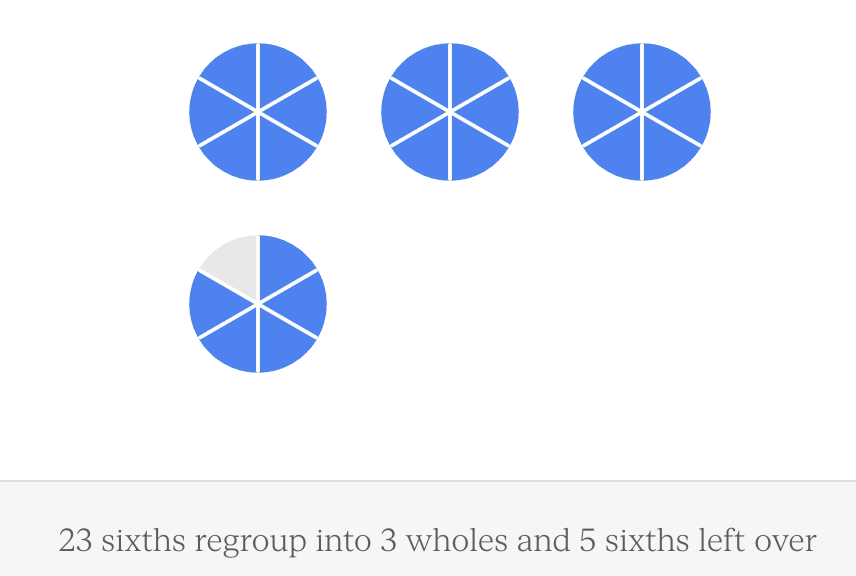
The important idea is that the value does not change. We are simply regrouping the same fractional pieces into wholes and a remainder.


Converting Improper Fractions to Mixed Numbers

To convert an improper fraction into a mixed number, use division.

Consider:

11/4

This means:

11 ÷ 4

Calculate:

11 ÷ 4 = 2 remainder 3

The quotient becomes the whole number:

2

The remainder becomes the numerator:

3

The denominator stays the same:

4

Therefore:

11/4 = 2 3/4


The Conversion Rule

To convert an improper fraction to a mixed number:

Step 1: Divide the numerator by the denominator.

Step 2: The quotient becomes the whole number.

Step 3: The remainder becomes the new numerator.

Step 4: Keep the original denominator.

For:

17/5

calculate:

17 ÷ 5 = 3 remainder 2

Therefore:

17/5 = 3 2/5

https://images.openai.com/static-rsc-4/6Ry564hrUUSeCYXeU6DK8PNonWsbhvHxYasP1ruL0Nsr4uJo3-c1ZHs9Nb_YuWasKNr2jy85WznjkgjiQlXkWw5lvIzBLG0bLxmnu0PsKSfCA2ncsTLWIHxL3lK19wnbuamfilal1YkLtuycsXuPP7OuiwDj6ExFZC26lZfKo2GuEYVQXQvbASC3LPjl43bo?purpose=fullsize
 
https://images.openai.com/static-rsc-4/UP1lg5gNVPwR1e60FsqByTYN5tC2c_nK3KSl0PB4oPOx4yyPgi4XVhzxPzVrCCYIARHTPFQA34Kmk_AKHuYpZ3nFoQAAPNGKetsa0r-_hTvMQV9Kz8jxGa8fXxZse2IY340bdv2crPc3GNFn5Yk3Jw6bQNWh7hHQOTmXBhKiyk9CMb4lWj5nxuI1RcVI1Pae?purpose=fullsize
 
https://images.openai.com/static-rsc-4/HKyPkIns35jCkf-qTDtQCAAZVzK4e3pS-3G0yaEsZakVDiZg0qTIV6GsYm13fcX73wKA_dgQBx7TFFPv03FJwr6mrquzn9t99oY_HpA5moV0PlK_w67nWlIH-8pTg3x0tHnvbspk_3jlIY6ta3j7VdLTLI1bmC1cVfafhSeY-jRzVdy7Hj6B-kTS6NzTJlHW?purpose=fullsize
 

Worked Example 1

Convert:

13/4

to a mixed number.

Divide:

13 ÷ 4 = 3 remainder 1

Therefore:

13/4 = 3 1/4

Check:

Three wholes contain:

12/4

plus another:

1/4

gives:

13/4


Worked Example 2

Convert:

22/6

to a mixed number.

Divide:

22 ÷ 6 = 3 remainder 4

Therefore:

22/6 = 3 4/6

But the fraction can be simplified:

4/6 = 2/3

So the final answer is:

22/6 = 3 2/3

Always check whether the fractional part can be simplified.


When There Is No Remainder

Sometimes an improper fraction represents an exact whole number.

Consider:

12/4

Calculate:

12 ÷ 4 = 3

There is no remainder.

Therefore:

12/4 = 3

https://images.openai.com/static-rsc-4/2jNxF2VZnbNXnjrH5MknNDLobNkLqP04Lj7l1S5P1GXBD9CintBmgXT59TOQUoV7qA0DvocV2Elhqa261_azLDNZkxzRrFdSxxoSb8pGCjnibeKhDE6jEhArIQrI22O8Y6O0kOfNodaGn5XFReJU-8myV89Hj-Ai5vzdeehNTjzVQrckZuHAI4U3DKbgRasN?purpose=fullsize
 
https://images.openai.com/static-rsc-4/h6ebR99Fc5k7VUV1xFji3bIXhNiJYaTWEHlo-Vm0dZMbWU7FVRgjsC9Rmpowe2yfYjQxxBJPY5OavTpQJ0GcTE4dmpHMbrj6eDmzMiCegrlBLnjmbr74ZmNuob3si6m2kfddQUbRUOQrV_TfslIiCnUrnlKn_6YVZtKRJwA93s9gc3uINfGAdSoJFRoivjDg?purpose=fullsize
 
https://images.openai.com/static-rsc-4/ch3nNkW8f79ZmqURetY5cN8D2rtD-yvs-TsGSu0GbnPcnFXRL1jE-GGHDKtU1pc71JPXRmc4eEbDCUGUBKB8dpL4FjtSHJYiPZ0j1930kxaw1jqKi_xRzcTx31ubt13ozVDdLBQA6zS33O_s7eJZRnu9saNT7cTXKutwEJeKZyfJN6vmy--kVxDb4bC4jlgx?purpose=fullsize
 

Similarly:

10/5 = 2

18/6 = 3

20/4 = 5

An improper fraction does not always produce a mixed number. Sometimes it produces a whole number.


Converting Mixed Numbers to Improper Fractions

We can also reverse the process.

Suppose we have:

2 3/4

Each whole contains four fourths.

Two wholes therefore contain:

2 × 4 = 8 fourths

Then add the remaining three fourths:

8 + 3 = 11

Therefore:

2 3/4 = 11/4

https://images.openai.com/static-rsc-4/vdCF1tfPoH6bDYURe4f3rb1-Xzn6Aodt2fOk0n8Jo6mHMC7cUPPhoJatqak1mFL05ZeWKmxVXugL5Wssp-EdGcJ501X2LDnw1r0GycJiVcUVZp7UdSrHPoClvx_WdLybWBI_4ReUPeb3hk6flXQU9HsKejWVMkdDp28TmsGeWREZ1IcrlDKXk9iMgFor3CyZ?purpose=fullsize
 
https://images.openai.com/static-rsc-4/p8OhRu4mz_0OMPgk9jRO4xN-lL9GtaXQBw_xaZBbMF3gVLvsAzrQmDmJF9z8xZrICISKbtW3rfBTHi2APypB7-Jq-wYaSJ4nyv59u_0TveSTTjcYXBQzbXkZ2MVw5NCV-BwsULNnOL8kTcLU2PlwSGS0unEq8QWHQqWTh7WXKJxxTPNjG6a3rejb14UVw-SW?purpose=fullsize
 
https://images.openai.com/static-rsc-4/kMjsOIyEG-AsBiv34Cs_CiklKHOwVvtiaJINnZI9AABMkMJqTX6WYbzwgtXCq73-vYCDFGvhANGoiBAZpkD3DJ1QVJXO8a57CmIB7mXnwnqf11M-nTZRzHqEfo4JkKgFngb_58VnmqQh5r7JUHiKWhYpsYeSLct_5mISk31aT4puYVGARHnmXg42IRz-lJHs?purpose=fullsize
 
5

The Mixed Number Conversion Rule

To convert a mixed number into an improper fraction:

Step 1: Multiply the whole number by the denominator.

Step 2: Add the numerator.

Step 3: Place the result over the original denominator.

For:

3 2/5

multiply:

3 × 5 = 15

Add:

15 + 2 = 17

Keep the denominator:

5

Therefore:

3 2/5 = 17/5

A useful pattern is:

Multiply → Add → Keep the denominator


Why the Method Works

Consider:

4 3/5

Each whole contains five fifths.

Four wholes contain:

4 × 5 = 20 fifths

There are another three fifths:

20 + 3 = 23

Therefore:

4 3/5 = 23/5

The calculation is simply counting how many fifth-sized pieces exist altogether.


Worked Example 3

Convert:

5 2/3

to an improper fraction.

Multiply:

5 × 3 = 15

Add the numerator:

15 + 2 = 17

Keep the denominator:

3

Therefore:

5 2/3 = 17/3


Worked Example 4

Convert:

7 5/8

to an improper fraction.

Multiply:

7 × 8 = 56

Add:

56 + 5 = 61

Keep the denominator:

8

Therefore:

7 5/8 = 61/8


Using Fraction Bars

Fraction bars can show how mixed numbers and improper fractions are connected.

Suppose we have:

1 3/4

https://images.openai.com/static-rsc-4/SztFF8tbuQMSSJBptVuDZ-tjKERmycipQQ7t2mWJ6fGKEx7o8HcQ15MhMD1FdhGS-3XkTfYK7oe32qMDLGaFfRx27f1edVYU_02mClevPUkDjno3oym1da9rzTi05kH9wYRGRm23DRjkwoffaKJ542kvOBLgM4bihRAFRPxRVgH6wmTI01Y6VKjPa0N7UyIV?purpose=fullsize
 
https://images.openai.com/static-rsc-4/RKzCeu6wTuc_GWTRSnNVGdYEaxSZq_Qp_aaO00U7-046m1v748f-I4QuRrYB-Vwwu5TPSDMbXjKMiPLVNScQavbUbrfy5arFBbyONBv83Wcvnv6a1w0yN7Ybx-TYRYWeZ698GUxhiW-WRwSD4W-pqclrrhOZb7E7Prbu7z8Y8WGjekcBdPBAGI1s7Glxc6YF?purpose=fullsize
 
https://images.openai.com/static-rsc-4/gHiwHEZavqCUZsAB2owqOHXSvDEplIkaGypdWESakXwhE7YgZCnTJQ7Pet9H4K2TXXwe_miAcbiIOVfw3AMCRfqfyAC_llfql4T5bLJTPvy_Jhlo1D34XbguAh5IBbX5F6UhM1XMMsXO9nHY5_VEYmCvi9C9lI4hpIE1xdtTmRLVhvjieZvL9O8gTvNTzEZj?purpose=fullsize
 
4

One whole contains:

4/4

Add:

3/4

Therefore:

4/4 + 3/4 = 7/4

So:

1 3/4 = 7/4


Using Fraction Circles

Fraction circles are another useful visual model.

Imagine:

2 1/3

This can be shown using:

  • two completely shaded circles
  • one-third of another circle
https://images.openai.com/static-rsc-4/gL25KNhfubdNUxs4lRdOKfyijviBuh9Io_pXLgneufHvW7Us-pjcEjz0JPh3kTTcjZgb9MbWkLoQ9FqCgS2SN8IzXla5yANsQVF2Hlvea4QlzFeqmjSYjvM3Dy4TNDVqMSTclx_XlXdSd4QJb2qLxH-NX-wgHhAztGqGkTs9VjVaqlqQB_S26PvlmC2IEMlD?purpose=fullsize
 
https://images.openai.com/static-rsc-4/02WV73gyM6tzeODk4Gf_nWkGGKG0v9jnz1f-H_tSzjB2DjSrYMEVnVRutLQPgouF5n7TSCsg9BbuKhRy6jjPcDwLXJ9NxgU52EmDwLGCKcSOy-6X5RFNt4yBU4KZlO9CCYXswcMsxubbQvKXJQwZ4SSmBM8HqP1d5PeUY0wSHW6e5JNOXOMovGL70lEDkoGW?purpose=fullsize
 
https://images.openai.com/static-rsc-4/LcttUdf_Z95OROa5V-U5rVYk4rCWkCd-mphG9LEyC0JV9fRbRC9dwUCbLvZSPZOr5gr4DBiw5raxfZFkZOXfX5HPVmyAKYrBWRzGAiGeCFdWYWADTLKl3cU4hNctsnm49N_EqY7e__Z9QxVTgyW11985auckq3oYFWpBq4AvTZHdrZNgVrmcMW23xdBOb9IA?purpose=fullsize
 
5

Each complete circle contains:

3/3

Two circles contain:

6/3

Add another:

1/3

Therefore:

2 1/3 = 7/3


Mixed Numbers on a Number Line

Mixed numbers can also be located on a number line.

Consider:

2 1/2

This number lies halfway between:

2 and 3

https://images.openai.com/static-rsc-4/kznQ1OmM8kXHbc-gy5w-IVQroBbaI01qnH2PP0pDGpTZ-B23ZkjxsAKCJ8KxBgqLWrGcHwIu544zrA3ZW68nwTcjaa53jhlEe15CgHHkBQ1ApY2DKJSWITxOjTd0xiGNoFcDjgqim1cCXSLBPklwZIN616DLENMobA0M_LW2paFZ03vNrvJ-SH7v6RXP8AP6?purpose=fullsize
 
https://images.openai.com/static-rsc-4/uelalfSfur_0ut10wXYGFi4ZESnPAXyzEiI6R68P1_47NML0e7OgzIGrDs41NTHcK1yfKE49W0yxM75wl7wCxZJzO1Q0Ht8I5BrQwavNS4d-qjmThWG0xN4iXj29qU1cVmAKaj_WG4QNyYC0c4XEHq_MLWNHzSCyCpLCjdehnML7qGei9kdqso9cFUa-wXE9?purpose=fullsize
 
https://images.openai.com/static-rsc-4/ONpqMSVPLoHZALOttMdtH6acwIig2R7Wwx2Ya4-PsMGnRaw5EOLD4CWJswEAISkvvzTisBGr6qkUYb8dNfFSGQYLtqfnnFo7wiFh-GbUTX_UVix4oKlxt7zB2fG_QaE6BaDbjigCEFTOLi68c0aZPYkZCcxpcGT0cB9n9UCNwjPPJl69wkSIZBfHfO6ngb5P?purpose=fullsize
 
5

The equivalent improper fraction is:

5/2

Both:

2 1/2

and:

5/2

occupy exactly the same point on the number line.


Comparing Improper Fractions and Mixed Numbers

Sometimes numbers are written in different forms.

For example, compare:

7/4 and 1 2/3

It may be easier to convert them into the same type.

Convert:

7/4 = 1 3/4

Now compare:

1 3/4 and 1 2/3

Both have one whole.

Compare:

3/4 and 2/3

Use twelfths:

3/4 = 9/12

2/3 = 8/12

Therefore:

1 3/4 > 1 2/3

So:

7/4 > 1 2/3


Ordering Mixed Numbers

Mixed numbers can be ordered just like other numbers.

Consider:

1 3/4, 2 1/4, 1 1/2

First compare the whole-number parts.

Both:

1 3/4

and:

1 1/2

are between 1 and 2.

But:

2 1/4

is greater than 2.

Now compare:

3/4 and 1/2

Since:

3/4 > 1/2

the order from least to greatest is:

1 1/2 < 1 3/4 < 2 1/4


Adding Improper Fractions

Improper fractions behave just like other fractions.

Consider:

5/4 + 2/4

The denominators are the same.

Add:

7/4

Convert:

7 ÷ 4 = 1 remainder 3

Therefore:

7/4 = 1 3/4

So:

5/4 + 2/4 = 1 3/4


Adding Mixed Numbers

Suppose:

1 1/4 + 2 2/4

Add the whole numbers:

1 + 2 = 3

Add the fractions:

1/4 + 2/4 = 3/4

Therefore:

1 1/4 + 2 2/4 = 3 3/4

If the fractional parts have different denominators, a common denominator will be needed.


When the Fractional Part Creates Another Whole

Consider:

1 3/4 + 2 2/4

Add the whole numbers:

1 + 2 = 3

Add the fractions:

3/4 + 2/4 = 5/4

But:

5/4 = 1 1/4

Therefore:

3 + 1 1/4

gives:

4 1/4

https://images.openai.com/static-rsc-4/UFLoEc2Kmk_ZNQon2sMxXn5tOmE0mgQENdvRD3eQXkquQac1DzU1_EQbl6zeDQUudbtvNEc2PN5qKKuj0BGdlaWEbcuekk0gTXCOf7nXLOesaMkuiGT--u52GMBHiKLfN7jQYNvw-IyMl4aNkSrUqxpAUmnn9dOTPsTlUS56kZhc02R_iTbXc8rznBZKG4yL?purpose=fullsize
 
https://images.openai.com/static-rsc-4/Uji9EnvE8EStvjNJoG3Cl5sBCPBoppOqvpuTMUZSlIYBS3EiaOIqbFjRDVZ29ld_eftyWNoDNHQ1plTxQ8zLOpnjRcfe-MGbpMsE6fUYlvyPi3R0J3Cs_9Hdm4UxeN8C4m0CrOEpOYUypYRAh1a0_qXUTz0jLkbapHE46yr0sffhFEsr-HKo4j8NJEu5MREQ?purpose=fullsize
 
https://images.openai.com/static-rsc-4/Thy-TbTna1uNQ8WStWaRzcSCIeHAuKSOKMTPZLR5y3SIiLv71u4IAA5r2FbdxeBmFQrpWvKBB4E9glPKbLuYwEE1tKx8C8XXN-lwz3Ux0rBsL4cgHn--3H3HQSdaU-yIUbFyr3K14NciCJrHmRrADYtno_V9Ba33pbx5P_8PNIO_xNylj1VH6JxYYdtCeZzN?purpose=fullsize
 
5

This process is called regrouping.


Real-World Example: Pizza

Three friends have eaten a total of:

9/8 pizzas

How many whole pizzas and what fraction of another pizza have they eaten?

https://images.openai.com/static-rsc-4/AgiEvrmvcUwMkxGbTQw5mRJa5XCxNMgb11uuGQMioSzxwqMokivPajmzASLrUDhgM6dgf7FMvTM3lX0wBSZwiDqjBO8kH1iVL9sMkDpTz9Jfctypk7rZE9Mgg4pDDcS7FOVp7Zx08YyMGAal3OLvvub0N6NQ4n8Zcb6pvteVzbdVdqlYI6uY-gDM-DAmBMAo?purpose=fullsize
 
https://images.openai.com/static-rsc-4/GV8qAoShaIxptwsHGHi4cwlBqkO98GEtvshfHROP-tp33JRyAEEamplq4zf1ZpEy9w07ekgFumxtsBj_xdegcfzoBlSbTpKLuxUh2D9yR9_qeOb2QQ6wG9gZFaRzkD0zBVkXdEYnh3HqUCNgCHCQl2WZ3ytr2UDAzDNhb-Pw6l9UXMagOGp-GSDbKTj_Qzb6?purpose=fullsize
 
https://images.openai.com/static-rsc-4/S4-QuefEFHHcjllUd-kqHiUZ8E9niHxyp1RghoHC5rWzLRlo5EqY_9ZA4QI4ou3S0_3lN1JesELmMmaq8_xsMHx3ANdTFpOyFNbN9Ka9CrzQA39z1s1twmm2GDX7_xd8XevmQpvVbfIlxBq8oxIo7XRSfLccsWqJ7gNzz5ST6zqwu0u2LBtUTmx2pw_RbIYB?purpose=fullsize
 

Convert:

9 ÷ 8 = 1 remainder 1

Therefore:

9/8 = 1 1/8

The friends have eaten:

1 1/8 pizzas


Real-World Example: Distance

A runner travels:

11/4 km

Express the distance as a mixed number.

Calculate:

11 ÷ 4 = 2 remainder 3

Therefore:

11/4 km = 2 3/4 km

This form can be easier to understand because it clearly shows that the runner traveled more than 2 km but less than 3 km.


Real-World Example: Cooking

A recipe requires:

2 1/2 cups of flour

How many half-cups of flour is this?

https://images.openai.com/static-rsc-4/Znnfip_pjai5Xj7bk7aM48cmlbefAnvZvN8icTXvqo59OUxgeYGXevxNDv59YusySeasu5wLMCwhMsURvs7vTIytlxwaVDNUDkMAPRNTVGS1ReZBhivvCLAxY2jOJ3J9KE-NqBUVi2uss7WsV6XF4lspr4ajk8O41tgwZK1dbm9C-v6mioegpRGwUBN9dNUD?purpose=fullsize
 
https://images.openai.com/static-rsc-4/8HPW7qHTjqwU0de6mGrtZk4xgnGSbrvwTtIjd0hTGmY9Yb-c69THn3Gx7_YlzFZzO2AkjmWYVMS6dgCFfuEkS0baMchQ0pAUtx5eWZHwh7D8xGR8RkAWjDtGWugwnLPIZrb_E44BZ8EMiurDSHji9wyqBkHCiUVjeDk8yhlaaAwGET2Gp3SV76Fthji4hUuV?purpose=fullsize
 
https://images.openai.com/static-rsc-4/L_jsHk_osWYBeJt_GN0s7FoO8C8UkOlTNtK6J1y17l3tcdXy-e7F-PYVlZkoln6KpJhWDaTk8TPp8tRDs5yF9rJ9bA1_sehmxYVNDAiRBgtXmFiy6Vig--FZK2cwCYnW9lHBQeDQ-Qx5og7ujARKpRzzZ3zv-Cg5B2K_1eZcJPgijd3PuEcl9Y3DMBv4hseZ?purpose=fullsize
 
4

Convert:

2 1/2

into an improper fraction.

Multiply:

2 × 2 = 4

Add:

4 + 1 = 5

Therefore:

2 1/2 = 5/2

So the recipe requires:

5 half-cups of flour.


Real-World Example: Construction

A piece of wood measures:

3 3/4 m

Express this measurement as an improper fraction.

Multiply:

3 × 4 = 12

Add:

12 + 3 = 15

Therefore:

3 3/4 = 15/4

So the length can be expressed as:

15/4 m

https://images.openai.com/static-rsc-4/PMnkeDk6RWpgiQ2q1JTFyhOKpdjmFPy2DyJzlQDvTK-Cl3z5u3SgwdS466ADsj_2nfIfoIbQB88QV5qeiflUv2EgL1ON7qRR9VonbpG99w1GBTjbwOu16x-eEbp6rvu_kYVyop6imTERi3HquPaf8OuPBIPvTsJ-0KNjaRUJhM-oUu8pWIShgtb2PWa7xaqm?purpose=fullsize
 
https://images.openai.com/static-rsc-4/lND0tko41ryjmOb8VUGd_mOnnKfOFDLl18_ozD72q8ERYnI4IMPS19M-t5CSQd_-lCp62Kd_Q7krRfjx3HNCfcVLlWdV7wUj9B9M6hfH6vQzVH65IbAKGsyvfCVw8cjA2XNlQX0VhGjIMn4cZRUOLGyzEVJym2S_-oPTXlN-ZH5L59SJdA5Z426GNT6kO_5L?purpose=fullsize
 
https://images.openai.com/static-rsc-4/NmNnb57eGYkpr1aIW8cepTZcJ83-ZrHV_z_3cB9qK_3JL4W7OUxre8ewWM77udu-nABya8mM1LagAkl-Vvy94ByojyikAIJ8ly9-cNkMQYFw8faKjbXbdq3lKUmsltBHs2n99NrQVkGmqjFpDPdlCwxTYQECPTTaPqj5n0LbDO5j6zqKNGVCjjQL5nEQxTX7?purpose=fullsize
 
5

Checking a Conversion

A good way to check your work is to convert the answer back into its original form.

Suppose:

14/5 = 2 4/5

Check by converting:

2 4/5

back to an improper fraction.

Multiply:

2 × 5 = 10

Add:

10 + 4 = 14

Therefore:

2 4/5 = 14/5

The conversion is correct.


Estimating Improper Fractions

You can often estimate an improper fraction by comparing its numerator with multiples of its denominator.

Consider:

17/5

We know:

15/5 = 3

and:

20/5 = 4

Therefore:

17/5

must be between 3 and 4.

Convert:

17 ÷ 5 = 3 remainder 2

So:

17/5 = 3 2/5

This matches our estimate.


Common Mistakes

Mistake 1: Thinking every fraction must be less than one

Fractions can represent quantities greater than one.

For example:

7/4 > 1


Mistake 2: Changing the denominator when converting

For:

11/4

the mixed number is:

2 3/4

The denominator remains 4.


Mistake 3: Forgetting the remainder

For:

17/5

17 ÷ 5 = 3 remainder 2

The answer is:

3 2/5

not simply 3.


Mistake 4: Adding instead of multiplying first

To convert:

3 2/5

do not calculate:

3 + 5 + 2.

Instead:

3 × 5 + 2

= 17

Therefore:

3 2/5 = 17/5


Mistake 5: Forgetting to simplify

For example:

14/6

becomes:

2 2/6

but:

2/6 = 1/3

So the simplified answer is:

2 1/3


A Strategy for Improper Fraction → Mixed Number

For:

numerator / denominator

  1. Divide the numerator by the denominator.
  2. Write the quotient as the whole number.
  3. Write the remainder as the numerator.
  4. Keep the original denominator.
  5. Simplify if necessary.

Example:

19/6

19 ÷ 6 = 3 remainder 1

Therefore:

19/6 = 3 1/6


A Strategy for Mixed Number → Improper Fraction

For:

whole number + fraction

  1. Multiply the whole number by the denominator.
  2. Add the numerator.
  3. Keep the denominator.

Example:

4 2/7

Multiply:

4 × 7 = 28

Add:

28 + 2 = 30

Therefore:

4 2/7 = 30/7

A useful memory aid is:

Multiply → Add → Keep


Did You Know?

Improper fractions are often more useful than mixed numbers when performing calculations, while mixed numbers can sometimes be easier to interpret in everyday situations.

https://images.openai.com/static-rsc-4/8HPW7qHTjqwU0de6mGrtZk4xgnGSbrvwTtIjd0hTGmY9Yb-c69THn3Gx7_YlzFZzO2AkjmWYVMS6dgCFfuEkS0baMchQ0pAUtx5eWZHwh7D8xGR8RkAWjDtGWugwnLPIZrb_E44BZ8EMiurDSHji9wyqBkHCiUVjeDk8yhlaaAwGET2Gp3SV76Fthji4hUuV?purpose=fullsize
 
https://images.openai.com/static-rsc-4/4uqypwr8uZtkmPD2rkzP14G1BGe_6dxHbUb665YBaANaY-JnPqPLHACMOwDACPwtj96NUSi-VqkhbQJ14gx3Xwu097G7mWCmCbEVQDnycfuufIKNArn6cq0Cfow-r3wCPSCjqioqiyDqrOva700CcarEqV3vvS_rydKl6M2fa9A4NukPs032klenBvBPzhgZ?purpose=fullsize
 
https://images.openai.com/static-rsc-4/pOSCcgiLqNx7MLSN8t3DlCHVKCoLXMV1QR6Shc9aybmA4zRsO-r1kv4VVGjK7yuuUZDXmeaIBXlUTxOo4Ta4JH9lM32bLa1HXTrirwFeaiZb0UZ0DDgR8CDZpW7AADtOu0XMdSItyeJiCeqUZY7Uc87OaU5yNcJBD1o_NHBhK8eQ8JOqEjwgxfmpAgZtltSn?purpose=fullsize
 
6

For example:

2 3/4 cups

is easy to picture when following a recipe.

But:

11/4

may be easier to use when performing fraction calculations.

Being able to move between the two forms allows us to choose the most useful representation for a particular problem.


Key Terms

Proper fraction: A fraction whose numerator is smaller than its denominator.

Improper fraction: A fraction whose numerator is equal to or greater than its denominator.

Mixed number: A number consisting of a whole number and a proper fraction.

Whole number: A number such as 0, 1, 2, 3, or 4 with no fractional part.

Numerator: The top number of a fraction.

Denominator: The bottom number of a fraction.

Remainder: The amount left after division when a number does not divide evenly.

Equivalent: Having the same mathematical value.

Regroup: To reorganize a quantity into different but equivalent groups.


Key Rules

To convert an improper fraction to a mixed number:

Divide numerator ÷ denominator

Then:

Quotient = whole number

Remainder = new numerator

Denominator stays the same

For example:

17/4 = 4 1/4

To convert a mixed number to an improper fraction:

New numerator = (whole number × denominator) + numerator

The denominator stays the same.

For example:

3 2/5 = (3 × 5 + 2)/5 = 17/5


Key Takeaways

  • A proper fraction has a numerator smaller than its denominator.
  • An improper fraction has a numerator equal to or greater than its denominator.
  • Improper fractions can represent quantities greater than one whole.
  • A mixed number contains a whole number and a proper fraction.
  • Improper fractions and mixed numbers can represent exactly the same value.
  • To convert an improper fraction to a mixed number, divide the numerator by the denominator.
  • The quotient becomes the whole number and the remainder becomes the new numerator.
  • The denominator remains unchanged.
  • To convert a mixed number to an improper fraction, multiply the whole number by the denominator, add the numerator, and keep the denominator.
  • Visual models can show how fractional pieces regroup into complete wholes.
  • Improper fractions and mixed numbers occupy the same positions on a number line when they are equivalent.
  • Some improper fractions convert exactly into whole numbers.
  • Fractional parts should be simplified when possible.
  • Mixed numbers are common in measurement, cooking, construction, distance, and many other real-world situations.
  • Being able to convert between mixed numbers and improper fractions makes later fraction calculations much easier.

5. Fractions in Everyday Life

Learning outcomes
  • I can identify situations where fractions are used in daily life.
  • I can interpret fractions in recipes, measurements, and sharing situations.
  • I can solve practical problems involving fractions.
  • I can estimate fractional quantities in real-world contexts.
  • I can communicate fraction solutions clearly using mathematical language.

https://images.openai.com/static-rsc-4/QwYnQ7Bzd3eu8xdCqaV4U7slGAX74dXtmyJaiYq-l_h6ZleFTLHIl6WzMpegsjmyzSdGF5q0bQrLNYzi51PIywsrerixJ_A7be1vOo0g8r14C5mTQ5LQzx3nXxYaeQx4bDf-yv1PU_H-7NSK_RdhgF4uEJyYb7mnNCX7x6dgCxbYnlZcITCX3D1FKUa-Zeza?purpose=fullsize
 
https://images.openai.com/static-rsc-4/8HPW7qHTjqwU0de6mGrtZk4xgnGSbrvwTtIjd0hTGmY9Yb-c69THn3Gx7_YlzFZzO2AkjmWYVMS6dgCFfuEkS0baMchQ0pAUtx5eWZHwh7D8xGR8RkAWjDtGWugwnLPIZrb_E44BZ8EMiurDSHji9wyqBkHCiUVjeDk8yhlaaAwGET2Gp3SV76Fthji4hUuV?purpose=fullsize
 
https://images.openai.com/static-rsc-4/7H2ppyKHghqGvOHDaIb9Bj9jEn9Fqqv45ITG9OUDvtQvcWIS9SsHOmZ69seHe2x1TStxI_gcdezkC-0LkA6Tu_8apuPcCuLbq6xaEagbjp4Ihea7UZJ7kkXMMeJljA7n5s8LFvR8xHzRG4tO7xTbcDdUMBcCOGS7JPSyFoENo4jDEpiCnZAOqGbGH9wSavMJ?purpose=fullsize
 
6

Fractions Are All Around Us

Fractions are not only numbers that appear in mathematics lessons. We use fractions whenever a whole is divided, measured, shared, compared, or described in parts.

For example, we might say:

  • half a pizza
  • three-quarters of an hour
  • one-quarter cup of sugar
  • two-thirds of a journey
  • one-half metre of wood

All of these situations involve fractions.

Understanding fractions helps us make sense of quantities that are between whole numbers.


Fractions Describe Parts of a Whole

A fraction can describe how much of a whole quantity we have.

Consider:

3/4

The denominator, 4, tells us that the whole has been divided into four equal parts.

The numerator, 3, tells us that we have three of those parts.

https://images.openai.com/static-rsc-4/b6ElJ6QqqLtzDMJz-mnuL793_ym-43xtQVCPtip-YIis3gfG09APNKMKqWnIqPSIHaLLIzV_fNdlnQow71fbhVhc69Rlb3Cmx6jEDy3-fPyK5GcsY27zPxmTn2j0Uwmq66sgD56_awL13VOZFmmC1SfYOQcjLiDenUJc_wzoQ_Mcqj1hJTauREJICsj2NJI2?purpose=fullsize
 
https://images.openai.com/static-rsc-4/mny82UEbrpOSXA59M_ULkyLGcQa3th8uys1CfNX_--6R2FIIIoAX6_UspQxnI9GWQwCYyTahGDgjtLkjOHSuw3-vV1-KSOzLJpKfmGQfx1hrY_e01ovWwWh_FlPVR49VSxa2IWJpfPbvcnBQZ1nulPkex9AbqRvqJYBsdp-mhBJz_RWLTYK0MC2R3DW7hJI3?purpose=fullsize
 
https://images.openai.com/static-rsc-4/7H2ppyKHghqGvOHDaIb9Bj9jEn9Fqqv45ITG9OUDvtQvcWIS9SsHOmZ69seHe2x1TStxI_gcdezkC-0LkA6Tu_8apuPcCuLbq6xaEagbjp4Ihea7UZJ7kkXMMeJljA7n5s8LFvR8xHzRG4tO7xTbcDdUMBcCOGS7JPSyFoENo4jDEpiCnZAOqGbGH9wSavMJ?purpose=fullsize
 
5

Fractions only describe parts of a whole correctly when the whole is divided into equal parts.


Fractions in Food

Food provides some of the easiest examples of fractions.

A pizza might be divided into 8 equal slices.

If 3 slices are eaten, then:

3/8 of the pizza has been eaten.

If 5 slices remain:

5/8 of the pizza remains.

https://images.openai.com/static-rsc-4/LSr_Ckj2eozcjjWHlHXXHwHkICGrE3sYKna_30EO1-1Yhr5vzMO84LC2B8AUJwSmevUxNRrUrU1-2Bz7e795JpURwKIkTNlA8ctJHHMTN4VnBnU7q-9yybAlF8-uPds1zITPdvathD3ylujYtgchHy0yUUJ5_MX98qVRqWhM5hvuOFieITVdPTYim1EXiPuL?purpose=fullsize
 
https://images.openai.com/static-rsc-4/D74GPT315OTCzHu_MzcCcKfNDlF01lQhWBDR5oMb4Kobj9GyOYualwLFq5oHBx4IKZtZ34GdgdckmPSi87SRdnZ09b0PTPDOZxBa40jB6v4zxLSbQR9lON6iaI-F8Kw-Rmi2kEgzGhBscvtlmGqmLf4qf8pH6Dgjsfh6-z1GhIZ51clDgx4kU7rLK4ZMrGfG?purpose=fullsize
 
https://images.openai.com/static-rsc-4/iP3CBhaTjXJYKMXpx1Ie9ewLm5xabo6FEPbDiUHbONnxeLuO6Z2V7gdahpis6RqJr5K-CYd0gJqQxs_BlZAJbE51x0JjgTy13MM2E09g7YDrg9m2G7j_Vzon_uOSScOBLiNKN7s_N9--7OVD0KGiuAuwXJyVA-yDKVMv5DRYpuipTbKM0UaxVpcyPzeXj-_z?purpose=fullsize
 
6

Cakes, sandwiches, chocolate bars, fruit, and many other foods can also be divided into fractional quantities.


Fractions in Recipes

Recipes frequently use fractions to describe quantities of ingredients.

You might see measurements such as:

1/2 cup of milk

3/4 cup of flour

1/4 teaspoon of salt

1 1/2 cups of water

https://images.openai.com/static-rsc-4/zI1U8uF7kDcfnVzxxjBfDJuHFzafvyCtvsUJbXGdA61A8PqYEM6DUry8IdxebOTZiF8mTUjIxhfLnE33dez5eTwedG9M_kXM6XUMtNwxYXK3focc5NpCyAd1xK109iC__cwdk33OsPikaRr6iAIVwY7LZkUWs6MBFHIwmDvyensg-wfzYnt9Ssdxw04Lo3hv?purpose=fullsize
 
https://images.openai.com/static-rsc-4/8BsjfoZoyAaeXVi_bqTiAS2Ub9iZGozqdqI_-e6xvFDmn6Tj8K4wSeW8k0AwECOvImzZsQFg5qrkXb7BtVx8-FeGQS_w3ZRpQX7zodgFPb-YlNEfnegcrRab2dnoMvl6VlHao4M6bzK4PcYlzBOKId77ChInjYYOwz2ZUQL5AcFUs9GeBPEU2yabWZML1jyn?purpose=fullsize
 
https://images.openai.com/static-rsc-4/F0vLXgybGvVcK2B_xfN8efGB8EHkZLmoqEpTI3FHjVyIc2qVzJ74JLe4cdORThalpccwJ_za7x3wOpq05Ab9cmNmO6CZPuJmiMX9AL0FTyfisYBD_kwOru1OZ0JcP4Xch_r6Zg3a0xUF70KF_gEss4Oete4WOTVA3_5rYaidIlfpDbNmRWlqMDwPXeo6UVhA?purpose=fullsize
 
5

Understanding fractions allows us to measure these ingredients accurately.


Reading a Recipe

Suppose a recipe requires:

3/4 cup of milk

but you have already added:

1/4 cup

How much more milk is needed?

Calculate:

3/4 − 1/4 = 2/4

Simplify:

2/4 = 1/2

Therefore:

1/2 cup of milk is still needed.

This problem uses fraction subtraction in a real-world situation.


Changing the Size of a Recipe

Fractions are especially useful when increasing or decreasing recipes.

Suppose a recipe uses:

1/2 cup of sugar

for one batch of cookies.

You want to make two batches.

Calculate:

2 × 1/2 = 2/2 = 1

Therefore, you need:

1 cup of sugar

https://images.openai.com/static-rsc-4/nV3hjrQFEHyTLZ9NL_aj4viluLuZgQE39jDTorVUsnQFVOPhz9vU5UhJMBKZFlhRCKTE24SG_WcAy_P0PMq22EYT3KOewz-wNX6FEga-2vZWQN8Tca3FJfGmT6tyn1bU855V3mqzr9ioJ2eHJc5BdAqHqsIw2QgPLzZu-I9VIi8jT481R46C_CxEphld6_lS?purpose=fullsize
 
https://images.openai.com/static-rsc-4/5ic2PaGQQzhs4QPcPsv09_X8gfmdfCd7MlMKlysyR9Xp4VFUXVqx-l7kX0O6iM1P45-x7TY0oUBmUp6b-2_ikJIRgImyabwYevwBa-uERDX7ac0MqfvlLO1dklTCuFga1pjstgoHlEBE3syWHpyh1YK0XM2LHjnYGv1yKPFt2vfWjbfDxCIDkIUpFwfh93s5?purpose=fullsize
 
https://images.openai.com/static-rsc-4/pwswY4CAT6lg3OEICD1EMxhF4FwACysCG0t5wAUBOpfwfjTRXIJANI78qjlLZu_N4IAOPEICUEOByXxUe9ShODewb8JocIFyQye2LB6m-_pd4pygGLkgFstIIaGVTNq8D7xU1mTINz7wRfzPOA3XTRVQZD6LN-ptDB7LOzB888sQlXRqSLIGdjViUagPU6bp?purpose=fullsize
 
5

If you wanted three batches:

3 × 1/2 = 3/2 = 1 1/2

You would need:

1 1/2 cups of sugar.


Fractions in Sharing

Fractions are often used when objects or quantities are shared equally.

Suppose one pizza is shared equally among four people.

Each person receives:

1/4

of the pizza.

https://images.openai.com/static-rsc-4/5Kek3dHDt5bWEkuss40vYpC-IF5JXUcWc3F0SsaDeItNIwrtzUN_Cg2Ux95wZTcdFtGcwbjf2TAvJZDgGcg5GZ3msN9-CTB0hqzL50DRrsl3mDB4A7iF3Jr6S9i7O3nVPw0Eg8yAzGLpe8pT5DStLm6GN2bHWutZ3iJ5nidkhpTTKxX9SfF695L9-zT8rjwZ?purpose=fullsize
 
https://images.openai.com/static-rsc-4/JGn6shyRNrbSxd31C29Miob1AOQXdpUC3WEavQihzLDCnOCKP3kZG8yPtsr_RLZ4sqPRIdbprCPHkxwBgJLzb0Rs2v3tk_d3pn4xcRAT_WQOpGzqWKdEHpU1dEdxA83odfJeL8eF0NB5gEPa3e9P3U7QYkzsZoSy5IF_BCYQlmwMulONspDoTBkveppw4u3t?purpose=fullsize
 
https://images.openai.com/static-rsc-4/BUfPcWaGyeZ9lfH9Er1jlZjncyv1is2hkz_1wRsggJeLA9AiEqRblZsGK9ROvpmo21pNyTo6V9M8yYkbuK96zRi3JSCWkf8w-eg8eNGCGd-uoV0BI0F5RYZCViqaqtR47a3_e7IEd3OuxZtQOhC7-rxtZQyCG_2CASKlhU1c-C2NygE8x6K0FYuk-ObHOpSu?purpose=fullsize
 
5

If two pizzas are shared equally among four people:

2 ÷ 4 = 2/4 = 1/2

Each person receives:

1/2 of a pizza.


Equal Sharing Is Important

Fractions depend on equal-sized parts.

Suppose three people share a cake.

If the cake is divided equally, each person receives:

1/3

But if one piece is much larger than the others, the pieces cannot all be described as one-third.

https://images.openai.com/static-rsc-4/Jy76V930t1x7F-lAE1-NqE-fQdCdt6m9uoRZzuEaGwHgtqfLJfz3KABc8D3cCwyIXAHmbAQ3Tjy9NUQ87rbFns0oVIWmwzjCOzkq_vheelaKk-18ia-Xj1WVTdgjFVVIhvDUNH7nTXmnoiEwNO7UrOldr_DjkL_VffvkhPc0miSp7BVkumL_EBIX24Kn-iJH?purpose=fullsize
 
https://images.openai.com/static-rsc-4/7H2ppyKHghqGvOHDaIb9Bj9jEn9Fqqv45ITG9OUDvtQvcWIS9SsHOmZ69seHe2x1TStxI_gcdezkC-0LkA6Tu_8apuPcCuLbq6xaEagbjp4Ihea7UZJ7kkXMMeJljA7n5s8LFvR8xHzRG4tO7xTbcDdUMBcCOGS7JPSyFoENo4jDEpiCnZAOqGbGH9wSavMJ?purpose=fullsize
 
https://images.openai.com/static-rsc-4/mwuAGSLHZNclVsCQSoBZP-sQJLtDkP6gFKO61r6TquQFcIWU99w84MBOkqxYQqiND7u_2CcolhJ2OwO92KZksOJhUKLmWl9lIGviM4nQHqoWXlyASaZGUwGfMN0WPl8rOcdTfvgvBgo2TBVGPDVKyinz3LQeMnw71WGnkyHEk0V6WRK9GgujyTHbR9WlnVGh?purpose=fullsize
 
6

When using fractions to describe sharing, always ask:

Are the parts equal?


Fractions in Measurement

Fractions are commonly used to measure:

  • length
  • mass
  • volume
  • distance
  • time

For example, a piece of wood might measure:

2 1/2 m

A bottle might contain:

3/4 L

A person might walk:

1 1/2 km

https://images.openai.com/static-rsc-4/tpqUeseQ6Wn2vh6ADXc9SgNXf66XE50dK5REBmqQsc9CjnypB9qnktsAvxbHTFpEoPiSOW54vl1PspjzlzurbrZLuA9ZjpifBo1_HgNK4BCkzNIShbTozgbK1RjY0ZV5CAUuTNxPojZ4TX-hZJZGaEr2zXTXN2BtDP1As4mculM3sZ3PrXDJeV8pgrN_l7t8?purpose=fullsize
 
https://images.openai.com/static-rsc-4/ItmuH7-y8OT8AZ9AQ2DlkbsCmdjmUtVbub95SmLAZsc-HNxVP8G5cZjoPX3cCczprMjziK53xJkQ0LsnfgwKSkxEcKbwUIMr6_6Uoyi0jE_Hvyahc2p7NWU_GGYjl-aeKByRlRlwwFYomxqhJcJTIqUXOUS0N9cnN4NrWRr8d4fLq4exWGfXqaIOyxOgCpgy?purpose=fullsize
 
https://images.openai.com/static-rsc-4/Ib4aPoY70us3X2Oj4OFRAncE1ExXA1Ahd0P0o-ZE8myGC5DVV6fNhmwJ32IiOsPhjsznp9AyWKU5mu4vuWoQKgEtzNRhO9-7fXJE558cwV3vmSVn0A9yBvMNBHVXSh9yYA6268TICKdcarAa9ROpVnQ-OKHOVGWgV3SvDuZuCrctQ19fEs--seefA_FE_1FQ?purpose=fullsize
 
5

Fractions allow measurements to be more precise than using whole numbers alone.


Fractions on a Ruler

Rulers and measuring tapes often divide units into smaller fractional parts.

For example, one unit might be divided into:

  • halves
  • quarters
  • eighths
  • sixteenths
https://images.openai.com/static-rsc-4/Ib5uLPsVMsI0ZtvAwj9KP2nYvRjJO5v04_1A2lfDQg2FmrOmoU0_eao7ABOUmQxH_7rfo7po8SfXsnZIYvw9lAdJXQOEjSsWpr8105__ZCWSXERxh4WNailGYlWCqHFNy7jRijOAIkWYvJiNAXCGFlYPkkEl1YmtoWdmIvecLAshGK_qjRSn-mVvfxPGxRoB?purpose=fullsize
 
https://images.openai.com/static-rsc-4/tpqUeseQ6Wn2vh6ADXc9SgNXf66XE50dK5REBmqQsc9CjnypB9qnktsAvxbHTFpEoPiSOW54vl1PspjzlzurbrZLuA9ZjpifBo1_HgNK4BCkzNIShbTozgbK1RjY0ZV5CAUuTNxPojZ4TX-hZJZGaEr2zXTXN2BtDP1As4mculM3sZ3PrXDJeV8pgrN_l7t8?purpose=fullsize
 
https://images.openai.com/static-rsc-4/hoSLA1mIFJUnpFtjSNy3OWEyd5rwX7zy3L8nEW8BowzaHGtMNciUM4tc6q8hXTj9Ya14d7e-fH5l2cCQAHB71rGEMObNASe0LPXkUG4iXG-VpZh3v184GSA__BToqE75NUpra8KFWkoqODNNe27vwipkjT2_L1tj6vBEVufSTXaMQJ3A3SZuvEklNBobEzpe?purpose=fullsize
 
5

A measurement could therefore be:

3 1/2 units

or:

5 3/4 units

This is one reason mixed numbers are useful in everyday measurement.


Practical Measurement Problem

A board is:

3 1/2 m

long.

A carpenter cuts off:

1/2 m

How much remains?

Calculate:

3 1/2 − 1/2 = 3

Therefore:

3 m of the board remains.


Fractions and Time

Time is full of fractional relationships.

One hour contains 60 minutes.

Therefore:

1/2 hour = 30 minutes

1/4 hour = 15 minutes

3/4 hour = 45 minutes

https://images.openai.com/static-rsc-4/TztjfNA4yD9a01YOs2NNMxlV0edZqm3tISBdOOFIi3I4QUzqiGJoJtEPljqraYoxD5GCaECNcZv6tu3MbtZmOPSShXYMXwxi3JRR7j-2Nvwi2NBvvIQEJqxs14wXEZNwe1auFGoEkGAt4UuUaC6q_kbKzPpkY9PVsJeRYC_3YY8yIwammpf6xxatUeaUEs3Q?purpose=fullsize
 
https://images.openai.com/static-rsc-4/GaOYdn9Reglxky_yoj0qwqmIzth0K6mHL2Gt0o7cgamMR8wThlj6MZu5YBFXACcN_LBACPRxoWIjYN-9QEfmxZsY_vGCilyAllUcDbsYhHWaJnnXByFU-bGu7pmPMa4AkLvotgeny9C1S-4dHTyDLOPH0NO9ve_xxFcXs4srSP1VUjsp5BVa9KE3eImxRMOE?purpose=fullsize
 
https://images.openai.com/static-rsc-4/mZIZr3mbPzoIfaJKX5USIppfkMCZIFFE9eTSUxrHYfRlgA_qOQ0vwRbMCkWnE68rWHH51y7NvaeR2BbYgMwxpxZ_2pgYTaDp3DSgnkc8kXxFLGU7_qUFxZCtx-BCV3RLxjJp7UI0ZUcGFYtcUc85jbL52VATEzo6nuS8D6Mwa-dMQwpByGITgYcLJMMfSrJ1?purpose=fullsize
 
5

The expressions:

quarter past

and:

half past

are examples of fractions being used in everyday language.


Fractions of an Hour

Suppose a student studies science for:

1/2 hour

and mathematics for:

1/4 hour

Total study time:

1/2 + 1/4

Convert:

1/2 = 2/4

Then:

2/4 + 1/4 = 3/4

Therefore, the student studies for:

3/4 of an hour

which is:

45 minutes


Fractions and Distance

Fractions can describe how much of a journey has been completed.

Suppose a hiking trail is 8 km long.

A hiker has completed:

3/4

of the trail.

https://images.openai.com/static-rsc-4/8dB_JmpotLKsWZ3beBfRmTQVJ_Jymx1Woz0rmPfyR1Y2F6b2pTAJOXn03e0y7vz43FZI6ZX1AOTZ62oUJUgr3x6P4MZJWinyOSr06J0JRzJihBI7KhcYNSGk0o6D9rFmljV9n0gZWlNgs4e6K6pgAMpi-z8nJyLCSU3NPgGGp-naemX2AOkOn4pgNoBIJ2tY?purpose=fullsize
 
https://images.openai.com/static-rsc-4/WkYr7too2zAt8s0DRg-fHaCeuOwgkKillj7X3YjJmlgMglOPDoKvUVoMlTLhGk-jVd8FGJxOT2oqNp8rWkh64Z6ce0VQ5e_JnIhQZATiJ1ffNm07u0v3zfOtm1Sm79Q1M2YIWR9CwY-kEdB0SEMJRwHkrRlAaGrVz5w9DDXBpWXQlIgmiiq4FHL93kccZsgi?purpose=fullsize
 
https://images.openai.com/static-rsc-4/vZDhdUNcMN0HI49Kigzf0fzk2BYsYMr4N6H4uls12mgHlHqATPT9msFyHHAPqtNhc1xNENbH6wmCCadk1gs0f3rNDF_ElekfwmPJ2pGolNtD6za33zk3M-8y31OR3WgX51ZitJ-8xj8cknlZrndODQ6y3KFXLe2Kb8FcORRjS4j9H_yoQYa-x5XwzPp4zOqC?purpose=fullsize
 

Find 3/4 of 8:

8 ÷ 4 = 2

Then:

2 × 3 = 6

Therefore:

3/4 of 8 km = 6 km

The hiker has traveled:

6 km

and has:

2 km remaining.


Finding a Fraction of a Quantity

A very common practical problem is finding a fraction of a quantity.

Suppose you need:

2/3 of 12

First divide 12 by the denominator:

12 ÷ 3 = 4

Then multiply by the numerator:

4 × 2 = 8

Therefore:

2/3 of 12 = 8

A useful method is:

Divide by the denominator, then multiply by the numerator.


Worked Example: Food

A box contains 20 chocolates.

You eat:

1/4

of them.

How many chocolates do you eat?

Calculate:

20 ÷ 4 = 5

Therefore:

1/4 of 20 = 5

You eat:

5 chocolates

and:

15 chocolates remain.

https://images.openai.com/static-rsc-4/NfWUrtb5znU2PkUupD7tRV1yg3FMduLj1oFrblLiFdlTKVMx83o5CrooRxizzUh_yjthnBLSe5IoEOHndn_L9KGPeV4CWJk4qBr5ZTQ3Mh1VYJxrsPjvNErCJ4Qbp0J_stOnSefdIFQ6ErwC_OC5FeG8pIQ-mGcEFiT28Obp62DBH_cfsAFcW0OJ0jAV48Sj?purpose=fullsize
 
https://images.openai.com/static-rsc-4/ntKniF3aWFFMWt3M8D-cHKnCI-Ui30-KEOpd_PElmVSMMnrn0VhwtXY3zAVm_XrnyvvE2NMSqoIwlsGL3Gs0h178nJfnuKnCQRBvPN_tdwiVYjDvem_2Xp9zWZLTCSlg1YiViIDCZddFufTjZaWsuSCdAOTMGXbrvG1OT8tLO0An0fdC4AHuS-ynXjorV2v-?purpose=fullsize
 
https://images.openai.com/static-rsc-4/PzdCh_DYMteZ8gq8SdmD0Z8-tS5kHe1rVv7UX0WfSLMS4tt_NWqHMeg__Z48an9RnErhTzjic1NgX8bo8uisDIzpstpU1LyhQQQ6cSyVKyxqsqUhcXiDbghXjcxa9sxgCLQrDkOYn-14YAw1yC_NgXoiSUCboB0yqfCuir62oWJN_E7egQu79zrx6QYqqODD?purpose=fullsize
 

Fractions in Shopping

Fractions can also describe portions of quantities when shopping.

Suppose you need:

1/2 kg of apples

and:

1/4 kg of strawberries

How much fruit are you buying altogether?

Calculate:

1/2 + 1/4

Convert:

1/2 = 2/4

Then:

2/4 + 1/4 = 3/4

Therefore:

3/4 kg of fruit

is being purchased.


Fractions in Sports

Fractions can describe parts of games, races, seasons, or attempts.

https://images.openai.com/static-rsc-4/Qb3pIOtTk2wfw9p3VFREoYlfnBiAwi-gvoedEjTmsAtjU4PFOdxXuYdOMJJGQWoO7Ts_qqPPD7AJ8NHXhrpIan92LZH4QslpBhNVbLZNyfWpKySDZ-lEFnuQifi6-FvGk1vpkWoOHzva8Deqeu-buZyZlwodvUapCdUc2OU9O9wQAm9imC4icgkbLrbECvjk?purpose=fullsize
 
https://images.openai.com/static-rsc-4/Aj3ARFOJypxbe0_GRsIsMKHCt3V1wVnRDNSDMEXb7onEFHV3VeJPEkjsAHh_dbrWtYnaEMi_DX8TjC1_bml8e8eVeeBM5bBpTUKJwEodj6nrGINTmTNkx7HwLUcXWerKUJCLdtTqv7O1Bj2fAdv6-bTl-ju1HNax2b0G_yvfaihL0dCOIZIQ8uVoZz3SKAcc?purpose=fullsize
 
https://images.openai.com/static-rsc-4/tLC7CpnwEmzMWigFvb9VjA72YrejTFjA_PoDcqhqWtM759bTHTlVMQFktFb-ylP3PwEnmwycV9kaCmN8oaQ45G4RZtrs6W7Rnh7pY8vLyunwIhWgrVzXZHLQbvf4JpTwN7hm2PsBECLN92ZllCjReyAtvyq-yJsYCnI15nyMMA96dTm7LC6-k7vtV-Li1rYH?purpose=fullsize
 
5

For example, a basketball player makes:

6 out of 8 shots

The fraction made is:

6/8

Simplify:

6/8 = 3/4

The player made:

3/4 of the shots.


Fractions in School

Fractions can describe completed work.

Suppose a student has completed:

7 out of 10 questions

The fraction completed is:

7/10

The fraction remaining is:

3/10

because:

7/10 + 3/10 = 10/10 = 1

Fractions are useful for describing progress toward completion.


Fractions in Money

Fractions can describe parts of an amount of money.

Suppose you have $40 and spend:

1/4

of it.

Calculate:

40 ÷ 4 = 10

Therefore:

1/4 of $40 = $10

You spend:

$10

and have:

$30 remaining.


Fractions and Groups of People

Fractions can describe parts of a group.

Suppose a club has 24 members.

3/8

of the members choose one activity.

How many members is that?

Find:

3/8 of 24

Divide:

24 ÷ 8 = 3

Multiply:

3 × 3 = 9

Therefore:

9 members

choose that activity.


Fractions in Construction

Builders, carpenters, and designers regularly work with fractional measurements.

https://images.openai.com/static-rsc-4/S0Ult0PZrEs7wAK3_R6bPOSriK2ewjk8pQ5EOa0txB0HkL7locn_K-R38gvxzQuFa8wm3P_UrmaQSWFJqncRW-AVJ_TGurfplAnKpZtoDBbbqeuRgpvpO43-5jV19q3VyDzKFjH8hq0oMk2db7SKSSJGgZoGtWsEgkKhMfh6M6oi7GzXYRkLYPRoRtgrhD1r?purpose=fullsize
 
https://images.openai.com/static-rsc-4/9jgKfVCV_m8zo7NcSJfJlesgDYkb3Z8vFJvAii1hjJa1pq_anHpXt7U5ybO2ZXzKH3Rzvi-JGSto4mfciGE1yt7F0WHENDxQ38Wg2uykCsC-ttttE_3ci1FP4T61Btm9A0yNDhWxSsBnLxljia6vp3ERMHxQ-bZnZ1BYipMrSW5iOhY7QeLeUYC9J-IEfrzr?purpose=fullsize
 
https://images.openai.com/static-rsc-4/qasGahfLUDUWxNG1M1fhZ4S6X6aWO14NZjtM9k5dSurHMlbAW1DMi37O1Tp3R2azOi5Qne2WvS1pc5bxozERZh1cdsRsNUykhCCE0OJnVCWry3rkJ-x0fEmlWptoTqCwCjN-NJNNzOQOIzpnuK0h0Ori6IB6Ik_m5KyH71Wr1BSGSWLP_Opx1TDi5MhmnThi?purpose=fullsize
 
5

A carpenter might need pieces measuring:

1/2 m

3/4 m

1 1/4 m

or:

2 3/8 units

Accurate fraction calculations are important because small measurement errors can affect how parts fit together.


Fractions in Music

Music also contains fractional ideas.

A whole note can be divided into smaller note values.

https://images.openai.com/static-rsc-4/2gXcnbwaIjiU5q1wJI-iQOTAl_LK7Gvi59GppnuU5sF86FP9ExZkNHfBfnKFZx-qnSUYLk24d38aBRXPlcrYYqrZmJe6vKhWD7zvClefNyJFpq8oIXrPL58z6Z2cUSivfc9GzfsAiMSIOe606_Usw1ot51_yS0UoBmy5ee9YjH1nKisFKcgXGpoVAFpv1JKy?purpose=fullsize
 
https://images.openai.com/static-rsc-4/xsPjRUYE3DFXbrkuevEtTZ8bWEpgQY6noNQEh_o4NNfaj3ZaKWrGWaU2ZkQgahDF4tVHWR3n3mlnT03ilhjTTOZo8zV0_eCKn9MADyMYxrFa22xiYwKqR9VbYRGfN2bM5IAcMcL81AEixazwv3t5Zk4AxR73vBsuO0B00e8FHN_IP3EDvgRWJdDlOBeJ4fmL?purpose=fullsize
 
https://images.openai.com/static-rsc-4/2lVSVvf6t5wLQfMIxY3Juuob0LeVptIkjVtSbk2YJGzcp2XWqiyjol5h1i-i_OjxLmnMN5-uqe61VmZC1b10l-aif1bIQW2RRpstGmmxQLVa1kD6CXpruV4eLeA8Z57fnz9FdeEbpjGbflTLaZEdW7a1PUL6NBsWG26U6VZYYboPhFEzIB66IEe5zK4Pl6an?purpose=fullsize
 
5

For example:

  • two half notes can equal one whole note
  • four quarter notes can equal one whole note
  • eight eighth notes can equal one whole note

This creates relationships similar to:

2 × 1/2 = 1

4 × 1/4 = 1

8 × 1/8 = 1


Fractions in Maps and Journeys

Fractions can help describe progress.

Suppose a journey is 120 km long.

You have completed:

3/5

of the journey.

Calculate:

120 ÷ 5 = 24

24 × 3 = 72

Therefore:

3/5 of 120 km = 72 km

Distance remaining:

120 − 72 = 48

Therefore:

48 km remains.


Estimating Fractions

Sometimes we do not need an exact answer.

Instead, we can estimate a fractional quantity.

Useful benchmark fractions include:

0

1/4

1/2

3/4

1

https://images.openai.com/static-rsc-4/gs55qLvWMCcjcoxYCfze8jD4VIgyTBGmyUCmjLRuP0UfMC35NykRQKI5jYK9h8Sh4ngp-b2TaQe7jAIFLjJjtSLZutmhXrQSEqbkDjAG0uPvLri4aV0TmBvEYXztEJEBJXFHsTWswVkNKlnQD4VP46oGJx0fTP7Z9Mo4TTnqb-cyyCMbDRVzcoMW8cKRQz6L?purpose=fullsize
 
https://images.openai.com/static-rsc-4/nVdSwUmOqe_uaiQCA53V34DIuqmgFJPAwcxabD1pcofZdQYYKFsL8Q9HkfB-lEbapaUyEvVZy1spCBMLfqEALYiQX2pFgHUKUOIqZ7llK46XyiTJ0jnIDq2QkIqVODNevA9BMnrBDvcfq2GYt70FTYkKshH3mYJoATEtS78GI8ySKRCbrhElMjOhkuOVQSky?purpose=fullsize
 
https://images.openai.com/static-rsc-4/2XPOjKgMsMFydPBmGZX726vvepI5YdRqybPe6Rd3ZjADLzQC2ITdmz3rkN_GMFr-J2IN7-TKvy2-o3oxweh50RIOThAUrz828sNTBVk4OYJXeWeClTWMybvtgPBdUQ0AhdyX3ZvOK0xYwIhh0wdyW3eWYAViwm11dsca0buPgEVr2x5VfDM3eNBZPiXwAI53?purpose=fullsize
 
6

For example, if a bottle looks approximately half full, we might estimate:

about 1/2 full

We do not need to know the exact amount.


Estimating a Fraction of a Quantity

Suppose approximately:

1/2 of 98 students

attend an event.

Instead of calculating exactly, we can round:

98 ≈ 100

Then:

1/2 of 100 = 50

So we estimate:

about 50 students

This is useful when an approximate answer is sufficient.


Using Benchmarks to Estimate

Suppose you want to estimate:

4/9 of 60

Notice:

4/9

is close to:

1/2

Half of 60 is:

30

Therefore:

4/9 of 60

should be a little less than 30.

The exact answer is:

60 × 4/9 = 26 2/3

So our estimate of slightly less than 30 was reasonable.


Estimating Portions

Imagine looking at a glass of water.

https://images.openai.com/static-rsc-4/mjHns2i5at1jFafWF5nU4SAtElZ0DZ_vdbvHRgQe4s7ltUwBF5bEJiCkwEMKb-Hz9ZyTXW0Y-R72r5D5YwwQ1QYgBvObeKyYinHIko4rFMIg2JjEgwe5Xo8aC88IQJ0wL_YWb808vbJHFCoC14X-iP7SlLIYp5XipVimLiNIG-4D6kZcTNYGw8GnVNuc8sNf?purpose=fullsize
 
https://images.openai.com/static-rsc-4/V1P6IwUzNrWsxWB8G_M7xF8Yoc6hkV3EPjHCFN9zjqCSOCaSVs8CWqNqcCDy-XXx1Bpmba1IbH4SXMbB-7Lk-Ag6Q057gndVAMRDQMpqoQ5I37TJVRuWB-VcBjHEydnXk-xwjplselPn2i6Sa-GdY0uXmadoMGalUWUbGogUR4PFVP5MFYHpd6ljHvjA1Fev?purpose=fullsize
 
https://images.openai.com/static-rsc-4/FcLScH-E9JLjUYlNVyPr4msatfFBvf8gFib6QRbh2g3JR5fNqqq_SvFvOuNppKKdrKeRsv5tuL9FWk08XQ7ApT-cPepZ84DFJUXSwCBNqZIdSjEXDOx9mkJEmAIJpHN_Qucp8T_1TQyLF4fOhuLx4Jekc-uVpPM-9aODfzudgklk4gqa1Vf7N3d4ezzuBJHw?purpose=fullsize
 
6

You might describe it as:

about 1/4 full

about 1/2 full

or:

about 3/4 full

Estimation is especially useful when exact measurement is unnecessary or unavailable.


Choosing a Reasonable Estimate

Suppose a container holds 2 litres.

It appears approximately:

3/4 full

Estimate how much liquid it contains.

Calculate:

3/4 of 2 L

2 ÷ 4 = 0.5

0.5 × 3 = 1.5

Therefore, the container holds approximately:

1.5 L

Because the original fraction was estimated visually, the final answer should also be described as an estimate.


Solving Real-World Fraction Problems

Fraction problems often require more than simply performing a calculation.

A useful process is:

Step 1: Identify the whole.

Step 2: Identify what the fraction represents.

Step 3: Decide which operation is needed.

Step 4: Perform the calculation.

Step 5: Simplify if necessary.

Step 6: Include the correct unit.

Step 7: Explain what the answer means in the original situation.


Choosing the Correct Operation

Different situations require different fraction operations.

If quantities are being combined, use addition.

If something is being removed or you need to find what remains, use subtraction.

If you need to find a fraction of a quantity, multiplication is often involved.

If something is being shared equally, division may be involved.

Recognizing the situation is often more important than simply memorizing a calculation rule.


Worked Problem 1: Recipe

A recipe uses:

2/3 cup of flour

and:

1/4 cup of oats

How much is used altogether?

Find a common denominator.

LCD = 12

Convert:

2/3 = 8/12

1/4 = 3/12

Add:

8/12 + 3/12 = 11/12

Therefore:

11/12 cup is used altogether.


Worked Problem 2: Sharing

Three pizzas are shared equally among eight people.

What fraction of a pizza does each person receive?

The total amount is:

3 pizzas

Divide by 8:

3 ÷ 8 = 3/8

Therefore:

Each person receives 3/8 of a pizza.

https://images.openai.com/static-rsc-4/qmfpcMQM0YXbrBlYSdmpeT5migPxcev0t2nB2RXzEO-FXqRfd7_tHsQMsHKfyKKcCKk8bPIRkikFiikVFcdc-yXBEm4SxF5Ndz3oZNHSWlMcMa27VaIshUwWvjJ3SQiUjpRvP41O1LST-MNSg7t3FqdRk1zJtpEIspo6Mqk9HTrjo1BIenFTx7QEu913dfbb?purpose=fullsize
 
https://images.openai.com/static-rsc-4/Pz030TY2MAY9l2fbjx1sQYP8i0ns8bYa_D5NQE22XRV557g_-6pCN1kyRobFr6nZ6BdSdUdx6vAFUguYglVD4DoGoyOCAWkunuM9LUp6oZf-Fv_ZMNUFtQURdXP_SZMmLXAJ7HdZEWCtjgsJmX5Cxz_JlqzVRIgOkgeOzCWkbZu7ms4VELBZa-ENflob-T73?purpose=fullsize
 
https://images.openai.com/static-rsc-4/Wf2wwWfyWW-Uy-1VM_wegNm_e_TAq7vFRzYVRaqaRJycpSrOmpOFS237PF0kYYVQdz0mOaLIMN2tdWDTr4fT9U8a10ByGQC3CsWkMRLHMFi8ZEMyKey_ZsRZvlKvsKqDzTgK_RPcTvcjwQNxLuR732AW9cODovnE5GdclXUnfP7t0dloIIwMIUkFeeaKi9_4?purpose=fullsize
 

Worked Problem 3: Distance

A cyclist plans to travel 36 km.

The cyclist has completed:

2/3

of the journey.

How far has the cyclist traveled?

Calculate:

36 ÷ 3 = 12

12 × 2 = 24

Therefore:

The cyclist has traveled 24 km.

Distance remaining:

36 − 24 = 12

Therefore:

12 km remains.


Worked Problem 4: Measurement

A container holds:

2 1/2 L

of water.

Another:

1/2 L

is added.

Calculate:

2 1/2 + 1/2

The fractional parts make:

1 whole

Therefore:

2 1/2 + 1/2 = 3

The container now holds:

3 L of water.


Communicating Fraction Solutions Clearly

A mathematical solution should show enough information for another person to understand your reasoning.

Instead of writing only:

3/4

write:

1/2 + 1/4 = 2/4 + 1/4 = 3/4

Therefore, 3/4 cup is needed altogether.

A strong solution includes:

  • the calculation
  • correct fraction notation
  • simplification
  • appropriate units
  • a final statement answering the question

Units Matter

A fraction answer without a unit may be incomplete.

For example:

3/4

could mean many different things.

But:

3/4 kg

3/4 hour

3/4 cup

and:

3/4 km

describe very different quantities.

Always check the original problem and include the appropriate unit.


Explaining Your Reasoning

Suppose a question asks:

"Which is greater, 2/3 L or 3/5 L?"

A strong explanation could be:

"The least common denominator is 15. Since 2/3 = 10/15 and 3/5 = 9/15, 2/3 is greater than 3/5. Therefore, 2/3 L is the greater quantity."

Clear mathematical communication explains both:

what the answer is

and:

why it is correct.


Checking Whether an Answer Makes Sense

Real-world context can help identify mistakes.

Suppose you calculate:

1/4 of 20 apples = 80 apples

This cannot be correct.

One-quarter of a group must be smaller than the whole group.

The correct calculation is:

20 ÷ 4 = 5

Therefore:

1/4 of 20 = 5

Estimation and common sense are powerful ways to check mathematical answers.


Real-World Fraction Challenge

A water tank holds 80 L when full.

It is currently:

3/4 full

How much water is in the tank?

Calculate:

80 ÷ 4 = 20

20 × 3 = 60

Therefore:

60 L of water is in the tank.

How much more water is needed to fill it?

80 − 60 = 20

Therefore:

20 L more water is needed.

https://images.openai.com/static-rsc-4/UiOpQsFZcHPNNayvblqI-sS7OSQO9ZBZ9HOfKIynGZVS5JZQn5J04XSTDvznhB-Y7l3Bb4nf1BOGyNNGjPvxfIHPKzR390L1EtizXi2KLF40NJe4lwyOCNy3DuZDZMXnkaS2EP7NUsS0V3bVWIuWPLoJYZJwIxBlc_Gi29NGu4ZQaike8sXgwAz_YQhOAqok?purpose=fullsize
 
https://images.openai.com/static-rsc-4/WULJCrLV3kLs6SUC-IJetjaobHdLenKlYeeaVAXTLj_DuAovBeWPjEWIVUmiPXt4OCxUtWlT29tnjYvNa3Rpxsh0c37SI2w--C1pY_Z4BdhVxPJhuBq-6TKZ1mL3X8FquOpO8QK3pGf9XcMwveihzuu2arfda9VnoP70OBDbzWOElWFGL4Zy7oRGIPCWmZIE?purpose=fullsize
 
https://images.openai.com/static-rsc-4/AlHscJyQu9yQ8RYcvOnsa-KHg6gFEqiaLsHdxkmi_1xNXVb2bkzzJpi3Sz9FYnSzrExCqcSfXR8VF_bbydtxiC3Ms-IsZKmVNi5k8UdqkWeliOpP4T0exDbhjvuqjBlP33GOP_d7gnlxa8UhIGBb2WMWeomM0IvQAn9oIvRsaN7SgUk8AUXKMxX1ia1ow7Zl?purpose=fullsize
 

Did You Know?

Fractions have been used for thousands of years because people needed ways to describe quantities smaller than whole units.

https://images.openai.com/static-rsc-4/_ZnnWXO7gGv-O7vpSFyexfUiQ-wdc2nD0knOhZR6LKZdVYW7wpTUzOo_jYLDsg-S4zp2cVDJjtv5I15BVURBKOwu-djqxtJRFYNWSMN6YYQPnbGFnk_BVa-YOPWE1GUv9ntjBO-TgHSjeecn-_jjSiwP4J9KsVSprmHGwcx81rGFnnl9H4rnP_QXX_EwGItz?purpose=fullsize
 
https://images.openai.com/static-rsc-4/LOVwd0tdKr29Rnc-5JaTJSmMOgW7hwP6yKrvWESxju4odu_z7cij_DqkyNIQqKl78INgExNFJibdJAB2zm74GYqYIf5P1faXF0fXpDe3uXlTlsz5KkVzsZYMkSIbp1ZwB7A2H7CeDuSVdvA9t7aAZGKjaSAoBMj5YTNiRjsV9I5F6Nqa8ES3BTwmXaDSwNU5?purpose=fullsize
 
https://images.openai.com/static-rsc-4/GcsGAGM1402D_oVAzrJzE_89q67-Ni6jBSWmpd1YnvK5OnPIJJSXASXqqi74hhwQhvNpeAdo2zNTlGRyDLDoYpeEE2VcokbHvGyKYQB2CovkHHSJfUC6UAj6KokATERNqKpjALtvWsaVqQWFOI0rrnS6hEazzJBPBwnU-z3gRMHNUxyohst9mSYx7N13HUSo?purpose=fullsize
 
4

Fractions became useful for:

  • dividing food
  • measuring land
  • trading goods
  • recording time
  • constructing buildings
  • sharing resources

Modern fraction notation has changed over time, but the need to describe parts of quantities remains just as important today.


Key Terms

Fraction: A number representing part of a whole or a ratio.

Numerator: The top number of a fraction.

Denominator: The bottom number of a fraction.

Whole: The complete quantity being divided or described.

Fraction of a quantity: A fractional part of a particular amount.

Estimate: A reasonable approximate value rather than an exact value.

Benchmark fraction: A familiar fraction such as 1/2 or 1/4 used to help estimate or compare quantities.

Mixed number: A number containing a whole number and a fraction.

Unit: The measurement associated with a quantity, such as kg, L, m, or h.


Useful Fraction Relationships

1/2 = 0.5

1/4 = 0.25

3/4 = 0.75

One hour:

1/2 hour = 30 minutes

1/4 hour = 15 minutes

3/4 hour = 45 minutes

One whole:

2/2 = 3/3 = 4/4 = 5/5 = 1

Finding a fraction of a quantity:

Divide by the denominator, then multiply by the numerator.

For example:

3/5 of 20

20 ÷ 5 = 4

4 × 3 = 12

Therefore:

3/5 of 20 = 12


Key Takeaways

  • Fractions are used throughout everyday life to describe parts of quantities.
  • Fractions appear in cooking, sharing, measurement, time, distance, shopping, sports, construction, music, and many other situations.
  • The denominator tells us how many equal parts make the whole.
  • The numerator tells us how many of those parts are being considered.
  • Equal sharing naturally produces fractional quantities.
  • Recipes frequently require adding, subtracting, multiplying, and converting fractions.
  • Fractions allow measurements to be more precise than whole numbers alone.
  • Fractions of an hour can be converted into minutes.
  • To find a fraction of a quantity, divide by the denominator and multiply by the numerator.
  • Benchmark fractions such as 1/4, 1/2, and 3/4 are useful for estimation.
  • Estimates should be identified as approximate rather than exact values.
  • Real-world context can help determine whether a mathematical answer is reasonable.
  • Units should always be included when solving measurement problems.
  • Clear fraction solutions should show the calculation, simplification, unit, and a final statement explaining the answer.
  • Understanding fractions gives us a practical way to describe, compare, divide, measure, and communicate quantities in everyday life.