Microorganisms in Industry and Biotechnology
| Site: | Young Education |
| Cours: | Microbiology and Disease |
| Livre: | Microorganisms in Industry and Biotechnology |
| Imprimé par: | Người dùng khách |
| Date: | lundi 5 octobre 2026, 04:05 |
1. Fermentation
Learning outcomes
- I can define fermentation.
- I can explain how microorganisms carry out fermentation.
- I can identify products made through fermentation.
- I can compare aerobic and anaerobic processes.
- I can explain the importance of fermentation in industry.


What Is Fermentation?
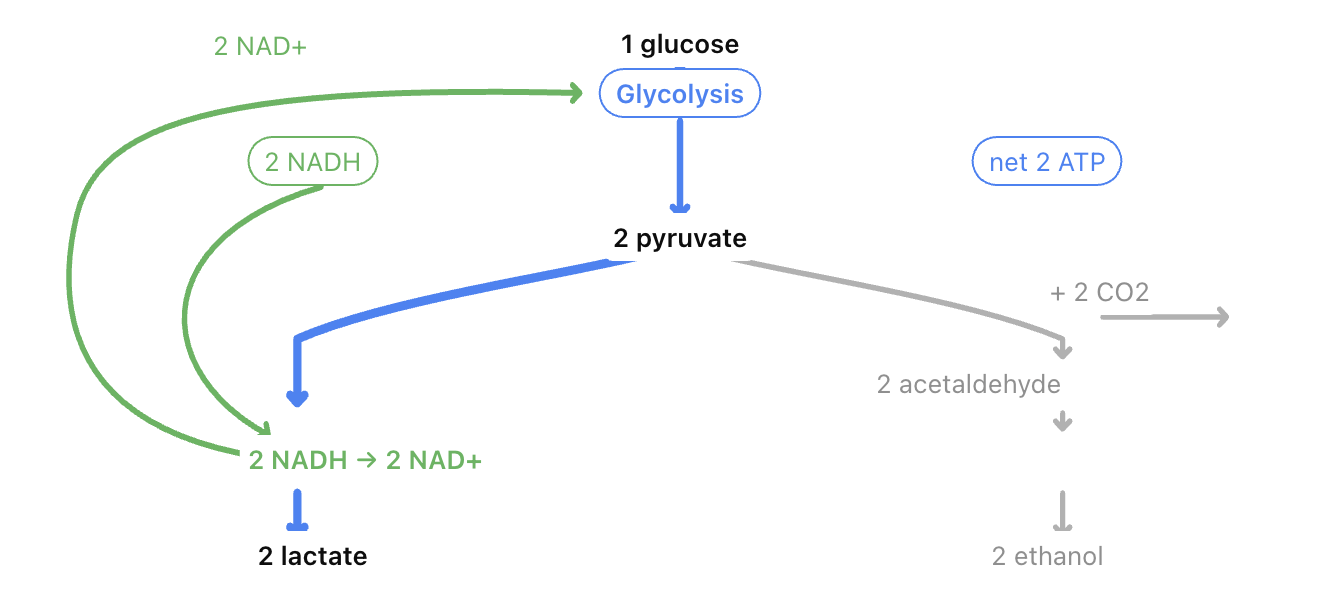
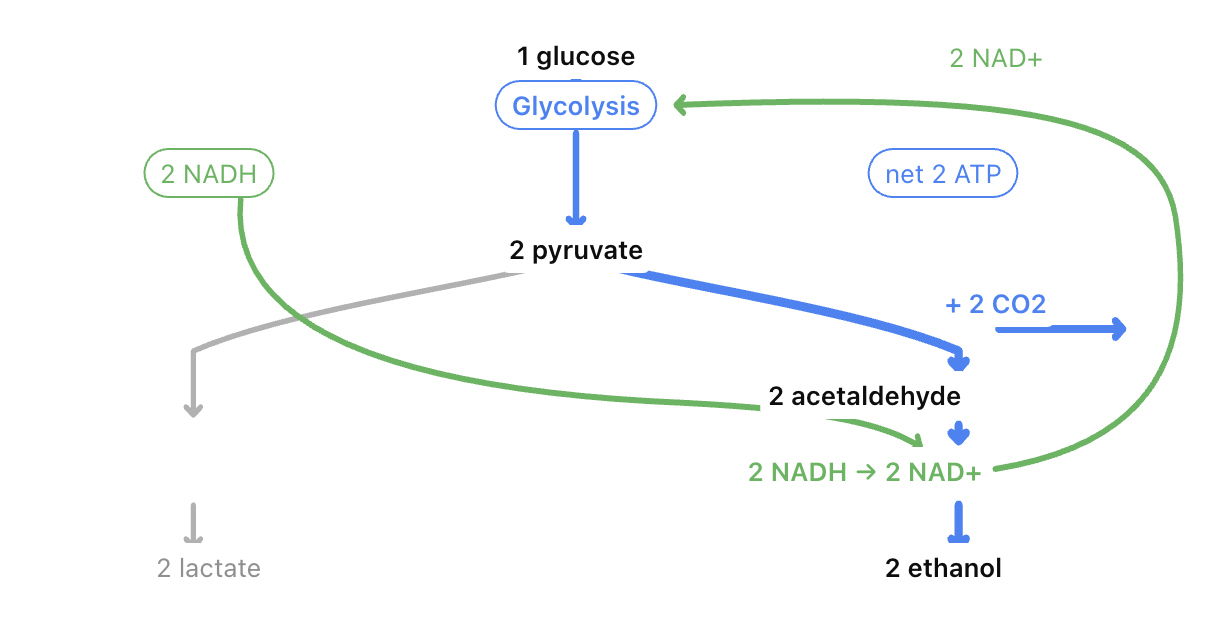
Fermentation is a process that allows cells to continue releasing energy from glucose when oxygen is unavailable or limited.
During fermentation, glucose is first partially broken down through:
glycolysis.
Glycolysis produces a small amount of ATP and molecules that carry high-energy electrons.
Fermentation then regenerates molecules needed for glycolysis to continue.
The overall process releases much less usable energy from glucose than:
aerobic respiration.
Why Do Cells Need Energy?
Living cells require energy for processes such as:
- growth
- movement
- active transport
- reproduction
- protein synthesis
- repair
Cells obtain usable energy through molecules of:
ATP (adenosine triphosphate).
Glucose is an important fuel that cells can break down to produce ATP.
Aerobic Respiration
When oxygen is available, many organisms use:
aerobic respiration.
A simplified word equation is:
glucose + oxygen → carbon dioxide + water + energy
Aerobic respiration releases a relatively large amount of energy from each glucose molecule.
Most stages occur in the:
mitochondria of eukaryotic cells.
What Happens Without Oxygen?
If oxygen is unavailable, aerobic respiration cannot continue normally.
However, some cells and microorganisms can continue producing a small amount of ATP through:
glycolysis followed by fermentation.
This is particularly important for:
- yeast
- certain bacteria
- muscle cells under some conditions
Glycolysis
Fermentation begins with:
glycolysis.
During glycolysis:
glucose → 2 pyruvate
A small amount of ATP is produced.
The net gain is:
2 ATP per glucose molecule.
Glycolysis occurs in the:
cytoplasm.
It does not directly require oxygen.
The Role of NAD+
Glycolysis also requires a molecule called:
NAD+.
During glycolysis, NAD+ accepts electrons and hydrogen and becomes:
NADH.
For glycolysis to continue, cells need to regenerate:
NAD+.
This is one of the main purposes of fermentation.
The Key Purpose of Fermentation
Fermentation allows:
NADH → NAD+
The regenerated NAD+ can return to glycolysis.
This means glycolysis can continue producing a small amount of:
ATP
even when oxygen is unavailable.


2. Food Production
Learning outcomes
- I can describe how microorganisms are used in food production.
- I can identify foods produced using microbes.
- I can explain the role of microorganisms in food preservation.
- I can evaluate the benefits and risks of microbial food production.
- I can connect food biotechnology to everyday life.


 b3KdR3yl1KsErt9yqilelMQVLc?purpose=inline" alt="


3. Industrial Microbiology
Learning outcomes
- I can explain how microorganisms are used in industrial processes.
- I can identify products manufactured using microbes.
- I can describe the role of bioreactors.
- I can explain how microbes contribute to medicine and manufacturing.
- I can evaluate the economic importance of industrial microbiology.


4. Genetic Engineering and Microbes
Learning outcomes
- I can explain how microorganisms are used in genetic engineering.
- I can describe how microbes can produce useful proteins.
- I can identify examples of genetically engineered microorganisms.
- I can explain the production of medicines using biotechnology.
- I can evaluate benefits and concerns associated with genetic engineering.


What Is Genetic Engineering?
Genetic engineering is the deliberate modification of an organism's genetic material using biotechnology.
Scientists can:
- insert genes
- remove genes
- modify genes
- transfer genes between organisms
A gene contains DNA instructions that can be used to produce a particular:
RNA or protein product.
By transferring a useful gene into a microorganism, scientists can sometimes turn that microorganism into a biological factory for producing a desired substance.
Why Use Microorganisms?
Microorganisms such as bacteria and yeast are especially useful in genetic engineering because they:
- reproduce rapidly
- can be grown in large numbers
- require relatively little space
- can be cultured in bioreactors
- are comparatively easy to manipulate genetically
- can produce useful proteins
- can be grown under controlled conditions
Some microorganisms can therefore be engineered to manufacture substances originally produced by:
humans, animals, plants, or other organisms.
DNA Contains Instructions
DNA contains biological information.
A gene is a sequence of DNA that contributes to the production of a functional product, often a protein.
The basic flow of genetic information can be represented as:
DNA → RNA → protein
This relationship is fundamental to genetic engineering.
If scientists place an appropriate gene into a suitable microorganism, the microorganism may be able to use that genetic information to produce the:
desired protein.


Recombinant DNA
Recombinant DNA is DNA created by joining genetic material from different sources.
For example, scientists might combine:
a useful human gene + bacterial DNA
The resulting DNA can be introduced into bacterial cells.
If the system is designed correctly, the bacteria can express the inserted gene.
What Is a Plasmid?
Many bacteria contain small circular pieces of DNA called:
plasmids.
Plasmids are separate from the main bacterial chromosome.
They can replicate inside bacterial cells.
Scientists can modify plasmids and use them as:
vectors.
A vector is a DNA molecule used to carry genetic material into a cell.


Using a Plasmid as a Vector
A simplified genetic-engineering process is:
identify useful gene → prepare plasmid → insert gene into plasmid → introduce recombinant plasmid into bacteria → grow bacteria → bacteria express gene → collect useful product
This process forms the basis of many applications of:
recombinant DNA technology.
Step 1: Identify the Desired Gene
Scientists first determine which gene contains the instructions for the desired product.
For example, if scientists want microorganisms to help produce human insulin, they need genetic information corresponding to:
human insulin production.
The relevant DNA sequence can then be prepared for insertion into a vector.
Step 2: Prepare the Plasmid
A bacterial plasmid can be removed or constructed and then opened at a particular location.
Traditionally, enzymes called:
restriction enzymes
have been used to cut DNA at specific sequences.
These enzymes act like molecular:
scissors.
Restriction Enzymes
A restriction enzyme recognizes a particular DNA sequence and cuts the DNA at or near that sequence.
Different restriction enzymes recognize different:
DNA sequences.
Scientists can use appropriate enzymes to prepare both the desired DNA and plasmid for joining.
Step 3: Join the DNA
Another enzyme called:
DNA ligase
can join pieces of DNA together.
DNA ligase forms bonds in the DNA backbone.
A simplified model is:
plasmid DNA + desired gene → DNA ligase → recombinant plasmid
The recombinant plasmid now contains the new genetic information.


Step 4: Introduce the Plasmid into Bacteria
The recombinant plasmid must enter bacterial cells.
The uptake of external DNA by a bacterial cell is commonly called:
transformation.
Not every bacterial cell successfully takes up the plasmid.
Scientists therefore need methods to identify:
successfully transformed cells.
Step 5: Select the Modified Cells
Plasmids can contain marker genes that help scientists identify cells carrying the desired plasmid.
Cells containing the recombinant DNA can then be:
selected and grown.
Modern biotechnology uses several selection and screening techniques depending on the organism and application.
Step 6: Grow the Microorganisms
Once suitable genetically engineered microorganisms have been obtained, they can be grown in:
bioreactors.
The microorganisms are provided with controlled conditions including:
- nutrients
- appropriate temperature
- suitable pH
- oxygen when required
- mixing
Large microbial populations can then produce substantial amounts of the desired product.
Step 7: Produce the Protein
Inside the genetically engineered cell, the inserted gene can be:
expressed.
Gene expression involves:
DNA → RNA → protein
The microorganism therefore manufactures the protein encoded by the introduced genetic information.
This process can occur repeatedly as the microorganisms grow.
Step 8: Recover the Product
The useful protein must usually be separated from the microbial culture.
Depending on the process, this may involve:
- collecting the culture
- separating cells
- breaking cells open if necessary
- extracting the protein
- purifying the protein
- testing its quality
These stages are part of:
downstream processing.
Producing Human Insulin
One of the best-known applications of genetically engineered microorganisms is the production of:
human insulin.
Insulin is a hormone involved in regulating blood glucose concentration.
Biotechnology allows insulin to be manufactured using genetically engineered microorganisms rather than relying on extraction from animal tissues.


Simplified Insulin Production
A simplified model is:
human insulin genetic sequence identified
↓
DNA introduced into a suitable microbial production system
↓
engineered microorganisms grown
↓
insulin or insulin precursor produced
↓
product recovered
↓
product purified and processed
↓
quality tested
↓
medicine prepared
This is an important example of:
medical biotechnology.
Why Was Recombinant Insulin Important?
Historically, insulin for medical use was obtained from animals such as:
- pigs
- cattle
Recombinant biotechnology made it possible to manufacture human insulin using engineered microorganisms.
Advantages include:
- reliable large-scale production
- high product consistency
- production of human insulin
- reduced dependence on animal tissues
- highly controlled manufacturing
Bacteria and Yeast
Both bacteria and yeast can be useful in genetic engineering.
Bacteria
Advantages include:
- rapid reproduction
- relatively simple cultivation
- well-understood genetics
- plasmids are readily available as vectors
Yeast
Advantages include:
- rapid growth
- ability to perform some protein-processing steps that bacteria cannot
- extensive industrial use
- ability to grow in large fermenters
The best organism depends on the:
protein being produced.
Producing Human Growth Hormone
Genetically engineered microorganisms can also be used in the production of:
human growth hormone.
Growth hormone is a protein involved in growth and metabolism.
Recombinant DNA technology allows the relevant human genetic information to be expressed in microbial production systems.
The protein can then be purified for medical use.
Producing Vaccine Components
Genetically engineered microorganisms can produce proteins from:
pathogens.
These purified proteins can sometimes be used as components of vaccines.
For example, recombinant biotechnology is used in the production of certain:
hepatitis B vaccines.


How Can a Recombinant Vaccine Work?
A simplified process is:
pathogen gene identified → gene inserted into production cells → cells produce pathogen protein → protein purified → vaccine manufactured
The purified protein can act as an:
antigen.
The immune system can learn to recognize the antigen without requiring exposure to the complete disease-causing pathogen.
Producing Enzymes
Genetically engineered microorganisms can also manufacture:
enzymes.
Microbial enzymes are used in:
- food processing
- detergents
- medicine
- textiles
- paper production
- biofuel manufacturing
Genetic engineering can increase how much enzyme a microorganism produces or alter the characteristics of the enzyme.
Chymosin and Cheese
An important example is:
chymosin.
Chymosin is an enzyme used during cheese production to help coagulate milk.
Traditionally, chymosin was obtained from the stomachs of young calves.
Today, genetically engineered microorganisms can manufacture:
recombinant chymosin.
This is a major example of genetic engineering in everyday food production.
How Recombinant Chymosin Is Produced
A simplified process is:
gene for chymosin → inserted into suitable microorganism → microorganism cultured → chymosin produced → enzyme purified → used in cheese manufacturing
The genetically engineered microorganism acts as a:
production system.
The purified enzyme is the useful industrial product.
Genetic Engineering and Industrial Enzymes
Microorganisms can be modified to:
- produce more enzyme
- tolerate industrial conditions
- use different raw materials
- produce enzymes with desirable properties
This can improve industrial:
efficiency.
Genetically Engineered Microorganisms in Agriculture
Microorganisms can also be engineered for agricultural applications.
Potential uses include:
- producing animal-feed enzymes
- supporting nutrient processing
- producing agricultural chemicals biologically
- improving industrial processing of crops
Some applications remain areas of active research and development.
Microorganisms and Biofuels
Scientists can genetically modify microorganisms to improve production of:
biofuels.
For example, microbes may be engineered to:
- break down plant material more efficiently
- tolerate higher concentrations of ethanol
- produce greater quantities of fuel
- use a wider variety of sugars
The goal is to make biological fuel production more:
efficient.
Metabolic Engineering
Genetic engineering can modify an entire metabolic pathway rather than only adding one gene.
This is called:
metabolic engineering.
Scientists alter genes controlling cellular reactions so that more resources are directed toward producing a desired:
chemical.


Microbial Cell Factories
Genetically engineered microorganisms are sometimes described as:
microbial cell factories.
Imagine a bacterium receiving sugar as its raw material.
Through a series of enzyme-controlled reactions, the cell converts the sugar into a useful product.
Scientists can modify these pathways to increase:
product yield.
Genetic Engineering vs Selective Breeding
Selective breeding chooses organisms with desirable existing characteristics and breeds them.
Genetic engineering directly modifies:
DNA.
Genetic engineering can also transfer genetic information between organisms that would not normally reproduce with one another.
This makes genetic engineering fundamentally different from traditional selective breeding.
Genetic Engineering vs Fermentation
These terms describe different things.
Genetic engineering changes genetic information.
Fermentation or microbial cultivation grows microorganisms under controlled conditions.
They are often used together:
genetic engineering creates the production strain → industrial cultivation grows the strain → useful product is manufactured
Benefits of Genetically Engineered Microorganisms
Genetically engineered microorganisms can provide several advantages.
They may:
- manufacture human proteins
- produce medicines at large scale
- produce consistent products
- reproduce rapidly
- require relatively little space
- reduce dependence on animal sources
- manufacture industrial enzymes
- use renewable materials
- be optimized for particular processes
These advantages make microbial biotechnology economically important.
Benefit: Large-Scale Production
Once an appropriate microbial strain has been developed, enormous populations can be grown in:
bioreactors.
Each cell can produce the desired substance.
Billions or trillions of cells working simultaneously can create significant quantities of product.
Benefit: Product Consistency
Industrial production requires:
consistent quality.
A carefully maintained microbial strain can be grown under standardized conditions.
This helps manufacturers control:
- product identity
- purity
- concentration
- performance
Consistency is particularly important for:
medicines.
Benefit: Reduced Dependence on Animals
Some substances that were historically extracted from animal tissues can now be produced using:
recombinant biotechnology.
This can:
- increase supply
- improve consistency
- reduce reliance on animal tissues
- simplify some aspects of purification
Recombinant insulin is a major example.
Benefit: Producing Complex Biological Molecules
Some proteins are difficult to manufacture using ordinary chemical synthesis.
Living cells already contain molecular machinery for:
protein production.
Scientists can use this machinery to manufacture useful biological molecules.
Concern: Containment
Genetically engineered microorganisms used in industry must be:
carefully contained.
Facilities use physical and biological safeguards designed to prevent inappropriate release.
The required level of containment depends on the organism and its characteristics.
Concern: Environmental Effects
A question sometimes raised is:
What would happen if a genetically modified microorganism entered the environment?
Risk depends on factors such as:
- ability to survive outside the facility
- ability to reproduce
- genes it carries
- possibility of gene transfer
- interactions with other organisms
These risks are evaluated before particular applications are approved or used.
Horizontal Gene Transfer
Bacteria can sometimes exchange genetic information through:
horizontal gene transfer.
This raises an important consideration when designing genetically modified microorganisms.
Scientists must consider whether introduced genes could potentially move into other:
microbial populations.
Antibiotic Resistance Marker Genes
Historically, antibiotic resistance genes have often been useful as markers for identifying genetically modified bacteria.
However, their use can raise concerns about:
antimicrobial resistance.
Modern biotechnology can use alternative selection methods in applications where resistance markers are undesirable.
Concern: Safety of the Product
A genetically engineered microorganism may produce a useful substance, but that substance must still be:
tested.
For medicines, manufacturers need to verify properties such as:
- identity
- purity
- biological activity
- sterility
- consistency
- safety
Genetic engineering does not eliminate the need for rigorous:
quality control.
Concern: Unintended Changes
Changing DNA can sometimes produce:
unexpected biological effects.
For example, altering one metabolic pathway may influence another.
Scientists therefore test engineered organisms to determine whether they behave as:
expected.
Concern: Ethical Questions
Genetic engineering can raise ethical questions such as:
- Should particular organisms be genetically modified?
- Who controls genetically engineered technologies?
- Who benefits from the technology?
- How should risks be evaluated?
- How should genetically modified organisms be regulated?
- How should intellectual property be handled?
These questions involve both:
science and society.
Concern: Cost
Developing a genetically engineered production organism can require substantial investment.
Costs may include:
- research
- laboratory equipment
- bioreactors
- testing
- purification
- quality control
- regulatory approval
However, once developed, a successful process may allow efficient:
large-scale production.
Evaluating Genetic Engineering
An evaluation should consider both:
benefits and concerns.
Possible benefits
- production of important medicines
- reliable large-scale manufacturing
- production of useful enzymes
- reduced dependence on animal sources
- more efficient industrial processes
- new biological products
- potential environmental applications
Possible concerns
- environmental release
- gene transfer
- contamination
- unintended biological effects
- ethical concerns
- regulatory challenges
- economic costs
The evidence should be evaluated for the:
specific application rather than assuming every genetic engineering application has identical benefits or risks.
Risk and Benefit Depend on the Application
Consider two engineered microorganisms:
Microorganism A: contained inside a pharmaceutical factory and used to produce insulin.
Microorganism B: deliberately released into an ecosystem.
These applications create very different:
risk profiles.
Therefore, evaluating genetic engineering requires asking:
What organism? What gene? What product? What environment? What containment? What benefit? What risk?
Genetic Engineering and Everyday Life
Microbial genetic engineering may seem like advanced laboratory science, but its products can appear in everyday life.
Examples include:
- recombinant insulin
- some vaccine components
- cheese-making enzymes
- industrial enzymes
- biotechnology-produced food ingredients
The genetically engineered microorganism itself does not necessarily appear in the:
final product.
Often, the microorganism produces a substance that is later purified.
Example: Medicine
Suppose bacteria are genetically engineered to manufacture a human protein.
The process might be:
gene → recombinant microorganism → bioreactor → protein production → purification → testing → medicine
The patient receives the purified:
medicine,
not necessarily the production microorganism.
Example: Cheese
A genetically engineered microorganism produces:
chymosin.
The enzyme is collected and purified.
The chymosin is then used during:
cheese production.
This demonstrates how genetic engineering can indirectly become part of an everyday manufacturing process.
Example: Industrial Enzyme
Scientists engineer a bacterium to produce large quantities of an enzyme that breaks down starch.
The bacteria are grown in:
bioreactors.
The enzyme is recovered and purified.
A manufacturer can then use the enzyme to process:
starch-containing materials.
Worked Example 1
Scientists insert a human gene into a bacterial plasmid.
What has been created?
A form of:
recombinant DNA.
Worked Example 2
What is the purpose of a plasmid during bacterial genetic engineering?
It acts as a:
vector
that carries genetic information into bacterial cells.
Worked Example 3
An enzyme cuts a plasmid at a particular DNA sequence.
What type of enzyme could this be?
A:
restriction enzyme.
Worked Example 4
Which enzyme can join pieces of DNA?
DNA ligase.
It forms bonds in the DNA backbone.
Worked Example 5
A bacterium takes up a recombinant plasmid.
What is this process commonly called?
Transformation.
The bacterium has acquired external genetic material.
Worked Example 6
Engineered microorganisms contain a human gene but produce very little protein.
Scientists want to increase production.
What might they investigate?
They could examine:
- gene expression
- growth conditions
- nutrient supply
- temperature
- pH
- oxygen
- regulatory DNA sequences
Both genetic design and culture conditions affect:
protein yield.
Worked Example 7
Why must a recombinant medicine be purified?
The microbial culture contains many substances besides the desired:
protein.
Purification removes cells, unwanted proteins, and other contaminants so the final medicine meets appropriate standards.
Worked Example 8
A student says genetically engineered bacteria contain only the inserted gene.
Is this correct?
No.
The bacteria still contain their normal genome.
The introduced gene represents only a small addition or modification to their genetic information.
Worked Example 9
Why can genetically engineered microbes produce proteins from another species?
The basic genetic code and mechanisms of gene expression are widely shared among living organisms.
If the gene is placed in an appropriate expression system, the microbial cell can use the genetic instructions to produce the encoded:
protein.
Some proteins require additional processing, so the production organism must be chosen carefully.
Worked Example 10
A company wants to release an engineered bacterium into agricultural soil.
Why would this require a different risk assessment from bacteria kept inside a sealed factory?
Released bacteria could interact with:
- natural microbial communities
- plants
- animals
- ecosystems
Scientists must therefore consider survival, reproduction, gene transfer, and environmental effects.
Comparing Traditional and Recombinant Production
Traditional extraction
Useful substance obtained from:
an organism or biological tissue
Possible limitations:
- limited supply
- variable source material
- difficult extraction
Recombinant microbial production
Useful gene placed into:
production microorganisms
Possible advantages:
- rapid microbial growth
- controlled production
- scalable manufacturing
- consistent production
Possible challenges:
- genetic engineering costs
- purification
- contamination control
- regulatory requirements
Common Mistake: Genetic Engineering Creates Genes From Nothing
Scientists generally work with:
DNA sequences and genetic information.
They may isolate, copy, synthesize, modify, or combine DNA sequences.
The process is based on manipulating genetic information.
Common Mistake: The Plasmid Is the Bacterial Chromosome
A plasmid is usually a small DNA molecule separate from the main:
bacterial chromosome.
Plasmids are useful vectors because they can be manipulated and maintained inside bacteria.
Common Mistake: The Bacterium Becomes Human
Adding a human gene to a bacterium does not make the bacterium:
human.
It remains a bacterium containing additional genetic information.
Common Mistake: Genetically Engineered Microorganisms Are Always in the Final Product
Often the microorganism is simply the:
production system.
The desired protein or chemical is extracted and purified.
The production organism may not be present in the final product.
Common Mistake: All Genetically Engineered Organisms Have the Same Risks
Risk depends on:
- organism
- inserted gene
- environment
- product
- containment
- intended use
Each application must therefore be evaluated:
individually.
Common Mistake: Genetic Engineering and Cloning Are the Same
Genetic engineering modifies genetic material.
Cloning produces genetically identical or nearly genetically identical copies of DNA, cells, or organisms.
The concepts can overlap in biotechnology, but they are:
not the same process.
Check Your Understanding
1. Define genetic engineering.
2. Why are microorganisms useful in genetic engineering?
3. What is a gene?
4. Describe the relationship between DNA, RNA, and proteins.
5. What is recombinant DNA?
6. What is a plasmid?
7. Why are plasmids useful in genetic engineering?
8. What is a vector?
9. What does a restriction enzyme do?
10. What does DNA ligase do?
11. What is bacterial transformation?
12. Why are marker genes useful?
13. What happens when an inserted gene is expressed?
14. Why are engineered microorganisms grown in bioreactors?
15. Give four conditions that may need to be controlled in a bioreactor.
16. Why must useful proteins be purified after microbial production?
17. Describe how genetically engineered microorganisms can be used to produce human insulin.
18. Give two advantages of recombinant insulin production.
19. Why might yeast sometimes be used instead of bacteria?
20. Name two medicines or medical products that can involve recombinant biotechnology.
21. How can genetically engineered microorganisms contribute to vaccine production?
22. What is recombinant chymosin?
23. How is genetic engineering used in industrial enzyme production?
24. How could genetic engineering improve biofuel production?
25. What is metabolic engineering?
26. What is meant by a microbial cell factory?
27. Compare genetic engineering with selective breeding.
28. Explain the difference between genetic engineering and fermentation.
29. Give four benefits of genetically engineered microorganisms.
30. Why can microbial production reduce dependence on animal tissues?
31. Why is containment important?
32. What environmental concerns could arise from releasing genetically engineered microorganisms?
33. What is horizontal gene transfer?
34. Why have antibiotic resistance marker genes raised concerns?
35. Why must recombinant medicines undergo quality control?
36. Why might genetic engineering produce unintended biological effects?
37. Give two ethical questions associated with genetic engineering.
38. Explain why different genetic engineering applications require different risk assessments.
39. Describe one example of microbial genetic engineering that affects everyday life.
40. Evaluate the use of genetically engineered microorganisms by considering both their potential benefits and their possible risks.
Key Terms
- Genetic engineering: Deliberate modification of an organism's genetic material using biotechnology.
- Gene: DNA sequence that contributes to a functional product, often a protein.
- Recombinant DNA: DNA created by combining genetic material from different sources.
- Plasmid: Small DNA molecule found separately from the main bacterial chromosome.
- Vector: DNA molecule used to carry genetic information into a cell.
- Restriction enzyme: Enzyme that cuts DNA at particular sequences.
- DNA ligase: Enzyme that joins pieces of DNA.
- Transformation: Uptake of external genetic material by a cell, particularly bacteria.
- Gene expression: Use of genetic information to produce RNA or protein.
- Recombinant protein: Protein produced using recombinant DNA technology.
- Bioreactor: Controlled vessel used for biological production.
- Insulin: Protein hormone regulating blood glucose.
- Chymosin: Enzyme used in cheese production that can be manufactured using genetically engineered microorganisms.
- Antigen: Substance recognized by the immune system that can trigger a specific immune response.
- Metabolic engineering: Modification of cellular metabolic pathways to increase or alter production.
- Microbial cell factory: Microorganism engineered or selected to manufacture useful products.
- Horizontal gene transfer: Movement of genetic material between organisms other than by parent-to-offspring inheritance.
- Downstream processing: Recovery and purification of a product after biological production.
- Containment: Measures used to prevent organisms or biological materials from escaping controlled conditions.
Key Takeaways
- Genetic engineering involves deliberately modifying genetic material.
- Microorganisms are useful because they reproduce rapidly and can be grown in large numbers.
- A useful gene can be introduced into a microorganism so that the cell produces a desired protein.
- Plasmids are commonly used as vectors in bacterial genetic engineering.
- Restriction enzymes can cut DNA, while DNA ligase can join DNA fragments.
- DNA containing genetic material from different sources is called recombinant DNA.
- Genetically modified bacteria can be identified, selected, and grown in bioreactors.
- The basic relationship DNA → RNA → protein explains how an inserted gene can lead to production of a useful protein.
- Genetically engineered microorganisms can contribute to the manufacture of insulin, growth hormone, vaccine components, enzymes, and other useful substances.
- Recombinant human insulin is a major example of medical biotechnology.
- Yeast as well as bacteria can be genetically engineered for protein production.
- Recombinant chymosin is an example of microbial genetic engineering used in food production.
- Genetic engineering and industrial cultivation often work together: genetic engineering creates the production strain, while cultivation produces large quantities of the desired substance.
- Useful proteins generally require extraction, purification, and quality testing.
- Genetically engineered microorganisms can provide efficient and consistent large-scale production.
- Genetic engineering can reduce dependence on animal-derived materials.
- Potential concerns include environmental release, gene transfer, contamination, unintended effects, cost, and ethical questions.
- Genetically engineered microorganisms must be appropriately contained and monitored.
- Risks and benefits depend on the specific organism, gene, product, environment, and application.
- Microbial genetic engineering connects DNA biology, microbiology, medicine, food production, biotechnology, and industrial manufacturing.
5. Environmental Applications
Learning outcomes
- I can explain how microorganisms help maintain ecosystems.
- I can describe the role of microbes in waste treatment.
- I can explain how bioremediation works.
- I can identify environmental applications of biotechnology.
- I can evaluate the importance of microbes in environmental sustainability.


Microorganisms and the Environment
Microorganisms are found almost everywhere on Earth.
They live in:
- soil
- water
- sediments
- oceans
- plants and animals
- decaying organic matter
- extreme environments
Although most microorganisms are invisible to the naked eye, their activities have enormous effects on:
ecosystems.
Without microorganisms, nutrients would not cycle efficiently, dead material would accumulate, and many ecosystems would be unable to function normally.
Microbes as Ecosystem Workers
Microorganisms perform several essential environmental roles.
They:
- decompose dead organisms
- recycle nutrients
- participate in the carbon cycle
- participate in the nitrogen cycle
- break down wastes
- form relationships with plants
- help maintain soil fertility
- remove some pollutants
- contribute to wastewater treatment
Microorganisms therefore connect the living and nonliving parts of an:
ecosystem.
Decomposition
Decomposition is the breakdown of dead organisms and organic waste into simpler substances.
Bacteria and fungi are important:
decomposers.
They secrete enzymes onto dead material.
These enzymes break large biological molecules into smaller substances that microorganisms can absorb and use.


Why Is Decomposition Important?
Imagine an ecosystem without decomposers.
Dead:
- plants
- animals
- leaves
- microorganisms
- wastes
would continually accumulate.
More importantly, nutrients trapped inside this material would not be efficiently returned to the environment.
Decomposition releases nutrients that can be:
reused by other organisms.
Nutrient Cycling
Matter does not simply flow through an ecosystem once and disappear.
Elements such as:
- carbon
- nitrogen
- phosphorus
- sulfur
are continually:
recycled.
Microorganisms carry out many of the chemical transformations that make this recycling possible.
Microorganisms and the Carbon Cycle
Carbon is found in:
- carbon dioxide
- living organisms
- dead organic matter
- soil
- oceans
- fossil fuels
Microorganisms affect the movement of carbon between these reservoirs.
During decomposition, microbes break down organic compounds.
Through respiration, many release:
carbon dioxide.
Microbial Respiration
Like other organisms, many microorganisms release energy through:
cellular respiration.
A simplified equation for aerobic respiration is:
glucose + oxygen → carbon dioxide + water + energy
The carbon dioxide can return to the atmosphere or water.
Plants and other photosynthetic organisms can then use carbon dioxide during:
photosynthesis.
Microbes and the Nitrogen Cycle
Nitrogen is essential for producing:
- proteins
- DNA
- RNA
Although the atmosphere contains large amounts of nitrogen gas, most organisms cannot use atmospheric nitrogen directly.
Microorganisms perform several crucial transformations in the:
nitrogen cycle.


Nitrogen Fixation
Nitrogen fixation converts atmospheric nitrogen gas into nitrogen-containing compounds that can enter biological systems.
Certain bacteria perform this process.
Some nitrogen-fixing bacteria live freely in soil.
Others form relationships with plants, particularly:
legumes.
Root Nodules
Plants such as:
- peas
- beans
- clover
can contain structures called:
root nodules.
These nodules may contain nitrogen-fixing bacteria.
The bacteria receive nutrients from the plant.
The plant benefits from access to biologically useful nitrogen compounds.
This is an example of a:
mutualistic relationship.
Nitrification
Other soil bacteria carry out:
nitrification.
During nitrification, nitrogen-containing compounds are converted through stages into forms such as:
nitrate ions.
Plants can absorb nitrate ions through their roots and use the nitrogen to manufacture:
- amino acids
- proteins
- nucleic acids
Microorganisms therefore strongly influence:
soil fertility.
Denitrification
Some bacteria carry out:
denitrification.
They convert nitrate compounds into gaseous forms of nitrogen, returning nitrogen to the:
atmosphere.
Nitrogen fixation, nitrification, decomposition, and denitrification together help maintain the nitrogen cycle.
Waste as an Environmental Problem
Human activities produce enormous quantities of:
waste.
Examples include:
- sewage
- food waste
- agricultural waste
- industrial wastewater
- animal waste
- household wastewater
Untreated waste can contain:
- organic matter
- nutrients
- pathogens
- chemicals
- suspended solids
Microorganisms can help treat many types of biological waste.
Wastewater Treatment
Wastewater treatment uses physical, chemical, and biological processes to make wastewater safer before it is discharged or reused.
Microorganisms are particularly important during:
biological treatment.
They consume and break down biodegradable organic substances in the wastewater.


A Simplified Wastewater Treatment Process
A wastewater-treatment system may include:
screening → settling → biological treatment → further clarification → disinfection → treated water
Different treatment facilities use different systems.
Microorganisms are particularly important in the:
biological treatment stage.
Primary Treatment
During primary treatment, physical processes remove larger materials and suspended solids.
Processes may include:
- screening
- sedimentation
- removal of floating materials
Primary treatment removes some waste, but substantial dissolved and suspended organic material can remain.
Microorganisms help deal with this during:
secondary treatment.
Secondary Treatment
Secondary treatment relies heavily on microorganisms.
Bacteria and other microorganisms consume:
biodegradable organic matter.
They use these substances as sources of:
- carbon
- nutrients
- energy
As microbes process the organic material, the amount of biodegradable waste in the water decreases.
Activated Sludge
One common biological wastewater-treatment system is the:
activated sludge process.
Wastewater is mixed with a community of microorganisms.
Air is supplied to provide:
oxygen.
The microorganisms grow and consume organic substances in the wastewater.
The Aeration Tank
An aeration tank contains wastewater and microorganisms.
Air or oxygen is introduced into the tank.
This supports aerobic microorganisms that use organic waste during:
respiration and growth.
A simplified process is:
organic waste + oxygen → microbial activity → simpler products + new microbial biomass
Why Add Oxygen?
Aerobic microorganisms require oxygen for:
aerobic respiration.
Providing oxygen allows them to break down organic material efficiently.
Without sufficient oxygen, the microbial community and treatment process may change significantly.
Settling the Microorganisms
After biological treatment, water may enter a settling tank.
Microbial cells and other particles form:
sludge.
This material settles toward the bottom.
Cleaner water can then be separated from the sludge.
Some activated sludge may be returned to the treatment system to maintain a healthy population of:
microorganisms.
Biological Oxygen Demand
A useful measure of water pollution is:
biochemical oxygen demand (BOD).
BOD is related to the amount of oxygen microorganisms require while breaking down biodegradable organic matter in water under specified conditions.
Water containing large amounts of biodegradable organic material generally has:
higher BOD.
Why Can High BOD Be Harmful?
If untreated organic waste enters a river:
microorganisms decompose waste → microbial respiration increases → dissolved oxygen decreases
Low dissolved oxygen can harm:
- fish
- aquatic invertebrates
- other aerobic organisms
Wastewater treatment reduces biodegradable organic material before water enters natural ecosystems.
Anaerobic Digestion
Some waste is treated using:
anaerobic digestion.
This process occurs without oxygen.
Communities of microorganisms break down organic matter and produce gases including:
methane and carbon dioxide.
The resulting gas mixture is called:
biogas.


What Can Be Treated by Anaerobic Digestion?
Materials can include:
- sewage sludge
- food waste
- animal manure
- agricultural waste
- some industrial organic wastes
Instead of simply disposing of these materials, microorganisms can convert part of their chemical energy into:
useful biogas.
Biogas
Biogas contains a significant proportion of:
methane.
Methane can be burned as a fuel.
Depending on the system, biogas can be used to produce:
- heat
- electricity
- upgraded renewable gas
Anaerobic digestion therefore combines:
waste treatment + energy recovery.
Digestate
After anaerobic digestion, material called:
digestate
remains.
Depending on its composition, treatment, and local regulations, digestate can sometimes be used as a source of nutrients for agriculture.
This illustrates how biotechnology can help turn some waste materials into:
useful resources.
Composting
Microorganisms are also responsible for:
composting.
Composting is the controlled biological decomposition of organic material.
Suitable materials can include:
- leaves
- grass
- plant waste
- food scraps
- agricultural residues
Bacteria and fungi break down this organic matter.


Why Does Compost Become Warm?
Microorganisms release energy during:
respiration.
Some of this energy becomes heat.
In an active compost pile, rapid microbial metabolism can cause the temperature to rise substantially.
Temperature is therefore evidence of intense:
microbial activity.
Conditions for Composting
Efficient composting depends on factors such as:
- moisture
- oxygen
- temperature
- particle size
- carbon-to-nitrogen balance
- microbial activity
Turning compost can increase:
aeration.
This supplies oxygen to aerobic decomposers.
What Is Bioremediation?
Bioremediation is the use of living organisms to remove, transform, or reduce environmental pollutants.
Microorganisms are especially useful because some can metabolize pollutants.
In some cases, microbes can use a pollutant as a source of:
carbon or energy.
How Does Bioremediation Work?
A simplified process is:
pollutant enters environment → suitable microorganisms encounter pollutant → microbial enzymes transform pollutant → less harmful products may form
The exact pathway depends on:
- pollutant
- microorganism
- oxygen availability
- temperature
- pH
- nutrients
- environmental conditions


Oil Pollution
Petroleum contains many:
hydrocarbons.
Some microorganisms can break down certain hydrocarbons.
They may use components of petroleum as:
energy and carbon sources.
This natural microbial activity can contribute to the breakdown of some oil contamination.
Bioremediation of Oil Spills
After an oil spill, naturally occurring hydrocarbon-degrading microorganisms may begin breaking down some oil components.
Environmental conditions may limit their activity.
Scientists may sometimes improve microbial degradation by supplying nutrients or optimizing conditions.
This approach is called:
biostimulation.
Biostimulation
Biostimulation involves changing environmental conditions to encourage microorganisms already present to break down pollutants more effectively.
This might involve adding:
- nutrients
- oxygen
- electron acceptors
The aim is not necessarily to add new microorganisms.
Instead, it helps the existing microbial community perform:
more effectively.
Bioaugmentation
Another approach is:
bioaugmentation.
Bioaugmentation involves introducing selected microorganisms into a contaminated environment.
These microorganisms are chosen because they can help degrade a particular:
pollutant.
Success depends strongly on whether the introduced organisms can survive and function under local environmental conditions.
Biostimulation vs Bioaugmentation
These terms are easy to confuse.
Biostimulation
→ improve conditions for microorganisms already present.
Bioaugmentation
→ introduce selected microorganisms.
Both approaches may be used in:
bioremediation.
Cleaning Contaminated Soil
Microorganisms can be used to treat soil contaminated with some:
- petroleum products
- solvents
- pesticides
- industrial chemicals
Treatment may occur:
in situ — directly at the contaminated location
or
ex situ — after contaminated material has been removed for treatment.
In Situ Bioremediation
In situ means:
in the original location.
For example, contaminated groundwater might be treated by encouraging microorganisms underground to degrade pollutants.
Advantages may include:
- less excavation
- reduced transport of contaminated material
- potentially lower disturbance
However, conditions underground can be difficult to control.
Ex Situ Bioremediation
Ex situ means that contaminated material is:
removed and treated elsewhere.
For example, contaminated soil could be excavated and placed in a controlled treatment system.
This can allow better control of:
- temperature
- moisture
- oxygen
- nutrients
However, excavation and transport can increase cost and disturbance.
Microbes and Heavy Metals
Heavy metals present a different problem.
A microorganism cannot simply:
destroy a chemical element.
However, microorganisms can sometimes change the:
chemical form, mobility, or availability
of metals.
This can help immobilize, concentrate, or recover certain metals.
Bioleaching
Bioleaching uses microorganisms to help release metals from minerals.
Certain microorganisms alter the chemical conditions surrounding ores.
This can help recover metals such as:
copper.
Bioleaching is an example of environmental biotechnology connected with:
mining and resource recovery.


Microbes and Plastic Waste
Scientists are investigating microorganisms and microbial enzymes that can break down certain:
plastics.
Some enzymes can attack particular polymers and break them into smaller molecules.
This is an active area of biotechnology research.
However, microbes are not currently a simple solution to all plastic pollution.
Different plastics have very different:
chemical structures and biodegradability.
Microbes and Pesticides
Some soil microorganisms can transform or degrade certain:
pesticides.
This may reduce the persistence of some chemicals in the environment.
However, degradation depends on:
- chemical structure
- microbial community
- temperature
- moisture
- pH
- oxygen
Some pollutants are much more resistant to microbial degradation than others.
Environmental Biotechnology
Environmental biotechnology uses biological organisms or biological processes to help solve environmental problems.
Applications include:
- wastewater treatment
- composting
- anaerobic digestion
- bioremediation
- bioleaching
- resource recovery
- biofuel production
- environmental monitoring
Microorganisms are central to many of these technologies.
Biosensors
Microorganisms or biological molecules can sometimes be used in:
biosensors.
A biosensor detects a biological or chemical substance and produces a measurable signal.
Environmental biosensors may help detect:
- pollutants
- toxins
- nutrients
- contaminants
This can help scientists monitor environmental:
quality.
Microbes and Agriculture
Microorganisms can support more sustainable agriculture.
Examples include:
- nitrogen-fixing bacteria
- microbes involved in nutrient cycling
- microorganisms associated with plant roots
- biological control organisms
- decomposition of crop residues
These microbes can influence:
soil health and plant growth.


Mycorrhizal Fungi
Mycorrhizae are associations between fungi and plant roots.
The fungus can increase the effective area available for absorbing:
- water
- mineral nutrients
The plant provides the fungus with:
organic carbon compounds.
These relationships can improve plant nutrient acquisition and contribute to healthy ecosystems.
Microorganisms and Soil Fertility
Healthy soil contains enormous microbial communities.
These microorganisms contribute to:
- decomposition
- nutrient recycling
- soil structure
- nitrogen transformations
- interactions with plant roots
Soil is therefore not simply:
dirt.
It is a complex biological ecosystem.
Microbes and the Carbon Cycle
Microorganisms can both release and store carbon.
For example:
decomposition and respiration → carbon dioxide released
while microbial growth can temporarily incorporate carbon into:
biomass.
Microorganisms therefore influence how carbon moves through ecosystems.
Methane-Producing Microorganisms
Some microorganisms called:
methanogens
produce methane under anaerobic conditions.
Methanogens are actually members of the domain:
Archaea.
They occur in environments such as:
- wetlands
- sediments
- digestive systems
- anaerobic digesters
Methane-Consuming Microorganisms
Other microorganisms can consume:
methane.
These are known as:
methanotrophs.
They can reduce the amount of methane reaching the atmosphere from some environments.
Microbial communities can therefore both produce and consume important:
greenhouse gases.
Microorganisms and Sustainability
Environmental sustainability means meeting present needs while protecting the ecological systems and resources needed in the future.
Microorganisms can contribute by:
- recycling nutrients
- treating waste
- reducing some pollution
- producing renewable fuels
- recovering useful resources
- supporting soil fertility
- reducing reliance on some chemical processes
Their environmental importance extends far beyond their small size.
Waste to Resource
A major principle of sustainability is finding ways to convert:
waste into useful resources.
Microorganisms can help achieve this.
For example:
food waste → anaerobic digestion → biogas
plant waste → composting → soil amendment
wastewater → microbial treatment → cleaner water
organic residues → microbial processing → useful chemicals
The Circular Economy
A circular economy aims to keep materials in use for as long as practical and reduce waste.
Microbial biotechnology can contribute by:
- recycling nutrients
- recovering energy
- converting waste materials
- producing biodegradable materials
- recovering valuable compounds
Microorganisms can therefore connect:
waste management and resource production.
Advantages of Environmental Biotechnology
Using microorganisms can offer several advantages.
Microbial processes may:
- operate at moderate temperatures
- use naturally occurring organisms
- break down certain pollutants
- reduce waste
- recover resources
- require less energy than some alternatives
- treat contamination directly at some sites
However, these advantages depend on the particular:
application.
Limitations of Bioremediation
Bioremediation is useful, but it is not a universal solution.
Limitations include:
- some pollutants cannot be biodegraded
- some processes are slow
- temperature may limit microbial activity
- incorrect pH may inhibit microbes
- nutrients may be limited
- oxygen may be unavailable
- toxic pollutant concentrations may kill microbes
- intermediate products may also require treatment
Bioremediation must therefore be carefully:
monitored.
Not Every Pollutant Can Be Destroyed
Microorganisms can transform many organic compounds.
However, they cannot destroy:
elements.
For example, a microbe cannot make lead atoms disappear.
Instead, biotechnology might help:
- immobilize the metal
- change its chemical form
- concentrate it
- assist in recovery
Understanding this distinction is important when evaluating environmental biotechnology.
Natural Processes vs Biotechnology
Microorganisms naturally:
- decompose waste
- cycle nutrients
- transform chemicals
Environmental biotechnology takes advantage of these natural abilities by:
controlling, enhancing, or applying them to specific problems.
Humans are therefore often using biological processes that already occur in ecosystems.
Monitoring Environmental Biotechnology
Environmental applications must be monitored carefully.
Scientists may measure:
- pollutant concentration
- microbial activity
- oxygen concentration
- pH
- temperature
- nutrient concentrations
- breakdown products
The goal is to determine whether treatment is actually:
working.
Evaluating Environmental Impact
A technology should not be considered sustainable simply because it uses:
microorganisms.
A complete evaluation should consider:
- energy use
- water use
- materials required
- waste generated
- effectiveness
- cost
- ecosystem effects
- long-term outcomes
Environmental sustainability requires looking at the:
whole system.
Worked Example 1
Dead leaves fall onto forest soil.
What happens to them?
Bacteria, fungi, and other decomposers break down the organic material.
Nutrients are eventually returned to the:
ecosystem.
Worked Example 2
Untreated sewage containing large amounts of organic material enters a river.
What may happen to dissolved oxygen?
Microorganisms rapidly decompose the organic matter.
Their respiration consumes oxygen.
Therefore:
dissolved oxygen may decrease.
This can harm aquatic organisms.
Worked Example 3
A wastewater-treatment plant pumps air into a tank containing sewage and microorganisms.
Why?
The oxygen supports:
aerobic respiration.
This allows microorganisms to break down biodegradable organic matter efficiently.
Worked Example 4
Food waste is placed inside an oxygen-free digester.
What useful product can microbial activity produce?
Biogas, containing methane.
The methane can be used as an energy source.
Worked Example 5
Oil contaminates coastal soil.
Scientists add nutrients to encourage naturally occurring oil-degrading bacteria.
What technique is being used?
Biostimulation.
The existing microbial population is being encouraged to degrade the pollutant.
Worked Example 6
Scientists introduce selected pollutant-degrading bacteria to contaminated soil.
What technique is being used?
Bioaugmentation.
Additional microorganisms are being introduced.
Worked Example 7
A student suggests using bacteria to completely destroy mercury contamination.
What is wrong with this idea?
Mercury is an:
element.
Microorganisms cannot destroy mercury atoms.
They may be able to change the mercury's chemical form, mobility, or availability.
Worked Example 8
Why can turning a compost pile increase decomposition?
Turning introduces more:
oxygen.
This can increase aerobic microbial activity.
Worked Example 9
Why might bioremediation work slowly during winter?
Low temperatures generally reduce:
enzyme activity and microbial metabolism.
Pollutant degradation may therefore occur more slowly.
Worked Example 10
A company claims its microbial treatment is environmentally sustainable because it uses bacteria.
Is this enough evidence?
No.
Scientists should also evaluate:
- energy consumption
- waste products
- effectiveness
- resources required
- environmental impacts
Sustainability must be evaluated across the whole process.
Comparing Environmental Applications
Wastewater treatment
Purpose: Remove biodegradable organic waste and other contaminants.
Microbial role: Consume and transform waste materials.
Composting
Purpose: Convert organic waste into useful material.
Microbial role: Decompose plant and food material.
Anaerobic digestion
Purpose: Treat organic waste and recover energy.
Microbial role: Break down organic matter without oxygen and ultimately produce methane-rich biogas.
Bioremediation
Purpose: Reduce environmental contamination.
Microbial role: Transform or degrade pollutants.
Bioleaching
Purpose: Recover metals.
Microbial role: Alter minerals and help release metals.
Nutrient cycling
Purpose: Maintain ecosystem function.
Microbial role: Transform and recycle essential elements.
Common Mistake: All Microorganisms Cause Pollution or Disease
Many microorganisms perform environmentally beneficial roles.
Without microbes:
- decomposition would be severely disrupted
- nutrient cycles would be altered
- wastewater treatment would be much more difficult
- many plants would lose important microbial partners
Microorganisms are essential components of healthy:
ecosystems.
Common Mistake: Bioremediation Means Microbes Eat Everything
Microorganisms can degrade only substances for which they have suitable:
metabolic pathways.
Some pollutants are easily degraded.
Others are extremely resistant or cannot be destroyed biologically.
Common Mistake: Bioremediation Removes All Pollution Immediately
Bioremediation can take:
weeks, months, or longer.
Its speed depends on the pollutant and environmental conditions.
Common Mistake: Anaerobic Digestion and Composting Are the Same
They differ significantly.
Composting
usually relies heavily on aerobic decomposition.
Anaerobic digestion
occurs without oxygen and can produce methane-rich biogas.
Common Mistake: Wastewater Treatment Simply Filters Sewage
Physical filtration and settling are important, but microorganisms perform much of the:
biological treatment.
They break down biodegradable organic material that cannot simply be removed by screens.
Common Mistake: Microbes Can Destroy Heavy Metals
Heavy metals are elements.
Microorganisms cannot destroy the atoms.
They can sometimes alter their:
chemical form, mobility, or concentration.
Check Your Understanding
1. Why are microorganisms important in ecosystems?
2. Define decomposition.
3. Name two major groups of microbial decomposers.
4. Why is decomposition important for nutrient cycling?
5. How do microorganisms contribute to the carbon cycle?
6. How do microorganisms contribute to the nitrogen cycle?
7. What is nitrogen fixation?
8. Explain the relationship between nitrogen-fixing bacteria and some plants.
9. What is nitrification?
10. What is denitrification?
11. How do microorganisms contribute to soil fertility?
12. Explain the role of microorganisms in wastewater treatment.
13. What happens during secondary wastewater treatment?
14. What is activated sludge?
15. Why is oxygen supplied to an aeration tank?
16. What is BOD?
17. Explain why high BOD can be harmful to aquatic ecosystems.
18. What is anaerobic digestion?
19. What useful fuel can be produced during anaerobic digestion?
20. How can anaerobic digestion contribute to sustainability?
21. Explain the role of microorganisms in composting.
22. Why can a compost pile become warm?
23. Define bioremediation.
24. How can microorganisms help clean petroleum contamination?
25. What is biostimulation?
26. What is bioaugmentation?
27. Compare in situ and ex situ bioremediation.
28. Why can microorganisms not completely destroy heavy metals?
29. What is bioleaching?
30. How might microbial biotechnology contribute to dealing with some plastic wastes?
31. Give four examples of environmental biotechnology.
32. What is a biosensor?
33. Explain how microorganisms support sustainable agriculture.
34. What is a mycorrhizal relationship?
35. How can microorganisms contribute to a circular economy?
36. Give three advantages of using microorganisms for environmental applications.
37. Give three limitations of bioremediation.
38. Why must environmental biotechnology be monitored?
39. Explain why a process is not automatically sustainable simply because it uses microorganisms.
40. Evaluate the importance of microorganisms to environmental sustainability using examples from nutrient cycling, waste treatment, bioremediation, and resource recovery.
Key Terms
- Environmental microbiology: Study of microorganisms and their activities in natural and human-managed environments.
- Decomposer: Organism that breaks down dead organic material.
- Decomposition: Breakdown of organic matter into simpler substances.
- Nutrient cycle: Movement and recycling of elements through ecosystems.
- Nitrogen fixation: Conversion of atmospheric nitrogen into biologically usable nitrogen compounds.
- Nitrification: Microbial conversion of reduced nitrogen compounds into nitrite and then nitrate.
- Denitrification: Microbial conversion of nitrate into gaseous forms of nitrogen.
- Wastewater treatment: Processes used to remove contaminants from wastewater.
- Activated sludge: Microbial biomass used in aerobic wastewater treatment.
- Aeration: Addition of air or oxygen to a system.
- Biochemical oxygen demand (BOD): Measure related to the oxygen microorganisms require to break down biodegradable organic matter under specified conditions.
- Anaerobic digestion: Microbial breakdown of organic material without oxygen.
- Biogas: Methane-rich gas produced during anaerobic digestion.
- Composting: Controlled biological decomposition of organic material.
- Bioremediation: Use of organisms to remove, transform, or reduce pollutants.
- Biostimulation: Modification of environmental conditions to encourage existing microorganisms to degrade pollutants.
- Bioaugmentation: Addition of selected microorganisms to assist pollutant degradation.
- In situ: Treatment performed at the original contaminated location.
- Ex situ: Treatment performed after contaminated material has been removed.
- Bioleaching: Use of microorganisms to help release metals from ores.
- Biosensor: System using a biological component to detect a substance and produce a measurable signal.
- Mycorrhiza: Association between a fungus and plant roots.
- Sustainability: Use of resources and processes in ways that protect long-term environmental and ecological functioning.
- Circular economy: Approach designed to reduce waste by keeping materials and resources in use.
Key Takeaways
- Microorganisms are essential components of healthy ecosystems.
- Bacteria and fungi decompose dead material and recycle nutrients.
- Microorganisms play major roles in the carbon and nitrogen cycles.
- Nitrogen-fixing bacteria convert atmospheric nitrogen into forms that can enter biological systems.
- Other microorganisms carry out nitrification and denitrification.
- Soil microorganisms contribute strongly to soil fertility and plant growth.
- Microorganisms are essential to many forms of wastewater treatment.
- During biological wastewater treatment, microbes consume biodegradable organic material.
- High levels of organic pollution can increase microbial oxygen demand and reduce dissolved oxygen in natural waters.
- Anaerobic microorganisms can help convert organic waste into biogas.
- Composting relies on microorganisms to recycle organic wastes into useful material.
- Bioremediation uses organisms to remove, transform, or reduce environmental pollutants.
- Microorganisms can help break down some petroleum hydrocarbons and other organic contaminants.
- Biostimulation encourages microorganisms already present, while bioaugmentation introduces selected microorganisms.
- Microorganisms cannot destroy elements such as heavy metals, but they can sometimes change their chemical form or mobility.
- Bioleaching uses microorganisms to help recover metals from ores.
- Environmental biotechnology includes wastewater treatment, bioremediation, composting, anaerobic digestion, resource recovery, and environmental monitoring.
- Microorganisms can contribute to more sustainable agriculture and healthier soils.
- Microbial biotechnology can help transform some wastes into useful resources.
- Biological treatment is not automatically environmentally sustainable; its complete environmental impact must still be evaluated.
- Microorganisms are important to sustainability because they connect waste treatment, nutrient recycling, pollution control, energy recovery, agriculture, and ecosystem health.