Plant Adaptations and Importance
| Сайт: | Young Education |
| Курс: | Plant Biology |
| Книга: | Plant Adaptations and Importance |
| Надруковано: | Người dùng khách |
| Дата: | понеділок 5 жовтня 2026 05:00 AM |
1. Adaptations to Different Environments
Learning outcomes
- I can identify adaptations that help plants survive in different habitats.
- I can compare adaptations of desert, aquatic, and rainforest plants.
- I can explain how plant structures help conserve water or acquire resources.
- I can relate environmental conditions to specific plant adaptations.
- I can evaluate how adaptations improve survival and reproduction.


2. Tropisms and Plant Responses
Learning outcomes
- I can define a tropism as a directional growth response to a stimulus.
- I can distinguish between phototropism, gravitropism, hydrotropism, and thigmotropism.
- I can explain how plants respond to environmental stimuli.
- I can describe the role of hormones in plant growth responses.
- I can predict how plants will respond to different environmental conditions.


Plants Respond to Their Environment
Plants may appear motionless, but they constantly detect and respond to changes in their surroundings.
Plants can respond to:
- light
- gravity
- water
- touch
- temperature
- chemicals
Unlike animals, plants cannot usually move their entire bodies from one location to another.
Instead, they often respond by changing:
the direction or rate of growth
A directional growth response to an environmental stimulus is called a:
tropism
What Is a Stimulus?
A stimulus is a detectable change in the environment that produces a response.
For example:
light from one direction → stimulus
shoot bends toward light → response
Other stimuli include:
- gravity
- moisture
- physical contact
Plants can detect these conditions and adjust their growth accordingly.
What Is a Tropism?
A tropism is a directional growth response of a plant to a stimulus.
The direction of the stimulus determines:
the direction of growth
For example, if light comes from the left, a young shoot may curve toward the:
left
If the light source is moved to the right, new growth can eventually curve toward the:
right
Positive and Negative Tropisms
A tropism can be:
positive
or:
negative
A positive tropism means growth:
toward the stimulus
A negative tropism means growth:
away from the stimulus
For example:
shoot grows toward light → positive phototropism
root grows away from light → negative phototropism
The terms positive and negative do not mean:
good or bad
They describe only the direction of growth.
The Four Major Tropisms
Four important plant tropisms are:
| Tropism | Stimulus | Typical Response |
|---|---|---|
| Phototropism | Light | Shoots grow toward light |
| Gravitropism | Gravity | Roots grow downward |
| Hydrotropism | Water/moisture | Roots grow toward greater moisture |
| Thigmotropism | Touch/contact | Tendrils grow around supports |
A useful way to remember them is:
photo = light
gravi = gravity
hydro = water
thigmo = touch
Phototropism
Phototropism is a directional growth response to:
light
Young shoots usually show:
positive phototropism
This means they grow:
toward light


This response can easily be observed in houseplants placed near windows.
Why Grow Toward Light?
Plants require light for:
photosynthesis
Photosynthesis allows plants to produce glucose.
Therefore, growth toward light can increase:
light absorption
which can improve:
- photosynthesis
- growth
- energy availability
- reproductive success
Positive phototropism is therefore closely connected to a plant's ability to obtain an essential resource.
How Does Phototropism Work?
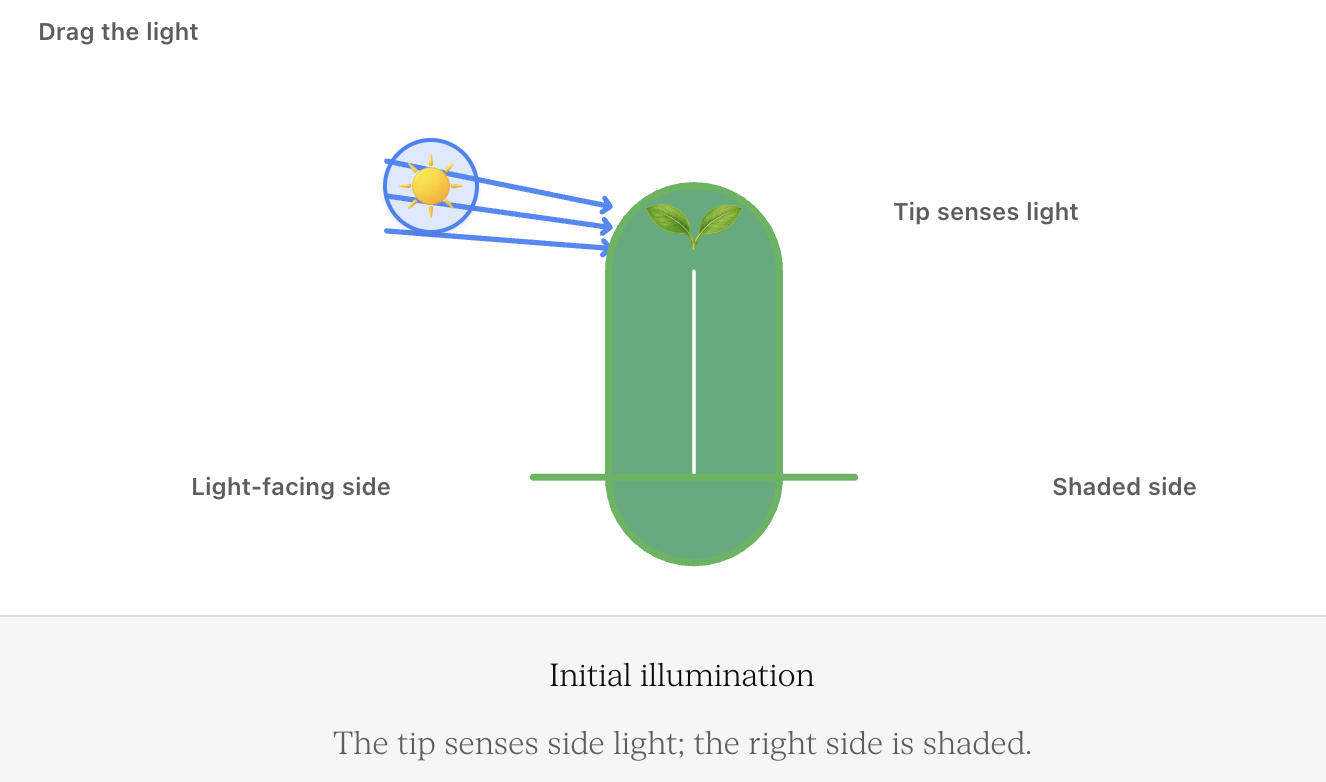
Imagine light reaching a young shoot mainly from one side.
The plant detects the unequal light conditions.
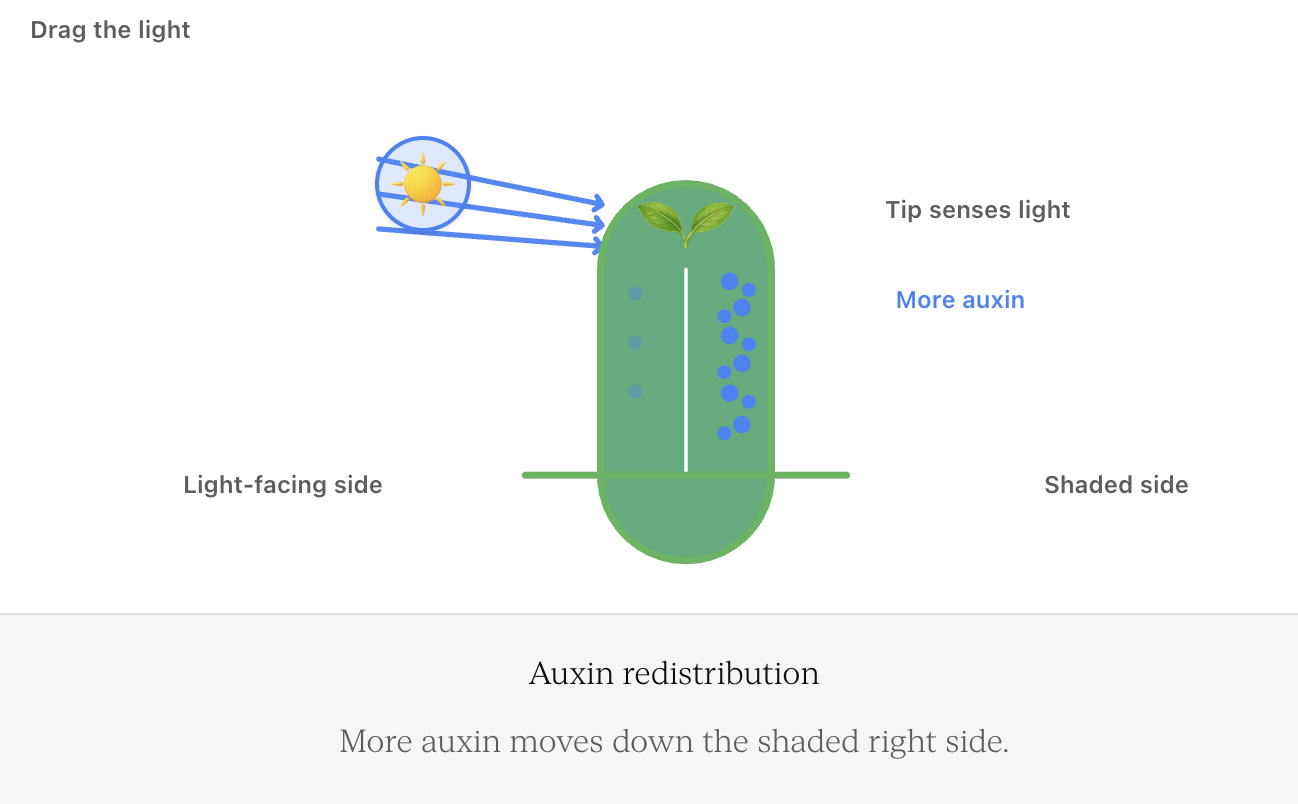
A plant growth hormone called:
auxin
becomes unevenly distributed.
In shoots, more auxin accumulates on the:
shaded side
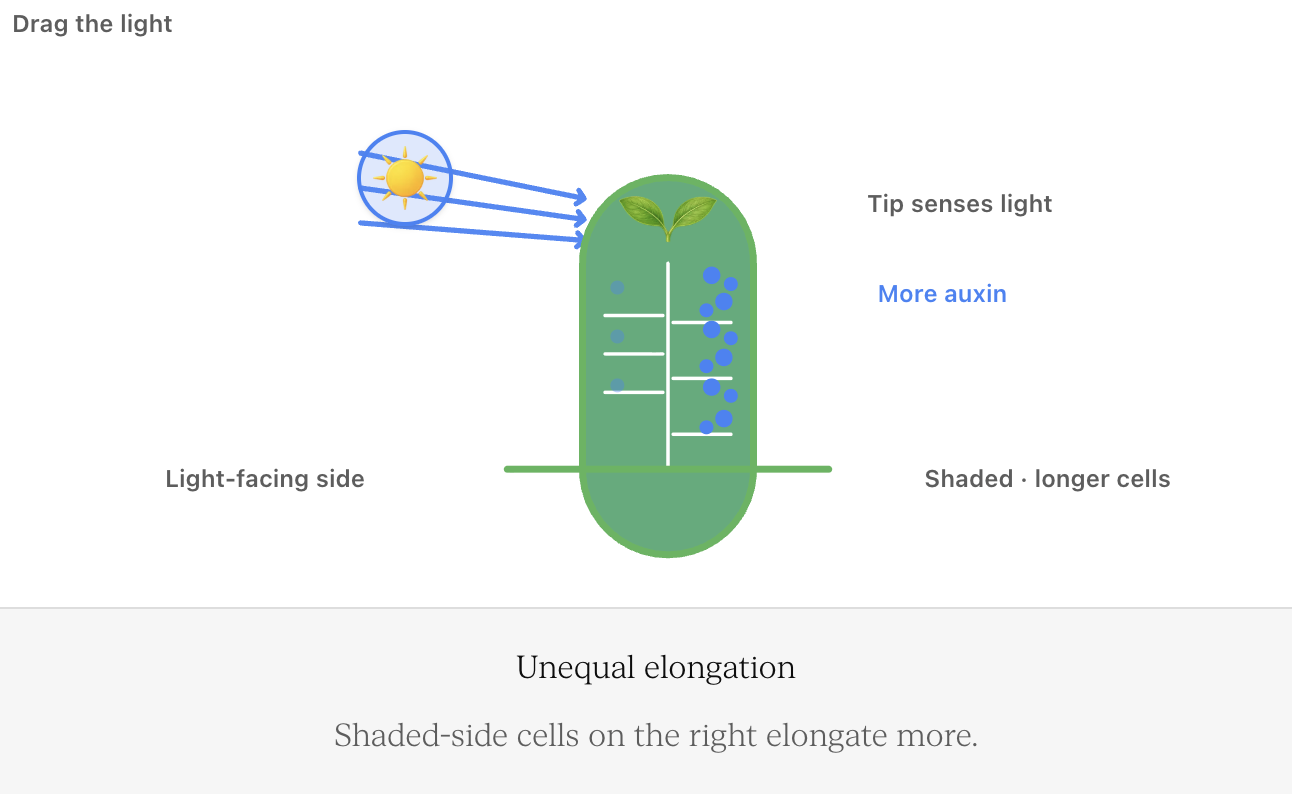
Auxin stimulates cells there to:
elongate more
The shaded side therefore grows faster than the illuminated side.
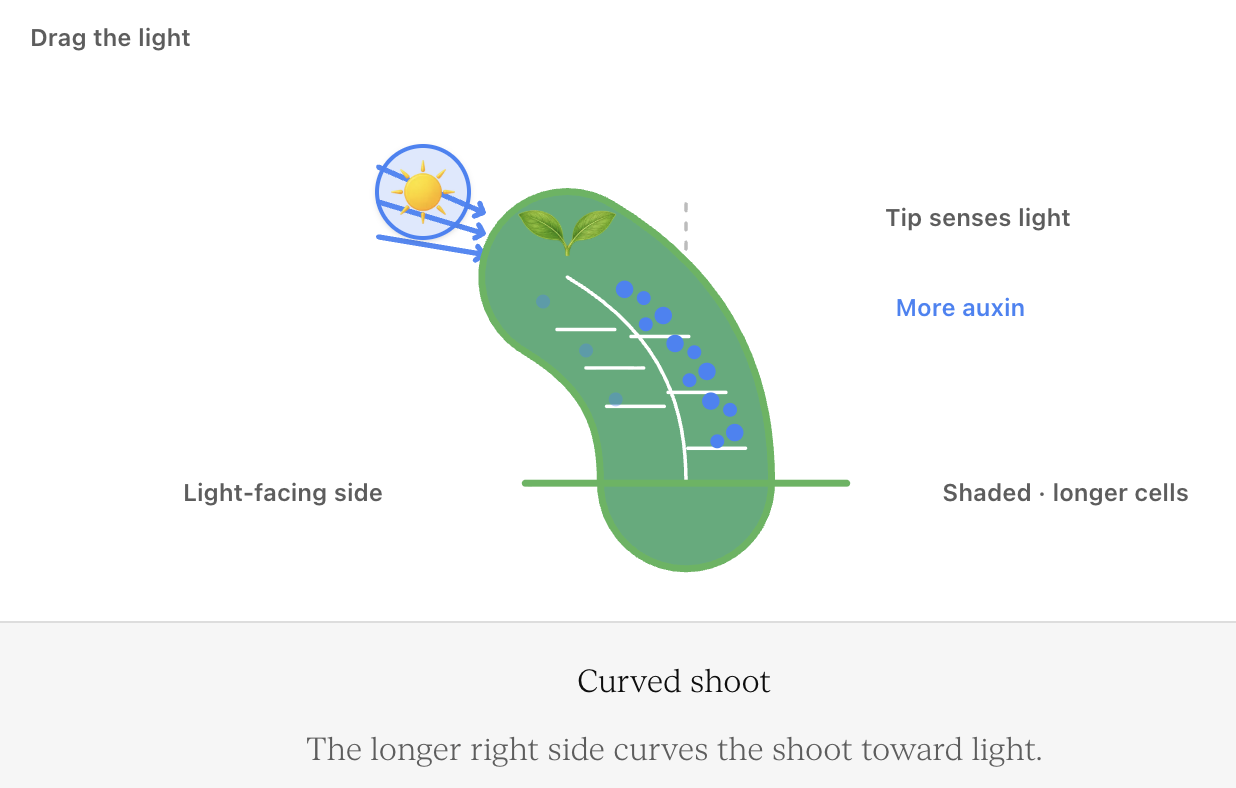
The shoot bends:
toward the light
This visualization shows how one-sided light changes auxin distribution and produces curvature.
Unequal Growth Produces Bending
This is an important idea.
The plant does not bend because light physically pulls it.
Instead:
one side grows faster than the other
Imagine the shoot receiving light from the left:
Light → 🌱
The right side is more shaded.
More auxin accumulates on the right.
Cells on the right elongate more.
Therefore, the shoot curves:
left, toward the light
Auxin
Auxin is an important plant growth regulator.
It is produced mainly in actively growing tissues, including:
shoot tips
Auxin influences:
- cell elongation
- root development
- shoot growth
- tropisms
- apical dominance
- fruit development
In tropisms, auxin helps create:
unequal growth on different sides of an organ
Phototropism Experiment
A simple experiment can demonstrate phototropism.
Place young seedlings inside a box with:
one opening on one side
Light enters through the opening.
After several days, the shoots usually:
bend toward the opening


The direction of the stimulus predicts the direction of the response.
What If Light Comes from Directly Above?
If light reaches both sides of the shoot approximately equally:
auxin distribution remains more balanced
Both sides elongate at similar rates.
Therefore, the shoot grows:
relatively straight upward
There is little reason for sideways curvature.
Gravitropism
Gravitropism, also called geotropism, is a directional growth response to:
gravity
Roots and shoots usually respond differently.
Roots generally show:
positive gravitropism
Shoots generally show:
negative gravitropism


Positive Gravitropism in Roots
Roots generally grow:
in the direction of gravity
This is positive gravitropism.
Growing downward helps roots enter the soil where they can obtain:
- water
- mineral ions
- anchorage
Therefore:
gravity → downward root growth → improved resource acquisition
Negative Gravitropism in Shoots
Shoots generally grow:
against the direction of gravity
This is:
negative gravitropism
Growing upward increases the chance that leaves will reach:
light
This is especially important when a seed germinates underground.
What If a Seed Is Planted Sideways?
Suppose a germinating seed is placed horizontally.
Initially, the root and shoot may point sideways.
Over time:
root curves downward
while:
shoot curves upward


The plant can therefore orient itself even when the seed begins in an unusual position.
How Do Plants Detect Gravity?
Specialized cells contain dense structures called:
statoliths
These can settle toward the lower side of cells under gravity.
This helps the plant determine:
which direction is down
The signal influences hormone distribution and growth.
As with phototropism:
unequal growth → bending
Auxin and Gravitropism
Auxin also contributes to gravitropism.
When a plant is placed horizontally, auxin can become redistributed toward the:
lower side
However, roots and shoots respond differently to auxin concentrations.
In shoots, increased auxin generally promotes:
cell elongation
In roots, higher auxin concentrations can:
inhibit elongation
This difference helps explain why roots and shoots curve in opposite directions.
Shoot Response to Gravity
Consider a horizontal shoot.
More auxin accumulates on the:
lower side
Those cells elongate more.
The lower side becomes longer than the upper side.
Therefore, the shoot bends:
upward
This produces:
negative gravitropism
Root Response to Gravity
Now consider a horizontal root.
Auxin also accumulates more on the:
lower side
But roots are more sensitive to auxin.
Higher auxin concentration reduces elongation on the lower side.
Cells on the upper side elongate more.
Therefore, the root bends:
downward
This produces:
positive gravitropism
Phototropism and Gravitropism Work Together
A young plant may experience several stimuli simultaneously.
A shoot may respond to:
light + gravity
A root may respond to:
gravity + water
Plants therefore integrate information from several environmental conditions.
This allows growth to be directed toward locations that improve:
resource acquisition and survival
Hydrotropism
Hydrotropism is a directional growth response to:
water or moisture
Roots commonly show:
positive hydrotropism
They tend to grow toward areas with greater water availability.


Why Is Hydrotropism Important?
Water is essential for:
- photosynthesis
- transport
- maintaining cell turgor
- enzyme-controlled reactions
- mineral uptake
- cooling through transpiration
A root system that grows toward available water improves the plant's ability to:
acquire this essential resource
Roots Search the Soil
Soil moisture is not always evenly distributed.
One region may be:
dry
while another contains more:
water
Roots can respond to moisture gradients.
Growth toward wetter regions allows the root system to exploit:
patches of available water
This is particularly important during periods of limited rainfall.
Hydrotropism vs Gravitropism
A root can receive more than one signal.
Gravity encourages:
downward growth
Water may encourage:
growth toward moisture
What happens if the wettest soil is not directly below the root?
The final growth direction can result from interactions among:
multiple plant responses
This shows that plant behaviour is more complex than simply "roots always grow downward."
Thigmotropism
Thigmotropism is a directional growth response to:
touch or physical contact
This response is particularly important in:
climbing plants
Examples include:
- peas
- grapevines
- passionflowers
- some cucumbers


Tendrils
A tendril is a thin specialized plant structure used for:
climbing and support
When a tendril touches an object, growth becomes unequal on its different sides.
The tendril begins to:
curve around the object
Continued growth can produce a tightly coiled structure.
Why Is Thigmotropism Useful?
Climbing plants face a challenge.
They need to reach:
light
but producing a thick supportive trunk requires substantial resources.
Instead, some plants use:
other structures for support
A tendril can attach to:
- branches
- stems
- fences
- rocks
- artificial supports
The plant can then climb upward.
Climbing Saves Resources
A climbing plant can invest less material in:
large supportive stems
and use surrounding structures instead.
This can allow rapid growth toward:
better light conditions
Thigmotropism therefore helps plants compete for light while reducing the cost of producing massive support structures.
How Does a Tendril Coil?
When part of a tendril contacts a support, signals cause:
different growth rates on opposite sides
One side elongates differently from the other.
This causes the tendril to:
curve
Continued differential growth produces:
coiling around the support
Once again, the underlying principle is:
unequal growth → directional bending
Comparing the Four Tropisms
| Tropism | Stimulus | Common Plant Organ | Typical Response |
|---|---|---|---|
| Phototropism | Light | Shoot | Toward light |
| Gravitropism | Gravity | Root | Downward |
| Gravitropism | Gravity | Shoot | Upward |
| Hydrotropism | Water | Root | Toward moisture |
| Thigmotropism | Touch | Tendril | Around support |
All four involve:
detecting a stimulus and changing growth direction
Tropisms Are Growth Responses
A key feature of a tropism is:
growth
A tropism is not simply any movement.
For example, a tendril gradually wrapping around a support involves:
differential growth
A shoot bending toward light also involves:
differential growth
These responses generally occur much more slowly than animal movements.
Plants Can Also Move Without Tropisms
Not every plant response is a tropism.
Some plants make relatively rapid movements that are not determined by the direction of the stimulus.
For example, the sensitive plant Mimosa pudica folds its leaves when touched.


This is not the same as thigmotropism because it is not primarily a directional growth response.
Tropism vs Nastic Response
A tropism depends on:
the direction of the stimulus
A nastic response does not depend primarily on the direction from which the stimulus arrives.
For example:
vine growing toward and around a touched support → tropism
Mimosa leaves rapidly closing after touch → nastic response
This distinction helps prevent the common mistake of calling every plant movement a tropism.
Hormones Coordinate Plant Responses
Plants do not have:
- brains
- nerves
- muscles
like animals.
Instead, many plant responses are coordinated using:
chemical signals
called plant hormones or plant growth regulators.
Important plant hormones include:
- auxins
- gibberellins
- cytokinins
- abscisic acid
- ethylene
For tropisms, the most important hormone to understand is:
auxin
Hormones Work at Low Concentrations
Plant hormones are effective in:
very small amounts
They can influence cells in different tissues and regulate:
- growth
- development
- germination
- fruit ripening
- leaf loss
- responses to environmental conditions
A plant's growth is therefore controlled by interactions between:
genes + hormones + environmental signals
Auxin and Cell Elongation
In young shoots, auxin can stimulate cells to:
elongate
If auxin is distributed evenly:
both sides grow similarly
and the shoot remains relatively straight.
If auxin becomes unevenly distributed:
one side grows faster
and the shoot:
bends
This is the central mechanism behind many tropic responses.
Differential Growth
Differential growth means different parts of an organ grow at:
different rates
Consider two sides of a shoot:
Side A grows 2 mm
Side B grows 5 mm
The shoot cannot remain straight.
It curves toward the:
shorter side
This simple idea explains much of plant tropism.
A Useful Model
Think of a flexible strip made of two connected layers.
If both layers increase in length equally:
the strip stays straight
If one layer becomes longer:
the strip bends
A plant organ behaves similarly when cells on one side elongate more than cells on the other.
Predicting Phototropism
Suppose a seedling receives light only from the:
right
What will happen?
The left side is more shaded.
Auxin accumulates more strongly on the shaded side.
Cells there elongate more.
Therefore:
the shoot bends right, toward the light
This is:
positive phototropism
Predicting a Change in Light Direction
Suppose the plant has already bent toward a window.
You rotate the pot 180°.
The light is now coming from the opposite side.
What happens?
New growth begins responding to the new light direction.
Over time:
the shoot curves back toward the window


Predicting Gravitropism
A germinating seed is placed sideways.
Predict the response.
Root:
curves downward.
Shoot:
curves upward.
Therefore:
root = positive gravitropism
shoot = negative gravitropism
This occurs even if the seed itself is positioned horizontally.
Predicting Hydrotropism
Imagine a root growing through soil.
The soil on the left is:
dry
The soil on the right is:
moist
If other factors are suitable, root growth may curve:
toward the right
This demonstrates:
positive hydrotropism
Predicting Thigmotropism
A climbing plant grows beside a thin pole.
A tendril touches the pole.
What happens?
The tendril begins:
curving and coiling around the pole
This anchors the plant and allows it to:
climb
When Stimuli Conflict
Real environments are complicated.
Imagine a root experiencing:
- gravity pulling the normal growth direction downward
- greater water availability toward one side
The plant receives both:
gravitropic and hydrotropic signals
The resulting growth may reflect the interaction between these responses.
Plants constantly integrate:
multiple environmental signals
rather than responding to only one factor.
Tropisms and Resource Acquisition
Tropisms help plants position their structures where resources are available.
Phototropism
helps shoots obtain light.
Gravitropism
helps roots enter soil and shoots grow upward.
Hydrotropism
helps roots locate water.
Thigmotropism
helps climbing plants reach light using external support.
Therefore, tropisms improve:
resource acquisition
Tropisms and Survival
A plant that cannot orient its growth effectively may struggle to survive.
Imagine a seedling whose roots grew upward.
It would have difficulty obtaining:
water and mineral ions
Imagine a shoot that consistently grew away from available light.
It would have difficulty performing:
photosynthesis
Directional growth therefore provides important survival advantages.
Tropisms and Reproduction
Tropisms can also indirectly increase:
reproductive success
A plant that acquires more light, water, and nutrients can potentially produce more:
- flowers
- pollen
- fruits
- seeds
Therefore:
better resource acquisition → improved growth → greater opportunity for reproduction
Tropisms ultimately contribute to the continuation of the species.
Roots and Shoots Have Different Jobs
The opposite responses of roots and shoots make sense when we consider their functions.
Roots need:
- water
- minerals
- anchorage
Therefore they usually grow:
into soil
Shoots need:
- light
- access to air
Therefore they usually grow:
above the soil
Different tropisms coordinate these contrasting needs.
A Germinating Seed Underground
Imagine a seed germinating several centimetres beneath the soil.
The plant initially cannot see where the surface is.
Yet:
root grows downward
and:
shoot grows upward


Gravitropism allows the young plant to orient itself before light becomes a major directional cue.
Once the Shoot Reaches Light
After the shoot emerges above the soil:
phototropism
becomes especially useful.
The shoot can adjust its direction toward:
stronger light
Therefore, different tropisms can become important at different stages of plant development.
Investigating Phototropism
A simple investigation can compare seedlings under different light conditions.
For example:
Group A: light from above
Group B: light from one side
Group C: complete darkness
Keep constant:
- plant species
- age
- water
- temperature
- soil
- investigation time
Measure:
direction and angle of shoot growth
This allows the effect of light direction to be investigated scientifically.
Investigating Gravitropism
Germinating seeds can be placed:
horizontally
Their root and shoot directions can then be recorded over several days.
A student could measure:
- root angle
- shoot angle
- time
- growth length
The predicted result is:
roots curve downward while shoots curve upward
Investigating Hydrotropism
A moisture gradient can be created so that one region around the root is:
wetter
than another.
Root growth direction can then be observed.
Care must be taken because:
gravity also affects root growth
A good investigation therefore needs careful experimental design.
Investigating Thigmotropism
Climbing plants can be grown with:
supports
and compared with plants grown without suitable supports.
Students can observe:
- tendril contact
- beginning of curvature
- coiling
- climbing direction
This provides visible evidence of a plant growth response to:
touch
Measuring Tropisms
Instead of simply saying:
"the plant bent"
scientists can collect quantitative data.
For example:
angle of shoot curvature = 35°
Measurements might include:
- curvature angle
- growth length
- time to respond
- root direction
- number of tendrils attached
Quantitative data make comparisons more precise.
Tropisms in Agriculture
Understanding plant responses has practical applications.
Farmers and horticulturists can manipulate:
- light direction
- plant spacing
- support structures
- irrigation
- plant hormones
to influence plant growth.


For example, climbing crops may be provided with:
trellises
that take advantage of thigmotropism.
Tropisms in Space
Plant tropisms become especially interesting in:
space
On Earth, gravity provides a strong directional signal.
In microgravity, this signal is greatly reduced.
Scientists study plants in space to understand:
- how roots orient
- how shoots grow
- how light influences growth
- how plants might be cultivated during long space missions
Plant responses therefore have applications beyond Earth.
Common Misconception: Plants Move Toward Light
It is more accurate to say:
plants grow toward light
Phototropism is a:
growth response
The plant is not walking or moving its whole body toward the light.
Unequal cell elongation causes the shoot to bend.
Common Misconception: Auxin Moves Toward the Light
During shoot phototropism, auxin becomes concentrated more strongly on the:
shaded side
That side elongates faster.
The shoot therefore bends:
toward the light
Remember:
more auxin on shaded side → more elongation → bending toward light
Common Misconception: Positive Means Beneficial
In tropisms:
positive = toward
negative = away
A negative tropism is not necessarily harmful.
For example:
negative gravitropism in shoots
is extremely useful because it helps shoots grow upward.
Common Misconception: Roots Only Respond to Gravity
Roots can respond to several stimuli, including:
- gravity
- water
- chemicals
- touch
Their final growth direction can reflect:
several interacting signals
Common Misconception: All Plant Movements Are Tropisms
A tropism must be a:
directional growth response
Rapid movements such as the closing of Mimosa leaves are not tropisms.
Likewise, the opening and closing of flowers in response to day-night cycles may involve other types of plant responses.
Common Misconception: Plants Do Not Sense Their Environment
Plants lack animal-like sense organs, but they can detect many environmental signals.
They can respond to:
- light direction
- gravity
- water
- touch
- temperature
- chemicals
Their responses are coordinated through:
cellular signalling and plant hormones
Check Your Understanding
1. Define a tropism.
2. Explain the difference between positive and negative tropisms.
3. A shoot grows toward a window. Name the tropism and state whether it is positive or negative.
4. Why do roots normally show positive gravitropism?
5. Explain how auxin causes a shoot to bend toward light.
6. A germinating seed is placed horizontally. Predict the direction of root and shoot growth.
7. A root encounters wetter soil on one side. Which tropism may affect its growth?
8. Explain how thigmotropism helps a climbing plant compete for light.
9. Why is the rapid closing of Mimosa leaves not considered a tropism?
10. Explain how tropisms can ultimately increase a plant's reproductive success.
Key Terms
- Stimulus: Detectable change in the environment that causes a response.
- Response: Change in an organism resulting from a stimulus.
- Tropism: Directional growth response to a stimulus.
- Positive tropism: Growth toward a stimulus.
- Negative tropism: Growth away from a stimulus.
- Phototropism: Directional growth response to light.
- Gravitropism: Directional growth response to gravity.
- Geotropism: Alternative term for gravitropism.
- Hydrotropism: Directional growth response to water or moisture.
- Thigmotropism: Directional growth response to touch or physical contact.
- Auxin: Plant growth regulator involved in cell elongation and many tropic responses.
- Plant hormone: Chemical signal that influences plant growth, development, or responses.
- Differential growth: Unequal growth rates in different parts of a plant organ.
- Cell elongation: Increase in the length of a cell.
- Tendril: Specialized structure that helps some plants climb.
- Statolith: Dense cellular structure involved in gravity detection.
- Nastic response: Plant response whose direction does not primarily depend on the direction of the stimulus.
- Resource acquisition: Obtaining resources such as light, water, and mineral ions needed for growth and survival.
Key Takeaways
- Plants detect and respond to environmental stimuli.
- A tropism is a directional growth response to a stimulus.
- Positive tropisms involve growth toward a stimulus.
- Negative tropisms involve growth away from a stimulus.
- Phototropism is a response to light.
- Young shoots normally show positive phototropism.
- Gravitropism is a response to gravity.
- Roots normally show positive gravitropism, while shoots show negative gravitropism.
- Hydrotropism is growth in response to water or moisture.
- Roots commonly show positive hydrotropism.
- Thigmotropism is growth in response to physical contact.
- Tendrils use thigmotropism to wrap around supports.
- Auxin is an important plant growth regulator involved in tropic responses.
- Unequal auxin distribution can produce differential cell elongation.
- Differential growth causes plant organs to bend.
- In shoot phototropism, greater elongation on the shaded side bends the shoot toward light.
- Roots and shoots can respond differently to the same hormone signal.
- Plants often respond to several environmental stimuli at the same time.
- Tropisms help plants obtain light, water, minerals, and physical support.
- Not every plant movement is a tropism; tropisms specifically involve directional growth.
- Tropisms improve survival and can ultimately increase reproductive success.
- The central idea is stimulus → detection/signalling → hormone redistribution → differential growth → directional response.
3. Plants in Ecosystems
Learning outcomes
- I can explain the role of plants as producers in ecosystems.
- I can describe how plants contribute energy to food webs.
- I can explain how plants provide habitats for other organisms.
- I can identify interactions between plants and other living things.
- I can analyze the ecological importance of plant communities.


4. Agriculture and Food Production
Learning outcomes
- I can explain the importance of plants in agriculture.
- I can identify factors that affect crop growth and yield.
- I can describe modern farming practices used to increase food production.
- I can explain challenges facing agricultural systems.
- I can evaluate strategies for sustainable food production.


5. Plants and Human Society
Learning outcomes
- I can identify ways plants benefit human society.
- I can describe how plants provide food, medicine, materials, and fuel.
- I can explain the role of plants in regulating Earth's atmosphere.
- I can analyze the impact of human activities on plant populations.
- I can evaluate the importance of plant conservation and biodiversity.


Human Civilization Depends on Plants
Plants are so common that it is easy to underestimate their importance.
Yet almost every human society depends on plants for basic needs.
Plants provide:
- food
- medicines
- clothing fibres
- timber
- paper
- fuels
- building materials
- oils
- rubber
- chemicals
Plants also perform ecological functions that support human life.
They influence:
- atmospheric gases
- climate
- soil
- water cycles
- biodiversity
- food webs
Plants are therefore important not only as individual resources but as components of the:
life-support systems of Earth
Plants as Producers
Plants capture light energy through:
photosynthesis
The overall word equation is:
carbon dioxide + water → glucose + oxygen
Light energy and chlorophyll are required.
Plants convert:
solar energy → chemical energy
This stored chemical energy supports most terrestrial food webs.
Humans therefore depend on plants both:
directly and indirectly
Plants Provide Food
Perhaps the most obvious human use of plants is:
food


Humans consume many different plant structures.
| Plant Structure | Examples |
|---|---|
| Roots | carrot, cassava, sweet potato |
| Stems | asparagus, sugar cane |
| Leaves | spinach, lettuce, cabbage |
| Flowers | broccoli, cauliflower |
| Fruits | apples, tomatoes, peppers |
| Seeds | rice, wheat, beans, nuts |
Different parts of plants therefore contribute to:
human nutrition
Staple Crops
A staple food is a food eaten regularly and providing a significant proportion of dietary energy for a population.
Important plant staples include:
- rice
- wheat
- maize
- potatoes
- cassava
These crops provide large quantities of:
carbohydrates
Other plant foods provide important:
- proteins
- fats
- vitamins
- minerals
- fibre
Plants and Protein
Plants are also important sources of:
protein
Examples include:
- beans
- lentils
- peas
- soybeans
- chickpeas
- nuts
- seeds
Proteins are required for:
- growth
- tissue repair
- enzymes
- hormones
- antibodies
- cellular structures
Plants therefore contribute much more than simply:
carbohydrates
to the human diet.
Plants Feed Livestock
Even when humans eat animal products, plants often remain the original source of much of the energy.
For example:
Sun → maize → chicken → human
or:
Sun → grass → cow → human
Plants therefore contribute indirectly to:
- meat
- milk
- eggs
- other animal products
Agriculture ultimately depends heavily on:
primary production by plants
Plants Provide Medicines
Humans have used plants medicinally for thousands of years.
Many modern medicines have been developed from chemicals originally discovered in:
plants


Plants produce enormous numbers of chemicals as part of their normal metabolism and defense systems.
Some of these chemicals affect:
human physiology
and can be medically useful.
Medicines Derived from Plants
Examples include compounds associated with:
Willow
Compounds in willow bark helped lead to the development of aspirin.
Foxglove
Digitalis compounds have been used in medicines affecting heart function.
Pacific yew
A compound originally isolated from this tree contributed to the development of paclitaxel, an important anticancer drug.
Madagascar periwinkle
Compounds from this plant contributed to medicines used in treating some cancers.
These examples demonstrate an important relationship:
plant biodiversity → chemical diversity → potential medical discoveries
Plants Are Chemical Factories
Plants produce chemicals for many purposes.
Some:
- discourage herbivores
- kill microorganisms
- attract pollinators
- protect tissues
- regulate growth
- communicate chemically
Humans can investigate these compounds for potential applications in:
- medicine
- agriculture
- cosmetics
- manufacturing
A plant species that has never been scientifically studied may contain:
chemically useful compounds
that remain unknown.
Plants Provide Materials
Many everyday materials come directly from plants.
Examples include:
wood
used for construction and furniture.
cotton
used to make textiles.
flax
used to produce linen.
bamboo
used for construction and manufactured products.
natural rubber
obtained from latex produced by rubber trees.


Plants are therefore an important source of:
renewable biological materials
when managed sustainably.
Wood
Wood has been one of humanity's most important materials.
It is used for:
- buildings
- furniture
- tools
- flooring
- packaging
- paper products
Wood contains large amounts of:
cellulose and lignin
which provide strength and structural support.
Trees effectively manufacture this material using:
carbon dioxide + water + sunlight + mineral nutrients
Paper
Paper is produced primarily from plant fibres containing:
cellulose
Wood is a major source.
Other plant fibres can also be used.
Paper demonstrates how plant biological structures can become:
industrial raw materials
Plant Fibres
Plant fibres are useful because cellulose can form:
strong structural fibres
Cotton fibres are almost entirely cellulose.
They can be spun into threads and woven into:
fabric


Humans have used plant fibres for clothing, ropes, baskets, and other products for thousands of years.
Plants Provide Oils
Plants produce oils that humans use for:
- cooking
- food processing
- cosmetics
- soaps
- industrial products
- fuels
Examples include:
- olive oil
- sunflower oil
- soybean oil
- canola oil
- coconut oil
Many oils are stored in:
seeds or fruits
where they provide energy for developing embryos.
Plants as Fuel
Plants can also provide:
energy
Traditional plant fuels include:
- wood
- charcoal
- crop residues
Plants can also be processed into:
biofuels
such as ethanol and biodiesel.


Biofuels
Biofuels are fuels produced from:
recently living biological material
For example, sugars from:
- sugar cane
- maize
can be fermented to produce:
ethanol
Plant oils can also be processed into fuels.
However, biofuel production involves important trade-offs.
Biofuel Trade-Offs
Potential advantages include:
- renewable biological source
- potential reduction in dependence on fossil fuels
- crops can be regrown
Potential concerns include:
- agricultural land requirements
- water use
- fertilizer use
- competition with food production
- habitat conversion
- energy required for cultivation and processing
Therefore, whether a particular biofuel system is sustainable depends on:
how and where it is produced
Plants Regulate Atmospheric Gases
Plants interact continuously with Earth's atmosphere.
During photosynthesis they absorb:
carbon dioxide
and release:
oxygen


Plants therefore play major roles in both the:
carbon cycle
and:
oxygen cycle
Plants and Oxygen
Most organisms require oxygen for:
aerobic respiration
Photosynthetic organisms have transformed Earth's atmosphere over geological time.
Today, terrestrial plants contribute to global oxygen production, alongside major contributions from aquatic photosynthetic organisms such as:
phytoplankton and algae
It is therefore more accurate to say:
photosynthetic organisms collectively maintain atmospheric oxygen
rather than attributing this role to forests alone.
Plants and Carbon Dioxide
During photosynthesis:
CO₂ is removed from the atmosphere
The carbon becomes incorporated into organic molecules.
These molecules may become part of:
- leaves
- roots
- stems
- fruits
- seeds
- wood
Carbon can therefore be stored in:
plant biomass
Carbon Storage
Long-lived plants, especially trees, can store carbon for long periods.
Forests also influence carbon stored in:
soil


Carbon storage in ecosystems is often called:
carbon sequestration
When forests are removed or burned, some stored carbon may return to the atmosphere.
Plants Also Respire
A common misconception is that plants only:
take in carbon dioxide and release oxygen
Plants also perform:
cellular respiration
During respiration:
glucose + oxygen → carbon dioxide + water + energy
Plants respire:
day and night
During daylight, photosynthesis may occur at a greater rate than respiration, resulting in net uptake of carbon dioxide and net release of oxygen.
Plants and Climate
Plant communities influence climate in several ways.
They can affect:
- carbon storage
- evaporation and transpiration
- surface temperature
- humidity
- water movement
- reflectivity of Earth's surface
Forests can therefore interact with both:
regional and global climate systems
Transpiration and the Atmosphere
Plants absorb water through their roots.
Water travels through:
xylem
and eventually leaves the leaves through:
stomata
as water vapour.
This process is:
transpiration
Large areas of vegetation can transfer substantial quantities of water into the atmosphere.


Vegetation therefore plays an important role in the:
water cycle
Plants Protect Soil
Roots help hold:
soil particles together
Vegetation can also:
- reduce the impact of rainfall
- slow surface runoff
- reduce wind speed near the ground
This can reduce:
soil erosion
Healthy plant communities therefore help protect the soil resources on which agriculture and natural ecosystems depend.
Plants and Water Quality
Vegetation can influence water moving across landscapes.
Plant-covered areas may:
- slow runoff
- trap sediments
- absorb some nutrients
- stabilize riverbanks
Wetland plants are particularly important in:
water movement and nutrient cycling
Plants therefore connect terrestrial ecosystems with:
freshwater systems
Plants Improve Human Environments
Plants are also important in towns and cities.
Urban vegetation can provide:
- shade
- cooling
- habitat
- recreation
- visual benefits
- reduced erosion
- some filtering of airborne particles


Trees can reduce surface temperatures by providing:
shade
and through:
evapotranspiration
Human Activities Affect Plants
Humans depend heavily on plants, but human activities can also dramatically alter plant populations.
Important pressures include:
- deforestation
- habitat destruction
- agriculture
- urbanization
- pollution
- invasive species
- overharvesting
- climate change
These pressures can change both:
plant abundance and plant diversity
Deforestation
Deforestation is the large-scale removal of forests.
Forests may be cleared for:
- agriculture
- timber
- roads
- settlements
- mining
- infrastructure


Deforestation can have effects far beyond the removal of trees.
Consequences of Deforestation
Potential consequences include:
- habitat loss
- reduced biodiversity
- increased soil erosion
- altered water cycling
- reduced carbon storage
- fragmentation of populations
Animals, fungi, microorganisms, and other plants may all depend on the forest habitat.
Removing vegetation can therefore affect:
entire ecological communities
Habitat Fragmentation
Sometimes habitat is not completely destroyed.
Instead, a large habitat becomes divided into smaller isolated areas.
This is called:
habitat fragmentation
For example:
continuous forest → roads and farms → isolated forest patches


Fragmentation can make it harder for populations to:
- disperse
- reproduce with distant populations
- maintain genetic diversity
- respond to environmental change
Urbanization
Cities and infrastructure replace natural vegetation with:
- buildings
- roads
- parking areas
- industrial areas
This can reduce:
natural plant habitat
Urban development can also divide remaining habitats into isolated fragments.
However, thoughtful urban planning can retain:
- parks
- native vegetation
- green corridors
- wetlands
- urban forests
Agriculture and Plant Populations
Agriculture is necessary for human food production, but converting natural ecosystems to farmland can reduce:
native vegetation
Large-scale monocultures may replace diverse plant communities with:
one or a few crop species
This can reduce local biodiversity.
Sustainable land management therefore attempts to balance:
food production and ecosystem protection
Pollution
Plants can be affected by pollutants in:
- air
- water
- soil
Pollution can:
- damage leaves
- interfere with photosynthesis
- alter soil chemistry
- affect roots
- change nutrient availability
Pollutants may also affect animals and microorganisms that plants depend upon for:
pollination, decomposition, and nutrient cycling
Climate Change
Changes in climate can alter:
- temperature
- rainfall
- drought frequency
- growing seasons
- wildfire patterns
- species distributions


Plant populations adapted to particular environmental conditions may struggle if those conditions change rapidly.
Changing Flowering Times
Temperature and seasonal conditions influence:
flowering
If plants flower earlier or later because of changing climate conditions, their timing may no longer match perfectly with:
pollinator activity
Changes in one species can therefore affect:
interactions with other species
Invasive Species
Humans transport organisms around the world.
Some introduced plants become:
invasive species
They may:
- spread rapidly
- compete with native plants
- alter habitats
- change nutrient cycling
- affect food webs
Not every non-native species is invasive.
The term is used when an introduced species spreads and causes significant:
ecological or other harm
Overharvesting
Wild plants may be collected for:
- timber
- medicine
- food
- ornamental trade
- fuel
If plants are removed faster than populations can reproduce:
population size declines
Sustainable harvesting requires the rate of use to remain compatible with:
population recovery
Biodiversity
Biodiversity means the variety of life.
It can be considered at several levels:
Genetic diversity
variation within a species.
Species diversity
variety of species.
Ecosystem diversity
variety of ecosystems and habitats.
Plant conservation involves protecting:
all three levels
Why Does Plant Biodiversity Matter?
Different plant species provide different:
- foods
- habitats
- chemicals
- ecological functions
- genetic characteristics


Losing plant species can therefore mean losing:
ecological functions and potential human resources
that may be difficult or impossible to replace.
Genetic Diversity
Imagine an agricultural crop in which every plant is genetically very similar.
A disease capable of infecting one plant may potentially infect:
many of them
Greater genetic diversity can increase the chance that some individuals possess:
resistance
Genetic diversity is therefore valuable for both:
natural ecosystems and agriculture
Wild Relatives of Crops
Modern crops have wild relatives.
These wild populations may contain useful genes for characteristics such as:
- disease resistance
- drought tolerance
- heat tolerance
- salt tolerance
- pest resistance
Plant breeders can potentially use this genetic diversity to improve:
future crop varieties
Protecting wild plant diversity therefore contributes to:
future food security
Unknown Future Uses
Humans do not know every potential use of every plant species.
A species currently considered economically unimportant may contain:
- useful medicines
- valuable genes
- industrial chemicals
- ecological functions
If the species becomes extinct before being studied:
those possibilities disappear
This is one reason conservation can have value even when the immediate economic benefit is unknown.
Extinction
Extinction occurs when the final individual of a species dies.
Extinction is:
permanent
Once a species disappears, its unique genetic information is lost from Earth's living biodiversity.
Natural extinction occurs, but human activities can increase extinction risk by changing environments:
faster than some populations can respond
Plant Conservation
Conservation involves protecting and managing biodiversity and natural resources.
Plant conservation can occur:
in natural habitats
or:
outside natural habitats
These approaches are called:
in situ conservation
and:
ex situ conservation
In Situ Conservation
In situ conservation protects species within their natural habitats.
Examples include:
- national parks
- nature reserves
- protected forests
- protected wetlands
- habitat restoration


A major advantage is that species remain within their:
ecological communities
where natural interactions can continue.
Ex Situ Conservation
Ex situ conservation protects organisms outside their original habitats.
Examples include:
- botanical gardens
- seed banks
- tissue culture collections
- living plant collections
These approaches can provide additional protection when wild populations are:
small or threatened
Seed Banks
A seed bank stores seeds under controlled conditions.


Low temperatures and carefully controlled moisture can allow seeds of many species to remain viable for long periods.
Seed banks can preserve:
genetic diversity
for future research, conservation, and crop breeding.
Botanical Gardens
Botanical gardens can maintain living collections of:
plant species
They can contribute to:
- conservation
- research
- education
- propagation
- public awareness
They are particularly useful for plants whose seeds are difficult to store conventionally.
Habitat Restoration
Conservation does not always mean protecting untouched habitats.
Damaged ecosystems can sometimes be:
restored
Restoration may involve:
- replanting native species
- removing invasive species
- restoring wetlands
- stabilizing soil
- reconnecting fragmented habitats


The goal is to rebuild:
ecological processes and functioning communities
rather than simply planting as many trees as possible.
Reforestation
Reforestation involves restoring trees to previously forested land.
Potential benefits include:
- habitat creation
- carbon storage
- soil protection
- improved water regulation
However, planting trees does not automatically recreate:
a natural forest ecosystem
A diverse native forest may contain hundreds of interacting species.
A plantation containing one tree species is ecologically very different.
Conservation Is More Than Saving Individual Species
Species exist within:
networks of interactions
A plant may depend on:
- pollinators
- seed dispersers
- fungi
- soil microorganisms
Other organisms may depend on that plant.
Effective conservation therefore often requires protecting:
habitats and ecological relationships
not simply individual organisms.
Ecosystem Services
Benefits humans obtain from functioning ecosystems are often called:
ecosystem services
Plants contribute to services involving:
- food production
- carbon storage
- water regulation
- soil protection
- habitat creation
- recreation
- raw materials
This concept emphasizes that healthy ecosystems have:
practical importance for human societies
Plants Have More Than Economic Value
The importance of plants cannot always be measured in money.
Plants may also have:
- cultural importance
- spiritual importance
- historical significance
- recreational value
- aesthetic value
Forests, gardens, and culturally significant plants can form important parts of:
human identity and heritage
Evaluating Conservation
Suppose an area of natural forest could be converted into farmland.
A complete evaluation should consider:
Potential agricultural benefits
- food production
- employment
- income
and:
Potential ecological costs
- habitat loss
- biodiversity decline
- carbon release
- soil degradation
- altered water cycling
A strong evaluation considers:
multiple consequences + different timescales + possible alternatives
rather than focusing on only one effect.
Sustainable Use
Conservation does not always require:
never using natural resources
Resources can sometimes be harvested sustainably.
Sustainable use means using a resource at a rate and in a manner that allows it to remain available over the long term.
For forests, this might involve:
- controlled harvesting
- protecting sensitive habitats
- allowing regeneration
- maintaining species diversity
- monitoring populations
The Tragedy of Short-Term Thinking
Imagine a forest that can sustainably provide a certain amount of timber each year.
Harvesting much more might produce:
greater short-term profit
but could eventually reduce the forest's ability to regenerate.
Then:
future timber supply decreases
along with other ecological benefits.
Sustainability therefore requires considering:
future consequences
as well as immediate benefits.
Plants and Human Well-Being
Plants contribute to human well-being in ways that extend beyond physical resources.
Green spaces provide opportunities for:
- recreation
- exercise
- relaxation
- social activities
- contact with nature
Urban trees can also make cities:
cooler and more comfortable
Human society therefore benefits from plants at:
ecological, economic, practical, and cultural levels
One Plant, Many Benefits
Consider a single mature tree.
It may:
- capture carbon dioxide
- produce oxygen through photosynthesis
- provide shade
- store carbon
- stabilize soil
- intercept rainfall
- provide animal habitat
- produce fruits or seeds
- contribute organic matter to soil
- provide wood
- have cultural or recreational value
A plant can therefore provide:
many benefits simultaneously
Plants Connect Human Society to Ecosystems
Modern technology can sometimes make humans appear separated from nature.
But consider the origins of:
food → plants
cotton clothing → plants
paper → plants
timber → plants
many medicines → plant compounds
oxygen and carbon cycles → photosynthetic organisms
Human societies remain deeply connected to:
biological systems
A Systems View
Plants connect many parts of Earth systems.
Sunlight
↓
photosynthesis
↓
plant biomass
↓
food + materials + fuels
At the same time:
plants ↔ atmosphere
plants ↔ soil
plants ↔ water
plants ↔ animals
plants ↔ microorganisms
plants ↔ humans
Understanding plants therefore requires thinking in terms of:
interconnected systems
Common Misconception: Humans Only Need Plants for Food
Plants also provide:
- medicines
- fibres
- timber
- fuels
- habitat
- carbon storage
- soil protection
- water regulation
Their contribution to human society extends far beyond:
agriculture
Common Misconception: Forests Produce All of Earth's Oxygen
Forests are important photosynthetic ecosystems, but aquatic photosynthetic organisms such as:
phytoplankton
also make major contributions to global oxygen production.
Earth's atmospheric oxygen is maintained by the combined activity of:
photosynthetic organisms and long-term biogeochemical processes
Common Misconception: Planting Any Tree Anywhere Is Conservation
Successful conservation requires considering:
- native species
- habitat suitability
- biodiversity
- ecological interactions
- long-term survival
Planting a single non-native species repeatedly is not equivalent to restoring:
a diverse natural ecosystem
Common Misconception: Conservation Means Humans Cannot Use Plants
Conservation often involves:
sustainable management
rather than complete exclusion of human use.
The central question is whether resources are used in ways that maintain:
populations, biodiversity, and ecosystem function over time
Common Misconception: One Species Does Not Matter
Species are connected through:
food webs and ecological interactions
Removing one plant species can affect:
- herbivores
- pollinators
- seed dispersers
- competitors
- microorganisms
The importance of a species depends partly on:
its relationships within the ecosystem
Check Your Understanding
1. Identify four different ways plants benefit human society.
2. Explain how humans depend indirectly on plants when eating animal products.
3. Give two examples of useful materials obtained from plants.
4. Explain why plant biodiversity may be important for discovering future medicines.
5. Describe how plants influence atmospheric carbon dioxide.
6. Explain why plants are important in the water cycle.
7. Describe two ways human activities can reduce plant biodiversity.
8. Explain the difference between in situ and ex situ conservation.
9. Why might protecting wild relatives of crop plants be important for future agriculture?
10. Evaluate why conserving a natural forest may provide benefits beyond simply protecting the trees themselves.
Key Terms
- Photosynthesis: Process by which plants use light energy to produce glucose from carbon dioxide and water.
- Staple food: Food eaten regularly that provides a major portion of dietary energy.
- Medicinal plant: Plant containing substances used or investigated for medical purposes.
- Plant fibre: Structural material obtained from plants, often rich in cellulose.
- Biofuel: Fuel produced from recently living biological material.
- Biomass: Biological material making up living or recently living organisms.
- Carbon sequestration: Capture and storage of carbon in organisms, soils, or other reservoirs.
- Transpiration: Loss of water vapour from plant surfaces, mainly through stomata.
- Deforestation: Large-scale removal of forest vegetation.
- Habitat fragmentation: Division of a continuous habitat into smaller separated areas.
- Biodiversity: Variety of life at genetic, species, and ecosystem levels.
- Genetic diversity: Genetic variation among individuals within a population or species.
- Extinction: Permanent disappearance of a species.
- Conservation: Protection and management of biodiversity and natural resources.
- In situ conservation: Conservation of species within their natural habitats.
- Ex situ conservation: Conservation outside a species' natural habitat.
- Seed bank: Facility that stores seeds to preserve plant genetic diversity.
- Habitat restoration: Process of helping damaged ecosystems recover.
- Reforestation: Re-establishment of trees on previously forested land.
- Ecosystem service: Benefit humans obtain from functioning ecosystems.
- Sustainable use: Use of resources in ways that maintain their availability and ecological function over time.
Key Takeaways
- Human societies depend heavily on plants for food, medicine, materials, fibres, oils, fuels, and many other products.
- Plants form the energetic foundation of most terrestrial food systems.
- Plants provide important compounds used in medicine, and unexplored plant diversity may contain future useful substances.
- Timber, paper, cotton, flax, bamboo, rubber, and plant oils are important biological materials.
- Plants can provide renewable fuels, although biofuel production involves environmental and economic trade-offs.
- Photosynthesis removes carbon dioxide from the atmosphere and releases oxygen.
- Plants also respire, so their overall effect depends on the balance between photosynthesis, respiration, growth, decomposition, and disturbance.
- Plants store carbon in biomass and contribute to carbon storage in soils.
- Vegetation influences the water cycle through transpiration.
- Plants protect soil, influence water movement, create habitats, and modify local environments.
- Human activities can reduce plant populations through habitat destruction, deforestation, pollution, overharvesting, invasive species, and climate change.
- Habitat fragmentation can isolate plant populations and reduce ecological connectivity.
- Biodiversity includes genetic, species, and ecosystem diversity.
- Plant biodiversity is important for ecosystem functioning, agriculture, medicine, materials, and future scientific discoveries.
- Wild relatives of crops can contain useful genetic characteristics for future plant breeding.
- In situ conservation protects plants within natural ecosystems.
- Ex situ conservation includes seed banks, botanical gardens, and other collections.
- Conservation should protect ecological relationships as well as individual species.
- Restoring a diverse native ecosystem is different from simply planting large numbers of trees.
- Sustainable resource use considers both present human needs and the ability of ecosystems to function in the future.
- Plants have ecological, economic, cultural, recreational, and scientific value.
- Human society is not separate from plant ecosystems; it remains fundamentally dependent on them.
- A useful summary is plant biodiversity → food + materials + medicines + ecosystem functions → human well-being and long-term sustainability.