Batteries and Fuel Cells
| Website: | Young Education |
| Kurs: | Electrochemistry |
| Buch: | Batteries and Fuel Cells |
| Gedruckt von: | ゲストユーザ |
| Datum: | Montag, 5. Oktober 2026, 03:04 |
1. Primary Cells
Learning outcomes
- I can describe the characteristics of primary cells.
- I can explain why primary cells are non-rechargeable.
- I can identify common examples of primary batteries.
- I can explain how primary cells produce electricity.
- I can evaluate the advantages and limitations of primary cells.


2. Secondary Cells
Learning outcomes
- I can describe the characteristics of secondary cells.
- I can explain how secondary cells differ from primary cells.
- I can describe how charging reverses chemical reactions.
- I can identify common examples of secondary batteries.
- I can compare the applications of primary and secondary cells.


What Is a Secondary Cell?
A secondary cell is an electrochemical cell designed to be:
recharged and used repeatedly.
Like a primary cell, a secondary cell converts stored chemical energy into electrical energy when it is supplying power.
During discharge:
chemical energy → electrical energy
However, a secondary cell can also use electrical energy from an external source to restore much of its original chemical state.
During charging:
electrical energy → chemical energy
This ability to undergo repeated charging and discharging is the defining characteristic of a:
secondary cell.
Rechargeable Cells
Secondary cells are commonly called:
rechargeable cells.
They are used in devices that require electrical energy repeatedly.
Examples include:
- smartphones
- laptops
- tablets
- electric vehicles
- cordless tools
- rechargeable flashlights
- cameras
- backup power systems
- vehicles
The ability to recharge the battery reduces the need to replace it after every:
discharge cycle.
How Does a Secondary Cell Produce Electricity?
During discharge, a secondary cell behaves as a:
galvanic cell.
A spontaneous redox reaction occurs.
At the anode:
oxidation occurs.
At the cathode:
reduction occurs.
Electrons travel through the external circuit:
anode → device → cathode
The movement of electrons provides electrical energy to the device.


What Happens During Discharge?
During discharge:
- oxidation releases electrons
- reduction consumes electrons
- electrons flow through the external circuit
- ions move within the battery
- reactants are converted into products
- stored chemical energy decreases
The cell therefore converts:
chemical energy → electrical energy.
What Happens During Charging?
Charging changes the direction of the electrochemical process.
An external power source supplies:
electrical energy.
This energy drives chemical reactions in the opposite direction from the spontaneous discharge reaction.
In simplified form:
During discharge:
Reactants → Products + electrical energy
During charging:
Products + electrical energy → Reactants
The cell stores energy again as:
chemical energy.
Charging Requires Energy
The reverse reaction does not occur spontaneously during charging.
A charger must provide sufficient electrical potential to drive the reaction in the:
nonspontaneous direction.
The cell temporarily operates as an:
electrolytic system.
Electrical energy forces chemical changes that restore the battery toward its charged state.


Reversible Chemical Reactions
The reactions in secondary cells are designed to be sufficiently:
reversible.
This does not mean they reverse perfectly.
During every charge-discharge cycle, small unwanted changes may occur.
Over many cycles:
- electrode materials may change
- side reactions may occur
- electrolyte may degrade
- internal resistance may increase
- usable capacity may decrease
Therefore rechargeable batteries do not last:
forever.
The Charge-Discharge Cycle
One complete sequence of:
discharge → recharge
is commonly called a:
charge-discharge cycle.
A secondary battery may undergo hundreds or even thousands of cycles depending on:
- battery chemistry
- operating conditions
- temperature
- depth of discharge
- charging method
- battery design
Eventually its performance decreases.
Primary vs Secondary Cells
The major difference is rechargeability.
Primary cell
Designed mainly for:
one discharge cycle.
Once its useful chemical reactants have been consumed or transformed, the cell is replaced or recycled.
Secondary cell
Designed for:
repeated charging and discharging.
Electrical energy can drive the chemical reactions back toward the charged state.
Comparing Energy Transformations
For a primary cell:
chemical energy → electrical energy
For a secondary cell during discharge:
chemical energy → electrical energy
For a secondary cell during charging:
electrical energy → chemical energy
This last transformation makes secondary cells:
rechargeable.
Common Types of Secondary Cells
Important rechargeable battery systems include:
- lithium-ion
- lead-acid
- nickel-metal hydride
- nickel-cadmium
- rechargeable alkaline systems in some specialized applications
The most important modern examples include:
lithium-ion, lead-acid, and nickel-metal hydride batteries.
Lithium-Ion Batteries
Lithium-ion batteries are among the most widely used rechargeable batteries.
They are commonly found in:
- smartphones
- laptops
- tablets
- cameras
- electric vehicles
- cordless power tools
- energy-storage systems
Their high energy density makes them particularly useful in:
portable electronics and transportation.


Structure of a Lithium-Ion Cell
A simplified lithium-ion cell contains:
- negative electrode
- positive electrode
- electrolyte
- separator
- current collectors
During operation, lithium ions move between the two electrodes through the:
electrolyte.
Electrons travel through the:
external circuit.
The separator prevents direct electrical contact between the electrodes while allowing:
ionic movement.
Lithium-Ion Discharge
During discharge:
- oxidation occurs at the negative electrode
- electrons enter the external circuit
- lithium ions move through the electrolyte
- electrons power the external device
- reduction occurs at the positive electrode
Energy conversion:
chemical energy → electrical energy.
Lithium-Ion Charging
During charging, an external power source forces the processes in the opposite direction.
Electrical energy causes lithium ions and electrons to move so that the battery returns toward its:
charged state.
Energy conversion:
electrical energy → chemical energy.
Why Lithium-Ion Batteries Are Popular
Lithium-ion batteries offer several useful characteristics:
- high energy density
- relatively low mass
- rechargeable operation
- relatively low self-discharge
- useful cycle life
- high cell voltage
These characteristics make them especially suitable for:
portable electronics.
Limitations of Lithium-Ion Batteries
Lithium-ion batteries also have limitations.
They can:
- degrade with time
- lose capacity through repeated cycling
- be damaged by excessive heat
- require electronic protection systems
- present fire risks if severely damaged, defective, improperly charged, or overheated
Battery management systems are therefore important in many lithium-ion applications.
Electric Vehicles
Electric vehicles commonly use large rechargeable battery packs based on:
lithium-ion technology.
A battery pack contains many individual cells arranged to provide the required:
- voltage
- capacity
- power
During driving:
chemical energy → electrical energy → kinetic energy
During charging:
electrical energy → chemical energy.


Regenerative Braking
Some electric and hybrid vehicles can recover part of their kinetic energy during braking.
Instead of converting all the vehicle's kinetic energy into heat through friction, the motor can act as a:
generator.
Energy can be transferred:
kinetic energy → electrical energy → chemical energy
and stored in the battery.
This process is called:
regenerative braking.
Lead-Acid Batteries
The lead-acid battery is one of the oldest widely used rechargeable battery systems.
It is commonly used in:
- cars
- motorcycles
- backup power systems
- uninterruptible power supplies
- some energy-storage applications
A typical car battery contains multiple lead-acid cells.
Lead-Acid Cell Chemistry
A lead-acid cell uses:
- lead
- lead dioxide
- sulfuric acid electrolyte
During discharge, both electrode materials are converted toward:
lead sulfate.
During charging, an external electrical source drives the reactions in the opposite direction, restoring the electrode materials toward their charged forms.


Why Use Lead-Acid Batteries?
Lead-acid batteries have several advantages:
- relatively low cost
- reliable technology
- ability to provide large currents
- established recycling systems
- useful performance for vehicle starting
However, they also have disadvantages:
- relatively high mass
- lower energy density than lithium-ion batteries
- toxic lead
- corrosive electrolyte
Car Starting Batteries
Starting a car engine requires a very large electrical current for a short period.
Lead-acid batteries are well suited to this because they can provide:
high current.
Once the engine is running, the vehicle's charging system restores energy to the battery.
The battery can therefore be used:
repeatedly.
Nickel-Metal Hydride Batteries
Nickel-metal hydride, or NiMH, batteries are another common type of secondary cell.
They are used in:
- rechargeable AA and AAA cells
- cameras
- toys
- household electronics
- some hybrid vehicles
NiMH batteries can often replace disposable alkaline cells in compatible devices.


Advantages of NiMH Batteries
NiMH cells offer:
- rechargeability
- useful capacity
- common AA and AAA sizes
- reduced disposable-battery waste when repeatedly used
They can be useful for devices such as:
- cameras
- game controllers
- toys
- flashlights
especially when the device is used:
frequently.
Nickel-Cadmium Batteries
Nickel-cadmium, or NiCd, batteries are rechargeable cells that were once widely used.
They have useful characteristics such as:
- high current capability
- good cycle performance
- operation across a range of conditions
However, cadmium is:
toxic.
Environmental and disposal concerns have reduced their use in many consumer applications.
Rechargeable Batteries Are Not All the Same
Different secondary battery chemistries have different:
- voltages
- capacities
- energy densities
- charging requirements
- cycle lives
- operating temperatures
- safety characteristics
A charger designed for one chemistry may not be appropriate for:
another chemistry.
Why Does Charging Need to Be Controlled?
Charging a battery is not simply a matter of connecting it to any electrical source.
The charger must control factors such as:
- voltage
- current
- charging time
- sometimes temperature
Incorrect charging can cause:
- overheating
- unwanted chemical reactions
- battery damage
- reduced lifespan
- safety hazards
Rechargeable batteries should therefore be used with:
appropriate charging systems.
Battery Management Systems
Large lithium-ion battery packs commonly use a:
battery management system (BMS).
A BMS can monitor factors such as:
- cell voltage
- current
- temperature
- state of charge
It can help prevent:
- overcharging
- excessive discharge
- overheating
- unsafe operating conditions
This is especially important in:
electric vehicles and large battery packs.
Why Do Rechargeable Batteries Lose Capacity?
Rechargeable batteries gradually degrade.
Over time:
- electrode structures may change
- side reactions may consume active material
- electrolyte may degrade
- internal resistance may increase
As a result, the battery stores less usable energy.
A battery that originally operated a device for 10 hours might eventually operate it for only:
7 hours, then 5 hours, and so on.
Capacity
Battery capacity measures the amount of electrical charge a battery can deliver under specified conditions.
It is commonly measured in:
ampere-hours (Ah)
or:
milliampere-hours (mAh).
For example:
3000 mAh = 3.0 Ah
Greater capacity generally means that a battery can deliver more total charge before needing to be:
recharged.
Battery Energy
An approximate measure of stored electrical energy is:
Energy (Wh) = Voltage (V) × Capacity (Ah)
Suppose a rechargeable battery is rated:
3.7 V, 4.0 Ah
Then:
Energy = 3.7 × 4.0
Energy = 14.8 Wh
The battery stores approximately:
14.8 watt-hours under its nominal rating.
Energy Is Lost During Charging
Charging is not perfectly efficient.
Some electrical energy is converted into:
thermal energy.
Therefore:
electrical energy supplied > chemical energy successfully stored
Likewise, not all stored chemical energy can be converted into useful electrical work.
Real batteries always involve some:
energy loss.
Charging Efficiency
The efficiency of charging depends on:
- battery chemistry
- charger design
- charging rate
- temperature
- battery condition
A battery becoming slightly warm during charging can indicate that some energy is being converted into:
thermal energy.
Excessive heating, however, may indicate a problem.
Self-Discharge
Even when a rechargeable battery is not connected to a device, it may gradually lose stored charge.
This is called:
self-discharge.
Different battery chemistries have different self-discharge rates.
This can be important when choosing batteries for devices that are:
rarely used.
Cycle Life
Cycle life describes how many charge-discharge cycles a battery can complete before its performance falls below a specified level.
Cycle life depends on:
- battery chemistry
- temperature
- charging conditions
- depth of discharge
- operating conditions
A battery's cycle life is therefore not always a single fixed number.
Depth of Discharge
Depth of discharge describes how much of a battery's stored capacity has been used.
For example, if a battery begins fully charged and 30% of its usable capacity is consumed, its depth of discharge is approximately:
30%.
For some battery chemistries, repeated very deep discharge can contribute to faster:
degradation.
Primary vs Secondary: Initial Cost
Primary cells often have a:
lower initial purchase cost.
Secondary cells may cost more initially because they require:
- rechargeable chemistry
- more complex construction
- sometimes a charger
However, the long-term picture can be different.
Primary vs Secondary: Long-Term Cost
Suppose a device requires new batteries every week.
Over several years, repeatedly buying primary batteries can become expensive.
A rechargeable battery can potentially be used for:
many cycles.
Therefore secondary cells may provide lower long-term cost in:
frequently used devices.
Primary vs Secondary: Waste
A primary battery is replaced after discharge.
A secondary battery can be recharged many times before replacement.
Therefore secondary cells can reduce the number of batteries:
discarded over time.
However, rechargeable batteries still require responsible recycling at the end of their useful lives.
Primary vs Secondary: Shelf Life
Primary batteries often have excellent:
shelf life.
This can make them suitable for:
- emergency equipment
- rarely used devices
- long-term storage
Some rechargeable batteries gradually lose charge during storage and may need:
periodic recharging.
Primary vs Secondary: High-Use Devices
Secondary cells are often advantageous for devices used frequently.
Examples include:
- smartphones
- laptops
- electric vehicles
- power tools
- game controllers
- cameras
Replacing primary cells every time these devices became discharged would be:
impractical and expensive.
Primary vs Secondary: Low-Use Devices
Primary cells may be practical in devices that use very little energy or are rarely operated.
Examples can include:
- clocks
- remote controls
- emergency equipment
- some sensors
The best choice depends on:
the application and battery chemistry.
Comparison of Primary and Secondary Cells
| Feature | Primary Cells | Secondary Cells |
|---|---|---|
| Rechargeable | Generally no | Yes |
| Discharge | Spontaneous redox reaction | Spontaneous redox reaction |
| Charging | Not normally designed for it | External energy reverses chemical changes |
| Initial cost | Often lower | Often higher |
| Repeated use | Limited | Designed for many cycles |
| Long-term cost | Can be high with frequent use | Often lower with repeated use |
| Waste | More replacements | Fewer replacements |
| Shelf life | Often very good | Depends on chemistry |
| Common uses | Remotes, clocks, emergency devices | Phones, laptops, EVs, power tools |
Choosing Between Primary and Secondary Cells
There is no single battery type that is ideal for every situation.
Important questions include:
- How often will the device be used?
- How much energy does it require?
- Is recharging convenient?
- How long must the battery remain in storage?
- Is low mass important?
- What voltage is required?
- How much current is required?
- What is the long-term cost?
- What environmental impacts should be considered?
Battery choice requires balancing:
performance, cost, convenience, safety, and sustainability.
Example: Television Remote
A television remote consumes relatively little energy.
A set of alkaline primary cells may last for:
months or years.
In this situation, primary cells can be convenient because frequent charging is unnecessary.
Example: Smartphone
A smartphone consumes significant electrical energy every day.
Using disposable primary cells would require constant:
replacement.
A rechargeable lithium-ion battery is much more practical because it can be:
recharged repeatedly.
Example: Digital Camera
A frequently used camera may consume batteries relatively quickly.
Rechargeable NiMH batteries can be useful because they can be:
recharged many times.
For a camera used only occasionally, long-shelf-life primary batteries might sometimes be more convenient.
Example: Electric Vehicle
An electric vehicle requires a large amount of stored electrical energy and must be used repeatedly.
A rechargeable battery is essential.
During driving:
chemical → electrical → kinetic
During charging:
electrical → chemical
A primary battery would be economically and practically unsuitable for normal repeated vehicle use.


Example: Emergency Flashlight
An emergency flashlight may remain unused for a long time.
A primary battery with:
long shelf life and low self-discharge
may be advantageous.
A rechargeable battery could also work, but it might require periodic checking and charging.
Example: Solar Energy Storage
Solar panels generate electricity when sufficient sunlight is available.
However, electricity may be needed:
at night.
Secondary batteries can store some of the daytime electrical energy as:
chemical energy.
Later:
chemical energy → electrical energy
when the stored energy is required.


Secondary Cells and Renewable Energy
Rechargeable batteries can help balance differences between:
energy production and energy demand.
For example:
During periods of high renewable electricity generation:
electrical energy → stored chemical energy
Later:
stored chemical energy → electrical energy
This makes secondary cells important in some modern:
energy-storage systems.
Environmental Considerations
Secondary batteries can reduce waste because a single battery may replace many primary batteries over its lifetime.
However, secondary batteries still require materials such as:
- lithium
- nickel
- cobalt in some chemistries
- lead in lead-acid batteries
- graphite
- copper
- aluminum
Mining, processing, manufacturing, and transportation all have environmental impacts.
Rechargeability does not mean:
zero environmental impact.
Battery Recycling
At the end of their useful life, secondary batteries should be appropriately:
collected and recycled.
Recycling can help recover materials such as:
- lead
- nickel
- cobalt
- copper
- lithium-containing materials
The exact recycling process depends on the:
battery chemistry.
Safety
Secondary batteries store substantial amounts of energy.
Safe use includes:
- using appropriate chargers
- avoiding physical damage
- avoiding excessive temperatures
- following manufacturer instructions
- properly storing and transporting batteries
- recycling damaged or worn-out batteries appropriately
A swollen, damaged, leaking, or overheating rechargeable battery should not be:
used normally.
Worked Example 1
A battery powers a laptop while disconnected from its charger.
What energy transformation occurs?
Chemical energy → electrical energy
The battery is:
discharging.
Worked Example 2
A laptop is connected to its charger.
Energy from the power supply restores the battery toward its charged state.
The main energy transformation is:
electrical energy → chemical energy.
Worked Example 3
Why can a secondary cell be recharged?
Its electrochemical system is designed so that an external electrical source can drive the discharge reactions substantially in the:
reverse direction.
This restores the chemical system toward its original charged state.
Worked Example 4
Why can't a rechargeable battery be recharged indefinitely?
Each cycle causes some:
irreversible chemical and physical changes.
Over time these reduce the battery's capacity and performance.
Worked Example 5
A battery is rated:
12 V, 5 Ah
Estimate its nominal stored energy.
Use:
Energy = Voltage × Capacity
Energy = 12 × 5
Energy = 60 Wh
Worked Example 6
A student says:
"Rechargeable batteries do not use chemical reactions because electricity is stored inside them."
Is this correct?
No.
Rechargeable batteries store energy mainly through:
chemical changes.
During discharge, chemical reactions produce electrical energy.
During charging, electrical energy drives chemical changes that restore the battery.
Worked Example 7
Why is a rechargeable battery usually more appropriate for a smartphone than a primary battery?
A smartphone:
- is used frequently
- requires substantial energy
- is charged repeatedly
Constantly replacing primary cells would be:
impractical, expensive, and wasteful.
Worked Example 8
Why might a primary cell still be preferable in an emergency device?
Some primary cells offer:
- excellent shelf life
- low self-discharge
- immediate readiness
These properties can be useful when a device is stored for:
long periods.
Worked Example 9
A rechargeable battery originally has a capacity of 3000 mAh.
After several years, its maximum capacity is only 2100 mAh.
Percentage of original capacity remaining:
2100 ÷ 3000 × 100 = 70%
The battery now stores approximately:
70% of its original rated capacity.
Worked Example 10
Why can a lead-acid car battery be used repeatedly?
The chemical changes occurring during discharge can be substantially reversed when the vehicle's charging system supplies:
electrical energy.
This restores the battery toward its charged state.
Common Mistake: Rechargeable Means Perfectly Reversible
Secondary-cell reactions are sufficiently reversible for repeated use, but they are not:
perfectly reversible.
Side reactions and structural changes gradually cause battery degradation.
Common Mistake: Charging Creates Energy
Charging does not create energy.
The charger transfers:
electrical energy into the battery.
Some becomes stored chemical energy and some is lost, mainly as:
thermal energy.
Energy is transformed, not created.
Common Mistake: A Charger Supplies Electrons That Stay in the Battery
A rechargeable battery does not simply store a container full of extra electrons.
Charging drives:
chemical and ionic changes.
Energy is stored mainly in the altered chemical state of the battery.
Common Mistake: Secondary Cells Never Need Replacing
All rechargeable batteries eventually:
degrade.
Their useful capacity and performance decrease with age and cycling.
Eventually they must be:
replaced and appropriately recycled.
Common Mistake: All Rechargeable Batteries Are Lithium-Ion
Lithium-ion is extremely common, but other rechargeable chemistries include:
- lead-acid
- nickel-metal hydride
- nickel-cadmium
Different chemistries are suitable for different:
applications.
Common Mistake: Primary Cells Are Always Worse
Primary cells can be better suited to some applications.
For example, they may offer:
- long shelf life
- low initial cost
- low self-discharge
- convenience for rarely used devices
The best choice depends on:
how the battery will be used.
Common Mistake: Secondary Cells Produce Electricity Differently
Both primary and secondary cells produce electricity during discharge through:
spontaneous redox reactions.
The important difference is that secondary cells are designed so their chemical changes can be substantially reversed through:
charging.
Common Mistake: Bigger Capacity Means Bigger Voltage
Capacity and voltage measure different things.
Voltage describes electrical potential difference.
Capacity describes how much charge a battery can deliver.
A battery can have a large capacity without having a large:
voltage.
Check Your Understanding
1. Define a secondary cell.
2. What is another common name for a secondary cell?
3. What energy transformation occurs during discharge?
4. What energy transformation occurs during charging?
5. What type of reaction produces electricity during discharge?
6. Where does oxidation occur during galvanic discharge?
7. Where does reduction occur during galvanic discharge?
8. In which direction do electrons travel through the external circuit during discharge?
9. Why can secondary cells be recharged?
10. Why does charging require an external energy source?
11. What is a charge-discharge cycle?
12. Why do secondary batteries eventually degrade?
13. Name three common types of secondary batteries.
14. Give four common applications of lithium-ion batteries.
15. What moves through the electrolyte in a lithium-ion cell?
16. What travels through the external circuit?
17. Give three advantages of lithium-ion batteries.
18. Give two limitations of lithium-ion batteries.
19. What is a battery management system?
20. Why are battery management systems important?
21. Name three applications of lead-acid batteries.
22. Why are lead-acid batteries useful for starting cars?
23. What is a NiMH battery?
24. Where might NiMH batteries be used?
25. Why has the use of nickel-cadmium batteries decreased in many consumer applications?
26. Define battery capacity.
27. What units are commonly used for capacity?
28. A 3.7 V battery has a capacity of 5.0 Ah. Calculate its approximate nominal energy.
29. What is self-discharge?
30. What is cycle life?
31. Explain why charging is not 100% efficient.
32. Compare the initial costs of primary and secondary cells.
33. Compare their long-term costs for frequently used devices.
34. Why can secondary cells reduce battery waste?
35. Why might primary cells still be preferable for some emergency devices?
36. Explain why a smartphone normally uses a secondary battery.
37. Explain why an electric vehicle requires rechargeable batteries.
38. Describe how secondary batteries can support renewable-energy systems.
39. Compare primary and secondary cells in terms of rechargeability, cost, applications, shelf life, and environmental impact.
40. A school must choose batteries for frequently used digital equipment and rarely used emergency equipment. Recommend an appropriate type for each situation and justify your choices.
Key Terms
- Secondary cell: Electrochemical cell designed for repeated charging and discharging.
- Rechargeable battery: Common name for a secondary cell or battery.
- Discharge: Process in which stored chemical energy is converted into electrical energy.
- Charging: Process in which external electrical energy drives chemical changes that restore the battery toward its charged state.
- Reversible reaction: Reaction that can proceed significantly in both forward and reverse directions under suitable conditions.
- Charge-discharge cycle: One sequence of using stored energy and then recharging the battery.
- Cycle life: Number of charge-discharge cycles a battery can undergo before its performance falls below a specified level.
- Capacity: Amount of electrical charge a battery can deliver under specified conditions.
- Self-discharge: Gradual loss of stored charge while a battery is not powering a device.
- Lithium-ion battery: Rechargeable battery in which lithium ions move between electrode materials.
- Lead-acid battery: Rechargeable battery using lead-based electrodes and sulfuric acid electrolyte.
- Nickel-metal hydride battery: Rechargeable battery commonly used in AA and AAA formats and some vehicles.
- Battery management system: Electronic system that monitors and controls battery operation.
- Depth of discharge: Fraction or percentage of battery capacity removed during use.
- Regenerative braking: Process that recovers some vehicle kinetic energy and transfers it back toward battery storage.
- Energy density: Amount of energy stored per unit mass or volume.
- Electrolyte: Material containing mobile ions that conducts charge within a cell.
- Separator: Material that prevents direct electrical contact between electrodes while permitting ionic movement.
Key Takeaways
- Secondary cells are rechargeable electrochemical cells.
- During discharge, they convert chemical energy into electrical energy.
- During charging, they convert supplied electrical energy into stored chemical energy.
- During galvanic discharge, oxidation occurs at the anode and reduction occurs at the cathode.
- Charging uses an external power source to drive the cell chemistry substantially in the reverse direction.
- Secondary cells differ from primary cells mainly because they are designed for repeated charge-discharge cycles.
- Rechargeable reactions are not perfectly reversible, so secondary cells gradually degrade.
- Common secondary batteries include lithium-ion, lead-acid, and nickel-metal hydride batteries.
- Lithium-ion batteries are widely used in smartphones, laptops, electric vehicles, and power tools.
- Lead-acid batteries are widely used in vehicles and backup power systems.
- NiMH cells are commonly available as rechargeable AA and AAA batteries.
- Rechargeable batteries usually cost more initially but can be more economical for frequently used devices.
- Primary cells can still be useful for devices requiring long shelf life or very infrequent use.
- Secondary cells can reduce the number of batteries discarded because one battery can be reused many times.
- Rechargeable batteries still require raw materials, energy for manufacturing and charging, and appropriate end-of-life recycling.
- Capacity and voltage are different battery characteristics.
- Charging is not perfectly efficient, so some energy is lost as heat.
- Battery management and appropriate charging are important for safety and battery lifespan.
- Secondary cells are important for portable electronics, transportation, backup power, and renewable-energy storage.
- Choosing between primary and secondary cells depends on frequency of use, energy requirements, cost, shelf life, convenience, safety, and environmental considerations.
3. Rechargeable Batteries
Learning outcomes
- I can explain how rechargeable batteries store and release energy.
- I can describe the operation of lithium-ion batteries.
- I can compare different rechargeable battery technologies.
- I can evaluate factors affecting battery performance.
- I can discuss the environmental impacts of battery use and disposal.


4. Fuel Cells
Learning outcomes
- I can describe how fuel cells generate electricity.
- I can explain the operation of a hydrogen fuel cell.
- I can compare fuel cells with conventional batteries.
- I can identify advantages and challenges of fuel-cell technology.
- I can evaluate fuel cells as an energy source.


What Is a Fuel Cell?
A fuel cell is an electrochemical device that converts the chemical energy of a fuel directly into:
electrical energy.
Like a battery, a fuel cell uses:
redox reactions
to produce an electric current.
However, there is an important difference.
A battery stores its chemical reactants inside the battery.
A fuel cell receives its reactants continuously from an:
external supply.
As long as fuel and an oxidizing agent continue to be supplied, the fuel cell can continue producing electricity.
Energy Conversion in a Fuel Cell
A fuel cell converts:
chemical energy → electrical energy
Some energy is also transferred as:
thermal energy.
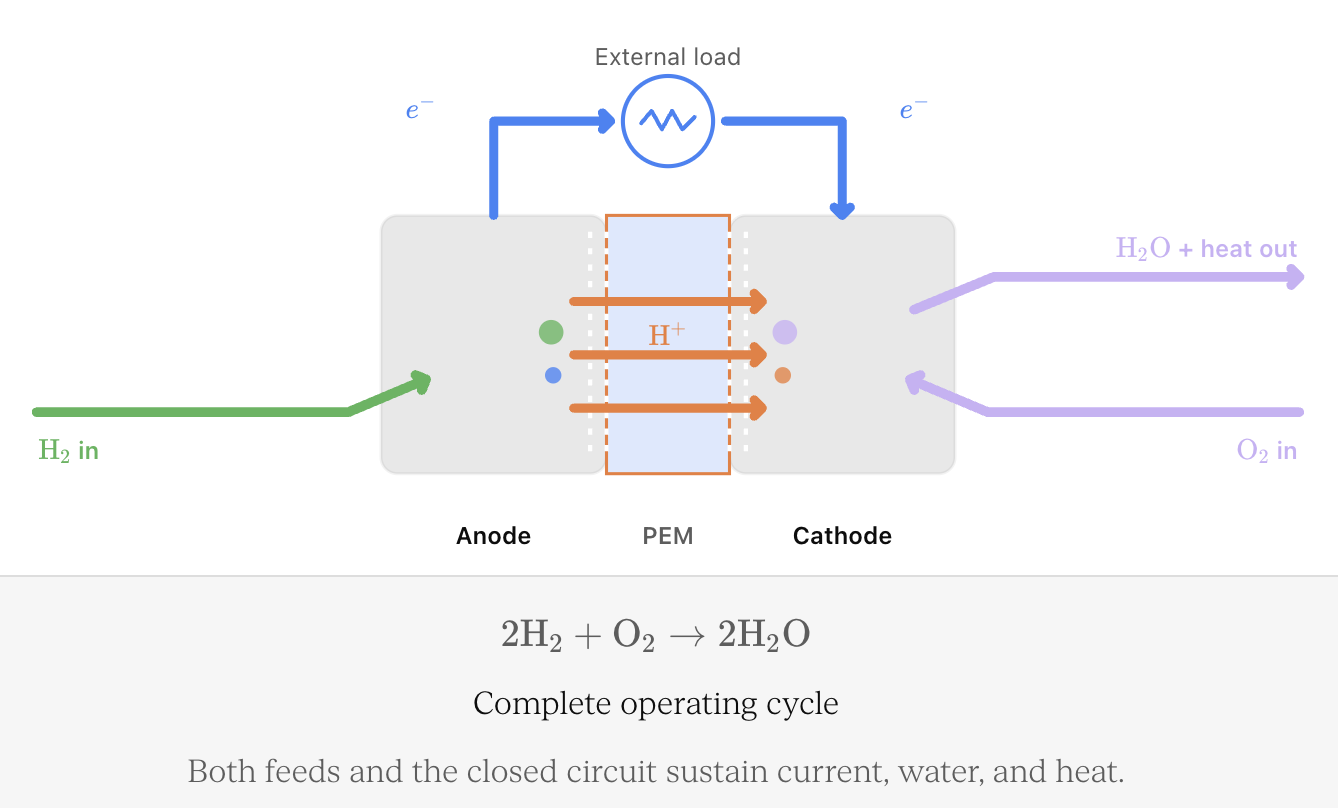
In a hydrogen fuel cell, the overall reaction combines:
hydrogen and oxygen
to produce:
water.
The overall reaction is:
2H₂ + O₂ → 2H₂O
Energy is released during this reaction.
Instead of allowing all of the energy to be released directly as heat, the fuel cell directs electrons through an external circuit.
This produces:
useful electrical energy.
Hydrogen Fuel Cells
One of the most important types of fuel cell is the:
hydrogen fuel cell.
A common example is the proton exchange membrane fuel cell, often abbreviated:
PEM fuel cell.
It uses:
- hydrogen
- oxygen
- two electrodes
- a catalyst
- a proton exchange membrane
The products are primarily:
- water
- electrical energy
- heat
Structure of a Hydrogen Fuel Cell
A simplified hydrogen fuel cell contains:
Anode
The electrode where hydrogen enters and oxidation occurs.
Cathode
The electrode where oxygen enters and reduction occurs.
Electrolyte or proton exchange membrane
Allows hydrogen ions, H⁺, to move through the cell while separating the reactant gases and blocking electrons from crossing directly.
Catalyst
Helps the electrode reactions occur at useful rates.
External circuit
Provides a path for electrons to travel through the electrical device.
How a Hydrogen Fuel Cell Works
The operation of a PEM hydrogen fuel cell can be divided into several stages.
1. Hydrogen enters the anode.
2. Hydrogen molecules are oxidized.
3. Hydrogen ions move through the membrane.
4. Electrons travel through the external circuit.
5. Oxygen enters the cathode.
6. Oxygen, hydrogen ions, and electrons combine to form water.
This separation of electron flow from ion movement allows the cell to generate:
electricity.
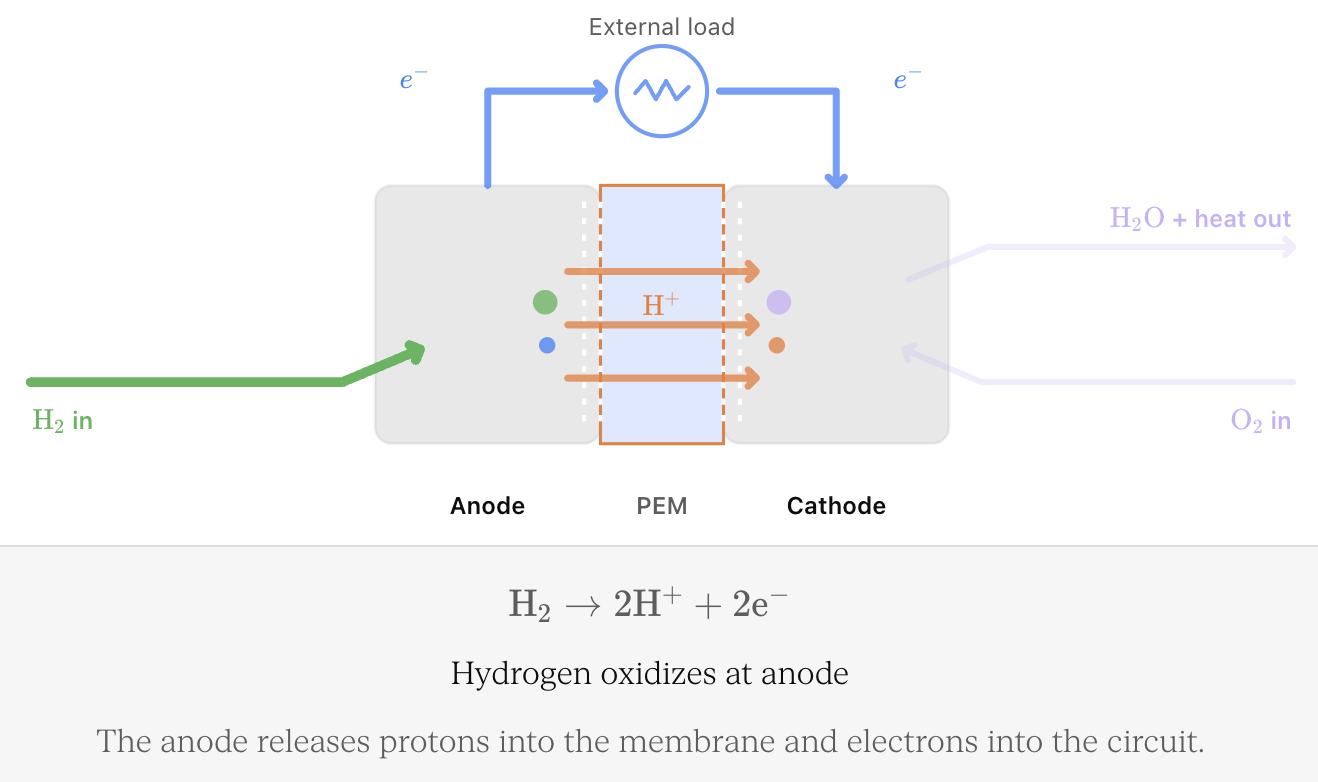
Step 1: Hydrogen Enters the Anode
Hydrogen gas enters the:
anode side
of the fuel cell.
Hydrogen exists as molecules:
H₂
At the catalyst surface, hydrogen molecules undergo:
oxidation.
Remember:
Oxidation = loss of electrons
Step 2: Hydrogen Is Oxidized
At the anode:
H₂ → 2H⁺ + 2e⁻
Each hydrogen molecule produces:
- two hydrogen ions, H⁺
- two electrons, e⁻
The hydrogen ions and electrons then take:
different paths.
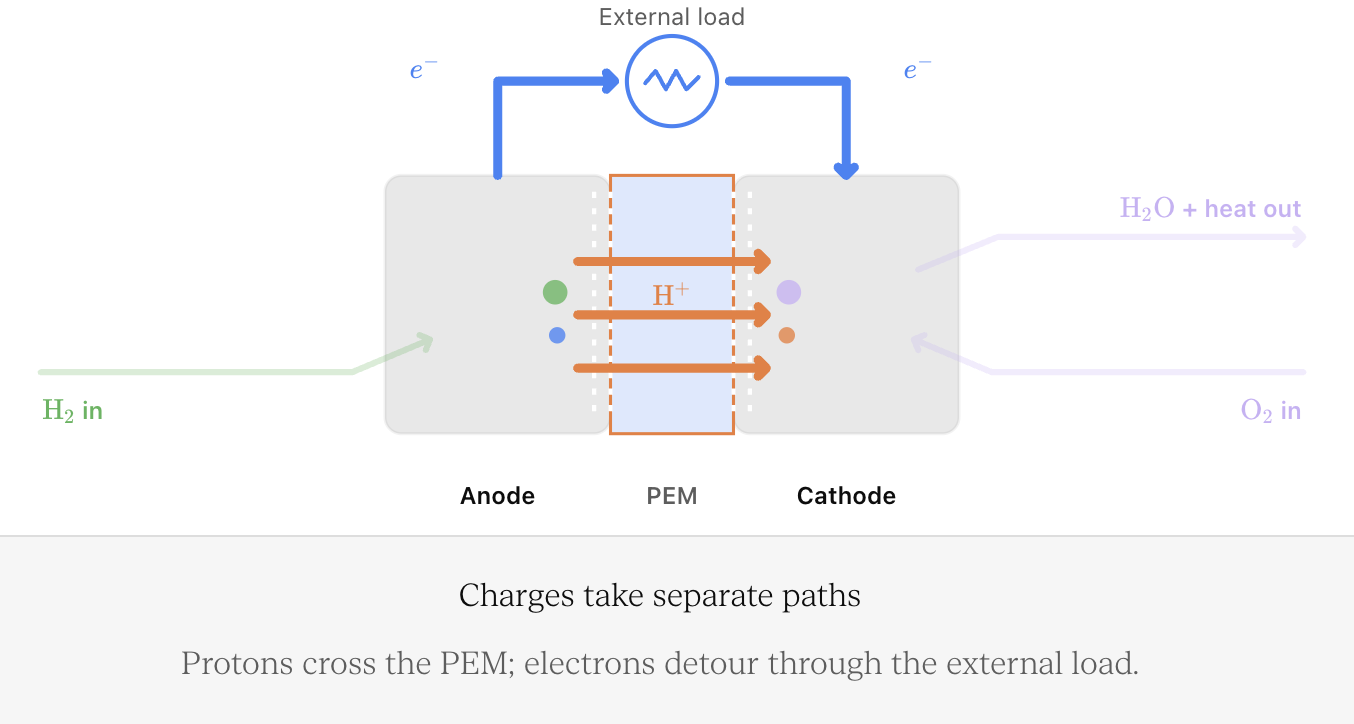
Step 3: Protons Cross the Membrane
The H⁺ ions are:
protons.
The proton exchange membrane allows these protons to pass through toward the:
cathode.
However, the membrane does not allow electrons to simply follow the same path.
The electrons must travel through the:
external circuit.
Step 4: Electrons Flow Through the Circuit
The electrons leave the anode and travel through:
an external electrical circuit.
Their movement produces an electric current that can power:
- an electric motor
- lights
- electronics
- other electrical devices
The electrons eventually reach the:
cathode.
This is how the fuel cell extracts useful electrical energy from the chemical reaction.


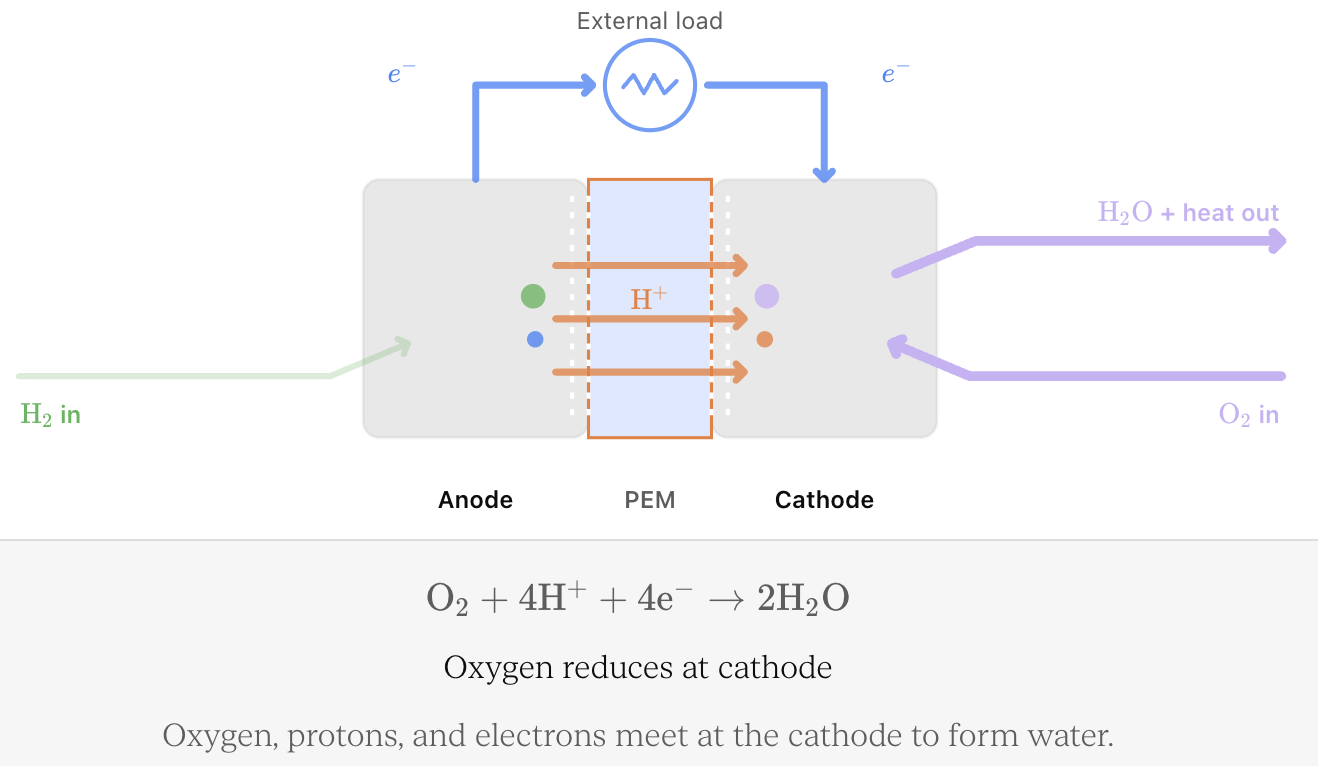
Step 5: Oxygen Enters the Cathode
Oxygen is supplied to the:
cathode.
In many fuel-cell systems, this oxygen comes from:
air.
At the cathode, oxygen participates in a reduction reaction.
Remember:
Reduction = gain of electrons
Step 6: Water Is Produced
At the cathode, oxygen combines with:
- hydrogen ions
- electrons
A simplified cathode reaction is:
O₂ + 4H⁺ + 4e⁻ → 2H₂O
The product is:
water.
Heat is also released during fuel-cell operation.
The Complete Reaction
At the anode:
2H₂ → 4H⁺ + 4e⁻
At the cathode:
O₂ + 4H⁺ + 4e⁻ → 2H₂O
Add the reactions together:
2H₂ + O₂ → 2H₂O
Notice that the electrons appear in both half-equations and cancel from the overall equation.
They are transferred from:
hydrogen to oxygen.
Oxidation and Reduction
The hydrogen fuel cell is a:
redox system.
At the anode:
hydrogen is oxidized.
At the cathode:
oxygen is reduced.
Therefore:
Anode = oxidation
Cathode = reduction
This is the same fundamental electrochemical principle found in:
galvanic cells and batteries.
Electron Flow vs Proton Flow
This distinction is very important.
Electrons:
travel through the external circuit.
Protons (H⁺):
travel through the proton exchange membrane.
The two paths eventually meet again at the:
cathode.
A common mistake is to say that electrons travel through the membrane.
They do not.
Why Does the Fuel Cell Produce Electricity?
Hydrogen and oxygen can react to form water.
The overall reaction releases energy.
A fuel cell separates the oxidation and reduction processes so that electrons cannot transfer directly between the reactants.
Instead, electrons must travel through an:
external circuit.
This controlled electron flow produces:
electric current.
The Role of the Catalyst
Fuel-cell reactions need to occur quickly enough to provide useful power.
A catalyst increases the rate of the electrochemical reactions without being consumed in the overall reaction.
PEM fuel cells commonly use catalysts containing:
platinum.
Platinum is effective but expensive.
Reducing the amount of expensive catalyst material is therefore an important area of:
fuel-cell research.
Fuel Cell Stacks
A single fuel cell produces a relatively small voltage.
To provide greater voltage and power, many individual cells can be connected together.
This arrangement is called a:
fuel-cell stack.
Fuel-cell vehicles and larger power systems typically use stacks containing many:
individual cells.


Fuel Cells and Batteries
Fuel cells and batteries have several similarities.
Both:
- are electrochemical devices
- involve redox reactions
- contain an anode and cathode
- use an electrolyte
- produce an electric current
- convert chemical energy into electrical energy
However, they differ in how their:
reactants are supplied.
Batteries Store Their Reactants
A conventional battery contains its active chemical materials:
inside the battery.
As the battery discharges, these materials undergo chemical changes.
A primary battery eventually needs to be:
replaced.
A secondary battery can be:
recharged.
Fuel Cells Receive Fuel Continuously
A fuel cell does not depend only on a fixed quantity of reactants stored inside the electrochemical cell itself.
Instead:
fuel enters continuously
and:
products leave continuously.
For a hydrogen fuel cell:
hydrogen enters
oxygen enters
water leaves
As long as suitable reactants are supplied, the fuel cell can continue:
generating electricity.
Fuel Cell vs Primary Battery
A primary battery:
- stores reactants internally
- operates until its reactants are depleted
- is normally replaced after discharge
A fuel cell:
- receives reactants externally
- can continue operating while fuel is supplied
- is refueled rather than electrically recharged in the same way as a secondary battery
Fuel Cell vs Rechargeable Battery
A rechargeable battery stores energy chemically inside the battery.
When discharged, it is connected to an electrical source and:
recharged.
A hydrogen fuel-cell system is instead supplied with more:
hydrogen fuel.
Therefore:
battery → recharge
fuel cell → refuel
Comparing Fuel Cells and Batteries
| Feature | Fuel Cell | Rechargeable Battery |
|---|---|---|
| Energy source | External fuel | Stored internally |
| Produces electricity by | Redox reactions | Redox reactions |
| Main energy conversion | Chemical → electrical | Chemical → electrical |
| Restoring energy | Refueling | Electrical charging |
| Operation | Continues while fuel is supplied | Limited by stored charge |
| Example | Hydrogen PEM fuel cell | Lithium-ion battery |
| Main exhaust/product at PEM fuel cell | Water | No continuous exhaust stream |
Hydrogen as an Energy Carrier
Hydrogen is often described as an:
energy carrier
rather than a primary energy source.
This distinction is important.
Hydrogen must normally be produced using another source of:
energy.
Energy is used to produce hydrogen.
The hydrogen can then be:
- stored
- transported
- supplied to a fuel cell
The fuel cell converts its chemical energy into:
electrical energy.
Producing Hydrogen
Hydrogen can be produced in several ways.
One method is:
electrolysis of water.
Electrical energy is used to split water into hydrogen and oxygen.
In simplified form:
water + electrical energy → hydrogen + oxygen
The hydrogen can later be used in a fuel cell.
Electrolysis and Fuel Cells
Electrolysis and hydrogen fuel cells can be viewed as related but different processes.
During electrolysis:
electrical energy → chemical energy stored in hydrogen
During fuel-cell operation:
chemical energy in hydrogen → electrical energy
This creates a possible energy-storage pathway:
electricity → hydrogen → electricity
Energy is lost at each conversion stage, so the complete cycle is:
not 100% efficient.


Where Does Hydrogen Come From?
The environmental impact of hydrogen depends strongly on:
how the hydrogen is produced.
Hydrogen can be produced from:
- water using electrolysis
- natural gas
- other hydrocarbons
- biomass
- other industrial processes
Different production methods can have very different:
greenhouse-gas emissions.
Hydrogen Produced from Fossil Fuels
Much hydrogen has historically been produced from:
natural gas and other fossil fuels.
These processes can release:
carbon dioxide.
Therefore, using hydrogen in a fuel cell does not automatically mean that the entire energy system has:
zero greenhouse-gas emissions.
The complete production pathway must be considered.
Hydrogen from Renewable Electricity
Hydrogen can also be produced by electrolysis using electricity generated from sources such as:
- solar power
- wind power
- hydroelectric power
When low-carbon electricity is used, the overall greenhouse-gas emissions associated with hydrogen production can be substantially reduced.
This is often called:
renewable hydrogen or green hydrogen.
Advantages of Hydrogen Fuel Cells
Hydrogen fuel cells offer several potential advantages.
They can provide:
- electrical energy without combustion at the point of use
- water as the main reaction product in a PEM fuel cell
- relatively quiet operation
- continuous operation while fuel is supplied
- relatively rapid refueling
- useful energy storage for some applications
- high electrochemical conversion efficiency compared with many heat-engine systems
No Carbon Dioxide at the Fuel Cell
A hydrogen fuel cell does not contain carbon in its fuel.
Therefore the fuel-cell reaction itself does not produce:
carbon dioxide.
The main chemical product is:
water.
However, this describes the:
point of use.
The production and transportation of the hydrogen may still create greenhouse-gas emissions.
Fuel Cells Do Not Require Combustion
A fuel cell does not need to burn hydrogen to produce electricity.
Instead, it uses:
electrochemical reactions.
This is important because combustion converts chemical energy first into thermal energy.
A fuel cell converts chemical energy more directly into:
electrical energy.
Efficiency
Fuel cells can convert a substantial fraction of the fuel's chemical energy directly into electrical energy.
Some energy is still converted into:
heat.
In certain applications, this heat can also be used.
Systems that produce electricity while also using the waste heat are called:
combined heat and power systems.
Rapid Refueling
One potential advantage of hydrogen vehicles is that hydrogen tanks can be:
refilled.
This differs from battery-electric vehicles, which must transfer electrical energy into their batteries during:
charging.
For applications requiring high utilization and quick turnaround, refueling time can be an important consideration.
Long-Duration Energy Storage
Hydrogen can potentially store energy for relatively long periods.
For example, excess renewable electricity could be used to produce hydrogen.
The hydrogen could then be stored and later used in:
- fuel cells
- industrial processes
- other applications
This may be useful where electricity must be stored for:
long periods or in very large quantities.
Challenges of Fuel Cells
Fuel-cell technology also faces significant challenges.
These include:
- hydrogen production
- hydrogen storage
- hydrogen transportation
- infrastructure
- cost
- catalyst materials
- overall energy efficiency
- durability
These factors must be considered when evaluating fuel cells as an:
energy technology.
Hydrogen Storage
Hydrogen has a very low density as a gas under ordinary conditions.
To store useful quantities, it may be:
- compressed to high pressure
- cooled to very low temperatures and liquefied
- stored using specialized materials or chemical carriers
Each approach requires:
energy and specialized equipment.


High-Pressure Storage
Fuel-cell vehicles commonly store hydrogen as:
compressed gas.
The storage tanks must withstand very high pressures.
This requires:
- strong materials
- careful engineering
- safety systems
- specialized refueling equipment
These requirements add:
cost and complexity.
Hydrogen Has Low Volumetric Energy Density
Hydrogen contains a large amount of energy relative to its:
mass.
However, gaseous hydrogen occupies a large volume.
This creates an important engineering challenge.
Hydrogen can have:
high specific energy by mass
but:
low volumetric energy density unless compressed or liquefied.
Transporting Hydrogen
Hydrogen must be transported from where it is produced to where it is used unless it is produced on site.
Possible approaches include:
- pipelines
- compressed-gas transport
- liquid hydrogen transport
- conversion into other hydrogen-containing materials
Each method has:
costs, energy losses, and infrastructure requirements.
Infrastructure
Gasoline and electricity already have extensive distribution infrastructure in many regions.
Hydrogen requires infrastructure such as:
- production facilities
- storage facilities
- pipelines or transport systems
- refueling stations
Building this infrastructure can require substantial:
investment.
Catalyst Cost
PEM fuel cells commonly use:
platinum-group catalysts.
These materials are:
- effective
- relatively scarce
- expensive
Researchers work to:
- reduce catalyst quantities
- improve catalyst durability
- develop alternative catalysts
Reducing catalyst cost could make fuel-cell systems more:
economically competitive.
Durability
Fuel cells must operate reliably for long periods.
Performance can decline because of:
- catalyst degradation
- membrane degradation
- contamination
- repeated operating cycles
- temperature and humidity changes
Increasing fuel-cell durability remains an important:
engineering challenge.
Fuel-Cell Vehicles
Hydrogen fuel cells can be used to power:
electric vehicles.
The fuel cell generates electricity.
That electricity powers an:
electric motor.
The basic energy pathway is:
chemical energy in hydrogen → electrical energy → kinetic energy


Fuel-Cell Vehicles Often Have Batteries Too
A fuel-cell vehicle may contain both:
a fuel-cell stack and a rechargeable battery.
The fuel cell provides electrical energy from hydrogen.
The battery can:
- store energy from regenerative braking
- provide additional power during acceleration
- smooth changes in power demand
Therefore fuel cells and batteries do not always have to be:
competing technologies.
They can work together.
Regenerative Braking
When a fuel-cell vehicle slows down, its electric motor can operate as a generator.
Some kinetic energy can be converted into:
electrical energy.
That energy can be stored in the vehicle's:
battery.
The energy pathway is:
kinetic → electrical → chemical
This improves overall vehicle efficiency.
Stationary Fuel Cells
Fuel cells can also generate electricity for:
- buildings
- hospitals
- data centers
- telecommunications equipment
- remote locations
- backup power systems
Stationary fuel cells can be especially useful when reliable:
continuous electrical power
is required.
Fuel Cells in Space
Fuel cells have also been used in:
spacecraft.
Hydrogen and oxygen can generate electricity while producing:
water.
This combination has made fuel cells useful in some space missions.
Fuel Cells vs Internal Combustion Engines
An internal combustion engine generally follows an energy pathway such as:
chemical → thermal → mechanical
A fuel-cell vehicle follows approximately:
chemical → electrical → mechanical
Fuel cells avoid the combustion step.
This can provide efficiency and emissions advantages at the:
point of use.
Fuel Cells vs Battery-Electric Vehicles
Both fuel-cell vehicles and battery-electric vehicles use:
electric motors.
The major difference is how the electrical energy is supplied.
Battery-electric vehicle:
electricity → battery → motor
Fuel-cell vehicle:
hydrogen → fuel cell → electricity → motor
Often a small battery is also included in the fuel-cell vehicle.
Energy Efficiency of the Whole System
When evaluating fuel cells, it is important to consider more than the fuel cell itself.
For hydrogen produced using electricity, the complete pathway may involve:
electricity
↓
↓
hydrogen
↓
compression or liquefaction
↓
transport and storage
↓
fuel cell
↓
electricity
Each stage involves some:
energy loss.
Why Batteries Can Be More Efficient in Some Applications
A battery-electric system can use electricity more directly:
electricity → battery → electricity → motor
A hydrogen system may require additional energy conversions.
Therefore battery systems can have higher overall electricity-to-wheel efficiency in many light-duty vehicle applications.
However, fuel cells may offer other advantages, such as:
- rapid refueling
- lower fuel-storage mass in some long-range applications
- potential long-duration energy storage
The best technology depends on the:
application.
Evaluating an Energy Technology
A good evaluation should not focus on only one advantage or disadvantage.
Important factors include:
- efficiency
- cost
- environmental impact
- fuel availability
- infrastructure
- storage
- safety
- reliability
- lifetime
- energy density
- refueling or charging time
Different applications may give different importance to each:
factor.
Environmental Impact
Hydrogen fuel cells can have very low emissions at the point of use.
For a PEM fuel cell, the main chemical product is:
water.
However, a complete environmental assessment should consider:
- hydrogen production
- electricity source
- transportation
- compression
- storage
- fuel-cell manufacturing
- catalyst materials
- end-of-life recycling
This is called a:
life-cycle assessment.
Fuel Cells and Renewable Energy
Renewable electricity is sometimes produced when electricity demand is relatively low.
Some of this electricity could be used to produce:
hydrogen through electrolysis.
The hydrogen could then be stored.
Later:
hydrogen → fuel cell → electricity
This provides one possible method for storing renewable energy.


Advantages of Fuel Cells
Important potential advantages include:
- continuous electricity production while fuel is supplied
- no carbon dioxide from hydrogen fuel-cell operation itself
- water as the main chemical product of PEM hydrogen fuel cells
- relatively quiet operation
- no combustion required
- rapid refueling in some applications
- potential use for long-duration energy storage
- useful efficiency
- modular design
- potential integration with renewable energy
Challenges of Fuel Cells
Important challenges include:
- hydrogen must first be produced
- low-carbon hydrogen can be expensive
- hydrogen storage is difficult
- compression requires energy
- hydrogen infrastructure is limited in many regions
- fuel-cell catalysts can be expensive
- fuel cells can degrade
- hydrogen must be handled carefully
- the complete hydrogen energy pathway involves efficiency losses
Worked Example 1
What energy conversion occurs in a hydrogen fuel cell?
Chemical energy → electrical energy + thermal energy
The chemical energy comes from the reaction between:
hydrogen and oxygen.
Worked Example 2
Write the overall hydrogen fuel-cell reaction.
2H₂ + O₂ → 2H₂O
Hydrogen and oxygen react to form:
water.
Worked Example 3
What happens at the anode?
Hydrogen is oxidized:
H₂ → 2H⁺ + 2e⁻
Hydrogen loses:
electrons.
Worked Example 4
What happens at the cathode?
Oxygen gains electrons and combines with hydrogen ions.
A balanced cathode half-equation is:
O₂ + 4H⁺ + 4e⁻ → 2H₂O
Therefore:
reduction occurs at the cathode.
Worked Example 5
A student says:
"The electrons travel through the membrane from the anode to the cathode."
Is this correct?
No.
The protons travel through the proton exchange membrane.
The electrons travel through the:
external circuit.
Their movement through the external circuit produces useful electrical current.
Worked Example 6
Why doesn't a fuel cell need to be recharged like a lithium-ion battery?
The fuel cell receives fresh reactants from:
external supplies.
Instead of recharging the electrochemical cell, the system is:
refueled.
Worked Example 7
Why is it misleading to say that hydrogen fuel cells are always "zero-emission energy"?
The fuel cell itself produces water rather than carbon dioxide.
However, producing, compressing, transporting, and storing hydrogen can require energy and may produce emissions.
The complete:
life cycle
must therefore be considered.
Worked Example 8
A wind farm produces excess electricity during the night.
Explain how hydrogen could be used to store this energy.
Step 1: Electricity powers electrolysis.
Step 2: Water is split to produce hydrogen.
Step 3: Hydrogen is stored.
Step 4: Later, hydrogen enters a fuel cell.
Step 5: The fuel cell produces electricity.
The pathway is:
electrical → chemical → electrical
Worked Example 9
Why might fuel cells be attractive for vehicles that must operate for long periods with short stops?
A hydrogen fuel-cell system can potentially be:
refueled relatively quickly.
This may be useful where long charging periods would interfere with vehicle operation.
The overall suitability still depends on fuel availability, infrastructure, efficiency, and cost.
Worked Example 10
Why might batteries be preferred for some smaller vehicles?
Batteries can use electricity more directly and avoid several energy-conversion stages associated with producing, storing, and reconverting hydrogen.
They can therefore provide high overall:
energy efficiency.
Common Mistake: Fuel Cells Store Electricity
Fuel cells do not primarily store electricity.
They convert the chemical energy of continuously supplied fuel into:
electrical energy.
Common Mistake: Fuel Cells Are Batteries
Fuel cells and batteries are both electrochemical devices, but they operate differently.
A battery stores its reactants internally.
A fuel cell receives:
reactants from outside the cell.
Common Mistake: Hydrogen Is a Source of Energy Like Sunlight
Hydrogen is better described as an:
energy carrier.
Energy must first be used to produce usable hydrogen.
Common Mistake: Hydrogen Fuel Cells Burn Hydrogen
Fuel cells do not normally produce electricity by combustion.
They use:
electrochemical redox reactions.
Common Mistake: Electrons Cross the Proton Exchange Membrane
The membrane allows:
H⁺ ions
to move through it.
Electrons travel through the:
external circuit.
Common Mistake: Fuel Cells Produce Only Electricity
Fuel cells also produce:
thermal energy.
Hydrogen PEM fuel cells additionally produce:
water.
Common Mistake: Hydrogen Is Automatically Green
The environmental impact depends strongly on:
how the hydrogen was produced.
Hydrogen produced using fossil fuels can be associated with significant greenhouse-gas emissions.
Common Mistake: Fuel Cells and Batteries Cannot Work Together
Some systems combine:
fuel cells and rechargeable batteries.
Fuel-cell vehicles are an important example.
The technologies can perform different roles within the same system.
Check Your Understanding
- Define a fuel cell.
- What energy conversion occurs in a fuel cell?
- What fuel is used in a hydrogen fuel cell?
- What substance provides oxygen to many hydrogen fuel cells?
- Write the overall reaction for a hydrogen fuel cell.
- What happens at the anode?
- Write the hydrogen oxidation half-equation.
- What happens at the cathode?
- Write the oxygen reduction half-equation.
- Where does oxidation occur?
- Where does reduction occur?
- What travels through the external circuit?
- What travels through the proton exchange membrane?
- What is the purpose of the catalyst?
- Why is platinum useful in PEM fuel cells?
- What is a fuel-cell stack?
- Why are several fuel cells connected together?
- Give three similarities between batteries and fuel cells.
- What is the major difference between a fuel cell and a battery?
- Why can a fuel cell continue operating while fuel is supplied?
- Why is a fuel cell refueled rather than recharged in the same way as a secondary battery?
- Why is hydrogen described as an energy carrier?
- What is electrolysis?
- Explain how electrolysis and fuel-cell operation can form an energy-storage cycle.
- Why is this cycle not 100% efficient?
- Give four advantages of hydrogen fuel cells.
- Give four challenges associated with hydrogen fuel cells.
- Why is hydrogen difficult to store?
- How can hydrogen gas be stored for vehicle use?
- Why does hydrogen infrastructure present a challenge?
- Why is catalyst cost important?
- What is the main chemical product of a PEM hydrogen fuel cell?
- Does the operation of a hydrogen PEM fuel cell produce carbon dioxide?
- Why can hydrogen production still produce carbon dioxide emissions?
- What is meant by renewable or green hydrogen?
- How can fuel cells be used in vehicles?
- Why might a fuel-cell vehicle also contain a battery?
- How can regenerative braking help a fuel-cell vehicle?
- Give three stationary applications of fuel cells.
- Explain how hydrogen could be used to store excess renewable energy.
- Compare the energy pathways of a battery-electric vehicle and a fuel-cell vehicle.
- Why can battery-electric systems have higher overall energy efficiency in some applications?
- Why might rapid refueling make fuel cells attractive in some applications?
- Explain why point-of-use emissions do not tell us the complete environmental impact of hydrogen.
- What factors should be considered in a life-cycle assessment?
- Explain why fuel cells do not require combustion.
- Compare a primary battery, secondary battery, and fuel cell.
- Explain why no single energy-storage technology is ideal for every application.
- Evaluate the advantages and disadvantages of hydrogen fuel cells for transportation.
- Evaluate whether hydrogen fuel cells could play a role in a future low-carbon energy system. Support your answer using efficiency, hydrogen production, storage, infrastructure, and environmental impact.
Key Terms
Fuel cell: Electrochemical device that converts the chemical energy of externally supplied fuel into electrical energy.
Hydrogen fuel cell: Fuel cell that uses hydrogen as a fuel and oxygen as an oxidizing agent.
PEM fuel cell: Proton exchange membrane fuel cell in which protons move through a specialized membrane.
Anode: Electrode where oxidation occurs.
Cathode: Electrode where reduction occurs.
Oxidation: Loss of electrons.
Reduction: Gain of electrons.
Redox reaction: Reaction involving both oxidation and reduction.
Proton exchange membrane: Material that allows H⁺ ions to pass while preventing electrons from directly crossing between electrodes.
Catalyst: Substance that increases reaction rate without being consumed in the overall reaction.
Fuel-cell stack: Group of individual fuel cells connected to provide greater voltage and power.
Hydrogen: Energy carrier that can be used as fuel in certain fuel cells.
Electrolysis: Process that uses electrical energy to drive a nonspontaneous chemical reaction, such as splitting water to produce hydrogen and oxygen.
Green hydrogen: Hydrogen produced using electrolysis powered by renewable or other qualifying low-carbon electricity, depending on the definition being used.
Energy carrier: Substance or system used to store and transport energy obtained from another source.
Life-cycle assessment: Evaluation of environmental impacts across production, transportation, use, and end-of-life stages.
Fuel-cell electric vehicle: Electric vehicle in which a fuel-cell system supplies electrical energy to the drivetrain.
Regenerative braking: Recovery of some kinetic energy during braking and conversion into stored energy.
Key Takeaways
- A fuel cell converts chemical energy directly into electrical energy through electrochemical reactions.
- Hydrogen fuel cells use hydrogen and oxygen to produce electricity, water, and heat.
- The overall reaction is 2H₂ + O₂ → 2H₂O.
- Hydrogen is oxidized at the anode.
- Oxygen is reduced at the cathode.
- Protons travel through the proton exchange membrane.
- Electrons travel through the external circuit, producing useful electric current.
- Fuel cells and batteries both use redox reactions, but fuel cells receive their reactants from external supplies.
- Batteries are generally recharged or replaced; fuel-cell systems are refueled.
- Hydrogen is an energy carrier, meaning energy must first be used to produce it.
- Hydrogen can be produced through electrolysis using renewable electricity.
- Fuel cells can provide low point-of-use emissions, quiet operation, and relatively rapid refueling.
- Important challenges include hydrogen production, storage, transportation, infrastructure, catalyst cost, durability, and overall efficiency.
- Hydrogen fuel cells produce no carbon dioxide at the point of use, but the complete environmental impact depends strongly on how the hydrogen is produced.
- Fuel cells can be used in transportation, stationary power, backup systems, and some energy-storage applications.
- Fuel cells and batteries can work together in the same system.
- Evaluating fuel cells requires considering the entire energy pathway rather than only the fuel cell itself.
- Fuel cells are one possible component of a lower-carbon energy system, but their suitability depends strongly on the particular application.
5. Energy Storage Technologies
Learning outcomes
- I can identify different methods of energy storage.
- I can compare batteries, fuel cells, and other storage technologies.
- I can evaluate the efficiency of energy-storage systems.
- I can explain the importance of energy storage in renewable energy systems.
- I can assess future developments in energy-storage technology.


