Solutions and Concentration

Site: Young Education
Course: Chemical Reactions and Stoichiometry
Book: Solutions and Concentration
Printed by: Guest user
Date: Monday, 5 October 2026, 4:04 AM

1. Solutes and Solvents

Learning outcomes
  • I can distinguish between solutes, solvents, and solutions.
  • I can describe how solutions are formed.
  • I can identify the solute and solvent in common solutions.
  • I can explain the difference between concentrated and dilute solutions.
  • I can relate particle models to the formation of solutions.

Solutes and Solvents

A solution is a homogeneous mixture formed when one substance dissolves in another.

Every solution contains at least two components:

  • a solute — the substance being dissolved
  • a solvent — the substance that dissolves the solute

For example, when salt dissolves in water:

salt = solute

water = solvent

salt water = solution

The solute particles become distributed throughout the solvent, producing a mixture that appears uniform.

https://images.openai.com/static-rsc-4/9isanDm-z8ylCFqUg0qjUSBDFcnv_6MIGmGmSNiUAVh_thhcyXbKviDXIKVtOOLV-GQi9tdDJNp4NS3gXoV9eI1CtNDjkROoy1fgIVgZzruk5RhoIviogDwBsY-xs_4s0XQY7X4pg36Qdzmt0lG00hwuH_MKCP1XQ-UCNut61iSc1zdEQkiE6J6h0jHVjawt?purpose=fullsize
 
https://images.openai.com/static-rsc-4/v8sMEQTXP2twvY5iHDcahhdJYJ0F1hM8fDT9bRf2L_fDdLBbodrdCDY7ccJnGliUEUkfec_8wr8ShgABL28l6Kb_Vuymk7uKb6WwhSTaDwxw08xByAJmSvnrpf1J7PK8DzHe9m7UnpM08RNaL-M85afyM2Z7DD1iq96O9vbrTk1ZAHNoaaoXrG9DyosppyIm?purpose=fullsize
 
https://images.openai.com/static-rsc-4/emdP_4knDCEXw_HQN3AWPBI2ONnv67sMBvzlsaOi_bEjKJ_EJlj_ag9Da8kV-6D1FIfG_jf_Ih8kgIUSijohSSqwqRJ_t6PMJTzyF8Qrhd7lFHiXOkhmBoY4kiJrN_clrceg3Go17IImtE5vUSFH4kLKmPvdAMJBYRyVQCMar0ZemJvEV8HYJz9vh55_w-1D?purpose=fullsize
 
5

What Is a Solute?

A solute is the substance that is dissolved in a solution.

For example, imagine adding a spoonful of sugar to a glass of water.

After stirring, the sugar appears to disappear.

The sugar has not actually disappeared. Its particles have become dispersed among the water particles.

In this example:

sugar = solute

A solution can contain more than one solute.

For example, seawater contains many dissolved substances, including different salts.


What Is a Solvent?

A solvent is the substance that dissolves the solute.

In sugar water:

water = solvent

In salt water:

water = solvent

The solvent is commonly the component present in the greater amount, although identifying the solvent is fundamentally about its role in the solution.

Water is an especially important solvent because many substances dissolve in it.


What Is a Solution?

A solution is the homogeneous mixture produced when a solute dissolves in a solvent.

Examples include:

  • salt water
  • sugar water
  • vinegar
  • carbonated water
  • air
  • some metal alloys

A solution is homogeneous, meaning its composition is uniform throughout at the scale we normally observe.

If you take samples from different parts of a properly mixed salt solution, each should have approximately the same concentration.


Solute + Solvent → Solution

A simple way to remember the relationship is:

solute + solvent → solution

For example:

salt + water → salt solution

or:

sugar + water → sugar solution

Dissolving usually does not mean that a new substance has been produced.

The particles of the solute are dispersed among the particles of the solvent.


What Happens When a Substance Dissolves?

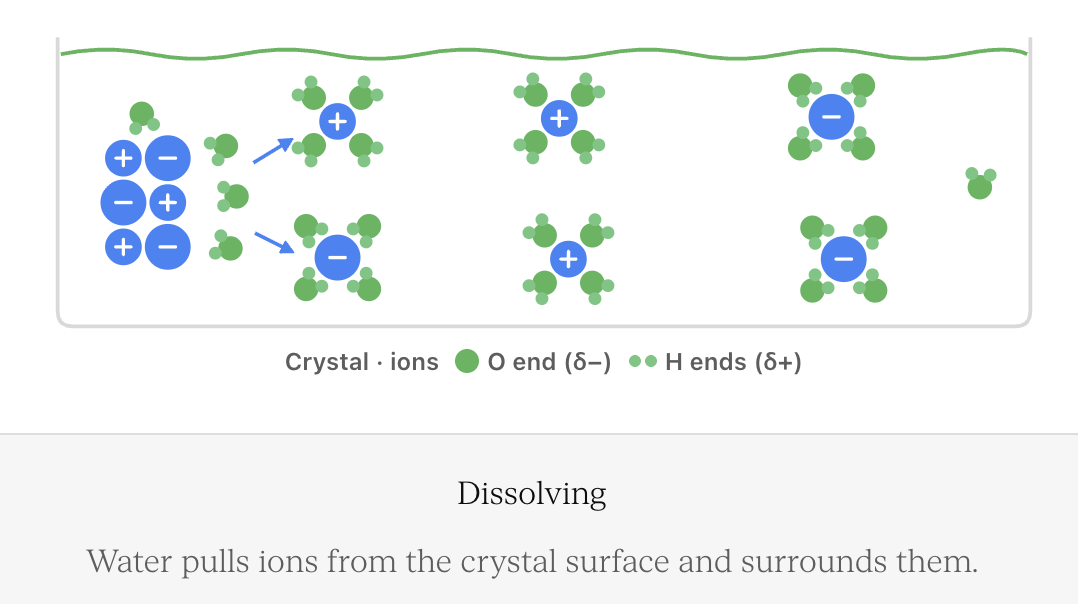
Consider a crystal of salt placed in water.

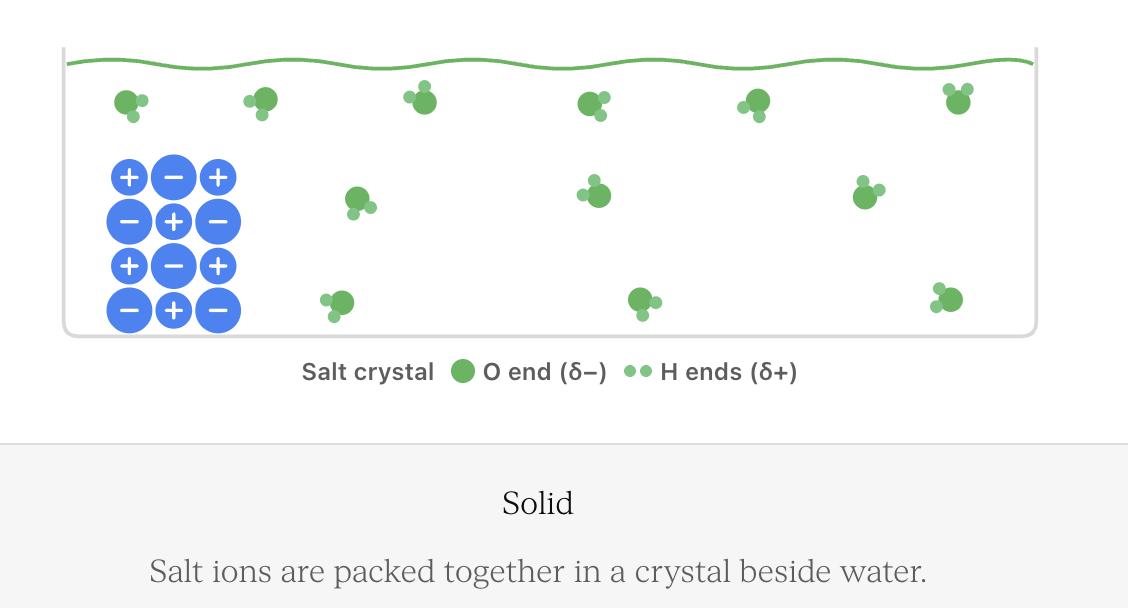
At first:

  • salt particles are together in the crystal
  • water molecules surround the crystal

As dissolution occurs:

  • particles separate from the crystal
  • water molecules surround the separated particles
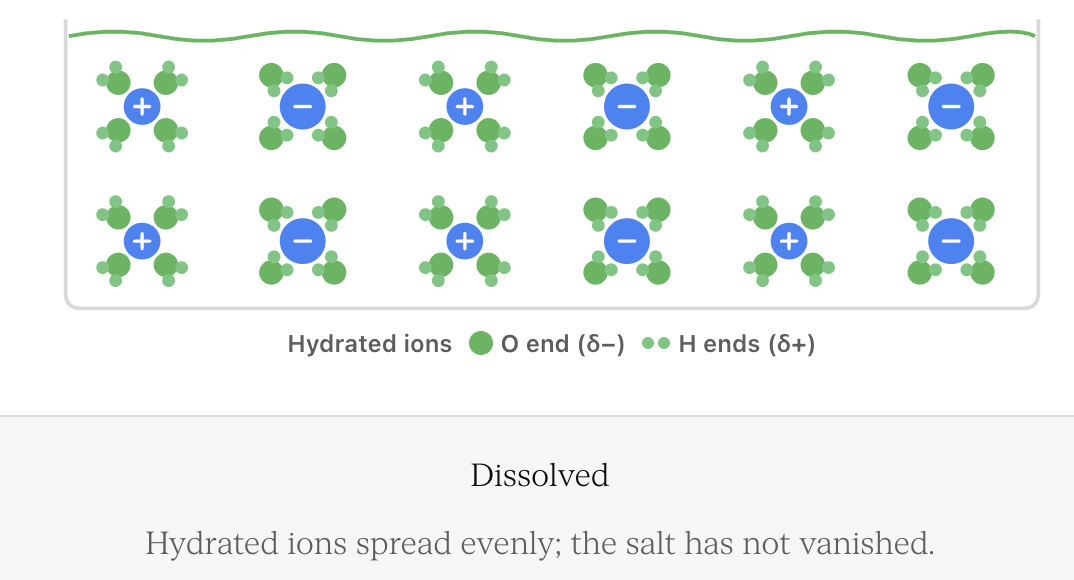
  • the dissolved particles spread throughout the water

Eventually, the particles are distributed throughout the solution.

This particle-level process can be explored here:
The salt may no longer be visible, but it is still present.


Dissolving Sugar

Sugar also dissolves in water, but there is an important difference at the particle level.

When sugar dissolves, individual sugar molecules separate from the crystal and become surrounded by water molecules.

The sugar molecules remain sugar molecules.

They simply become dispersed throughout the solvent.

https://images.openai.com/static-rsc-4/fxoHCoXZXoJV-UGh7AI_jNfDKUr66dwusAIdctQBM-csKlHFA-geLIpojAdOuyBl21pM2LtSQjvGTL8oQZ4kZg6CbEIfEOO35Svp7LGh8dgEevqBwTjCtfbtgMk1ulvzH_bgwcl27xi6EWHt9aaq7KUuKwVMnK8heFatQJ2xbn06ik12Sam52lWmknWhZBvR?purpose=fullsize
 
https://images.openai.com/static-rsc-4/1uq8WG9ooQxoH68wX3c4Q8O3v_H6DgU8AnQqJOknLGtYOOkrKSInNc_TyKcN1QZOCPOqt89KY_v_DWTVKIp2K8VlSTDixCCUmd_jB8iwWDUrM158JC0oOKrD-7-HikbBcsWjYmwZU9V--EQr5qbCPAqfsigqX1X1S9yTqjJ7YQH1Nj7e3trVLtQZ6mLksJPz?purpose=fullsize
 
https://images.openai.com/static-rsc-4/mD68ERJiKZ6VyK-GI5IKthc97Q8j9ZKxzfsd-jfkb2xjNNS1fLMJHbjawmO1X8i0X9TwOoyia0wBNtZ14dohYUi-POfFMnK2Np9CacnL0j8zNcHWW6ZDaWp6P7a_Ng4uOrp_-Zkbat9fnZKb7pqczFxnXT5IkpuV3kh4iTQKYBnZq5fXA6ItSoDfst_x8QFI?purpose=fullsize
 
6

Dissolving Is Not the Same as Melting

These processes are often confused.

Dissolving

A substance becomes dispersed within a solvent.

Example:

sugar + water → sugar solution

Melting

A solid changes into a liquid because energy is transferred to it.

Example:

solid ice → liquid water

When sugar disappears into water, the sugar has dissolved, not melted.


Dissolving Is Usually Not a Chemical Reaction

When salt or sugar dissolves in water, we usually describe this as a physical process rather than the formation of an entirely new substance.

The components can often be separated again.

For example, if water evaporates from salt water, solid salt remains.

This shows that the salt was still present in the solution.


Identifying Solutes and Solvents

Ask two questions:

What substance is being dissolved?

That is the solute.

What substance is doing the dissolving?

That is the solvent.

For example:

Solution Solute Solvent
Salt water Salt Water
Sugar water Sugar Water
Copper sulfate solution Copper sulfate Water
Carbonated water Carbon dioxide Water
Vinegar Acetic acid and other dissolved substances Mainly water

Water as a Solvent

Water is one of the most important solvents in chemistry and biology.

Many substances can dissolve in water, including:

  • salts
  • sugars
  • acids
  • bases
  • gases

Solutions in which water is the solvent are called aqueous solutions.

For example:

aqueous sodium chloride

means sodium chloride dissolved in water.

The symbol:

(aq)

is commonly used in chemical equations to indicate that a substance is dissolved in water.

For example:

NaCl(aq)

means sodium chloride in aqueous solution.


Not Everything Dissolves in Water

Water can dissolve many substances, but not everything.

For example:

  • salt dissolves readily
  • sugar dissolves readily
  • oil does not mix well with water
  • sand does not significantly dissolve in water

A substance that can dissolve in a particular solvent is described as soluble.

A substance that does not dissolve to an appreciable extent is described as insoluble.

Solubility depends on both the solute and the solvent.

https://images.openai.com/static-rsc-4/l5HZV9j80KKnLKb3DPF97cdBdSYyiS20fpALxpdbJrSQr7k_nod9FkJ0iGwAQomaDjDTx8OqRrIA7NZZK7t9G4TdH-CGiWWdnI4mYgHhwz8T2j7r6aAttfu4XoPRWozEOmysRxn2dhHdfavG7VGppeSD2-E8dSBmxpwr8iBmLbk5oivdcnh4QXZf1zjV5qPH?purpose=fullsize
 
https://images.openai.com/static-rsc-4/KjJeN4P_UFDzHVf1CYN-PDepcZosnfruEAix3WqSl4oG3YFlyvFX1bnJCAt0DoOO4JGcDXNXcLg48bUHkCFpx6RI9zSVcy5TdfMR_0FydG9RPecsgYDukABh4O7uLnDw6wBm9NJYvdmRSQl9dsH81CIuN-RfbUpblBhjRfFyz7YXjqKvSr7xY2bk3wp6YTXo?purpose=fullsize
 
https://images.openai.com/static-rsc-4/YIST-u6R1qZtCfqKwDsGbGqum8lr4Gpm50idXTe06IncbVXOOPzHkhJap13BoV5VBUqwXpPnXpIj9YyHi1afyh3VVd2LyWpUIbjgi9-pOHROnOQ3EyPVuIylp9JagX7ii42llpO1rPNUu759zPLqVhub6PAib5789HiPExsIFzWWHlnsEzDTi_3ikIMRx4Pk?purpose=fullsize
 
5

Solutions Do Not Have to Be Liquids

We often think of solutions as liquids, but solutions can exist in other states.

Gas Solutions

Air is a mixture of gases.

Nitrogen is the major component, with oxygen, argon, carbon dioxide, and other gases mixed throughout.

Solid Solutions

Some alloys can be considered solid solutions.

For example, brass contains mainly:

  • copper
  • zinc

Gas Dissolved in Liquid

Carbonated drinks contain:

carbon dioxide dissolved in water

This demonstrates that a solute does not have to be a solid.


Concentrated Solutions

A concentrated solution contains a relatively large amount of solute compared with the amount of solvent or solution.

Imagine two glasses containing the same amount of water.

Glass A contains:

1 spoonful of sugar

Glass B contains:

5 spoonfuls of sugar

Glass B is more concentrated.

It contains more dissolved sugar relative to the amount of solution.


Dilute Solutions

A dilute solution contains a relatively small amount of solute compared with the amount of solvent or solution.

For example:

A glass containing:

1 g salt in 200 mL water

is generally more dilute than one containing:

20 g salt in 200 mL water.

The terms concentrated and dilute describe relative amounts. They do not by themselves give an exact numerical concentration.


Concentrated Does Not Mean Saturated

These terms have different meanings.

A solution can be concentrated without being saturated.

Concentrated means there is a relatively large amount of solute.

Saturated means the solution contains approximately the maximum amount of dissolved solute possible under the given conditions.

A concentrated solution might still be capable of dissolving more solute.


Diluting a Solution

A solution can often be made more dilute by adding additional solvent.

Suppose we have:

10 g salt in 100 mL water

If we add more water without adding more salt, the salt becomes distributed through a larger amount of solvent.

The solution becomes more dilute.

The amount of salt has not changed.

Only its concentration has decreased.


Concentrating a Solution

A solution can become more concentrated if:

  • more solute is added and dissolves
  • some solvent is removed

For example, if water evaporates from salt water, the amount of water decreases while the salt remains.

The solution becomes more concentrated.

If enough water evaporates, salt may eventually begin to crystallize.


Particle Model of a Dilute Solution

Imagine a container containing water molecules and only a few dissolved solute particles.

The solute particles are:

  • separated
  • surrounded by solvent particles
  • distributed throughout the liquid

Because relatively few solute particles are present, the solution is dilute.

At the particle level:

few solute particles relative to solvent particles = dilute


Particle Model of a Concentrated Solution

Now imagine the same volume containing many more dissolved solute particles.

There are more solute particles between the solvent particles.

At the particle level:

many solute particles relative to solvent particles = concentrated

The important difference is the relative amount of solute, not necessarily the total volume of solution.


Comparing Two Solutions

Suppose:

Solution A

5 g sugar in 100 mL water

Solution B

20 g sugar in 100 mL water

Solution B contains four times as much sugar in approximately the same amount of solvent.

Therefore:

Solution B is more concentrated.

Now consider:

Solution C

20 g sugar in 500 mL water

Even though C contains the same total amount of sugar as B, that sugar is distributed through much more water.

Therefore, Solution C is more dilute than Solution B.


Everyday Solutions

Solutions are everywhere.

https://images.openai.com/static-rsc-4/-sWBqA96OHdtQk9w-Wk6npFGEJor2lN0DNBer1GempegRQLzjdTOguzxt9O747yu01MZ2n5UjfHkTfztdERnSmnNq6SfTkCjHfZNgDNKfTKwbwKIGF_HkgppD8eBjJQAM8ZcCa9qc3_vTN_NEyhGiNtIh8nfSuiiUgg-KK9DLjuVSqfaG615bYYssJ5Vkzc9?purpose=fullsize
 
https://images.openai.com/static-rsc-4/nvhbisdEppcN672cusjT67DsoyU4NU0N_q1b2ti82-Bt8vzvc4JrXLDnjJU0YRfApjyb7mm8u6PB0hns0ReJsIxP91-INV9xGyM_0rHKid2j9MFIA_2Lnk3xzMWS_GcwncOWEjfvRPo7IuSiViD5ccqf6QlFQmYxtrjUQy7duWv4COProXdPnwTBY6yvrKwd?purpose=fullsize
 
https://images.openai.com/static-rsc-4/62JcS9tGyWyV5xwUx62fuVdCx3x0foSX0vSE9O3tl9ScGsaLKHrltPmoV0ilhUGk0jk8YRuV5NBPo3qXhRjWka8IXX07IczCgouT0zMkDAwjCilemQlpCWRicD_XRtoazH7_kUj4OqNqNBbkPXO91WAEiaGHgT2Eaq3AWyquFPXAwCORmNO4R07WZtCTL1MB?purpose=fullsize
 
6

Salt Water

Solute:

salt

Solvent:

water

Sugar Water

Solute:

sugar

Solvent:

water

Vinegar

Vinegar contains acetic acid dissolved mainly in water.

Carbonated Water

Solute:

carbon dioxide

Solvent:

water

Sports Drinks

Sports drinks may contain several solutes, including:

  • sugars
  • sodium compounds
  • potassium compounds
  • flavouring substances

The solvent is mainly water.


Solutions in the Human Body

Many important biological processes occur in solutions.

Blood plasma contains water along with dissolved substances such as:

  • ions
  • glucose
  • hormones
  • gases
  • waste products

Cells also contain aqueous solutions.

Dissolved substances can be transported through organisms because they are dispersed in water.


Solutions in Plants

Plants depend on solutions as well.

Water taken up by roots contains dissolved mineral ions.

These substances can be transported through the plant.

Sugars and other substances are also transported in aqueous mixtures.

The ability of substances to dissolve in water is therefore essential to plant function.


Solutions in the Environment

Natural water contains many dissolved substances.

Ocean water contains dissolved salts.

River water may contain:

  • mineral ions
  • dissolved gases
  • nutrients
  • pollutants

Groundwater can dissolve minerals as it moves through soil and rock.

Understanding solutions is therefore important in environmental science and water treatment.


Solutes Can Affect Properties

Adding a solute can change the properties of a solvent.

For example, dissolved substances can affect:

  • freezing point
  • boiling point
  • electrical conductivity
  • density

Salt water behaves differently from pure water because of the dissolved ions.

This is why the properties of a solution depend on both the solvent and the substances dissolved within it.


Solutions and Electrical Conductivity

Some solutions conduct electricity because they contain mobile ions.

For example, when sodium chloride dissolves in water, charged particles become dispersed throughout the solution.

These mobile ions allow electrical charge to move through the liquid.

Sugar solution behaves differently because dissolved sugar remains as neutral molecules rather than producing ions.

This difference becomes important when studying electrolytes and conductivity.


Solute Particles Have Not Vanished

A common misconception is that a solute disappears when it dissolves.

Suppose:

5 g salt

is added to water and dissolves completely.

The salt is still present.

If the water is evaporated, the salt can be recovered.

The solute particles have simply become too small and widely dispersed to see individually.


Mass Is Conserved During Dissolving

Suppose:

100 g water

is mixed with:

10 g salt

If nothing escapes, the total mass is:

100 g + 10 g = 110 g

After the salt dissolves, the solution still has a mass of approximately:

110 g

Dissolving does not destroy matter.


Worked Example: Identifying Components

A student mixes:

15 g sugar

with:

200 mL water

The sugar completely dissolves.

What is the solute?

Sugar

What is the solvent?

Water

What is the solution?

Sugar solution

What happened to the sugar?

The sugar molecules became dispersed throughout the water.


Worked Example: Comparing Concentration

Solution A contains:

5 g salt in 100 mL water

Solution B contains:

15 g salt in 100 mL water

Which is more concentrated?

Both contain the same amount of water, but B contains more solute.

Therefore:

Solution B is more concentrated.


Worked Example: Same Solute, Different Volumes

Solution A:

10 g sugar in 100 mL water

Solution B:

10 g sugar in 500 mL water

Both contain the same amount of solute.

However, Solution B contains much more solvent.

Therefore:

Solution A is more concentrated.


Worked Example: Dilution

A student has a concentrated salt solution.

They add:

200 mL water

without adding any additional salt.

What happens?

The amount of solute remains the same.

The amount of solvent increases.

Therefore:

the solution becomes more dilute.


Separating a Solute from a Solution

Because dissolving does not necessarily produce a new substance, components of some solutions can be separated physically.

For example, salt can be recovered from salt water by evaporating the water.

As the water leaves:

  • the solution becomes more concentrated
  • eventually crystals may begin to form
  • solid salt can remain after the water is removed
https://images.openai.com/static-rsc-4/ENEhW8MOBV3otcuJneDnqpbTJ34Mtf8MQ1a1H7ojLXyVdFjvWsWSvByoxg1QOh_f0fozQw8A_4n4o8nkSB81zK0ayqIdKjKRsiDgOTCyQ0Or_YMVCqd1Un7z-rFs9fPTBbNXCf9m9vsTLEk6GQNenu8TjCYqcG54jE0VWygvDUzZOMiJMfttaHwVHANjaIKu?purpose=fullsize
 
https://images.openai.com/static-rsc-4/Ln3NkGnYcaOCbgC32S7HDz4W0UpoGEDswQgctVOA-QzdX3kttw99lEWmyCj8upOQ3NcHL6saZVmC46hcfk7BKCYleEZzX2_G2MLvgBpqiHsj0ncFKxbshg1C4b_vY-utTQnD6H38EidH-7KbnXsO21hwO-F-Z8sPbmwHc2PYK-m8dM5oxMnCmZLhyPbTjkYD?purpose=fullsize
 
https://images.openai.com/static-rsc-4/9-H56gFUZR_PINYMefJbdYh2tkE1XZHqvNSXLdBm_ng8ZYEClWUZ0RDS2dYs6s4xXviltLQ-wBZv86ht_H6e6_-JtR7Xep2RZ3WxcwTJb60Gmiiu4OCKqPwRgqeDQNf7pIbJkPJbwZ9tnbCvKgWaTidBORXWo9tB368NiJkk51BK5gGiLi0TDthzlgrQRxzy?purpose=fullsize
 
7

Solutions vs. Suspensions

Not every mixture involving a liquid is a solution.

Consider sand mixed with water.

The sand:

  • does not dissolve
  • remains as visible particles
  • may eventually settle

This is different from a true solution.

In a salt solution:

  • the dissolved particles are extremely small
  • the mixture remains uniform
  • the salt does not simply settle to the bottom

Solutions vs. Colloids

Some mixtures have particles larger than those in true solutions but smaller than those in ordinary suspensions.

These are called colloids.

Examples can include:

  • milk
  • fog
  • some gels

Solutions, colloids, and suspensions behave differently because of the size and behaviour of the particles they contain.


Why Some Substances Dissolve

Dissolving depends on interactions between:

  • solute particles
  • solvent particles

For dissolution to occur, solvent particles must interact strongly enough with the solute particles to separate and disperse them.

This helps explain why:

  • salt dissolves in water
  • sugar dissolves in water
  • oil does not mix well with water

Different substances have different chemical structures and therefore interact differently.


Temperature and Dissolving

Temperature can affect how much of a substance can dissolve.

For many solid solutes, increasing temperature allows more solute to dissolve in a given amount of water.

For example, hot water can often dissolve more sugar than cold water.

However, this pattern does not apply in exactly the same way to every substance.

Temperature can also affect how quickly dissolution occurs.

These are two different ideas:

solubility = how much can dissolve

rate of dissolving = how quickly it dissolves


Stirring and Particle Size

Stirring can help a solute dissolve more quickly because fresh solvent is continually brought into contact with the solute.

Breaking a solid into smaller pieces can also increase the rate of dissolving because more surface area is exposed to the solvent.

However, stirring and crushing do not necessarily increase the final maximum amount that can dissolve under the same conditions.

They mainly affect the rate of dissolution.


Common Mistakes

Saying the Solute Disappears

The solute remains present.

Its particles become dispersed throughout the solvent.


Confusing Solute and Solvent

Remember:

solute = dissolved

solvent = does the dissolving


Assuming Solutes Must Be Solids

Solutes can be:

  • solids
  • liquids
  • gases

Carbon dioxide dissolved in water is an example of a gas solute.


Assuming Solutions Must Be Liquids

Gas and solid solutions also exist.

Air and some alloys are examples.


Confusing Dissolving with Melting

Melting is a change of state.

Dissolving involves mixing a solute with a solvent at the particle level.


Thinking Concentrated Means a Large Volume

A large container does not automatically contain a concentrated solution.

Concentration depends on the relative amount of solute.


Thinking Darker Colour Always Means More Concentrated

For some coloured solutions, darker colour can indicate greater concentration under comparable conditions.

But colour alone is not a universal measure of concentration.


Confusing Concentrated with Saturated

A concentrated solution contains a relatively large amount of solute.

A saturated solution contains approximately the maximum amount that can dissolve under the given conditions.


Thinking Dilution Removes Solute

Adding solvent does not remove solute.

It spreads the existing solute through a greater amount of solution.


Key Terms

Solute — A substance that is dissolved in a solvent.

Solvent — The substance that dissolves the solute.

Solution — A homogeneous mixture containing one or more solutes dispersed throughout a solvent.

Dissolve — To become dispersed at the particle level throughout a solvent.

Dissolution — The process by which a solute dissolves in a solvent.

Homogeneous mixture — A mixture with a uniform composition throughout.

Aqueous solution — A solution in which water is the solvent.

Soluble — Able to dissolve to a significant extent in a particular solvent.

Insoluble — Unable to dissolve to a significant extent in a particular solvent.

Concentrated solution — A solution containing a relatively large amount of solute.

Dilute solution — A solution containing a relatively small amount of solute.

Concentration — A measure of how much solute is present in a given amount of solution or solvent.

Saturated solution — A solution containing approximately the maximum amount of dissolved solute possible under particular conditions.

Particle model — A model describing matter as being made of tiny particles whose arrangement and interactions help explain observable properties.

Suspension — A heterogeneous mixture containing particles that do not dissolve and may settle over time.

Colloid — A mixture containing dispersed particles intermediate in size between those of a solution and a typical suspension.


Key Takeaways

  • A solution contains a solute and a solvent.
  • The solute is the substance being dissolved.
  • The solvent is the substance doing the dissolving.
  • A solution is a homogeneous mixture.
  • Water is an important solvent in chemistry, biology, and environmental science.
  • A solution with water as the solvent is called an aqueous solution.
  • Solutes can be solids, liquids, or gases.
  • Solutions can also exist as liquids, gases, or solids.
  • When a substance dissolves, its particles do not disappear.
  • Solute particles become dispersed among solvent particles.
  • Dissolving is different from melting.
  • Dissolving usually does not mean a new substance has formed.
  • A concentrated solution contains relatively more solute.
  • A dilute solution contains relatively less solute.
  • Adding solvent usually makes a solution more dilute.
  • Adding dissolved solute usually makes a solution more concentrated.
  • Removing solvent can also increase concentration.
  • Concentrated and saturated do not mean the same thing.
  • Particle models help explain why dissolved substances remain present even when they cannot be seen.
  • The total mass is conserved when a solute dissolves in a solvent, provided nothing enters or leaves the system.

The central relationship is:

SOLUTE + SOLVENT → SOLUTION


Check Your Understanding

1. Define a solute.

2. Define a solvent.

3. Define a solution.

4. In salt water, identify the solute and solvent.

5. In sugar water, identify the solute and solvent.

6. Explain what happens to sugar particles when sugar dissolves in water.

7. Why is it incorrect to say that dissolved salt has disappeared?

8. Explain why a solution is described as homogeneous.

9. What does the term aqueous solution mean?

10. What does NaCl(aq) tell us about sodium chloride?

Concentrated and Dilute Solutions

11. Explain the difference between a concentrated and dilute solution.

12. Solution A contains 5 g sugar in 100 mL water. Solution B contains 20 g sugar in 100 mL water. Which is more concentrated? Explain.

13. Solution A contains 10 g salt in 100 mL water. Solution B contains 10 g salt in 500 mL water. Which is more concentrated? Explain.

14. What happens to concentration when additional solvent is added but no additional solute is added?

15. What happens to the concentration of salt water as some of the water evaporates?

16. Explain why a concentrated solution is not necessarily saturated.

Particle Model

17. Describe the arrangement of solute particles in a solution.

18. Compare the particle model of a dilute solution with that of a concentrated solution.

19. Explain why dissolved particles do not settle to the bottom of a true solution.

20. A student says, "The sugar is gone because I can't see it." Use the particle model to explain why this statement is incorrect.

Applying the Ideas

21. Identify the solute and solvent in carbonated water.

22. Give an example showing that a solute does not have to be a solid.

23. Give an example showing that a solution does not have to be a liquid.

24. Explain the difference between dissolving and melting.

25. Explain why sand mixed with water is not a true solution.

26. Describe one method that could be used to recover salt from salt water.

27. If 10 g salt are added to 100 g water and completely dissolve, what should the approximate total mass of the solution be? Explain.

28. Explain why stirring can make a solid dissolve faster.

29. Explain why crushing a solid solute into smaller pieces can increase its rate of dissolving.

30. Distinguish between solubility and rate of dissolving.

Analysis and Reasoning

31. Two clear solutions look identical. Can you conclude that they have the same concentration? Explain.

32. A student adds water to orange squash and notices that its flavour becomes weaker. Explain this using the idea of dilution.

33. A salt solution is left in an open container for several days and some water evaporates. Predict what happens to its concentration.

34. If enough water evaporates from the solution in Question 33, what might eventually happen to the dissolved salt?

35. Explain why dissolved substances are important for transporting materials in living organisms.

36. Explain why water's ability to act as a solvent is important in rivers and oceans.

37. A student adds 5 g of sugar to water and another student adds 15 g to the same volume of water. Assuming all the sugar dissolves, compare the two solutions.

38. A student adds 20 g salt to a small amount of water, but some solid salt remains at the bottom even after stirring. What might this suggest?

39. Explain how a particle model helps us understand what happens when a solute dissolves.

40. Describe, using the terms solute, solvent, solution, dissolve, concentrated, dilute, and particles, what happens when sugar is added to water and then more water is added to the resulting mixture.

2. Concentration

Learning outcomes
  • I can define concentration as the amount of solute in a given volume of solution.
  • I can compare solutions based on their concentrations.
  • I can explain how concentration changes when solute or solvent quantities change.
  • I can calculate concentration using appropriate units.
  • I can solve problems involving concentration.

Concentration

Concentration describes how much solute is present in a given volume of solution.

A solution containing a large amount of solute in a particular volume is more concentrated. A solution containing a smaller amount of solute in the same volume is more dilute.

For example:

  • 5 g of salt dissolved to make 100 mL of solution
  • 20 g of salt dissolved to make 100 mL of solution

The second solution is more concentrated because it contains more solute in the same volume of solution.

https://images.openai.com/static-rsc-4/QUbJzqkfnGxKB2L4Tlfu459VCLEQJaLkwJwwnQEeVNaZ6vByw1Eu_8LWHmVSnxJUCVqSUdF3EmMmxrKSHX9BdHT7y0gbVr6ydveEMLUfIGXsq9oZRKNfYyUFN6lITdCPRC5XELiSTz60acEZqjU5daB0Dlh7fYpSLlGHv9IRfmv1IEUgE_CfmF6T02UXKuPS?purpose=fullsize
 
https://images.openai.com/static-rsc-4/xTXwyhg9OSY_150fhku0CyDrMnFPNKyMFowAwmwCB1XSIZPlc0WfuroOAULR2NK2NM0M_k_Irl-AyMPBDBS1qfDT0gbFUp5czec1Qgqn5_pm72RzIDmMP5_jy2tglCQToPD-KfygpLcjctOAoP-azfDhZnGNDJIKGqzjPEw5o7_5iiRuKuhMwt_aVcT8NcE7?purpose=fullsize
 
https://images.openai.com/static-rsc-4/MqlBrVHO5NrbfDaAQoAJQ7A1QXAXzAjQSSpwtj7rtHOPJ9hSmDsyVsOi6tV_uQYBtaiMfpBniAa9vW1O3TnDPpQWZuTPqpDB4XuLiY5eY-wuerqZiRfW4tGOJgmS97pL9MOZAe6w5_jlLcfwgDOHGeMAZ9qSR3wRv4pL8mGk8GP_537BzRT2CIf0liCrY6Zj?purpose=fullsize
 
5

What Does Concentration Tell Us?

Concentration allows us to compare solutions quantitatively.

It answers the question:

How much solute is present in a certain volume of solution?

Consider two salt solutions:

Solution A

10 g salt in 500 mL solution

Solution B

10 g salt in 100 mL solution

Both contain the same mass of salt, but Solution B contains that salt in a much smaller volume.

Therefore:

Solution B is more concentrated.

The important idea is that concentration depends on both the amount of solute and the volume of solution.


Concentrated and Dilute Solutions

A concentrated solution contains relatively more solute in a given volume.

A dilute solution contains relatively less solute in a given volume.

These terms are useful for general comparisons, but they do not tell us the exact concentration.

For example:

Solution A is more concentrated than Solution B.

is a qualitative comparison.

But:

Solution A has a concentration of 25 g/L.

is a quantitative measurement.


Calculating Concentration

A common way of expressing concentration is:

concentration = mass of solute / volume of solution

Using symbols:

c = m/V

where:

  • c = concentration
  • m = mass of solute
  • V = volume of solution

A common unit is:

g/L

meaning:

grams of solute per litre of solution

For example:

20 g/L

means there are:

20 g of solute in every 1 L of solution


Understanding g/L

The unit g/L is a ratio.

Suppose a solution has a concentration of:

50 g/L

This means:

1 L solution contains 50 g solute

Therefore:

2 L solution contains 100 g solute

and:

0.5 L solution contains 25 g solute

The concentration remains the same because the ratio of solute to solution remains the same.


Worked Example: Basic Concentration

A student dissolves 20 g of salt to make 2.0 L of solution.

Calculate the concentration.

Use:

c = m/V

Substitute:

c = 20 g / 2.0 L

c = 10 g/L

Answer

Concentration = 10 g/L

This means every litre of solution contains 10 g of salt.


Worked Example: Smaller Volume

A solution contains:

15 g sugar

in:

0.50 L solution

Calculate the concentration.

c = m/V

c = 15 / 0.50

c = 30 g/L

Answer

Concentration = 30 g/L


Converting Millilitres to Litres

A common source of mistakes is using millilitres when the required unit is g/L.

Remember:

1000 mL = 1 L

Therefore:

500 mL = 0.500 L

250 mL = 0.250 L

100 mL = 0.100 L

50 mL = 0.050 L

To convert:

mL → L

divide by:

1000


Worked Example: Converting Volume

A solution contains:

8.0 g salt

in:

200 mL solution

Calculate the concentration in g/L.

First convert the volume:

200 mL = 0.200 L

Then:

c = m/V

c = 8.0 / 0.200

c = 40 g/L

Answer

Concentration = 40 g/L


Worked Example: Very Small Volume

A medicine contains:

1.5 g

of dissolved substance in:

50 mL

of solution.

Convert:

50 mL = 0.050 L

Calculate:

c = 1.5 / 0.050

c = 30 g/L

Answer

Concentration = 30 g/L

This illustrates why small volumes can still have relatively high concentrations.


Comparing Concentrations

Consider:

Solution A

10 g solute in 1 L solution

Solution B

20 g solute in 1 L solution

Solution B contains twice as much solute in the same volume.

Therefore:

B is twice as concentrated as A.

Their concentrations are:

A:

10 / 1 = 10 g/L

B:

20 / 1 = 20 g/L


Comparing Different Volumes

Comparisons become more interesting when the volumes are different.

Solution A

10 g solute in 200 mL solution

Solution B

20 g solute in 500 mL solution

We cannot simply say B is more concentrated because it contains more solute.

We must calculate the concentration.

Solution A

200 mL = 0.200 L

c = 10 / 0.200

= 50 g/L

Solution B

500 mL = 0.500 L

c = 20 / 0.500

= 40 g/L

Therefore:

Solution A is more concentrated.

Even though A contains less total solute, that solute is packed into a smaller volume.


Concentration at the Particle Level

Imagine equal volumes of two solutions.

In the dilute solution, there are relatively few solute particles among the solvent particles.

In the concentrated solution, there are many more solute particles within the same volume.

https://images.openai.com/static-rsc-4/NsCDQv7EQvll06kaR4Vq5Oa4clB1sft6g0s9nFAPY96VPWJ83M5Lpazasi6Ljf6X_chGqEY3k3GNBPsoW96XntEFCYbqQqQcu3pXinzBR7p2-g4mP3xrpuy6DTc_HoCYMF5WhqfSalbzGC74378B1bPg78DlDaZK38qZJCPHEPvkuV8K5rJ4NxDCaMy8lrHF?purpose=fullsize
 
https://images.openai.com/static-rsc-4/CB25PbfI0IocEP2b_AqdHRdJi_IsL8lWpb9tjraDOw_mgmtlD0VuBg2VnaMPZC02PG-jXQi5D0cJqjWdOfvYCbMplZm9ZWhU-9Yl5rk4fT5x-4Ep6vojvIM4MDPumARGK5SKgFqSTfJPHbIuBXn3LieTLVugqS6tNDjRNujHp63a3IMuh3ZHMhy7xSQL3rgr?purpose=fullsize
 
https://images.openai.com/static-rsc-4/vf9PE5-ALEMGQeF1SQV1D_ab9HuM0tm08UGJGibrxjYSpz_O7wG2Hcm1yQDsGoG5-1sLkY-b68Plzy3XSUkqpuAP-2dBuLqbYD9fzMNm4p5T0kYEZAdpVfgNDD_9HFjUwyL4lBWU-t3JTVfi3TeA8NiEA43PoIqMaj1jtsYYPDFK1HC1y05qEZg-Cedpcrf-?purpose=fullsize
 
5

The solute particles are still distributed throughout the solution.

The difference is the number of solute particles per unit volume.

This particle model helps explain why concentrated solutions may behave differently from dilute solutions.


Increasing Concentration by Adding Solute

Suppose we have:

10 g solute in 1 L solution

Concentration:

10 g/L

If more solute is dissolved while the volume remains approximately the same, the concentration increases.

For example:

20 g solute in 1 L solution

has a concentration of:

20 g/L

More solute in the same volume means a greater concentration.


Decreasing Concentration by Adding Solvent

Suppose we begin with:

20 g solute in 1 L solution

Concentration:

20 g/L

If solvent is added until the total volume becomes:

2 L

the amount of solute remains:

20 g

New concentration:

c = 20 / 2

= 10 g/L

The solution has become more dilute.

This process is called dilution.


What Happens During Dilution?

During dilution:

  • solvent is added
  • total solution volume increases
  • amount of solute stays the same
  • concentration decreases

This is an important point:

Dilution does not remove solute.

It spreads the same amount of solute through a larger volume.


Increasing Concentration by Removing Solvent

Suppose a salt solution contains:

20 g salt in 1 L solution

If water evaporates, the amount of water decreases while the salt remains.

If the solution volume decreases to:

0.5 L

then:

c = 20 / 0.5

= 40 g/L

The concentration has increased.

Evaporation can therefore make a solution more concentrated.

https://images.openai.com/static-rsc-4/rLOwBVxyl-DskXwmkLpXz4QIRT8TPaWsuuiQlfmJ_IBjbCDBCQ_aaMhdLyfK5JlV41s8BLfB0rQf6XvM-o6OmZv-BxW4tSFdwUIbzYsmk6zxNqv03Cwmmu0-eMGHklSgfbVyIeXXKmUdKvoEcwjSuC-kihu1xpLGw4T_To9eo7uS_F8G-OYsTi8M5bw95NJL?purpose=fullsize
 
https://images.openai.com/static-rsc-4/BlxeqiAJAuznkAWd5Pa4n41u9N-Obz2rh02olsdW-eXMoAl7N64q9uXtkN3_cdbVemedspNn2JgHrCQo6p8lvQcu49TudjHIVZnKgDowVs600BV3FT10s4i5uZNcSewZ_A4S8Z9YmqvfwSVVtjDXzc6SZvBNooGEWhYboKte5ZtyzmdVNwnMCkpRN_JR5r70?purpose=fullsize
 
https://images.openai.com/static-rsc-4/93QkOVEvtGY12HpZJDf_RRUozxgT21jZhATKiZXUgTWC4FQTbVKaQaj3wTdyt-KkWFYlGya59voOKNmx5snxqKYx6qvSsCVMfHeqaePm0b3ZuAjlUmb9f-InNuz_UctcpLVxYG3Jr6V2Z9uTpMqjXd7UBMbomMan_kBK5ddcd4phDi_WF5jkY_K0F-GgM26E?purpose=fullsize
 
5

What Happens if Solute Is Removed?

Suppose some solute is removed while the volume remains approximately unchanged.

The amount of solute decreases.

Therefore:

concentration decreases

This is less common as a simple laboratory process because dissolved solute cannot usually just be picked out of a solution, but it can sometimes be removed using chemical or separation processes.


Rearranging the Concentration Equation

The main equation is:

c = m/V

We can rearrange this to find mass or volume.

Finding Mass

m = cV

Finding Volume

V = m/c

So the three useful forms are:

c = m/V

m = cV

V = m/c


Worked Example: Finding Mass

A solution has a concentration of:

25 g/L

and a volume of:

2.0 L

How much solute does it contain?

Use:

m = cV

m = 25 × 2.0

m = 50 g

Answer

Mass of solute = 50 g


Worked Example: Finding Mass in a Smaller Volume

A solution has a concentration of:

40 g/L

What mass of solute is present in:

250 mL

of solution?

First convert:

250 mL = 0.250 L

Then:

m = cV

m = 40 × 0.250

m = 10 g

Answer

Mass of solute = 10 g


Worked Example: Finding Volume

A solution contains:

30 g solute

and has a concentration of:

15 g/L

Find the volume.

Use:

V = m/c

V = 30 / 15

V = 2.0 L

Answer

Volume = 2.0 L


Worked Example: Finding Volume in Millilitres

A solution contains:

12 g solute

at a concentration of:

48 g/L

Find the volume.

V = m/c

V = 12 / 48

V = 0.250 L

Convert:

0.250 L = 250 mL

Answer

Volume = 250 mL


A Useful Equation Triangle

Students sometimes remember the relationship as:

m = c × V

Then rearrange as needed:

c = m ÷ V

V = m ÷ c

Rather than memorizing three unrelated equations, remember that mass equals concentration multiplied by volume.


Comparing Solutions Using Calculations

Consider three solutions:

Solution Mass of Solute Volume Concentration
A 5 g 0.50 L 10 g/L
B 10 g 0.50 L 20 g/L
C 20 g 2.00 L 10 g/L

Solutions A and C have the same concentration even though C contains more total solute.

Solution B is twice as concentrated as A and C.

This shows why concentration is more useful than simply comparing the total amount of solute.


Same Concentration, Different Amounts

Consider:

Solution A

10 g solute in 0.5 L

c = 10 / 0.5 = 20 g/L

Solution B

40 g solute in 2.0 L

c = 40 / 2.0 = 20 g/L

Both solutions have:

20 g/L

Therefore, they have the same concentration.

Solution B simply contains a larger total amount of solution.


Concentration and Colour

For some coloured solutions, concentration affects colour intensity.

A more concentrated solution may appear darker because there are more coloured particles in a given volume.

A more dilute solution may appear lighter.

https://images.openai.com/static-rsc-4/DSAYHcY3AQBUpoJ2zImqNrqjT8HtAsV1zN0fIE04EWtaExVezrFf_-SOSJASsuiHwJZyPtMmGEteRsrgNL_7OrQ5rERLZix0wPIwO79Lz5jvxtJm7iHrRPKeSGyECjUjRhxM1x4fDUPbD236h4rRBKiBo3j3J0LPIGhwrREBhBkHWDebN7xby-9y5vW5Q9DP?purpose=fullsize
 
https://images.openai.com/static-rsc-4/hdXF0FHST182QzZFlmWIj_Ms1iLEDZgdCigqlg7E43HvHUY0z681Z_sGfgvI_10i4bP5wc7CP9k54829BxABcm1JWcNwzYbSzE_qyYKkKHlPH3uYHbOLroE9uCbudCB9fD1_8jMd8d3dlllrHUzyEfGB9TTIuZ43tISmETaK16E73wNKI7ma2CFGfSHCXwLx?purpose=fullsize
 
https://images.openai.com/static-rsc-4/Qo_TvA2ZYSAVt_4E7Hbx_mWCb7gKvYOXHUVEo1gic5Q2E56wReHQe4FQkd3W5hKQViLm1ZV2KYGzHf5YqyW8MOXc83E3quiAn8My1b2B2uL9wRkBPGFvewHBINcofhc9pOJWTyNed9LfpbqvDZyuk1lbBS7o-zmWZrFsrxppRH0L9zK0ESBM_q30rSOf1q50?purpose=fullsize
 
6

However, colour should not normally be used as an exact measurement of concentration without proper equipment and calibration.

Different substances produce different colours, and some solutions are colourless.


Concentration in Everyday Life

Concentration is important far beyond the chemistry laboratory.

Examples include:

  • medicines
  • cleaning products
  • sports drinks
  • swimming pools
  • fertilizers
  • food and beverages
  • environmental testing
  • water treatment
  • industrial chemicals

Instructions often specify concentrations because having too much or too little of a substance can affect how well a product works.


Concentration in Medicines

Medicines often contain specific concentrations of active ingredients.

For example, a liquid medicine might contain a certain mass of active ingredient per volume of liquid.

The concentration helps determine how much active substance is delivered in a particular dose.

This is why accurate concentration measurements are important in pharmaceutical chemistry.


Concentration in the Environment

Scientists measure concentrations of substances in:

  • rivers
  • lakes
  • oceans
  • drinking water
  • soil water
  • wastewater

They may measure substances such as:

  • nitrate ions
  • phosphate ions
  • dissolved metals
  • salts
  • pollutants

Concentration provides more useful information than simply stating that a substance is present.

For example, detecting a pollutant does not tell us whether its concentration is very low or potentially significant.


Concentration in Biology

Living organisms depend on carefully controlled concentrations.

Cells contain solutions of:

  • ions
  • sugars
  • proteins
  • other dissolved substances

Differences in concentration are important in processes such as:

  • diffusion
  • osmosis
  • transport across membranes

A concentration gradient exists when the concentration of a substance differs between two regions.

Particles tend to diffuse from regions of higher concentration toward regions of lower concentration.


Concentration and Reaction Rate

Concentration can also affect the rate of chemical reactions.

In many reactions, increasing the concentration of reactants increases the number of reacting particles in a given volume.

This can lead to more frequent successful collisions.

As a result, the reaction may occur faster.

This relationship becomes important when studying collision theory and rates of reaction.


Mass Concentration vs. Molar Concentration

In these notes, we have mainly used mass concentration:

c = m/V

with units such as:

g/L

At more advanced levels of chemistry, concentration is often expressed using moles rather than grams.

For example:

mol/L

or:

mol dm⁻³

This is called molar concentration.

The underlying idea remains the same:

amount of solute per unit volume of solution


Litres and Cubic Decimetres

In chemistry:

1 L = 1 dm³

Therefore:

g/L

and:

g/dm³

represent equivalent concentration units.

For example:

25 g/L = 25 g/dm³

Similarly:

mol/L = mol/dm³


Concentration vs. Solubility

These terms should not be confused.

Concentration describes how much solute is currently present in a given volume of solution.

Solubility describes the maximum amount of a substance that can dissolve under particular conditions.

For example, a solution might have a relatively low concentration even though much more solute could still dissolve.


Concentration vs. Saturation

A concentrated solution contains a relatively large amount of solute.

A saturated solution contains approximately the maximum amount of solute that can dissolve under the given conditions.

A solution can therefore be:

  • dilute and unsaturated
  • concentrated and unsaturated
  • saturated

Concentrated does not automatically mean saturated.


Worked Example: Evaporation

A solution contains:

12 g salt

in:

300 mL solution

Initial concentration:

300 mL = 0.300 L

c = 12 / 0.300

= 40 g/L

Water evaporates until the solution volume is:

150 mL

Assume no salt is lost.

Convert:

150 mL = 0.150 L

New concentration:

c = 12 / 0.150

= 80 g/L

Answer

The concentration increases from:

40 g/L → 80 g/L

Halving the volume while keeping the solute mass constant doubles the concentration.


Worked Example: Dilution

A solution contains:

15 g sugar

in:

250 mL solution

Initial concentration:

250 mL = 0.250 L

c = 15 / 0.250

= 60 g/L

Water is added until the total volume becomes:

750 mL

The amount of sugar remains:

15 g

New volume:

750 mL = 0.750 L

New concentration:

c = 15 / 0.750

= 20 g/L

Answer

The concentration decreases:

60 g/L → 20 g/L

The solution becomes more dilute.


Worked Example: Comparing Three Solutions

Consider:

Solution A

12 g solute in 200 mL

Solution B

18 g solute in 300 mL

Solution C

20 g solute in 250 mL

Calculate each concentration.

Solution A

200 mL = 0.200 L

c = 12 / 0.200 = 60 g/L

Solution B

300 mL = 0.300 L

c = 18 / 0.300 = 60 g/L

Solution C

250 mL = 0.250 L

c = 20 / 0.250 = 80 g/L

Therefore:

A and B have the same concentration.

C is the most concentrated.


Predicting Changes in Concentration

It is useful to predict the result before calculating.

Add Solute

If the volume stays approximately constant:

concentration increases

Add Solvent

If the amount of solute stays constant:

concentration decreases

Remove Solvent

If the solute remains:

concentration increases

Remove Solute

If the volume remains approximately constant:

concentration decreases

Double Solute and Double Volume

concentration stays the same

because the ratio remains unchanged.


Proportional Reasoning

Suppose a solution contains:

10 g/L

If the concentration stays constant:

Volume Solute Mass
0.25 L 2.5 g
0.50 L 5.0 g
1.00 L 10 g
2.00 L 20 g
5.00 L 50 g

Doubling the volume of the same solution doubles the amount of solute present.

But the concentration remains unchanged.

This distinction between amount and concentration is extremely important.


Common Mistakes

Using Solvent Volume Instead of Solution Volume

The concentration equation normally uses the final volume of the solution:

c = mass of solute / volume of solution

For example, dissolving a solute in 100 mL of water does not necessarily produce exactly 100 mL of solution.


Forgetting to Convert mL to L

If concentration is required in g/L, the volume must be in litres.

Incorrect:

c = 10 / 200

Correct:

200 mL = 0.200 L

then:

c = 10 / 0.200 = 50 g/L


Assuming More Solute Always Means More Concentrated

Not necessarily.

Compare:

20 g in 2 L = 10 g/L

and:

10 g in 0.5 L = 20 g/L

The solution containing less total solute is actually more concentrated.


Assuming Larger Volume Means More Dilute

Not necessarily.

A large volume can have exactly the same concentration as a small volume.

For example:

5 g in 0.5 L = 10 g/L

20 g in 2.0 L = 10 g/L


Thinking Dilution Removes Solute

Adding solvent decreases concentration but does not remove solute.


Confusing Concentration and Solubility

Concentration tells us how much solute is present.

Solubility tells us how much could dissolve under particular conditions.


Confusing Concentrated and Saturated

A concentrated solution may still be able to dissolve additional solute.


Forgetting Units

A concentration answer should include units.

For example:

25 g/L

not simply:

25


Key Terms

Concentration — The amount of solute present in a given volume of solution.

Mass concentration — Concentration expressed using the mass of solute per unit volume of solution.

Solute — The substance dissolved in a solution.

Solvent — The substance that dissolves the solute.

Solution — A homogeneous mixture containing a solute dissolved in a solvent.

Concentrated solution — A solution containing a relatively large amount of solute per unit volume.

Dilute solution — A solution containing a relatively small amount of solute per unit volume.

Dilution — The process of decreasing concentration by adding solvent.

Volume — The amount of space occupied by a substance or solution.

g/L — Grams per litre, a common unit of mass concentration.

g/dm³ — Grams per cubic decimetre; equivalent to g/L.

Molar concentration — The amount of solute in moles per unit volume of solution.

Concentration gradient — A difference in concentration between two regions.

Solubility — The maximum amount of a substance that can dissolve under specified conditions.

Saturated solution — A solution containing approximately the maximum amount of dissolved solute possible under particular conditions.


Key Takeaways

  • Concentration describes the amount of solute in a given volume of solution.
  • A concentrated solution contains relatively more solute per unit volume.
  • A dilute solution contains relatively less solute per unit volume.
  • Mass concentration can be calculated using:

c = m/V

  • Mass can be calculated using:

m = cV

  • Volume can be calculated using:

V = m/c

  • A common concentration unit is g/L.
  • Always convert mL to L when calculating concentration in g/L.
  • Adding solute generally increases concentration.
  • Adding solvent decreases concentration.
  • Removing solvent increases concentration.
  • Dilution does not remove solute.
  • Two solutions can contain different total amounts of solute but have the same concentration.
  • A solution with more total solute is not necessarily more concentrated.
  • Concentration describes a ratio between amount of solute and volume.
  • Concentration and solubility are different concepts.
  • Concentrated and saturated are not synonyms.
  • Concentration is important in chemistry, biology, medicine, environmental science, and industry.

The central relationship is:

CONCENTRATION = MASS OF SOLUTE ÷ VOLUME OF SOLUTION

or:

c = m/V


Check Your Understanding

Understanding Concentration

1. Define concentration.

2. Explain the difference between a concentrated and dilute solution.

3. What does a concentration of 20 g/L mean?

4. Explain why concentration depends on both the amount of solute and the volume of solution.

5. Describe a concentrated solution using the particle model.

6. Describe a dilute solution using the particle model.


Calculating Concentration

Use:

c = m/V

7. Calculate the concentration of 10 g solute in 2.0 L solution.

8. Calculate the concentration of 25 g solute in 0.50 L solution.

9. Calculate the concentration of 12 g solute in 0.30 L solution.

10. Calculate the concentration of 40 g solute in 2.5 L solution.

11. A solution contains 5 g solute in 250 mL. Calculate the concentration in g/L.

12. A solution contains 18 g solute in 300 mL. Calculate the concentration in g/L.

13. A solution contains 2.5 g solute in 50 mL. Calculate the concentration in g/L.

14. A solution contains 24 g solute in 800 mL. Calculate the concentration in g/L.


Finding Mass

Use:

m = cV

15. A 2.0 L solution has a concentration of 15 g/L. Calculate the mass of solute.

16. A 0.50 L solution has a concentration of 40 g/L. Calculate the mass of solute.

17. How much solute is present in 250 mL of a 60 g/L solution?

18. How much solute is present in 750 mL of a 32 g/L solution?


Finding Volume

Use:

V = m/c

19. A solution contains 20 g solute at a concentration of 10 g/L. Calculate its volume.

20. A solution contains 15 g solute at a concentration of 30 g/L. Calculate its volume.

21. A solution contains 12 g solute at 48 g/L. Calculate its volume in litres and millilitres.

22. A solution contains 5 g solute at 20 g/L. Calculate its volume in millilitres.


Comparing Solutions

23. Solution A contains 10 g solute in 200 mL. Solution B contains 20 g in 500 mL. Which is more concentrated? Show your calculations.

24. Solution A contains 15 g in 300 mL. Solution B contains 25 g in 500 mL. Compare their concentrations.

25. Solution A contains 8 g in 100 mL. Solution B contains 30 g in 500 mL. Which is more concentrated?

26. Explain why the solution containing the greatest mass of solute is not necessarily the most concentrated.


Changes in Concentration

27. What happens to concentration when more solute is added while volume remains approximately constant?

28. What happens when solvent is added but the amount of solute remains unchanged?

29. Explain what happens to concentration when solvent evaporates.

30. A solution contains 20 g solute in 500 mL. Water is added until the volume reaches 1.0 L. Calculate the initial and final concentrations.

31. A solution contains 10 g salt in 500 mL. Water evaporates until the volume is 250 mL. Calculate the initial and final concentrations.

32. A solution contains 15 g solute in 300 mL. It is diluted to 900 mL. Calculate the new concentration.


Analysis and Application

33. Two solutions both have a concentration of 25 g/L. One has a volume of 100 mL and the other has a volume of 2 L. Do they contain the same mass of solute? Explain.

34. A student claims that a 1 L solution must be more dilute than a 100 mL solution because it contains more liquid. Explain why this reasoning is incorrect.

35. A student calculates the concentration of 10 g solute in 200 mL as 0.05 g/L. Identify the likely mistake and calculate the correct answer.

36. Explain why adding water to a solution decreases its concentration even though the amount of solute does not change.

37. Explain the difference between concentration and solubility.

38. Explain why a concentrated solution is not necessarily saturated.

39. Give two examples of situations outside the chemistry laboratory where concentration is important.

40. A student prepares a solution containing 12 g solute in 200 mL. They then add water until the volume reaches 600 mL. Describe what happens at the particle level and calculate the concentration before and after dilution.


3. Molar Concentration

Learning outcomes
  • I can define molar concentration and state its units.
  • I can use the equation c = n/V to calculate concentration.
  • I can calculate the number of moles in a solution from its concentration and volume.
  • I can determine the volume of solution required for a given number of moles.
  • I can solve multi-step problems involving molar concentration.

Molar Concentration

Molar concentration describes the number of moles of solute present in a given volume of solution.

Instead of measuring the solute in grams, molar concentration measures the amount of solute in moles.

The equation is:

c = n/V

where:

  • c = molar concentration
  • n = amount of solute in moles
  • V = volume of solution in litres

The most common unit is:

mol/L

This can also be written as:

mol dm⁻³

because:

1 L = 1 dm³

So a solution with a concentration of:

2.0 mol/L

contains 2.0 mol of solute in every litre of solution.

https://images.openai.com/static-rsc-4/etl_bCRrYjXu8FjXdfaU4Ny7povK_tdw0FphLPIL_MXlZpaAPSz9vzzO2MQJ1pSxBtPIFDzKdVY_zYONNQe3yNLyyVpcCC9B6YCshhLdDu7iBiOB0jRygcW1q__ojEaw3DaIraZYzBK-RQ99g-3G1JA6CsDGNdsJWrHMRlAOlpZ2eqa7eRlRblZbJeu4iF-V?purpose=fullsize
 
https://images.openai.com/static-rsc-4/AxoWPST6mbq2JCtMwM_YkEbr3dUppo67dzLMFBEsu9ZHjTA4pOmJlpXGYr6RIorrdABgeKYvVfAIIiq3JNsa9oUuqZqfEHvYaYNgRX55ERI42sdFg0XYCQm50Mp7RA29QxD-vdqyvflwhrkrHU_AyhzTn1CsWcP7OGQH1QcRb85-WgF6QetI3p8OqLO3u3qY?purpose=fullsize
 
https://images.openai.com/static-rsc-4/eqyIlSVa3Ay7sQAVwUZLA73kTu_4RSJziuP4A2gztkdvG7g9ODuuV7_ulydkg2aQnWcURsiVcQkodXdx8iThbt6MkB7NmhCJnj9fwKcKSbjlI5sfCqJNLKa7zzjPO-bR1pzybGeOlrQy8uE89VZRSUcm6CKMjcwQQaO_2-ykeERxMktyitYwBeALImlKS4Y9?purpose=fullsize
 
5

From Mass Concentration to Molar Concentration

Previously, concentration could be expressed using mass:

mass concentration = mass of solute / volume of solution

or:

c = m/V

with units such as:

g/L

Molar concentration uses the same general idea, but measures the amount of solute in moles:

molar concentration = moles of solute / volume of solution

or:

c = n/V

with units:

mol/L

This is especially useful in chemistry because chemical equations describe reactions using mole ratios.


What Does 1 mol/L Mean?

Suppose a sodium chloride solution has a concentration of:

1.0 mol/L

This means:

1 L of solution contains 1.0 mol NaCl

Since the molar mass of NaCl is approximately:

58.5 g/mol

1 L of this solution contains:

58.5 g NaCl

Similarly:

0.5 L contains 0.5 mol NaCl

0.25 L contains 0.25 mol NaCl

2.0 L contains 2.0 mol NaCl

The concentration remains:

1.0 mol/L


Understanding the Equation

The central equation is:

c = n/V

For example, suppose:

n = 3.0 mol

and:

V = 2.0 L

Then:

c = 3.0 / 2.0

c = 1.5 mol/L

This means there are 1.5 moles of solute per litre of solution.


Volume Must Usually Be in Litres

When using:

c = n/V

with concentration in mol/L, volume must be measured in litres.

Remember:

1000 mL = 1 L

Therefore:

500 mL = 0.500 L

250 mL = 0.250 L

100 mL = 0.100 L

50 mL = 0.050 L

25 mL = 0.025 L

To convert:

mL → L

divide by 1000.

To convert:

L → mL

multiply by 1000.

This conversion is one of the most important steps in molar concentration calculations.


Calculating Molar Concentration

A solution contains:

0.50 mol NaCl

in:

2.0 L solution

Calculate the molar concentration.

Use:

c = n/V

Substitute:

c = 0.50 / 2.0

c = 0.25 mol/L

Answer

Concentration = 0.25 mol/L NaCl


Worked Example: Smaller Volume

A solution contains:

0.30 mol KCl

in:

500 mL solution

First convert the volume:

500 mL = 0.500 L

Then:

c = n/V

c = 0.30 / 0.500

c = 0.60 mol/L

Answer

Concentration = 0.60 mol/L KCl


Worked Example: 250 mL Solution

A solution contains:

0.125 mol NaOH

in:

250 mL

Convert:

250 mL = 0.250 L

Then:

c = 0.125 / 0.250

c = 0.500 mol/L

Answer

Concentration = 0.500 mol/L NaOH


Rearranging the Molar Concentration Equation

The main equation is:

c = n/V

We can rearrange it.

Finding Moles

n = cV

Finding Volume

V = n/c

Therefore, the three useful forms are:

c = n/V

n = cV

V = n/c

These relationships are used repeatedly in solution chemistry.


Calculating the Number of Moles

Suppose a solution has:

c = 2.0 mol/L

and:

V = 3.0 L

Calculate the number of moles.

Use:

n = cV

n = 2.0 × 3.0

n = 6.0 mol

Answer

Amount of solute = 6.0 mol


Worked Example: Moles in 500 mL

A sodium chloride solution has:

c = 0.40 mol/L

and:

V = 500 mL

Convert:

500 mL = 0.500 L

Then:

n = cV

n = 0.40 × 0.500

n = 0.200 mol

Answer

n = 0.200 mol NaCl


Worked Example: Moles in 50 mL

A hydrochloric acid solution has:

c = 1.5 mol/L

and:

V = 50 mL

Convert:

50 mL = 0.050 L

Then:

n = cV

n = 1.5 × 0.050

n = 0.075 mol

Answer

n = 0.075 mol HCl

Notice that even though the concentration is relatively high, the small volume contains a relatively small number of moles.


Concentration and Amount Are Different

This is an important distinction.

Suppose:

Solution A

1.0 L of 1.0 mol/L NaCl

Moles:

n = 1.0 × 1.0 = 1.0 mol

Solution B

0.10 L of 5.0 mol/L NaCl

Moles:

n = 5.0 × 0.10 = 0.50 mol

Solution B is more concentrated, but Solution A contains more total moles of NaCl.

Therefore:

higher concentration does not necessarily mean more total solute.


Calculating Volume

If concentration and moles are known:

V = n/c

For example:

How much solution is needed to contain:

2.0 mol NaCl

at a concentration of:

0.50 mol/L?

Calculate:

V = 2.0 / 0.50

V = 4.0 L

Answer

Volume = 4.0 L


Worked Example: Finding a Smaller Volume

How much:

2.0 mol/L HCl

contains:

0.50 mol HCl?

Use:

V = n/c

V = 0.50 / 2.0

V = 0.25 L

Convert:

0.25 L = 250 mL

Answer

Volume = 250 mL


Worked Example: Laboratory Volume

A chemist needs:

0.025 mol NaOH

from a solution with concentration:

0.50 mol/L

Calculate the required volume.

V = n/c

V = 0.025 / 0.50

V = 0.050 L

Convert:

0.050 L = 50 mL

Answer

Volume required = 50 mL

https://images.openai.com/static-rsc-4/8fe4UALhnPRg_F37SOMvBKdVAMyrAVt9ANRdefNkYIPAX2WxV9ljlS3MQf3mjciYwoze_XiSth_mzd1-xNJaBoHgsfivAsc8-E_-_42qlv03hitSl5HYcRYSyo9pRyAoDBelcewYnE3ZlfEjwy-Mnw5-rmgTa3INZbwWm1ME_3C4X0woMQghQiREtJulEwpe?purpose=fullsize
 
https://images.openai.com/static-rsc-4/DvIwPFhYBOFYhydFW6dKZvg4Mr420U_sriL4muPpx7hd4VpqubNDNxw7G5hljvpNl9Qx4JyQmHA8o_Ij3BNZYeaHb2OHb8GEpHsvx8DweCY3bOA3Hd8dWh3Jwu-iy3NXMohLp9l1ZKfeyz6IPYQ2h8i2NDVqYEMC5-kphi3k6hQ5cFFe2oVO1zatQ3TXmA4u?purpose=fullsize
 
https://images.openai.com/static-rsc-4/UPjhizGfJchIJxw4AMH8_EdCvgTMsGC28RzSCMm1rOYTSRApN5B1aHTmrRjFeDaM2A2BHNQgeAAA1_7p-513mnnCFRLuuNaqZbTgkgfTZWlYCG_EyRtXzc68CcgJYvA7oxBnbUFUiW_JeqbJhPwEPmuslEd0pySLLWWvEvElgGj0AAWtyamzVY6AESOSLRpx?purpose=fullsize
 
5

Molar Concentration and Particle Number

A mole represents a very large number of particles.

1 mol = 6.022 × 10²³ particles

Therefore, a:

1 mol/L NaCl solution

contains 1 mole of NaCl formula units per litre of solution.

That corresponds to approximately:

6.022 × 10²³ NaCl formula units per litre

Molar concentration therefore connects the macroscopic solution we can measure in the laboratory with the enormous number of particles present at the microscopic level.


Concentrated and Dilute Solutions

Consider:

Solution A

0.10 mol/L

Solution B

1.0 mol/L

Solution C

2.5 mol/L

Solution C is the most concentrated.

Solution A is the most dilute.

At the particle level, equal volumes of Solution C contain more solute particles than equal volumes of A or B.

https://images.openai.com/static-rsc-4/Fje6G4GE4Ww3pFjOGGcGP8LJDVZCyftKa-2bRYAv1wIleFYgDFgWgiU8wA-VvHEwP-72DeLgoUpYu-aGtcPeEb-390_sdThAuXS6ZMhVwQtdcrMdilYeEuZV5O_NaR_61GliH3Q9sl6PoaTVEDI6IcdrndOKIvm2Fbpl788exeLA8USatfEhV9kIvFeIETP4?purpose=fullsize
 
https://images.openai.com/static-rsc-4/iRBrlacoadN1nbSSSuGJz4hygjFrKxswUJ55YaMao-FaO7k-qFOrzfNsRcsKZKou2UzesfGHEh7J8tMVT27BMEODradR_PhESdLx86p-L-MibOxJMSc7igZ3zc4F5MeCP6n696ORQ2Mbdt74hhBc064WlW3Cfpimja5WEEyXCnXCVtuiMvfMwhJaqJkmZ69o?purpose=fullsize
 
https://images.openai.com/static-rsc-4/yZoDAAFAq0HmAS4WRZIZQwKMu3Cy6EEU2HPvZ-lUfTUdUoGlZ16sIhVEXTxz5tSuZ9g8F0PACb5TrSNwil0LpI2fiyBAYwmh2C--POa-FkbWsJMWWPBXHtyY_qHVJR5QiC-EwS3Wb_Ti7MzpCdjkeFoknCni10ZvaFC1Mmk14Rr_BW0qBJzZgAHZYp-OB2gv?purpose=fullsize
 
5

Connecting Mass and Moles

Many molar concentration problems begin with the mass of a solute rather than the number of moles.

We therefore need another equation:

n = m/M

where:

  • n = moles
  • m = mass in grams
  • M = molar mass in g/mol

We can combine this with:

c = n/V

The pathway becomes:

mass → moles → molar concentration


Multi-Step Example: NaCl Solution

A student dissolves:

11.7 g NaCl

to make:

500 mL solution

Calculate the molar concentration.

Use:

M(NaCl) = 58.5 g/mol

Find the number of moles

n = m/M

n = 11.7 / 58.5

n = 0.200 mol

Convert volume

500 mL = 0.500 L

Calculate concentration

c = n/V

c = 0.200 / 0.500

c = 0.400 mol/L

Answer

Concentration = 0.400 mol/L NaCl


Multi-Step Example: NaOH Solution

A solution is prepared by dissolving:

8.0 g NaOH

to make:

250 mL solution

Calculate the molar concentration.

Use:

M(NaOH) = 40.0 g/mol

Calculate moles

n = 8.0 / 40.0

n = 0.200 mol

Convert volume

250 mL = 0.250 L

Calculate concentration

c = 0.200 / 0.250

c = 0.800 mol/L

Answer

Concentration = 0.800 mol/L NaOH


Multi-Step Example: Calcium Chloride

A student dissolves:

22.2 g CaCl₂

to make:

400 mL solution

Use:

M(CaCl₂) = 111 g/mol

Calculate the molar concentration.

Moles

n = 22.2 / 111

n = 0.200 mol

Volume

400 mL = 0.400 L

Concentration

c = 0.200 / 0.400

c = 0.500 mol/L

Answer

Concentration = 0.500 mol/L CaCl₂


Finding Mass from Molar Concentration

Sometimes we know concentration and volume but need the mass of solute.

The pathway becomes:

concentration + volume → moles → mass

Use:

n = cV

then:

m = nM


Worked Example: Finding Mass of NaCl

What mass of NaCl is required to prepare:

500 mL

of:

0.20 mol/L NaCl?

Use:

M(NaCl) = 58.5 g/mol

Convert volume

500 mL = 0.500 L

Find moles

n = cV

n = 0.20 × 0.500

n = 0.100 mol

Find mass

m = nM

m = 0.100 × 58.5

m = 5.85 g

Answer

5.85 g NaCl


Worked Example: Preparing NaOH

What mass of NaOH is needed to prepare:

250 mL

of:

0.40 mol/L NaOH?

Use:

M(NaOH) = 40.0 g/mol

Convert volume

250 mL = 0.250 L

Find moles

n = 0.40 × 0.250

n = 0.100 mol

Find mass

m = 0.100 × 40.0

m = 4.00 g

Answer

4.00 g NaOH


Preparing a Solution in the Laboratory

To prepare a solution with a known molar concentration, a chemist may:

  1. Calculate the required mass of solute.
  2. Measure the solute using a balance.
  3. Dissolve the solute in some solvent.
  4. Transfer the solution to a volumetric flask.
  5. Add solvent until the final volume reaches the calibration mark.
  6. Mix thoroughly.
https://images.openai.com/static-rsc-4/0lgyZKyQ3dNs_ZR-rm5P09nXuKJwzMoSPGRTXO2PY3O-6cB0n5pt0xkvySSnSGB9qiLf8P_kBg8v4e9xC2iVT-zk4U97FakzltIg7iwIQ_ACGJRgJbdoHR04LYDcXX4TroNrFPN8JtCXAzXYRagrhVWbEBu52-Zbqj68pinYmP0oyUyE5jCWDHhQA6buebKt?purpose=fullsize
 
https://images.openai.com/static-rsc-4/IMsRTxlnSPpbwTIbauwDKqGcr7YcVqgZ2mP6n9x-UCZ4gS3zTD392ez_BxJSvu-jYaKyuHG9rz3AyzHJXTxgUs0usGsTcAhF_mh6yDu57SML9CYKwSz9A63N6UUBwZ2mXirq9ry4oOwhK18BSuH0uniq1QBaE9ri4wqH2mi8fUj1igJK7NsSuIwdETW4gSWh?purpose=fullsize
 
https://images.openai.com/static-rsc-4/fonxcrTl_9blL2gz86HQXj1ORWPkXoV_EPgGlORz9Nc9Rqm_VwQ02O24YeipmLq-95gAsOvzUVwxsAURnofY8viBfZ2-Jwf5p0VWLWbgqZHuGf4_rFVx7hQiEhJy6i_ighbjfklJ0UyRlHCwoLuGi0moXiHXHyb8D6Uv7NGaj7nTYKXxp0Zw273SX8vkgKIc?purpose=fullsize
 
5

The final volume is the volume of the entire solution, not simply the volume of solvent initially added.


Why Use a Volumetric Flask?

A volumetric flask is designed to contain a very precise volume of solution.

For example, a:

250 mL volumetric flask

allows a chemist to prepare a solution with a final volume of approximately:

250 mL

The solute is dissolved first, and then solvent is added until the bottom of the meniscus reaches the calibration line.

This gives a more accurate concentration than simply measuring water in an ordinary beaker.


Volume of Solution vs. Volume of Solvent

Suppose the instructions say:

Prepare 250 mL of solution.

This does not mean:

Add the solute to 250 mL of water.

Instead:

Dissolve the solute and then add enough water to make the total solution volume 250 mL.

This distinction is important in accurate laboratory preparation.


Comparing Molar Concentrations

Consider:

Solution A

0.50 mol solute in 1.0 L

c = 0.50 mol/L

Solution B

0.25 mol solute in 0.25 L

c = 1.0 mol/L

Although B contains fewer total moles, it is more concentrated.


Same Concentration, Different Volumes

Consider:

Solution A

0.20 mol in 0.50 L

c = 0.40 mol/L

Solution B

0.80 mol in 2.0 L

c = 0.40 mol/L

The solutions have the same molar concentration.

Solution B contains four times as many moles because it has four times the volume.


Molar Concentration During Dilution

Suppose we have:

0.50 mol solute

in:

0.50 L solution

Initial concentration:

c = 0.50 / 0.50

= 1.0 mol/L

Water is added until the total volume becomes:

1.0 L

The number of moles remains:

0.50 mol

New concentration:

c = 0.50 / 1.0

= 0.50 mol/L

The concentration has been halved.

The solute has not disappeared. The same number of moles is now distributed through twice the volume.


Moles Are Conserved During Simple Dilution

When only solvent is added:

moles of solute before dilution = moles of solute after dilution

This idea leads to an important dilution relationship:

c₁V₁ = c₂V₂

where:

  • c₁ = initial concentration
  • V₁ = initial volume
  • c₂ = final concentration
  • V₂ = final volume

This equation is especially useful when preparing dilute solutions from concentrated stock solutions.


Worked Dilution Example

A:

2.0 mol/L

solution has a volume of:

100 mL

It is diluted to:

500 mL

Find the new concentration.

Use:

c₁V₁ = c₂V₂

2.0 × 100 = c₂ × 500

Therefore:

c₂ = 0.40 mol/L

Answer

Final concentration = 0.40 mol/L

Because both volumes were expressed in the same units, there was no need to convert them to litres in this particular ratio calculation.


Molar Concentration and Chemical Reactions

Molar concentration is particularly useful because balanced chemical equations use mole ratios.

Consider:

HCl + NaOH → NaCl + H₂O

The mole ratio is:

1 mol HCl : 1 mol NaOH

Suppose we have:

100 mL of 0.50 mol/L HCl

Convert:

100 mL = 0.100 L

Moles HCl:

n = cV

n = 0.50 × 0.100

= 0.050 mol HCl

Therefore, complete reaction requires:

0.050 mol NaOH

This connects solution concentration directly to stoichiometry.


Multi-Step Reaction Example

Consider:

2HCl + Mg → MgCl₂ + H₂

A student reacts magnesium with:

200 mL of 0.50 mol/L HCl

How many moles of hydrogen could theoretically form if magnesium is in excess?

Calculate moles HCl

200 mL = 0.200 L

n = cV

n = 0.50 × 0.200

= 0.100 mol HCl

Use the mole ratio

From:

2HCl → 1H₂

Therefore:

0.100 mol HCl × (1 mol H₂ / 2 mol HCl)

= 0.050 mol H₂

Answer

0.050 mol H₂

This demonstrates why molar concentration is so useful in chemical calculations.


Multi-Step Problem: Concentration from Mass

A student dissolves:

9.8 g H₂SO₄

to prepare:

500 mL solution

Use:

M(H₂SO₄) = 98 g/mol

Calculate the molar concentration.

Find moles

n = 9.8 / 98

= 0.100 mol

Convert volume

500 mL = 0.500 L

Find concentration

c = 0.100 / 0.500

= 0.200 mol/L

Answer

Concentration = 0.200 mol/L H₂SO₄


Multi-Step Problem: Required Mass

How much KOH is required to prepare:

750 mL

of:

0.20 mol/L KOH?

Use:

M(KOH) = 56.1 g/mol

Convert volume

750 mL = 0.750 L

Calculate moles

n = cV

n = 0.20 × 0.750

= 0.150 mol

Calculate mass

m = nM

m = 0.150 × 56.1

= 8.415 g

Answer

Approximately:

8.42 g KOH


Molar Concentration and Ions

When ionic compounds dissolve, they separate into ions.

For example:

NaCl → Na⁺ + Cl⁻

A:

1.0 mol/L NaCl

solution produces approximately:

1.0 mol/L Na⁺

and:

1.0 mol/L Cl⁻

But consider:

CaCl₂ → Ca²⁺ + 2Cl⁻

A:

1.0 mol/L CaCl₂

solution produces approximately:

1.0 mol/L Ca²⁺

and:

2.0 mol/L Cl⁻

because each formula unit of CaCl₂ contains two chloride ions.

This becomes important in more advanced solution chemistry.


Molar Concentration in Everyday and Scientific Applications

Molar concentration is used extensively in:

  • analytical chemistry
  • titrations
  • pharmaceutical manufacturing
  • environmental testing
  • biochemical research
  • industrial chemistry
  • water analysis
  • reaction stoichiometry

Knowing the concentration allows scientists to determine how many moles of a substance are present without evaporating the solution and weighing the solute.


Common Mistakes

Using Millilitres Directly in c = n/V

If concentration is in mol/L, volume should be in litres.

Incorrect:

c = 0.2 / 250

Correct:

250 mL = 0.250 L

then:

c = 0.2 / 0.250


Confusing Moles and Mass

The equation:

c = n/V

uses moles, not grams.

If mass is given, first calculate:

n = m/M


Confusing Molar Mass and Molar Concentration

Molar mass has units:

g/mol

Molar concentration has units:

mol/L

They describe completely different quantities.


Using Solvent Volume Instead of Solution Volume

Concentration is based on the final solution volume.

If 5 g solute are dissolved and the final solution is made up to 250 mL, use:

V = 250 mL


Assuming Higher Concentration Means More Total Moles

A small volume of concentrated solution can contain fewer total moles than a large volume of dilute solution.

Always use:

n = cV

when comparing total amounts.


Forgetting to Convert the Final Volume

If:

V = 0.075 L

and the question asks for mL:

0.075 L = 75 mL


Rounding Too Early

Keep several digits during calculations and round the final answer appropriately.


Using the Wrong Molar Mass

Be careful to calculate the molar mass of the entire chemical formula.

For example:

CaCl₂

contains:

  • 1 Ca
  • 2 Cl

not just one chlorine atom.


A Problem-Solving Strategy

For molar concentration problems:

Identify what you know.

Look for:

  • concentration
  • moles
  • volume
  • mass
  • molar mass

Convert units.

If using mol/L:

mL → L

Choose the correct relationship.

c = n/V

n = cV

V = n/c

If mass is involved:

n = m/M

or:

m = nM

Solve.

Substitute the values with units.

Check your answer.

Ask:

  • Are the units correct?
  • Does the size of the answer make sense?
  • Did I convert mL to L?
  • Did I use moles rather than grams?

Key Terms

Molar concentration — The number of moles of solute present per unit volume of solution.

Concentration — The amount of solute present in a given volume of solution.

Mole — A unit for amount of substance equal to approximately 6.022 × 10²³ particles.

Solute — The substance dissolved in a solution.

Solvent — The substance that dissolves the solute.

Solution — A homogeneous mixture of solute and solvent.

mol/L — Moles per litre, a common unit of molar concentration.

mol dm⁻³ — Moles per cubic decimetre; equivalent to mol/L.

Molar mass — The mass of one mole of a substance, usually expressed in g/mol.

Dilution — Decreasing the concentration of a solution by adding solvent.

Stock solution — A solution of known concentration that can be used to prepare other solutions.

Volumetric flask — Laboratory glassware designed to prepare a precise volume of solution.

Volumetric pipette — Laboratory equipment designed to accurately transfer a specific volume of solution.

Concentration gradient — A difference in concentration between two regions.


Key Takeaways

  • Molar concentration measures moles of solute per volume of solution.
  • The main equation is:

c = n/V

  • The common unit is:

mol/L

  • Because 1 L = 1 dm³:

mol/L = mol/dm³

  • To calculate moles:

n = cV

  • To calculate volume:

V = n/c

  • When concentration is in mol/L, volume should normally be in litres.
  • Convert mL to L by dividing by 1000.
  • Molar concentration uses moles rather than grams.
  • If mass is given, use:

n = m/M

before calculating molar concentration.

  • If concentration and volume are known, moles can be found directly.
  • If moles and concentration are known, the required solution volume can be calculated.
  • A more concentrated solution contains more moles of solute per unit volume.
  • A more concentrated solution does not necessarily contain more total moles.
  • During simple dilution, the number of moles of solute remains unchanged.
  • Molar concentration connects solution chemistry directly to stoichiometry and balanced chemical equations.

The central relationships are:

c = n/V

n = cV

V = n/c

and, when mass is involved:

n = m/M


Check Your Understanding

Basic Molar Concentration

1. Define molar concentration.

2. State the common unit of molar concentration.

3. What does a concentration of 2.0 mol/L mean?

4. Explain the difference between molar concentration and mass concentration.

5. Why are moles particularly useful when describing chemical solutions?


Calculate Concentration

Use:

c = n/V

6. Calculate the concentration of 2.0 mol solute in 4.0 L solution.

7. Calculate the concentration of 0.50 mol solute in 2.0 L solution.

8. Calculate the concentration of 0.25 mol solute in 500 mL solution.

9. Calculate the concentration of 0.075 mol solute in 250 mL solution.

10. Calculate the concentration of 0.020 mol solute in 50 mL solution.


Calculate Moles

Use:

n = cV

11. How many moles are present in 2.0 L of a 0.50 mol/L solution?

12. Calculate the number of moles in 500 mL of a 1.2 mol/L solution.

13. Calculate the number of moles in 250 mL of a 0.80 mol/L solution.

14. Calculate the number of moles in 25 mL of a 2.0 mol/L solution.

15. A 0.150 L sample has a concentration of 0.40 mol/L. Calculate the number of moles.


Calculate Volume

Use:

V = n/c

16. What volume of 0.50 mol/L solution contains 1.0 mol solute?

17. What volume of 2.0 mol/L solution contains 0.50 mol solute?

18. What volume of 0.40 mol/L solution contains 0.10 mol solute?

19. What volume of 1.5 mol/L solution contains 0.075 mol solute? Give your answer in mL.

20. What volume of 0.25 mol/L solution contains 0.050 mol solute? Give your answer in mL.


Multi-Step Problems

Use:

n = m/M

and:

c = n/V

21. Calculate the concentration of a solution made by dissolving 5.85 g NaCl to make 500 mL solution. Use M(NaCl) = 58.5 g/mol.

22. Calculate the concentration of 8.0 g NaOH dissolved to make 500 mL solution. Use M(NaOH) = 40.0 g/mol.

23. Calculate the concentration of 9.8 g H₂SO₄ in 250 mL solution. Use M(H₂SO₄) = 98 g/mol.

24. Calculate the concentration of 11.1 g CaCl₂ in 200 mL solution. Use M(CaCl₂) = 111 g/mol.


Finding Mass

25. What mass of NaCl is needed to make 1.0 L of 0.50 mol/L NaCl? Use M(NaCl) = 58.5 g/mol.

26. What mass of NaOH is required to prepare 250 mL of 0.20 mol/L solution? Use M(NaOH) = 40.0 g/mol.

27. What mass of KOH is required to make 500 mL of 0.40 mol/L solution? Use M(KOH) = 56.1 g/mol.

28. What mass of CaCl₂ is needed to make 200 mL of 0.25 mol/L solution? Use M(CaCl₂) = 111 g/mol.


Analysis and Application

29. Solution A contains 0.50 mol in 1.0 L. Solution B contains 0.25 mol in 250 mL. Which is more concentrated? Show your calculations.

30. A student says that a 2.0 mol/L solution must contain more solute than a 1.0 mol/L solution. Explain why this is not necessarily true.

31. A student calculates the concentration of 0.20 mol in 200 mL as 0.001 mol/L. Identify the error and calculate the correct concentration.

32. Explain what happens to molar concentration when solvent is added without changing the number of moles of solute.

33. A 1.0 mol/L solution has a volume of 200 mL. It is diluted to 500 mL. Calculate the new concentration.

34. Explain why the number of moles of solute remains unchanged during simple dilution.

35. Explain the difference between molar mass and molar concentration.

36. A chemist needs 0.10 mol NaOH. What volume of 0.50 mol/L NaOH should be used?

37. A student dissolves 4.0 g NaOH to make 200 mL solution. Calculate the molar concentration. Use M(NaOH) = 40.0 g/mol.

38. A 250 mL sample of NaCl solution has a concentration of 0.80 mol/L. Calculate the number of moles and then the mass of NaCl present. Use M(NaCl) = 58.5 g/mol.

39. Describe how you would prepare 500 mL of 0.20 mol/L NaCl solution, including the calculation of the required mass. Use M(NaCl) = 58.5 g/mol.

40. A student has 100 mL of 2.0 mol/L NaCl and adds water until the total volume is 400 mL. Calculate the initial number of moles, the final number of moles, and the final molar concentration.


4. Dilution

Learning outcomes
  • I can explain what happens when a solution is diluted.
  • I can describe how dilution affects concentration.
  • I can calculate new concentrations after dilution.
  • I can determine the volume of solvent required to achieve a desired concentration.
  • I can apply dilution concepts to laboratory situations.

Dilution

Dilution is the process of decreasing the concentration of a solution by adding more solvent.

For an aqueous solution, the solvent is water, so dilution usually means adding water to an existing solution.

During simple dilution:

  • more solvent is added
  • the total volume increases
  • the amount of solute stays the same
  • the concentration decreases

The key idea is:

Dilution changes the concentration, but it does not change the amount of solute.

https://images.openai.com/static-rsc-4/6E2DsP8aA6urZ-YjiqkglsvAsYYLv1OJGC7xsWjNQhhcDNphPQk55EkNp358_X-APWhxmCgz2Cwhh_GWr-zs0q6r9xnsTZc-4Vu1_HI7zeQYt4N9aQ-TQfCVFanshR1qgZViur-skTNNiiStyCBJWKvSrOTtMKgg4DjytyKBQJ9LrNipEEtK-F8rYmkelDyc?purpose=fullsize
 
https://images.openai.com/static-rsc-4/JpQbI9piNaQHM25WmC-kz28J7SC5K9QVt8q6OgxKOMr-5bqAksIU7k4Ob9CrM4wndOfUwDixfmiLn-hZEM4fYg2tUG8d6gYmVvYwHZHmaNcCQFGmPwxNxgM3dchcBTbDDIjqsj-t2ZJ2-hY25-nw6NA5QrFtVMLYK73igaFnPCt5mtgmXMKe2cI92Bk7jwDh?purpose=fullsize
 
https://images.openai.com/static-rsc-4/aHpoNjELTAvsy28GBeOdQAzYKKWyZn2N8FMoowV7PeVwyx792Rgd1qhx2bTiHp4ihBBKuFB6DzGXGY3mlS-O9px1T2t8OS5_JMf8MhQ8hX1KrH5B6qRw3-21IRBq3Z833TFR3ffKGak2blYnh9npczz1a6tSpZRu6lGIwBM2RMX4i1QSssMx-qC-Xw0ID3zd?purpose=fullsize
 
5

What Happens During Dilution?

Suppose we have:

100 mL of salt solution

and add:

400 mL water

The total volume becomes approximately:

500 mL

The amount of salt has not changed.

The salt particles are simply spread throughout a larger volume.

Therefore, there are fewer solute particles in each unit of volume.

The solution becomes more dilute.

At the particle level:

same number of solute particles + larger volume = lower concentration


Concentrated and Dilute Solutions

A concentrated solution contains relatively more solute per unit volume.

A dilute solution contains relatively less solute per unit volume.

Imagine:

Before dilution

100 solute particles distributed through 100 mL.

After dilution

The same 100 solute particles distributed through 500 mL.

The number of solute particles has not changed.

Their concentration has decreased because they occupy a larger volume.

https://images.openai.com/static-rsc-4/gfbO95edCDnHAQZgvyArFw-22QMd4gCYMfxyqPV7eZDq97yV-hK3SlgHld9XLc5kegHkBwPl8mCO1P2I21nWZ7-hAeKUcBgPY7vuRjyzDtb9cb4HLgLvLLNU2oR6DC9VFEUJhtlKkPOXCxvsJFuSfU0Nnm1lC90vUuq7vcZ6eMOl0lE_0DexJ-UjOE4Uh4sK?purpose=fullsize
 
https://images.openai.com/static-rsc-4/7wOfpEkChzLAEaGKsqFc2NSH7iLLb1HWtRGCqT09bwHcjQzSe-G8jBg2WTMzz8ZrxsQLRPRDTSGOYkkrXJsX9JsGtnxMcvlw0HpcsIRUyRBj9Kp2bZD8mkbPkW3NUPRe2u05WwpzqFgtUztBJUASBe_BfU9hgkmp5G7doA9grD6fpcef3D2uPo8ebipGaOwZ?purpose=fullsize
 
https://images.openai.com/static-rsc-4/NsCDQv7EQvll06kaR4Vq5Oa4clB1sft6g0s9nFAPY96VPWJ83M5Lpazasi6Ljf6X_chGqEY3k3GNBPsoW96XntEFCYbqQqQcu3pXinzBR7p2-g4mP3xrpuy6DTc_HoCYMF5WhqfSalbzGC74378B1bPg78DlDaZK38qZJCPHEPvkuV8K5rJ4NxDCaMy8lrHF?purpose=fullsize
 
6

Moles Are Conserved During Dilution

When solvent is added, no additional solute is added and none is removed.

Therefore:

moles of solute before dilution = moles of solute after dilution

Using:

n = cV

we can write:

c₁V₁ = c₂V₂

where:

  • c₁ = initial concentration
  • V₁ = initial volume
  • c₂ = final concentration
  • V₂ = final volume

This is the dilution equation.


Understanding the Dilution Equation

The equation:

c₁V₁ = c₂V₂

comes directly from conservation of the solute.

Before dilution:

n₁ = c₁V₁

After dilution:

n₂ = c₂V₂

Since the amount of solute does not change:

n₁ = n₂

Therefore:

c₁V₁ = c₂V₂

This is not a separate chemical law to memorize. It follows from the fact that the same amount of solute is present before and after dilution.


Initial and Final Values

It is useful to identify the variables carefully.

Before Dilution After Dilution
c₁ = initial concentration c₂ = final concentration
V₁ = initial volume V₂ = final volume

Usually:

V₂ > V₁

and:

c₂ < c₁

because dilution increases volume and decreases concentration.


Worked Example: Basic Dilution

A student has:

100 mL of 2.0 mol/L NaCl

Water is added until the total volume becomes:

500 mL

Calculate the new concentration.

Use:

c₁V₁ = c₂V₂

Substitute:

2.0 × 100 = c₂ × 500

Rearrange:

c₂ = (2.0 × 100) / 500

c₂ = 0.40 mol/L

Answer

Final concentration = 0.40 mol/L

The concentration decreased because the same amount of NaCl is now distributed through five times the volume.


Why We Can Sometimes Use mL

Normally, calculations involving:

n = cV

require volume in litres when concentration is measured in mol/L.

However, in:

c₁V₁ = c₂V₂

both volumes can be in mL if they use the same units.

For example:

2.0 × 100 mL = c₂ × 500 mL

The mL units cancel in the ratio.

You could also use litres:

2.0 × 0.100 = c₂ × 0.500

Both methods give:

c₂ = 0.40 mol/L


Worked Example: Diluting Hydrochloric Acid

A chemist takes:

50 mL of 3.0 mol/L HCl

and dilutes it to:

250 mL

Calculate the new concentration.

Use:

c₁V₁ = c₂V₂

3.0 × 50 = c₂ × 250

c₂ = 150 / 250

c₂ = 0.60 mol/L

Answer

Final concentration = 0.60 mol/L


Worked Example: A Tenfold Dilution

A solution has an initial concentration of:

5.0 mol/L

A:

20 mL

sample is diluted to:

200 mL

Calculate the final concentration.

c₁V₁ = c₂V₂

5.0 × 20 = c₂ × 200

c₂ = 0.50 mol/L

The volume increased by a factor of:

10

Therefore, the concentration decreased by a factor of:

10

This is called a tenfold dilution.


Dilution Factor

The dilution factor tells us how much the solution has been diluted.

One common definition is:

dilution factor = final volume / initial volume

For example:

Initial volume:

50 mL

Final volume:

500 mL

Then:

dilution factor = 500 / 50

= 10

This is a tenfold dilution.

The concentration therefore becomes:

1/10 of its original value

If the original concentration were:

2.0 mol/L

the new concentration would be:

0.20 mol/L


Doubling the Volume

Suppose a solution has:

c₁ = 1.0 mol/L

and:

V₁ = 200 mL

Water is added until:

V₂ = 400 mL

The volume has doubled.

Since the amount of solute remains constant:

the concentration is halved

Therefore:

c₂ = 0.50 mol/L

This proportional reasoning can often help you predict the answer before calculating.


Tripling the Volume

Suppose:

c₁ = 0.90 mol/L

and the volume is tripled.

The concentration becomes:

0.90 / 3

= 0.30 mol/L

The relationship is inverse:

volume increases → concentration decreases

provided the amount of solute remains constant.


Finding the Final Volume

Sometimes the desired final concentration is given.

For example:

A chemist has:

100 mL of 2.0 mol/L NaCl

They want to prepare a:

0.50 mol/L

solution.

What should the final volume be?

Use:

c₁V₁ = c₂V₂

Substitute:

2.0 × 100 = 0.50 × V₂

Rearrange:

V₂ = 200 / 0.50

V₂ = 400 mL

Answer

The solution should be diluted to a final volume of 400 mL.


Final Volume Is Not the Amount of Solvent Added

This is one of the most important ideas in dilution calculations.

In the previous example:

Initial volume:

100 mL

Required final volume:

400 mL

This does not mean that 400 mL of water should be added.

The amount of water required is approximately:

400 − 100 = 300 mL

Therefore:

final volume = 400 mL

but:

solvent added ≈ 300 mL


Finding the Volume of Solvent Required

The general relationship is:

volume of solvent added = final volume − initial volume

or:

V_solvent = V₂ − V₁

For example:

Initial solution volume:

150 mL

Required final volume:

600 mL

Water added:

600 − 150 = 450 mL

Answer

Approximately:

450 mL water

must be added.

In precise laboratory work, however, a chemist normally dilutes the solution to the final volume rather than simply measuring and adding a calculated solvent volume, because solution volumes are not always perfectly additive.


Worked Example: Finding Water Required

A student has:

200 mL of 1.5 mol/L solution

They need a:

0.50 mol/L solution

Find:

  1. the required final volume
  2. the approximate volume of water added

Use:

c₁V₁ = c₂V₂

1.5 × 200 = 0.50 × V₂

V₂ = 600 mL

Now calculate water added:

600 − 200 = 400 mL

Answer

Final volume = 600 mL

Water added ≈ 400 mL


Worked Example: Larger Dilution

A chemist has:

250 mL of 4.0 mol/L solution

They want to dilute it to:

1.0 mol/L

Calculate the final volume.

4.0 × 250 = 1.0 × V₂

V₂ = 1000 mL

Therefore:

V₂ = 1.0 L

Approximate water added:

1000 − 250 = 750 mL

Answer

Final volume = 1.0 L

Water added ≈ 750 mL


Finding the Initial Volume Needed

Another common laboratory problem asks how much concentrated solution is needed to prepare a dilute solution.

Suppose a chemist wants:

500 mL of 0.20 mol/L NaCl

using a stock solution with concentration:

2.0 mol/L

Use:

c₁V₁ = c₂V₂

2.0 × V₁ = 0.20 × 500

2.0V₁ = 100

V₁ = 50 mL

Answer

The chemist needs:

50 mL of the 2.0 mol/L stock solution

and dilutes it to a final volume of:

500 mL

https://images.openai.com/static-rsc-4/KelrPI78WY1bUUu4bz3ALw2k1ooEjyhwZyugAjFDyaErUiG21EpIdktZ5anBr1qRGHgZ9xH87dovIFlIScwB5OTxud8r23IFXcWspA5SZqH3VfOthazQDmbZSd0h0ZNd8gz8gB-80EjNbbeVhxDx3bu8Cr6FWUk3g_mYSDiuBuDBWhTrcXkOffJ404gGdgwv?purpose=fullsize
 
https://images.openai.com/static-rsc-4/-qEbfJrAGGTB9IeGbGQ0Gmcpy4lvE3-TlU3I7kBrEuK5Y6FvkHUp83xrkEdVQcL54KEaqW_8AITUIPNTzW-SI_t5XijRk3inBzJnJCFkQSQP-v7LAf2o28WAgysKTUtE9sia1rMu2VLdeIuBsCUYfPhk-va5srBude6Jose2pcOhjWvP3z1Ax-JFgMIFCXbJ?purpose=fullsize
 
https://images.openai.com/static-rsc-4/sC68t95FoknxAdvIUW2hmYCZPSL9XqOri-llEMd04VgAAGyX6RZQT2IB6JBRWyK9WkwLJbn_Hs78EdwkY1xySKJE27Kwy5TP9fnIHUlMUb4YG_x8_aJHZhDYaNXA0FtFesV0h9ZO601Q1mVHmBSot27l1tYA1TFNxWYOa6vgIHVmTbR1-sYIpBcyca57R8mh?purpose=fullsize
 
5

Stock Solutions

A stock solution is a concentrated solution of known concentration.

Scientists often prepare dilute solutions from stock solutions because it is:

  • convenient
  • accurate
  • efficient
  • reproducible

Instead of preparing every solution directly from a solid, a measured volume of stock solution can be diluted to the required concentration.


Preparing a Dilution in the Laboratory

Suppose we need:

250 mL of 0.20 mol/L solution

from:

1.0 mol/L stock solution

First calculate the required stock volume:

1.0 × V₁ = 0.20 × 250

V₁ = 50 mL

A laboratory procedure might then be:

  1. Measure 50 mL of stock solution accurately.
  2. Transfer it to a 250 mL volumetric flask.
  3. Add distilled or deionized water.
  4. Approach the calibration line carefully.
  5. Add the final water dropwise.
  6. Adjust the bottom of the meniscus to the calibration line.
  7. Stopper the flask.
  8. Mix thoroughly.

The final solution contains the same amount of solute that was present in the original 50 mL sample.


Why Volumetric Glassware Is Used

Precise dilution requires accurate measurement.

Common equipment includes:

  • volumetric pipettes
  • graduated pipettes
  • burettes
  • volumetric flasks
https://images.openai.com/static-rsc-4/0dDXUTabHaV-HmgFdpGVpiBsdhfcwH698LsvmIG_LsjLSy5nRaLSHywqmCuXLkY6iuzGLgAbJLPrjTlL-gvGdDjoyLlS6B4XjV1VpHtvOZdVM1DJk-IHBMDXntXaXp1NsQABW3EdnShnNwx5fPLoqemPpE5Mlh1BfD95M3jkH65oPVslc1E03R4bWWMB7Ci7?purpose=fullsize
 
https://images.openai.com/static-rsc-4/1-Gy1UYDU-Uw2FqBSn7Pv9w9Ana_6UmAdwsE9nXhULzNd9Kbg1hP9MtDAkt2uQ9suk_wmnXMh-qQVQVb30BOW9ecnNc6jBJtEzP1wa5PGslsHbwtRFsgDT7SlOis4Uye_n0UZ5qb263Q6SU99qzaQ-9Yg3L_8guO9RdmH2Er70Zk0r79TLJb_REoURmUj2dh?purpose=fullsize
 
https://images.openai.com/static-rsc-4/C1S0vLpGLADvuJ9owNv-yuay_PqPVXIXr6HYzYFlMKJPdaLabhG6KUtRMVF4CSxNiEGYBJvkcdtqC8A48k7N5fiIlfL5XfnAJFxEgzIi30OB9x08sP4hDqob9DrbZf86pceb2VMCQiAJHjGjcoHNs42MlzdHY5fC6tblh82HRnTopWm2VbBaKTgudEZdmfyC?purpose=fullsize
 
6

A beaker is useful for holding and mixing liquids but is generally not the best equipment for preparing a highly accurate final volume.

A volumetric flask is designed specifically for preparing solutions to a precise volume.


Reading the Meniscus

When using a volumetric flask, the liquid surface usually forms a curved shape called a meniscus.

For many aqueous solutions, the volume is read from the bottom of the meniscus.

The eye should be level with the calibration mark.

Reading from above or below can cause parallax error.

Accurate volume measurement helps ensure that the final concentration is correct.


Multi-Step Example: Preparing a Dilute Acid

A laboratory needs:

250 mL of 0.40 mol/L HCl

from:

2.0 mol/L HCl

Calculate the volume of stock solution required.

Use:

c₁V₁ = c₂V₂

2.0 × V₁ = 0.40 × 250

2.0V₁ = 100

V₁ = 50 mL

Therefore:

50 mL stock solution

is required.

The chemist transfers this amount and adds water until the total volume reaches 250 mL.


Checking the Calculation Using Moles

We can verify the previous calculation.

Initial solution:

c = 2.0 mol/L

V = 50 mL = 0.050 L

Moles:

n = cV

n = 2.0 × 0.050

n = 0.100 mol

Final solution:

c = 0.40 mol/L

V = 250 mL = 0.250 L

Moles:

n = 0.40 × 0.250

n = 0.100 mol

Therefore:

moles before = moles after

The calculation is consistent.


Dilution Using Mass Concentration

The same dilution principle can be used with mass concentration.

Suppose a solution has:

80 g/L

and:

100 mL

is diluted to:

400 mL

Use:

c₁V₁ = c₂V₂

80 × 100 = c₂ × 400

c₂ = 20 g/L

The concentration decreases from:

80 g/L → 20 g/L

The dilution equation works because the mass of solute remains unchanged.


Multi-Step Example: Mass Concentration

A fruit drink concentrate contains:

120 g/L

of dissolved sugar.

A:

250 mL

sample is diluted to:

1.0 L

Calculate the final concentration.

Convert:

1.0 L = 1000 mL

Then:

120 × 250 = c₂ × 1000

c₂ = 30 g/L

Answer

Final concentration = 30 g/L

The final volume is four times larger, so the concentration becomes one-quarter of its original value.


Dilution and Particle Models

At the particle level, dilution does not change the identity of the particles.

Before dilution:

  • solute particles are relatively close together
  • there are many solute particles per unit volume

After dilution:

  • the same solute particles remain
  • more solvent particles are present
  • solute particles are spread through a larger volume
  • fewer solute particles occur per unit volume

This is why concentration decreases.


Dilution Does Not Mean Removing Solute

Suppose a solution contains:

0.20 mol NaCl

Adding water does not reduce this to:

0.10 mol NaCl

The solution still contains:

0.20 mol NaCl

Only the concentration changes.

For example:

Before:

0.20 mol in 0.20 L = 1.0 mol/L

After:

0.20 mol in 1.0 L = 0.20 mol/L

Same amount of solute.

Different concentration.


Dilution vs. Removing Solution

These processes are different.

Suppose we have a well-mixed:

1.0 mol/L solution

If we simply pour half of it away, the remaining solution is still:

1.0 mol/L

Both solute and solvent were removed in the same proportion.

The concentration has not changed.

If instead we add water:

concentration decreases

This distinction is important.


Dilution vs. Evaporation

Dilution:

add solvent → volume increases → concentration decreases

Evaporation:

remove solvent → volume decreases → concentration increases

They have opposite effects.


Serial Dilution

Sometimes a solution must be diluted by a very large factor.

Instead of performing one enormous dilution, scientists may perform several smaller dilutions in sequence.

This is called a serial dilution.

For example:

Start:

1.0 mol/L

Perform a tenfold dilution:

0.10 mol/L

Dilute tenfold again:

0.010 mol/L

Dilute tenfold again:

0.0010 mol/L

https://images.openai.com/static-rsc-4/7xI5d2GXIs-GE7QqKf0D0UwfADQMxwZFDGveWv2NEqjXBmLbj5SNaAgcAY3JUlf2MLuuxue_tt6nvh1rv-pDZhDu-D-Xm5E19xr7CKjh5jN635Kb5e2l7xWIOl9b_22ZEteYhbCTasbp5Ahwy6LytcsQywNbqHhH6UwaUu6nupRw7dR130uuoc5IFc28smLl?purpose=fullsize
 
https://images.openai.com/static-rsc-4/uKiwrW-mCtedMc7ZBhnz1yXT8RzCYn2psnTyE7zFlhCU8qONOMG9zyux4v7uv68yHFeYmAH5XJDAZeK5YvR90kzlFqTnI_pyLnI_-yF04HArLUQ-Cv06VKtck9TKizbmhpHHi20hTKmm39jdZXT5hkvOz30sfZzlPQTK_EdUB5UdvgZhVjTUKbdX-L2PwdkZ?purpose=fullsize
 
https://images.openai.com/static-rsc-4/cRkSLPKDAhsFG1n7z_glsfgAo4-UR9_IEQfpNXaFIxi6Xa7xa_b1KxYXFFJEwpR6IOJFfqqWmK-pciMsSB0nCPLm5XugH8aFUt59dbAB-CUvlrzAWNXYaGMahxQHltQ7qPIFtZ2qyzd7YDZ9_E0fs2Ke5VPUwN8HQpEVpb_gRKevoXjQG4lyzXDCzCYan-e6?purpose=fullsize
 
5

Serial dilutions are common in:

  • chemistry
  • microbiology
  • medicine
  • biochemistry
  • environmental testing

Worked Example: Serial Dilution

A student starts with:

1.0 mol/L solution

They take:

10 mL

and dilute it to:

100 mL

First dilution:

1.0 × 10 = c₂ × 100

c₂ = 0.10 mol/L

They then take:

10 mL

of this new solution and dilute it again to:

100 mL

Second dilution:

0.10 × 10 = c₂ × 100

c₂ = 0.010 mol/L

The original solution has now undergone an overall:

100-fold dilution


Dilution in Everyday Life

Dilution occurs in many everyday situations.

Examples include:

  • adding water to juice concentrate
  • mixing cleaning products according to instructions
  • preparing fertilizers
  • adding water to concentrated food products
  • preparing laboratory reagents

In each case, adding solvent reduces the concentration of substances already present.


Dilution in Medicine

Solutions used in medicine often need carefully controlled concentrations.

A concentrated preparation may need to be diluted before use.

The calculation must be accurate because concentration affects the amount of substance delivered in a particular volume.

This is one reason accurate measurements and careful laboratory procedures are essential.


Dilution in Environmental Science

Environmental scientists may need to dilute samples before analysis.

For example, a water sample containing a high concentration of a dissolved substance may be too concentrated for an analytical instrument.

A known dilution can be performed.

The original concentration can then be calculated from:

  • the measured concentration
  • the dilution factor

Working Backwards from a Diluted Sample

Suppose a sample is diluted by a factor of:

20

The diluted sample is measured as:

0.15 mg/L

Original concentration:

0.15 × 20

= 3.0 mg/L

Therefore:

original concentration = 3.0 mg/L

This technique is common in analytical chemistry.


Laboratory Safety During Dilution

Some dilutions can release significant heat.

A particularly important example is diluting concentrated acids.

When diluting a strong concentrated acid, laboratory procedures typically require adding the acid carefully to water, rather than pouring water directly into concentrated acid.

This helps reduce the risk of rapid heating and splashing.

Appropriate:

  • eye protection
  • protective clothing
  • laboratory procedures
  • supervision

should always be used.


Common Mistakes

Thinking Dilution Removes Solute

It does not.

The amount of solute remains the same during simple dilution.


Confusing Final Volume with Solvent Added

If:

V₁ = 100 mL

and:

V₂ = 500 mL

the approximate amount of water added is:

500 − 100 = 400 mL

not 500 mL.


Adding the Required Final Volume of Water

If the instructions say:

Dilute to 250 mL.

This means the total final solution volume should be 250 mL.

It does not mean:

Add 250 mL water.


Mixing Up Initial and Final Values

Remember:

c₁ and V₁ = before dilution

c₂ and V₂ = after dilution


Predicting That Concentration Increases

Dilution means adding solvent.

Therefore:

concentration must decrease

If your calculation gives a higher concentration after simple dilution, check your work.


Assuming Moles Decrease

During simple dilution:

n₁ = n₂

Only concentration and volume change.


Using Different Volume Units

In:

c₁V₁ = c₂V₂

both volumes must use the same units.

Do not use:

V₁ = 50 mL

and:

V₂ = 0.250 L

without first converting one of them.


Confusing Dilution with Removing Half the Solution

Removing half of a well-mixed solution removes approximately half of both the solute and solvent.

Its concentration remains the same.

Adding solvent decreases concentration.


Using a Beaker for Precise Dilution

Beakers are not designed for highly precise volume measurements.

Volumetric glassware is generally preferred when accurate concentrations are required.


Key Terms

Dilution — The process of decreasing the concentration of a solution by adding solvent.

Dilute solution — A solution containing relatively little solute per unit volume.

Concentrated solution — A solution containing relatively more solute per unit volume.

Initial concentration (c₁) — The concentration before dilution.

Final concentration (c₂) — The concentration after dilution.

Initial volume (V₁) — The volume before dilution.

Final volume (V₂) — The total volume after dilution.

Dilution equation — The relationship c₁V₁ = c₂V₂.

Dilution factor — A measure of how many times a solution has been diluted, commonly calculated as final volume divided by initial volume.

Stock solution — A concentrated solution of known concentration used to prepare more dilute solutions.

Solute — The substance dissolved in a solution.

Solvent — The substance that dissolves the solute.

Volumetric flask — Laboratory glassware designed to contain an accurately specified volume.

Volumetric pipette — Laboratory equipment used to accurately transfer a specific volume of liquid.

Meniscus — The curved surface of a liquid in narrow laboratory glassware.

Serial dilution — A sequence of repeated dilution steps.


Key Takeaways

  • Dilution decreases the concentration of a solution by adding solvent.
  • During simple dilution, the amount of solute remains unchanged.
  • The total solution volume increases.
  • Solute particles become distributed through a larger volume.
  • The central dilution equation is:

c₁V₁ = c₂V₂

  • The equation comes from conservation of the amount of solute.
  • Initial concentration and volume are represented by c₁ and V₁.
  • Final concentration and volume are represented by c₂ and V₂.
  • During dilution:

V₂ > V₁

and normally:

c₂ < c₁

  • The volume of solvent added is approximately:

V_solvent = V₂ − V₁

  • Final volume is not the same as the amount of solvent added.
  • A stock solution can be diluted to prepare solutions of lower concentration.
  • Volumetric glassware improves the accuracy of laboratory dilutions.
  • Serial dilution allows very low concentrations to be prepared accurately.
  • Simply removing some well-mixed solution does not dilute what remains.
  • Dilution and evaporation have opposite effects on concentration.

The central idea is:

SAME AMOUNT OF SOLUTE + MORE SOLVENT = LOWER CONCENTRATION

and the central calculation is:

c₁V₁ = c₂V₂


Check Your Understanding

Understanding Dilution

1. Define dilution.

2. What happens to concentration when a solution is diluted?

3. What happens to the amount of solute during simple dilution?

4. What happens to the total volume during dilution?

5. Explain dilution using the particle model.

6. Explain why adding water to a salt solution does not remove any salt.


Calculate Final Concentration

Use:

c₁V₁ = c₂V₂

7. 100 mL of 2.0 mol/L solution is diluted to 500 mL. Calculate the final concentration.

8. 50 mL of 3.0 mol/L solution is diluted to 300 mL. Calculate the final concentration.

9. 250 mL of 1.2 mol/L solution is diluted to 1.0 L. Calculate the final concentration.

10. 20 mL of 5.0 mol/L solution is diluted to 200 mL. Calculate the final concentration.

11. 400 mL of 0.80 mol/L solution is diluted to 800 mL. Calculate the final concentration.

12. 25 mL of 4.0 mol/L solution is diluted to 500 mL. Calculate the final concentration.


Calculate Final Volume

13. 100 mL of 2.0 mol/L solution must be diluted to 0.50 mol/L. Calculate the required final volume.

14. 250 mL of 1.5 mol/L solution must be diluted to 0.50 mol/L. Calculate the required final volume.

15. 50 mL of 4.0 mol/L solution must be diluted to 0.40 mol/L. Calculate the final volume.

16. 200 mL of 0.90 mol/L solution must be diluted to 0.30 mol/L. Calculate the final volume.


Calculate Solvent Required

17. A 100 mL solution must be diluted to a final volume of 500 mL. Approximately how much water must be added?

18. A 250 mL solution must be diluted to 1.0 L. Approximately how much water must be added?

19. 200 mL of 1.5 mol/L solution is diluted to 0.50 mol/L. Calculate the final volume and the approximate volume of water added.

20. 50 mL of 4.0 mol/L solution is diluted to 0.80 mol/L. Calculate the final volume and approximate amount of water added.


Preparing Solutions from Stock Solutions

21. What volume of 2.0 mol/L stock solution is needed to prepare 500 mL of 0.20 mol/L solution?

22. What volume of 5.0 mol/L stock solution is required to prepare 250 mL of 1.0 mol/L solution?

23. What volume of 1.5 mol/L stock solution is needed to prepare 300 mL of 0.50 mol/L solution?

24. What volume of 4.0 mol/L stock solution is required to prepare 1.0 L of 0.20 mol/L solution?


Laboratory Applications

25. Describe how you would prepare 250 mL of 0.20 mol/L solution from a 1.0 mol/L stock solution.

26. Why is a volumetric flask preferred over a beaker for preparing an accurately diluted solution?

27. Explain why the final volume should be read at eye level.

28. Explain the difference between "add 250 mL water" and "dilute to 250 mL."

29. Why should a solution be mixed thoroughly after dilution?

30. Explain why the amount of solute before and after dilution should be equal.


Analysis and Problem Solving

31. A solution is diluted from 100 mL to 500 mL. By what factor has it been diluted?

32. A 3.0 mol/L solution undergoes a tenfold dilution. What is its new concentration?

33. A 0.80 mol/L solution has its volume doubled by adding solvent. Predict its new concentration without using the dilution equation.

34. A 1.2 mol/L solution has its volume tripled. Predict its new concentration.

35. A student removes half of a well-mixed 1.0 mol/L solution. What is the concentration of the solution remaining? Explain.

36. Another student adds an equal volume of water to a 1.0 mol/L solution. What happens to its concentration? Explain.

37. A solution is diluted from 2.0 mol/L to 0.25 mol/L. Determine the dilution factor.

38. A 10 mL sample of 1.0 mol/L solution is diluted to 100 mL. Then 10 mL of this new solution is diluted again to 100 mL. Calculate the final concentration.

39. An environmental sample is diluted by a factor of 25. The diluted sample has a measured concentration of 0.40 mg/L. Calculate the concentration of the original sample.

40. A chemist needs 500 mL of 0.10 mol/L solution and has a 2.0 mol/L stock solution. Calculate the volume of stock solution required, describe how the dilution should be carried out using appropriate laboratory glassware, and explain at the particle level why the concentration decreases.


5. Solution Stoichiometry

Learning outcomes
  • I can use concentration and volume data to determine the number of moles in solution.
  • I can apply stoichiometric calculations to reactions involving solutions.
  • I can determine the quantities of reactants and products in solution reactions.
  • I can solve problems involving concentration, volume, and mole ratios.
  • I can analyze chemical reactions occurring in aqueous solutions.

Solution Stoichiometry

Solution stoichiometry combines concentration calculations with the mole ratios in balanced chemical equations.

When a reactant is dissolved in a solution, we may not be given its mass directly. Instead, we are often given:

  • the concentration of the solution
  • the volume of the solution

From these, we can calculate the number of moles:

n = cV

where:

  • n = amount of substance in moles
  • c = molar concentration in mol/L
  • V = volume in litres

Once the number of moles is known, the balanced chemical equation tells us how many moles of another reactant or product are involved.

The basic pathway is:

concentration + volume → moles → mole ratio → required quantity

https://images.openai.com/static-rsc-4/0YoKmycPCuFNmwAtfaLXL3II05PSzin2eTjij4ti7njgocVwspuhXKbj6JRlvyJfGfqVRBfktUayLuj2v-8Bxm6RPnr3QWIvoL4L3rCwKRkO0pSGRVJvGxn4AsRPkvxlueRHoc3s5Us8QI58KNdWKj8h7Q1anfCx_qGmXCiSPHchB323S7lrA5J3Ji2Sghyi?purpose=fullsize
 
https://images.openai.com/static-rsc-4/YTNmpRPsVa2ExUWHPA9tkemOXWvGbxvdYhYwQi390rXtpp6YmLbEOkBJ2eqkS1S4dDvsJ8Kv7KGLHAgGAuN3yss7XsvV6nvbwAoyLdrVxS_v6IXKpd5SuUdzLKPXsa56t6ZsK3ii6WlyjYP9FMxsQL7o-02v0I8g2Q6KbAFih5Ls25mJhtDQkY7KAzP7m2Bl?purpose=fullsize
 
https://images.openai.com/static-rsc-4/kI8nD2fJSFnou1M-Ov2ywYNVsv5wdfF88Huzm8sn11FVc7dG_ZG_ZpNkOescW5j8sdnA7kJefFyohAD4MA-aWCcdudOweGRZLOmTvXCuAjzINDwICAUOb3UGHdF1eMDpfDeN3FUkIid073nu9d3110uLsvSH_Z253CkTCxeFP11QhcLHhfIq8O7q3RyTPxyH?purpose=fullsize
 
5

Why Solution Stoichiometry Is Useful

Many chemical reactions occur in solution.

Examples include:

  • acid-base reactions
  • precipitation reactions
  • reactions involving dissolved ionic compounds
  • analytical chemistry
  • environmental testing
  • industrial chemical processes

Instead of weighing every reactant, chemists can measure a known volume of a solution with a known concentration.

Because:

n = cV

the amount of reactant can be determined accurately.


The Core Calculation

Suppose we have:

250 mL of 0.40 mol/L NaOH

How many moles of NaOH are present?

First convert the volume:

250 mL = 0.250 L

Then:

n = cV

n = 0.40 × 0.250

n = 0.100 mol

Therefore:

250 mL of 0.40 mol/L NaOH contains 0.100 mol NaOH.

This is usually the first step in solution stoichiometry.


The Importance of the Balanced Equation

Consider:

HCl + NaOH → NaCl + H₂O

The coefficients show:

1 mol HCl : 1 mol NaOH : 1 mol NaCl : 1 mol H₂O

Therefore:

0.10 mol HCl

requires:

0.10 mol NaOH

and produces:

0.10 mol NaCl

The balanced equation provides the bridge between different substances.


The Solution Stoichiometry Pathway

Most problems can be solved using the following sequence:

Step 1: Write or identify the balanced equation

For example:

HCl + NaOH → NaCl + H₂O

Step 2: Convert volume to litres

For example:

200 mL = 0.200 L

Step 3: Calculate moles

Use:

n = cV

Step 4: Apply the mole ratio

Use the coefficients from the balanced equation.

Step 5: Calculate the requested quantity

You may need to find:

  • moles
  • concentration
  • solution volume
  • mass
  • amount of product

Worked Example: Acid and Base

Consider:

HCl + NaOH → NaCl + H₂O

A student reacts:

100 mL of 0.50 mol/L HCl

with sufficient NaOH.

How many moles of NaOH are required?

Convert volume

100 mL = 0.100 L

Calculate moles HCl

n = cV

n = 0.50 × 0.100

n = 0.050 mol HCl

Use the mole ratio

From the equation:

1 mol HCl : 1 mol NaOH

Therefore:

0.050 mol HCl requires 0.050 mol NaOH

Answer

0.050 mol NaOH


Finding the Required Volume

Suppose the NaOH in the previous example has a concentration of:

0.25 mol/L

We need:

0.050 mol NaOH

Use:

V = n/c

V = 0.050 / 0.25

V = 0.200 L

Convert:

0.200 L = 200 mL

Answer

200 mL of 0.25 mol/L NaOH

is required.


A Complete Concentration-to-Volume Problem

Consider:

HCl + NaOH → NaCl + H₂O

What volume of:

0.20 mol/L NaOH

is required to react completely with:

50 mL of 0.40 mol/L HCl?

Convert HCl volume

50 mL = 0.050 L

Calculate HCl moles

n = cV

n = 0.40 × 0.050

n = 0.020 mol HCl

Use the mole ratio

HCl : NaOH = 1 : 1

Therefore:

0.020 mol NaOH

is required.

Calculate NaOH volume

V = n/c

V = 0.020 / 0.20

V = 0.100 L

Convert:

0.100 L = 100 mL

Answer

100 mL NaOH


When the Mole Ratio Is Not 1:1

Many reactions do not have equal mole ratios.

Consider:

H₂SO₄ + 2NaOH → Na₂SO₄ + 2H₂O

The mole ratio is:

1 mol H₂SO₄ : 2 mol NaOH

This means:

0.10 mol H₂SO₄

requires:

0.20 mol NaOH

Ignoring the coefficients would produce an incorrect answer.


Worked Example: Sulfuric Acid and Sodium Hydroxide

What volume of:

0.50 mol/L NaOH

is required to react completely with:

100 mL of 0.25 mol/L H₂SO₄?

Equation:

H₂SO₄ + 2NaOH → Na₂SO₄ + 2H₂O

Calculate H₂SO₄ moles

Convert:

100 mL = 0.100 L

Then:

n = cV

n = 0.25 × 0.100

= 0.025 mol H₂SO₄

Apply the mole ratio

H₂SO₄ : NaOH = 1 : 2

Therefore:

0.025 × 2 = 0.050 mol NaOH

Calculate NaOH volume

V = n/c

V = 0.050 / 0.50

= 0.100 L

Convert:

0.100 L = 100 mL

Answer

100 mL NaOH


Another Non-1:1 Ratio

Consider:

2HCl + Ca(OH)₂ → CaCl₂ + 2H₂O

The ratio is:

2 mol HCl : 1 mol Ca(OH)₂

Suppose:

200 mL of 0.30 mol/L HCl

react completely.

Calculate HCl moles

200 mL = 0.200 L

n = 0.30 × 0.200

= 0.060 mol HCl

Apply the ratio

2 HCl : 1 Ca(OH)₂

Therefore:

0.060 ÷ 2 = 0.030 mol Ca(OH)₂

If the Ca(OH)₂ solution has concentration:

0.20 mol/L

then:

V = 0.030 / 0.20

= 0.150 L

= 150 mL

Answer

150 mL Ca(OH)₂ solution


Solution Stoichiometry and Particle Ratios

Balanced equations represent particle relationships as well as mole relationships.

For:

H₂SO₄ + 2NaOH → Na₂SO₄ + 2H₂O

one formula unit of sulfuric acid reacts with two formula units of sodium hydroxide.

At the mole level:

1 mol H₂SO₄ reacts with 2 mol NaOH

At the particle level, the same proportional relationship applies.

This is why balanced equations are essential.


Precipitation Reactions

Solution stoichiometry is also important when two aqueous ionic solutions react to form an insoluble solid.

The solid that forms is called a precipitate.

For example:

AgNO₃(aq) + NaCl(aq) → AgCl(s) + NaNO₃(aq)

Silver chloride, AgCl, is insoluble and forms a solid precipitate.

https://images.openai.com/static-rsc-4/Kbnt4oDvwwWD2EjU3AW0wGuhvWbXI3xHLscgnOMnPnFuzu13-CqSkumsla-Kd0lcQjP_7ZqgVjOKvbs081UhwdiId6-hpjddbcotUBIqQDbswbQckoARupG0zW_ETsf_Vs2Mac6khcl0eviRtNTmTaei8dqQBIQ5GwLNkI3Km02c0IcowqHmWf_b-2e3UYCC?purpose=fullsize
 
https://images.openai.com/static-rsc-4/1wxDiuHg9U5ZmjDkbFmlVMjNgSGU1atIRdB7580J4g7ZTXUHrwOqNSbR1aYNsBUQSWo9d-xhxAHGYnqx3WMSqQlifytqAIRM_KwXgSZ6Am0zxR5lF7RnD5pswP-nprol-jXIxV9l3nag1tmuefFYnH4cNeRdrTrFY5zYnbFwnu-4v3C7sdBDpZYkn8qUwcGu?purpose=fullsize
 
https://images.openai.com/static-rsc-4/769MO9L8jdCfdkMh0Y-c4QexArGx2MKBEkLjsgo18dwaj-p0Qi111U8hnrsKKWeNV-NMG4oddiGq3ec8dUBeYUIyGLt4S06Rvyo7k1btaXB8V4d_DEAWKnzhHuB3RHpamlQJpVyypnT2kRZWPGzFKF9sPLxHI8j3RHXYFNOBCstLDA-PGwzv6kOgwXSMdWlW?purpose=fullsize
 
5

Worked Example: Precipitate Formation

Consider:

AgNO₃ + NaCl → AgCl + NaNO₃

A student mixes:

100 mL of 0.20 mol/L AgNO₃

with excess NaCl.

How many moles of AgCl can form?

Calculate AgNO₃ moles

100 mL = 0.100 L

n = cV

n = 0.20 × 0.100

= 0.020 mol AgNO₃

Apply the mole ratio

AgNO₃ : AgCl = 1 : 1

Therefore:

0.020 mol AgCl

can form.

Answer

0.020 mol AgCl


Finding the Mass of a Product

We can extend the previous problem.

If:

0.020 mol AgCl

forms, what mass is produced?

Use:

m = nM

Take:

M(AgCl) = 143.5 g/mol

Then:

m = 0.020 × 143.5

m = 2.87 g

Answer

2.87 g AgCl

The full pathway was:

concentration → moles → mole ratio → moles product → mass product


Multi-Step Example: Product Mass

Consider:

BaCl₂ + Na₂SO₄ → BaSO₄ + 2NaCl

A student reacts:

250 mL of 0.10 mol/L BaCl₂

with excess sodium sulfate.

Calculate the mass of BaSO₄ formed.

Use:

M(BaSO₄) = 233 g/mol

Calculate BaCl₂ moles

250 mL = 0.250 L

n = 0.10 × 0.250

= 0.025 mol BaCl₂

Apply the mole ratio

BaCl₂ : BaSO₄ = 1 : 1

Therefore:

0.025 mol BaSO₄

forms.

Calculate mass

m = nM

m = 0.025 × 233

= 5.825 g

Answer

Approximately:

5.83 g BaSO₄


Finding Product Concentration

Sometimes a problem asks for the concentration of a product in the resulting solution.

Consider:

HCl + NaOH → NaCl + H₂O

Suppose:

100 mL of 1.0 mol/L HCl

reacts exactly with:

100 mL of 1.0 mol/L NaOH

Calculate HCl moles

n = 1.0 × 0.100

= 0.100 mol

The 1:1 ratio means:

0.100 mol NaCl

forms.

Assuming the solution volumes are approximately additive:

total volume = 100 + 100 = 200 mL

= 0.200 L

NaCl concentration:

c = n/V

c = 0.100 / 0.200

= 0.50 mol/L

Answer

[NaCl] ≈ 0.50 mol/L

This calculation assumes the final solution volume is approximately the sum of the original solution volumes.


Reactants in Solution

A chemical equation may include the symbol:

(aq)

This means aqueous.

For example:

HCl(aq)

means hydrogen chloride dissolved in water.

Other state symbols include:

  • (s) = solid
  • (l) = liquid
  • (g) = gas
  • (aq) = aqueous

These symbols help us interpret what is physically occurring during a reaction.


Ions in Aqueous Solutions

Many ionic compounds separate into ions when dissolved.

For example:

NaCl(aq) → Na⁺(aq) + Cl⁻(aq)

and:

CaCl₂(aq) → Ca²⁺(aq) + 2Cl⁻(aq)

This means:

1 mol CaCl₂

produces:

1 mol Ca²⁺

and:

2 mol Cl⁻

So a:

0.50 mol/L CaCl₂

solution contains approximately:

0.50 mol/L Ca²⁺

and:

1.0 mol/L Cl⁻

assuming complete dissociation.


Worked Example: Ion Concentration

A solution contains:

0.30 mol/L AlCl₃

Assuming complete dissociation:

AlCl₃ → Al³⁺ + 3Cl⁻

For every mole of AlCl₃:

  • 1 mol Al³⁺ forms
  • 3 mol Cl⁻ form

Therefore:

[Al³⁺] = 0.30 mol/L

and:

[Cl⁻] = 3 × 0.30

= 0.90 mol/L

Answer

Al³⁺ concentration = 0.30 mol/L

Cl⁻ concentration = 0.90 mol/L


Net Ionic Equations

Some solution reactions can be represented more clearly using net ionic equations.

Consider:

AgNO₃(aq) + NaCl(aq) → AgCl(s) + NaNO₃(aq)

In solution:

AgNO₃ → Ag⁺ + NO₃⁻

NaCl → Na⁺ + Cl⁻

The ions Na⁺ and NO₃⁻ remain unchanged.

They are called spectator ions.

The particles actually reacting are:

Ag⁺(aq) + Cl⁻(aq) → AgCl(s)

This is the net ionic equation.


Spectator Ions

A spectator ion is an ion that is present in the solution but does not participate directly in the chemical change.

In:

Ag⁺ + NO₃⁻ + Na⁺ + Cl⁻ → AgCl + Na⁺ + NO₃⁻

the spectator ions are:

Na⁺

and:

NO₃⁻

They appear unchanged before and after the reaction.


Neutralization in Solution

Acid-base neutralization is another major application of solution stoichiometry.

For a strong acid and strong base, the central ionic reaction is:

H⁺(aq) + OH⁻(aq) → H₂O(l)

One mole of H⁺ reacts with one mole of OH⁻.

This explains why concentration and volume measurements can be used to determine how much acid or base is required for neutralization.

https://images.openai.com/static-rsc-4/XJnP7WeW-2hjf1tceU0rVTAALrO1zxh2S9XSAXgi1XQdIygxOF0gvs1xERXW2l62sV9xJjPPuC_e_MTVJRl8tTxUj3IHMZ1C9rU_WY-HPs8uUDaPcjbv_Feo6YHjlDlpynrnQw0Xa4lLd3OfOWcHJz2MWWwCBp6ov11DAxYoWH6fDkTVRPs9d3nh1aVNJf11?purpose=fullsize
 
https://images.openai.com/static-rsc-4/6crqeyP8bXBjgYzoZdcOPFkmC_lzNRqQO5ORFdlCLnppP67HW1_wwqs_tc2Z8oqp1nxqwalA8Dizouaug7aHHI7OvVHZqu3TN99Pm3q3dKmGb4DEjUoW0sCGtS_hQwwryaaQfVkLuWaF-waOsnmJanj83IW5-S4uy9RTpQE5Ac40b1F6_Orv0ZBIDn0uiLPq?purpose=fullsize
 
https://images.openai.com/static-rsc-4/hNiHxonL7NF_dQsih1aE_-wv7PWLkgZNbpmCEs6gh-ytsmZSbx9QnzdN8jZjmD7jH-7O64LJc_n0gSqNDcxCzY9CJ3q6Px90DpbsK5xjhOSEgBCOEIozGr2mqMxt-q0b2xwYKSX0j3pA3dRBDTeeHFl1Z8a31Pv7GAHWJelvl7OTVgfmYooAYrs9pX9CVTNj?purpose=fullsize
 
5

Solution Stoichiometry and Titration

A titration is an experimental technique used to determine an unknown concentration by reacting a solution with another solution of known concentration.

Typically:

  • one solution is measured using a pipette
  • another is added from a burette
  • an indicator or instrument helps determine when the reaction is complete
  • the measured volumes are used in stoichiometric calculations

Solution stoichiometry provides the mathematical foundation for titration calculations.


Worked Example: Unknown Concentration

Consider:

HCl + NaOH → NaCl + H₂O

A:

25.0 mL

sample of HCl reacts exactly with:

20.0 mL of 0.150 mol/L NaOH

Calculate the concentration of HCl.

Calculate NaOH moles

Convert:

20.0 mL = 0.0200 L

n = cV

n = 0.150 × 0.0200

= 0.00300 mol NaOH

Apply the mole ratio

HCl : NaOH = 1 : 1

Therefore:

n(HCl) = 0.00300 mol

Calculate HCl concentration

Convert:

25.0 mL = 0.0250 L

Use:

c = n/V

c = 0.00300 / 0.0250

= 0.120 mol/L

Answer

HCl concentration = 0.120 mol/L


Titration with a Different Mole Ratio

Consider:

H₂SO₄ + 2NaOH → Na₂SO₄ + 2H₂O

A:

25.0 mL

sample of H₂SO₄ reacts with:

30.0 mL of 0.200 mol/L NaOH

Find the H₂SO₄ concentration.

Calculate NaOH moles

30.0 mL = 0.0300 L

n = 0.200 × 0.0300

= 0.00600 mol NaOH

Apply the ratio

H₂SO₄ : NaOH = 1 : 2

Therefore:

n(H₂SO₄) = 0.00600 / 2

= 0.00300 mol

Calculate concentration

25.0 mL = 0.0250 L

c = 0.00300 / 0.0250

= 0.120 mol/L

Answer

H₂SO₄ concentration = 0.120 mol/L


Limiting Reactants in Solution

When two solutions are mixed, either reactant can be limiting.

Consider:

AgNO₃ + NaCl → AgCl + NaNO₃

Suppose we mix:

100 mL of 0.20 mol/L AgNO₃

and:

100 mL of 0.10 mol/L NaCl

Calculate AgNO₃ moles

n = 0.20 × 0.100

= 0.020 mol

Calculate NaCl moles

n = 0.10 × 0.100

= 0.010 mol

The mole ratio is:

1 : 1

We have:

0.020 mol AgNO₃

but only:

0.010 mol NaCl

Therefore:

NaCl is the limiting reactant.

Only:

0.010 mol AgCl

can form.


Calculating the Excess Reactant

Continue the previous example.

Initially:

0.020 mol AgNO₃

Only:

0.010 mol

can react because NaCl is limiting.

AgNO₃ remaining:

0.020 − 0.010

= 0.010 mol AgNO₃

Therefore, AgNO₃ is the excess reactant.

If the final solution volume is approximately:

200 mL = 0.200 L

the concentration of remaining AgNO₃ would be:

c = 0.010 / 0.200

= 0.050 mol/L

This type of calculation combines:

  • concentration
  • moles
  • limiting reactants
  • excess reactants
  • final solution volume

Producing a Gas from a Solution

Solution stoichiometry can also predict gas production.

Consider:

Mg + 2HCl → MgCl₂ + H₂

Suppose magnesium reacts with:

250 mL of 0.40 mol/L HCl

and magnesium is in excess.

Calculate HCl moles

250 mL = 0.250 L

n = 0.40 × 0.250

= 0.100 mol HCl

Apply the ratio

2 mol HCl : 1 mol H₂

Therefore:

n(H₂) = 0.100 / 2

= 0.050 mol H₂

Answer

0.050 mol H₂

can theoretically form.


Finding the Mass of a Reactant Required

Consider:

Mg + 2HCl → MgCl₂ + H₂

How much Mg is required to react completely with:

500 mL of 1.0 mol/L HCl?

Use:

M(Mg) = 24.3 g/mol

Calculate HCl moles

500 mL = 0.500 L

n = 1.0 × 0.500

= 0.500 mol HCl

Apply the mole ratio

2 HCl : 1 Mg

Therefore:

n(Mg) = 0.500 / 2

= 0.250 mol Mg

Calculate mass

m = nM

m = 0.250 × 24.3

= 6.075 g

Answer

Approximately:

6.08 g Mg


Multi-Step Example

Consider:

CaCO₃ + 2HCl → CaCl₂ + H₂O + CO₂

A student reacts excess calcium carbonate with:

300 mL of 0.50 mol/L HCl

Calculate the number of moles of CO₂ produced.

Calculate HCl moles

300 mL = 0.300 L

n = 0.50 × 0.300

= 0.150 mol HCl

Apply the mole ratio

2 HCl : 1 CO₂

Therefore:

n(CO₂) = 0.150 / 2

= 0.075 mol CO₂

Answer

0.075 mol CO₂


A General Problem-Solving Strategy

For solution stoichiometry, use:

BALANCE → MOLES → RATIO → ANSWER

Balance

Write the balanced chemical equation.

Moles

Convert concentration and volume into moles:

n = cV

Ratio

Use the coefficients in the balanced equation.

Answer

Convert the resulting moles into whatever quantity the question asks for:

  • concentration
  • volume
  • mass
  • moles
  • product quantity

This pathway works for a wide range of solution problems.


A More Detailed Calculation Map

Depending on the information provided, you might use:

volume + concentration

↓

n = cV

↓

moles of known substance

↓

balanced equation

↓

mole ratio

↓

moles of unknown substance

↓

Then choose:

c = n/V → concentration

V = n/c → volume

m = nM → mass

or leave the answer in moles.


Common Mistakes

Forgetting to Balance the Equation

Stoichiometric ratios come from the balanced equation.

An unbalanced equation gives incorrect mole relationships.


Using Volume Directly as Moles

A volume such as:

100 mL

does not tell you the number of moles by itself.

You need concentration:

n = cV


Forgetting to Convert mL to L

When using:

n = cV

with concentration in mol/L:

250 mL = 0.250 L

not 250 L.


Ignoring the Mole Ratio

For:

H₂SO₄ + 2NaOH → Na₂SO₄ + 2H₂O

0.10 mol H₂SO₄ does not react with 0.10 mol NaOH.

It requires:

0.20 mol NaOH


Using the Wrong Ratio Direction

If:

2HCl : 1Mg

and you know HCl moles:

Mg moles = HCl moles × 1/2

not:

× 2


Confusing Concentration with Moles

0.50 mol/L

is a concentration.

It is not:

0.50 mol

unless the solution volume is exactly 1.0 L.


Assuming Equal Volumes Mean Equal Moles

Equal volumes contain equal moles only if their concentrations are also equal.

For example:

100 mL of 1.0 mol/L contains:

0.100 mol

100 mL of 0.20 mol/L contains:

0.020 mol


Assuming Equal Concentrations Mean Equal Amounts

Two solutions can have the same concentration but different volumes.

Therefore, they can contain different numbers of moles.


Forgetting the Limiting Reactant

If quantities of both reactants are given:

  1. calculate the moles of each
  2. compare them using the mole ratio
  3. identify the limiting reactant

Do not automatically use the first reactant listed.


Using Total Volume Too Early

Use each solution's own volume when calculating its initial number of moles.

Only use the combined volume when calculating concentrations after mixing, if the problem allows volumes to be treated as additive.


Key Terms

Solution stoichiometry — Quantitative calculations involving chemical reactions in solution.

Molar concentration — Number of moles of solute per litre of solution.

Mole ratio — The ratio between substances given by coefficients in a balanced chemical equation.

Aqueous solution — A solution in which water is the solvent.

Precipitate — An insoluble solid formed during a reaction in solution.

Precipitation reaction — A reaction in which dissolved ions combine to form an insoluble solid.

Neutralization — A reaction between an acid and a base.

Titration — A technique in which measured volumes of solutions are reacted to determine an unknown concentration or amount.

Limiting reactant — The reactant consumed first, which limits the amount of product.

Excess reactant — A reactant present in more than the amount required.

Spectator ion — An ion that remains unchanged during an ionic reaction.

Net ionic equation — An equation showing only the particles directly involved in the chemical change.

Stoichiometric ratio — The quantitative relationship between substances in a balanced equation.

Equivalence point — The point in a titration at which reactants have been combined in their required stoichiometric proportions.


Key Takeaways

  • Solution stoichiometry combines molar concentration with mole ratios.
  • Moles in a solution can be calculated using:

n = cV

  • When concentration is in mol/L, volume must be in litres.
  • The balanced chemical equation determines the mole ratio.
  • A useful pathway is:

concentration + volume → moles → mole ratio → answer

  • If the required answer is another solution volume, use:

V = n/c

  • If the required answer is concentration, use:

c = n/V

  • If the required answer is mass, use:

m = nM

  • Acid-base neutralization calculations are common examples of solution stoichiometry.
  • Precipitation reactions can be analyzed using concentration and volume data.
  • Solution stoichiometry can predict the amount of precipitate or gas formed.
  • When quantities of both reactants are provided, the limiting reactant may need to be identified.
  • Ionic compounds can produce multiple moles of ions per mole of compound.
  • Net ionic equations show the particles actually undergoing chemical change.
  • Titration uses solution stoichiometry to determine unknown concentrations.
  • Concentration and moles are related but are not the same quantity.

The central strategy is:

BALANCE → MOLES → RATIO → ANSWER


Check Your Understanding

Concentration and Moles

1. How many moles are present in 500 mL of 0.40 mol/L NaCl?

2. Calculate the moles in 250 mL of 1.2 mol/L HCl.

3. Calculate the moles in 50 mL of 2.0 mol/L NaOH.

4. A solution contains 0.15 mol solute in 300 mL. Calculate its concentration.

5. What volume of 0.50 mol/L solution contains 0.10 mol solute?


1:1 Reactions

Use:

HCl + NaOH → NaCl + H₂O

6. How many moles of NaOH react with 0.20 mol HCl?

7. How many moles of NaCl form from 0.050 mol HCl?

8. 100 mL of 0.50 mol/L HCl reacts completely. Calculate the moles of NaOH required.

9. If the NaOH in Question 8 has a concentration of 0.25 mol/L, calculate the required volume.

10. Calculate the moles of NaCl formed in Question 8.


Different Mole Ratios

Use:

H₂SO₄ + 2NaOH → Na₂SO₄ + 2H₂O

11. How many moles of NaOH react with 0.10 mol H₂SO₄?

12. Calculate the moles of H₂SO₄ in 200 mL of 0.25 mol/L solution.

13. Determine the moles of NaOH required for Question 12.

14. If the NaOH concentration is 0.50 mol/L, calculate the required volume.


Use:

2HCl + Ca(OH)₂ → CaCl₂ + 2H₂O

15. 150 mL of 0.40 mol/L HCl reacts completely. Calculate the moles of Ca(OH)₂ required.

16. If the Ca(OH)₂ concentration is 0.20 mol/L, calculate its required volume.


Precipitation Reactions

Use:

AgNO₃ + NaCl → AgCl + NaNO₃

17. Calculate the moles of AgNO₃ in 250 mL of 0.20 mol/L solution.

18. If NaCl is in excess, calculate the moles of AgCl formed.

19. Calculate the mass of AgCl formed. Use M(AgCl) = 143.5 g/mol.


Use:

BaCl₂ + Na₂SO₄ → BaSO₄ + 2NaCl

20. 200 mL of 0.15 mol/L BaCl₂ reacts with excess Na₂SO₄. Calculate the moles of BaSO₄ formed.

21. Calculate the mass of BaSO₄ formed. Use M(BaSO₄) = 233 g/mol.


Gas-Producing Reactions

Use:

Mg + 2HCl → MgCl₂ + H₂

22. Calculate the moles of HCl in 300 mL of 0.50 mol/L HCl.

23. If Mg is in excess, calculate the moles of H₂ formed.

24. Calculate the moles of Mg required.

25. Calculate the mass of Mg required. Use M(Mg) = 24.3 g/mol.


Unknown Concentrations

Use:

HCl + NaOH → NaCl + H₂O

26. 25.0 mL HCl reacts exactly with 30.0 mL of 0.100 mol/L NaOH. Calculate the HCl concentration.

27. 20.0 mL NaOH reacts exactly with 25.0 mL of 0.200 mol/L HCl. Calculate the NaOH concentration.


Use:

H₂SO₄ + 2NaOH → Na₂SO₄ + 2H₂O

28. 25.0 mL H₂SO₄ reacts exactly with 40.0 mL of 0.150 mol/L NaOH. Calculate the H₂SO₄ concentration.


Limiting Reactants

Use:

AgNO₃ + NaCl → AgCl + NaNO₃

29. 100 mL of 0.30 mol/L AgNO₃ is mixed with 200 mL of 0.10 mol/L NaCl. Calculate the moles of each reactant.

30. Identify the limiting reactant.

31. Calculate the moles of AgCl formed.

32. Calculate the moles of excess reactant remaining.


Ions in Solution

33. A solution contains 0.40 mol/L NaCl. Determine the concentrations of Na⁺ and Cl⁻.

34. A solution contains 0.30 mol/L CaCl₂. Determine the concentrations of Ca²⁺ and Cl⁻.

35. A solution contains 0.20 mol/L AlCl₃. Determine the concentrations of Al³⁺ and Cl⁻.


Analysis and Application

36. Explain why a balanced equation is essential in solution stoichiometry.

37. Explain why equal volumes of two solutions do not necessarily contain equal numbers of moles.

38. A student uses 50 mL instead of 0.050 L in the equation n = cV when c is expressed in mol/L. Explain the error and its effect on the answer.

39. Describe the complete calculation pathway for determining the mass of a precipitate when the concentration and volume of one reactant are given and the other reactant is in excess.

40. Two aqueous reactants are mixed and the concentration and volume of both are known. Describe how you would determine the limiting reactant, the amount of product formed, and the quantity of excess reactant remaining.