Resonance and Sound Waves
| Сайт: | Young Education |
| Курс: | Oscillations and Resonance |
| Книга: | Resonance and Sound Waves |
| Надруковано: | Gast |
| Дата: | пʼятниця 25 вересня 2026 02:38 AM |
1. Standing Waves
Learning outcomes
- I can describe how standing waves are formed through the interference of waves traveling in opposite directions.
- I can identify and distinguish between nodes and antinodes in standing wave patterns.
- I can explain the relationship between harmonics and the fundamental frequency in vibrating systems.
- I can determine the wavelengths and frequencies of different harmonics in strings and air columns.
- I can explain resonance and describe how systems oscillate with maximum amplitude at their natural frequency.
When waves travel through a medium, they normally transfer energy from one place to another. However, under certain conditions, waves can combine to form a special pattern called a standing wave. Standing waves are produced when two waves of the same frequency and amplitude travel in opposite directions through the same medium. This often happens when a wave reflects back on itself, such as on a stretched string or inside an air column. Instead of appearing to move forward, the resulting wave pattern seems to “stand still.”
In a standing wave, some points remain completely stationary. These points are called nodes. At a node, destructive interference occurs continuously, meaning the two waves cancel each other out. Other points vibrate with maximum amplitude and are called antinodes. At antinodes, constructive interference occurs continuously, causing the largest oscillations. The distance between two neighboring nodes (or antinodes) is equal to half a wavelength
(λ/2).
Standing waves can only form at specific frequencies called natural frequencies. The lowest possible frequency at which a standing wave forms is called the fundamental frequency or first harmonic. In this mode, the system vibrates in its simplest pattern. For a string fixed at both ends, the fundamental mode contains one antinode in the center and nodes at both ends.
Higher-frequency standing wave patterns are called harmonics or overtones. Each harmonic produces a different arrangement of nodes and antinodes. The second harmonic has twice the frequency of the fundamental, the third harmonic has three times the frequency, and so on. In strings and open pipes, all harmonics can usually form. In closed pipes, however, only odd harmonics are present because of the boundary conditions at the closed end.
The frequency of a standing wave depends on the properties of the system. For strings, the wave speed, length, and tension all affect the harmonic frequencies. For air columns, the length of the pipe and whether the ends are open or closed determine the standing wave patterns that can occur. These ideas explain how musical instruments such as guitars, violins, flutes, and organ pipes produce different notes.
A particularly important phenomenon related to standing waves is resonance. Resonance occurs when an external force drives a system at one of its natural frequencies. When this happens, energy is transferred very efficiently into the system, causing the amplitude of oscillation to increase dramatically. A playground swing is a common example: pushing the swing at just the right frequency makes it go higher and higher.
Resonance has many important applications in science, engineering, and music. Musical instruments rely on resonance to amplify sound. Radios use resonance to select specific frequencies. Bridges and buildings must also be carefully designed to avoid unwanted resonance, which can produce dangerous vibrations. One famous example was the collapse of the Tacoma Narrows Bridge in 1940, where resonance caused oscillations to grow until the structure failed.
Standing waves, harmonics, and resonance reveal how wave behavior can create organized patterns and powerful physical effects. These concepts are fundamental in understanding sound, music, engineering systems, and many areas of modern physics.
2. Waves on Strings
Learning outcomes
- I can describe how standing waves form on vibrating strings fixed at both ends.
- I can identify the fundamental frequency and higher harmonics produced by vibrating strings.
- I can explain how tension, length, and mass per unit length affect wave speed and frequency on a string.
- I can calculate relationships between wavelength, frequency, and wave speed for standing waves on strings.
- I can relate standing waves on strings to the operation of musical instruments such as guitars, violins, and pianos.
When a string is stretched tightly between two fixed points and disturbed, waves travel along the string and reflect back from the ends. Under the right conditions, these reflected waves interfere with incoming waves to produce standing waves. In a vibrating string, the ends of the string are always fixed, so they form nodes where no motion occurs. Between the nodes, regions of maximum vibration called antinodes are produced.
The simplest standing wave pattern on a string is called the fundamental frequency or first harmonic. In this mode, the string contains one antinode at its center and nodes at both ends. The wavelength of the first harmonic is twice the length of the string:
where
L is the length of the string. The frequency of this vibration determines the basic pitch heard from the instrument.
Strings can also vibrate in more complex patterns called harmonics or overtones. In the second harmonic, the string contains two antinodes and an additional node at the center. In the third harmonic, three antinodes are present, and so on. Each harmonic has a shorter wavelength and a higher frequency than the previous one. The harmonic frequencies are simple multiples of the fundamental frequency:
where
fn is the harmonic frequency,
n is the harmonic number, and
f1 is the fundamental frequency.
The speed of waves traveling on a string depends strongly on the tension in the string and the string’s mass per unit length. A tighter string generally produces faster wave speeds and therefore higher frequencies. Heavier strings vibrate more slowly and produce lower pitches. The wave speed on a stretched string is given by:
where
v is the wave speed,
T is the tension in the string, and
μ is the mass per unit length.
The basic wave relationship also applies to vibrating strings:
v=fλ
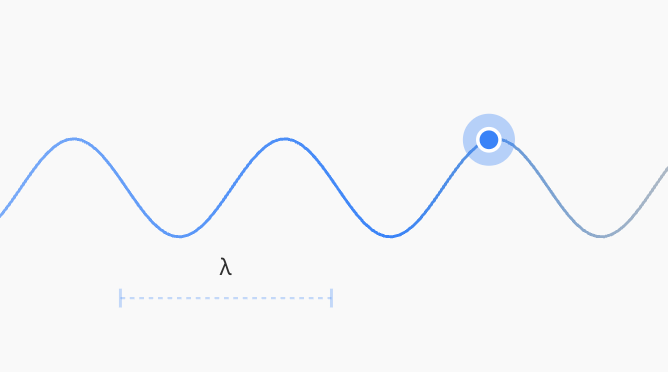
This equation connects wave speed, frequency, and wavelength. Since the allowed wavelengths on a string are fixed by the length of the string, changing the tension or mass of the string changes the frequencies that can be produced.
Musical instruments such as guitars, violins, pianos, and harps all rely on vibrating strings to produce sound. Musicians change pitch by adjusting string length, tension, or thickness. Pressing a guitar string against a fret shortens the vibrating length and increases the frequency. Tightening a tuning peg increases tension and raises the pitch. Thicker strings vibrate more slowly and produce deeper notes.
The harmonics produced by vibrating strings are also responsible for the unique sound quality, or timbre, of musical instruments. Although two instruments may play the same fundamental frequency, the relative strengths of their harmonics differ, giving each instrument its distinctive tone. Understanding vibrating strings and standing waves is therefore essential in both physics and music.
3. Pipes and Air Columns
Learning outcomes
- I can distinguish between open pipes and closed pipes based on their standing wave patterns and boundary conditions.
- I can identify the harmonics that can form in open and closed air columns.
- I can calculate wavelengths and frequencies for standing waves in pipes using harmonic relationships.
- I can explain how resonance produces amplified sound in air columns and wind instruments.
- I can compare standing wave patterns in strings and air columns, including similarities and differences in their harmonics.
4. Beats and Interference
Learning outcomes
- I can explain constructive and destructive interference using the principle of superposition.
- I can describe how beats are formed when two waves with slightly different frequencies interfere.
- I can calculate beat frequency from the frequencies of interfering sound waves.
- I can explain how musicians use beats to tune musical instruments accurately.
- I can analyze real-world examples of sound interference and describe their effects on wave amplitude and sound intensity.
When two or more waves meet in the same region of space, they combine according to the principle of superposition. This means that the total displacement of the medium at any point is equal to the sum of the individual displacements of the waves. The interaction of overlapping waves is called interference, and it can produce either larger or smaller amplitudes depending on how the waves combine.
When two waves meet in phase, their amplitudes add together to produce constructive interference. This results in a wave with a larger amplitude than either original wave. Constructive interference occurs when crests meet crests and troughs meet troughs. In sound waves, constructive interference produces a louder sound because the intensity of the wave increases.
When two waves meet out of phase, they produce destructive interference. In this case, the amplitudes partially or completely cancel each other out. Complete destructive interference occurs when a crest meets a trough of equal size, producing zero displacement at that point. For sound waves, destructive interference can reduce sound intensity or even create regions of near silence.
A particularly interesting form of interference occurs when two sound waves have frequencies that are very close, but not identical. The waves alternate between constructive and destructive interference, producing periodic changes in loudness called beats. Instead of hearing two separate notes, the listener hears a single tone whose volume rises and falls repeatedly.
The number of beats heard each second is called the beat frequency. The beat frequency is equal to the difference between the two interfering frequencies:
where
f1 and
f2 are the frequencies of the two sound waves.
Beats are extremely useful in tuning musical instruments. When two notes are slightly different in frequency, beats can be heard clearly. As the frequencies become closer together, the beat frequency decreases. When no beats are heard, the frequencies match and the instruments are considered properly tuned. Musicians often rely on this technique when tuning guitars, violins, pianos, and wind instruments.
Sound interference occurs in many real-world situations beyond music. Noise-canceling headphones use destructive interference to reduce unwanted sounds by producing sound waves that are out of phase with background noise. Concert halls and recording studios are carefully designed to manage sound interference and avoid echoes or dead spots. Interference effects are also important in sonar systems, medical ultrasound, and wave-based technologies.
The study of interference demonstrates how waves interact and combine to produce complex patterns. Constructive interference increases amplitude, destructive interference reduces amplitude, and beats reveal subtle differences between frequencies. These ideas are fundamental to understanding sound, acoustics, music, and many modern technologies involving waves.
5. The Doppler Effect
Learning outcomes
- I can explain how relative motion between a source and an observer causes a Doppler shift in observed frequency.
- I can distinguish between the effects of a moving source and a moving observer on wave frequency and wavelength.
- I can describe how radar and sonar systems use the Doppler effect to measure speed and motion.
- I can explain redshift and blueshift in electromagnetic waves and relate them to the motion of stars and galaxies.
- I can analyze applications of the Doppler effect in astronomy, medicine, navigation, and modern technology.