Circular Motion
| 站点: | Young Education |
| 课程: | Forces |
| 图书: | Circular Motion |
| 打印: | Gast |
| 日期: | 2026年09月25日 星期五 02:38 |
1. Motion in a Circle
Learning outcomes
- I can describe uniform circular motion.
- I can explain why velocity changes in circular motion.
- I can identify acceleration in circular motion.
- I can distinguish circular motion from linear motion.
- I can analyze examples of circular motion.


What Is Circular Motion?
Circular motion occurs when an object moves along a circular path around a fixed point or axis.
Examples include:
- a car travelling around a circular track
- a satellite orbiting Earth
- a rider on a Ferris wheel
- a point on a rotating fan blade
- a ball attached to a string being swung in a circle
- a point on the edge of a spinning wheel
- Earth moving approximately around the Sun
In each case, the direction of the object's motion is continually changing.
That changing direction is the key to understanding circular motion.
Uniform Circular Motion
Uniform circular motion occurs when an object moves around a circular path at constant speed.
The word uniform refers to the speed remaining constant.
For example, a car could travel around a circular track at:
10 m/s
without speeding up or slowing down.


However, something important is still changing:
the direction of motion.
Therefore, the object's velocity is changing even though its speed is constant.
Speed and Velocity Are Different
Speed tells us how fast an object is moving.
Speed is a scalar quantity.
Velocity tells us both:
- how fast an object is moving
- the direction in which it is moving
Velocity is a vector quantity.
Therefore:
velocity = speed + direction
This distinction is essential for understanding circular motion.
Constant Speed Does Not Mean Constant Velocity
Imagine a car travelling around a circular track at exactly:
20 m/s
At the top of the circle it may be travelling left.
At the bottom it may be travelling right.
On one side it may be travelling upward.
On the other side it may be travelling downward.


Its speed remains:
20 m/s
but its direction continually changes.
Therefore:
its velocity continually changes.
Velocity Is Tangent to the Circle
At any instant, the velocity of an object in circular motion points tangent to the circular path.
A tangent is a line that touches a circle at one point.

Therefore:
velocity → tangent to circle
while, as we will see:
acceleration → toward centre
These directions are perpendicular in uniform circular motion.
What Happens If the Circular Motion Stops?
Imagine a ball attached to a string being swung in a circle.
If the string suddenly breaks, the ball does not continue travelling around the circle.
Instead, it moves approximately along the tangent to the circle at the instant the string breaks.


This happens because the ball's instantaneous velocity was already pointing along the tangent.
Without the inward force, there is nothing to continually change the direction of that velocity.
Newton's First Law then describes the subsequent motion.
Circular Motion Involves Acceleration
Acceleration means:
the rate of change of velocity
An object accelerates whenever its velocity changes.
Velocity can change because:
- speed changes
- direction changes
- both speed and direction change
Therefore, an object moving at constant speed around a circle is still accelerating because its direction changes continuously.
Centripetal Acceleration
The acceleration of an object moving in a circle is directed:
toward the centre of the circle
This acceleration is called centripetal acceleration.
The word centripetal means:
centre-seeking


At every point around the circle:
velocity → tangent
acceleration → centre
Velocity and Acceleration Directions
This relationship is one of the most important ideas in circular motion.
Imagine an object at the right side of a circle moving counterclockwise.
Its velocity points:
upward
Its acceleration points:
left, toward the centre
At the top of the circle:
velocity points left
acceleration points down toward the centre.
At the left side:
velocity points down
acceleration points right.
At the bottom:
velocity points right
acceleration points up.

The directions continually change as the object moves.
Why Does Inward Acceleration Produce a Circle?
Imagine an object travelling forward.
If no force acts on it, Newton's First Law predicts that it will continue moving in a straight line.
Now imagine that its velocity is continually redirected slightly toward one side.
Its path bends.
If the direction changes continuously toward one fixed centre, the object can follow a circular path.
Circular motion therefore requires continuous inward acceleration.
Centripetal Acceleration and Speed
The magnitude of centripetal acceleration is:
a_c = v² / r
where:
- a_c = centripetal acceleration in m/s²
- v = speed in m/s
- r = radius of the circular path in m
This equation tells us two important things.
Higher speed → greater centripetal acceleration
Larger radius → smaller centripetal acceleration
Effect of Speed
Because:
a_c ∝ v²
centripetal acceleration depends on the square of speed.
If speed doubles:
a_c becomes 4 times greater
If speed triples:
a_c becomes 9 times greater


This is why travelling around a curve much faster requires a much greater inward acceleration.
Effect of Radius
Because:
a_c ∝ 1/r
increasing the radius decreases centripetal acceleration when speed remains constant.
For example:
double the radius → half the centripetal acceleration.
This helps explain why gentle, wide curves are easier to travel around at high speed than tight curves.
Example 1: Centripetal Acceleration
A car travels around a circular track at:
10 m/s
The radius is:
20 m
Calculate the centripetal acceleration.
a_c = v²/r
a_c = 10²/20
a_c = 100/20
a_c = 5 m/s²
The acceleration is:
5 m/s² toward the centre of the circle.
Example 2: Faster Motion
The same car now travels at:
20 m/s
around the same 20 m radius curve.
a_c = 20²/20
a_c = 400/20
a_c = 20 m/s²
The speed doubled from 10 m/s to 20 m/s.
But the acceleration increased from:
5 m/s² to 20 m/s²
That is four times greater.
Centripetal Force
Acceleration requires a resultant force.
Newton's Second Law tells us:
F = ma
Therefore, circular motion requires a resultant force directed toward the centre.
This inward resultant force is called the centripetal force.
Centripetal Force Is Not a New Type of Force
This is extremely important.
"Centripetal force" is not an additional force such as gravity, friction, tension, or normal force.
It is the name given to the resultant inward force that produces circular motion.


Different real forces can provide the centripetal force.
For example:
- tension can provide it
- gravity can provide it
- friction can provide it
- normal force can provide it
- a combination of forces can provide it
Ball on a String
Consider a ball attached to a string and swung horizontally in a circle.
The string pulls the ball toward the centre.


The inward force is provided by:
tension
Without the tension, the ball would no longer follow the circular path.
Car Turning on a Flat Road
When a car travels around a curve on a flat road, the tyres need an inward force.
That force is generally supplied by:
static friction between the tyres and the road


The friction force points toward the centre of the curved path.
If there is not enough friction, the car cannot follow the required circular path.
Why a Car May Skid
Suppose a car enters a curve too quickly.
The required centripetal acceleration increases with:
v²
Therefore, the required inward force also increases rapidly.
If the available tyre-road friction is insufficient, the car cannot turn as sharply as required and deviates from the intended circular path.
This is one reason excessive speed is particularly important on tight curves.
Satellites in Orbit
A satellite travelling around Earth is another example of circular or approximately circular motion.


The satellite has a tangential velocity.
Gravity pulls it toward Earth.
Gravity therefore provides the inward acceleration required for the orbit.
For an ideal circular orbit:
gravity provides the centripetal force.
Why Doesn't the Satellite Fall Straight Down?
A satellite is falling toward Earth.
However, it also has a large sideways velocity.
As it falls, Earth's curved surface falls away beneath it.
The result is continuous free fall around Earth.
This produces an orbit.
The satellite's velocity remains tangent to its path while gravitational acceleration points approximately toward Earth's centre.
Planets and Circular Motion
Planetary orbits are generally elliptical rather than perfectly circular.
However, circular motion provides a useful introductory model.


Gravity provides the inward force that continually changes the direction of a planet's velocity.
For a perfectly circular orbit, the speed would remain constant while the velocity direction continually changed.
Ferris Wheel
A rider on a Ferris wheel follows a circular path.


At every point:
velocity is tangent to the wheel.
Centripetal acceleration points toward the centre.
At the top:
acceleration points downward.
At the bottom:
acceleration points upward.
At the sides:
acceleration points horizontally toward the centre.
Rotating Fan
Consider a point near the end of a fan blade.


As the fan rotates:
- the point follows a circular path
- its velocity continually changes direction
- its acceleration points toward the axis of rotation
Points farther from the centre travel through a larger distance during each rotation.
Washing Machine Spin Cycle
During a washing machine's spin cycle, the drum rotates rapidly.


The drum exerts forces on the clothes that help keep them moving along a circular path.
Water can pass through holes in the drum and is no longer constrained in the same way.
This everyday device provides a useful example of circular motion and the need for inward force.
Amusement-Park Rides
Many amusement-park rides involve circular motion.
Examples include:
- Ferris wheels
- rotating swings
- looped tracks
- spinning platforms


In each case, some real force or combination of forces must provide the required inward resultant force.
The exact forces depend on the particular ride.
Circular Motion vs Linear Motion
Linear motion occurs along a straight path.
If an object moves in a straight line at constant speed:
- speed is constant
- direction is constant
- velocity is constant
- acceleration is zero
Uniform circular motion occurs along a circular path.
If speed remains constant:
- speed is constant
- direction changes
- velocity changes
- acceleration is not zero
This is the key difference.
Comparing the Two
For constant-velocity linear motion:
velocity → same magnitude and same direction
For uniform circular motion:
velocity → same magnitude but continuously changing direction
Therefore:
Linear constant velocity:
a = 0
Uniform circular motion:
a ≠ 0
even though speed is constant.
Is the Object Accelerating or Decelerating?
Students sometimes describe centripetal acceleration as "speeding up."
That is not necessarily correct.
In uniform circular motion:
speed remains constant
The acceleration changes the direction of the velocity rather than its magnitude.
Therefore, the object accelerates without speeding up.
Velocity Vector Changes
Consider two nearby points on a circular path.
At the first point, the velocity points in one direction.
A short time later, the velocity points in a slightly different direction.


The difference between these velocity vectors is:
Δv
For uniform circular motion, the change in velocity points inward.
Since:
a = Δv/Δt
the acceleration also points inward.
The Centre Is Special
In uniform circular motion, centripetal acceleration always points toward the instantaneous centre of curvature.
For a perfect circle, this is simply the centre of the circle.
As the object moves, the direction of acceleration therefore changes continuously.
The acceleration vector is not fixed in one compass direction.
It continually follows the object around the circle while pointing inward.
Example 3: Identify the Directions
A car moves clockwise around a circular track.
At the top of the track:
Velocity points:
right
Centripetal acceleration points:
down toward the centre
At the right side:
Velocity points:
down
Centripetal acceleration points:
left toward the centre
At the bottom:
Velocity points:
left
Centripetal acceleration points:
up toward the centre
At the left side:
Velocity points:
up
Centripetal acceleration points:
right toward the centre
Period and Circular Motion
The period, T, is the time required for one complete revolution.
It is measured in:
seconds
If an object completes one circle every 4 seconds:
T = 4 s


The distance travelled in one complete revolution is the circumference:
distance = 2πr
Therefore, for uniform circular motion:
v = 2πr/T
Example 4: Speed from Period
A rider travels around a circular ride of radius:
5 m
One revolution takes:
10 s
Distance per revolution:
2πr
= 2π(5)
≈ 31.4 m
Speed:
v = 31.4/10
v ≈ 3.14 m/s
Frequency
Frequency describes how many complete revolutions occur each second.
It is measured in:
hertz (Hz)
1 Hz means:
1 revolution per second
Period and frequency are related:
f = 1/T
and:
T = 1/f
For example, if:
T = 0.5 s
then:
f = 1/0.5
f = 2 Hz
The object completes two revolutions every second.
Speed and Frequency
Since:
v = 2πr/T
and:
f = 1/T
we can also write:
v = 2πrf
Therefore, at a fixed radius:
higher frequency → greater speed.
This is useful for rotating wheels, motors, fans, laboratory centrifuges, and other rotating systems.
Example 5: A Rotating Wheel
A point on a wheel is:
0.40 m
from the centre.
The wheel completes:
2 revolutions each second
Therefore:
f = 2 Hz
Speed:
v = 2πrf
v = 2π(0.40)(2)
v ≈ 5.0 m/s
The point moves at approximately:
5.0 m/s
along its circular path.
Different Points on a Rotating Object
Consider a rotating disc.
A point near the centre and a point near the edge complete each revolution in the same amount of time.
However, the point near the edge travels a greater distance.


Therefore, points farther from the centre have greater tangential speed when they share the same angular rotation rate.
This explains why the outer edge of a large rotating object can move very quickly.
Example 6: Circular Motion Analysis
A ball moves around a circle at constant speed.
Which quantities remain constant?
Mass: constant
Speed: constant
Radius: constant
Which quantities change?
Velocity: changes because direction changes
Acceleration direction: changes continuously while always pointing toward the centre
Therefore, uniform circular motion is accelerated motion despite having constant speed.
Example 7: What Happens If Speed Doubles?
An object moves around a circle of fixed radius.
Its original centripetal acceleration is:
3 m/s²
Its speed doubles.
Because:
a_c ∝ v²
the acceleration becomes:
4 × 3
= 12 m/s²
Doubling speed quadruples centripetal acceleration.
Example 8: What Happens If Radius Doubles?
An object moves at constant speed around a circle.
Its radius doubles.
Because:
a_c ∝ 1/r
the centripetal acceleration becomes:
half as large.
If the original acceleration was:
8 m/s²
the new acceleration is:
4 m/s²
Circular Motion and Newton's First Law
Newton's First Law states that an object remains at rest or continues moving with constant velocity unless acted upon by a resultant force.
An object moving in a circle does not have constant velocity.
Its direction changes.
Therefore:
there must be a resultant force.
That resultant force points inward.


If the inward resultant force disappears, the object moves approximately tangent to the circle.
Circular Motion and Newton's Second Law
Newton's Second Law states:
F_net = ma
In circular motion, the acceleration is inward.
Therefore, the resultant force must also point inward.
For uniform circular motion:
F_c = mv²/r
where:
- F_c = inward resultant or centripetal force
- m = mass
- v = speed
- r = radius
This equation will become especially important when solving quantitative circular-motion problems.
Example 9: Required Inward Force
A 2 kg object moves at:
6 m/s
around a circle of radius:
3 m
Centripetal acceleration:
a_c = 6²/3
a_c = 12 m/s²
Required inward force:
F = ma
F = 2 × 12
F = 24 N
Therefore, the system must provide a resultant force of:
24 N toward the centre.
Where Does Centripetal Force Come From?
The phrase centripetal force tells us the direction and role of the resultant force.
We still need to identify the real physical force producing it.
Examples:
Ball on string:
tension
Satellite:
gravity
Car on flat curve:
friction
Object against the wall of a rotating container:
normal force
Roller coaster:
often a combination of normal force and gravity


Always identify the actual forces in a free-body diagram.
Is There an Outward Force?
When sitting in a turning car, you may feel as though you are being pushed outward.
However, in an inertial frame, the force needed to make your body follow the circular path is directed inward.
Your body's inertia tends to keep it moving along its previous straight-line direction.
The car changes direction beneath and around you.
This can create the sensation of being pushed outward.
Centrifugal Force
You may encounter the term centrifugal force.
In a rotating reference frame, centrifugal force can be introduced as an apparent or inertial force to describe observations from within that rotating frame.
But when analyzing circular motion from an ordinary inertial reference frame, the physical resultant force on the object points:
inward
toward the centre.
For introductory free-body diagrams, do not automatically add an outward "centrifugal force" as another real interaction force.
Analyzing Circular Motion Examples
When you encounter a circular-motion situation, ask:
1. What object is moving?
2. Where is the centre of the circle?
3. Which direction is the velocity?
The velocity is tangent to the path.
4. Which direction is the acceleration?
Toward the centre.
5. What real force or forces produce the inward resultant?
Examples include gravity, friction, tension, or normal force.
6. Is the speed constant?
If yes, the motion may be uniform circular motion.
Example 10: Satellite
Object:
satellite
Path:
approximately circular orbit
Velocity:
tangent to orbit
Acceleration:
toward Earth's centre
Force providing acceleration:
gravity
Speed:
constant for an ideal circular orbit
Therefore:
uniform circular motion is a useful model.
Example 11: Car on a Circular Track
Object:
car
Velocity:
tangent to track
Acceleration:
toward centre of curve
Force providing horizontal inward acceleration on a flat road:
friction
If the car maintains constant speed:
uniform circular motion
If the car speeds up or slows down while turning:
the motion is circular but not uniform circular motion.
Non-Uniform Circular Motion
An object can move in a circle while changing its speed.
This is called non-uniform circular motion.
In this case, the object can have:
- inward centripetal acceleration
- tangential acceleration
The inward component changes direction.
The tangential component changes speed.


Uniform circular motion has constant speed, so it has no tangential acceleration.
Its acceleration is purely inward.
Real-World Example: Centrifuge
A centrifuge spins samples rapidly around a circular path.


High rotational speeds can produce very large centripetal accelerations.
Centrifuges are used in:
- scientific laboratories
- medicine
- biotechnology
- chemistry
They can help separate materials with different densities.
Real-World Example: Earth
Earth rotates around its axis approximately once every 24 hours.
A point on Earth's surface therefore follows a circular path around the rotation axis.
Points near the equator travel through a larger circle than points closer to the poles.


This means tangential speed due to Earth's rotation depends on distance from the rotation axis.
Common Mistakes
Mistake 1: Saying constant speed means zero acceleration
In circular motion, direction changes.
Therefore, velocity changes and acceleration exists.
Mistake 2: Pointing velocity toward the centre
Velocity points:
tangent to the circle
Acceleration points:
toward the centre
Mistake 3: Pointing centripetal acceleration outward
Centripetal acceleration always points inward.
Mistake 4: Treating centripetal force as an extra force
Centripetal force is the resultant inward force, not a separate interaction force.
Mistake 5: Saying a released object flies radially outward
If the inward force disappears, the object initially follows the tangent to its circular path.
Mistake 6: Confusing speed with velocity
Speed can remain constant while velocity changes because direction changes.
Mistake 7: Thinking circular motion violates Newton's First Law
Circular motion requires a resultant inward force precisely because the object would otherwise continue in a straight line.
Mistake 8: Assuming every circular motion is uniform
If speed changes, the circular motion is not uniform.
Mistake 9: Assuming gravity always points downward on a diagram
For an orbiting satellite, gravity points toward the centre of Earth.
Mistake 10: Automatically adding an outward centrifugal force to a free-body diagram
In an inertial reference frame, identify the actual physical forces and determine their inward resultant.
Did You Know?
A satellite in circular orbit is constantly accelerating even if its speed remains almost perfectly constant.


Its velocity continuously turns as gravity pulls it toward Earth.
If gravity suddenly disappeared, the satellite would not continue following its curved orbit.
It would initially move along the tangent to its orbit.
The same basic idea applies to a ball on a string, a car on a circular track, and a planet in orbit:
circular motion requires continuous inward acceleration.
Key Terms
Circular motion: Motion along a circular path.
Uniform circular motion: Circular motion at constant speed.
Speed: The rate at which distance is travelled.
Velocity: Speed in a specified direction.
Vector: A quantity with both magnitude and direction.
Acceleration: Rate of change of velocity.
Centripetal acceleration: Acceleration directed toward the centre of a circular path.
Centripetal force: The resultant inward force responsible for centripetal acceleration.
Tangent: A line touching a circle at one point; instantaneous velocity is tangent to the circular path.
Radius: Distance from the centre of a circle to the moving object.
Period: Time required for one complete revolution.
Frequency: Number of complete revolutions per second.
Revolution: One complete trip around a circular path.
Key Equations
Centripetal acceleration:
a_c = v²/r
Centripetal force:
F_c = mv²/r
Newton's Second Law:
F_net = ma
Circumference:
C = 2πr
Speed in uniform circular motion:
v = 2πr/T
Period and frequency:
f = 1/T
T = 1/f
Speed using frequency:
v = 2πrf
Key Takeaways
- Circular motion occurs when an object follows a circular path.
- Uniform circular motion means the object moves around the circle at constant speed.
- Constant speed does not mean constant velocity.
- Velocity changes continuously because its direction changes.
- Therefore, an object in uniform circular motion is accelerating.
- The velocity vector is always tangent to the circular path.
- Centripetal acceleration always points toward the centre.
- The magnitude of centripetal acceleration is a_c = v²/r.
- Increasing speed greatly increases centripetal acceleration because acceleration depends on speed squared.
- Increasing radius decreases centripetal acceleration when speed is unchanged.
- Circular motion requires a resultant inward force.
- The inward resultant is called the centripetal force.
- Centripetal force is not a new type of physical force.
- Tension, friction, gravity, normal force, or combinations of forces can provide the required inward force.
- If the inward force disappears, the object initially travels tangent to the circular path.
- Uniform circular motion differs from constant-velocity linear motion because circular motion has continuously changing direction and non-zero acceleration.
- Non-uniform circular motion involves changing speed as well as changing direction.
- The period is the time for one revolution, while frequency is the number of revolutions per second.
- Satellites, planets, cars turning, Ferris wheels, fan blades, centrifuges, and rotating machinery can all involve circular motion.
- A useful circular-motion reasoning chain is:
identify the circular path → locate the centre → draw velocity tangent to the path → draw acceleration toward the centre → identify the real inward force → determine whether speed is constant → analyze the motion.
2. Centripetal Force
Learning outcomes
- I can define centripetal force.
- I can identify sources of centripetal force.
- I can explain why centripetal force points toward the center.
- I can calculate centripetal force.
- I can analyze situations involving centripetal force.

What Is Centripetal Force?
When an object moves in a circle, its direction of motion continuously changes.
A change in velocity means that the object is accelerating, even when its speed remains constant.
This acceleration points toward the centre of the circular path and is called centripetal acceleration.
According to Newton's Second Law, acceleration requires a resultant force.
The resultant force directed toward the centre of a circular path is called the centripetal force.
Centripetal force = the net inward force that keeps an object moving along a circular path.
The word centripetal means:
centre-seeking
Centripetal Force Points Toward the Centre
In uniform circular motion:
- velocity points tangent to the circle
- acceleration points toward the centre
- resultant force points toward the centre


This relationship follows from Newton's Second Law:
F_net = ma
If acceleration points toward the centre, the net force must also point toward the centre.
Why Does the Object Need an Inward Force?
According to Newton's First Law, an object moving with no resultant force will continue moving in a straight line at constant velocity.
A circular path is not straight.
Therefore, something must continuously change the direction of the object's velocity.
That requires an inward force.
Without the inward force:
the object would leave the circular path and initially travel along a tangent.

The centripetal force does not pull the object "forward" around the circle.
Instead, it continuously redirects the object's velocity.
Centripetal Force Is Not a New Force
This is one of the most important ideas in this topic.
Centripetal force is not a separate type of force.
It is the name given to the net force directed toward the centre.
The actual physical force producing it might be:
- tension
- friction
- gravity
- normal force
- electric force
- a combination of several forces

Therefore, you should not automatically add "centripetal force" as an extra arrow on a free-body diagram.
Instead, identify the real forces and determine which forces combine to produce the inward resultant.
Centripetal Force Equation
The centripetal force required for uniform circular motion depends on:
- mass
- speed
- radius
Explore how each variable changes the required inward force:
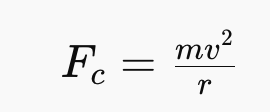
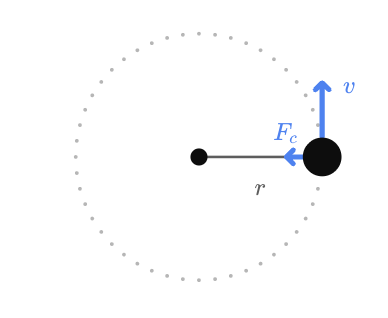
where:
- F_c = centripetal force in newtons (N)
- m = mass in kilograms (kg)
- v = speed in metres per second (m/s)
- r = radius in metres (m)
Where Does the Equation Come From?
Centripetal acceleration is:
a_c = v²/r
Newton's Second Law states:
F = ma
Substituting the centripetal acceleration:
F_c = m(v²/r)
Therefore:
F_c = mv²/r
This shows that centripetal force is simply Newton's Second Law applied to circular motion.
Effect of Mass
From:
F_c = mv²/r
centripetal force is directly proportional to mass.
F_c ∝ m
If mass doubles:
centripetal force doubles
If mass triples:
centripetal force triples
assuming speed and radius remain constant.


A heavier object requires a greater inward force to follow the same circular path at the same speed.
Effect of Speed
Centripetal force depends on the square of speed:
F_c ∝ v²
This has a very important consequence.
If speed doubles:
centripetal force becomes 4 times greater
If speed triples:
centripetal force becomes 9 times greater
If speed quadruples:
centripetal force becomes 16 times greater


This is why speed has such a large effect when vehicles travel around curves.
Effect of Radius
Centripetal force is inversely proportional to radius:
F_c ∝ 1/r
If radius doubles:
centripetal force becomes half as large
If radius triples:
centripetal force becomes one-third as large
assuming mass and speed remain constant.
Therefore:
tight curve → larger required force
wide curve → smaller required force
Example 1: Basic Centripetal Force
A 2 kg object moves at:
6 m/s
around a circular path with radius:
3 m
Calculate the centripetal force.
F_c = mv²/r
F_c = (2)(6²)/3
F_c = (2)(36)/3
F_c = 24 N
Therefore:
F_c = 24 N toward the centre
Always include the direction when describing centripetal force.
Example 2: A Car Turning
A 1000 kg car travels around a curve at:
10 m/s
The radius of the curve is:
50 m
Calculate the required centripetal force.
F_c = mv²/r
F_c = (1000)(10²)/50
F_c = 100 000/50
F_c = 2000 N
The car requires a net force of:
2000 N toward the centre of the curve.
What Provides the Force for the Car?
On a flat road, the horizontal centripetal force is generally provided by:
static friction between the tyres and the road


The tyres interact with the road, allowing the road to exert an inward frictional force on the car.
Therefore:
friction provides the centripetal force.
We should not draw both "friction" and a separate "centripetal force."
In this situation, friction is the force providing the required inward resultant.
What Happens If the Car Goes Faster?
Suppose the same car doubles its speed from:
10 m/s to 20 m/s
Original:
F_c = 2000 N
Because force depends on v²:
new force = 4 × 2000
new force = 8000 N
Doubling speed requires four times the inward force.
This helps explain why excessive speed makes cornering much more demanding.
What Happens If There Is Not Enough Friction?
The required centripetal force might be greater than the friction available between the tyres and road.
If this happens, the car cannot follow the desired circular path.


Instead, the vehicle tends to continue more nearly along its existing direction of motion.
This is particularly important on:
- wet roads
- icy roads
- loose surfaces
- high-speed curves
Example 3: Effect of Speed
A car requires:
3000 N
of centripetal force while travelling around a particular curve.
What force would be required if its speed doubled?
Because:
F_c ∝ v²
doubling speed gives:
F_new = 4F_original
F_new = 4(3000)
F_new = 12 000 N
Example 4: Effect of Radius
An object requires:
600 N
of centripetal force while moving around a circle of radius r.
If the radius doubles while mass and speed remain constant:
F_new = 600/2
F_new = 300 N
A larger-radius curve requires less inward force at the same speed.
Ball on a String
Consider a ball attached to a string and swung in a horizontal circle.
The string pulls inward on the ball.
The force is:
tension

Therefore:
tension provides the centripetal force
in a simplified horizontal circular-motion model.
If the required centripetal force is 15 N, the relevant inward tension component must provide 15 N.
Example 5: Ball on a String
A 0.50 kg ball moves at:
4 m/s
in a horizontal circle of radius:
2 m
Calculate the required centripetal force.
F_c = mv²/r
F_c = (0.50)(4²)/2
F_c = (0.50)(16)/2
F_c = 4 N
Therefore, the required inward force is:
4 N
What Happens If the String Breaks?
Before the string breaks:
- velocity is tangent to the circle
- tension pulls inward
After the string breaks:
- tension disappears
- there is no longer that inward force
- the ball initially moves tangent to the circular path


The ball does not fly directly outward along the radius.
Its inertia carries it along its instantaneous tangential direction.
Satellites and Centripetal Force
A satellite orbiting Earth requires an inward force.
That force is:
gravity

For an ideal circular orbit:
gravitational force = required centripetal force
Gravity continually changes the direction of the satellite's velocity.
The satellite is essentially falling around Earth.
Why Doesn't a Satellite Need a String?
A ball moving in a circle may need tension.
A car may need friction.
A satellite needs neither.
Gravity provides the inward force.
This demonstrates why "centripetal force" is not a specific type of force.
Different situations use different physical forces to produce the same effect:
inward acceleration.
Planets Orbiting the Sun
Planets also require an inward force to follow their curved orbital paths.
That force is:
gravitational attraction between the Sun and the planet

Real planetary orbits are elliptical rather than perfectly circular, but circular motion provides a useful introductory model.
Ferris Wheel
A rider on a Ferris wheel follows a circular path.
The required centripetal force always points toward the centre of the wheel.

At the top:
toward centre = downward
At the bottom:
toward centre = upward
At the side:
toward centre = horizontal
The direction of the required resultant force therefore changes continuously.
Centripetal Force Is a Net Force
This becomes especially important for vertical circular motion.
At the bottom of a Ferris wheel, for example, forces on a rider may include:
- normal force upward
- gravitational force downward
The centripetal force is not an additional third force.
Instead:
net inward force = combination of the real forces
At the bottom, inward is upward, so:
F_c = F_N − F_g
depending on the situation.
At the Top of a Circle
At the top of a vertical circle, inward points downward.
Therefore, forces pointing downward contribute to the centripetal resultant.
For a rider:
gravity may contribute toward the centre.
Depending on the system, normal force or tension may also contribute.
The key question is always:
Which direction is toward the centre?
Then analyze the real forces along that direction.
Example 6: Finding Speed
A 4 kg object experiences a centripetal force of:
100 N
while travelling in a circle of radius:
4 m
Find its speed.
Start with:
F_c = mv²/r
Substitute:
100 = (4)v²/4
100 = v²
v = 10 m/s
Example 7: Finding Radius
A 5 kg object moves at:
6 m/s
and requires a centripetal force of:
45 N
Find the radius.
F_c = mv²/r
Rearrange:
r = mv²/F_c
Substitute:
r = (5)(6²)/45
r = 180/45
r = 4 m
Example 8: Finding Mass
An object moves at:
8 m/s
around a circle of radius:
4 m
The centripetal force is:
32 N
Find its mass.
F_c = mv²/r
Rearrange:
m = F_cr/v²
Substitute:
m = (32)(4)/(8²)
m = 128/64
m = 2 kg
Centripetal Force and Free-Body Diagrams
Free-body diagrams are extremely useful for circular-motion problems.


A good method is:
1. Draw only the real forces.
Examples:
- weight
- normal force
- tension
- friction
2. Locate the centre of the circular path.
3. Determine which forces point toward or away from the centre.
4. Calculate the net inward force.
That net inward force equals:
mv²/r
Example 9: Identify the Centripetal Force
Consider each situation.
Car on a flat circular road
Source:
friction
Satellite orbiting Earth
Source:
gravity
Ball attached to a string
Source:
tension
Object pressed against the inside wall of a rotating drum
Source:
normal force
Planet orbiting the Sun
Source:
gravity
The source changes, but the required direction remains:
toward the centre.
Rotating Drum
Imagine an object inside a rotating cylindrical drum.
The wall pushes on the object.


The normal force from the wall can provide the inward force needed for circular motion.
Therefore:
normal force provides the centripetal force
in the radial direction.
Centrifuges
A laboratory centrifuge rotates samples at high speed.

Because centripetal acceleration depends on:
v²/r
very high speeds can produce very large accelerations.
Centrifuges are used in:
- medicine
- biotechnology
- chemistry
- biological research
to help separate components of mixtures.
Roller-Coaster Loops
A roller-coaster car moving through a loop follows a curved path.


At different points in the loop, different combinations of:
- gravity
- normal force
produce the required inward resultant.
The direction toward the centre changes as the car moves around the loop.
This makes vertical-circle problems especially useful for applying free-body diagrams.
Is There an Outward Centripetal Force?
No.
Centripetal means inward.
The required centripetal force always points toward the centre.
People inside turning vehicles sometimes feel as though they are being pushed outward.
This sensation is related to inertia and the choice of reference frame.
From an inertial reference frame, the physical net force producing the circular motion points inward.
Centrifugal Force
The term centrifugal force is sometimes used when describing motion from a rotating reference frame.
It is an apparent or inertial force introduced in that non-inertial frame.
For most introductory free-body diagrams viewed from an inertial frame:
do not draw centrifugal force as an additional real interaction force.
Instead, identify the real forces that produce the inward resultant.
Example 10: Analyzing a Turning Car
A 1200 kg car travels around a curve of radius:
60 m
at:
15 m/s
Required centripetal force:
F_c = mv²/r
F_c = (1200)(15²)/60
F_c = (1200)(225)/60
F_c = 4500 N
Therefore, the tyres and road must provide a net horizontal inward force of:
4500 N
If the available friction is less than this, the car cannot maintain that circular path at that speed.
Example 11: Same Car, Double Speed
Now the car travels at:
30 m/s
Same mass:
1200 kg
Same radius:
60 m
F_c = (1200)(30²)/60
F_c = (1200)(900)/60
F_c = 18 000 N
At 15 m/s:
4500 N
At 30 m/s:
18 000 N
The speed doubled.
The required centripetal force quadrupled.
Example 12: Wider Curve
The same 1200 kg car travels at 15 m/s, but the curve radius increases from:
60 m to 120 m
F_c = (1200)(15²)/120
F_c = 2250 N
Doubling the radius reduced the required centripetal force by half.
Why Road Curves Are Often Banked
Some high-speed roads and racetracks use banked curves.


On a banked surface, the normal force is tilted.
A component of that normal force can point toward the centre of the curve.
Therefore, the road itself can contribute to the required inward force rather than relying only on friction.
Why Speed Matters So Much
The equation:
F_c = mv²/r
contains v².
This means speed has a stronger effect on centripetal force than mass or radius.
For example:
2× mass → 2× force
2× speed → 4× force
2× radius → ½ force
This relationship is extremely important when analyzing vehicles, rotating machinery, amusement rides, and orbital systems.
Circular Motion in Sports
Centripetal force appears in many sports.


Examples include:
- hammer throwing
- swinging a bat
- swinging a golf club
- cycling around a curved track
- skating around a turn
- rotating gymnastics movements
The object or athlete needs an inward resultant force to maintain a curved path.
Hammer Throw Example
During a hammer throw, the athlete rotates the hammer around their body.
The cable exerts tension on the hammer.
That tension has an inward component that provides the required centripetal force.
As speed increases:
required force increases with v²
Therefore, high-speed rotation can produce very large tension forces.
Circular Motion in Space
Centripetal force is fundamental to orbital motion.

For an ideal circular orbit:
gravity = centripetal force
This relationship can be used to investigate:
- orbital speeds
- orbital radii
- satellite motion
- planetary motion
It connects Newton's laws of motion with Newton's law of universal gravitation.
A Reliable Centripetal Force Strategy
When solving a circular-motion problem:
Step 1: Identify the moving object.
What is following the circular path?
Step 2: Locate the centre.
Which direction is inward?
Step 3: Identify the real forces.
Examples:
- gravity
- friction
- tension
- normal force
Step 4: Determine the net inward force.
This is the centripetal force.
Step 5: Record the variables.
m = mass
v = speed
r = radius
Step 6: Use the centripetal-force relationship.
Relate the net inward force to mass, speed, and radius.
Step 7: Rearrange if necessary.
Solve for force, mass, speed, or radius.
Step 8: Include units.
Force → N
Mass → kg
Speed → m/s
Radius → m
Step 9: Include direction.
Centripetal force points:
toward the centre
Step 10: Check whether your answer is reasonable.
Higher speed should require substantially greater force.
Larger radius should require less force at the same speed.
Worked Problem 1
A 0.25 kg ball moves at 8 m/s around a circle of radius 2 m.
F_c = mv²/r
F_c = (0.25)(8²)/2
F_c = (0.25)(64)/2
F_c = 8 N
Answer:
8 N toward the centre
Worked Problem 2
A 1500 kg vehicle moves at 12 m/s around a curve of radius 80 m.
F_c = mv²/r
F_c = (1500)(12²)/80
F_c = (1500)(144)/80
F_c = 2700 N
Answer:
2700 N toward the centre
Worked Problem 3
A 3 kg object experiences an inward force of 48 N while moving at 8 m/s.
Find the radius.
r = mv²/F_c
r = (3)(8²)/48
r = 192/48
r = 4 m
Worked Problem 4
A 2 kg object moves around a circle of radius 5 m.
The required centripetal force is 40 N.
Find its speed.
F_c = mv²/r
40 = (2)v²/5
Multiply by 5:
200 = 2v²
v² = 100
v = 10 m/s
Worked Problem 5: Predict Before Calculating
Object A and Object B have the same mass and travel around circles with the same radius.
Object B moves three times faster.
How much greater is its centripetal force?
Because:
F_c ∝ v²
3² = 9
Object B requires:
9 times the centripetal force.
No full calculation was necessary.
Common Mistakes
Mistake 1: Drawing centripetal force as an extra force
Centripetal force is the net inward force produced by real forces.
Mistake 2: Pointing centripetal force outward
Centripetal force always points toward the centre.
Mistake 3: Pointing velocity toward the centre
Velocity is tangent to the circular path.
Force and acceleration point inward.
Mistake 4: Forgetting to square velocity
The equation contains:
v²
not v.
Mistake 5: Using diameter instead of radius
The equation requires the radius.
If given diameter:
r = diameter/2
Mistake 6: Assuming every circular-motion problem uses tension
Different forces can provide the centripetal resultant.
Mistake 7: Assuming gravity is an additional centripetal force in an orbit
For a simple circular orbit, gravity itself provides the required centripetal force.
Mistake 8: Adding an outward centrifugal force to every free-body diagram
For analysis from an inertial frame, identify the actual interaction forces instead.
Mistake 9: Thinking constant speed means no force
Constant speed around a circle still involves changing velocity and therefore requires a resultant force.
Did You Know?
One of the most useful features of the centripetal-force equation is how strongly it depends on speed.

A small increase in speed can produce a much larger required inward force.
For example:
10 m/s → force proportional to 100
20 m/s → force proportional to 400
30 m/s → force proportional to 900
This squared relationship explains why high-speed circular motion places large demands on tyres, tracks, cables, rotating machinery, and other structures.
Key Terms
Centripetal force: The net force directed toward the centre of a circular path.
Centripetal: Centre-seeking.
Circular motion: Motion along a circular path.
Centripetal acceleration: Acceleration directed toward the centre of a circular path.
Tangent: A line touching a circle at one point; instantaneous velocity points along the tangent.
Radius: Distance from the centre of the circle to the moving object.
Tension: Pulling force transmitted through a string, rope, or cable.
Friction: Force between surfaces that can provide an inward force when a vehicle turns.
Normal force: Contact force acting perpendicular to a surface.
Gravity: Attractive force between masses; it can provide centripetal force in orbital motion.
Resultant force: The vector sum of all forces acting on an object.
Key Equations
Centripetal acceleration:
a_c = v²/r
Centripetal force:
F_c = mv²/r
Newton's Second Law:
F_net = ma
Useful rearrangements:
m = F_cr/v²
v = √(F_cr/m)
r = mv²/F_c
Key Relationships
If mass increases:
F_c increases proportionally
If speed increases:
F_c increases with v²
If radius increases:
F_c decreases
Therefore:
F_c ∝ m
F_c ∝ v²
F_c ∝ 1/r
Key Takeaways
- Centripetal force is the net inward force required for circular motion.
- Centripetal means centre-seeking.
- Centripetal force always points toward the centre of the circular path.
- Velocity points tangent to the circular path.
- Circular motion requires an inward force because velocity continuously changes direction.
- Without the inward force, an object initially moves tangent to the circle.
- Centripetal force is not a new type of force.
- Tension, friction, gravity, normal force, electric force, or combinations of forces can provide the centripetal resultant.
- On a flat road, friction can provide the inward force for a turning car.
- For a ball on a string, tension can provide the inward force.
- For satellites and planets, gravity provides the inward force.
- Centripetal force follows the relationship F_c = mv²/r.
- Increasing mass increases the required force proportionally.
- Doubling speed quadruples the required force.
- Tripling speed increases the required force by a factor of nine.
- Increasing radius decreases the required force when speed remains constant.
- Free-body diagrams should contain the real physical forces, not an additional "centripetal force" arrow.
- In vertical circular motion, several forces may combine to produce the required inward resultant.
- Centripetal-force concepts apply to vehicles, satellites, planets, centrifuges, amusement rides, rotating machinery, and sports.
- A reliable analysis follows:
locate the centre → identify the real forces → determine the net inward force → relate it to mass, speed, and radius → solve → state the direction toward the centre.
3. Centripetal Acceleration
Learning outcomes
- I can define centripetal acceleration.
- I can calculate centripetal acceleration.
- I can relate acceleration to speed and radius.
- I can compare circular systems with different radii and speeds.
- I can solve problems involving centripetal acceleration.


What Is Centripetal Acceleration?
An object moving around a circular path is constantly changing its direction.
Because velocity includes direction, changing direction means changing velocity.
A change in velocity means that the object is accelerating.
The acceleration directed toward the centre of a circular path is called centripetal acceleration.
The word centripetal means:
centre-seeking
Therefore:
centripetal acceleration = acceleration directed toward the centre of a circular path.
Constant Speed but Changing Velocity
An object can have:
constant speed
while still having:
changing velocity
This happens during uniform circular motion.


Imagine a car travelling around a circular track at exactly 15 m/s.
Its speed remains 15 m/s.
However:
- at one point it travels north
- later it travels west
- later it travels south
- later it travels east
Its direction changes continuously.
Therefore, its velocity changes continuously.
So the car is accelerating.
Direction of Centripetal Acceleration
Centripetal acceleration always points:
toward the centre of the circular path
At the same time, the object's instantaneous velocity points:
tangent to the circular path
Therefore, in uniform circular motion:
velocity → tangent
centripetal acceleration → centre
The two vectors are perpendicular at each instant.
Why Does Acceleration Point Inward?
Acceleration describes how velocity changes.
Consider an object at two nearby points on a circular path.
Its speed may be the same at both points, but the velocity vectors point in slightly different directions.
The change in velocity, Δv, points toward the inside of the circular path.


Since:
a = Δv/Δt
the acceleration also points inward.
This inward acceleration continuously turns the velocity vector and keeps the object following the curved path.
What Happens Without Centripetal Acceleration?
Newton's First Law tells us that an object with no resultant force continues moving with constant velocity.
That means:
straight-line motion
If the inward acceleration disappeared, the object would no longer follow the circle.
It would initially move along a line tangent to the circle.
Centripetal acceleration is therefore what continually changes the direction of the object's velocity.
Calculating Centripetal Acceleration
The magnitude of centripetal acceleration is:
a_c = v²/r
where:
- a_c = centripetal acceleration in m/s²
- v = speed in m/s
- r = radius of the circular path in m
This equation shows that centripetal acceleration depends on:
speed
and:
radius
Notice that mass does not appear in the equation.
Mass Does Not Affect Centripetal Acceleration Directly
Suppose two objects travel around the same circular path at the same speed.
Object A has a mass of 2 kg.
Object B has a mass of 20 kg.
Because:
a_c = v²/r
both objects have the same centripetal acceleration.
However, the heavier object requires a greater centripetal force because:
F = ma
This is an important difference between centripetal acceleration and centripetal force.
Effect of Speed
From:
a_c = v²/r
centripetal acceleration is proportional to the square of speed:
a_c ∝ v²
This means speed has a very strong effect.
If speed doubles:
acceleration becomes 4 times greater
If speed triples:
acceleration becomes 9 times greater
If speed quadruples:
acceleration becomes 16 times greater


A relatively small increase in speed can therefore produce a large increase in centripetal acceleration.
Example 1: Basic Calculation
A car travels at:
10 m/s
around a circular curve of radius:
20 m
Calculate its centripetal acceleration.
Use:
a_c = v²/r
Substitute:
a_c = 10²/20
a_c = 100/20
a_c = 5 m/s²
Therefore:
a_c = 5 m/s² toward the centre
Example 2: Doubling the Speed
The same car travels around the same 20 m radius curve at:
20 m/s
Calculate the centripetal acceleration.
a_c = 20²/20
a_c = 400/20
a_c = 20 m/s²
Compare:
At 10 m/s:
a_c = 5 m/s²
At 20 m/s:
a_c = 20 m/s²
The speed doubled.
The centripetal acceleration became:
4 times greater.
Why Speed Is Squared
The v² relationship means that faster circular motion becomes increasingly demanding.
Consider the same curve:
5 m/s → v² = 25
10 m/s → v² = 100
15 m/s → v² = 225
20 m/s → v² = 400
The speed increases evenly, but v² increases much more rapidly.


This is one reason high-speed cornering produces much larger accelerations than low-speed cornering.
Effect of Radius
Centripetal acceleration is inversely proportional to radius:
a_c ∝ 1/r
Therefore:
larger radius → smaller centripetal acceleration
smaller radius → larger centripetal acceleration
assuming speed remains constant.
If radius doubles:
acceleration becomes half as large
If radius triples:
acceleration becomes one-third as large
Example 3: Changing Radius
A car travels at 12 m/s around a curve of radius 24 m.
a_c = 12²/24
a_c = 144/24
a_c = 6 m/s²
Now suppose the radius doubles to:
48 m
a_c = 144/48
a_c = 3 m/s²
Doubling the radius reduced the acceleration by half.
Tight Curves vs Wide Curves
Imagine two cars travelling at the same speed.
Car A travels around a tight curve.
Car B travels around a wide curve.


The car on the tighter curve has the greater centripetal acceleration.
Why?
Its direction must change more rapidly.
A larger-radius curve changes the direction of motion more gradually.
Comparing Circular Systems
The equation:
a_c = v²/r
allows us to compare circular systems without always calculating exact values.
For example:
System A:
v = 10 m/s
r = 20 m
System B:
v = 20 m/s
r = 40 m
For System A:
a_A = 10²/20 = 5 m/s²
For System B:
a_B = 20²/40 = 10 m/s²
Even though System B has twice the radius, its doubled speed has a larger effect because speed is squared.
Therefore:
System B has twice the centripetal acceleration.
Ratio Method
We can compare two systems using:
a₂/a₁ = (v₂²/r₂) ÷ (v₁²/r₁)
which can be rearranged to:
a₂/a₁ = (v₂/v₁)²(r₁/r₂)
This is useful when the question asks:
"How many times larger?"
rather than asking for an exact acceleration.
Example 4: Compare Two Systems
System B has:
- twice the speed of System A
- twice the radius of System A
How do their centripetal accelerations compare?
Speed effect:
2² = 4
Radius effect:
÷ 2
Therefore:
4 ÷ 2 = 2
System B has:
2 times the centripetal acceleration of System A.
Example 5: Same Speed, Different Radius
Object A travels around a circle of radius:
2 m
Object B travels around a circle of radius:
8 m
Both travel at:
4 m/s
Object A:
a_A = 4²/2 = 8 m/s²
Object B:
a_B = 4²/8 = 2 m/s²
Therefore:
Object A has four times the centripetal acceleration.
Example 6: Same Radius, Different Speed
Object A:
v = 3 m/s
Object B:
v = 6 m/s
Both move around circles with radius:
4 m
Object A:
a_A = 3²/4 = 2.25 m/s²
Object B:
a_B = 6²/4 = 9 m/s²
Object B moves twice as fast but experiences:
four times the centripetal acceleration.
Cars Turning
A car travelling around a curved road experiences centripetal acceleration toward the centre of the curve.


If the car travels faster:
a_c increases strongly
If the curve becomes tighter:
a_c increases
This helps explain why tight curves often require lower speeds.
Example 7: Car on a Curve
A car travels at:
18 m/s
around a curve of radius:
54 m
Calculate the centripetal acceleration.
a_c = 18²/54
a_c = 324/54
a_c = 6 m/s²
The acceleration is:
6 m/s² toward the centre of the curve.
Satellites and Centripetal Acceleration
A satellite in a circular orbit constantly changes direction.
Therefore, it experiences centripetal acceleration.

The acceleration points toward Earth's centre.
For a satellite, this centripetal acceleration is produced by:
gravity
The satellite can maintain approximately constant speed while its velocity continuously changes direction.
Why Satellites Are Accelerating
A satellite may appear to move smoothly around Earth at nearly constant speed.
But acceleration does not require a change in speed.
It requires a change in:
velocity
Because the satellite's direction changes continuously:
velocity changes
Therefore:
the satellite accelerates continuously.
Planets and Circular Motion
Planetary orbits are elliptical, but a circular orbit can be used as a useful simplified model.

For an ideal circular orbit:
velocity → tangent
centripetal acceleration → toward the Sun
gravity → provides the required inward acceleration.
Ferris Wheel
A rider on a Ferris wheel moves around a circular path.
The rider's centripetal acceleration always points toward the centre.


At the top:
acceleration points downward.
At the bottom:
acceleration points upward.
At the right side:
acceleration points left.
At the left side:
acceleration points right.
The magnitude may remain constant during uniform circular motion, but its direction continuously changes.
Rotating Wheels
A point on the edge of a rotating wheel experiences centripetal acceleration toward the centre.
A point closer to the centre follows a smaller circular path.


How the accelerations compare depends on what is held constant.
If the points have the same linear speed, the smaller-radius point has greater centripetal acceleration.
However, points fixed on the same rigid rotating wheel share the same angular speed, and points farther from the axis have greater linear speed. In that case, their centripetal acceleration increases with radius.
This distinction is important in more advanced circular-motion analysis.
Period and Centripetal Acceleration
The period, T, is the time required for one complete revolution.
The distance travelled in one revolution is:
2πr
Therefore:
v = 2πr/T
Substituting this into:
a_c = v²/r
gives:
a_c = 4π²r/T²
This equation allows us to calculate centripetal acceleration using radius and period.
Example 8: Using Period
An object moves in a circle of radius:
2 m
and completes one revolution every:
4 s
Use:
a_c = 4π²r/T²
Substitute:
a_c = 4π²(2)/4²
a_c = 8π²/16
a_c ≈ 4.93 m/s²
Therefore:
a_c ≈ 4.9 m/s² toward the centre.
Frequency and Centripetal Acceleration
Frequency is:
f = 1/T
Since:
v = 2πrf
we can substitute into the centripetal acceleration equation:
a_c = (2πrf)²/r
Therefore:
a_c = 4π²rf²
This is useful for rotating systems where frequency is known.
Example 9: Using Frequency
A point moves in a circle of radius:
0.50 m
at a frequency of:
2 Hz
Use:
a_c = 4π²rf²
a_c = 4π²(0.50)(2²)
a_c = 8π²
a_c ≈ 79 m/s²
This is much larger than Earth's gravitational acceleration.
Rapid rotation can therefore produce very large centripetal accelerations.
Centrifuges
Laboratory centrifuges demonstrate this dramatically.


A centrifuge rotates samples at high speed.
Because:
a_c ∝ v²
high rotational speeds can produce accelerations many times greater than gravitational acceleration near Earth's surface.
This allows substances with different properties to separate more quickly.
Centrifuges are widely used in:
- biology
- medicine
- biotechnology
- chemistry
Comparing Centripetal Acceleration with g
Near Earth's surface:
g ≈ 9.8 m/s²
Suppose a rotating system produces:
a_c = 49 m/s²
Then:
49/9.8 = 5
The acceleration is approximately:
5g
This means its magnitude is about five times Earth's gravitational acceleration.
Centripetal Acceleration and Centripetal Force
Centripetal acceleration and centripetal force are closely connected but are not the same quantity.
Centripetal acceleration:
a_c = v²/r
Centripetal force:
F_c = ma_c
Therefore:
F_c = mv²/r
The acceleration depends on:
- speed
- radius
The required force also depends on:
- mass

A more massive object does not automatically have greater centripetal acceleration, but it requires more force to produce the same acceleration.


4. Banking and Curved Motion
Learning outcomes
- I can explain why roads and tracks are banked.
- I can identify forces acting on objects moving around curves.
- I can analyze the role of friction in turning.
- I can apply circular motion concepts to transportation systems.
- I can solve problems involving banked curves.

What Is a Banked Curve?
A banked curve is a curved road or track in which the outside edge is raised above the inside edge.
Instead of the road being completely horizontal, the surface is tilted at an angle.
Banking is commonly found on:
- racetracks
- highways
- cycling tracks
- railway curves
- some amusement rides
The purpose of banking is to help provide the inward force needed for circular motion.
Why Does a Turning Vehicle Need an Inward Force?
A vehicle travelling around a curve is constantly changing direction.
Changing direction means changing velocity.
Therefore, the vehicle has centripetal acceleration directed toward the centre of the curve.
The required acceleration is:
a_c = v²/r
where:
- a_c = centripetal acceleration
- v = speed
- r = radius of the curve
According to Newton's Second Law, this acceleration requires a net inward force.


That required inward force is:
F_c = mv²/r
Centripetal Force Is the Net Inward Force
Remember that centripetal force is not an additional type of force.
It is the name given to the net force directed toward the centre of a circular path.
For a turning vehicle, the actual forces may include:
- weight
- normal force
- friction
The combination of these forces produces the required inward resultant.
A Car Turning on a Flat Road
First consider a car travelling around a curve on a flat road.
The main forces are:
Weight, mg
Acts vertically downward.
Normal force, N
Acts vertically upward.
Friction
Can act horizontally toward the centre of the curve.


Vertically:
N = mg
if there is no vertical acceleration.
Horizontally, friction provides the centripetal force:
F_f = mv²/r
Therefore, on a flat road, turning depends strongly on tyre-road friction.
What Type of Friction Is Involved?
When tyres roll normally without sliding, the relevant friction is generally static friction.
This may sound surprising because the car is moving.
However, the point of the tyre touching the road does not continuously slide across the road during normal rolling.
Therefore, static friction can provide the sideways force needed for turning.
If the tyres begin to slide, the situation changes and control can be reduced.
Why Can a Car Skid on a Curve?
The amount of friction available between the tyres and road is limited.
If the required centripetal force becomes too large, the available friction may be insufficient.
Since:
F_c = mv²/r
the required force increases when:
- mass increases
- speed increases
- radius decreases
Speed is especially important because it is squared.


A car travelling too quickly around a tight curve may therefore be unable to follow the intended circular path.
The Effect of Speed
Suppose a car travels around the same curve but doubles its speed.
Because:
F_c ∝ v²
doubling speed requires:
4 times the centripetal force
For example:
10 m/s → required force = F
20 m/s → required force = 4F
30 m/s → required force = 9F
This is one reason road speed limits are often lower on sharp curves.
The Effect of Radius
For constant speed:
F_c ∝ 1/r
A smaller radius means a tighter turn.
Therefore:
small radius → larger required inward force
large radius → smaller required inward force


Wide curves allow vehicles to change direction more gradually.
Why Bank a Road?
On a flat road, the horizontal inward force must usually come primarily from friction.
Banking tilts the road surface.
This also tilts the normal force exerted by the road on the vehicle.


The tilted normal force has:
- a vertical component
- a horizontal component
The horizontal component can contribute to the centripetal force.
This reduces how much the vehicle must rely on friction for turning.
Forces on a Banked Curve
Consider a vehicle on a banked road.
The basic forces are:
Weight
mg
directed vertically downward.
Normal force
N
directed perpendicular to the road surface.
Friction
may act along the road surface, depending on the vehicle's speed and conditions.
The normal force is tilted because the road is tilted.
Resolving the Normal Force
Suppose the road is banked at an angle:
θ
The normal force can be resolved into components.
Vertical component:
N cos θ
Horizontal component:
N sin θ

The vertical component helps balance the vehicle's weight.
The horizontal component points toward the centre of the curve and can provide centripetal force.
Ideal Banked Curve
There is a particularly useful case where the vehicle can travel around the curve without needing friction.
This is sometimes called the design speed or ideal-speed condition for the bank.
The forces are then simply:
- weight, mg
- normal force, N
Vertically:
N cos θ = mg
Horizontally:
N sin θ = mv²/r
Deriving the Banked-Curve Equation
Start with:
N sin θ = mv²/r
and:
N cos θ = mg
Divide the first equation by the second:
(N sin θ)/(N cos θ) = (mv²/r)/(mg)
Cancel N and m:
tan θ = v²/(rg)
Therefore:
v² = rg tan θ
and:
v = √(rg tan θ)
This equation gives the ideal speed for a frictionless banked curve.
An Important Result
Notice that mass does not appear in:
v = √(rg tan θ)
Therefore, in the idealized frictionless model, the design speed of a banked curve does not depend on vehicle mass.
A light car and a heavy car travelling around the same banked curve have the same ideal speed.
Their required forces are different, but their accelerations are the same.
Example 1: Finding the Ideal Speed
A road has:
radius = 50 m
bank angle = 20°
Find the ideal speed if friction is not required.
Use:
v = √(rg tan θ)
Take:
g = 9.8 m/s²
Then:
v = √[(50)(9.8)(tan 20°)]
v ≈ √178.3
v ≈ 13.4 m/s
Therefore, the ideal speed is approximately:
13.4 m/s
This is about:
48 km/h
Why the Mass Cancels
Suppose the vehicle is twice as massive.
It requires twice as much centripetal force:
F_c = mv²/r
But it also experiences twice as much weight:
F_g = mg
This results in a proportionally larger normal force.
Therefore, the same bank angle can support the same ideal speed regardless of vehicle mass in the simplified frictionless model.
Example 2: Finding the Bank Angle
A curve has radius:
100 m
and is designed for a speed of:
20 m/s
Find the ideal banking angle.
Start with:
tan θ = v²/(rg)
Substitute:
tan θ = 20²/[(100)(9.8)]
tan θ = 400/980
tan θ ≈ 0.408
Therefore:
θ = tan⁻¹(0.408)
θ ≈ 22.2°
The road should be banked at approximately:
22°
in this idealized model.
Example 3: Finding Radius
A racetrack is banked at:
30°
and has an ideal speed of:
25 m/s
Find the radius.
Start with:
tan θ = v²/(rg)
Rearrange:
r = v²/(g tan θ)
Substitute:
r = 25²/[9.8(tan 30°)]
r ≈ 110 m
Therefore, the curve has a radius of approximately:
110 m
What Happens at the Design Speed?
At the ideal design speed:
- the horizontal component of normal force provides the required centripetal force
- the vertical component balances weight
- friction is not required in the simplified model


This does not mean real roads have no friction.
It means the geometry of the bank can provide the necessary inward force at one particular speed even if friction is neglected.
What If the Car Travels Faster?
Suppose a vehicle travels faster than the ideal speed.
The required centripetal force becomes larger because:
F_c ∝ v²
The normal force alone may no longer provide the required inward component.
Friction can then contribute to the inward resultant.
For a vehicle tending to slide up the bank, friction acts down the slope, opposing that tendency.
What If the Car Travels More Slowly?
If a vehicle travels significantly slower than the ideal speed, it may tend to slide down the bank.
Static friction can act up the slope to oppose that tendency.


Therefore, the direction of friction on a banked curve is not always the same.
It depends on the vehicle's tendency to slip relative to the road.
Friction Does Not Always Point Toward the Centre
This is an important point.
On a flat curve, friction usually points horizontally toward the centre.
On a banked curve, friction acts along the surface.
Depending on the speed:
- friction may act up the slope
- friction may act down the slope
- at the ideal speed, friction may not be needed
Always determine the direction of the tendency to slide before assigning the friction direction.
Free-Body Diagram for a Banked Curve
A good free-body diagram should include only real forces.

Include:
mg vertically downward
N perpendicular to the road
f along the road if friction is involved
Do not add a separate arrow labelled "centripetal force."
The centripetal force is the net inward component of the real forces.
Example 4: Comparing Two Curves
Curve A:
radius = 50 m
Curve B:
radius = 100 m
Both are banked at the same angle.
Since:
v = √(rg tan θ)
the larger-radius curve has a larger ideal speed.
If radius doubles:
v increases by √2
not by a factor of 2.
Therefore, Curve B's ideal speed is approximately:
1.41 times greater
than Curve A's.
Example 5: Comparing Bank Angles
Two curves have the same radius.
Curve A:
θ = 10°
Curve B:
θ = 30°
Since:
v² = rg tan θ
the curve with the larger bank angle supports a higher ideal speed.
A steeper bank produces a larger horizontal component of the normal force.
Why Racetracks Have Steep Banking
Race cars travel at very high speeds.
Because:
F_c = mv²/r
high speed produces a very large required inward force.


Banking allows part of the normal force from the track to contribute to the required inward force.
This can reduce dependence on tyre-road friction and allows curves to be negotiated under a wider range of conditions, though real vehicle dynamics are considerably more complex.
Velodromes
Cycling tracks often have strongly banked curves.


Cyclists can travel around the bends at high speeds.
The banked surface allows the normal force from the track to contribute to the inward resultant.
The cyclist and bicycle may also lean while turning.
Why Cyclists Lean
A cyclist turning on a flat road usually leans toward the centre of the curve.
The road exerts forces on the tyres while gravity acts downward.


Leaning helps align the resultant contact force appropriately relative to the rider-bike system, allowing the turn to occur without the system simply tipping outward.
Motorcyclists use the same principle.
Higher speeds or tighter turns generally require greater lean angles.
Railways and Superelevation
Railway curves can also be banked.
In railway engineering, raising one rail above the other is often called superelevation or cant.


The tilted track allows the contact force from the rails to contribute to the required inward acceleration.
This can improve passenger comfort and reduce lateral loading at the intended operating speed.
Highway Banking
Highway curves may also use banking or superelevation.
The bank helps vehicles negotiate the curve by allowing the road's normal force to have an inward component.
However, real road design must account for much more than the simple frictionless equation, including:
- different vehicle speeds
- tyre-road friction
- wet conditions
- vehicle dimensions
- road geometry
- safety margins
The simple physics model provides the foundation for understanding why banking works.
Aircraft Turning
Banking is not limited to roads.
Aircraft bank when turning.


When an aircraft banks, the lift force tilts.
The lift can then be resolved into:
- a vertical component
- a horizontal component
The horizontal component contributes to the centripetal force required for the turn.
This is conceptually similar to the tilted normal force on a banked road.
Banking an Aircraft More Steeply
A steeper aircraft bank gives the lift force a larger horizontal component.
This allows a greater inward acceleration, provided sufficient total lift is maintained.
Therefore, banking allows an aircraft to change direction rather than simply continuing straight ahead.
The exact flight dynamics involve additional aerodynamic considerations, but the circular-motion principle is the same.
Amusement Rides
Banking is also important in roller coasters and other amusement rides.


Tracks can be tilted so that the forces from the seat and track help produce the inward acceleration required for the turn.
Banking can also change how forces are distributed on riders.
Example 6: Highway Curve
A highway curve has:
radius = 75 m
bank angle = 15°
Calculate its ideal speed.
v = √(rg tan θ)
v = √[(75)(9.8)(tan 15°)]
v ≈ √197
v ≈ 14.0 m/s
Convert to km/h:
14.0 × 3.6 ≈ 50.4 km/h
Ideal speed:
approximately 50 km/h
under the frictionless model.
Example 7: Racetrack
A racetrack has a curve of radius:
200 m
banked at:
25°
Calculate the ideal speed.
v = √(rg tan θ)
v = √[(200)(9.8)(tan 25°)]
v ≈ 30.2 m/s
Convert:
30.2 × 3.6 ≈ 109 km/h
Therefore, the ideal speed is approximately:
30 m/s or 109 km/h
Example 8: Determine the Banking Angle
A track has radius:
150 m
and is designed for an ideal speed of:
25 m/s
Use:
tan θ = v²/(rg)
tan θ = 25²/[(150)(9.8)]
tan θ ≈ 0.425
Therefore:
θ ≈ 23°
The required ideal banking angle is approximately:
23°
Example 9: Which Curve Requires More Banking?
Two roads have the same radius.
Road A is designed for:
10 m/s
Road B is designed for:
20 m/s
Because:
tan θ = v²/(rg)
Road B requires a much larger value of tan θ.
Doubling the design speed makes:
v² four times larger
Therefore, substantially more banking is required.
Example 10: Radius and Speed Change Together
Curve A:
r = 50 m
v = 10 m/s
Curve B:
r = 100 m
v = 20 m/s
Compare:
Curve A:
v²/r = 100/50 = 2
Curve B:
v²/r = 400/100 = 4
Curve B requires:
twice the centripetal acceleration
and therefore a larger ideal bank angle.
Banking and Passenger Comfort
When a vehicle turns on a flat surface, passengers may feel strong sideways effects as their direction changes.
Banking changes the orientation of the supporting force.

Well-designed banking can reduce the lateral force passengers experience relative to the vehicle.
This is one reason banking is important in:
- railway systems
- high-speed roads
- amusement rides
Designing Transportation Systems
Transportation engineers must consider circular-motion physics when designing curves.
Important variables include:
Speed
Higher speeds require greater centripetal acceleration.
Radius
Larger-radius curves reduce required acceleration at a given speed.
Bank angle
Greater banking can provide a larger inward component of the normal force.
Friction
Provides additional force when vehicles travel above or below the ideal speed.
Surface conditions
Wet or icy surfaces reduce available friction.
These factors must be considered together.
A Reliable Banked-Curve Strategy
For an ideal frictionless banked-curve problem:
Step 1: Draw the forces.
Include:
- mg downward
- N perpendicular to the surface
Step 2: Identify the centre of the curve.
This determines the inward direction.
Step 3: Resolve the normal force.
Vertical:
N cos θ
Horizontal:
N sin θ
Step 4: Apply vertical equilibrium.
N cos θ = mg
Step 5: Apply circular motion horizontally.
N sin θ = mv²/r
Step 6: Divide the equations.
This eliminates N and m:
tan θ = v²/(rg)
Step 7: Solve for the required variable.
Speed:
v = √(rg tan θ)
Radius:
r = v²/(g tan θ)
Angle:
θ = tan⁻¹(v²/rg)
Step 8: Check the result.
Higher speed should require:
- greater banking, or
- larger radius
for the ideal frictionless case.
Common Mistakes
Mistake 1: Adding centripetal force as an extra force
Centripetal force is the net inward result of the real forces.
Mistake 2: Assuming friction always provides all the centripetal force
On a banked road, the horizontal component of the normal force contributes to the inward resultant.
Mistake 3: Assuming friction always points toward the centre
On a banked surface, friction acts along the surface and may point up or down the slope depending on the tendency to slip.
Mistake 4: Drawing the normal force vertically
The normal force is always:
perpendicular to the surface
Therefore, on a banked road, it is tilted.
Mistake 5: Drawing weight perpendicular to the road
Weight always points:
vertically downward
Mistake 6: Using the diameter instead of radius
Circular-motion equations use:
radius
Mistake 7: Forgetting to square speed
Both:
F_c = mv²/r
and:
tan θ = v²/(rg)
contain v².
Mistake 8: Assuming a banked curve works at only one speed
The frictionless model gives one ideal speed at which friction is unnecessary. Real vehicles can negotiate a range of speeds because friction can contribute.
Mistake 9: Thinking vehicle mass determines the ideal bank angle
Mass cancels from the ideal frictionless banked-curve equation.
Did You Know?
Banking appears in transportation systems that seem very different from one another.


A race car on a banked track, a cyclist in a velodrome, a train on a canted railway, and an aircraft making a banked turn all use the same underlying idea.
A support or lift force is tilted so that part of it points toward the centre of the curved path.
The exact force is different:
car → normal/contact forces from road
train → forces from rails
aircraft → aerodynamic lift
but the physics requirement is the same:
a net inward force is needed to change the direction of motion.
Key Terms
Banked curve: A curved surface tilted so that its outside edge is higher than its inside edge.
Bank angle: The angle between the banked surface and the horizontal.
Centripetal force: The net force directed toward the centre of a circular path.
Centripetal acceleration: Acceleration directed toward the centre of a circular path.
Normal force: Contact force acting perpendicular to a surface.
Friction: Force that opposes relative motion or the tendency for surfaces to slide.
Static friction: Friction acting when surfaces are not sliding relative to one another at the point of contact.
Design speed: The speed at which a simplified banked curve can provide the required centripetal acceleration without relying on friction.
Superelevation: Banking used on roads or railway tracks.
Radius: Distance from the centre of the circular path to the moving object.
Key Equations
Centripetal acceleration:
a_c = v²/r
Centripetal force:
F_c = mv²/r
For an ideal frictionless banked curve:
Vertical:
N cos θ = mg
Horizontal:
N sin θ = mv²/r
Banking relationship:
tan θ = v²/(rg)
Ideal speed:
v = √(rg tan θ)
Radius:
r = v²/(g tan θ)
Bank angle:
θ = tan⁻¹(v²/rg)
Key Takeaways
- A vehicle travelling around a curve requires centripetal acceleration toward the centre.
- This requires a net inward force.
- On a flat road, static friction can provide the horizontal centripetal force.
- The required inward force increases with the square of speed.
- Tighter curves require greater centripetal acceleration at the same speed.
- Banking tilts the normal force from the road or track.
- The tilted normal force has both vertical and horizontal components.
- The horizontal component can contribute to the required centripetal force.
- Banking therefore reduces dependence on friction.
- At the ideal speed of a simplified frictionless banked curve, friction is not required.
- For an ideal banked curve, tan θ = v²/(rg).
- The ideal speed is v = √(rg tan θ).
- Vehicle mass cancels from the ideal banked-curve equation.
- A larger bank angle allows a higher ideal speed for the same radius.
- A larger radius allows a higher ideal speed for the same bank angle.
- If a vehicle travels faster or slower than the ideal speed, friction may be needed.
- Friction can act either up or down a banked surface depending on the vehicle's tendency to slip.
- Centripetal force should not be drawn as an additional force on a free-body diagram.
- Roads, racetracks, velodromes, railway tracks, aircraft turns, and amusement rides all use banking principles.
- A useful analysis sequence is:
identify the curve → locate the centre → draw the real forces → resolve the tilted normal force → identify the inward resultant → apply circular-motion equations → solve → check whether the result makes physical sense.
5. Applications of Circular Motion
Learning outcomes
- I can analyze circular motion in amusement rides.
- I can explain circular motion in sports and transportation.
- I can identify real-world sources of centripetal force.
- I can apply circular motion principles to engineering systems.
- I can evaluate designs that rely on circular motion.


Circular Motion in the Real World
Circular motion is found almost everywhere.
Whenever an object follows a circular or curved path, its velocity changes direction. This means the object is accelerating even if its speed remains constant.
The acceleration points toward the centre of the circular path and is called centripetal acceleration.
A net inward force is therefore required.
Different systems provide this inward force in different ways.
Examples include:
- friction between tyres and roads
- tension in ropes and cables
- gravity in orbital systems
- normal forces from tracks and seats
- aerodynamic forces on aircraft
- combinations of several forces
Understanding these forces allows engineers to design safer and more effective transportation systems, machines, sports equipment, and amusement rides.
Review: The Physics of Circular Motion
For an object travelling at speed v around a circle of radius r:
a_c = v²/r
The required centripetal force is:
F_c = mv²/r
where:
- F_c = centripetal force in N
- m = mass in kg
- v = speed in m/s
- r = radius in m
The important relationships are:
greater mass → greater required force
greater speed → much greater required force
greater radius → smaller required force at the same speed
Why Speed Matters So Much
Because speed is squared:
F_c ∝ v²
and:
a_c ∝ v²
If speed doubles:
centripetal acceleration becomes 4 times greater
centripetal force becomes 4 times greater
If speed triples:
both become 9 times greater
This relationship is extremely important when designing high-speed systems.
Application 1: Ferris Wheels
A Ferris wheel is one of the clearest examples of circular motion.
As a rider moves around the wheel:
- velocity is tangent to the circular path
- centripetal acceleration points toward the centre
- the required net force also points toward the centre
However, the direction toward the centre changes continuously.
At the top:
centripetal acceleration points downward
At the bottom:
centripetal acceleration points upward
At the sides:
centripetal acceleration points horizontally toward the centre
Forces on a Ferris Wheel Rider
The main forces on a rider are usually:
Weight, mg
directed downward.
Normal force, N
exerted by the seat.
At the bottom of the circle, inward is upward.
Therefore:
N − mg = mv²/r
At the top, inward is downward.
Therefore:
mg − N = mv²/r
for a simplified rider-seat model where the normal force is upward.
This means the normal force from the seat can differ at different positions around the ride.
Why Riders Feel Heavier at the Bottom
At the bottom of the circle, the net force must point upward.
The seat must support the rider's weight and provide the additional upward resultant.
Therefore:
N > mg
The rider may feel "heavier."
What actually changes is not the rider's mass or gravitational weight.
The normal force from the seat changes.
Why Riders Can Feel Lighter at the Top
At the top, the required centripetal acceleration points downward.
Gravity already points downward and therefore contributes to the inward resultant.
The seat may not need to push as strongly on the rider.
Therefore:
N can be smaller
and the rider may feel lighter.


This idea is closely related to apparent weight.
Application 2: Roller-Coaster Loops
A roller coaster moving through a loop experiences changing velocity and centripetal acceleration.

At every point, the required centripetal acceleration points toward the centre of the loop.
The actual forces can include:
- gravity
- normal force from the track
These forces combine to produce the required inward resultant.
At the Bottom of a Roller-Coaster Loop
At the bottom:
toward centre = upward
Gravity acts downward.
The normal force acts upward.
Therefore:
N − mg = mv²/r
So:
N = mg + mv²/r
The normal force must be greater than the rider's weight.
This is why riders often experience a strong sensation of being pushed into their seats at the bottom of a loop.
At the Top of a Roller-Coaster Loop
At the top:
toward centre = downward
Gravity acts downward.
Depending on the vehicle and track arrangement, the contact force may also contribute inward.
For a simplified object on the inside of a vertical loop:
mg + N = mv²/r

The important point is that the net force toward the centre must equal the required centripetal force.
Minimum Speed at the Top of a Loop
In a simplified loop problem, consider the limiting condition where an object just maintains contact with the track.
At that instant:
N = 0
Gravity alone provides the required centripetal force:
mg = mv²/r
Cancel mass:
g = v²/r
Therefore:
v = √(gr)
This gives the minimum speed at the top of an idealized circular loop for this simplified model.
Real roller-coaster design includes additional constraints and safety margins.
Example 1: Minimum Loop Speed
Suppose the radius of an idealized loop is:
10 m
Minimum speed:
v = √(gr)
v = √[(9.8)(10)]
v = √98
v ≈ 9.9 m/s
Therefore, the simplified minimum speed at the top is approximately:
9.9 m/s
Why Roller-Coaster Loops Are Often Not Perfect Circles
A perfect circular loop can produce large differences in acceleration between the bottom and top.
Modern coaster loops are often shaped more like elongated clothoid or teardrop loops.


Changing the radius throughout the loop can help engineers manage acceleration and forces on riders.
This is an example of engineering design using circular-motion principles rather than simply building a perfect circle.
Application 3: Rotating Amusement Rides
Many amusement rides rotate passengers around a central axis.
Examples include:
- spinning platforms
- rotating swings
- carousel rides
- rotating cylinders


Passengers require a net inward force to follow the circular path.
Depending on the ride, this force may come from:
- tension
- normal force
- friction
- combinations of these forces
Rotating Swing Ride
Consider a rider suspended by chains from a rotating platform.
As the ride spins, the chains tilt outward.
The forces are:
- weight downward
- tension along the chain


The vertical component of tension supports the rider's weight.
The horizontal component provides the centripetal force.
Vertical:
T cos θ = mg
Horizontal:
T sin θ = mv²/r
This is similar to the force analysis used for banked curves.
Application 4: Rotating Cylinder Ride
Some amusement rides use a rapidly rotating cylindrical wall.
Passengers stand against the inside wall.


The wall exerts a normal force toward the centre.
This normal force provides the centripetal force:
N = mv²/r
If the floor drops, friction between the passenger and wall can act upward.
To prevent the passenger from sliding downward:
friction must be large enough to balance weight
This system demonstrates how different forces can act in perpendicular directions.
Application 5: Cars Turning
A car travelling around a curve requires centripetal acceleration.
On a flat road, the inward force is generally provided by static friction between the tyres and road.

The required force is:
F_c = mv²/r
If the car travels faster, the required friction increases rapidly.
If the road becomes wet or icy, the available friction may decrease.
This combination can make high-speed cornering difficult.
Example 2: Car on a Curve
A 1200 kg car travels at:
15 m/s
around a curve of radius:
75 m
Calculate the required inward force.
F_c = mv²/r
F_c = (1200)(15²)/75
F_c = 3600 N
The road must provide a net horizontal force of:
3600 N toward the centre.
Application 6: Banked Roads
Roads can be banked so that the normal force contributes to the required centripetal force.

For an ideal frictionless banked curve:
N cos θ = mg
and:
N sin θ = mv²/r
Combining these gives:
tan θ = v²/(rg)
Banking reduces the dependence on tyre-road friction at the design speed.
Transportation Design
Circular-motion physics affects the design of:
- highway curves
- exit ramps
- racetracks
- railway curves
- cycling tracks
- aircraft turns
- amusement rides
Engineers must consider:
- expected speed
- radius
- available friction
- banking
- acceleration
- forces on passengers
- structural loads
Changing one variable can affect several others.
Application 7: Velodromes
Track cyclists travel at high speeds around banked curves.

The banked surface allows the normal force from the track to contribute to the inward resultant.
Cyclists also lean into turns.
This helps align the forces acting through the bicycle and rider while they follow the curved path.
Application 8: Motorcycles
Motorcyclists lean toward the centre of a turn.
If a rider remained upright during a high-speed turn, the forces could produce a tipping effect.


The required lean depends on factors including:
- speed
- radius
- gravitational acceleration
Higher speed or smaller radius generally requires a greater lean angle.
This is another example of balancing gravitational and turning effects.
Application 9: Railway Curves
Railway tracks can be tilted on curves.
This is called cant or superelevation.


Raising the outer rail allows the rail forces to contribute more effectively to the required inward acceleration.
This can:
- reduce sideways loading
- improve passenger comfort
- reduce wear
- support higher operating speeds
Application 10: Aircraft Turns
Aircraft also use banking to turn.
When an aircraft flies level, lift acts mostly upward.
When the aircraft banks, the lift force tilts.

The tilted lift can be resolved into:
- a vertical component
- a horizontal component
The horizontal component contributes to the required centripetal force.
Therefore, an aircraft changes direction by banking rather than simply pointing its nose sideways.
Application 11: Hammer Throw
In the hammer throw, an athlete rotates a heavy ball attached to a cable.


The hammer follows a curved path because tension in the cable provides an inward force.
As the hammer's speed increases:
required force increases with v²
This means the cable and athlete experience much larger forces at higher speeds.
When the athlete releases the hammer, the tension disappears and the hammer leaves approximately along the tangent to its circular path before projectile motion dominates.
Application 12: Swinging a Ball or Racket
Circular motion also appears when swinging:
- baseball bats
- golf clubs
- tennis rackets
- hockey sticks
Parts farther from the axis of rotation travel through larger circles.


This allows the end of the equipment to reach high speeds.
The athlete must provide forces that continually change the direction of the equipment during the swing.
Application 13: Satellites
A satellite in circular orbit requires centripetal acceleration toward Earth.
Gravity provides the required inward force.
For an ideal circular orbit:
gravitational force = centripetal force
The satellite's velocity is tangent to the orbit while gravity pulls toward Earth's centre.
The result is continuous orbital motion.
Application 14: Centrifuges
A centrifuge rotates samples rapidly.


Because:
a_c = v²/r
high rotational speeds can create very large accelerations.
Centrifuges are used in:
- medicine
- chemistry
- biotechnology
- research
- industrial processing
For example, laboratory centrifuges can help separate components of blood.
Application 15: Washing Machines
A washing machine uses a rapidly rotating drum during its spin cycle.
The drum provides inward forces that keep the clothes moving approximately in circular paths.

Water can pass through holes in the drum.
Once it is no longer constrained by the drum in the same way, it does not continue following the same circular path.
This helps remove water from the clothes.
Application 16: Industrial Rotating Machinery
Circular motion is essential in machines such as:
- turbines
- motors
- generators
- grinding wheels
- flywheels
- pumps
- fans
Rotating components experience centripetal acceleration.


At high speeds, the required internal forces can become very large.
Engineers must ensure that materials can withstand these forces without excessive deformation or failure.
Why Rotating Machinery Must Be Balanced
Imagine a rotating wheel with more mass on one side than the other.
The mass distribution is uneven.
As the wheel rotates, the forces on the system vary with direction.
This can produce:
- vibration
- noise
- increased bearing loads
- wear
- structural damage
Engineers therefore carefully balance rotating components.
Examples include:
- car wheels
- turbine rotors
- washing-machine drums
- fans
- aircraft engines
Why High-Speed Rotation Is Challenging
The required centripetal force increases with:
v²
This means doubling rotational speed can greatly increase the forces inside a machine.
For example:
Original speed → required force = F
2× speed → required force = 4F
3× speed → required force = 9F
This places limits on how quickly rotating equipment can safely operate.
Engineering Design and Circular Motion
Engineers rarely ask only:
"Can this object move in a circle?"
They must also ask:
- What speed will it reach?
- What radius will it follow?
- What acceleration will occur?
- What force will be required?
- What material will provide that force?
- How much friction is available?
- What loads will passengers or components experience?
- What happens if conditions change?
- What happens if a component fails?
Circular-motion equations therefore become tools for evaluating designs.
Evaluating Design A: Two Road Curves
Suppose two roads are designed for vehicles travelling at the same speed.
Road A:
radius = 40 m
Road B:
radius = 80 m
Since:
a_c = v²/r
Road A produces:
twice the centripetal acceleration
of Road B.
Therefore, Road A requires a larger inward force for the same vehicle and speed.
From a circular-motion perspective, increasing the radius reduces the required acceleration.
However, engineers must also consider available space, construction costs, terrain, and other constraints.
Evaluating Design B: Two Amusement Rides
Ride A:
radius = 10 m
speed = 8 m/s
Ride B:
radius = 20 m
speed = 16 m/s
Ride A:
a_c = 8²/10
a_c = 6.4 m/s²
Ride B:
a_c = 16²/20
a_c = 12.8 m/s²
Ride B has twice the centripetal acceleration.
Even though its radius is twice as large, its doubled speed has a greater effect because speed is squared.
Evaluating Design C: Changing Ride Speed
Suppose a ride operates at:
10 m/s
and engineers consider increasing the speed to:
15 m/s
Compare:
15/10 = 1.5
Because acceleration depends on speed squared:
1.5² = 2.25
The required centripetal acceleration becomes:
2.25 times greater
not merely 1.5 times greater.
The required centripetal force on each rider also becomes 2.25 times greater if mass and radius remain unchanged.
This illustrates why seemingly modest speed increases can have major engineering consequences.
Evaluating Design D: Increase the Radius
Suppose engineers want to reduce centripetal acceleration while maintaining the same speed.
One option is to increase the radius.
If:
radius doubles
then at constant speed:
centripetal acceleration halves
This principle can influence the design of:
- highway curves
- railway curves
- roller-coaster transitions
- racetracks
A larger radius produces a more gradual change in direction.
Example 3: Amusement Ride
A rider of mass:
60 kg
moves around a circular ride at:
8 m/s
with radius:
5 m
Centripetal acceleration:
a_c = v²/r
a_c = 8²/5
a_c = 12.8 m/s²
Required inward force:
F_c = ma_c
F_c = (60)(12.8)
F_c = 768 N
The real forces acting on the rider must combine to produce a net inward force of:
768 N
Example 4: Comparing Speeds
A rotating ride has radius:
6 m
At 4 m/s:
a_c = 4²/6
a_c ≈ 2.67 m/s²
At 8 m/s:
a_c = 8²/6
a_c ≈ 10.67 m/s²
Doubling the speed quadrupled the acceleration.
This would also quadruple the required inward force for the same rider.
Example 5: Centrifuge
A sample travels at:
20 m/s
around a circle of radius:
0.50 m
Calculate its centripetal acceleration.
a_c = v²/r
a_c = 20²/0.50
a_c = 800 m/s²
Compare with:
g ≈ 9.8 m/s²
800/9.8 ≈ 82
The centripetal acceleration is approximately:
82g
This shows why centrifuges can create extremely large accelerations.
Example 6: Sports Equipment
A 0.40 kg object moves at:
15 m/s
around a circular path of radius:
1.5 m
Calculate the required centripetal force.
F_c = mv²/r
F_c = (0.40)(15²)/1.5
F_c = 60 N
The system must provide approximately:
60 N toward the centre.
Sources of Centripetal Force
A useful skill is identifying which real force provides the required inward resultant.
Ball on string:
tension
Car on flat road:
friction
Satellite:
gravity
Planet:
gravity
Rotating cylinder:
normal force
Roller coaster:
normal force + gravity
Banked road:
normal force + possibly friction
Aircraft:
horizontal component of lift
Swing ride:
horizontal component of tension
The phrase "centripetal force" describes what the net inward force does, not what type of interaction produced it.
Using Free-Body Diagrams
When analyzing a real circular-motion system:
Step 1: Identify the object.
Step 2: Locate the centre of the circular path.
Step 3: Draw only the real forces.
Step 4: Determine which components point toward or away from the centre.
Step 5: Find the net inward force.
Step 6: Set the net inward force equal to:
mv²/r
This method prevents one of the most common mistakes in circular-motion problems: adding a separate fictitious "centripetal force" arrow.
Evaluating a Circular-Motion Design
When evaluating a design, consider several factors rather than looking at only one equation.
Speed
Higher speed produces much larger centripetal acceleration and force.
Radius
A larger radius generally reduces acceleration at the same speed.
Forces
The system must be able to provide the required inward force.
Friction
Transportation systems may depend on friction, but friction can change with surface conditions.
Banking
Banking can allow normal or support forces to contribute more effectively to the inward resultant.
Material Strength
Rotating components must withstand the forces created by their motion.
Human Effects
Amusement rides and transportation systems must consider the accelerations experienced by passengers.
Design Trade-Offs
Engineering usually involves trade-offs.
For example, increasing the radius of a road curve can reduce centripetal acceleration.
But a larger curve may:
- require more land
- cost more
- be difficult because of surrounding buildings
- be impossible because of terrain
Reducing speed may also reduce centripetal acceleration but could:
- increase travel time
- reduce system capacity
Increasing banking may help but can introduce other design constraints.
Therefore, engineers balance multiple requirements rather than optimizing only one variable.
Safety Factors
Engineering structures are not normally designed to operate exactly at the point where they would fail.
Designers use safety factors and operating limits.
For circular-motion systems, engineers may consider:
- maximum expected speed
- maximum expected load
- variations in friction
- material fatigue
- vibration
- weather
- component wear
- unusual operating conditions
Physics equations provide the starting point for determining the forces and accelerations that a design must handle.
What Happens During Failure?
Circular-motion systems can also be analyzed by considering what happens if the inward force disappears.
For example:
string breaks → object leaves tangent to circle
tyres lose grip → vehicle cannot maintain intended curved path
track contact is lost → vehicle follows motion determined by its remaining forces


This is why the tangential velocity at the moment of failure is important.
The object does not naturally fly directly outward from the centre.
A Reliable Real-World Analysis Method
For any circular-motion application:
1. Identify the moving object.
What exactly are you analyzing?
2. Identify the circular path.
What is the radius?
3. Locate the centre.
Which direction is inward?
4. Identify the velocity.
Velocity is tangent to the path.
5. Identify the acceleration.
Centripetal acceleration points inward.
6. Identify the real forces.
Gravity?
Friction?
Tension?
Normal force?
Lift?
7. Determine the net inward force.
Do not automatically add a separate centripetal force.
8. Apply the equations.
Use:
a_c = v²/r
and:
F_c = mv²/r
as appropriate.
9. Consider how changing speed or radius affects the system.
Remember the v² relationship.
10. Evaluate the design.
Consider forces, acceleration, friction, materials, geometry, operating conditions, and safety margins.
Common Mistakes
Mistake 1: Treating centripetal force as a separate physical force
Identify the real forces that create the inward resultant.
Mistake 2: Saying constant speed means no acceleration
Direction changes, so velocity changes.
Mistake 3: Pointing centripetal acceleration outward
Centripetal acceleration points toward the centre.
Mistake 4: Assuming an object released from circular motion moves radially outward
It initially moves tangent to the circle.
Mistake 5: Forgetting that speed is squared
Doubling speed quadruples centripetal acceleration and required force.
Mistake 6: Assuming friction always provides centripetal force
Different systems use different forces.
Mistake 7: Assuming banking removes friction in all situations
The frictionless model applies at an idealized design speed. Real systems operate across a range of conditions.
Mistake 8: Evaluating an engineering design using only one variable
Real designs involve speed, radius, forces, materials, friction, operating conditions, and safety margins.
Mistake 9: Saying a rider's mass changes when they feel heavier
Mass and gravitational weight do not change merely because of circular motion. The support force changes.
Did You Know?
Circular-motion physics connects systems that initially appear completely unrelated.


A satellite orbiting Earth, a race car rounding a banked track, a laboratory centrifuge, a cyclist in a velodrome, and a rider travelling through a roller-coaster loop all obey the same basic principles.
In every case:
- velocity changes direction
- inward acceleration is required
- a real force or combination of forces provides the inward resultant
- speed and radius determine the required acceleration
The physical source of the force changes, but the underlying circular-motion physics remains the same.
Key Terms
Circular motion: Motion along a circular or curved path.
Uniform circular motion: Circular motion at constant speed.
Centripetal acceleration: Acceleration directed toward the centre of a circular path.
Centripetal force: The net inward force required for circular motion.
Tangential velocity: Instantaneous velocity directed tangent to a circular path.
Radius: Distance from the centre of a circular path to the moving object.
Normal force: Contact force perpendicular to a surface.
Tension: Pulling force transmitted through a rope, string, chain, or cable.
Static friction: Friction that can act between surfaces that are not sliding relative to each other at their point of contact.
Banking: Tilting a road, track, or vehicle so that a support or lift force contributes to the inward resultant.
Apparent weight: The support force experienced by an object, often associated with a normal-force reading.
Safety factor: Engineering allowance that gives a structure or component additional capacity beyond expected operating loads.
Key Equations
Centripetal acceleration:
a_c = v²/r
Centripetal force:
F_c = mv²/r
Newton's Second Law:
F_net = ma
Ideal banked curve:
tan θ = v²/(rg)
Ideal banked-curve speed:
v = √(rg tan θ)
Simplified minimum speed at the top of an ideal vertical loop:
v = √(gr)
Key Takeaways
- Circular motion occurs throughout transportation, sports, amusement rides, engineering, industry, and space science.
- An object moving in a circle has centripetal acceleration because its velocity changes direction.
- Centripetal acceleration always points toward the centre of the circular path.
- A net inward force is required to produce this acceleration.
- Centripetal force is the net inward force, not a separate type of physical force.
- Tension, friction, gravity, normal force, lift, or combinations of forces can provide the required inward resultant.
- Ferris-wheel riders experience changing normal forces as they move around the wheel.
- Roller-coaster loops involve gravity and normal forces producing the required inward resultant.
- Rotating amusement rides may use tension, normal force, and friction.
- Cars rely on tyre-road friction and can also benefit from banked roads.
- Railways use cant or superelevation on curves.
- Aircraft bank so that part of the lift force points inward.
- Circular motion appears in sports such as cycling and hammer throwing.
- Satellites use gravity to provide their centripetal acceleration.
- Centrifuges use high-speed rotation to produce very large accelerations.
- Rotating machinery must be carefully balanced and strong enough to withstand the forces associated with rotation.
- Speed is especially important because centripetal acceleration and force depend on v².
- Increasing radius reduces centripetal acceleration at a fixed speed.
- Engineering designs must balance speed, radius, force, friction, geometry, materials, passenger effects, operating conditions, and safety margins.
- A strong real-world analysis follows:
identify the system → locate the centre → identify velocity and acceleration → draw the real forces → determine the inward resultant → apply circular-motion equations → change variables and predict effects → evaluate the design and its constraints.