Basics of Electric Fields

Site: Young Education
Cours: Electric and Magnetic Fields
Livre: Basics of Electric Fields
Imprimé par: Guest user
Date: vendredi, 25 septembre 2026, 03:22

1. Electric charge

Learning outcomes
  • I can describe electric charge as a fundamental property of matter.
  • I can distinguish between positive and negative electric charges.
  • I can explain how like charges repel and opposite charges attract.
  • I can describe how electric charge is transferred through friction, conduction, and induction.
  • I can explain the principle of conservation of charge in physical systems.

Introduction

Have you ever rubbed a balloon on your hair and watched it stick to a wall? Or noticed a small shock after walking across a carpet and touching a metal door handle? These everyday experiences are caused by electric charge.

Electric charge is one of the most fundamental properties of matter. It is responsible for electric forces, electric fields, lightning, and many of the technologies we use every day. Understanding electric charge is the first step toward learning about electric fields, electric circuits, magnetism, and modern electronics.


What Is Electric Charge?

Electric charge is a fundamental property of matter that causes objects to experience electric forces.

Every atom contains charged particles:

  • Protons, which have a positive (+) charge.
  • Electrons, which have a negative (–) charge.
  • Neutrons, which have no charge.

An object's overall charge depends on the balance between its protons and electrons.

Definition:
Electric charge is a fundamental property of matter that causes objects to attract or repel one another through electric forces.


https://images.openai.com/static-rsc-4/AK8dmZGwgsoab-n9vrSrbP9AB68bSHSXzjHwpd9KpPoix-PjGsv2-tIngONY87SDK1YWqbaVhQNCWyT0qft5z1tJ2VQ8UZiI5WjKrcViB_ifCnOC7Fo5yBsxggaoOy38ksBJLQ2HipdYTS-LmQ8HbhQj6uLIM2mv--a_vTOq63Q1uoYzKS_cN_VzIB9e4rrz?purpose=fullsize
 
https://images.openai.com/static-rsc-4/fHfaQO0qkUnQY4kh3_n98Bhn4vz9Xh6RaABrqcaZljNux6j0Bu76B8QdkFtxA81UBt_Wo8mCnF3xFW_V89-HEnl4RNBrjr76j5C9mF0y_bk0z6VC4e1LILlzb7v_7QTxsjKEz0kRUVJeWS1JkZVzIDCPaEDCg0Q4uCJkKCPyHzCy0FN0a-_1erIxInKWxKT3?purpose=fullsize
 
https://images.openai.com/static-rsc-4/c04Mk8zcGFQ2o65Elwq1W7-IKyE2MgWD3gsvs_20HMMzMmrezS6QsGIzzAhLFRj7_EFkjuzoQVqoTU2l0OEj5j1GwByjNj-876boEojoRO6-UwqshKDt9ma1oZ12rpN5kcAmQEv2azUOKWZ884Iupyh4zDnIoIps2rKAXRTyah_Z5wnugawi4fyAtRf7oy7v?purpose=fullsize
5

Positive and Negative Charge

There are two types of electric charge:

  • Positive (+)
  • Negative (–)

Normally:

  • Protons remain fixed inside the nucleus.
  • Electrons can move from one object to another.

An object becomes:

  • positively charged if it loses electrons,
  • negatively charged if it gains electrons,
  • electrically neutral if it has equal numbers of protons and electrons.
Object Charge
More protons than electrons Positive
More electrons than protons    Negative
Equal protons and electrons Neutral

Worked Example 1

A neutral atom loses two electrons.

Question

What is the overall charge of the atom?

Solution

The atom now has two more protons than electrons, so it has a +2 charge.


How Charged Objects Interact

Charged objects exert forces on one another.

The rules are simple:

  • Like charges repel.
  • Unlike (opposite) charges attract.

This can be summarised as:

Charges Force
Positive and Positive Repel
Negative and Negative Repel
Positive and Negative    Attract

These forces act even when the objects are not touching.


https://images.openai.com/static-rsc-4/tqvVYtX76nwSGa2IxQyeQtsXLc1LYUJ96vVPxHpHbKMKJrPPxFxp1Vc0HjgUhfZXtdykCfmY6Os7sdR_kTLx58MQy-nAwjeCuhclmOtqFTWiMFb-8AY6jZ6GbXc6cOSodR9g_n7fh-d-z8-Q_pAI5Z2lQOHD6w8EENt65_avNCe_z0UMODIoE-2ZEOdtPkWV?purpose=fullsize
 
https://images.openai.com/static-rsc-4/V4qHOd7cVN64KrJrLLw593N6bDV2nkScWJUPSs91hQs4Auf6jxEhiigNf4wepAY69wIjzAhekvqXoWnjNx3RvJB23cIQI4FOMu8xuI2q06q0q3xF3Dw-RTqIqWMaDqXeFmZB9ksLCotb_Any9HcXRdUI0ClOcdxRz9VI1WGu6M1qOmxK9vdZY5f03tdq-AeV?purpose=fullsize
 
https://images.openai.com/static-rsc-4/zX0uIdaXeWqRIVu4xuyGbMq2U4_RD6rtZcV5e7TnoB0segV7wKF0zGwo90nkaeE-Xcmt3VsKnvIRITJOJias13RXYzq0qokpSiOedOmugylazf_YkGVR--BvacTAgCdoYp6t2diXDwzSuau27TuC3qlVq3ViN7kedT8hSvOLncPeYuIwyj0VX3jgp1cvHywq?purpose=fullsize
5

Why Do Charges Attract and Repel?

Charged particles produce electric fields around themselves.

When another charged particle enters this field, it experiences an electric force.

For example:

  • Two negatively charged balloons push apart.
  • A positively charged object attracts a negatively charged object.
  • Lightning occurs because enormous electric charges build up in clouds and then discharge.

The strength of the force depends on:

  • the amount of charge,
  • the distance between the charges.

(You will study this in more detail when learning Coulomb's Law.)


Transferring Electric Charge

Electric charge is usually transferred by the movement of electrons, not protons.

There are three main methods of charging an object:

  1. Friction
  2. Conduction
  3. Induction

Charging by Friction

When two different materials are rubbed together, electrons may move from one material to the other.

One object:

  • loses electrons and becomes positively charged.

The other:

  • gains electrons and becomes negatively charged.

Example

Rubbing a balloon on your hair:

  • electrons move from your hair to the balloon,
  • the balloon becomes negatively charged,
  • your hair becomes positively charged.

The opposite charges attract, causing your hair to stand up or the balloon to stick to a wall.


https://images.openai.com/static-rsc-4/nML5HUDr1NRHhc3MnUlb0chBJvWgmaL20z-BIr4cV2iZs52KPPR5nY6gLDI8NzTL8GjtVOL8rd4oPISKxW6jIG__BQgjKwpdA34KsnZ4Hnm-eai1UvSkiX_Pu1IIFv6F69_uyY7uL9bsIHBgql16aW24X_nYYXzddqfl9670Im0DJsGkHH6PZYam6qwKr1M9?purpose=fullsize
 
https://images.openai.com/static-rsc-4/xcu2Haaao-Bg7fN6pCgcrb4CWuasCLyKy-04B5frxm1Y8RpLrF2NTDPwcXVgXmKjdvDdSEZFVHpjVvW4_qoSHZiQZPfFcBC4LAGyyEUBgArGqjsWnIWBE27ylSCqMK-cjxsnBJeR1HC5j7tpN-02u1S1CuUtkY7-povjlH5yazcJnaAeojnCYWojI8DT6b74?purpose=fullsize
8

Charging by Conduction

Conduction occurs when a charged object touches another object.

Electrons flow between the objects until the charges are redistributed.

Example:

  • A negatively charged metal rod touches a neutral metal sphere.
  • Some electrons move onto the sphere.
  • Both objects become negatively charged.

Conduction requires physical contact.


Charging by Induction

Induction allows an object to become charged without touching the charged object.

A nearby charged object causes electrons inside a conductor to move.

If the conductor is grounded while the charged object is nearby, electrons can enter or leave the conductor. Removing the ground and then the nearby charged object leaves the conductor with a net charge.

Induction is widely used in:

  • electrostatic painting,
  • photocopiers,
  • lightning protection.


https://images.openai.com/static-rsc-4/rN8PGKJJOSXBXMQTDSyLpFEJBFQEPhKUvO1GfVgH_MVY1JWbjm_Mq5f5GalC2EX4x5RhO9yArIa2puQ_KZ0xXB6i-P8u8T2a_pXOY7USS2f8GfbDRQAaLVFsJWeLftqT60O93Y0JzHiaIo2ekLsERDwRZAiy6WZ0WRFELpWhhVQeZi2wQcGP54pxXyKucsAQ?purpose=fullsize
 
 
https://images.openai.com/static-rsc-4/VMks2eEqO5VwRCrQgmNTH8QJniCPt3RWQJ6RkfOQM-zn-JzSjr4w1e9KtLzx1F7k3DJ-4-NgKeIGLu7ihZpH1kJNVjHHa8LP2KSlTqkw71SFPbeuvI9VFJLyHpvW2EqN_h2jjuwqPU9lfVTLMHBz_cwVhZjKuTGez6tpC3ZMZc0FukVoBWDkfo05Qzbu5n2B?purpose=fullsize
 
https://images.openai.com/static-rsc-4/7f0eQENqXv7rwCdsenyF6U7F8PEnPYRqfQLORE01jj0IAhrbjp5VggUTR4orfRuEN3cP9Goot_7vh2W2jYjLhCYqW6d2vEEs-_UT38cyvmYIeymnnn3fsipLdRMQgs6B8zcCyhojC4-r-Uxo2C1S8OeT7Ci3ynJQueS08VslUIXfY8sSlHPZAbkt16T60BIJ?purpose=fullsize
5

Comparing the Three Methods of Charging

Method Contact Required?   How Charge Is Transferred
Friction ✔ Yes Electrons move during rubbing
Conduction   ✔ Yes Electrons move through direct contact
Induction ✘ No Charges rearrange due to a nearby charged object, often with grounding

Conservation of Charge

One of the most important laws in physics is the Law of Conservation of Charge.

It states:

Electric charge cannot be created or destroyed. It can only be transferred from one object to another.

When one object gains electrons:

  • another object loses the same number of electrons.

The total electric charge in a closed system remains constant.


Worked Example 2

A neutral metal sphere gains 5 electrons.

Question

What is its new charge?

Solution

Each electron carries one negative elementary charge.

The sphere now has 5 extra electrons, so its overall charge is –5e, where e is the elementary charge.


Worked Example 3

A student says:

"When an object becomes positively charged, it has gained protons."

Question

Is this correct?

Solution

No.

In ordinary charging processes, protons remain in the nucleus.

An object becomes positively charged because it loses electrons.


Everyday Examples of Electric Charge

Electric charge is responsible for many familiar phenomena.

Examples include:

  • lightning,
  • static shocks after walking on carpet,
  • clothes sticking together after drying,
  • balloons sticking to walls,
  • dust sticking to television screens,
  • electrostatic air filters,
  • photocopiers and laser printers.

Understanding electric charge helps explain these everyday observations.


https://images.openai.com/static-rsc-4/7O5rjRKlKNopT5pDYLGmLm3I0aCx3fMtU2SigsFd4sB7D-P9wFdNIDFqwoHOA1FqsXeFeN2UQp9VGIc06TfWHXMG2-a_rUsLgT3xnZ0jAGI5p2nJm9FqFV8V2c2GegSJtjSWL2BXJ-M__OPghzlkzb6vTZM9EElhdfZGd-ezN76aUn9GEgT9V-ULA7cPXFBn?purpose=fullsize
 
https://images.openai.com/static-rsc-4/q61eNYUW2uxJA8kFKIa-UoBBRGICAS3u0V0GcH4IfSxwFOXWkiSkFEM9jaHQYZK0V-oJuwYZE9EF0bXfDzom1uuE73RojfPvUYWaECgUMx5VRS54eAWxiPDWzvmnWbIGEh8OdrqvQeDtes8AS1q1z-XIsYpeg9Lbj44UMdUc_LH8ztLKAUH9Y7EMx6oCNLql?purpose=fullsize
 
https://images.openai.com/static-rsc-4/DUjwQryhgrMgRck7Zcm5yPfk3WoIOB0fGVazkdT9a2oIOf_H4S6rxzNXVHWzSt8UCdJiIqv67JU5hprh_05P5s0GqBXCUOAsnnpHD3B2SyXZG_0c-jjBMNL3NriGB52EnCEdE9K_uHl_826Y3mkRHBxCYdoGeDz_7Ju45CJw8bWCfs-srgzTN5pMKVs_B52G?purpose=fullsize
5

Real-World Connection

Electrostatic charging is used in many industries. Spray painters use charged paint droplets so that paint is attracted evenly to metal surfaces, reducing waste. Air purifiers and electrostatic precipitators remove tiny dust particles from the air by charging them and collecting them on oppositely charged plates. Engineers also design electronic devices to prevent damage from static electricity, which can destroy delicate microchips.


Did You Know?

A single lightning bolt can transfer tens of coulombs of charge and carry currents of tens of thousands of amperes. The lightning channel can reach temperatures of about 30,000°C, which is roughly five times hotter than the surface of the Sun!


Key Terms

  • Electric charge — a fundamental property of matter that causes electric forces.
  • Positive charge — the type of charge associated with protons or an object that has lost electrons.
  • Negative charge — the type of charge associated with electrons or an object that has gained electrons.
  • Neutral object — an object with equal numbers of protons and electrons.
  • Friction — a method of charging by rubbing materials together.
  • Conduction — charging by direct contact, allowing electrons to move between objects.
  • Induction — charging without direct contact by causing electrons to redistribute.
  • Conservation of charge — the principle that electric charge cannot be created or destroyed, only transferred.
  • Electric field — the region around a charged object where another charge experiences an electric force.

Key Takeaways

  • Electric charge is a fundamental property of matter arising from the presence of protons and electrons.
  • There are two types of charge: positive and negative.
  • Like charges repel, while opposite charges attract.
  • Objects become charged through the movement of electrons, not protons.
  • Electric charge can be transferred by friction, conduction, and induction.
  • The Law of Conservation of Charge states that total electric charge remains constant and can only be transferred between objects.
  • Understanding electric charge provides the foundation for studying electric fields, electric forces, circuits, and magnetism.


2. Coulomb’s Law

Learning outcomes
  • I can describe Coulomb's Law and explain how electric force depends on charge and distance.
  • I can use Coulomb's Law to calculate the electric force between two point charges.
  • I can determine whether the electric force between charged objects is attractive or repulsive.
  • I can analyze how changing charge magnitude or separation distance affects electric force.
  • I can determine the net electric force on a charge in a system containing three or more charges using vector addition and the principle of superposition.


Coulomb's Law

Electric charges exert forces on one another even when they are not touching. These forces are known as electrostatic forces and can be either attractive or repulsive depending on the types of charges involved. Positive and negative charges attract each other, while two positive charges or two negative charges repel each other.

The strength of the electric force between two point charges is described by Coulomb's Law, which was developed by the French physicist Charles-Augustin de Coulomb in the late eighteenth century. Coulomb's Law states that the electric force between two charges is:

  • directly proportional to the product of the charges,
  • inversely proportional to the square of the distance between them.

The mathematical form of Coulomb's Law is:

\( F = \frac{k|q_1q_2|}{r^2} \)

where:

  • F = electric force (N)
  • k = 8.99•109 Nm2/C2 (Coulomb's constant)
  •  
  • q1​ and q2​ = charges (C)
  • r = separation distance between the charges (m)

The absolute value signs indicate that the equation calculates the magnitude of the force. The direction of the force must be determined separately by considering whether the charges attract or repel.

Attractive Force

Two charges of and are separated by 0.50m.

Substituting into Coulomb's Law:

\( F = \frac{(8.99×10⁹)|(2.0×10^{−6})(3.0×10^{−6})|}{(0.5)^2} = 0.216 N \)

Since the charges have opposite signs, the force is attractive.

Repulsive Force

Two electrons are separated by a distance of .

Because both charges are negative, the force between them is repulsive. Coulomb's Law can be used to calculate the magnitude of this force.

One of the most important features of Coulomb's Law is the inverse square relationship. Because distance appears squared in the denominator, changes in separation distance have a large effect on the force.

Effect of Distance

If the distance between two charges is doubled: r

then:

\( F \rightarrow \frac{F}{4} \)

The force becomes one-quarter as large.

If the distance is tripled:

then:

\( F \rightarrow \frac{F}{9} \)

The force becomes one-ninth as large.

The force also depends directly on the size of the charges.

Effect of Charge

If one charge is doubled while the distance remains constant: then:

The force doubles.

If both charges are doubled:  then:

The force becomes four times larger.

In many situations, a charge experiences forces from several other charges simultaneously. To determine the total force, we use the principle of superposition. This principle states that the net electric force is the vector sum of all individual electric forces.

\( F_{net} = F_1 + F_2 + F_2 + ... \)

Three Charges on a Line

Suppose a positive charge is located between two other positive charges.

  1. Calculate the force exerted by the charge on the left.
  2. Calculate the force exerted by the charge on the right.
  3. Determine the direction of each force.
  4. Add the forces using vector addition.

The resulting force is the net electric force acting on the charge.

For systems arranged in two dimensions, forces must be resolved into horizontal and vertical components before being combined. This often requires trigonometry and vector addition techniques.

Charges at the Corners of a Triangle

Three charges are placed at the corners of a right triangle. The force on one charge is determined by:

  • calculating the force from each of the other two charges,
  • resolving forces into components,
  • adding the horizontal and vertical components,
  • finding the magnitude and direction of the resultant force.

This approach allows Coulomb's Law to be applied to complex charge configurations and prepares students for the study of electric fields.

Coulomb's Law is one of the fundamental laws of electromagnetism. It explains how charged objects interact and provides the foundation for understanding electric fields, electric potential, capacitors, circuits, and many modern technologies.

Suggested Diagrams

  1. Two positive charges repelling each other.
  2. A positive and negative charge attracting each other.
  3. An inverse-square graph of Force vs Distance.
  4. Three charges arranged on a line showing force vectors.
  5. Three charges arranged in a triangle showing vector addition of forces.

3. Electric field strength

Learning Outcomes
  • I can define an electric field as a region where a charge experiences a force.
  • I can define electric field strength as force per unit charge.
  • I can calculate electric field strength using appropriate equations.
  • I can determine the direction of an electric field around a charged object.
  • I can explain the relationship between electric force and electric field strength.

Key Topics:
  • Electric field: \( E = \frac{F}{q} \)
  • Units and dimensions of E

One of the most important ideas in electricity is that charged objects create an electric field around them. An electric field is an invisible region of space where other charges experience an electric force. Rather than thinking of charged objects as somehow "reaching out" to pull or push one another, physicists describe these interactions through electric fields. Any charged object placed within an electric field will experience a force.

Imagine placing a small positive test charge near a positively charged sphere. The test charge would be repelled and move away from the sphere. This happens because the sphere creates an electric field that exerts a force on the test charge. The stronger the field, the greater the force experienced by the charge.

To measure the strength of an electric field, physicists use a quantity called electric field strength, represented by the symbol E.

Electric field strength is defined as the force experienced per unit charge:

\( E = \frac{F}{q} \)

where:

  • E = electric field strength (N/C)
  • F = electric force (N)
  • q = charge experiencing the force (C)

This equation tells us how much force each coulomb of charge would experience at a particular location in the field.

For example, if a charge of 2.0 C experiences a force of 10 N, the electric field strength at that location is:

\( E = \frac{10}{2.0} = 5.0 N/C \)

This means every coulomb of positive charge placed at that location would experience a force of 5.0 N.

Electric field strength is a vector quantity, meaning it has both magnitude and direction. The direction of the electric field is defined as the direction that a positive test charge would move if placed in the field.

This leads to two important rules:

  • Electric fields point away from positive charges.
  • Electric fields point toward negative charges.

Because electric fields are vectors, both their strength and direction must be considered when solving problems.

Electric Field Around a Point Charge

The electric field produced by a single point charge can also be calculated directly from the source charge:

\( E = \frac{kQ}{r^2} \)​

where:

  • E = electric field strength (N/C)
  • k = Coulomb's constant (8.99 × 10⁹ N·m²/C²)
  • Q = source charge (C)
  • r = distance from the source charge (m)

This equation shows two important relationships:

Larger Charges Produce Stronger Fields

As the charge Q increases, the electric field strength increases.

A charge of +10 μC produces a stronger field than a charge of +1 μC at the same distance.

Electric Fields Weaken with Distance

Electric field strength decreases according to an inverse-square relationship.

If the distance from a charge doubles:

\( E \alpha \frac{1}{r^2} \)

the electric field becomes four times weaker.

If the distance triples, the field becomes nine times weaker.

This inverse-square behavior is similar to the behavior of gravitational fields.

Relationship Between Force and Electric Field

The electric force experienced by a charge depends on both the electric field strength and the amount of charge present.

Rearranging the electric field equation gives:

This equation shows that:

  • Larger charges experience larger forces.
  • Stronger electric fields produce larger forces.
  • The force direction depends on the sign of the charge.

A positive charge experiences force in the direction of the field.

A negative charge experiences force opposite the direction of the field.

Comparing Electric and Gravitational Fields

Electric fields and gravitational fields share many similarities:

Electric Field Gravitational Field
Produced by charge Produced by mass
Can attract or repel Only attracts
Follows inverse-square law Follows inverse-square law
Measured in N/C Measured in N/kg

While gravity is always attractive, electric fields can either attract or repel depending on the charges involved.

Applications of Electric Fields

Electric fields are used in many modern technologies:

  • Photocopiers and laser printers
  • Electrostatic precipitators that remove pollution particles
  • Particle accelerators
  • Cathode-ray tubes
  • Electron microscopes

In each case, electric fields are used to exert forces on charged particles and control their motion.

Key Equations

Electric field strength:

\( E = \frac{F}{q} \)

Electric field around a point charge:

\( E = \frac{kQ}{r^2} \)​

Force on a charge in an electric field:


Suggested Diagrams

Diagram 1: A positive charge creating an electric field with a positive test charge experiencing a force.

Diagram 2: A negative charge showing field vectors pointing inward.

Diagram 3: Electric field strength decreasing with increasing distance from a point charge.

Diagram 4: Comparison of electric field and gravitational field patterns.

Summary

Electric field strength describes how strongly an electric field acts on a charge. It is defined as the force experienced per unit charge and is measured in newtons per coulomb. Electric fields are produced by charged objects and decrease in strength with increasing distance according to an inverse-square law. Understanding electric field strength allows physicists to predict how charged particles will move and forms the basis for many technologies involving electricity and electromagnetism.

4. Field lines

Learning Outcomes
  • I can interpret electric field diagrams using field lines.
  • I can describe the direction of electric field lines around positive and negative charges.
  • I can explain how field line density indicates field strength.
  • I can sketch electric field patterns for isolated and interacting charges.
  • I can use field line diagrams to compare electric field strengths in different regions.

Key Topics:
  • Field line rules and representation
  • Dipoles and uniform fields

Electric fields are invisible, making them difficult to visualize directly. To help represent electric fields, physicists use electric field lines, also known as lines of force. These lines provide a visual way of showing both the direction and strength of an electric field.

Field lines do not physically exist. They are simply a useful model that helps us understand how electric fields behave and how charged particles interact.

The Direction of Field Lines

Electric field lines always show the direction that a positive test charge would move if placed in the field.

This leads to an important rule:

  • Field lines point away from positive charges.
  • Field lines point toward negative charges.

For a single positive charge, the field lines radiate outward in all directions.

For a single negative charge, the field lines point inward from all directions toward the charge.

Because field lines indicate direction, arrows are always included on field diagrams.

Field Lines Around Isolated Charges

A positive point charge creates a radial electric field that spreads outward uniformly in all directions.

A negative point charge creates a radial electric field that converges inward toward the charge.

These patterns are symmetrical because the field strength is the same at all points located the same distance from the charge.

Field Lines Between Opposite Charges

When a positive charge and a negative charge are placed near one another, a pattern called an electric dipole is formed.

In a dipole:

  • Field lines begin on the positive charge.
  • Field lines end on the negative charge.
  • The field is strongest in the region between the charges.

The curved field lines illustrate how a positive test charge would move through the electric field.

This pattern helps explain why opposite charges attract each other.

Field Lines Between Like Charges

When two positive charges are placed near each other, their electric fields interact.

Because both charges repel positive test charges:

  • Field lines spread outward from both charges.
  • The lines bend away from the space between them.
  • No field lines connect the two charges.

A similar pattern occurs for two negative charges, except the field lines point inward toward both charges.

These diagrams help explain why like charges repel one another.

Field Line Density and Field Strength

Field lines also provide information about the strength of an electric field.

The closer the field lines are together, the stronger the electric field.

The farther apart the field lines are, the weaker the electric field.

This relationship exists because a greater concentration of field lines indicates a larger force acting on charges placed in that region.

For example:

  • Near a charge, field lines are closely packed.
  • Far from a charge, field lines spread apart.

This reflects the fact that electric fields weaken with distance.

Rules for Drawing Electric Field Lines

Physicists follow several conventions when drawing electric field diagrams:

Rule 1: Field Lines Begin on Positive Charges

Field lines always originate from positive charges.

Rule 2: Field Lines End on Negative Charges

Field lines terminate on negative charges.

Rule 3: Field Lines Never Cross

Electric field lines can never intersect.

If field lines crossed, the electric field would have two different directions at the same location, which is impossible.

Rule 4: Line Density Indicates Strength

Closer spacing means a stronger field.

Rule 5: Arrows Show Direction

Arrows always point in the direction a positive test charge would move.

Uniform Electric Fields

Not all electric fields are created by point charges.

Between two large parallel conducting plates carrying opposite charges, a nearly uniform electric field is produced.

A uniform electric field has:

  • Parallel field lines
  • Equal spacing between lines
  • Constant field strength throughout the region

Uniform electric fields are commonly used in laboratories and particle accelerators.

Electric Fields and Potential Energy

Field lines can also help us understand energy.

A positive charge naturally moves in the direction of the electric field, reducing its electric potential energy.

Moving a positive charge against the field requires work, increasing its electric potential energy.

This idea is similar to lifting an object upward in a gravitational field.

Comparing Electric and Gravitational Field Lines

Electric and gravitational field diagrams share some similarities.

Electric Fields Gravitational Fields
Produced by charges Produced by masses
Can attract or repel Always attract
Lines may point inward or outward Lines always point inward
Strength shown by line density Strength shown by line density

Both use field lines to represent invisible forces acting at a distance.


Key Ideas

Field Line Direction

  • Positive → outward
  • Negative → inward

Field Strength

  • Close lines = strong field
  • Widely spaced lines = weak field

Drawing Rules

  • Begin on positive charges
  • End on negative charges
  • Never cross
  • Use arrows to show direction

Suggested Diagrams

Diagram 1: Field lines around a single positive charge.

Diagram 2: Field lines around a single negative charge.

Diagram 3: Electric dipole showing field lines connecting positive and negative charges.

Diagram 4: Field lines between two positive charges illustrating repulsion.

Diagram 5: Uniform electric field between parallel plates.

Summary

Electric field lines provide a visual representation of electric fields, showing both their direction and strength. Field lines point away from positive charges and toward negative charges, while the density of the lines indicates the strength of the field. Field line diagrams help physicists understand how charges interact, explain attraction and repulsion, and predict the motion of charged particles. Although field lines are only a model, they are one of the most useful tools for visualizing electric fields and understanding electrostatic phenomena.


The Milikan Oil Drop experiment, conducted by Robert A. Milikan in 1909, aimed to measure the elementary electric charge (the charge of a single electron) and investigate the nature of electric charges. In this experiment, tiny oil droplets were sprayed into a chamber where they fell between two charged plates. By applying electric fields of known strengths, Milikan was able to observe and measure the gravitational and electric forces acting on the droplets.

Through careful observations of the oil droplets' motion and using the principles of electrostatics, Milikan was able to determine the charge of each droplet. By analyzing multiple droplets and their charges, he deduced that the charges were all multiples of a single fundamental value, which corresponded to the charge of a single electron.
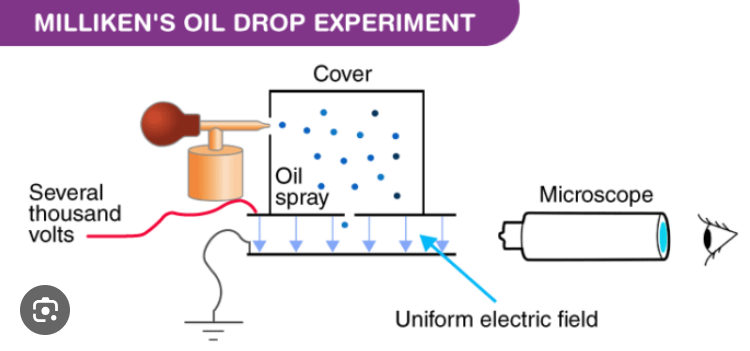
In Milikan's experiment, he observed that the charges on the oil droplets were always integer multiples of a certain fundamental value, which he deduced to be the charge of a single electron. This consistent pattern of quantized charge values provided strong evidence for the idea that electric charge is not continuous but rather exists in discrete, indivisible units.

By meticulously measuring the charges on multiple oil droplets and finding that they were all multiples of the same elementary charge, Milikan demonstrated the discrete nature of electric charge. This quantization of charge supports the notion that electric charge is fundamentally composed of individual, indivisible units, which we now know as the charge of an electron.

5. Superposition of fields

Learning Outcomes
  • I can explain the principle of superposition for electric fields.
  • I can determine the net electric field produced by multiple charges.
  • I can add electric field vectors using vector addition techniques.
  • I can identify locations where electric fields reinforce or cancel each other.
  • I can solve problems involving electric fields created by multiple charges.

Key Topics:
  • Vector addition of electric fields
  • Examples with multiple charge systems

In many real-world situations, electric fields are not produced by a single charge. Instead, multiple charged objects may be present, each creating its own electric field. To determine the overall electric field at a particular location, physicists use a principle known as the principle of superposition.

The principle of superposition states that:

The total electric field at a point is equal to the vector sum of all individual electric fields acting at that point.

This means that each charge contributes its own electric field independently, and the combined effect is found by adding the electric field vectors together.

Why Superposition Is Needed

Consider two charges placed near each other.

Each charge creates an electric field that extends throughout the surrounding space.

At any location:

  • Charge 1 produces an electric field.
  • Charge 2 produces an electric field.
  • The total field is the combination of both fields.

Rather than one field replacing the other, both fields exist simultaneously and overlap.

This overlapping of fields is known as superposition.

Electric Fields Are Vectors

Because electric fields have both magnitude and direction, they must be added using vector addition.

This means:

  • Fields pointing in the same direction reinforce one another.
  • Fields pointing in opposite directions partially or completely cancel.
  • Fields at angles must be added using vector methods.

The direction of each field is just as important as its strength.

Fields in the Same Direction

Suppose two positive charges create electric fields at a point that both point to the right.

If:

and

then:

Because the fields point in the same direction, their magnitudes simply add together.

Fields in Opposite Directions

Now suppose two charges create fields that point in opposite directions.

If:

to the right and

to the left, then:

to the right.

The stronger field determines the final direction.

Equal and Opposite Fields

Sometimes two fields have equal magnitude but opposite direction.

For example:

to the right and

to the left.

In this case:

The fields cancel completely.

Such locations are called electric field null points or equilibrium points.

At these locations a positive test charge experiences no net electric force.

Superposition Between Two Like Charges

Consider two identical positive charges.

At the midpoint between them:

  • One field points away from the left charge.
  • One field points away from the right charge.
  • The fields point in opposite directions.

Because the charges are equal, the fields cancel exactly at the midpoint.

The net electric field is zero.

This creates a field null point between the charges.

Superposition Between Opposite Charges

Now consider a positive charge and a negative charge.

At points between the charges:

  • The field from the positive charge points away from the positive charge.
  • The field from the negative charge points toward the negative charge.

Both fields point in the same direction.

As a result, the fields reinforce one another and the net field becomes stronger.

This helps explain why opposite charges attract so strongly.

Two-Dimensional Superposition

In many situations, electric fields are not perfectly aligned.

For example:

  • One field may point east.
  • Another may point north.

Because electric fields are vectors, they must be added using vector methods.

Students often use:

  • Scale vector diagrams
  • Pythagorean theorem
  • Trigonometry

to determine the magnitude and direction of the resultant field.

This is very similar to adding force vectors or velocity vectors.

Superposition and Coulomb's Law

When calculating fields from multiple charges, physicists often follow these steps:

Step 1

Calculate the electric field from each charge individually.

Use:

\( E = \frac{kQ}{r^2} \)

Step 2

Determine the direction of each field.

Remember:

  • Away from positive charges
  • Toward negative charges

Step 3

Add the field vectors using vector addition.

The result is the net electric field.

Why Superposition Matters

The principle of superposition is one of the most powerful ideas in physics.

It allows scientists and engineers to analyze:

  • Electric circuits
  • Particle accelerators
  • Capacitors
  • Electronic devices
  • Electric field mapping

Without superposition, calculating fields from multiple charges would be nearly impossible.

The same principle is also used in:

  • Gravitational fields
  • Magnetic fields
  • Waves
  • Sound
  • Light

Key Equations

Electric field from a point charge:

\( E = \frac{kQ}{r^2} \)

Superposition principle:


Superposition Outcomes

Situation Result
Fields in same direction Add together
Fields in opposite directions Subtract
Equal and opposite fields Cancel completely
Fields at angles Add as vectors

Suggested Diagrams

Diagram 1: Two electric field vectors pointing in the same direction and adding together.

Diagram 2: Two electric field vectors pointing in opposite directions and partially cancelling.

Diagram 3: Two identical positive charges showing a field null point at the midpoint.

Diagram 4: A positive-negative charge pair showing reinforcement of fields between the charges.

Diagram 5: Two electric field vectors at right angles being added using vector addition.

Summary

The principle of superposition states that the total electric field at a point is the vector sum of all individual electric fields present. Because electric fields are vectors, both magnitude and direction must be considered when combining them. Fields may reinforce, partially cancel, or completely cancel depending on their directions. Superposition allows physicists to analyze complex systems involving multiple charges and is a fundamental principle used throughout electricity, magnetism, waves, and many other areas of physics.