Angular Momentum and Energy

Site: Young Education
Cursus: Rigid Body Mechanics
Boek: Angular Momentum and Energy
Afgedrukt door: Guest user
Datum: maandag, 9 november 2026, 16:39

1. Angular Momentum

Learning outcomes
  • I can define angular momentum.
  • I can calculate angular momentum for simple systems.
  • I can explain factors that affect angular momentum.
  • I can compare linear and angular momentum.
  • I can solve problems involving angular momentum.

Key Topics:
  • Angular momentum formula: L=Iω.
  • Direction of angular momentum (right-hand rule).

Angular Momentum

Angular momentum describes the rotational motion of an object. It depends on both how difficult the object is to rotate and how quickly it is rotating.

For a rigid object rotating about a fixed axis:

L = Iω

where:

  • L = angular momentum
  • I = moment of inertia
  • ω = angular velocity

The SI unit of angular momentum is:

kg·m²/s

Angular momentum is the rotational counterpart of linear momentum.

https://images.openai.com/static-rsc-4/wlvlg7L16FjWoRnXUz8V0kdm8yaFI6qz3dKoURh0DC2xPcpfxgYVbQbcKRpq9-nvE4ow4B7j4XmdntVW-UcKSsOXG9h3xQiFbKs-yzvhrN4YBTQ4oZBit5HIElekMcRNZ4yMNhajgAI-Y2a9U-d8tYlWjZPGEoo9sGpQcZBq1q2MELWi3s0IEnTKlEwfNHXz?purpose=fullsize
 
https://images.openai.com/static-rsc-4/Q4UElf5RTZKHhp2EmtAHXSiNP0flXDLqNUUBayubycksPp3juAv9ck3wknjTU8QYQg6hEyp-bmBRrRMMCViwz_kgayL1EFlyKXsvOJN9OzJDnbaNHEWbdXAHYsmT3u96X3_Ys0pWL5-4u1l3-m71rwRAVIUCumoIpFzy0i73uMHldaBQfkC2BjaaQyBXjgUB?purpose=fullsize
 
https://images.openai.com/static-rsc-4/9KDpLL_XXupoVI0ovpBJciQ2Bq735oSms4l4gLXdUMWeW_BmqdsWpSB-Cdyq5hPWmNdBArQg5bGQrLJtbqrXYvbq96YREvnwrPX6oa3ZqGjyW6DHXdVi68HrFi-f024LfjxKbW02XNN4G_SiPYYnFP8QZgM-3RGwssyB2BCkunlUGyizvy1jrii7ahmm3bOw?purpose=fullsize
 
8

Understanding Angular Momentum

An object has angular momentum when it is rotating.

The amount of angular momentum depends on:

  • the object's mass
  • how that mass is distributed around the axis
  • how quickly the object rotates
  • the direction of rotation

For a rigid rotating object:

L = Iω

This means that angular momentum increases if either:

  • I increases
  • ω increases

Moment of Inertia and Angular Momentum

Moment of inertia describes the object's resistance to changes in rotational motion.

For example, a thin ring rotating around its centre has:

I = MR²

Therefore:

L = Iω

becomes:

L = MR²ω

A larger mass, larger radius, or larger angular velocity produces greater angular momentum.


Worked Example: Rotating Disk

A disk has:

I = 2.5 kg·m²

ω = 8 rad/s

Calculate its angular momentum.

L = Iω

L = (2.5)(8)

L = 20 kg·m²/s


Effect of Angular Velocity

For an object whose moment of inertia remains constant:

L ∝ ω

Suppose:

I = 4 kg·m²

At:

ω = 5 rad/s

L = (4)(5)

L = 20 kg·m²/s

If angular velocity doubles:

ω = 10 rad/s

L = (4)(10)

L = 40 kg·m²/s

Doubling angular velocity doubles angular momentum.


Effect of Moment of Inertia

For a fixed angular velocity:

L ∝ I

Suppose two objects both rotate at:

ω = 6 rad/s

Object A:

I_A = 2 kg·m²

Object B:

I_B = 5 kg·m²

Then:

L_A = (2)(6)

L_A = 12 kg·m²/s

L_B = (5)(6)

L_B = 30 kg·m²/s

The object with the greater moment of inertia has greater angular momentum.


Mass Distribution and Angular Momentum

Moment of inertia depends strongly on the distribution of mass.

Moving mass farther from the rotation axis increases I.

Since:

L = Iω

moving mass outward increases angular momentum if angular velocity is held constant.

However, in an isolated system where angular momentum is conserved, moving mass outward causes ω to decrease.

This distinction is important.

https://images.openai.com/static-rsc-4/pI661wWalxrSwn7E3L9aPieNLtmL9vWimOdENzeKT71yGredlxcAv3RcPMQTrL6Dw2yTjG4cTwwf2_FP4wtF0dPiGnk9cqpXMCjcl1EJi7CHunD1t4aOjr5AP5PnziMRlyy-2vk04lt9DQnjj8lRgRb7qQvqLA1_tmR5a-5odG6ka5-4yE92n2OvX61H97sP?purpose=fullsize
 
https://images.openai.com/static-rsc-4/qnFlYy__1-KXgnlbZSJH3qVV13qpWE7ax6t0IG1jqsbql1gQlCEsFoac_KriAkUUFXLDHOmlPW-bSHOREYf-hdDRGHEMxIesLAP9sZn-Nid17pHW8G-nxIyTkuSxfg6CjDS37OF8K0K0Ifr9Xj4b1g3Gk4AlMvr7xuz5Uqo16Elww1Qub0sAVuTuQCqIOx09?purpose=fullsize
 
https://images.openai.com/static-rsc-4/Q4UElf5RTZKHhp2EmtAHXSiNP0flXDLqNUUBayubycksPp3juAv9ck3wknjTU8QYQg6hEyp-bmBRrRMMCViwz_kgayL1EFlyKXsvOJN9OzJDnbaNHEWbdXAHYsmT3u96X3_Ys0pWL5-4u1l3-m71rwRAVIUCumoIpFzy0i73uMHldaBQfkC2BjaaQyBXjgUB?purpose=fullsize
 
7

Angular Momentum of a Point Mass

Angular momentum is not limited to spinning rigid objects.

A point mass moving around an axis can also have angular momentum.

For a point mass moving perpendicular to the radius:

L = mvr

where:

  • m = mass
  • v = tangential speed
  • r = distance from the axis

Since:

v = rω

then:

L = mr(rω)

L = mr²ω

Since:

I = mr²

we obtain:

L = Iω


Worked Example: Orbiting Point Mass

A 2.0 kg mass moves at:

5.0 m/s

around a circular path of radius:

3.0 m

Its angular momentum is:

L = mvr

L = (2.0)(5.0)(3.0)

L = 30 kg·m²/s


Angular Momentum Depends on the Axis

Just as moment of inertia depends on the axis of rotation, angular momentum must be considered relative to a chosen axis or point.

Changing the reference axis can change:

  • r
  • I
  • L

Therefore, always identify the axis when analyzing angular momentum.


Linear Momentum and Angular Momentum

Linear momentum is:

p = mv

Angular momentum for a rigid rotating object is:

L = Iω

These equations show an important parallel.

Linear Motion Rotational Motion
Linear momentum p Angular momentum L
Mass m Moment of inertia I
Linear velocity v Angular velocity ω
p = mv L = Iω
Force changes p Torque changes L
https://images.openai.com/static-rsc-4/ItraPi7DqpZ9vitfcYgHsZ3WAEZmjiHNQ4i38I7wfJ4owlKPPg1w1dBilhxxsMRzqVdA1A-OA9wrUH9GdsjtwCmTlcOuOSeP-WXjLEZEgQq16Nr8hkrl-McLTVGbbO2wFgdzIhtb87ySnCFD7TW1TerCLIKw5Jp7TLDa5kFdxGXAEgxUaCSdRAmxSQ_q38_M?purpose=fullsize
 
https://images.openai.com/static-rsc-4/chDCY8nNKOeY_-Xykke1_9H8J6uK2L2M85xRgOe_1NXF8MaE1Wa6ImFk0EN5koTALgRQGFZ2oMTzl8ivWXQ8MF2EWQR0v6nTdjmlrHBd69y03zDmizolUMERq9ec5dr16aW-FPuqgLnswkDG2JWfGUcum7oGuNx0xyx_7zFEheecQNtKYEZh5GmylUwGpL0W?purpose=fullsize
 
https://images.openai.com/static-rsc-4/C3k9I5dAtY38YxZ5yvxd4mqkSyuG38M41pkTiOo53XK6ZWTRlWmJcRWFvbJ_z7U1_kqqux1Zqic1s1wn3njl2Z6qWhtHPOcrQ6BbtjQj9BJPuE4vbKKDby423K2OJGS3UW-ixXK4Tzal80bMrASD7Mb9Fc8i4BfeJrDFASDvZouqtwuORbHvrKQkoz2GW4HX?purpose=fullsize
 
7

Comparing Linear and Angular Momentum

Linear momentum describes an object's tendency to continue moving in a straight-line sense.

Angular momentum describes rotational motion about an axis.

For linear momentum:

more mass → more p

greater velocity → more p

For angular momentum:

greater moment of inertia → more L

greater angular velocity → more L

Both quantities also have direction.


Direction of Angular Momentum

Angular momentum is a vector quantity.

For a rotating object, its direction lies along the rotation axis.

The right-hand rule can be used to determine the direction.

Curl the fingers of your right hand in the direction of rotation.

Your thumb points in the direction of angular momentum.

https://images.openai.com/static-rsc-4/wlvlg7L16FjWoRnXUz8V0kdm8yaFI6qz3dKoURh0DC2xPcpfxgYVbQbcKRpq9-nvE4ow4B7j4XmdntVW-UcKSsOXG9h3xQiFbKs-yzvhrN4YBTQ4oZBit5HIElekMcRNZ4yMNhajgAI-Y2a9U-d8tYlWjZPGEoo9sGpQcZBq1q2MELWi3s0IEnTKlEwfNHXz?purpose=fullsize
 
https://images.openai.com/static-rsc-4/p-nvArqUNtLFQdtFhRJbanmzg4uWvC5sNE5augaLfvDwjg-SDfJ4xE-FdCb7W-78nudisJmKsXg2EqdIjwMfPleSQJfhk8sefJaqqQ0kvKXjUCoGUW574r-zdpr3WOFH_SWztyCBwoIlVdXhil6qBnHfs0dAylQ9Zq6iU7nJ5owH8YPpHZCbIYkAULxm3OiE?purpose=fullsize
 
https://images.openai.com/static-rsc-4/4fIeZUY4SakbSXNW_aCb5T_YerGbMOZP-F0_DxsQLhGzTLHZTde0BGn8drdIUUx8jn2h8m6fcuoaTuGz_Dnv6pLh9OASe5tjy6xq9JCOy5wpvhNEwXwjUgkScQ6q2qk7t7sFpRKNAoTxyEiu30vYFTL2uU7W9dSXzo77mHVMPrbaoMfDSnW74UESFh9Ifhen?purpose=fullsize
 
7

For example, when viewed from above:

  • counterclockwise rotation → angular momentum points upward
  • clockwise rotation → angular momentum points downward

Positive and Negative Angular Momentum

In one-dimensional rotational problems, we often use signs rather than full vector notation.

A common convention is:

counterclockwise = positive

clockwise = negative

Then:

ω > 0 → L > 0

ω < 0 → L < 0

provided I is positive, which it always is.


Worked Direction Example

A wheel has:

I = 3 kg·m²

and:

ω = −4 rad/s

Then:

L = Iω

L = (3)(−4)

L = −12 kg·m²/s

The negative sign indicates angular momentum in the chosen negative rotational direction.


Torque Changes Angular Momentum

Force changes linear momentum.

Similarly:

torque changes angular momentum.

The relationship is:

Στ = ΔL/Δt

For an instantaneous rate of change:

Στ = dL/dt

This is a more general form of Newton's Second Law for rotation.


Connecting Torque to Στ = Iα

If I remains constant:

L = Iω

Therefore:

ΔL = IΔω

Divide by Δt:

ΔL/Δt = I(Δω/Δt)

Since:

Δω/Δt = α

then:

Στ = Iα

So Newton's Second Law for rotation can be understood as the rate at which torque changes angular momentum.


Angular Impulse

The product of torque and time is called angular impulse.

For constant torque:

angular impulse = τΔt

and:

τΔt = ΔL

This is the rotational equivalent of linear impulse:

FΔt = Δp


Worked Example: Angular Impulse

A constant torque of:

6 N·m

acts for:

4 s

The change in angular momentum is:

ΔL = τΔt

ΔL = (6)(4)

ΔL = 24 kg·m²/s

If the object initially had:

L_i = 10 kg·m²/s

then:

L_f = L_i + ΔL

L_f = 10 + 24

L_f = 34 kg·m²/s


Finding Angular Velocity from Angular Momentum

The equation:

L = Iω

can be rearranged:

ω = L/I

Suppose:

L = 45 kg·m²/s

I = 5.0 kg·m²

Then:

ω = 45/5.0

ω = 9.0 rad/s


Finding Moment of Inertia

The same equation can be rearranged:

I = L/ω

Suppose:

L = 30 kg·m²/s

ω = 12 rad/s

Then:

I = 30/12

I = 2.5 kg·m²


Angular Momentum of a Solid Disk

For a solid disk:

I = 1/2 MR²

Therefore:

L = 1/2 MR²ω

Suppose:

M = 8 kg

R = 0.50 m

ω = 10 rad/s

Moment of inertia:

I = 1/2(8)(0.50²)

I = 4(0.25)

I = 1.0 kg·m²

Angular momentum:

L = (1.0)(10)

L = 10 kg·m²/s


Angular Momentum of a Thin Ring

For a thin ring:

I = MR²

Suppose the ring has the same:

M = 8 kg

R = 0.50 m

ω = 10 rad/s

Then:

I = (8)(0.50²)

I = 2.0 kg·m²

Angular momentum:

L = (2.0)(10)

L = 20 kg·m²/s

The ring has twice the angular momentum of the disk at the same angular velocity because it has twice the moment of inertia.

https://images.openai.com/static-rsc-4/Gy3RiKRpOlh6rDM-nl8zbnylu-IXnzudU0AAwkjzAc3hK1ECDLEdtQ2SESJmbgTrSuMu0KfjkyJJCVIn_wzO2te0QKxhExLqmw5Qq2l3mZE8ezbeshnyD98nAJgjWLOYSG7qQrlze-0DYIxifJIUgLnEqWiZbK0ON2YbsobeLibgDH796ATGYGS3EsBhpwm9?purpose=fullsize
 

Angular Momentum of a Rotating Rod

For a uniform rod rotating about its centre:

I = 1/12 ML²

Suppose:

M = 6 kg

L = 2.0 m

ω = 9 rad/s

Moment of inertia:

I = 1/12(6)(2²)

I = 2.0 kg·m²

Angular momentum:

L = Iω

L = (2.0)(9)

L = 18 kg·m²/s


Changing the Axis

The same rod rotating about one end has:

I = 1/3 ML²

For:

M = 6 kg

L = 2.0 m

I = 1/3(6)(4)

I = 8 kg·m²

At the same angular velocity:

L = (8)(9)

L = 72 kg·m²/s

The axis of rotation strongly affects moment of inertia and therefore angular momentum.


Conservation of Angular Momentum

One of the most important principles in rotational mechanics is the conservation of angular momentum.

If the net external torque on a system is zero:

L_initial = L_final

or:

L_i = L_f

For a rotating rigid system:

I_i ω_i = I_f ω_f

This principle explains many dramatic examples of rotational motion.

https://images.openai.com/static-rsc-4/Q4UElf5RTZKHhp2EmtAHXSiNP0flXDLqNUUBayubycksPp3juAv9ck3wknjTU8QYQg6hEyp-bmBRrRMMCViwz_kgayL1EFlyKXsvOJN9OzJDnbaNHEWbdXAHYsmT3u96X3_Ys0pWL5-4u1l3-m71rwRAVIUCumoIpFzy0i73uMHldaBQfkC2BjaaQyBXjgUB?purpose=fullsize
 
https://images.openai.com/static-rsc-4/UdfoIIbPMS7wP1ezH5896AjdgPJs6XYDJBDrzoMmLvjNmuIRUrz2XzkGfMCB_bbJo_hkspq6c7druYR-eDH3eESCJ9LypGepZ90HtkurOsnW1FxgQ5CLCoJ2aWPyFqU0j9PTT1mM_84eUMy6MIrO6VJl7RW6WSQZRz3v7NvAkB66EbDjpV5KCK5AEZPwXcVS?purpose=fullsize
 
https://images.openai.com/static-rsc-4/iHARiR7k3tIK2vVDwwOGkNd_A7wH5lkhNAcKoA6uQdkTlArDOQzZlJiGxpvWIep60Exr8CE2E9Dxxis6WJyd16imRlFof0iOBhIRS8QU-TtbYV4lpugQzdCFxr4HOeERh_WVIyZfUFvXqHFlLY1JHWlseapj8kNFKCM1qsh9uaaojFNAoAgJS4WOKrVnvkcg?purpose=fullsize
 
8

Figure Skater Example

A figure skater spins with:

I_i = 6 kg·m²

ω_i = 2 rad/s

The skater pulls their arms inward, reducing moment of inertia to:

I_f = 2 kg·m²

Assuming external torque is negligible:

I_i ω_i = I_f ω_f

(6)(2) = (2)ω_f

12 = 2ω_f

ω_f = 6 rad/s

The moment of inertia decreased by a factor of three.

The angular velocity increased by a factor of three.

Angular momentum remained:

12 kg·m²/s


Why the Skater Speeds Up

The skater does not need an external torque to increase angular velocity.

Instead:

I decreases

so:

ω increases

in order to keep:

L = Iω

constant.

This is an example of angular momentum conservation rather than angular acceleration caused by an external torque.


Extending the Arms

The reverse also occurs.

If a skater extends their arms:

  • I increases
  • ω decreases
  • L remains constant if external torque is negligible

Therefore:

mass inward → faster rotation

mass outward → slower rotation


Diver Example

A diver leaves the platform with angular momentum.

While airborne, external torque may be relatively small.

The diver tucks:

  • moment of inertia decreases
  • angular velocity increases

Before entering the water, the diver extends:

  • moment of inertia increases
  • angular velocity decreases
https://images.openai.com/static-rsc-4/UzKww0bqXdZIZHdO5PmKAL5x4VCSmc-3dO5H56-lzvu4eVDVHxCmyLdxOOnxfu8Unc79xIsP6KpgDygbx-LtoNH1JTgze8_djJ7iCOoQo0dGeosydt5gKVQaPjwLHS4aCRem_XaC7B5Yrfw7KuZqSlri_2zBTkp2kvZu40HSpktnmwD_gKAWpXOaBj8yw5To?purpose=fullsize
 
https://images.openai.com/static-rsc-4/jP34oLPfMFjYxdZ8fLISW1TNjT2RkYy1YhVgKQi3l1PZGCaAwjZYceEriZjcnVoF1fcHGlYQvGAKT9uU-CI3g2BSomCtvrU9v3YwbYz5onBYgX14JwEdTleyikIntW152NNOve8Ic4QxCaDpwMRTWjU70-Pnf_YW2qyxpS7DhWf0p_7k8Yla4UlLEIdFEicT?purpose=fullsize
 
https://images.openai.com/static-rsc-4/wD2LeZCgnI8oE0IlRZLnZqL0yBoIjfgldooJmCg3FxkgQk1MWUPjWqpI1-O_uGWKIIWVZsFnhkWUHHFnLHFZfelP87km0zDc6pLK04IQlPeU-qb5fhrnLGAnbQOgCqFc0MIfaJ872oFDRWC0C_uuzVu_LhFqxpSmN3n6G2Lw9uoQ4f9i2YwSYRvfm-Od905G?purpose=fullsize
 
6

This allows the diver to control rotation without needing a large external torque while airborne.


Gymnastics

Gymnasts use the same principle during:

  • somersaults
  • flips
  • twists
  • dismounts

Changing body position changes moment of inertia.

This changes angular velocity while approximately conserving angular momentum during airborne motion.


Rotating Chair Experiment

Imagine a person sitting on a freely rotating chair while holding weights.

Initially:

I_i = 5 kg·m²

ω_i = 3 rad/s

Initial angular momentum:

L_i = (5)(3)

L_i = 15 kg·m²/s

The person pulls the weights inward so that:

I_f = 3 kg·m²

Then:

15 = (3)ω_f

ω_f = 5 rad/s

Angular momentum remains constant.


Angular Momentum and Planets

Angular momentum is important in astronomy.

Planets orbit stars and possess angular momentum associated with their orbital motion.

When external torque is negligible, orbital angular momentum is conserved.

This helps explain why planets move faster when closer to the Sun and more slowly when farther away.

https://images.openai.com/static-rsc-4/N4tgXJNUzCgjdMyC_CUMskYPQAkOpCXD4l4hd4-W3F53ht4Xw3H8sVPmBvCw_MaevAuGr09rh46xm1eUUcvzyXzIYE9PFLasIDCHcpyuyBHEz6B6bodiuMdiDDaHZCzMGDZa4NLrBzWMeSRUkBoGXlldxLbT0YCwWhb-7ZnNFJSyP9Db6MC_cwBsoJrl-ohT?purpose=fullsize
 
https://images.openai.com/static-rsc-4/t-kR_7KINGvE_YE8mIhmOwA4odm8ks3dmWnZyEyg33aAILY3Hdbw-djR32bKuHDNpPAERAZNzwXOvY6r72lBwWLxTE_nEPefrdRHGwKzcR9cx3adARfM7iN80878d_wc_gvac3MRR_kzKnYeUEfnO5xbNb4k52JQhPsnA4DVNtW1kauyGXUTYuGw8nWfSLko?purpose=fullsize
 
https://images.openai.com/static-rsc-4/oJMbUvVTxuTnyUTTMvorC4QczkH3SL-FTX_ByE0NQEHjG-rG_j656Zli1Gm8xPhLVACMLuELC5afJeyYMskERz-k8EFPIz_h_xvSgEI0DLsmIttcuebcfh3efbEn8qyVCMdqPq9y1Rl8usM8XGpVDpbGaepRoXDwCLXmKYKSUuh7mFSuVr8Ssfti9J71bFja?purpose=fullsize
 
7

This behaviour is closely related to Kepler's Second Law.


Collapsing Stars

Angular momentum conservation can produce extreme changes in angular velocity.

Suppose a rotating star contracts.

Its mass moves much closer to its rotation axis.

Therefore:

I decreases dramatically

If external torque is small:

L remains approximately constant

so:

ω increases dramatically

This contributes to the rapid rotation of compact objects such as neutron stars.


Angular Momentum of Wheels

A spinning wheel has angular momentum along its axle.

The larger its:

  • moment of inertia
  • angular velocity

the larger its angular momentum.

A rapidly spinning wheel therefore resists changes to the direction of its rotation axis.

This behaviour is important in gyroscopes.

https://images.openai.com/static-rsc-4/0j67eBlQaFgf2Gg3h02WJ00WXWR2KURfKWG96ymD7R5bBhT1gS6DAY5fdrkJ7UkSCIdBA0diIwunczbKwU0MnS_8RilSBiseLH0hQNiU-Ry-fVdC2K98O93dOu3VWK5jG0KU6C-7RXwoQO6P_V47f7lIClqVoNKUe09a_fXX7vPShIiT4Ghwvu3xnxuxkQHs?purpose=fullsize
 
https://images.openai.com/static-rsc-4/nH7ShNU5icvfDfVhBQLkVFltdUnbyH9HSEu7ibS-6ckLy3eN17EdwVW1BxEPT2NpnKQBIWcl53fISbj8FUS5TF3QDbeag6hfM_m8rP0zCg25atiRxvLThBuklCG2LGtoIE2BTKSWmHyxgrAMxDdFNRo2DIJ3zYutKUzRu9gCQ0yxuriqouUvfaPz0MCDDI5R?purpose=fullsize
 
https://images.openai.com/static-rsc-4/HDrrRwDyZw52lQT_4hvQlXNXCt6fgrACh6WH1PogsxS_KzmYHKyMO2GTNcoYqTrG4gKb8HZjAt3uXShBUjRnXddZuv6Rfy-mIeBEW5q655YSOKfWfzLjFq54xu1Oh8rvejCH_VYdD_odGd4zCtWOOHfTCzXlfikKqTDQgXqlO71ATTKFX6_L8S4Mz4W4YCCf?purpose=fullsize
 
9

Gyroscopes

A gyroscope contains a rapidly rotating object.

Its angular momentum helps it resist changes in orientation.

Gyroscopic effects are used in:

  • aircraft
  • spacecraft
  • ships
  • navigation systems
  • smartphones
  • drones
  • stabilization systems

Changing the direction of angular momentum requires a torque.


Angular Momentum in Sports

Angular momentum appears throughout sports.

Examples include:

  • figure skating
  • gymnastics
  • diving
  • cycling
  • discus
  • hammer throw
  • baseball
  • golf
  • ice hockey

Athletes control angular momentum by applying torques and changing body configuration.


Throwing and Swinging

During a swing or throw, muscles apply torque to body segments.

The torque changes their angular momentum:

τΔt = ΔL

Applying a larger torque or applying torque for a longer time can produce a larger change in angular momentum.

This is the rotational counterpart of impulse in linear motion.


Angular Momentum in a Collision

Angular momentum can also be conserved during rotational collisions if external torque is negligible.

Suppose a rotating platform has:

I₁ = 4 kg·m²

ω₁ = 6 rad/s

A stationary object lands on it, increasing the total moment of inertia to:

I₂ = 10 kg·m²

Initial angular momentum:

L_i = (4)(6)

L_i = 24 kg·m²/s

Conservation gives:

24 = (10)ω_f

ω_f = 2.4 rad/s

The system rotates more slowly because its moment of inertia increased.


Rotational Collisions and Energy

Angular momentum may be conserved during a collision even when rotational kinetic energy is not.

Before:

E_rot = 1/2 I_iω_i²

After:

E_rot = 1/2 I_fω_f²

Some kinetic energy may be transferred into:

  • heat
  • sound
  • deformation

Therefore:

conservation of angular momentum does not automatically mean conservation of kinetic energy.


Worked Energy Comparison

Using the previous example:

Before:

E_i = 1/2(4)(6²)

E_i = 72 J

After:

E_f = 1/2(10)(2.4²)

E_f = 28.8 J

Angular momentum is conserved, but rotational kinetic energy decreases.

The difference is:

72 − 28.8 = 43.2 J

transferred to other forms.


External Torque and Conservation

Angular momentum is conserved only when:

Στ_external = 0

Internal forces can redistribute angular momentum within the system, but they cannot change the total angular momentum of an isolated system.

This is similar to linear momentum:

no net external force → linear momentum conserved

no net external torque → angular momentum conserved


Internal and External Torques

Suppose a skater pulls their arms inward.

Muscles exert internal forces and torques within the skater's body.

These can change the distribution of mass and individual motions.

However, if external torque is negligible:

total angular momentum remains constant.


A Complete Angular Momentum Problem

A rotating platform has:

I_i = 8.0 kg·m²

ω_i = 3.0 rad/s

A person changes position, reducing the system's moment of inertia to:

I_f = 5.0 kg·m²

Assume external torque is negligible.

Initial Angular Momentum

L_i = I_iω_i

L_i = (8.0)(3.0)

L_i = 24 kg·m²/s

Final Angular Momentum

By conservation:

L_f = 24 kg·m²/s

Final Angular Velocity

I_iω_i = I_fω_f

(8.0)(3.0) = (5.0)ω_f

ω_f = 24/5

ω_f = 4.8 rad/s

The system spins faster because its moment of inertia decreased.


A Problem Involving External Torque

A wheel has:

I = 3.0 kg·m²

and initially rotates at:

ω_i = 4.0 rad/s

A constant net torque of:

6.0 N·m

acts for:

5.0 s

Initial Angular Momentum

L_i = Iω_i

L_i = (3.0)(4.0)

L_i = 12 kg·m²/s

Change in Angular Momentum

ΔL = τΔt

ΔL = (6.0)(5.0)

ΔL = 30 kg·m²/s

Final Angular Momentum

L_f = L_i + ΔL

L_f = 12 + 30

L_f = 42 kg·m²/s

Final Angular Velocity

ω_f = L_f/I

ω_f = 42/3.0

ω_f = 14 rad/s


Checking with Newton's Second Law

We can verify the previous answer.

α = τ/I

α = 6.0/3.0

α = 2.0 rad/s²

Then:

ω_f = ω_i + αt

ω_f = 4.0 + (2.0)(5.0)

ω_f = 14 rad/s

Both methods agree.


Linear and Angular Conservation Laws

There is a powerful symmetry between translational and rotational mechanics.

Linear Rotational
Momentum p = mv Angular momentum L = Iω
Force changes momentum Torque changes angular momentum
F = Δp/Δt τ = ΔL/Δt
Impulse FΔt = Δp Angular impulse τΔt = ΔL
ΣF_ext = 0 → p conserved Στ_ext = 0 → L conserved

This parallel makes angular momentum easier to understand if linear momentum is already familiar.


Choosing the Right Angular Momentum Equation

For a rigid object rotating around a fixed axis:

L = Iω

For a point mass moving perpendicular to the radius:

L = mvr

For angular momentum conservation:

L_i = L_f

or commonly:

I_iω_i = I_fω_f

For a change caused by constant torque:

ΔL = τΔt

Choosing the correct relationship depends on the situation.


Problem-Solving Strategy

First identify the system and rotation axis.

Then determine whether you are dealing with:

  • a rotating rigid body
  • a point mass
  • a changing mass distribution
  • an external torque
  • a rotational collision

If I and ω are known, use:

L = Iω

If a point mass moves perpendicular to the radius, use:

L = mvr

If external torque is negligible, use:

L_i = L_f

If torque acts over a known time, use:

ΔL = τΔt

Finally, check:

  • units
  • signs
  • rotation direction
  • whether angular momentum should be conserved

Common Mistakes

Confusing angular momentum with linear momentum

Linear momentum is p = mv. Angular momentum describes motion about an axis.

Using mass instead of moment of inertia

For a rigid rotating body:

L = Iω

not mω.

Ignoring mass distribution

Changing mass distribution changes I and can therefore change ω when angular momentum is conserved.

Assuming angular momentum is always conserved

It is conserved only when the net external torque is zero.

Thinking pulling the arms inward creates angular momentum

It changes I and ω, but total L remains constant when external torque is negligible.

Forgetting direction

Angular momentum is a vector quantity.

Assuming zero torque means zero angular momentum

Zero net torque means angular momentum does not change. It may already be nonzero.

Assuming conservation of angular momentum means conservation of kinetic energy

The two are separate conservation principles.

Ignoring the axis of rotation

Angular momentum depends on the chosen reference axis.

Confusing torque with angular momentum

Torque describes the rate at which angular momentum changes.


Key Terms

Angular momentum (L) — quantity describing rotational motion, commonly calculated for a rigid body using L = Iω.

Moment of inertia (I) — measure of an object's resistance to changes in rotational motion and its mass distribution relative to an axis.

Angular velocity (ω) — rate at which angular position changes.

Linear momentum (p) — quantity of translational motion calculated using p = mv.

Torque (τ) — turning effect of a force and the rate of change of angular momentum.

Conservation of angular momentum — principle stating that total angular momentum remains constant when net external torque is zero.

Angular impulse — product of torque and time, equal to the change in angular momentum.

External torque — torque produced by forces originating outside the chosen system.

Internal torque — torque produced by interactions between parts of the chosen system.

Rotation axis — axis relative to which rotational quantities are measured.

Right-hand rule — method for determining the direction of angular momentum.

Rotational collision — interaction between objects in which rotational motion and angular momentum are important.

Gyroscope — rotating device whose angular momentum gives it resistance to changes in orientation.

Isolated system — system with no relevant external interaction capable of changing its total momentum.

Rotational kinetic energy — energy of rotation, calculated using E_rot = 1/2 Iω².


Key Takeaways

  • Angular momentum describes rotational motion.
  • For a rigid body rotating around a fixed axis, L = Iω.
  • Angular momentum is measured in kg·m²/s.
  • Greater moment of inertia produces greater angular momentum at the same angular velocity.
  • Greater angular velocity produces greater angular momentum for the same moment of inertia.
  • Mass distribution affects angular momentum through moment of inertia.
  • Angular momentum has direction and is therefore a vector.
  • The right-hand rule can determine its direction.
  • Linear momentum and angular momentum are closely related concepts.
  • Linear momentum uses p = mv, while rotational angular momentum uses L = Iω.
  • Torque changes angular momentum.
  • Στ = ΔL/Δt describes the relationship between torque and angular momentum.
  • Angular impulse is τΔt = ΔL for constant torque.
  • If net external torque is zero, total angular momentum is conserved.
  • Conservation of angular momentum is commonly expressed as I_iω_i = I_fω_f.
  • Moving mass inward decreases I and can increase ω.
  • Moving mass outward increases I and can decrease ω.
  • Figure skaters, divers, gymnasts, rotating platforms, planets and stars demonstrate angular momentum principles.
  • Angular momentum can be conserved even when kinetic energy is not.
  • Conservation of angular momentum is one of the fundamental conservation laws of physics.

Check Your Understanding

  1. Define angular momentum and give its SI unit.
  2. A wheel has I = 3.0 kg·m² and rotates at 8.0 rad/s. Calculate its angular momentum.
  3. The angular velocity of the wheel in Question 2 doubles while I remains constant. Calculate its new angular momentum.
  4. Two objects rotate at the same angular velocity. Object A has I = 2 kg·m² and Object B has I = 7 kg·m². Compare their angular momenta.
  5. A 3.0 kg point mass travels at 6.0 m/s around a circular path of radius 2.0 m. Calculate its angular momentum about the centre.
  6. A solid disk has mass 10 kg, radius 0.40 m, and angular velocity 12 rad/s. Calculate its moment of inertia and angular momentum.
  7. A thin ring has the same mass, radius, and angular velocity as the disk in Question 6. Calculate its angular momentum and explain why it differs.
  8. A rotating object has angular momentum 36 kg·m²/s and moment of inertia 4.0 kg·m². Calculate its angular velocity.
  9. Explain how torque is related to the rate of change of angular momentum.
  10. A constant torque of 8.0 N·m acts for 3.0 s. Calculate the change in angular momentum.
  11. A skater initially has I = 5.0 kg·m² and ω = 3.0 rad/s. The skater pulls their arms inward so that I = 2.0 kg·m². Assuming angular momentum is conserved, calculate the final angular velocity.
  12. Explain why pulling the arms inward makes a spinning skater rotate faster without increasing the system's total angular momentum.
  13. A rotating platform initially has I = 6.0 kg·m² and ω = 5.0 rad/s. A stationary object lands on it, increasing the total moment of inertia to 10 kg·m². Calculate the final angular velocity.
  14. Explain why angular momentum can be conserved during a rotational collision even though rotational kinetic energy decreases.
  15. A wheel has I = 4.0 kg·m² and initially rotates at 6.0 rad/s. A constant net torque of 8.0 N·m acts in the direction of rotation for 5.0 s. Calculate the initial angular momentum, angular impulse, final angular momentum, and final angular velocity.

2. Conservation of Angular Momentum

Learning outcomes
  • I can state the principle of conservation of angular momentum.
  • I can explain why angular momentum is conserved.
  • I can analyze systems with changing moment of inertia.
  • I can predict outcomes using conservation principles.
  • I can solve conservation problems involving rotation

Key Topics:
  • Law of conservation: ΔL=0 in the absence of external torques.
  • Examples: Ice skaters spinning, collapsing stars, gyroscopes.

Conservation of Angular Momentum

The principle of conservation of angular momentum states that the total angular momentum of a system remains constant when there is no net external torque acting on the system.

In simple form:

L_initial = L_final

For a rotating rigid system:

I_iω_i = I_fω_f

where:

  • I_i = initial moment of inertia
  • ω_i = initial angular velocity
  • I_f = final moment of inertia
  • ω_f = final angular velocity

This principle explains why figure skaters spin faster when they pull in their arms, why divers rotate faster when they tuck, and why collapsing stars can rotate extremely rapidly.

https://images.openai.com/static-rsc-4/xJM0rXaxWWyHXoIY0uB502B7G31gvsq9Chn-6DSl4nKSxCL56-IoUA4z7n85j0JixEH_u5-ikaFUJqjh2vGAneql3PUtppOf6-exmg1EI2FkA1-s6g7OVtwWrtorfCuurqhiSqJXafx2LfZvF_tpkGpcfGBxr_aW2sdE8Ocu_LZXKj2q9BUQUiVAFwEWEOm8?purpose=fullsize
 
https://images.openai.com/static-rsc-4/UdfoIIbPMS7wP1ezH5896AjdgPJs6XYDJBDrzoMmLvjNmuIRUrz2XzkGfMCB_bbJo_hkspq6c7druYR-eDH3eESCJ9LypGepZ90HtkurOsnW1FxgQ5CLCoJ2aWPyFqU0j9PTT1mM_84eUMy6MIrO6VJl7RW6WSQZRz3v7NvAkB66EbDjpV5KCK5AEZPwXcVS?purpose=fullsize
 
https://images.openai.com/static-rsc-4/j46ZxVrHv_l3dEzrVvrR_irzsSIwEJiTaABOcOpWLj-vT6zapk8b0EIQO7iyTvQkxNnFkuniyvM8hVACzfQZo2bpzYvbzlj9U9HpL8fisxYO2nXxysL3X9NzWZadK-3Rx8nRxBEe_Hw7Teao0ZH3bcUub1CZumUsBIj8buAY8wtM-3ABfpYoVQzGtBMPTdPm?purpose=fullsize
 
6

Angular Momentum

For a rigid object rotating around a fixed axis:

L = Iω

Angular momentum depends on:

  • the object's moment of inertia
  • its angular velocity
  • its direction of rotation

Moment of inertia depends on how mass is distributed relative to the axis.

Therefore, angular momentum can remain constant even while I and ω individually change.


The Conservation Principle

If the net external torque on a system is zero:

Στ_external = 0

then:

ΔL = 0

Therefore:

L_i = L_f

This does not mean that nothing in the system can change.

The system may change:

  • shape
  • moment of inertia
  • angular velocity
  • distribution of mass

What remains constant is the total angular momentum.


Why Angular Momentum Is Conserved

Torque is related to the rate of change of angular momentum:

Στ_external = ΔL/Δt

If:

Στ_external = 0

then:

ΔL/Δt = 0

Therefore:

ΔL = 0

and angular momentum remains constant.

This is the rotational equivalent of conservation of linear momentum.

For linear motion:

ΣF_external = 0 → p remains constant

For rotational motion:

Στ_external = 0 → L remains constant


Internal and External Torques

The distinction between internal and external torques is important.

Internal forces and torques act between parts of the chosen system.

External forces and torques come from outside the system.

Internal interactions can redistribute angular momentum between parts of a system, but they do not change the system's total angular momentum.

For example, a figure skater uses muscles to pull their arms inward. These internal forces change the skater's mass distribution, but if external torque is negligible, total angular momentum remains constant.


Changing Moment of Inertia

For a rotating system:

L = Iω

If angular momentum is conserved:

I_iω_i = I_fω_f

This produces an important relationship:

I increases → ω decreases

I decreases → ω increases

This inverse relationship appears throughout rotational mechanics.

https://images.openai.com/static-rsc-4/d0IGKldEdoV8T_HMYelmsTpV_k6k3yBwJy4DTxPV96I9QLiX9hVuEIMzRnBmmmaUh4KXC_xJH7sONxRIvpc8WpQ5M3RFZ3r662pZbYskl7emp0qtySfXcOIgKDKdaSU-NWESk7w0XwLBaFAUFyY8nc-BvMVDdGdX8Us7zvL7WF5jTFjDHDSOeLESdEAOJhix?purpose=fullsize
 
https://images.openai.com/static-rsc-4/n8HzYJI9iqyuWxF2Sq9enY9OhyvSD6KaS_XkYVC7P17gwjrcE89uDnGfCRSqw1lPNHcDiWbrtZSUJvtUc4buR6yg0QrQy1H9Pl-osL0JumurUYImzc7gux1mkRast_uoZuxZCPdRneeUndHDBhojBEMBlrZEQrhHvMqtiltM1Eh0189XHSy0VtakhOfLvo_m?purpose=fullsize
 
https://images.openai.com/static-rsc-4/R0iXtY5AtiefWo7cAxpySIrcvnFl28eumCQ8SbFqb49kVtmXD6F73BoCsyKBTOqQYuleTMkEWclo5XVAwwvLExP8Aen7zrxtHfm-ITVrWjKgeiRXridW7-iVFxldHCv9UW3fNog1vdpI6g5z6nauUBSKdbo1tQaHa79g3HEPSOUdgTuE6lfEAr-YFcXVq8jF?purpose=fullsize
 
8

Figure Skater

A spinning figure skater provides a classic example.

With arms extended:

  • mass is distributed farther from the axis
  • moment of inertia is relatively large
  • angular velocity is relatively small

When the skater pulls their arms inward:

  • mass moves closer to the axis
  • moment of inertia decreases
  • angular velocity increases

If external torque is negligible:

I_iω_i = I_fω_f


Worked Example: Figure Skater

A skater initially has:

I_i = 6.0 kg·m²

ω_i = 2.0 rad/s

The skater pulls their arms inward so that:

I_f = 2.0 kg·m²

Find the new angular velocity.

I_iω_i = I_fω_f

(6.0)(2.0) = (2.0)ω_f

12 = 2ω_f

ω_f = 6.0 rad/s

The moment of inertia decreased by a factor of three, so the angular velocity increased by a factor of three.


Checking the Angular Momentum

Before:

L_i = I_iω_i

L_i = (6)(2)

L_i = 12 kg·m²/s

After:

L_f = I_fω_f

L_f = (2)(6)

L_f = 12 kg·m²/s

The angular velocities are different, but the angular momentum is unchanged.


Extending the Arms

The process works in reverse.

Suppose:

I_i = 2 kg·m²

ω_i = 8 rad/s

The skater extends their arms so:

I_f = 5 kg·m²

Conservation gives:

(2)(8) = (5)ω_f

16 = 5ω_f

ω_f = 3.2 rad/s

Increasing the moment of inertia decreases the angular velocity.


Predicting Changes Without Calculating

Many conservation problems can be solved using proportional reasoning.

Since:

I_iω_i = I_fω_f

if I doubles:

ω becomes half as large

if I triples:

ω becomes one-third as large

if I becomes half as large:

ω doubles

if I becomes one-quarter as large:

ω becomes four times larger

These relationships assume angular momentum is conserved.


Divers

Divers use conservation of angular momentum to control their rotation.

After leaving the diving board, the diver may experience relatively little external torque.

When the diver tucks:

  • mass moves closer to the rotation axis
  • I decreases
  • ω increases

When the diver straightens before entering the water:

  • I increases
  • ω decreases
https://images.openai.com/static-rsc-4/UzKww0bqXdZIZHdO5PmKAL5x4VCSmc-3dO5H56-lzvu4eVDVHxCmyLdxOOnxfu8Unc79xIsP6KpgDygbx-LtoNH1JTgze8_djJ7iCOoQo0dGeosydt5gKVQaPjwLHS4aCRem_XaC7B5Yrfw7KuZqSlri_2zBTkp2kvZu40HSpktnmwD_gKAWpXOaBj8yw5To?purpose=fullsize
 
https://images.openai.com/static-rsc-4/4h1U1YbKJ6FoLe4We89BucORh2kg2-dQ9e-sTYvWboKq-4soEHVGtv0kc9b603dYUBLVMwP1ucpUXxdoJv1Y41OLGKbuhnFlQ0oyDVi2OjiwNwwZtmozy5Qare-DmStTiQc0QEB4ibiLPp9oif-isrS1oAME3453U4pYEkSbTzI2_-qxzBW8JTchFKbtopxH?purpose=fullsize
 
https://images.openai.com/static-rsc-4/sIvCzKmLDwVfajwH_e6F9Z9q0bgNjrZaVL-EO4pkYPF05uK1bxgzUSemGvVLC4TPq9VPawV7vqgn3fUMEGssqHPZlzvVvlARZzFaWZ74vvTpPn3ymDdyzBUEa3TQY4LsdEeg5_lPCDWc6TrtGoJFN8B2McM3ZsTSTXkjoBf8wpxI_P6tJNNWH6jRh9w1LLkv?purpose=fullsize
 
7

The diver can therefore change rotational speed without requiring a large external torque while airborne.


Gymnastics

Gymnasts use the same principle during:

  • somersaults
  • flips
  • twists
  • dismounts

A tucked position generally produces a smaller moment of inertia than an extended position.

Therefore, for approximately constant angular momentum:

tuck → faster rotation

extend → slower rotation

This allows the gymnast to control the timing of a landing.


Rotating Chair Demonstration

A person sits on a low-friction rotating chair holding masses.

Initially:

I_i = 8 kg·m²

ω_i = 1.5 rad/s

The person pulls the masses inward, reducing the moment of inertia to:

I_f = 3 kg·m²

Initial angular momentum:

L = (8)(1.5)

L = 12 kg·m²/s

Therefore:

12 = (3)ω_f

ω_f = 4 rad/s

The person rotates much faster.

https://images.openai.com/static-rsc-4/gWbZfIWxGBhPs_0zxwEHXZEnos8f853ckLYyK7DcXnHVw0dJG1pUNUq3mCMso1Qovk3ayoHn4jnXBL5G9JC3yDs5VovFHgj9O_9VBXcBoJETQmLtfr_b7eHigKJ2IcnQLpWauEqcTu-gafE87lhZTv<img class=QzZi_ldLZfgGSgmYhiJPtiDNKfwC75YisR3zMaC?purpose=fullsize">
 
https://images.openai.com/static-rsc-4/s4TjTqZSpWApkCuaOak1Q0_hUCU3KbE02Vsy0rSdm8YKGkZBSuUqZ3ebXklR7R1l9biqPgQmxvkbCF3YcCTCzCuqNT6WHcfQZAmRqKuvVddA9SzO9yPWEIqAknsIhtmDOAe-U3806UJ32vFjRXpkfTMscmN1MNRxUL847gW4B-OKP4EzGt_QBPakhXE-OqCg?purpose=fullsize
 
https://images.openai.com/static-rsc-4/S-B9Q6qmtYw2Va7wRa038dRYM1ctw5_7mVMDURd1WaXxctueXhgUtfp915HXsDZqmkXSPbo79Rj6ePU-RlLQli8zJlMZfxbEGavn8eWUYb7Ck42Nldc1buC7SSlx3B8OyoFnT6oDXEez0lEi3zh9VSh6ysiE5lWgmP5I25HTqp2WQb7nFifhnMqcekKCbt2z?purpose=fullsize
 
6

Moving Point Masses

The conservation principle can also be applied to systems containing point masses.

For a point mass:

I = mr²

Suppose two identical masses move closer to the rotation axis.

Because:

I ∝ r²

even a relatively small change in radius can produce a large change in moment of inertia.


Worked Example: Changing Radius

Two masses rotate around an axis.

Initially each mass is:

0.80 m

from the axis.

They are moved inward to:

0.40 m

The mass does not change.

For each mass:

I ∝ r²

Therefore:

I_f/I_i = (0.40/0.80)²

I_f/I_i = (1/2)²

I_f = 1/4 I_i

Conservation requires:

I_iω_i = I_fω_f

Therefore:

ω_f = 4ω_i

Halving the radius causes the angular velocity to become four times larger.


Why Radius Has Such a Strong Effect

Moment of inertia depends on the square of the distance from the axis.

For a point mass:

I = mr²

Therefore, moving mass inward can dramatically reduce I.

This is why pulling the arms inward can have such a noticeable effect on rotational speed.


Rotational Collisions

Conservation of angular momentum is especially useful when objects collide or join together while rotating.

If external torque during the collision is negligible:

L_before = L_after

This works even when the collision is inelastic.

https://images.openai.com/static-rsc-4/YGSWfQ2mHYi3hFgCkUBk-qzMpKh_Hr071h29JNdCCkmBVsko0GOvA-cJ--tTszDyVvm8OG_u3377IGl9NPZ2UzMyQ4xkufLnnRSDMvYOJkRLXOUePomldsTUKgkz3jfTl8UZKMn1B4xEUofWXk8ja0BwFpV3k-lfgfCnsG13ljazAMzM2En3uYel3trUej4I?purpose=fullsize
 
https://images.openai.com/static-rsc-4/-Ks3VfAq7i98jsoiLWyTkoTyNLy64zdTBBFQpVPUqAwYqM6lXqiIdC1QzJVaJ9fD16yZid6D_k9Mni5FLDDYZNsNrfF-oarGCoNr8Auwjf1ZeayL2EBqeYsIRGbjs2CUNq86a1tJw0qxX884DHX4ljcQRDwDmqhjKvyoQ6ZnmEdKZpDrF9E8RrH34Lnqiolj?purpose=fullsize
 
https://images.openai.com/static-rsc-4/sJR1EAAq7H4PnSm9FYZfcfvg-6OC7tYZVGzgrds-LcgdXLhar73dZ-9BpO8YCuAZE_rqyqtdEJkDX0c-LZmOjr0mSie7LddvyHfQhc50L_mRS_0qOiCJO_sPDCMJoqAawL1I-VBVfO_xxlH0TmiVVyPZpSDuckpEgzbC5uQG0MRd5agTAL24oAF-xmJJg0r5?purpose=fullsize
 
9

Object Landing on a Rotating Platform

A platform has:

I_p = 4.0 kg·m²

and rotates at:

ω_i = 6.0 rad/s

A stationary object lands on the platform.

The total final moment of inertia becomes:

I_f = 10 kg·m²

Before:

L_i = I_pω_i

L_i = (4)(6)

L_i = 24 kg·m²/s

After:

L_f = I_fω_f

Conservation gives:

24 = 10ω_f

ω_f = 2.4 rad/s

The system slows because its moment of inertia increased.


Why the Platform Slows Down

The stationary object increases the system's moment of inertia.

Since no significant external torque acts:

angular momentum must remain constant

Therefore, increasing I requires ω to decrease.

This is the same principle as a skater extending their arms.


Angular Momentum Can Be Shared

Consider two rotating disks that are brought into contact and eventually rotate together.

Initially:

Disk A has angular momentum.

Disk B may be stationary or rotating differently.

Friction between the disks produces internal torques that redistribute angular momentum.

If external torque is negligible:

L_total before = L_total after


Worked Example: Two Disks

Disk A:

I₁ = 2 kg·m²

ω₁ = 10 rad/s

Disk B:

I₂ = 3 kg·m²

ω₂ = 0

They are coupled together and rotate at the same final angular velocity.

Initial angular momentum:

L_i = I₁ω₁ + I₂ω₂

L_i = (2)(10) + (3)(0)

L_i = 20 kg·m²/s

Final moment of inertia:

I_f = 2 + 3

I_f = 5 kg·m²

Therefore:

20 = 5ω_f

ω_f = 4 rad/s


Opposite Rotational Directions

Direction must be considered when conserving angular momentum.

Choose one direction as positive.

For example:

counterclockwise = positive

clockwise = negative

Suppose:

I₁ = 3 kg·m²

ω₁ = +6 rad/s

and:

I₂ = 2 kg·m²

ω₂ = −4 rad/s

Initial angular momentum:

L_i = I₁ω₁ + I₂ω₂

L_i = (3)(6) + (2)(−4)

L_i = 18 − 8

L_i = +10 kg·m²/s

If they join:

I_f = 3 + 2

I_f = 5 kg·m²

Then:

10 = 5ω_f

ω_f = +2 rad/s

The final rotation is counterclockwise.


When Opposing Angular Momenta Cancel

Suppose two identical disks have equal angular speeds in opposite directions.

Disk A:

L_A = +20 kg·m²/s

Disk B:

L_B = −20 kg·m²/s

Then:

L_total = 0

If they are coupled together:

ω_f = 0

They stop rotating.

The individual disks initially had angular momentum, but the total angular momentum of the system was zero.


Conservation Does Not Mean Each Object Keeps Its Momentum

Angular momentum conservation applies to the total system.

Individual objects can:

  • gain angular momentum
  • lose angular momentum
  • reverse rotational direction

provided the total angular momentum remains constant when external torque is zero.


Angular Momentum and Rotational Kinetic Energy

Angular momentum conservation does not necessarily mean rotational kinetic energy is conserved.

Rotational kinetic energy is:

E_rot = 1/2 Iω²

During collisions or coupling:

  • angular momentum may remain constant
  • kinetic energy may decrease

Energy can be transferred into:

  • thermal energy
  • sound
  • deformation

Worked Energy Comparison

Consider the two-disk example:

Before:

I₁ = 2 kg·m²

ω₁ = 10 rad/s

Disk B is stationary.

Initial energy:

E_i = 1/2(2)(10²)

E_i = 100 J

After:

I_f = 5 kg·m²

ω_f = 4 rad/s

E_f = 1/2(5)(4²)

E_f = 2.5(16)

E_f = 40 J

Angular momentum was conserved, but:

100 − 40 = 60 J

of mechanical energy was transferred to other forms.


Angular Momentum and Energy When Shape Changes

A surprising situation occurs when a skater pulls their arms inward.

Angular momentum remains constant:

L = Iω

But rotational kinetic energy can increase.

How is this possible?

The skater's muscles do work while pulling the arms inward.

Chemical energy stored in the body is transferred into rotational kinetic energy.

Therefore:

conservation of angular momentum does not require constant rotational kinetic energy.


Example: Energy of a Spinning Skater

Initially:

I_i = 6 kg·m²

ω_i = 2 rad/s

Initial energy:

E_i = 1/2(6)(2²)

E_i = 12 J

After pulling inward:

I_f = 2 kg·m²

ω_f = 6 rad/s

Final energy:

E_f = 1/2(2)(6²)

E_f = 36 J

Angular momentum remains:

12 kg·m²/s

but rotational kinetic energy increases from:

12 J to 36 J

The additional energy came from work done by the skater.


External Torque Breaks the Simple Conservation Condition

If a significant external torque acts:

L_i ≠ L_f

Instead:

ΔL = τ_external Δt

for constant external torque.

Therefore, before applying conservation of angular momentum, always ask:

Is the net external torque approximately zero?


Example with External Torque

A wheel initially has:

L_i = 20 kg·m²/s

An external torque of:

5 N·m

acts for:

4 s

Change in angular momentum:

ΔL = τΔt

ΔL = (5)(4)

ΔL = 20 kg·m²/s

Therefore:

L_f = 20 + 20

L_f = 40 kg·m²/s

Angular momentum was not conserved because an external torque acted.


Planets and Orbital Motion

Angular momentum conservation is also important in orbital motion.

A planet moves faster when closer to the Sun and slower when farther away.

https://images.openai.com/static-rsc-4/LHzuJgJJ7hdBoKfe-7wBM1DOqGvmqSU6Hqnw4p4aGclngO0fQ3pFdE1abMGpFd6AZHM0cTNPWIUk9uI5sodhyggzLIZJ5w4StmaDth6A7_T1th6rEZ0z3UIqsVV87JY1GQw52pD52N2igXFj_SGN9krre1LhgTpPQnpAx0JsmWNnuJHDMeV-D1q38AHYHEQs?purpose=fullsize
 
https://images.openai.com/static-rsc-4/VcxU4RtDrhCS1TPEzYUX3JUVJ1IDa12FabsRIVt82DDPN9MHuYIkoYHENjVn7mFtPY5dDVb8aflLMOQBJaNS9vP9dGx4OKEQt8mi4sGeQJ_ofiy_PAWUVZ04UFvsyr8SAopdr9Iy11mnyOouJ9qp3-dfOn8wv88ycCOJszJu2BM1WbcWkDqNPcH4nC721XsR?purpose=fullsize
 
https://images.openai.com/static-rsc-4/N4tgXJNUzCgjdMyC_CUMskYPQAkOpCXD4l4hd4-W3F53ht4Xw3H8sVPmBvCw_MaevAuGr09rh46xm1eUUcvzyXzIYE9PFLasIDCHcpyuyBHEz6B6bodiuMdiDDaHZCzMGDZa4NLrBzWMeSRUkBoGXlldxLbT0YCwWhb-7ZnNFJSyP9Db6MC_cwBsoJrl-ohT?purpose=fullsize
 
8

The gravitational force points approximately toward the Sun.

Because this force acts along the radius, its torque about the Sun is zero:

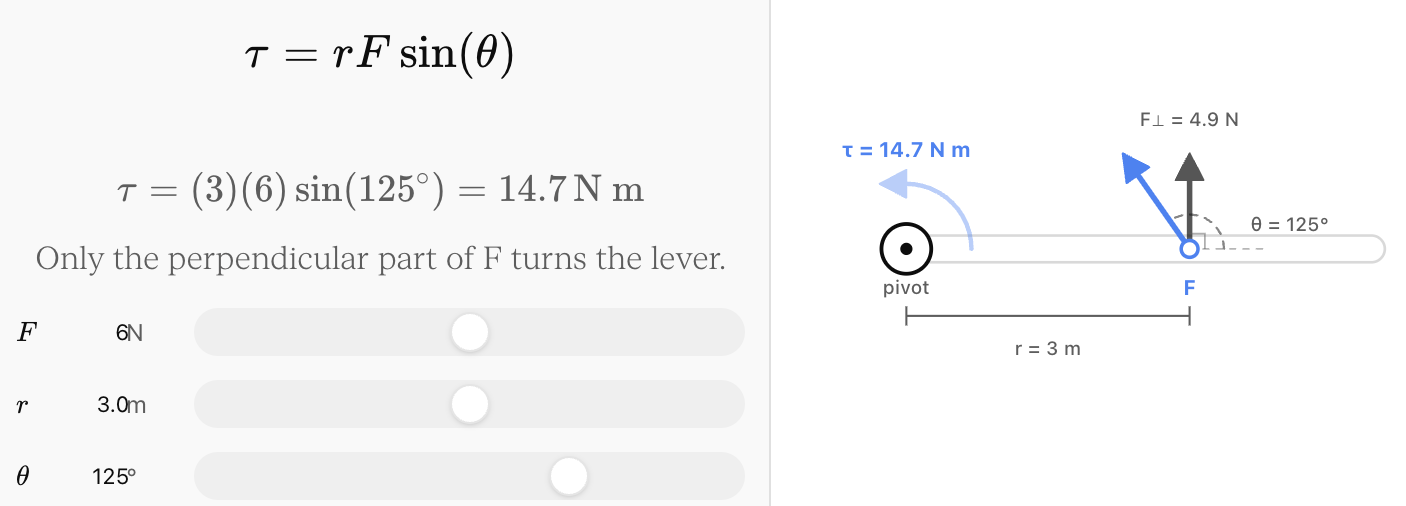
τ = rF sin 180° = 0

Therefore, the planet's angular momentum about the Sun is conserved.


Connection to Kepler's Second Law

Kepler's Second Law states that a line from a planet to the Sun sweeps out equal areas in equal times.

Angular momentum conservation provides the physical explanation.

Near the Sun:

  • r is smaller
  • orbital speed is greater

Farther away:

  • r is larger
  • orbital speed is smaller

The changing speed allows angular momentum to remain constant.


Collapsing Stars

One of the most dramatic applications occurs when stars collapse.

A large star can shrink to form a compact object such as a neutron star.

As the radius decreases:

  • mass moves closer to the rotation axis
  • moment of inertia decreases dramatically
  • angular velocity increases
https://images.openai.com/static-rsc-4/VbttgAAEvjtWk1syvsrh_lBqsxKlpxDbvM1JQUN7zPQjCT7z9xiEfN4ar2KPWKGNHNNvleerpLST9dGqps3WUg-tfz0ZrwkoxF5HEP22iIYJMs6UTplGR4stbM99XJRxODihP8kWxYXZe7-NxOp3VeaSjPAgtl2KrGwNc_WDBFtTlbAOHwFhbHN1BoyU0COX?purpose=fullsize
 
https://images.openai.com/static-rsc-4/4LRYKI5Fn895Wwo_M7CsI0Hl4bMzc2CWPGks5JDqxS9xtjru3gspYlCGOVEMtAQtfCjXrqM5a5EPpHKjd1KU6mAolpA9YFTEwW5gv3yGx9i0728kNyfj71Ne0bi--wi1smipA7AP04JH6GmplyuFpSP9WN309Huxnz3hI6g7adAArk4gmhQC_bczcvpmmNqy?purpose=fullsize
 
https://images.openai.com/static-rsc-4/6R1XIA0lceljWwFIIV5s41Jbjx3q6qfrJsExUHZgANreDnl_P7E2uHqLrVEB9T2SyTtxODKVQdYZxryJu9avZEuwY7uDAQ4arFzGxKNxx39esWgd0j1eDE3vdza-Z7-rRfTe5BTRa8P_Lud1u4ajNFKTMQFpoc84cGN6osrYCVAi2lV62RHXOGuKZHVyR7Q4?purpose=fullsize
 
4

This is the same basic principle as a skater pulling in their arms, but on an astronomical scale.


Simple Model of a Contracting Star

Treat a star approximately as a sphere.

Moment of inertia has the form:

I = kMR²

where k depends on mass distribution.

If mass and k remain approximately constant:

I ∝ R²

Suppose the radius decreases to:

1/100

of its original value.

Then:

I_f/I_i = (1/100)²

I_f = I_i/10,000

If angular momentum is conserved:

ω_f ≈ 10,000ω_i

The actual behaviour of stars is more complicated, but the example shows how powerful the radius-squared dependence can be.


Gyroscopes

A rapidly spinning gyroscope has substantial angular momentum.

Changing the direction of that angular momentum requires torque.

https://images.openai.com/static-rsc-4/0YaHcUHFAJML16ogqDbR6BOdELm9TaDDoSxObhqnQWNqzKpO9NoYLSjSf2kimjzsAVhm7UXLHiTTCugZvYv_gFXJuxyVg2rJKE094uKBaM9nZ2tf-o9CADnLTV0BbSvQn-pWKYz-ZyXMySMpSKPqOF_9x-IXUB_GqIwpKv8cX3u5vVYAcKIYJm5Ydm2zMpJu?purpose=fullsize
 
https://images.openai.com/static-rsc-4/xXBddKh7k-42NOmJn-SGe5gnZ9l1ekxP9dREVV7Jb72073k6s5x7yHcTyJOOOcTPlYjpc3oiKYxosDasvfW26S4nYJogF5d73qv9CSLdoHWh9oXx_LrCrbaqEa0gp5ZzSefde5A6Y7z7cnWtSri6TAQXsPS4AASo7jsD_CVHjC7TEvIzQAR6PEj0FC3ZDjnN?purpose=fullsize
 
https://images.openai.com/static-rsc-4/YuldpWCWbpCmzt8aLNbKWvjTURi6hdUGOGHLkU1XjUEnX8fjtMhiwdlCaLmEBbApJ5zTTs4JbZyqWvfKkaOU0eHp7mrrN3nCEi0c0EKsXcAMy24w9y5D7Qb7J1yoKFgayZyxd7sUP81oQskNid4oGwrYInwWKHJx9KM9NzQrM8TgrJSljyRLEuKZJTJGjdyO?purpose=fullsize
 
9

This property makes gyroscopic systems useful for:

  • navigation
  • spacecraft orientation
  • aircraft instruments
  • drones
  • stabilization systems

Angular Momentum in Sports

Athletes regularly use conservation of angular momentum.

Examples include:

  • figure skating
  • gymnastics
  • diving
  • freestyle skiing
  • snowboarding
  • trampoline
  • aerial sports

Once an athlete is airborne, the external torque may be relatively small.

Changing body configuration allows the athlete to control angular velocity.


Why an Athlete Cannot Create Angular Momentum in Mid-Air

Once airborne, an athlete can change:

  • moment of inertia
  • angular velocity
  • body orientation

But without significant external torque, the athlete cannot change the total angular momentum of the system.

The initial angular momentum must therefore usually be generated during contact with:

  • the ground
  • a diving board
  • ice
  • sporting equipment

External forces during takeoff provide the torque that establishes the initial angular momentum.


Reaction Wheels in Spacecraft

Spacecraft can change orientation using reaction wheels.

A motor spins a wheel inside the spacecraft.

If the wheel gains angular momentum in one direction, the rest of the spacecraft gains angular momentum in the opposite direction.

https://images.openai.com/static-rsc-4/L9Ekp2ODj9hJzwyHX_PWtqJ4xTddjVyC4rMB91jRlVwJ_frYpozikE_BTlV6LZN11_oUrwLETnWwMoVNYpupHQrLf3PyrAKqZ_R1W6oStFMxwui6rAXuoIfK1wpWg2253TrpRRjE9bb3rpI1B8by_oXHmFqCR4UfNekj1ofIBmN3wlNNxDX5REuknw51dLdH?purpose=fullsize
 
https://images.openai.com/static-rsc-4/w4Ife_UOfKDRXM8-1W_F9GD60ExB2cBIOTWy1zcSOnTzCRxtUoYB6lT-P0dx9DIvlUq6AitLQYBYUvEO1wAzToX4uBtBV7RjhQf6kcp0loUIHKdBNTNgYFtE2TGbTrz8xRKooJMKMf1PjJxDPogVrMc0UJeRdmdE90mYA570gse0wutwVUATM9drcqeg13w-?purpose=fullsize
 
https://images.openai.com/static-rsc-4/5kIm36Lz9G8Q_hL2msxCRMR2Q8ylq33VNJBbXvPreNKH9CbcP-DggMW41RtdSRKzHnF52gJaEebRH64cgtDoCLQRtRtoTa4Ljsa4ZoDnVezjlIX4dysve1J8fBL-SUOxPP4obyVNu8Oq_JCS3gshiDjy0KKR6uZpnn4xtCi1aIDsPDbXfmSiKR2Itb-YHy93?purpose=fullsize
 
7

Total angular momentum of the spacecraft-wheel system remains constant if external torque is negligible.

This allows spacecraft to rotate without continuously firing external thrusters.


Worked Reaction-Wheel Example

Suppose a spacecraft is initially stationary.

A reaction wheel gains:

+30 kg·m²/s

of angular momentum.

The spacecraft body must gain:

−30 kg·m²/s

so that:

L_total = 0

If the spacecraft body has:

I = 150 kg·m²

then:

L = Iω

−30 = (150)ω

ω = −0.20 rad/s

The spacecraft rotates opposite to the reaction wheel.


Conservation in a System of Several Objects

For multiple rotating objects:

L_total = L₁ + L₂ + L₃ + ...

If external torque is zero:

ΣL_initial = ΣL_final

Signs must be included to represent rotational direction.

This is especially useful for:

  • coupled disks
  • gears
  • spacecraft systems
  • rotating platforms
  • rotational collisions

A Complete Conservation Problem

A rotating platform has:

I_p = 5.0 kg·m²

ω_i = 8.0 rad/s

A stationary object with an effective moment of inertia of:

I_o = 3.0 kg·m²

is dropped onto the platform and sticks.

Initial Angular Momentum

L_i = I_pω_i

L_i = (5.0)(8.0)

L_i = 40 kg·m²/s

Final Moment of Inertia

I_f = 5.0 + 3.0

I_f = 8.0 kg·m²

Apply Conservation

L_i = L_f

40 = (8.0)ω_f

ω_f = 5.0 rad/s

The angular velocity decreases because the moment of inertia increases.


Checking the Energy

Initial rotational energy:

E_i = 1/2(5)(8²)

E_i = 2.5(64)

E_i = 160 J

Final rotational energy:

E_f = 1/2(8)(5²)

E_f = 4(25)

E_f = 100 J

Angular momentum is conserved, but kinetic energy decreases by:

60 J

The lost mechanical energy is transferred to other forms during the inelastic interaction.


Predicting Outcomes

Before calculating, conservation principles can often predict what will happen.

Mass moves inward

I decreases.

Therefore:

ω increases

Mass moves outward

I increases.

Therefore:

ω decreases

Stationary mass joins a rotating system

I increases.

Therefore:

ω usually decreases

Two objects rotating in the same direction join

Their angular momenta add.

Two objects rotating in opposite directions join

Their angular momenta partially or completely cancel.

External torque acts

Total angular momentum changes.


Problem-Solving Strategy

First, define the system.

Then choose a positive rotational direction.

Next, determine whether significant external torque acts.

If:

Στ_external ≈ 0

use conservation:

L_i = L_f

Write the angular momentum of every relevant part of the system.

For rigid rotating objects:

L = Iω

Then construct:

ΣI_iω_i = ΣI_fω_f

Solve for the unknown.

Finally, check:

  • units
  • direction/sign
  • whether the change in ω makes sense
  • whether I increased or decreased

Do not automatically assume kinetic energy is conserved.


Conservation of Linear and Angular Momentum

The two conservation laws follow very similar patterns.

Linear Motion Rotational Motion
p = mv L = Iω
Net external force changes p Net external torque changes L
ΣF_ext = 0 Στ_ext = 0
p_i = p_f L_i = L_f
m₁v₁ + m₂v₂ = ... I₁ω₁ + I₂ω₂ = ...

Both are fundamental conservation principles.


Common Mistakes

Assuming angular momentum is always conserved

It is conserved only when net external torque is zero or negligible.

Conserving angular velocity

Angular velocity does not have to remain constant. Angular momentum does.

Ignoring changes in moment of inertia

If mass distribution changes, I changes.

Thinking pulling inward creates angular momentum

It changes I and ω while L remains constant.

Ignoring rotational direction

Clockwise and counterclockwise angular momenta must have opposite signs.

Conserving each object's angular momentum separately

It is usually the total angular momentum of the chosen system that is conserved.

Assuming kinetic energy must also be conserved

Angular momentum can be conserved while kinetic energy changes.

Forgetting stationary objects

An initially stationary object has zero initial angular momentum, but it can still change the final moment of inertia.

Using mass instead of moment of inertia

For rigid-body rotation, use:

L = Iω

Forgetting external torque

Friction, motors, brakes, supports, and contact forces can sometimes provide external torque.

Using the wrong axis

All angular momenta and moments of inertia must be calculated about the same reference axis.


Key Terms

Conservation of angular momentum — principle stating that total angular momentum remains constant when net external torque is zero.

Angular momentum (L) — rotational quantity commonly calculated using L = Iω.

Moment of inertia (I) — measure of mass distribution and resistance to changes in rotational motion.

Angular velocity (ω) — rate of change of angular position.

External torque — torque produced by an interaction outside the chosen system.

Internal torque — torque produced by interactions between parts within the chosen system.

Isolated rotational system — system experiencing no significant net external torque.

Rotational collision — interaction involving rotating objects in which angular momentum may be transferred between components.

Inelastic rotational collision — rotational collision in which objects may join and rotational kinetic energy is not conserved.

Reaction wheel — rotating wheel used to change spacecraft orientation through angular momentum exchange.

Mass distribution — arrangement of mass relative to a rotation axis.

Rotational kinetic energy — energy associated with rotation, calculated using E_rot = 1/2 Iω².

Angular impulse — product of external torque and the time over which it acts, equal to the change in angular momentum.


Key Takeaways

  • Angular momentum is conserved when net external torque is zero.
  • The conservation principle can be written as L_i = L_f.
  • For many rotating systems, this becomes I_iω_i = I_fω_f.
  • Conservation does not require I or ω to remain constant individually.
  • Decreasing moment of inertia causes angular velocity to increase when L is conserved.
  • Increasing moment of inertia causes angular velocity to decrease.
  • Moving mass closer to an axis decreases moment of inertia.
  • Moving mass farther from an axis increases moment of inertia.
  • Radius has a strong effect because moment of inertia often depends on r².
  • Internal forces can redistribute angular momentum without changing the total.
  • External torque changes the total angular momentum.
  • Rotational collisions can conserve angular momentum even when kinetic energy is not conserved.
  • Rotational direction must be included when combining angular momenta.
  • Figure skaters, divers, gymnasts, planets, stars and spacecraft all demonstrate angular momentum conservation.
  • Athletes can change their angular velocity in mid-air by changing moment of inertia, but they cannot create total angular momentum without external torque.
  • Reaction wheels allow spacecraft to exchange angular momentum internally and change orientation.
  • Conservation of angular momentum is one of the fundamental conservation laws of physics.

Check Your Understanding

  1. State the principle of conservation of angular momentum and the condition required for it to apply.
  2. A skater has I_i = 6.0 kg·m² and ω_i = 3.0 rad/s. The skater pulls their arms inward until I_f = 2.0 kg·m². Calculate the final angular velocity.
  3. Explain why the skater in Question 2 rotates faster even though no external torque is required.
  4. A rotating system's moment of inertia doubles while angular momentum remains constant. What happens to its angular velocity?
  5. Two masses are moved from 0.60 m to 0.30 m from a rotation axis. Assuming the masses can be treated as point masses, by what factor does their moment of inertia change? What happens to angular velocity if angular momentum is conserved?
  6. A platform has I = 4.0 kg·m² and rotates at 10 rad/s. A stationary object lands on it, increasing the total moment of inertia to 10 kg·m². Calculate the final angular velocity.
  7. Two disks are coupled together. Disk A has I = 3.0 kg·m² and ω = 8.0 rad/s. Disk B has I = 5.0 kg·m² and is initially stationary. Calculate their common final angular velocity.
  8. Disk A has I = 4.0 kg·m² and rotates at +5.0 rad/s. Disk B has I = 2.0 kg·m² and rotates at −6.0 rad/s. They join together. Calculate their final angular velocity and state its direction.
  9. Explain why angular momentum can be conserved in an inelastic rotational collision even though rotational kinetic energy decreases.
  10. A diver decreases their moment of inertia from 12 kg·m² to 4.0 kg·m² while airborne. If the initial angular velocity is 1.5 rad/s, calculate the final angular velocity.
  11. Explain why a diver extends their body before entering the water.
  12. A rotating platform initially has I = 8.0 kg·m² and ω = 4.0 rad/s. A person changes position so that the total moment of inertia becomes 5.0 kg·m². Calculate the final angular velocity and verify that angular momentum is conserved.
  13. A spacecraft reaction wheel gains +24 kg·m²/s of angular momentum. What change in angular momentum must the rest of the spacecraft experience? If the spacecraft body has I = 120 kg·m² and initially has zero angular velocity, calculate its resulting angular velocity.
  14. Explain why a planet moves faster near the Sun and slower farther away using conservation of angular momentum.
  15. A rotating disk has I = 5.0 kg·m² and ω = 8.0 rad/s. A stationary ring with I = 3.0 kg·m² is dropped onto it and the two rotate together. Calculate the final angular velocity. Then calculate the initial and final rotational kinetic energies and determine how much mechanical energy was transferred to other forms.


3. Rotational Kinetic Energy

Learning outcomes
  • I can define rotational kinetic energy.
  • I can calculate rotational kinetic energy.
  • I can identify factors affecting rotational energy.
  • I can compare rotational and translational kinetic energy.
  • I can solve energy problems involving rotating systems.

Rotational Kinetic Energy

A rotating object possesses rotational kinetic energy because its particles are moving around an axis of rotation.

Rotational kinetic energy is calculated using:

E_rot = 1/2 Iω²

where:

  • E_rot = rotational kinetic energy, measured in joules (J)
  • I = moment of inertia, measured in kg·m²
  • ω = angular velocity, measured in rad/s

This equation is the rotational equivalent of the familiar translational kinetic-energy equation:

E_k = 1/2 mv²

https://images.openai.com/static-rsc-4/qq9y6VzjVYRtcW2E-L0g4I_t-TgGex-ocfdf9z-XLLIaHVBKbjfGPVdZi0cvXXfS5GaUF4lcEBXFPHjpgxCBWjVy-7lvpR8xyb-iVk7oZT_4OclEQhXaE25g7lAi6BaPQQpzVDNFLemSdFZ5r8ZAEce1OwQgiETjf211Q8X1ETeSD4Gibf_H4qLwtPAYeuq9?purpose=fullsize
 
https://images.openai.com/static-rsc-4/lY8PTUypVm6P_NGlxn-zXyMm2Q2nuOt-kk011fmC3zsS4UkShzvAhmF329rH5MLsIxzrEWwVXr_uWQ8PWgS7YhAIuXOGYU7kULy8q87nOW2Bips_rVjAXOT3b0InSUD3UCIYdncXvZVaHzWGmHfGsnYaLgB0U0KLqY_uqSAmIXxH7R4gr8GYNfkfUEIX9JuA?purpose=fullsize
 
https://images.openai.com/static-rsc-4/a6aaLaj-KLueNH0-XyAnPtFw__grTOyEmL91VebLh7sWzeMpJI_0U4eIuFpBRR0DAxo8i2HljTFgPpXK5vX61FaeAxq8OddeyrUJDZvGROYpqbjahsyIwH3NV5c5k0Gx3GS9y_YMcCrHkXnptSrgljw2j54px7aigo6kg53jnVlWUaMbq-t0F29-MvWSffEs?purpose=fullsize
 
9

Where Rotational Kinetic Energy Comes From

Every part of a rotating object is moving.

Consider a spinning disk. Points near the centre move relatively slowly, while points near the edge move much faster.

For each small piece of the disk:

E_k = 1/2 mv²

Since:

v = rω

the kinetic energy of each piece depends on:

  • its mass
  • its distance from the axis
  • the angular velocity

Adding the kinetic energies of all the pieces produces:

E_rot = 1/2 Iω²

The moment of inertia accounts for how all the object's mass is distributed around the rotation axis.


Rotational and Translational Kinetic Energy

The two equations have the same mathematical structure.

Translational Motion Rotational Motion
E_k = 1/2 mv² E_rot = 1/2 Iω²
Mass m Moment of inertia I
Linear velocity v Angular velocity ω

In translational motion, mass measures resistance to changes in linear motion.

In rotational motion, moment of inertia measures resistance to changes in rotational motion.


Calculating Rotational Kinetic Energy

Suppose a wheel has:

I = 4.0 kg·m²

and:

ω = 6.0 rad/s

Then:

E_rot = 1/2 Iω²

E_rot = 1/2(4.0)(6.0²)

E_rot = 2.0(36)

E_rot = 72 J


The Effect of Moment of Inertia

For constant angular velocity:

E_rot ∝ I

If moment of inertia doubles while ω remains constant:

rotational kinetic energy doubles

For example:

Object A:

I = 2 kg·m²

ω = 5 rad/s

E_rot = 1/2(2)(5²)

E_rot = 25 J

Object B:

I = 4 kg·m²

ω = 5 rad/s

E_rot = 1/2(4)(5²)

E_rot = 50 J

At the same angular velocity, the object with the larger moment of inertia has more rotational kinetic energy.


The Effect of Angular Velocity

Angular velocity has an even stronger effect because it is squared:

E_rot ∝ ω²

If ω doubles:

E_rot becomes four times larger

If ω triples:

E_rot becomes nine times larger

If ω is halved:

E_rot becomes one-quarter as large


Worked Example: Doubling Angular Velocity

A flywheel has:

I = 5 kg·m²

Initially:

ω = 10 rad/s

Its rotational kinetic energy is:

E_rot = 1/2(5)(10²)

E_rot = 250 J

If its angular velocity doubles:

ω = 20 rad/s

Then:

E_rot = 1/2(5)(20²)

E_rot = 1000 J

The angular velocity doubled, but the energy increased by a factor of four.


Why Angular Velocity Matters So Much

Because:

E_rot = 1/2 Iω²

a relatively small increase in angular velocity can produce a large increase in energy.

This is extremely important in the design and safety of:

  • flywheels
  • turbines
  • motors
  • centrifuges
  • vehicle wheels
  • industrial machinery

A rapidly rotating object can store a very large amount of energy.

https://images.openai.com/static-rsc-4/ll5m8BWOv6Y96xZjglr7TwQAenrtt3JibcPSJIgrJ0_UhKFofsYidqQ74gDZGFD5V4AyAhqakFfaxHOw8Qi67hT8LnSc9U_vqAJH3n0eQqXOZFYyZtetx7P_mSbbjwnC1l8H8zFWVKaV9q-dR9gBtOUNiuQM1O_L7Ez92SpN1NyvWt9VpydlPROy2vBAbe47?purpose=fullsize
 
https://images.openai.com/static-rsc-4/CObKfLUF25Bt8O-ve_hjnkQhRrinY1wtjNALAP1MhUZH5xLWwrimVJV8VUu6o4_C8J40CzLO9tqqmIchJomXbHbUk0-xRW6EiVzGvnv-8C9e7RComFxKvcwntJadWeNIxktwvsOIFNl2n4TBlL2ZKq0VbSNjYUOSsmdReDlzItMi2acV8N2lepfTQK_oqEPP?purpose=fullsize
 
https://images.openai.com/static-rsc-4/T83up5ZYpC2ijL08jm_woRKVgA-wvvwVQhVA_Wa0TAsiw6dCUV3sSVdy1jILp2XXBAw9eiEFbGY-lGSIalsCP5VuqTIOCOb4wDJQCHFeNjWXjKznsWHlXYcg3yeuD7j9VjhfbJ0xyaxQ4Wrki3gX31KSNrolHhgs9Bnc8jce3JevG-R347RKHP2z1FbISqdq?purpose=fullsize
 
8

Moment of Inertia and Mass Distribution

Moment of inertia depends on how mass is distributed relative to the rotation axis.

For example:

Thin ring:

I = MR²

Solid disk:

I = 1/2 MR²

Solid sphere:

I = 2/5 MR²

At the same M, R, and ω, these objects have different rotational kinetic energies because their moments of inertia are different.


Comparing a Ring and a Disk

Suppose a thin ring and a solid disk both have:

M = 8.0 kg

R = 0.50 m

ω = 10 rad/s

Thin Ring

I = MR²

I = (8.0)(0.50²)

I = 2.0 kg·m²

Therefore:

E_rot = 1/2(2.0)(10²)

E_rot = 100 J

Solid Disk

I = 1/2 MR²

I = 1/2(8.0)(0.50²)

I = 1.0 kg·m²

Therefore:

E_rot = 1/2(1.0)(10²)

E_rot = 50 J

At the same angular velocity, the ring has twice as much rotational kinetic energy.

https://images.openai.com/static-rsc-4/NMBDDcpKMutEmNB1vPK2SJR7z2sGF-1IBKxZJ1COpsV_SXIUtT2ZlhuLPVh57ECwskkG__kdk39s0kpW9QRkN8yZFmhZg5KkpU_kw_g_FEaB-HqYk81v7jK3ioQQwyMtBpKmBM8DsFCTeW2Gsklot0S6PyOCz5oe_zgo9OA-CBxdWW7ZFQc0rUBqriQ9A2kd?purpose=fullsize
 
https://images.openai.com/static-rsc-4/e8VxU3ZLu1iY4SbWtl-7fOqnUk1BnfL0uBZoBETdqvEdKb1v0xbQmslxWL8mc3Fkx3A7hI_xMFQP1y7imc7hlCwMM6NIKW_xR8ajYrm0reeYtZYMIsZXrB-3zbdmIjSax1WggCCDE06lP2yfQhCMMRP-SkswqHwIGaVt4Yz7OD5NCkMmWUoGuBSTwIAc7P9C?purpose=fullsize
 
https://images.openai.com/static-rsc-4/sBkshujrjXC88tOmIqepugQgnOgq_MYhES7fw14D4uBlccJTO7VPzjGlhLhPYXOBXypvqKSrlldQLkVBxS9zuwHTjJluOLc4e9E-2Du8r4OKzdB1MJD7Njbq62cesXIg5vwSdio980d6Hn_Qebxw5_AoRzWjtWm-5VILI1iRb6xKCy6D0gK1Aqajo_EnhQLU?purpose=fullsize
 
6

Why the Ring Has More Energy

The ring has more of its mass concentrated far from the axis.

This gives it a larger moment of inertia.

Since:

E_rot = 1/2 Iω²

a larger I gives greater rotational kinetic energy when ω is the same.


Finding Angular Velocity from Energy

The rotational energy equation can be rearranged.

Starting with:

E_rot = 1/2 Iω²

Multiply by 2:

2E_rot = Iω²

Divide by I:

ω² = 2E_rot/I

Therefore:

ω = √(2E_rot/I)


Worked Example

A flywheel stores:

E_rot = 1600 J

and has:

I = 8.0 kg·m²

Then:

ω = √(2E_rot/I)

ω = √[(2)(1600)/8]

ω = √400

ω = 20 rad/s


Finding Moment of Inertia from Energy

Starting with:

E_rot = 1/2 Iω²

Rearrange:

I = 2E_rot/ω²

Suppose:

E_rot = 900 J

ω = 15 rad/s

Then:

I = (2)(900)/(15²)

I = 1800/225

I = 8.0 kg·m²


Work and Rotational Energy

Just as work can change translational kinetic energy, rotational work can change rotational kinetic energy.

For constant torque:

W = τΔθ

where:

  • W = work
  • τ = torque
  • Δθ = angular displacement in radians

The rotational work-energy theorem is:

W_net = ΔE_rot

or:

W_net = E_rot,f − E_rot,i


Worked Example: Torque Doing Work

A constant net torque of:

12 N·m

turns a wheel through:

20 rad

The work done is:

W = τΔθ

W = (12)(20)

W = 240 J

If the wheel begins from rest and there are no other energy transfers:

E_rot,f = 240 J


Finding Final Angular Velocity

Suppose the wheel in the previous example has:

I = 3.0 kg·m²

Then:

E_rot = 1/2 Iω²

240 = 1/2(3.0)ω²

240 = 1.5ω²

ω² = 160

ω ≈ 12.6 rad/s


Work-Energy Method vs Dynamics Method

Some rotational problems can be solved using either forces and torques or energy.

Dynamics Approach

Use:

Στ = Iα

then rotational kinematics.

Energy Approach

Use:

W_net = ΔE_rot

The energy approach can be especially useful when:

  • time is not given
  • angular acceleration is not needed
  • torque acts through a known angular displacement

Rotational Power

Power measures the rate of energy transfer.

For rotational motion:

P = τω

where:

  • P = power in watts
  • τ = torque
  • ω = angular velocity

This equation is widely used for:

  • motors
  • engines
  • turbines
  • generators
  • vehicle drivetrains

Worked Power Example

A motor produces:

τ = 40 N·m

while rotating at:

ω = 50 rad/s

Power:

P = τω

P = (40)(50)

P = 2000 W

or:

P = 2.0 kW


Flywheels

A flywheel is designed to store rotational kinetic energy.

Flywheels often have substantial moment of inertia and rotate rapidly.

https://images.openai.com/static-rsc-4/tS0-cyPK03_rA4MSSh5XNIHHNTcX0Py6Bb9qBtyOXNJ-unZzQ_8If61FQJ3xjmOCI8qQvoyvduBtda_8ev98w1iWaOhlo16XUEyMd3k6ESSH52XIZZOphj7bt-hK4HnrOrQwfAnQlCKUpaGfO9R0Yn7bOsY3IbCSbEzJ-mGTbFzEJs1D_YAAewGuIg1FEJZP?purpose=fullsize
 
https://images.openai.com/static-rsc-4/cs6V8wZEMaycBc9FBgkg6JONzJE8McEObcn5jpddnLh7PwxKj6u-HCatepXPHioIKf5XVDxmFU6gpyT6kf8FbAIxEoMMJw09934lFYNnujDBmZVw95X8JMZkSFpTVqCh1JMN6rmZks0qY8YzyewnHsoYacRbqLH4luXuVU3K3IvkkX0hJtbR3VnSXzoCzkaQ?purpose=fullsize
 
https://images.openai.com/static-rsc-4/LFDUXzjY3Rih8484bAdRDzE5DFHlSFCMkasQfgdzvEAYhOJcKZVptto_c-RdJ5HaBVrVAb-S0TI4hF2ZaGPTj7OPHOvRfFazPDeGsR1q8_ANZISipZLtqXtPdd6iPddSFTUFBoDBAGHEANaMt5fWx2UCsinM6OtybYHWr6VBOqSo6_-yhLa-TkUyL52FtPfy?purpose=fullsize
 
7

Their stored energy is:

E_rot = 1/2 Iω²

Flywheels can:

  • smooth changes in machinery speed
  • temporarily store energy
  • provide bursts of power
  • recover energy in some systems

Why Flywheel Mass Is Often Far from the Axis

Moving mass farther from the axis increases moment of inertia.

For a point mass:

I = mr²

Therefore, distributing mass farther outward can increase the energy stored at a particular angular velocity.

However, increasing radius and rotational speed also increases mechanical stresses, so engineering design must balance energy storage with safety.


Energy in Rolling Motion

A rolling object can have two types of kinetic energy at the same time:

  1. translational kinetic energy of its centre of mass
  2. rotational kinetic energy about its centre

Therefore:

E_total = E_trans + E_rot

or:

E_total = 1/2 mv² + 1/2 Iω²

For rolling without slipping:

v = rω

https://images.openai.com/static-rsc-4/2l3850tVziLFZXYxZZXIcuobDBh9g0NP2yMtrF48dCFn3TuFiWNQbKe-dFR_DMu-4E-_J11uhPQi081jLQpGJ_UwBTRaxaMeyIccv3r8QSSz72eUQaNMnuXcRscfYrDIsyCVlX5JtD1bVzjVzLr7tdr0_v_Rm4bGjQ7ICDjjITTJD3WmtVOiD9Oql1_5PJbZ?purpose=fullsize
 
https://images.openai.com/static-rsc-4/4GIpivNVwOYzHJi4i8CUVouNYlsiaFeixLRoiWCH-QIZDzSoslMtu11zm9FOae2uN9KhjZoEgN-oz3VOLebokr1YNz3kDxEvqLqRfixxD6DR0LQOcczjB_Fx9mCJcOE9t3qp_Xf-S73XS7fEbEusAmB30ESbc8sJpyio4vy42VCjk8sQ2BevNmjGi2zd-fNC?purpose=fullsize
 
https://images.openai.com/static-rsc-4/301js9Km2k_J1R5iZo0ARp_vTTbaiFKOJZ__4pG9r5wnVz4af4HZ1ufsUC9L6Gm7m3wlFJXDHnkLdNq0si_-EbPRK2Pw1CVVKggi55c9f0aRbjeffnKgsC76Amk_Vk4guHrZtdIIugpbyzmPKGOoJVU_KY2uDuslM6HHe1gOVDVeizufLWVtmQM6c9tMDSAI?purpose=fullsize
 
7

Worked Example: Rolling Wheel

A wheel has:

m = 4.0 kg

I = 0.50 kg·m²

r = 0.25 m

It rolls without slipping at:

v = 3.0 m/s

First find angular velocity:

v = rω

ω = v/r

ω = 3.0/0.25

ω = 12 rad/s

Translational Kinetic Energy

E_trans = 1/2 mv²

E_trans = 1/2(4.0)(3.0²)

E_trans = 18 J

Rotational Kinetic Energy

E_rot = 1/2 Iω²

E_rot = 1/2(0.50)(12²)

E_rot = 0.25(144)

E_rot = 36 J

Total Kinetic Energy

E_total = 18 + 36

E_total = 54 J


Rolling Objects Down a Hill

Consider an object rolling from rest down a slope.

Initially, it has gravitational potential energy.

As it descends, that energy becomes:

  • translational kinetic energy
  • rotational kinetic energy

Ignoring energy losses:

mgh = 1/2 mv² + 1/2 Iω²

Since:

ω = v/r

we can analyze how mass distribution affects the final speed.


Shape Affects Rolling Motion

Consider objects with the same mass and radius rolling down the same hill.

A thin ring has:

I = MR²

A solid disk has:

I = 1/2 MR²

A solid sphere has:

I = 2/5 MR²

The object with the smaller moment of inertia relative to MR² requires a smaller fraction of its available energy for rotation.

As a result, its centre of mass can gain more translational speed.

https://images.openai.com/static-rsc-4/sBkshujrjXC88tOmIqepugQgnOgq_MYhES7fw14D4uBlccJTO7VPzjGlhLhPYXOBXypvqKSrlldQLkVBxS9zuwHTjJluOLc4e9E-2Du8r4OKzdB1MJD7Njbq62cesXIg5vwSdio980d6Hn_Qebxw5_AoRzWjtWm-5VILI1iRb6xKCy6D0gK1Aqajo_EnhQLU?purpose=fullsize
 
https://images.openai.com/static-rsc-4/bZzAOYe79jDSu4zFccufydZzAzrnIUCzKtrs-56Ln0RgIN-oPbi7LMWkEJjEiSFbQ3cL7AvGl_STAfbkE94NnbRHyebpP7BDjsm-aeEM12hohbK75FBejbbcH-Eglhf-I4LYTLnB6Kk3oG8hSp5kqpu0mqmZ209jK3CofF_J8PlaL15DmqzuBbQkA6C0Wu3v?purpose=fullsize
 
https://images.openai.com/static-rsc-4/gHa3yPihLUkE8AgSLneSStEKVyRawyHvgYNZJPWcZrx6ksIOvFZF358DSNreioyxMPR_dF-nOw8eSw64n3KAlQRuxm10ijIycDwPtKAFD7XEKLATgK7gLXhcB7Hd1Jj-a58stTP5NX1XnFF6ZqpgD_S-MNnH8JNV7D5GSlbxXz0XncSRoyEvXk0qHdLV4Ehi?purpose=fullsize
 
8

For ideal rolling from the same height:

solid sphere reaches the bottom before a solid disk

and:

solid disk reaches the bottom before a thin ring

assuming comparable conditions.


Deriving the Speed of a Rolling Object

Start with:

mgh = 1/2 mv² + 1/2 Iω²

For rolling without slipping:

ω = v/r

Substitute:

mgh = 1/2 mv² + 1/2 I(v²/r²)

Factor out:

mgh = 1/2 v²(m + I/r²)

Therefore:

v² = 2mgh/(m + I/r²)

This equation shows directly how moment of inertia affects the speed reached by a rolling object.


Example: Solid Sphere Rolling Down a Hill

For a solid sphere:

I = 2/5 mr²

Substitute into the energy equation:

mgh = 1/2 mv² + 1/2(2/5 mr²)(v²/r²)

mgh = 1/2 mv² + 1/5 mv²

mgh = 7/10 mv²

Therefore:

v² = 10gh/7

and:

v = √(10gh/7)

Notice that the mass cancels.

For ideal rolling, the final speed does not depend on the object's mass.


Rotational Energy in Vehicle Wheels

A moving vehicle has translational kinetic energy, but its rotating wheels also contain rotational kinetic energy.

The total energy therefore includes:

  • translational energy of the vehicle
  • rotational energy of the wheels
  • rotational energy of other moving components

This means an engine must provide energy not only to accelerate the vehicle forward but also to spin its wheels.


Why Lightweight Wheels Can Matter

Reducing the moment of inertia of a wheel reduces the energy required to reach a particular angular velocity:

E_rot = 1/2 Iω²

It can also make the wheel easier to angularly accelerate.

This is one reason engineers may try to reduce rotating mass, particularly mass located far from the axis.


Braking a Rotating Wheel

Brakes remove rotational kinetic energy.

Suppose:

I = 5.0 kg·m²

ω_i = 20 rad/s

Initial rotational energy:

E_i = 1/2(5)(20²)

E_i = 2.5(400)

E_i = 1000 J

If the wheel stops:

E_f = 0

Therefore:

1000 J

of rotational kinetic energy must be transferred elsewhere.

Usually much of it becomes thermal energy in the braking system.


Braking Torque and Energy

Suppose a constant braking torque of:

25 N·m

acts on the previous wheel.

Using:

W = τΔθ

the angular displacement required for the brakes to remove 1000 J is:

1000 = (25)Δθ

Δθ = 40 rad

Therefore, the wheel rotates through:

40 rad

while stopping.

In revolutions:

N = 40/(2π)

N ≈ 6.37 revolutions


Conservation of Energy in Rotating Systems

Mechanical energy can be conserved when dissipative forces are negligible.

A typical rotational energy equation might be:

E_initial = E_final

For example:

mgh = 1/2 mv² + 1/2 Iω²

or:

E_rot,i + W = E_rot,f

Energy may move between:

  • gravitational potential energy
  • translational kinetic energy
  • rotational kinetic energy
  • elastic potential energy

Angular Momentum and Rotational Energy

Angular momentum is:

L = Iω

Rotational kinetic energy is:

E_rot = 1/2 Iω²

These are related but different quantities.

If L is known, then:

ω = L/I

Substitute into the energy equation:

E_rot = 1/2 I(L/I)²

Therefore:

E_rot = L²/(2I)

This relationship is particularly useful when angular momentum is conserved.


Energy When Moment of Inertia Changes

If angular momentum remains constant:

E_rot = L²/(2I)

Therefore:

smaller I → greater rotational kinetic energy

This may seem surprising.

Consider a skater pulling their arms inward.

  • I decreases
  • ω increases
  • L remains constant
  • E_rot increases

Where does the additional energy come from?

The skater does work while pulling their arms inward.

Chemical energy in the body is transferred into rotational kinetic energy.

https://images.openai.com/static-rsc-4/pI661wWalxrSwn7E3L9aPieNLtmL9vWimOdENzeKT71yGredlxcAv3RcPMQTrL6Dw2yTjG4cTwwf2_FP4wtF0dPiGnk9cqpXMCjcl1EJi7CHunD1t4aOjr5AP5PnziMRlyy-2vk04lt9DQnjj8lRgRb7qQvqLA1_tmR5a-5odG6ka5-4yE92n2OvX61H97sP?purpose=fullsize
 
https://images.openai.com/static-rsc-4/rzVfwizWRy0_5vfFvgZqi3TQBOXTnKa1jM6uhWRoU3eMj_cCIXHRVsZezl4UFBXbfBBSV8hEV--vi69rqOeNYuwggLGaquElRuWnlLXUUErVvZjpjPOsz9kkTlACDSw7akVwXhoaYEpFcbC0FdtGyRdIDkiC5kl9P8CbEt1GRRXNPrT-BdJ66nsUA9jhlJbC?purpose=fullsize
 
https://images.openai.com/static-rsc-4/WJJCyfXnq-f4Q1T4JAFI_poPgUDFQH3qSd3TmeURhmzPu8Kouv4BH1tEMP8COeSh9OZYAinENbBoNo1uZDPqOckGc6pbgHlysBEMbUMTMRwgsoo_mzwXxfJ9f1-HT9meB4p4T55r79_vBE_WB0n56UqvS0p9HEbvLEVygvox4SVg7w-KuRtTnw7BKmT26mcB?purpose=fullsize
 
7

Worked Skater Energy Example

Initially:

I_i = 6 kg·m²

ω_i = 2 rad/s

Initial energy:

E_i = 1/2(6)(2²)

E_i = 12 J

Angular momentum:

L = (6)(2)

L = 12 kg·m²/s

The skater pulls inward:

I_f = 2 kg·m²

Angular momentum is conserved:

12 = (2)ω_f

ω_f = 6 rad/s

Final rotational energy:

E_f = 1/2(2)(6²)

E_f = 36 J

The rotational kinetic energy increased by:

36 − 12 = 24 J

That additional energy came from work done by the skater.


Rotational Collisions

Angular momentum can be conserved during a rotational collision while rotational kinetic energy decreases.

Suppose a rotating disk interacts with another object and they stick together.

The final moment of inertia increases.

Angular momentum may remain constant, but some kinetic energy can be transferred into:

  • heat
  • sound
  • deformation

This is similar to an inelastic collision in linear motion.


Worked Rotational Collision

A disk has:

I₁ = 2 kg·m²

ω₁ = 10 rad/s

A stationary disk with:

I₂ = 3 kg·m²

is dropped onto it.

They rotate together.

Angular momentum conservation gives:

I₁ω₁ = (I₁ + I₂)ω_f

(2)(10) = (5)ω_f

ω_f = 4 rad/s

Initial rotational energy:

E_i = 1/2(2)(10²)

E_i = 100 J

Final rotational energy:

E_f = 1/2(5)(4²)

E_f = 40 J

Mechanical energy transferred to other forms:

100 − 40 = 60 J

Angular momentum was conserved, but rotational kinetic energy was not.


Energy Stored in Rotating Machinery

Many machines contain rotating components such as:

  • shafts
  • gears
  • wheels
  • turbines
  • rotors
  • fans

Every rotating component contributes rotational kinetic energy.

The total rotational energy is:

E_rot,total = 1/2 I₁ω₁² + 1/2 I₂ω₂² + ...

If different components rotate at different angular velocities, each must be calculated separately.


Gears and Rotational Energy

Connected gears generally rotate at different angular velocities.

For meshing gears:

r₁ω₁ = r₂ω₂

A small gear may rotate rapidly while a larger gear rotates more slowly.

Each gear has rotational energy:

E_rot = 1/2 Iω²

Therefore, both the moment of inertia and angular velocity of each gear must be considered when calculating the total energy of a gear system.

https://images.openai.com/static-rsc-4/TYXgdz3jWZk_9i5aMC54v6IxVG9SOHxuhp-XWoypT_-09omoOxsGFlgZy2gd9cQaCbqUsvqAAigPVY0c4B-49qVdhgfs-5Oy5Ez_Lw8tt9JdBQ221WJRjivgnfIM2eEl8MudVMocBCd30grNPN_1v3zQy0on822SPH3vQ8TUQuDKtJtzBI61MJWmuXtznsvz?purpose=fullsize
 
https://images.openai.com/static-rsc-4/LVq89w8-IFIaExGtqYLqOxzwaeVC5yShlJz4kigbVLWOjQ7jZhu_DdMzqvkcIiKjwq7OhERlBF1V2fQqHAQRPWfQVtUeqrxjCRlPyDxs9gv7BtkMbzbvY6H6Da45NxMDxBo3ljvfk5H6gNt5kOxGT3sIfJs8eEf4Hi9fOg4K_awHv16FKv4zM-XVao35MhTC?purpose=fullsize
 
https://images.openai.com/static-rsc-4/vaNH_b-4rBh4_vSe0ZVkyu3YqVugZqbWz4-nMuXZ1n54Msq4mUTNDh7VgBeM1H4Z3gHpE5eMTOmxzBDD9FABr6PYKEP4R9_kIV7hjjV_JrYosGBHCdjx7CF4zs9Rj_wiK3dKFplNn_HaXA4WJtOFkFQiOclqkffej4cJBlUkfEmhuX-G1MvfBPcXYp4-ZBWU?purpose=fullsize
 
6

Rotational Energy and Safety

Rapidly rotating systems can store enormous amounts of energy.

Because:

E_rot ∝ ω²

doubling angular velocity produces four times the energy.

This creates important safety considerations for:

  • turbine blades
  • flywheels
  • grinding wheels
  • centrifuges
  • industrial rotors

A mechanical failure at high angular speed can release a large amount of stored energy very quickly.


A Complete Rotational Energy Problem

A solid disk has:

M = 12 kg

R = 0.50 m

It starts from rest.

A constant net torque of:

6.0 N·m

acts through:

25 rad

of angular displacement.

Moment of Inertia

For a solid disk:

I = 1/2 MR²

I = 1/2(12)(0.50²)

I = 6(0.25)

I = 1.5 kg·m²

Work Done

W = τΔθ

W = (6.0)(25)

W = 150 J

Since the disk starts from rest:

E_rot,f = 150 J

Final Angular Velocity

E_rot = 1/2 Iω²

150 = 1/2(1.5)ω²

150 = 0.75ω²

ω² = 200

ω ≈ 14.1 rad/s


Checking with Rotational Dynamics

We can solve the same problem another way.

Newton's Second Law for rotation:

Στ = Iα

α = 6.0/1.5

α = 4.0 rad/s²

Then use:

ω_f² = ω_i² + 2αΔθ

ω_f² = 0 + 2(4.0)(25)

ω_f² = 200

ω_f ≈ 14.1 rad/s

Both approaches give the same result.

This demonstrates the consistency between:


A Complete Rolling-Energy Problem

A solid cylinder has:

m = 6.0 kg

r = 0.20 m

It rolls without slipping at:

v = 4.0 m/s

For a solid cylinder:

I = 1/2 mr²

Moment of Inertia

I = 1/2(6.0)(0.20²)

I = 3(0.04)

I = 0.12 kg·m²

Angular Velocity

ω = v/r

ω = 4.0/0.20

ω = 20 rad/s

Translational Kinetic Energy

E_trans = 1/2 mv²

E_trans = 1/2(6)(4²)

E_trans = 48 J

Rotational Kinetic Energy

E_rot = 1/2 Iω²

E_rot = 1/2(0.12)(20²)

E_rot = 0.06(400)

E_rot = 24 J

Total Kinetic Energy

E_total = 48 + 24

E_total = 72 J

The rolling cylinder therefore has both translational and rotational kinetic energy.


Problem-Solving Strategy

First determine what type of motion is involved:

  • rotation only
  • translation only
  • rolling with both translation and rotation

Identify the moment of inertia.

Then identify the angular velocity.

For pure rotation, use:

E_rot = 1/2 Iω²

For rolling motion, include:

E_total = 1/2 mv² + 1/2 Iω²

and:

v = rω

If torque and angular displacement are given, consider:

W = τΔθ

and:

W_net = ΔE_rot

If gravitational potential energy is involved, use conservation of energy.

Finally, check that every energy term is measured in joules.


Common Mistakes

Using mass instead of moment of inertia

Rotational kinetic energy uses:

E_rot = 1/2 Iω²

not 1/2 mω².

Forgetting to square angular velocity

The equation contains ω².

Using rpm directly in the equation

Convert rpm to rad/s before using E_rot = 1/2 Iω².

Ignoring mass distribution

Different shapes can have different I even if they have the same mass and radius.

Forgetting translational kinetic energy in rolling problems

A rolling object usually has both translational and rotational kinetic energy.

Counting rotational energy twice

Be careful when deciding which parts of a system are translating and rotating.

Assuming angular momentum conservation means energy conservation

Angular momentum and kinetic energy are different quantities.

Forgetting that a person can do work while changing I

A skater's rotational kinetic energy can change even while angular momentum remains constant.

Using degrees instead of radians in rotational work

For W = τΔθ, angular displacement must be expressed in radians.

Ignoring friction or other energy losses

Real systems may transfer mechanical energy into thermal energy and sound.


Key Terms

Rotational kinetic energy — energy possessed by an object because it is rotating, calculated using E_rot = 1/2 Iω².

Moment of inertia (I) — measure of how an object's mass is distributed relative to its rotation axis.

Angular velocity (ω) — rate at which angular position changes.

Translational kinetic energy — energy associated with linear motion, calculated using E_k = 1/2 mv².

Rotational work — energy transferred by a torque acting through an angular displacement.

Work-energy theorem — principle stating that net work equals the change in kinetic energy.

Rotational power — rate of rotational energy transfer, calculated using P = τω.

Flywheel — rotating device designed to store rotational kinetic energy.

Rolling without slipping — motion in which v = rω.

Total kinetic energy — combined kinetic energy of all forms of motion in a system.

Angular momentum — rotational quantity calculated for a rigid body using L = Iω.

Energy conservation — principle stating that total energy cannot be created or destroyed but can be transferred or transformed.

Inelastic rotational collision — rotational interaction in which angular momentum may be conserved while kinetic energy is transferred to other forms.


Key Takeaways

  • Rotating objects possess rotational kinetic energy.
  • Rotational kinetic energy is calculated using E_rot = 1/2 Iω².
  • Rotational kinetic energy is measured in joules.
  • Moment of inertia plays the rotational role that mass plays in translational kinetic energy.
  • Angular velocity plays the rotational role that linear velocity plays.
  • For constant ω, rotational energy is directly proportional to I.
  • For constant I, rotational energy is proportional to ω².
  • Doubling angular velocity produces four times the rotational kinetic energy.
  • Mass distribution affects rotational energy through moment of inertia.
  • Torque can transfer energy to a rotating object.
  • For constant torque, rotational work is W = τΔθ.
  • Net rotational work equals the change in rotational kinetic energy.
  • Rotational power is P = τω.
  • A rolling object has both translational and rotational kinetic energy.
  • For rolling without slipping, v = rω.
  • Different shapes can roll differently because their moments of inertia differ.
  • Flywheels can store substantial amounts of rotational kinetic energy.
  • Angular momentum can remain constant while rotational kinetic energy changes.
  • Rapidly rotating machinery can store very large amounts of energy and therefore requires careful engineering and safety controls.
  • Energy methods provide a powerful alternative to torque and kinematics when solving rotational mechanics problems.

Check Your Understanding

  1. Define rotational kinetic energy and give its SI unit.
  2. A wheel has I = 3.0 kg·m² and rotates at 8.0 rad/s. Calculate its rotational kinetic energy.
  3. The angular velocity of the wheel in Question 2 doubles. By what factor does its rotational kinetic energy change?
  4. Two objects rotate at the same angular velocity. Object A has I = 2.0 kg·m² and Object B has I = 6.0 kg·m². Compare their rotational kinetic energies.
  5. A flywheel stores 2500 J of rotational kinetic energy and has I = 5.0 kg·m². Calculate its angular velocity.
  6. A rotating object has 600 J of rotational kinetic energy while rotating at 10 rad/s. Calculate its moment of inertia.
  7. A thin ring and solid disk have the same mass, radius, and angular velocity. Which has greater rotational kinetic energy? Explain why.
  8. A constant torque of 15 N·m turns a wheel through 30 rad. Calculate the work done. If the wheel starts from rest and there are no energy losses, determine its final rotational kinetic energy.
  9. The wheel in Question 8 has I = 5.0 kg·m². Calculate its final angular velocity.
  10. A motor produces 60 N·m of torque while rotating at 40 rad/s. Calculate its rotational power.
  11. A 5.0 kg wheel rolls without slipping at 4.0 m/s. Its moment of inertia is 0.40 kg·m² and its radius is 0.20 m. Calculate its angular velocity, translational kinetic energy, rotational kinetic energy, and total kinetic energy.
  12. Explain why a solid sphere generally accelerates down an incline faster than a thin ring of the same mass and radius when both roll without slipping.
  13. A skater has I_i = 8.0 kg·m² and ω_i = 2.0 rad/s. The skater pulls inward until I_f = 2.0 kg·m². Assuming angular momentum is conserved, calculate the final angular velocity and compare the initial and final rotational kinetic energies.
  14. Two disks collide and stick together. The first has I₁ = 3.0 kg·m² and rotates at 8.0 rad/s. The second has I₂ = 5.0 kg·m² and is stationary. Calculate their final angular velocity, initial rotational kinetic energy, final rotational kinetic energy, and energy transferred to other forms.
  15. A solid cylinder of mass 8.0 kg and radius 0.25 m rolls without slipping down a hill from a vertical height of 5.0 m. Assuming no energy losses and using I = 1/2 mr², determine its speed and angular velocity at the bottom of the hill.


4. Work and Power in Rotational Systems

Learning outcomes
  • I can define rotational work.
  • I can calculate work done by torque.
  • I can define rotational power.
  • I can solve problems involving rotational energy transfer.
  • I can analyze rotating machines using power concepts.

Key Topics:
  • Rotational kinetic energy: KErot=12Iω2.
  • Comparison of translational and rotational kinetic energy.

Work and Power in Rotational Systems

Rotating systems can transfer energy in much the same way as objects moving in a straight line. When a torque causes an object to rotate through an angular displacement, work is done on the object.

For a constant torque acting in the direction of rotation:

W = τΔθ

where:

  • W = rotational work, measured in joules (J)
  • τ = torque, measured in newton-metres (N·m)
  • Δθ = angular displacement, measured in radians (rad)

Rotational power describes how quickly this work is done or how quickly energy is transferred.

For a rotating system:

P = τω

where:

  • P = power, measured in watts (W)
  • τ = torque
  • ω = angular velocity in rad/s

These relationships are essential for understanding motors, engines, turbines, generators, gears, vehicle drivetrains, and other rotating machines.

https://images.openai.com/static-rsc-4/eTtRCqpWor540-PmlS35ej_0SRI_V0HxCzTL9PsuksAHC0yVTDa-nJaPOdXjAHWWlgr-CTrQMW5Evlis-vSqhkAC8hvG1pfNwgKXTqxV7KOQKXK20xeTsLTxy4KFMJNaF1gSPzLS9j0bVkZhfBxv_GcHZYdswLuQSvjdUdeUXANQPS7JcdR0hNzrbbnZ-dJB?purpose=fullsize
 
https://images.openai.com/static-rsc-4/OhZINLG0sPXhLubuRPKpl6tumO_gLc1Wy-f35aDLojUia1aRqQIEeZdpmXtzKwOxYVgZHMRqGk-6IcWS2sBxPl16AidzT2Y3C-c8QwFK5xfLK8bCewJvvhQdEBjmNqtLOPaeSoXjp0cZB6-iokLlBP0bQ1Q1ig-0gel5D5D5IDqez8yokpotYIhgScyzZ40Z?purpose=fullsize
 
https://images.openai.com/static-rsc-4/5LSphJUTDhs6FJdY2sABbZAWwnrKWqrVO3wvI_P_ST99nMflEsiz2UjmF7HTFg9MZC_nhu-VVfeDI2oM6JhZus0tg8cL-kCS4YUj-o0JN4icr1KIZ8YlaCzAkFoyj6r_Yq7WKXOYW3xJXzyxAJ20Z9yk1A74qXk-ZNKXdSSxvDjP63G6ykz6LtO7TSejuEN3?purpose=fullsize
 
7

Rotational Work

In linear motion, work is done when a force acts through a displacement.

For a constant force acting in the direction of motion:

W = Fd

The rotational equivalent is:

W = τΔθ

Instead of:

  • force F, we use torque τ
  • linear displacement d, we use angular displacement Δθ

This creates another important parallel between translational and rotational mechanics.

Translational Motion Rotational Motion
Force F Torque τ
Displacement d Angular displacement Δθ
W = Fd W = τΔθ
Velocity v Angular velocity ω
P = Fv P = τω

How Torque Does Work

Torque produces a turning effect.

If a torque causes an object to rotate, energy is transferred to or from the rotating system.

For example, a motor applies torque to a wheel.

As the wheel turns:

  • the motor does work
  • energy is transferred to the wheel
  • the wheel's rotational kinetic energy may increase

If friction or brakes apply an opposing torque, energy can be transferred out of the wheel's rotational motion.


Torque from a Force

Before calculating rotational work, we may first need to calculate torque.

For a force acting at distance r:

τ = rF sin θ

For a force perpendicular to the lever arm:

τ = rF

The amount of torque therefore depends on:

  • force magnitude
  • distance from the axis
  • angle of the applied force

Worked Example: Rotational Work

A constant torque of:

τ = 15 N·m

rotates a wheel through:

Δθ = 20 rad

Work done:

W = τΔθ

W = (15)(20)

W = 300 J

Therefore, 300 J of energy is transferred to the wheel.


Angular Displacement Must Be in Radians

When using:

W = τΔθ

angular displacement should be measured in radians.

One complete revolution is:

2π rad

Therefore:

1 revolution = 2π rad

If an object completes N revolutions:

Δθ = 2πN


Worked Example: Several Revolutions

A motor applies a constant torque of:

8.0 N·m

while a shaft rotates through:

10 revolutions

First convert revolutions to radians:

Δθ = 10(2π)

Δθ = 20π rad

Δθ ≈ 62.8 rad

Then:

W = τΔθ

W = (8.0)(62.8)

W ≈ 503 J


Work from an Applied Force

Sometimes a problem gives a force rather than torque.

Suppose a tangential force of:

50 N

acts at the edge of a wheel with radius:

0.30 m

Torque:

τ = rF

τ = (0.30)(50)

τ = 15 N·m

If the wheel rotates through:

12 rad

then:

W = τΔθ

W = (15)(12)

W = 180 J

The problem requires two steps:

force → torque → work


Force Applied at an Angle

Suppose:

F = 80 N

r = 0.40 m

θ = 30°

First calculate torque:

τ = rF sin θ

τ = (0.40)(80)(sin 30°)

τ = (0.40)(80)(0.50)

τ = 16 N·m

If the object rotates through:

Δθ = 15 rad

then:

W = τΔθ

W = (16)(15)

W = 240 J

Only the component of the force that produces torque contributes to rotational work.


Positive and Negative Work

Rotational work can be positive or negative.

Positive Work

Torque acts in the same direction as angular displacement.

Energy is transferred into the rotational motion.

Negative Work

Torque acts opposite to angular displacement.

Energy is transferred out of the rotational motion.

Braking and friction commonly perform negative rotational work.


Work-Energy Theorem for Rotation

Net rotational work changes rotational kinetic energy:

W_net = ΔE_rot

Therefore:

W_net = E_rot,f − E_rot,i

Since:

E_rot = 1/2 Iω²

we can write:

W_net = 1/2 Iω_f² − 1/2 Iω_i²

This allows us to connect torque directly to changes in rotational speed.

https://images.openai.com/static-rsc-4/d2z-m1V1gKmjc8UPrR7xe8BRxQY3xoZxCioDtXSa-RcoRxlrFvjpYSIm8LtC1MYLRi4ryoKhBm1XcMl5tEe0jREGgLwb6piI8_V_Ddq79_31-Mr0lDCGk6wG2B3QLeDdAMVgNeHAZtJXjqGzbInm5juRB1_eugYF-ufVLRplJ5iImPWULoKCsW15Do1zdmIK?purpose=fullsize
 
https://images.openai.com/static-rsc-4/xh84a-iFywZCCElPuAprFKW8iet4_IhAok2vg85Tu6um6j9FQ-nH4hLmJwlyV603A1jDOlCx2NbvmlupAlueF8Vm0kdjIkShHb_LbSknQURWEpLtkjTk9Mu-hqOAZ99yK7u3pHoDBvPmsJ6u4Ly_VMS6MbytoDNMZM7dJq9MC6tsx5b_sJU8SRh3q43oI4gY?purpose=fullsize
 
https://images.openai.com/static-rsc-4/5LSphJUTDhs6FJdY2sABbZAWwnrKWqrVO3wvI_P_ST99nMflEsiz2UjmF7HTFg9MZC_nhu-VVfeDI2oM6JhZus0tg8cL-kCS4YUj-o0JN4icr1KIZ8YlaCzAkFoyj6r_Yq7WKXOYW3xJXzyxAJ20Z9yk1A74qXk-ZNKXdSSxvDjP63G6ykz6LtO7TSejuEN3?purpose=fullsize
 
8

Worked Example: Wheel Accelerating

A wheel has:

I = 4.0 kg·m²

ω_i = 5.0 rad/s

A motor does:

300 J

of net work on the wheel.

Initial rotational energy:

E_i = 1/2 Iω_i²

E_i = 1/2(4)(5²)

E_i = 50 J

Since:

W_net = E_f − E_i

300 = E_f − 50

E_f = 350 J

Now:

350 = 1/2(4)ω_f²

350 = 2ω_f²

ω_f² = 175

ω_f ≈ 13.2 rad/s


Work Done by Friction

Friction often produces torque opposite the direction of rotation.

Suppose:

τ_friction = −4.0 N·m

and the wheel rotates through:

Δθ = +25 rad

Then:

W_friction = τΔθ

W_friction = (−4.0)(25)

W_friction = −100 J

The negative sign indicates that friction removes 100 J of rotational mechanical energy.

That energy is typically transferred into:

  • thermal energy
  • sound
  • deformation

Multiple Torques

If several torques act on a system, calculate the net torque.

Suppose:

τ_motor = +20 N·m

τ_friction = −5 N·m

Then:

τ_net = 20 − 5

τ_net = 15 N·m

If the system rotates through:

Δθ = 30 rad

then:

W_net = τ_net Δθ

W_net = (15)(30)

W_net = 450 J

The rotational kinetic energy increases by 450 J.


Work and Newton's Second Law for Rotation

Newton's Second Law for rotation is:

Στ = Iα

The work-energy relationship is:

W_net = ΔE_rot

These provide two different approaches to rotational problems.

Use dynamics when you need:

  • angular acceleration
  • time
  • angular velocity as a function of time

Use energy when you know:

  • angular displacement
  • work
  • initial and final energy

Often either method can solve the same problem.


Deriving the Rotational Work-Energy Relationship

For constant torque:

W = τΔθ

Using:

τ = Iα

gives:

W = IαΔθ

Rotational kinematics gives:

ω_f² = ω_i² + 2αΔθ

Therefore:

αΔθ = (ω_f² − ω_i²)/2

Substituting:

W = I(ω_f² − ω_i²)/2

Therefore:

W = 1/2 Iω_f² − 1/2 Iω_i²

So:

W_net = ΔE_rot

This is the rotational work-energy theorem.


Rotational Power

Power measures how quickly work is done.

Average power is:

P_avg = W/Δt

where:

  • P = power in watts
  • W = work in joules
  • Δt = time in seconds

One watt is:

1 W = 1 J/s

For rotational motion, instantaneous power can also be calculated using:

P = τω


Why P = τω

In linear motion:

P = Fv

For rotation:

v = rω

and for a perpendicular force:

τ = rF

Therefore:

P = F(rω)

P = (rF)ω

so:

P = τω

This is the rotational equivalent of P = Fv.


Worked Example: Rotating Motor

A motor produces:

τ = 30 N·m

while rotating at:

ω = 40 rad/s

Power:

P = τω

P = (30)(40)

P = 1200 W

or:

P = 1.2 kW


Same Torque at Different Speeds

Suppose a motor produces a constant torque of:

20 N·m

At:

ω = 10 rad/s

P = (20)(10)

P = 200 W

At:

ω = 30 rad/s

P = (20)(30)

P = 600 W

At:

ω = 50 rad/s

P = (20)(50)

P = 1000 W

At constant torque, power increases directly with angular velocity.


Same Power at Different Speeds

Now suppose a motor delivers constant power:

P = 2000 W

Since:

τ = P/ω

at:

ω = 20 rad/s

τ = 2000/20

τ = 100 N·m

At:

ω = 100 rad/s

τ = 2000/100

τ = 20 N·m

For constant power:

higher angular speed → lower torque

This relationship is extremely important in motors, engines, and gear systems.


Torque-Speed Trade-Off

Many rotating machines face a trade-off between:

  • torque
  • angular speed

Because:

P = τω

a machine operating at a given power cannot independently increase both torque and angular velocity.

This is one reason gearboxes are useful.

A gearbox can trade:

speed for torque

or:

torque for speed

https://images.openai.com/static-rsc-4/OhZINLG0sPXhLubuRPKpl6tumO_gLc1Wy-f35aDLojUia1aRqQIEeZdpmXtzKwOxYVgZHMRqGk-6IcWS2sBxPl16AidzT2Y3C-c8QwFK5xfLK8bCewJvvhQdEBjmNqtLOPaeSoXjp0cZB6-iokLlBP0bQ1Q1ig-0gel5D5D5IDqez8yokpotYIhgScyzZ40Z?purpose=fullsize
 
https://images.openai.com/static-rsc-4/E3aFDHpySf2APzKYmZxn5cmywvC2YZ8I8NRmm4Hx21cpA8g1SpjFapwBAgMo2ODyMf8HtrN87_OB0Vw9HeWQcxBxpE5C846VyhqHKcjzf4k0YUZ7AwO3BvfLa_4MM9Z8N6uLmW4z7CG5K0YI7JlOc08BMkwGgoCcxlagRbXfOI03U08SXQ4OJU8JPxn_koVf?purpose=fullsize
 
https://images.openai.com/static-rsc-4/0za2Z_UXAjHirre2fXB1HMIscxxrt4xdwiteY4cKcIt6YsCLZiBgNv3746hdBQ_LhgRnlVLj3GHMP22VnUVOS4e2oqoAOjVGyYj8M2vyJGbc29NC8YikMBoJzonCBDK4kwG8xiAaadOtiAwFYFDA-k8_HEvSeYeFIg7YRD0OrY5srzx8cam12Yh2KeiONb0M?purpose=fullsize
 
10

Gears and Power

For an ideal gearbox:

P_in = P_out

Therefore:

τ_inω_in = τ_outω_out

If output angular velocity decreases, output torque increases.


Worked Gear Example

A motor provides:

τ_in = 10 N·m

ω_in = 120 rad/s

Input power:

P_in = τ_inω_in

P_in = (10)(120)

P_in = 1200 W

A gearbox reduces the output speed to:

ω_out = 30 rad/s

Assuming an ideal gearbox:

P_out = 1200 W

Therefore:

τ_out = P_out/ω_out

τ_out = 1200/30

τ_out = 40 N·m

The speed decreased by a factor of four while torque increased by a factor of four.


Efficiency in Rotating Machines

Real machines are not perfectly efficient.

Some energy is transferred into:

  • thermal energy
  • sound
  • vibration
  • deformation

Efficiency is:

efficiency = useful output power / input power × 100%

or:

efficiency = useful output energy / input energy × 100%


Worked Efficiency Example

A motor receives:

3000 W

of electrical power and delivers:

2400 W

of useful rotational mechanical power.

Efficiency:

efficiency = 2400/3000 × 100%

efficiency = 80%

The remaining:

3000 − 2400 = 600 W

is transferred to other forms, mainly thermal energy.


Gearbox Efficiency

A gearbox receives:

1500 W

and operates at:

90% efficiency

Useful output power:

P_out = 0.90(1500)

P_out = 1350 W

If the output shaft rotates at:

45 rad/s

then:

τ_out = P_out/ω_out

τ_out = 1350/45

τ_out = 30 N·m


Motors

Electric motors convert electrical energy into rotational mechanical energy.

Important motor quantities include:

  • torque
  • angular velocity
  • power
  • efficiency
https://images.openai.com/static-rsc-4/OhZINLG0sPXhLubuRPKpl6tumO_gLc1Wy-f35aDLojUia1aRqQIEeZdpmXtzKwOxYVgZHMRqGk-6IcWS2sBxPl16AidzT2Y3C-c8QwFK5xfLK8bCewJvvhQdEBjmNqtLOPaeSoXjp0cZB6-iokLlBP0bQ1Q1ig-0gel5D5D5IDqez8yokpotYIhgScyzZ40Z?purpose=fullsize
 
https://images.openai.com/static-rsc-4/d2z-m1V1gKmjc8UPrR7xe8BRxQY3xoZxCioDtXSa-RcoRxlrFvjpYSIm8LtC1MYLRi4ryoKhBm1XcMl5tEe0jREGgLwb6piI8_V_Ddq79_31-Mr0lDCGk6wG2B3QLeDdAMVgNeHAZtJXjqGzbInm5juRB1_eugYF-ufVLRplJ5iImPWULoKCsW15Do1zdmIK?purpose=fullsize
 
https://images.openai.com/static-rsc-4/OM0ORP5c7ousBgHXHl2Wv8gB9rLeQUjHvNIPtGGyit94zPnNB7brPdX5APTmB49Q9qQdJ-3zgZqOHmbDMX6N02oPmOVonZisi7jHBFauAiTOJHgd9QgbcP5IO9d8acONua1fciG-Z-Bwad7WYiHjmSd2_D0hq8t6Ut3q_txZmu11MTmhcy6FwHboFsDIplzv?purpose=fullsize
 
8

A motor used to lift a heavy load may need high torque.

A motor used to spin a fan may operate at higher angular speed but require much less torque.

Motor selection therefore depends on the task.


Engines

Vehicle engines and other combustion engines produce torque over a range of rotational speeds.

Rotational power is:

P = τω

This explains why an engine's maximum torque and maximum power usually do not occur at exactly the same rotational speed.

Power depends on both:

  • torque
  • angular velocity

Converting rpm to rad/s

Rotating machines often specify speed in revolutions per minute (rpm).

Physics equations generally require:

rad/s

Since:

1 revolution = 2π rad

1 minute = 60 s

then:

ω = rpm × 2π/60


Worked rpm Example

A motor rotates at:

1800 rpm

Convert to rad/s:

ω = 1800 × 2π/60

ω = 60π

ω ≈ 188.5 rad/s

If the motor produces:

τ = 12 N·m

then:

P = τω

P = (12)(188.5)

P ≈ 2262 W

or approximately:

2.26 kW


Finding Torque from Power

Rearrange:

P = τω

to give:

τ = P/ω

Suppose a motor delivers:

P = 5000 W

at:

ω = 100 rad/s

Then:

τ = 5000/100

τ = 50 N·m


Finding Angular Velocity from Power

Rearrange:

ω = P/τ

Suppose:

P = 2400 W

τ = 30 N·m

Then:

ω = 2400/30

ω = 80 rad/s


Power and Energy Transfer

Power tells us the rate at which energy is transferred.

Since:

P = E/t

energy transferred is:

E = Pt

Suppose a motor delivers:

P = 1500 W

for:

t = 20 s

Then:

E = Pt

E = (1500)(20)

E = 30,000 J

or:

30 kJ


Connecting Power, Torque, and Work

Several important relationships can be connected:

W = τΔθ

P = W/Δt

and:

ω = Δθ/Δt

Therefore:

P = τΔθ/Δt

so:

P = τω

This shows that rotational work and rotational power are closely connected.


Power During Angular Acceleration

Suppose a constant torque acts while an object speeds up.

Since:

P = τω

the power changes as ω changes.

If torque remains constant:

  • low ω → lower power
  • high ω → higher power

Therefore, constant torque does not mean constant power.


Worked Example: Accelerating Flywheel

A flywheel has:

I = 5.0 kg·m²

A constant net torque:

τ = 10 N·m

acts from rest for:

8.0 s.

First find angular acceleration:

α = τ/I

α = 10/5

α = 2.0 rad/s²

Final angular velocity:

ω_f = ω_i + αt

ω_f = 0 + (2)(8)

ω_f = 16 rad/s

Instantaneous power at the end:

P = τω

P = (10)(16)

P = 160 W

The power started at zero because ω = 0 and increased as the flywheel sped up.


Average Power During Acceleration

The final power in the previous example is 160 W, but that is not the average power.

Final rotational energy:

E_rot = 1/2 Iω²

E_rot = 1/2(5)(16²)

E_rot = 2.5(256)

E_rot = 640 J

Average power:

P_avg = W/t

P_avg = 640/8

P_avg = 80 W

For this constant-torque acceleration from rest, the final instantaneous power is twice the average power.


Braking Power

Brakes apply torque opposite the direction of rotation.

Suppose:

τ_brake = −50 N·m

and:

ω = +20 rad/s

Then:

P = τω

P = (−50)(20)

P = −1000 W

The negative sign means rotational mechanical energy is being removed from the wheel at a rate of:

1000 J/s

https://images.openai.com/static-rsc-4/t83JsZAUAEham0F-1slvixaVJnzEqL5LX9GmKXwKWTtkAWBNpdUY8MeYbGjbC6Zm39_GB3ZsaGNKxLt5yoNFe9wKQ7VcY5trP-aMzhFEq7JFSKJC4-NihsFUG3LccGFLq8QhUPPQXnfO5OjdL-dMfQmkvwFIbkMJru4sawGfDlzsDqsH8E6GDSpunXYQqu9K?purpose=fullsize
 
https://images.openai.com/static-rsc-4/7OohjXuSbudXrhsQfTnqEby6lY21UEmOx52oLCBjsG3zf65vS3p7rJ8Hrkzss0xym8VwmuZY1982n_jAZhFVjHhd9WJhVTjtQoMunLh6b3778jPdotasAGFd0CkiyWPbM1-siQzmzNiQFuD2kSIcz6dxnb2fPuHtWBfOqwMGD_qJzHim0xOOzC91PzOPIcN8?purpose=fullsize
 
https://images.openai.com/static-rsc-4/yNqZZgw_kQeZtfeDQ2mAJYykWZaVUGLPIQdtBXwDkBhZSqxr3BTDy0K_P4GHpFEZi6AbImJgquaGU3X-FLv-Hy0Jp4oqVaAWrzRtNZ9YW-n8cTdybIqruJqeBsp9YFfXLJGCoB7g491j06Kund6q6mJb3ayYrGOhiHNEpTLJBfv5scHxyXpof3dkNNlDl1vc?purpose=fullsize
 
6

Where Does Braking Energy Go?

In conventional friction brakes, much of the vehicle's mechanical energy becomes:

thermal energy

This heats:

  • brake discs
  • brake pads
  • surrounding air

In some electric and hybrid vehicles, regenerative braking can transfer some of the vehicle's mechanical energy back into electrical energy.


Turbines

Turbines extract energy from moving fluids such as:

  • steam
  • water
  • air
  • combustion gases

The fluid applies forces to the turbine blades.

These forces create torque.

The rotating turbine shaft then transfers mechanical power.

https://images.openai.com/static-rsc-4/OhZINLG0sPXhLubuRPKpl6tumO_gLc1Wy-f35aDLojUia1aRqQIEeZdpmXtzKwOxYVgZHMRqGk-6IcWS2sBxPl16AidzT2Y3C-c8QwFK5xfLK8bCewJvvhQdEBjmNqtLOPaeSoXjp0cZB6-iokLlBP0bQ1Q1ig-0gel5D5D5IDqez8yokpotYIhgScyzZ40Z?purpose=fullsize
 
https://images.openai.com/static-rsc-4/1f_GVBxbBzFvuXHOx8LMu8vVXy7Vgm4zVYe_hMaBIevBoE1FukghP5c0xinJjaUEvqIEBJh55MX6Y9E40AoTeOJ-1N0fUdVLkJlebkUElPhom2Rw7jixTmelZHsNA0bnypvOnlmdMdv07XLm1Ww7WzRzeKde5NozEkyX_hZrPoygRXc8BCJIJ5y4VQ6XrAz5?purpose=fullsize
 
https://images.openai.com/static-rsc-4/PuG3orz-gbgdVmGkkENjMR3OpZzB1xS1dJBfS0PBRyoJk4A2AM3jDJKz_y6AlJ9P4pyX42x6HMw_raf5Ykl9U7zXG0FoRyKgDTPCJCf4hxN1JKtC_yxOAZVEQYveDNBHSPj5mdkrHJrtvSpkujaFeTKEx6Y2dENLIS7GBjeCTAPC6ux-ULxaPVXDEhwyBYH9?purpose=fullsize
 
8

For the shaft:

P = τω

A turbine can therefore produce high power through:

  • large torque
  • high angular velocity
  • or a combination of both

Wind Turbine Example

Suppose a wind turbine shaft produces:

τ = 25,000 N·m

at:

ω = 2.0 rad/s

Power:

P = τω

P = (25,000)(2.0)

P = 50,000 W

or:

50 kW

Even though the angular velocity is relatively low, the very large torque allows substantial power transfer.


Drills and Power Tools

A drill needs both rotational speed and torque.

High speed is useful for rapid drilling.

High torque is useful when greater turning force is required.

The mechanical power delivered by the drill is:

P = τω

Gear settings can change the balance between:

  • high speed / low torque
  • low speed / high torque

without creating additional energy.


Vehicle Drivetrains

A vehicle drivetrain transfers rotational power from the motor or engine to the wheels.

https://images.openai.com/static-rsc-4/iXtalSDjvT7LhJ6M2LkcyBqaiyqFGKrvtL0svOcCbmoNciOR6aQPkEbonpTt3Ihs_qoq6itOrscWCKxTeF-rZpFu_XCPllvH9I1q2Np9jilVjVADEmV5fCRBswjfeDvbneBExbRkswnblhUz7OqecHlfkIKLJiBnHa1peCpDve-bYWLkiTw7Qigu8XrHs0I7?purpose=fullsize
 
https://images.openai.com/static-rsc-4/zDP139CXk0WxzJerWK_4ZM2L_yihBwZO1skcOxQV1xoX4yeCpOn4IAdBS9UUYFh1_RxmwklLGEymAU741K-oP6wqxejss--jJyzMi5R1idu2hoy35E6yKBBc09NvNP2IqG3-SB0pLmcODh2F8guQ9PD6WDDjNUf4NFQRk1T8ky6Zdvy7P72D7mJa3VDR5euj?purpose=fullsize
 
https://images.openai.com/static-rsc-4/_3xYpht6RRperxrivwtpH-jm-XwMSxEVogTjS6wSKtIC1cxWah0aBkYrXbMDgrS2hKLlOIbXUqFRZa7e83pQbGwSw5zzEibboCZuXTU0g6yUzIDKC62qfe5ysSOyRD4wipLzdYS286Uk4-fsn1xjFQdH2gsTpGR2sugWBjVB2RdAC2PLJLx-n4BDwq2fzi4z?purpose=fullsize
 
8

Lower gears generally provide:

  • greater wheel torque
  • lower wheel angular speed for a given engine speed

Higher gears generally provide:

  • lower torque multiplication
  • greater wheel angular speed

This allows the drivetrain to adapt the engine or motor's output to different driving conditions.


Why High Torque Is Useful at Low Speed

When starting from rest or climbing a steep hill, a vehicle needs substantial force at the road.

Greater wheel torque can produce a larger tangential force because:

τ = rF

Therefore:

F = τ/r

A gearbox can increase wheel torque even though it reduces angular speed.


Flywheel Energy Transfer

Flywheels can store rotational kinetic energy:

E_rot = 1/2 Iω²

A motor can do positive work to accelerate the flywheel.

Later, the flywheel can do work on another part of the system as it slows.

This allows rotational energy to be:

  • stored
  • released
  • transferred

Worked Flywheel Problem

A flywheel has:

I = 10 kg·m²

It speeds up from:

ω_i = 10 rad/s

to:

ω_f = 30 rad/s

Initial energy:

E_i = 1/2(10)(10²)

E_i = 500 J

Final energy:

E_f = 1/2(10)(30²)

E_f = 4500 J

Work required:

W = E_f − E_i

W = 4500 − 500

W = 4000 J

If this energy is supplied in:

5.0 s

average power is:

P_avg = 4000/5

P_avg = 800 W


A Complete Rotational Machine Problem

A motor drives a solid disk.

The disk has:

M = 20 kg

R = 0.40 m

The motor applies:

τ_motor = 18 N·m

Friction produces:

τ_friction = 3.0 N·m

The disk starts from rest and rotates through:

Δθ = 40 rad

Net Torque

τ_net = 18 − 3

τ_net = 15 N·m

Net Work

W_net = τ_netΔθ

W_net = (15)(40)

W_net = 600 J

Moment of Inertia

For a solid disk:

I = 1/2 MR²

I = 1/2(20)(0.40²)

I = 1.6 kg·m²

Final Rotational Energy

Since it starts from rest:

E_rot,f = 600 J

Final Angular Velocity

600 = 1/2(1.6)ω²

600 = 0.8ω²

ω² = 750

ω ≈ 27.4 rad/s

Motor Work

The motor itself does:

W_motor = τ_motorΔθ

W_motor = (18)(40)

W_motor = 720 J

Energy Lost to Friction

Friction does:

W_friction = (−3)(40)

W_friction = −120 J

Therefore:

720 J − 120 J = 600 J

becomes rotational kinetic energy.

This demonstrates the complete energy transfer within the system.


Analyzing Rotating Machines

When analyzing a rotating machine, it is useful to identify:

Input

What provides energy?

Examples:

  • electricity
  • fuel
  • moving water
  • wind

Torque

What produces the turning effect?

Angular velocity

How rapidly does the shaft rotate?

Power

How quickly is useful energy transferred?

Output

What useful task does the machine perform?

Losses

Where does unwanted energy go?

Common losses include:

  • friction
  • heating
  • sound
  • vibration

Efficiency

How much of the input becomes useful output?


Choosing the Right Equation

Use:

W = τΔθ

when torque and angular displacement are known.

Use:

P_avg = W/Δt

when total work and time are known.

Use:

P = τω

when torque and angular velocity are known.

Use:

W_net = ΔE_rot

when connecting work with changes in rotational kinetic energy.

Use:

E_rot = 1/2 Iω²

when the object's rotational energy is required.

Use:

efficiency = useful output/input × 100%

when analyzing real machines.


Common Mistakes

Using degrees in W = τΔθ

Angular displacement must be in radians.

Confusing torque and work

Torque is measured in N·m, while work is measured in joules. Although the units are dimensionally equivalent, they describe different physical quantities.

Using P = τω with rpm

Convert rpm to rad/s first.

Using applied torque instead of net torque

If friction acts, the net work depends on the net torque.

Assuming constant torque means constant power

Since P = τω, power changes if angular velocity changes.

Assuming gears create power

Gears trade torque for angular speed. Real gearboxes actually lose some power.

Ignoring negative work

Braking and frictional torques can remove rotational mechanical energy.

Confusing energy and power

Energy measures the amount transferred. Power measures how quickly it is transferred.

Ignoring efficiency

Real motors, turbines, gearboxes, and engines lose some useful mechanical energy.

Using final power as average power

When angular velocity changes, instantaneous power may also change.


Key Terms

Rotational work — energy transferred when a torque acts through an angular displacement.

Torque (τ) — turning effect of a force about an axis.

Angular displacement (Δθ) — change in angular position, measured in radians.

Rotational power — rate at which rotational work is done or rotational energy is transferred.

Average power — total work divided by the time interval over which the work occurs.

Instantaneous power — rate of energy transfer at a particular instant, calculated in rotational motion using P = τω.

Rotational kinetic energy — energy associated with rotation, E_rot = 1/2 Iω².

Work-energy theorem — principle stating that net work equals the change in kinetic energy.

Efficiency — fraction of input energy or power converted into useful output.

Gearbox — mechanical system that changes the relationship between torque and angular speed.

Flywheel — rotating device used to store rotational kinetic energy.

Regenerative braking — system that recovers some mechanical energy during braking and converts it into another useful form.

Input power — rate at which energy enters a machine.

Output power — rate at which useful energy leaves a machine.

Energy loss — transfer of energy into less useful forms such as thermal energy and sound.


Key Takeaways

  • Rotational work occurs when torque acts through an angular displacement.
  • For constant torque, W = τΔθ.
  • Angular displacement must be expressed in radians.
  • Positive rotational work adds mechanical energy to rotational motion.
  • Negative rotational work removes mechanical energy from rotational motion.
  • Net rotational work equals the change in rotational kinetic energy.
  • W_net = ΔE_rot.
  • Rotational kinetic energy is E_rot = 1/2 Iω².
  • Power measures the rate of energy transfer.
  • Average power is P_avg = W/Δt.
  • Instantaneous rotational power is P = τω.
  • High torque and high angular velocity both contribute to high power.
  • At constant power, increasing angular velocity requires decreasing torque.
  • Gears trade torque for angular speed rather than creating energy or power.
  • Real rotating machines lose energy through friction, heat, sound, and vibration.
  • Efficiency compares useful output with total input.
  • Motors convert electrical energy into rotational mechanical energy.
  • Turbines convert energy from moving fluids into rotational mechanical energy.
  • Brakes perform negative work and remove rotational kinetic energy.
  • Work and power concepts allow engineers to analyze how quickly rotating machines transfer and transform energy.

Check Your Understanding

  1. Define rotational work and state its equation.
  2. A constant torque of 12 N·m rotates an object through 15 rad. Calculate the work done.
  3. A motor applies 20 N·m of torque while a shaft completes 8 revolutions. Calculate the angular displacement in radians and the work done.
  4. A 60 N tangential force acts at the edge of a wheel with radius 0.25 m. Calculate the torque. If the wheel rotates through 20 rad, calculate the work done.
  5. A wheel experiences a driving torque of 25 N·m and an opposing frictional torque of 7 N·m. It rotates through 30 rad. Calculate the net torque and net work.
  6. Explain the difference between rotational work and rotational power.
  7. A motor does 18,000 J of work in 12 s. Calculate its average power.
  8. A shaft rotates at 50 rad/s while transmitting a torque of 40 N·m. Calculate the rotational power.
  9. A motor operates at 2400 rpm while producing 15 N·m of torque. Convert its angular speed to rad/s and calculate its mechanical power.
  10. A gearbox receives 2000 W of mechanical power and operates at 85% efficiency. Calculate its useful output power. If the output shaft rotates at 40 rad/s, calculate the output torque.
  11. A flywheel has I = 8.0 kg·m² and speeds up from 5.0 rad/s to 20 rad/s. Calculate the increase in rotational kinetic energy. If this occurs in 6.0 s, calculate the average power transferred to the flywheel.
  12. A brake applies a constant torque of −30 N·m to a wheel rotating through 25 rad before stopping. Calculate the work done by the brakes and explain the meaning of the sign.
  13. A motor supplies 24 N·m of torque while friction provides 4.0 N·m in the opposite direction. The system rotates through 50 rad. Calculate the motor's work, the work done by friction, and the net increase in rotational kinetic energy.
  14. Explain why a gearbox can increase torque without increasing power. Include the relationship P = τω in your explanation.
  15. A solid disk has mass 16 kg and radius 0.50 m. It starts from rest. A motor provides 20 N·m of torque while friction provides an opposing 4.0 N·m torque. The disk rotates through 40 rad. Calculate its moment of inertia, net torque, work done by the motor, work done by friction, net work, final rotational kinetic energy, and final angular velocity.


5. Energy Conservation in Rotating Systems

Learning outcomes
  • I can apply conservation of energy to rotational systems.
  • I can identify energy transformations involving rotation.
  • I can solve combined energy problems.
  • I can analyze real-world rotating systems.
  • I can explain the role of friction and energy losses.

Key Topics:
  • Examples: Gyroscopes, satellites, sports (e.g., diving, gymnastics).
  • Role of angular impulse in collision scenarios (e.g., spinning objects).

Energy Conservation in Rotating Systems

The law of conservation of energy applies to rotating systems just as it does to objects moving in a straight line. Energy cannot be created or destroyed, but it can be transferred between different energy stores and transformed from one form to another.

For an ideal mechanical system with no energy losses:

E_initial = E_final

A rotating system may involve several forms of mechanical energy:

  • gravitational potential energy
  • translational kinetic energy
  • rotational kinetic energy
  • elastic potential energy

For a rotating object:

E_rot = 1/2 Iω²

For an object that is both translating and rotating:

E_k,total = 1/2 mv² + 1/2 Iω²

https://images.openai.com/static-rsc-4/GcpMh3EQPJMIHab4SWGtFntiMqjdm_hzOzg4CbiJ_MMmozLyKL5S-4KlscXhcvdbyuw_dHwnRMEhUExLdvcACwQcmh12ftbrh5lKEPm-MQCRG94o1dy6hZGviAO4VhLmqO8hGUZ6AN1ugRGwtURHm8YoSkgG4Wbptt_qn4wksR4nqC1qOV3_80AymOr_aQra?purpose=fullsize
 
https://images.openai.com/static-rsc-4/gVXweFIQ60CBYgxzhtRHdUL-Aky94_sTMt7Bwh8tlfxWMuVXzOlHuEsd3owaVItpqy44fjj8lCKuo_M5CLrtBmyuE-_P6duEwdbZGgxV5P0rhNrJe9LZyIoy4s27SESMobwrzy5b_7lzoEqnmQhuFsRbaKUcnbxaKCkc0Py7EEZYfdXPKu9CzYspNNOg7RxM?purpose=fullsize
 
https://images.openai.com/static-rsc-4/301js9Km2k_J1R5iZo0ARp_vTTbaiFKOJZ__4pG9r5wnVz4af4HZ1ufsUC9L6Gm7m3wlFJXDHnkLdNq0si_-EbPRK2Pw1CVVKggi55c9f0aRbjeffnKgsC76Amk_Vk4guHrZtdIIugpbyzmPKGOoJVU_KY2uDuslM6HHe1gOVDVeizufLWVtmQM6c9tMDSAI?purpose=fullsize
 
7

Energy Transformations Involving Rotation

Many rotating systems continuously transform energy.

A falling object attached to a pulley can transform:

gravitational potential energy → translational kinetic energy + rotational kinetic energy

A rolling ball moving down a hill transforms:

gravitational potential energy → translational kinetic energy + rotational kinetic energy

A motor transforms:

electrical energy → rotational kinetic energy + other energy transfers

A brake transforms:

rotational kinetic energy → thermal energy

A generator can transform:

rotational mechanical energy → electrical energy

The total energy remains conserved when all energy stores and transfers are included.


Mechanical Energy in Rotating Systems

Mechanical energy may include:

E_mech = E_p + E_trans + E_rot + E_elastic

Depending on the system, some terms may be zero.

For gravitational systems:

E_p = mgh

For translational motion:

E_trans = 1/2 mv²

For rotational motion:

E_rot = 1/2 Iω²

For a spring:

E_elastic = 1/2 kx²

A complete energy equation might therefore look like:

mgh = 1/2 mv² + 1/2 Iω²


Pure Rotation

An object rotating about a fixed axis may have rotational kinetic energy without having translational kinetic energy.

For example, a stationary flywheel spinning around its axle has:

E_rot = 1/2 Iω²

but its centre of mass is not translating.

https://images.openai.com/static-rsc-4/qq9y6VzjVYRtcW2E-L0g4I_t-TgGex-ocfdf9z-XLLIaHVBKbjfGPVdZi0cvXXfS5GaUF4lcEBXFPHjpgxCBWjVy-7lvpR8xyb-iVk7oZT_4OclEQhXaE25g7lAi6BaPQQpzVDNFLemSdFZ5r8ZAEce1OwQgiETjf211Q8X1ETeSD4Gibf_H4qLwtPAYeuq9?purpose=fullsize
 
https://images.openai.com/static-rsc-4/nmIM9Q0ykP4JXc9rSihTvAjiec0NmnZY9qHn-1xDVR6IcYj9G2rykXPx8e-ZE770P0tA2uCAgYE9LWaIIN5HIE4WJ8IjsWkuOpazl1DJv60vHz_WaU9TRCApHPX6PvDzu63Mwq1Kgd4AuM3ejixrbaiGQPbtUSmOzX1qua8KDslv1y496NEMvsH3EQwrWw9j?purpose=fullsize
 
https://images.openai.com/static-rsc-4/Dt-Fahx4cgBcyY_rklU6OeftMlPefA9mZ2PovxUfloYaX4NJr0puSqT0ZZqn6NJlXSYmpFjNqXUqK27bdcKSZ0OdLe2vYALQ4jsbjU8L9xbn8vg4j05Cm8C55cF_2C2m5_FQLuqr4Bxvc02pDTORojr9R61Hb5AZRh7N88nZtFcmfyo0gdwc_F8hb83itQlw?purpose=fullsize
 
8

Worked Example: Spinning Flywheel

A flywheel has:

I = 8.0 kg·m²

ω = 15 rad/s

Its rotational kinetic energy is:

E_rot = 1/2 Iω²

E_rot = 1/2(8.0)(15²)

E_rot = 4(225)

E_rot = 900 J

If friction is negligible, the flywheel could ideally transfer this 900 J to another part of the system as it slows to rest.


Translation and Rotation Together

Rolling objects possess both:

  • translational kinetic energy
  • rotational kinetic energy

Therefore:

E_total = 1/2 mv² + 1/2 Iω²

For rolling without slipping:

v = rω

or:

ω = v/r

This relationship allows rotational and translational energy to be connected.


Rolling Down a Hill

Consider a wheel starting from rest at height h.

Initially:

E_initial = mgh

At the bottom:

E_final = 1/2 mv² + 1/2 Iω²

If friction does not dissipate mechanical energy:

mgh = 1/2 mv² + 1/2 Iω²

Using:

ω = v/r

gives:

mgh = 1/2 mv² + 1/2 I(v²/r²)

https://images.openai.com/static-rsc-4/gVXweFIQ60CBYgxzhtRHdUL-Aky94_sTMt7Bwh8tlfxWMuVXzOlHuEsd3owaVItpqy44fjj8lCKuo_M5CLrtBmyuE-_P6duEwdbZGgxV5P0rhNrJe9LZyIoy4s27SESMobwrzy5b_7lzoEqnmQhuFsRbaKUcnbxaKCkc0Py7EEZYfdXPKu9CzYspNNOg7RxM?purpose=fullsize
 
https://images.openai.com/static-rsc-4/GJH7uTUkAg2pcCt5yQej-yS0KMtMQGfR-xWwCLmaLKrUouP5gGcJ1UZHWUxU42FhZUFJPd6ZgzPf4p0wSg57e9mOtlcjnbes5BNnYY27x4wPmXo1WzZBfT3bOIeljH7KNpQBIMsSkxkatAR41c7t4VJam_O7UKvQpKt4yocDQzUVeAtSKgnaBdruVJVbL-7v?purpose=fullsize
 
https://images.openai.com/static-rsc-4/S0k6Cm1RUXwOrmKREJFXn9q2FVva5qXAwt2eiJOZHqNr8WOdujPgFUZJ7BSdm8FFyof8ZWn6CMhBuzE7TOE_2U0_FWxVuh1BSLnOH95BWOUu8qEhHb4RxgonfhtzXOogPVUgmXMAeb52ha2rglhq-IEX3B6XxknSPGUIL7LkOhxWr92Umyiz9G6jjCV_Fyty?purpose=fullsize
 
8

Why Rotational Energy Cannot Be Ignored

Suppose a rolling ball moves down a hill.

If we incorrectly write:

mgh = 1/2 mv²

we are assuming all gravitational potential energy becomes translational kinetic energy.

But some energy goes into rotation.

The correct relationship is:

mgh = 1/2 mv² + 1/2 Iω²

Therefore, the rolling object's translational speed is generally lower than it would be if all the energy went into translation.


Shape Affects Energy Distribution

Different objects have different moments of inertia.

For common shapes:

Object Moment of Inertia
Thin ring I = MR²
Solid disk/cylinder I = 1/2 MR²
Solid sphere I = 2/5 MR²
Thin spherical shell I = 2/3 MR²

These differences affect how gravitational potential energy is divided between translation and rotation.


Rolling Ring

For a thin ring:

I = mr²

Energy conservation gives:

mgh = 1/2 mv² + 1/2(mr²)(v²/r²)

Simplify:

mgh = 1/2 mv² + 1/2 mv²

mgh = mv²

Therefore:

v = √(gh)


Rolling Solid Cylinder

For a solid cylinder:

I = 1/2 mr²

Then:

mgh = 1/2 mv² + 1/2(1/2 mr²)(v²/r²)

mgh = 1/2 mv² + 1/4 mv²

mgh = 3/4 mv²

Therefore:

v = √(4gh/3)


Rolling Solid Sphere

For a solid sphere:

I = 2/5 mr²

Then:

mgh = 1/2 mv² + 1/2(2/5 mr²)(v²/r²)

mgh = 1/2 mv² + 1/5 mv²

mgh = 7/10 mv²

Therefore:

v = √(10gh/7)


Which Object Reaches the Bottom First?

Compare:

Ring:

v = √(gh)

Cylinder:

v = √(4gh/3)

Sphere:

v = √(10gh/7)

Since:

10/7 > 4/3 > 1

the solid sphere reaches the greatest translational speed.

For ideal rolling from the same height:

solid sphere → fastest

solid cylinder → next

thin ring → slowest

https://images.openai.com/static-rsc-4/NlDeyGLYa78foIktm6G3GbS_6k3uLBMx6OUZnxxVo_8cGKWYQBeF9LJA1slIi6zPBnMyF3mRPP4Wg2dpjEg7Jtl6jNhXOlW0oNsNJSZeOJKdh4qDg6QobnQHa40XM8L49SaPLaOtz_6YcCC-Z7SwtVyIpHoz_e2Cbvc0C3APKdus-iLFGNHOTGoZJ00hoOYj?purpose=fullsize
 
https://images.openai.com/static-rsc-4/3jtQgjTj9OyUHUctLkAVZeSr2ojacOO3QCFB3FQUycx9h3I1qi7mHFQLidP71bVbnkN-m4hzd_C3MFYXl9VK1jeFj0Le3KBWJGrn7WzCkkswIr1qt-qQzNhUWLMtcA-KZex0KvNG6XaPrw9ixQ89m54p4Ur28lXpn6CwBM7F0g30go7qVgCdDSPtWRM01UF4?purpose=fullsize
 
https://images.openai.com/static-rsc-4/nO8BpV7EEAhH43EHNE3Yu2XamSQZsmKmgKFBGIXpxZ8PV69kEXOy11pu0Fy97inreL2QfIVsQXRVBEVEx972v_U1b1RLsBTid5Qj5tnZs1p4xAHbdNW6eq_mBrJug8_gnZVHHpTlg5zXMvFlgnMQKWc1A4v0JnfIDydaHWRH7RkPJLgcjNKmppcotqfsBWy6?purpose=fullsize
 
7

The difference occurs because their moments of inertia distribute the available energy differently.


Worked Rolling Example

A solid cylinder starts from rest at a height:

h = 2.0 m

Use:

g = 9.8 m/s²

For a solid cylinder:

v = √(4gh/3)

v = √[(4)(9.8)(2.0)/3]

v = √26.13

v ≈ 5.11 m/s

If its radius is:

r = 0.25 m

then:

ω = v/r

ω = 5.11/0.25

ω ≈ 20.4 rad/s


Energy Distribution in the Cylinder

Suppose the cylinder has:

m = 6.0 kg

Its initial gravitational potential energy is:

E_p = mgh

E_p = (6)(9.8)(2)

E_p = 117.6 J

Translational kinetic energy:

E_trans = 1/2 mv²

E_trans = 1/2(6)(5.11²)

E_trans ≈ 78.3 J

Rotational kinetic energy:

E_rot = 117.6 − 78.3

E_rot ≈ 39.3 J

The total remains approximately:

117.6 J

Small differences may occur because of rounding.


Static Friction and Rolling

An important point is that friction does not always mean mechanical energy is lost.

For ideal rolling without slipping, the contact point between the wheel and the ground is instantaneously at rest relative to the ground.

The static friction responsible for producing rotational motion does not necessarily dissipate mechanical energy.

Therefore, we can still write:

E_initial = E_final

for ideal rolling.


Sliding Friction

If an object slides or skids, kinetic friction generally converts mechanical energy into thermal energy.

Then:

E_initial = E_final + E_thermal

or equivalently:

E_initial + W_non-conservative = E_final

Mechanical energy decreases, but total energy is still conserved.


Friction Does Not Destroy Energy

It is incorrect to say that friction "destroys" energy.

Friction transforms mechanical energy into other forms, particularly:

  • thermal energy
  • sound
  • deformation

The total energy remains conserved.

What is reduced is the amount of energy available as useful mechanical energy.


Energy Losses in Rotating Machinery

Real rotating machines experience energy transfers caused by:

  • bearing friction
  • air resistance
  • fluid resistance
  • gear friction
  • deformation
  • vibration
  • electrical resistance
  • sound
https://images.openai.com/static-rsc-4/ESnvPm95XZ4DW35eBOMi6TfpdnmgMCJXgKnRcbA-vHWeK2g_WEQ-FLMBL3KWr2oJNXB6-RtUD7H6p9JSeLl2LOa4-SYovKtt-Fdm4QFfklR_COepMjIHWgl8PcqGhYbuM5wUcbjUClMq2C-fqao-tEOats9ykeHN87xsI8q7yyG55RYY-u2sFY02yALxMeou?purpose=fullsize
 
https://images.openai.com/static-rsc-4/XpYxknawntHsODNHh2VDPAErD_tTGznx5hR9mudIib2Xe8fpzp38UeEUEkY8TgTnXMWVXn3rSFpvDdOSyDwaF5LV5pOOsEheccgvsND7HSksHHEgX-YgWI5FfmOTTF0-TKxrvk3wXk5QdCZ0hJqF8diwhZzE8jhxWFCGDTtZTCTUO3c_Rzsi6ulO0_S6zshe?purpose=fullsize
 
https://images.openai.com/static-rsc-4/JAs5_VfIqmze3y4O444JINmTx5ElU7lTHYuvVIcQoIsn6SUw7y3LtN9MbyQTfWGKb5R2kDGXA7gr2AjdQ_KvczSKKkgnM9sojphdWCrT5_rCrg-kBxD_jb_ijXp8a7E9CDP5N_zS6F1priMBoq81RqGYoqGnLlOS7ly7Qn9giXrfKqKaKusKlwyeRnm7npLO?purpose=fullsize
 
9

These processes reduce the amount of input energy that becomes useful mechanical output.


Efficiency

Efficiency describes the fraction of input energy converted into useful output.

efficiency = useful output energy / total input energy × 100%

The same relationship can be written using power:

efficiency = useful output power / input power × 100%


Worked Efficiency Example

A motor receives:

5000 J

of electrical energy.

It produces:

4200 J

of useful rotational mechanical energy.

Efficiency:

efficiency = 4200/5000 × 100%

efficiency = 84%

Energy transferred to other forms:

5000 − 4200 = 800 J


Motor Energy Transformations

An electric motor transforms:

electrical energy → rotational mechanical energy

However, some energy is also transferred into:

  • thermal energy
  • sound
  • vibration

Therefore:

electrical input = useful rotational output + energy transferred to other forms


Generator Energy Transformations

A generator performs approximately the reverse process:

rotational mechanical energy → electrical energy

Generators are used in:

  • hydroelectric power stations
  • wind turbines
  • thermal power stations
  • portable generators

Some energy is transferred into unwanted forms because of electrical resistance and mechanical friction.


Wind Turbines

A wind turbine transforms energy through several stages:

kinetic energy of moving air → rotational mechanical energy → electrical energy

https://images.openai.com/static-rsc-4/cOETlYyg499mkMiY7imHIUSoHT9K0zJOAoOlqXAbQe8-5_h0jZUiEyi_D8sEzl2slxg7OJBmMrDypfSP4waByUNVdl34bAlt8ENeq3O_F38LYKf08ttD8n15uSBysT1NUWCDatVj25E6bqid9KSVxgi983ZdRSOj8gsr3VQ5tV9HC8s-fJ0tGe6LPvrkiiJc?purpose=fullsize
 
https://images.openai.com/static-rsc-4/acy9wlGE4TPhBeQnAFmZbNQg_XBuLevqvjMji2F_k1ilde4I7ybL5CW9V2Fa3Du5qmW7isdVa-EdGK4ejDur51ytXZcpHeFs4BgOWzhd9N3nuS1lNBRfZFoOdbXdnDiNjnSElkcDR1bgNzhAIJgScBlKNPol7M0foFpvr-KrST0DorM8_u5-lu3g8mBtbn_D?purpose=fullsize
 
https://images.openai.com/static-rsc-4/boSjgxj-Kkl7nf9Uut5rOF8F7vL6OsuJ94sWP8Co8c6T5KYFnHgTdrCuz3Zf4Ni3oQCIfA38mfPQ-zFvp6BoMdPPn5SXfqxh_n4oWO0AA27WGWD0HzMb8RDB08yatB00KfvHHawcDG1q_gMAMaX09aMxIU_NON7sqmGMOx1X-WjhAYxTRF5p_xd-XrGOh3Oe?purpose=fullsize
 
8

Not all of the wind's kinetic energy can become electrical energy.

Energy remains in:

  • moving air
  • turbulence
  • thermal energy
  • sound
  • mechanical vibration

Hydroelectric Turbines

In hydroelectric generation:

gravitational potential energy of water → kinetic energy of water → rotational energy of turbine → electrical energy

This is a large-scale example of conservation of energy involving rotation.


Vehicle Wheels

A moving vehicle contains both translational and rotational kinetic energy.

The vehicle body has primarily translational kinetic energy:

E_trans = 1/2 mv²

The wheels have:

  • translational kinetic energy
  • rotational kinetic energy

Therefore, accelerating a vehicle requires energy not only to increase its forward speed but also to increase the rotational speed of its wheels.


Why Wheel Mass Matters

A heavier wheel generally has a larger moment of inertia.

More energy is then required to reach the same angular velocity:

E_rot = 1/2 Iω²

Mass located near the wheel rim has a particularly strong effect because moment of inertia depends strongly on distance from the axis.

Reducing wheel mass can therefore reduce the energy required during acceleration.


Braking

When brakes are applied, the vehicle's kinetic energy decreases.

In conventional friction brakes:

translational + rotational kinetic energy → thermal energy

https://images.openai.com/static-rsc-4/t83JsZAUAEham0F-1slvixaVJnzEqL5LX9GmKXwKWTtkAWBNpdUY8MeYbGjbC6Zm39_GB3ZsaGNKxLt5yoNFe9wKQ7VcY5trP-aMzhFEq7JFSKJC4-NihsFUG3LccGFLq8QhUPPQXnfO5OjdL-dMfQmkvwFIbkMJru4sawGfDlzsDqsH8E6GDSpunXYQqu9K?purpose=fullsize
 
https://images.openai.com/static-rsc-4/O6nX9yLHj286y17tlvJ7blFrvpvsJglxGkvWg0Br8qM4xn7zJjljscgQY-ugrxNQLqwmLMsU1zH9-mCOdysLFhOQucWmJXyoENJ9GUGBFqZy5Vwr0_re8sQvXCST6472GFXf51-z516oSzyYjySEgwUiTnWp2atcJyfPceZ8yOKOxEZpqxYlsRyAuyhV8e6Y?purpose=fullsize
 
https://images.openai.com/static-rsc-4/biNIuJhLskbir-CEd6Su1tOQI8iXDfRhwyg87q2DSDxQ4gI9lEI472LlBxnS3b_mQmX9n8QX7dzHLXhVDI6iFESz5gkG1moTCqqV1nw27sqEYrf-z8dJQqioT0VhWmQ1Tio6BO7PXb9MflonAiJA0xCooLueFs-8axVZTvi9j2Fmcz9BkhI62Zis-J_drcyU?purpose=fullsize
 
7

The brake discs and pads become hot because mechanical energy is being transferred into thermal energy.


Regenerative Braking

Electric and hybrid vehicles may use regenerative braking.

Instead of converting all mechanical energy into thermal energy, the motor operates as a generator.

The energy transformation becomes approximately:

vehicle kinetic energy → rotational mechanical energy → electrical energy → stored battery energy

Some energy is still lost through:

  • electrical resistance
  • friction
  • battery inefficiency
  • electronics

Regenerative braking therefore cannot recover 100% of the vehicle's kinetic energy.


Flywheels

Flywheels store energy in rotational motion:

E_rot = 1/2 Iω²

They can store energy when accelerated and release energy when slowed.

https://images.openai.com/static-rsc-4/dfq0i9_X_2mR28vIJlksPxF8RKIWk0JhOjHt2Aggc1VfBrsCn3rRqXadUc4wFbzgYSzbt42ezMaF47ySSlRa8oNXJ_OhNMm7yivJZylGyoGzC90rOygMpZQC7nLAX7b91Hb3Gnbm887iNYQkT3imNBlcBXX6PXjWALtTiOAVznBS_3FEGslAB5xb3kumOWe4?purpose=fullsize
 
https://images.openai.com/static-rsc-4/tS0-cyPK03_rA4MSSh5XNIHHNTcX0Py6Bb9qBtyOXNJ-unZzQ_8If61FQJ3xjmOCI8qQvoyvduBtda_8ev98w1iWaOhlo16XUEyMd3k6ESSH52XIZZOphj7bt-hK4HnrOrQwfAnQlCKUpaGfO9R0Yn7bOsY3IbCSbEzJ-mGTbFzEJs1D_YAAewGuIg1FEJZP?purpose=fullsize
 
https://images.openai.com/static-rsc-4/Dt-Fahx4cgBcyY_rklU6OeftMlPefA9mZ2PovxUfloYaX4NJr0puSqT0ZZqn6NJlXSYmpFjNqXUqK27bdcKSZ0OdLe2vYALQ4jsbjU8L9xbn8vg4j05Cm8C55cF_2C2m5_FQLuqr4Bxvc02pDTORojr9R61Hb5AZRh7N88nZtFcmfyo0gdwc_F8hb83itQlw?purpose=fullsize
 
5

Flywheel systems may be used for:

  • short-term energy storage
  • smoothing power fluctuations
  • regenerative braking
  • backup power
  • industrial machinery

Worked Flywheel Energy Problem

A flywheel has:

I = 12 kg·m²

Its angular velocity increases from:

ω_i = 10 rad/s

to:

ω_f = 30 rad/s

Initial energy:

E_i = 1/2(12)(10²)

E_i = 600 J

Final energy:

E_f = 1/2(12)(30²)

E_f = 5400 J

Energy added:

ΔE = 5400 − 600

ΔE = 4800 J

If the motor supplying this energy is 80% efficient:

input energy = useful energy / efficiency

input energy = 4800/0.80

input energy = 6000 J

Therefore:

6000 − 4800 = 1200 J

is transferred to other forms.


Falling Mass and Rotating Pulley

A classic combined-energy problem involves a falling mass connected to a rotating pulley.

As the mass falls:

gravitational potential energy → translational kinetic energy of mass + rotational kinetic energy of pulley

Ignoring losses:

mgh = 1/2 mv² + 1/2 Iω²

If the rope does not slip:

v = rω

Therefore:

ω = v/r

https://images.openai.com/static-rsc-4/hYvH4NVyNqkQoQwnnQMwojDpgI4Tv4jEiVkRbTSpd9xoHcztfiXEh2B8qGHI_BM5HIyJUMNWBLnSApFP7eVaiKVwNQ3zRzQYsotXJ_sKvSBDcDe1z_uwNDaShavTU9GVP1olShZcXbMTof0389iXGW0jCALNWjuSdRphERDFCls-altAD3OM7v9IvqWfgT5X?purpose=fullsize
 
https://images.openai.com/static-rsc-4/5S8GCBm5_uhJfvLdDUh5UrNfR3DEeUBjfwkwrdQi5sW3UUjQafXI5cUtairHhC24hPBJS93rM9Dft0crC0-XaRN6lhqf9cvwDzLOXHr0r1mGd6nM9kHMQreJ4PSwDYuAtQzlgJ6GMERRdr2ttOHWfJfADhF34EE1G2ZqGer34hkD21vCnWxYmj7YZhqoojrc?purpose=fullsize
 
https://images.openai.com/static-rsc-4/ULXwXJ4UB2Yc8Q6pLzbZQ0p4X8P8IGC5i-YkHsyTr3wEdbTvyOhvzxNvGKnZR-SZMGm49u-9QtSkF4yHsZ0Bz1PGllGPSpLEqxpGfpYa5QpNU-Yn400D-R1l_7-l1r8VGENgHFpRNADvaUqEaMGgWwaPTWr04dgmGJuxBAxKYAL0RFiOSMxBwPiHXhi3X8aV?purpose=fullsize
 
6

Worked Pulley Example

A:

4.0 kg

mass falls:

2.0 m

while turning a pulley.

The pulley has:

I = 0.50 kg·m²

r = 0.20 m

Assume no friction.

Initial gravitational energy:

E_p = mgh

E_p = (4)(9.8)(2)

E_p = 78.4 J

Energy conservation gives:

78.4 = 1/2(4)v² + 1/2(0.50)ω²

Since:

ω = v/0.20

ω = 5v

Substitute:

78.4 = 2v² + 0.25(25v²)

78.4 = 2v² + 6.25v²

78.4 = 8.25v²

v² ≈ 9.50

v ≈ 3.08 m/s

Then:

ω = 5(3.08)

ω ≈ 15.4 rad/s


Why the Falling Mass Is Slower Than Expected

If the pulley had negligible moment of inertia, almost all the gravitational potential energy would become translational kinetic energy.

But the real pulley also rotates.

Some of the available energy becomes:

rotational kinetic energy of the pulley

Therefore, the falling mass accelerates less and reaches a lower speed.


Atwood Machine with a Massive Pulley

Suppose two different masses are connected over a pulley.

As the heavier mass descends and the lighter mass rises:

  • gravitational potential energy changes
  • both masses gain translational kinetic energy
  • the pulley gains rotational kinetic energy

A suitable energy equation is:

loss in gravitational potential energy = translational KE of masses + rotational KE of pulley

This method can often solve the problem without explicitly calculating the tensions in the rope.


Spring and Rotating Wheel

Rotational systems may also involve elastic potential energy.

For a spring:

E_elastic = 1/2 kx²

If a compressed spring causes a wheel to rotate:

1/2 kx² = 1/2 Iω²

in an ideal system.

If the wheel also moves forward:

1/2 kx² = 1/2 mv² + 1/2 Iω²


Worked Spring Example

A spring has:

k = 500 N/m

and is compressed:

x = 0.20 m

Stored elastic energy:

E_elastic = 1/2 kx²

E_elastic = 1/2(500)(0.20²)

E_elastic = 10 J

If all of this energy becomes rotational energy of a wheel with:

I = 0.20 kg·m²

then:

10 = 1/2(0.20)ω²

10 = 0.10ω²

ω² = 100

ω = 10 rad/s


Rotational Energy and Angular Momentum

Energy conservation and angular momentum conservation are different principles.

Rotational kinetic energy:

E_rot = 1/2 Iω²

Angular momentum:

L = Iω

Angular momentum is conserved when:

Στ_external = 0

Mechanical energy is conserved when there are no transfers into non-mechanical forms.

A system may conserve angular momentum while its rotational kinetic energy changes.


Skater Example

A skater pulls their arms inward.

Angular momentum remains approximately constant:

I_iω_i = I_fω_f

As I decreases, ω increases.

However:

E_rot = 1/2 Iω²

can increase.

The additional rotational energy comes from work done by the skater's muscles.

Therefore, there is no violation of energy conservation.

Chemical energy is transformed into rotational kinetic energy.


Rotational Collisions

Suppose two rotating disks come into contact and eventually rotate together.

Angular momentum may be conserved:

L_i = L_f

but rotational kinetic energy may decrease.

The missing mechanical energy becomes:

  • thermal energy
  • sound
  • deformation

Total energy is still conserved.


Worked Rotational Collision

Disk A:

I₁ = 2 kg·m²

ω₁ = 12 rad/s

Disk B:

I₂ = 4 kg·m²

ω₂ = 0

They join together.

Angular momentum conservation:

(2)(12) = (2 + 4)ω_f

24 = 6ω_f

ω_f = 4 rad/s

Initial rotational energy:

E_i = 1/2(2)(12²)

E_i = 144 J

Final rotational energy:

E_f = 1/2(6)(4²)

E_f = 48 J

Mechanical energy transferred to other forms:

144 − 48 = 96 J

Angular momentum is conserved, while rotational kinetic energy is not.


Torque and Energy

Torque can transfer energy to a rotating object.

For constant torque:

W = τΔθ

The work-energy theorem gives:

W_net = ΔE_rot

Therefore:

τ_net Δθ = 1/2 Iω_f² − 1/2 Iω_i²

This provides another way to solve rotational energy problems.


Worked Torque-Energy Problem

A wheel has:

I = 3.0 kg·m²

and starts from rest.

A net torque of:

12 N·m

acts through:

25 rad

Work done:

W = τΔθ

W = (12)(25)

W = 300 J

Therefore:

E_rot,f = 300 J

Now:

300 = 1/2(3)ω²

300 = 1.5ω²

ω² = 200

ω ≈ 14.1 rad/s


Power in Energy Transformations

Power measures how quickly energy is transferred.

Average power:

P = E/t

For rotation:

P = τω

A powerful motor can transfer large amounts of energy in a short time.

However, power and energy are not the same.

A motor may have high power but operate only briefly.

Another motor may have lower power but operate for a long time and transfer more total energy.


Efficiency and Power

Efficiency can also be expressed using power:

efficiency = P_useful/P_input × 100%

Suppose an electric motor receives:

P_input = 4000 W

and provides:

P_output = 3400 W

Then:

efficiency = 3400/4000 × 100%

efficiency = 85%

The remaining:

600 W

is transferred into less useful forms.


Bearings and Lubrication

Bearings are designed to reduce friction in rotating systems.

Lubrication helps reduce:

  • friction
  • heating
  • wear

Reducing friction improves efficiency because more input energy remains available for useful mechanical output.

However, no real machine can completely eliminate energy losses.


Aerodynamic Drag

Rapidly rotating components can also transfer energy to the surrounding air.

Fans intentionally do this.

Other machines may experience it as an unwanted energy loss.

At high rotational speeds, air resistance can become significant.

This is one reason some high-speed rotating systems operate in low-pressure environments.


Heating in Rotating Systems

Friction can cause substantial heating in:

  • brakes
  • bearings
  • gears
  • shafts
  • tires

This thermal energy must sometimes be removed using:

  • ventilation
  • cooling systems
  • lubricants
  • heat sinks

Energy conservation therefore has direct consequences for engineering design.


Energy Flow in a Real Rotating Machine

Consider an electric motor driving a mechanical load.

A simplified energy pathway is:

electrical energy input

↓

rotational mechanical energy

↓

useful work by the machine

At the same time, some energy is transferred into:

  • thermal energy
  • sound
  • vibration

Therefore:

E_input = E_useful + E_losses

This is the most useful way to think about energy conservation in real machines.


A Complete Combined Energy Problem

A solid cylinder has:

m = 10 kg

r = 0.30 m

It starts from rest and rolls without slipping down a slope from:

h = 4.0 m

For a solid cylinder:

I = 1/2 mr²

Initial Energy

E_initial = mgh

E_initial = (10)(9.8)(4)

E_initial = 392 J

Final Energy

E_final = 1/2 mv² + 1/2 Iω²

Moment of inertia:

I = 1/2(10)(0.30²)

I = 0.45 kg·m²

Since:

ω = v/r

ω = v/0.30

Substitute:

392 = 1/2(10)v² + 1/2(0.45)(v/0.30)²

392 = 5v² + 0.225(v²/0.09)

392 = 5v² + 2.5v²

392 = 7.5v²

v² = 52.27

v ≈ 7.23 m/s

Angular velocity:

ω = 7.23/0.30

ω ≈ 24.1 rad/s


Adding Energy Losses

Suppose the same cylinder loses:

50 J

of mechanical energy through rolling resistance and other effects.

Then:

E_final = 392 − 50

E_final = 342 J

Therefore:

342 = 7.5v²

v² = 45.6

v ≈ 6.75 m/s

Energy losses reduce the final speed.


A Complete Machine-Efficiency Problem

A motor receives:

12,000 J

of electrical energy.

Its efficiency is:

75%

Useful mechanical energy:

E_useful = 0.75(12,000)

E_useful = 9000 J

Suppose this energy accelerates a flywheel with:

I = 20 kg·m²

from rest.

Then:

9000 = 1/2(20)ω²

9000 = 10ω²

ω² = 900

ω = 30 rad/s

Energy transferred into less useful forms:

12,000 − 9000

= 3000 J


Solving Combined Rotational Energy Problems

A useful strategy is to begin by identifying all relevant energy stores.

Initial Energy

Ask what energy the system has initially:

  • gravitational?
  • elastic?
  • translational?
  • rotational?

Final Energy

Identify the final energy stores.

Energy Transfers

Determine whether energy is transferred through:

  • friction
  • motor work
  • braking
  • electrical systems
  • external forces

Then write:

total initial energy + energy transferred in = total final energy + energy transferred out

This general relationship works even for complicated systems.


Choosing the System Boundary

Energy analysis depends on what is included in the system.

For example, if a wheel slows because of friction:

If the system is only the wheel, mechanical energy leaves the wheel.

If the system includes the wheel, brake, and surroundings, the energy remains within the larger system but changes form.

Carefully defining the system helps explain where the energy goes.


Energy Bar-Chart Thinking

Before calculating, it can help to imagine energy as amounts distributed among different stores.

For example, a rolling ball at the top of a hill may have:

  • high gravitational potential energy
  • zero translational kinetic energy
  • zero rotational kinetic energy

At the bottom:

  • lower gravitational potential energy
  • greater translational kinetic energy
  • greater rotational kinetic energy

If friction is present, some energy also appears as thermal energy.

This makes it easier to build the correct equation before substituting numbers.


Common Mistakes

Forgetting rotational kinetic energy

A rolling object usually has both translational and rotational kinetic energy.

Assuming friction always causes energy loss

Static friction in ideal rolling can provide the torque needed for rotation without dissipating mechanical energy.

Saying friction destroys energy

Energy is transformed, usually into thermal energy.

Using the wrong moment of inertia

Different shapes have different moment-of-inertia equations.

Forgetting v = rω

This relationship is essential for rolling without slipping.

Assuming mechanical energy is always conserved

Mechanical energy decreases when energy is transferred into thermal energy, sound, or other forms.

Confusing total energy with mechanical energy

Total energy is always conserved. Mechanical energy may not be.

Ignoring rotational energy of pulleys

A massive pulley can store significant rotational kinetic energy.

Ignoring efficiency

Real machines do not convert all input energy into useful mechanical output.

Assuming angular momentum conservation means energy conservation

These are separate conservation principles with different conditions.

Ignoring energy supplied by a person or motor

If rotational kinetic energy increases while angular momentum remains constant, another energy store may be supplying the energy.


Key Terms

Conservation of energy — principle stating that energy cannot be created or destroyed, only transferred or transformed.

Mechanical energy — energy associated with motion and position, including kinetic and potential energy.

Rotational kinetic energy — energy associated with rotation, calculated using E_rot = 1/2 Iω².

Translational kinetic energy — energy associated with linear motion, calculated using E_k = 1/2 mv².

Gravitational potential energy — energy associated with position in a gravitational field, commonly calculated near Earth's surface using E_p = mgh.

Elastic potential energy — energy stored in a stretched or compressed elastic object.

Rolling without slipping — rolling motion satisfying v = rω.

Static friction — friction acting when surfaces do not slide relative to each other.

Kinetic friction — friction acting when surfaces slide relative to each other.

Thermal energy — internal energy associated with particle motion that often increases because of friction.

Efficiency — fraction of input energy or power converted into useful output.

Flywheel — rotating device designed to store rotational kinetic energy.

Regenerative braking — process that recovers some mechanical energy during braking and converts it into another useful form.

Work-energy theorem — principle stating that net work changes kinetic energy.

System boundary — chosen division between the system being studied and its surroundings.


Key Takeaways

  • Energy conservation applies to rotational systems.
  • Total energy cannot be created or destroyed.
  • Rotating objects can store energy as rotational kinetic energy.
  • Rotational kinetic energy is E_rot = 1/2 Iω².
  • Rolling objects possess both translational and rotational kinetic energy.
  • For rolling without slipping, v = rω.
  • Gravitational potential energy can transform into both translational and rotational kinetic energy.
  • Moment of inertia affects how energy is distributed in rolling systems.
  • Objects with different mass distributions can reach different speeds even when starting with the same gravitational potential energy per unit mass.
  • A solid sphere generally rolls down an ideal incline faster than a solid cylinder or thin ring.
  • Static friction in ideal rolling does not necessarily dissipate mechanical energy.
  • Sliding friction generally transfers mechanical energy into thermal energy.
  • Friction does not destroy energy.
  • Real rotating machines transfer some energy into heat, sound, vibration, and deformation.
  • Efficiency measures how much input energy becomes useful output.
  • Motors transform electrical energy into rotational mechanical energy.
  • Generators transform rotational mechanical energy into electrical energy.
  • Braking transforms kinetic energy into other forms, especially thermal energy.
  • Regenerative braking can recover part of a vehicle's kinetic energy.
  • Flywheels store energy as rotational kinetic energy.
  • Massive pulleys must be included in energy calculations because they can store rotational energy.
  • Energy conservation and angular momentum conservation are different principles and should not be confused.
  • Energy methods are especially useful for solving complex rotational systems involving several types of motion and energy transfer.

Check Your Understanding

  1. State the law of conservation of energy and explain how it applies to a rotating system.
  2. A flywheel has I = 6.0 kg·m² and rotates at 12 rad/s. Calculate its rotational kinetic energy.
  3. Explain why a rolling wheel has both translational and rotational kinetic energy.
  4. A 5.0 kg solid cylinder rolls without slipping at 4.0 m/s. Its radius is 0.20 m. Calculate its moment of inertia, angular velocity, translational kinetic energy, rotational kinetic energy, and total kinetic energy.
  5. A solid sphere, solid cylinder, and thin ring of equal mass and radius roll from rest down the same incline. Predict their order at the bottom and explain your reasoning using energy conservation and moment of inertia.
  6. A solid cylinder rolls from rest down a hill of vertical height 3.0 m. Use conservation of energy to calculate its speed at the bottom.
  7. Explain why static friction in ideal rolling does not necessarily cause a loss of mechanical energy.
  8. A rotating wheel initially contains 1200 J of rotational kinetic energy. Friction transfers 350 J into thermal energy. How much rotational kinetic energy remains?
  9. A motor receives 8000 J of electrical energy and is 85% efficient. Calculate the useful mechanical energy produced and the energy transferred to other forms.
  10. A flywheel has I = 15 kg·m² and accelerates from 10 rad/s to 25 rad/s. Calculate the increase in rotational kinetic energy.
  11. A 3.0 kg mass falls 2.5 m while turning a pulley with I = 0.40 kg·m² and radius 0.20 m. Assuming no losses and no slipping, determine the speed of the mass immediately before it reaches the bottom.
  12. Explain how conventional braking and regenerative braking differ in the way they transform a vehicle's kinetic energy.
  13. Two rotating disks join together. Disk A has I = 3.0 kg·m² and ω = 10 rad/s. Disk B has I = 2.0 kg·m² and is stationary. Calculate their final angular velocity using conservation of angular momentum. Then compare the initial and final rotational kinetic energies and explain the difference.
  14. A spring with k = 600 N/m is compressed by 0.25 m and releases all its energy into a wheel with I = 0.30 kg·m². Assuming no losses, calculate the wheel's angular velocity.
  15. A 12 kg solid cylinder of radius 0.40 m rolls without slipping from rest down a hill with a vertical drop of 5.0 m. During the descent, 100 J of mechanical energy is transferred into thermal energy. Calculate the cylinder's final translational speed and angular velocity.