Rote
4. Reference Frames and Coordinate Systems
Reference Frames and Coordinate Systems
Choosing an observer, an origin and axes before describing motion
Motion is always described relative to a chosen reference frame. Coordinate systems provide a language for position and orientation. The same motion may look different from different observers, even though the physical event is the same.
Learning targets
- I can define a reference frame and explain relative motion.
- I can use Cartesian coordinates to locate objects.
- I can interpret polar coordinates and angular position.
- I can select appropriate axes and rotational origins.
- I can explain how descriptions differ between observers.
1. Reference frames and observers
A reference frame specifies the observer, the reference object or origin, the directions of the axes, and a clock. A passenger sitting on a moving bus is stationary relative to the bus but moving relative to the road.
A bus travels east at 15 m/s. A passenger walks toward the front at 1.5 m/s relative to the bus.
Relative to the road, passenger velocity = 15 + 1.5 = 16.5 m/s east.
If the passenger walks toward the rear at 1.5 m/s, road velocity = 15 − 1.5 = 13.5 m/s east.
These simple velocity additions assume ordinary non-relativistic speeds and reference frames moving at constant velocity relative to each other.
2. Cartesian coordinates
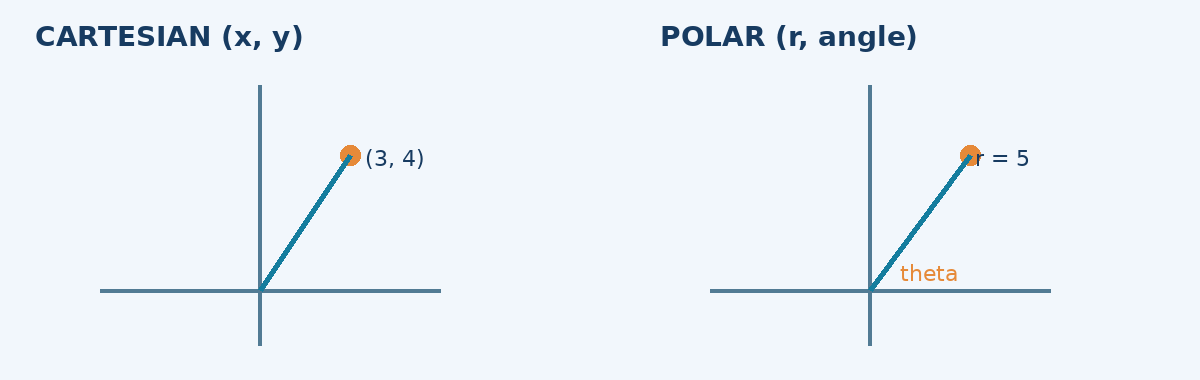
In a Cartesian system, an object’s position is described by (x, y) in a plane, or (x, y, z) in three dimensions. The origin is the point (0, 0), and axes must have specified directions and units.
For a position change from (2, 1) m to (5, 5) m, the displacement vector is (3, 4) m. Its magnitude is √(3² + 4²) = 5 m.
There is no rule that the x-axis must be horizontal or that the origin must be at the center of the room. Choose axes that simplify the problem.
3. Polar coordinates
Polar coordinates describe position using a distance r from an origin and an angle θ measured from a chosen reference direction. They are especially convenient for circular motion.
x = r cos θ and y = r sin θ. Conversely, r = √(x² + y²), while θ is found from the correct quadrant of (x, y).
A point is 5 m from the origin at θ = 53.13° above the positive x-axis.
x = 5 cos 53.13° ≈ 3.0 m.
y = 5 sin 53.13° ≈ 4.0 m.
The Cartesian coordinates are approximately (3, 4) m.
4. Rotational axes and signs
A rotation axis need not pass through the object’s center. A door rotates around its hinges; a wheel around its axle; a seesaw around its support. Radius is measured perpendicular to the chosen axis, not simply from the center of the object.
In two-dimensional problems, counterclockwise is usually positive and clockwise negative. State the convention, especially when comparing angular displacement or torque.
A wheel turns 90° clockwise, then 180° counterclockwise. Take counterclockwise as positive.
Δθ = −90° + 180° = +90° = π/2 rad.
5. Choosing the most useful description
Cartesian coordinates work well for straight-line movement and forces along perpendicular directions. Polar coordinates simplify circular trajectories, angular displacement, and rotation about a fixed point.
For a wheel moving down a road, describe the center with Cartesian coordinates and the wheel’s orientation with angular position θ. This combination handles translation and rotation without confusion.
Navigation systems use a reference frame tied to Earth, while a robot arm often uses a coordinate system attached to its joints. Engineers must transform between these systems to describe the same motion.
Common mistakes
- Describing motion without stating a reference frame.
- Assuming the origin has to be at the geometric center.
- Measuring radius from the wrong point instead of the rotation axis.
- Ignoring angle quadrants when converting polar coordinates.
- Treating clockwise as intrinsically positive or negative.
Key terms
- Reference frame: observer and coordinate system used to describe motion
- Origin: zero point of a coordinate system
- Cartesian coordinates: position given by perpendicular coordinates
- Polar coordinates: position given by radius and angle
- Relative velocity: velocity measured with respect to another frame
- Rotation axis: line about which an object rotates
Check your understanding — fully worked answers
- A passenger sits on a moving train. Are they moving?
Worked answer: They are stationary relative to the train but moving relative to the ground.
- Find the magnitude of displacement from (1, 2) m to (4, 6) m.
Worked answer: Δr = (3, 4) m; magnitude = √(9 + 16) = 5 m.
- Convert r = 10 m, θ = 30° to Cartesian coordinates.
Worked answer: x = 10 cos 30° ≈ 8.66 m; y = 10 sin 30° = 5.0 m.
- A wheel turns 270° clockwise. Express Δθ in radians with CCW positive.
Worked answer: Δθ = −270° × π/180° = −3π/2 rad.
- Where is the rotation axis of a hinged door?
Worked answer: Along the hinge line, not through the door’s geometric center.
Key takeaways
- State the observer, origin, axes, and sign convention before calculating.
- Different frames can give different velocities without contradiction.
- Cartesian coordinates suit linear motion; polar coordinates suit circular motion.