Rote
3. Translational vs Rotational Motion
Translational vs Rotational Motion
How position, velocity and acceleration describe different kinds of movement
Translation changes an object’s position; rotation changes its orientation. A rolling wheel does both. Linear quantities describe distances and speeds in metres, while angular quantities describe angles and rates of turning in radians.
Learning targets
- I can distinguish translational and rotational motion.
- I can describe linear and angular displacement.
- I can compare linear and angular velocity and acceleration.
- I can relate linear and angular quantities mathematically.
- I can identify combined motion in everyday systems.
1. Translation: movement without turning
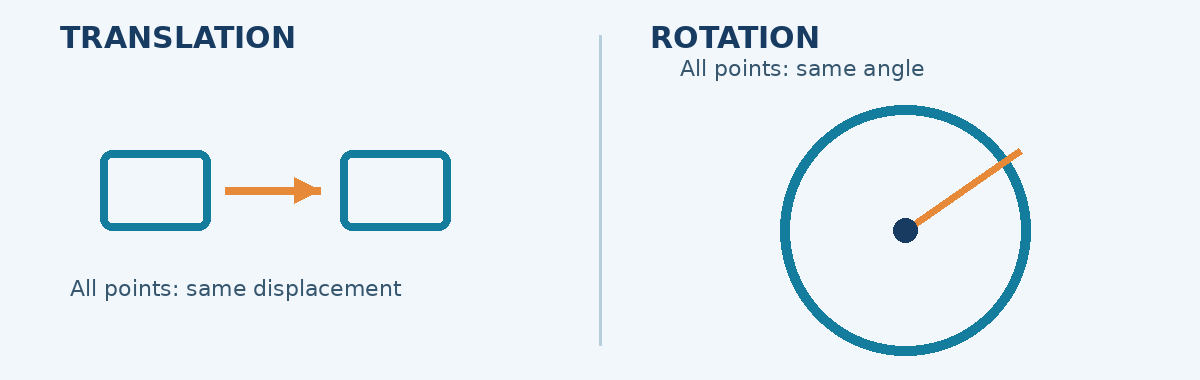
In pure translation, every point of a rigid body experiences the same displacement over a given interval. The path may be straight or curved, but the body does not change its orientation.
Linear displacement: Δx = xf − xi (m). Average velocity: v = Δx/Δt (m/s). Average acceleration: a = Δv/Δt (m/s²).
A box moves from x = 2 m to x = 14 m in 4 s.
Displacement = 14 − 2 = 12 m.
Average velocity = 12/4 = 3 m/s in the positive x-direction.
2. Rotation: changing orientation
In pure rotation about a fixed axis, every point turns through the same angle, although points at different distances from the axis travel different arc lengths.
Angular displacement: Δθ (radians). Average angular velocity: ω = Δθ/Δt (rad/s). Average angular acceleration: α = Δω/Δt (rad/s²).
One complete revolution equals 2π radians or 360°. Counterclockwise is often defined as positive, but the sign convention must be stated.
3. Connecting linear and angular quantities
s = rθ (arc length), v = rω (tangential speed), at = rα (tangential acceleration). These use radians and a radius measured from the rotation axis.
At a fixed angular speed, doubling the radius doubles tangential speed. Every point on the same rigid wheel shares ω but not v.
A wheel of radius 0.35 m turns at ω = 8 rad/s.
Tangential speed at the rim: v = rω = 0.35 × 8 = 2.8 m/s.
At radius 0.175 m: v = 0.175 × 8 = 1.4 m/s.
4. Angular acceleration and circular motion
If angular velocity changes, the body has angular acceleration. Even if angular speed is constant, a point moving in a circle has centripetal acceleration because its velocity direction changes.
Tangential acceleration: at = rα. Centripetal acceleration: ac = v²/r = rω², directed toward the axis.
A fan speeds up uniformly from 2 rad/s to 14 rad/s in 3 s.
α = (14 − 2)/3 = 4 rad/s².
At r = 0.25 m, at = rα = 0.25 × 4 = 1.0 m/s².
5. Combined motion: rolling
A rolling wheel translates as its center moves forward and rotates about its center. For rolling without slipping, the center’s speed satisfies vcenter = Rω.
This relationship is used in vehicle wheels, conveyor rollers, gears, and bicycle motion. It fails for a wheel skidding across the ground.
A car tire may rotate quickly while the car travels slowly on ice. In that case the tire is slipping, so v = Rω does not describe the vehicle speed.
Common mistakes
- Assuming all movement is translation.
- Calling rotation motion only when an object changes location.
- Confusing radians with degrees in s = rθ.
- Assuming all points on a rotating body have equal tangential speed.
- Using v = Rω for a slipping wheel without checking the assumption.
Key terms
- Displacement: change in position
- Angular displacement: change in orientation measured in radians
- Angular velocity: rate of angular displacement
- Angular acceleration: rate of change of angular velocity
- Tangential speed: linear speed along a circular path
- Rolling without slipping: rolling motion where v of center equals Rω
Check your understanding — fully worked answers
- How many radians are in half a revolution?
Worked answer: π radians.
- A disk rotates 6 rad in 2 s. Find average angular velocity.
Worked answer: ω = Δθ/Δt = 6/2 = 3 rad/s.
- Find rim speed for r = 0.50 m and ω = 10 rad/s.
Worked answer: v = rω = 0.50 × 10 = 5.0 m/s.
- Why is a point on a spinning wheel accelerating at constant angular speed?
Worked answer: Its velocity direction changes continuously, producing centripetal acceleration.
- A wheel of radius 0.40 m rolls without slipping at 2 m/s. Find ω.
Worked answer: ω = v/R = 2/0.40 = 5 rad/s.
Key takeaways
- Translation and rotation describe different aspects of motion.
- Points on a rigid body share angular speed but have different tangential speeds if radii differ.
- Use s = rθ, v = rω, aₜ = rα with angles in radians.