Rote
2. What Is a Rigid Body
What Is a Rigid Body?
A useful model for objects that move without changing shape
A rigid body is an idealization: the distance between any two material points stays constant. The object may move or rotate, but it does not stretch, bend, or change shape in the model. Real objects are never perfectly rigid; we use this approximation when deformation is too small to affect the answer.
Learning targets
- I can define a rigid body and explain its assumptions.
- I can distinguish particle and rigid-body models.
- I can identify examples of approximately rigid objects.
- I can explain why rigid-body approximations simplify physics.
- I can recognize situations in which deformation matters.
1. Defining a rigid body
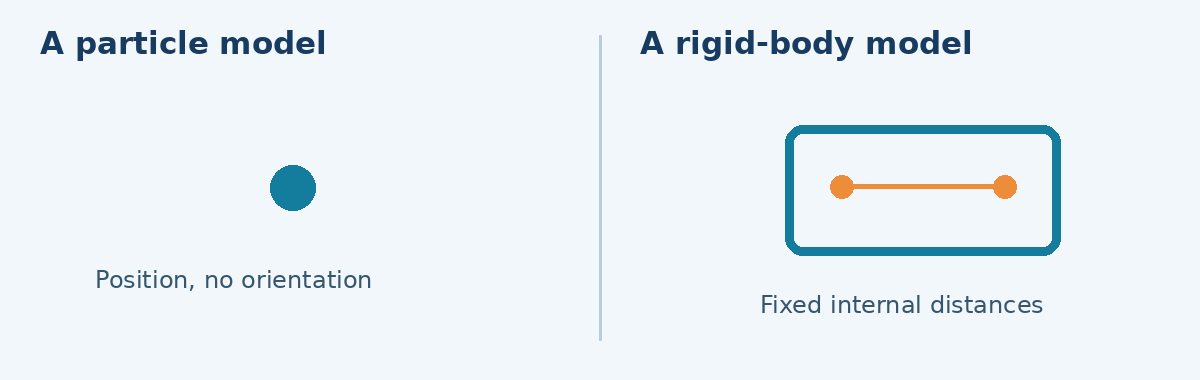
Imagine marking points A and B on a solid wheel. As the wheel turns, both points move, yet their separation AB remains constant. This fixed-distance condition defines a rigid body. It implies that the body maintains its size and shape.
Rigidity does not mean stationary. A rigid body may translate, rotate about a fixed axis, or undergo a combination of both. The model ignores internal deformation, not motion.
2. Particle model versus rigid-body model
A particle model treats an object as a point with mass. It is appropriate when size, shape, and orientation do not influence the calculation. A rigid-body model retains geometry, orientation, and the positions where forces act.
| Feature | Particle model | Rigid-body model |
|---|---|---|
| Shape and size | Ignored | Retained |
| Rotation about own axis | Not described | Described |
| Useful for | Orbital trajectory | Door, gear, wheel |
A satellite moving around Earth can often be treated as a particle when calculating orbital period. A door opening on hinges needs a rigid-body model because its orientation and the location of applied force matter.
3. Everyday examples
- Door: rotates around hinges while keeping approximately the same shape.
- Bicycle wheel: rotates while distances between points on its rim remain approximately fixed.
- Wrench: transmits a turning effect from the hand to a nut.
- Book sliding across a table: approximately translates without changing shape.
- Seesaw: rotates around its pivot; the positions of the children determine torque.
Whether an object is approximately rigid depends on the question. A steel beam may be treated as rigid for its overall motion but not when calculating its bending.
4. Why the approximation is useful
Modeling every tiny deformation requires complicated material properties and internal forces. Treating an object as rigid lets us focus on its translation, rotation, net force, and torque. This simplification is accurate when changes in shape are negligible compared with the distances or angles we study.
A wheel rotates through 1.5 radians. Two marked points lie 0.20 m and 0.40 m from the axis. Find each point’s arc length.
Use s = rθ, with θ in radians.
Inner point: s = 0.20 × 1.5 = 0.30 m.
Outer point: s = 0.40 × 1.5 = 0.60 m.
Both points have the same angular displacement, but the point farther from the axis travels twice as far.
5. When a rigid-body model fails
A rubber band stretches, a spring compresses, a diving board bends, and a vehicle crumples during a collision. If deformation is central to the question, a rigid-body model leaves out the very behavior we need to explain.
Ask: “Would ignoring the change in shape materially change my answer?” If yes, use a deformable-body model instead.
Common mistakes
- Rigid means motionless — false; rigid bodies can translate and rotate.
- Metal is always rigid — false; metals deform under sufficient load.
- A rigid body is the same as a particle — false; a rigid body has size and orientation.
- A force’s point of application never matters — false; it changes torque.
Key terms
- Rigid body: idealized object with fixed internal distances
- Particle model: object represented by one point
- Translation: motion with equal displacement of all points
- Rotation: change in orientation about an axis
- Deformation: change in shape or dimensions
Check your understanding — fully worked answers
- What property defines a rigid body?
Worked answer: The distance between every pair of points stays constant.
- Can a rigid body rotate?
Worked answer: Yes. Rigidity concerns shape, not whether the object moves.
- Why is a particle model insufficient for a door opening?
Worked answer: It cannot represent orientation or torque about the hinges.
- A point at radius 0.30 m rotates by 2 rad. Find its arc length.
Worked answer: s = rθ = 0.30 × 2 = 0.60 m.
- Is a car rigid during a crash?
Worked answer: Not for studying impact deformation, because its body changes shape.
Key takeaways
- Rigid-body mechanics is an approximation, not a claim that materials never deform.
- Particle models ignore size; rigid-body models retain shape and orientation.
- Choose the simplest model that keeps the features relevant to the question.