Introduction to Matrices
3. Determinants
Learning outcomes
- I can calculate determinants of 2×2 and 3×3 matrices.
- I can interpret the meaning of determinants.
- I can determine whether matrices are invertible.
- I can apply determinants to geometric problems.
- I can solve determinant-based problems.
Introduction
Matrices allow us to organise numbers, represent transformations, and solve systems of equations. However, matrices also have important properties that cannot be determined simply by looking at their individual elements.
One of these properties is the determinant.
A determinant is a single number calculated from a square matrix. Although it produces only one value, that value reveals important information about the matrix.
For example, the determinant can tell us whether:
-
A matrix has an inverse.
-
A system of linear equations has a unique solution.
-
A geometric transformation enlarges or reduces an area or volume.
-
A transformation reverses orientation.
-
Points in a coordinate plane lie on the same straight line.
Consider the matrix:
Its determinant is:
det(A) = 3(4) − 2(1) = 10
This value has several interpretations. Geometrically, the transformation represented by A multiplies areas by 10. Algebraically, because the determinant is not zero, the matrix has an inverse.
Determinants therefore connect matrix algebra with geometry, transformations, and systems of equations.
What Is a Determinant?
The determinant is a scalar value associated with a square matrix.
A square matrix has the same number of rows and columns.
For example:
The determinant can be written as:
det(A)
or:
Although vertical bars are also used for absolute value, the determinant is a different operation.
A determinant can be positive, negative, or zero.
Important properties
-
Determinants are defined for square matrices.
-
The determinant of a 2 × 2 matrix is calculated using four elements.
-
The determinant of a 3 × 3 matrix is calculated using nine elements.
-
A nonzero determinant indicates that a square matrix is invertible.
-
A zero determinant indicates that a square matrix is singular.
-
The absolute value of a determinant describes an area or volume scaling factor.
The sign of the determinant provides information about orientation.
Calculating the Determinant of a 2 × 2 Matrix
For a matrix:
the determinant is:
This is one of the most important formulas in introductory matrix algebra.
Visualising the formula
The determinant of a 2 × 2 matrix
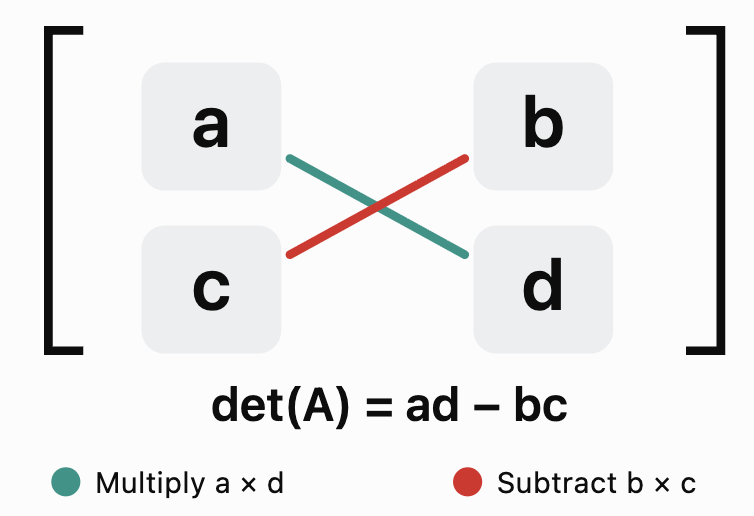
The process is:
-
Multiply the top-left element by the bottom-right element.
-
Multiply the top-right element by the bottom-left element.
-
Subtract the second product from the first.
Worked Example 1: Positive Determinant
Calculate:
Using:
det(A) = ad − bc
Substitute:
det(A) = 4(5) − 2(3)
= 20 − 6
det(A) = 14
The determinant is positive and nonzero.
Therefore, the matrix is invertible.
Worked Example 2: Negative Determinant
Calculate:
det(B) = 2(3) − 5(4)
= 6 − 20
det(B) = −14
The determinant is negative.
This indicates that the associated linear transformation reverses orientation.
The area scaling factor is |−14| = 14.
Worked Example 3: Zero Determinant
Calculate:
det(C) = 2(6) − 4(3)
= 12 − 12
det(C) = 0
The second column is twice the first column.
The columns are linearly dependent.
This matrix is singular and does not have an inverse.
Calculating the Determinant of a 3 × 3 Matrix
Consider the general matrix:
The determinant is:
This formula can be understood through cofactor expansion.
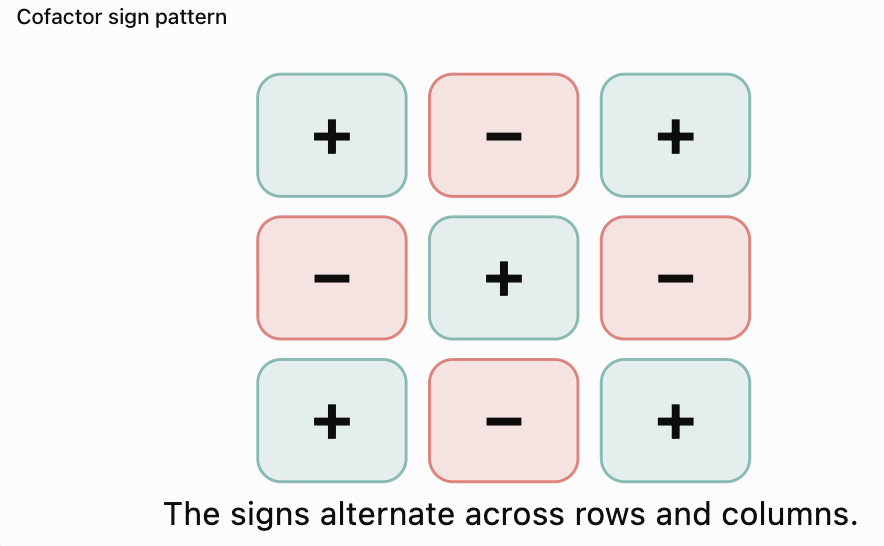
Cofactor expansion along the first row
Each element in the first row is multiplied by the determinant of a smaller 2 × 2 matrix.
The signs follow the pattern:
+ − +
What is a minor?
The minor of an element is the determinant of the smaller matrix formed by removing the row and column containing that element.
For example, for the top-left element a:
Remove the first row and first column.
The remaining matrix is:
Its determinant is:
ei − fh
This is the minor associated with a.
A cofactor is the minor multiplied by the appropriate positive or negative sign.
Worked Example 4: Determinant of a 3 × 3 Matrix
Calculate:
Expand along the first row.
Step 1: Apply the cofactor expansion formula.
det(A) = 2(4 × 6 − 5 × 2) − 1(0 × 6 − 5 × 1) + 3(0 × 2 − 4 × 1)
Step 2: Calculate the 2 × 2 determinants.
First:
4(6) − 5(2) = 24 − 10 = 14
Second:
0(6) − 5(1) = −5
Third:
0(2) − 4(1) = −4
Step 3: Substitute.
det(A) = 2(14) − 1(−5) + 3(−4)
= 28 + 5 − 12
det(A) = 21
The matrix is invertible because its determinant is nonzero.
Worked Example 5: Expanding Along a Row Containing Zeros
Consider:
Expanding along the first row is particularly efficient because two elements are zero.
det(B) = 3(4 × 6 − 1 × 2)
= 3(24 − 2)
= 3(22)
det(B) = 66
This example demonstrates an important strategy:
When calculating a 3 × 3 determinant, choose a row or column containing the most zeros whenever possible.
The Rule of Sarrus
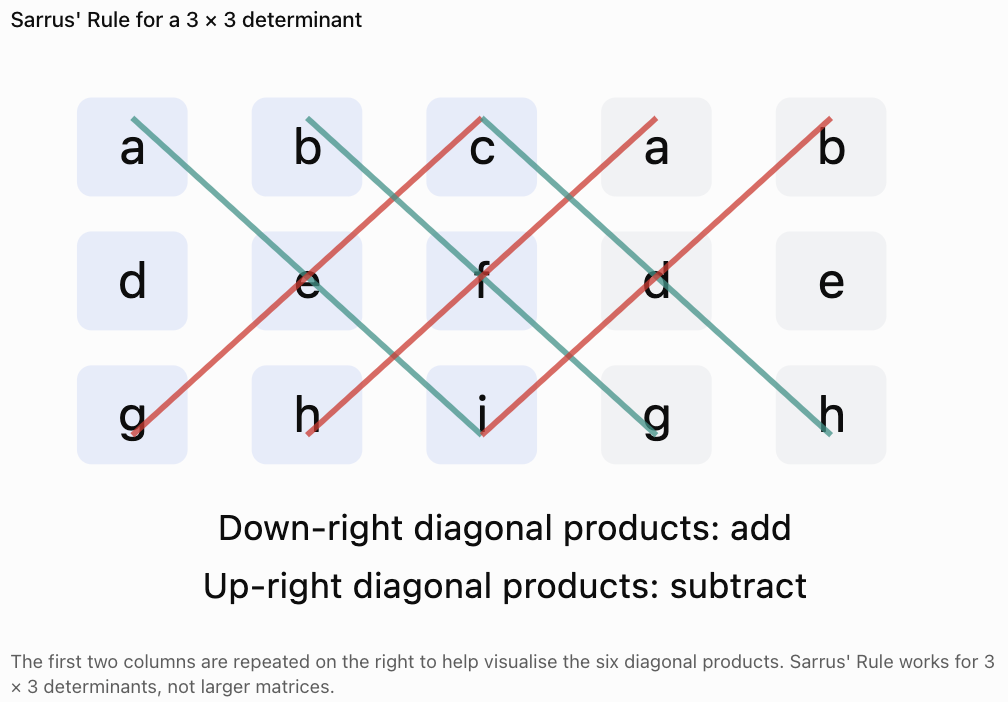
Another method for calculating a 3 × 3 determinant is the Rule of Sarrus.
This method uses diagonal products.
For:
the determinant is:
det(A) = aei + bfg + cdh − ceg − bdi − afh
Visualising Sarrus' Rule
Worked Example 6: Using Sarrus' Rule
Calculate:
Add the downward diagonal products:
1(5)(10) + 2(6)(7) + 3(4)(8)
= 50 + 84 + 96
= 230
Add the upward diagonal products:
3(5)(7) + 2(4)(10) + 1(6)(8)
= 105 + 80 + 48
= 233
Subtract:
det(C) = 230 − 233
det(C) = −3
Properties of Determinants
Determinants follow several important algebraic rules.
Property 1: Identity matrix
The determinant of an identity matrix is 1.
det(I) = 1
For example:
Property 2: Interchanging two rows
Swapping two rows changes the sign of the determinant.
If det(A) = 5, then swapping two rows produces a matrix with determinant −5.
Property 3: Identical rows
If two rows are identical, the determinant is zero.
For example:
Property 4: Proportional rows
If one row is a multiple of another, the determinant is zero.
Property 5: Multiplying one row by a scalar
Multiplying one row by k multiplies the determinant by k.
Property 6: Adding a multiple of one row to another
Adding a multiple of one row to another row does not change the determinant.
This property is especially useful when simplifying larger determinants.
Property 7: Triangular matrices
The determinant of an upper or lower triangular matrix equals the product of its diagonal elements.
For example:
det(A) = 2 × 5 × 7
det(A) = 70
Property 8: Product of matrices
For square matrices of the same order:
det(AB) = det(A)det(B)
Property 9: Transpose
The determinant does not change when rows and columns are interchanged.
det(Aᵀ) = det(A)
Property 10: Scalar multiplication
For an n × n matrix:
det(kA) = kⁿdet(A)
For example, for a 2 × 2 matrix:
det(3A) = 3²det(A) = 9det(A)
This is different from simply multiplying the determinant by 3.
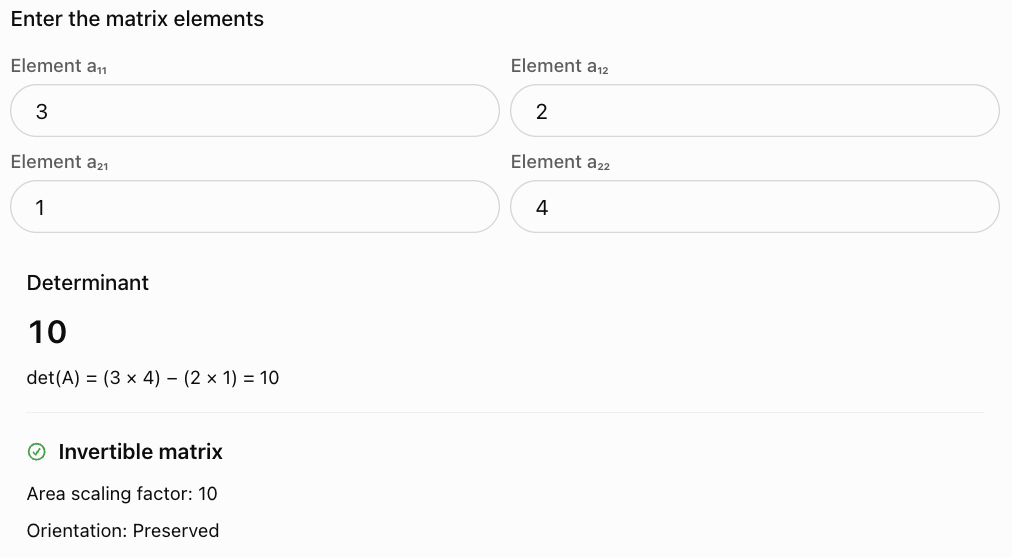
Try changing the values so that the determinant becomes zero. What relationships do you notice between the rows or columns?
Determinants and Invertible Matrices
A square matrix is invertible if another matrix exists that reverses its effect under multiplication.
For an invertible matrix A:
AA⁻¹ = A⁻¹A = I
where:
-
A⁻¹ is the inverse matrix.
-
I is the identity matrix.
The determinant tells us whether an inverse exists.
Invertibility condition
If det(A) ≠ 0, the matrix is invertible.
If det(A) = 0, the matrix is singular and not invertible.
This is one of the most important applications of determinants.
Formula for the inverse of a 2 × 2 matrix
For:
if ad − bc ≠ 0:
Worked Example 7: Finding an Inverse
Given:
Step 1: Calculate the determinant.
det(A) = 4(3) − 1(2)
= 12 − 2
= 10
Since det(A) ≠ 0, an inverse exists.
Step 2: Apply the inverse formula.
Therefore:
Worked Example 8: Identifying a Singular Matrix
Given:
det(B) = 6(3) − 9(2)
= 18 − 18
= 0
Therefore, B is singular.
B has no inverse.
The first row is three times the second row, so the rows are linearly dependent.
Geometric Meaning of Determinants
Determinants have a powerful geometric interpretation.
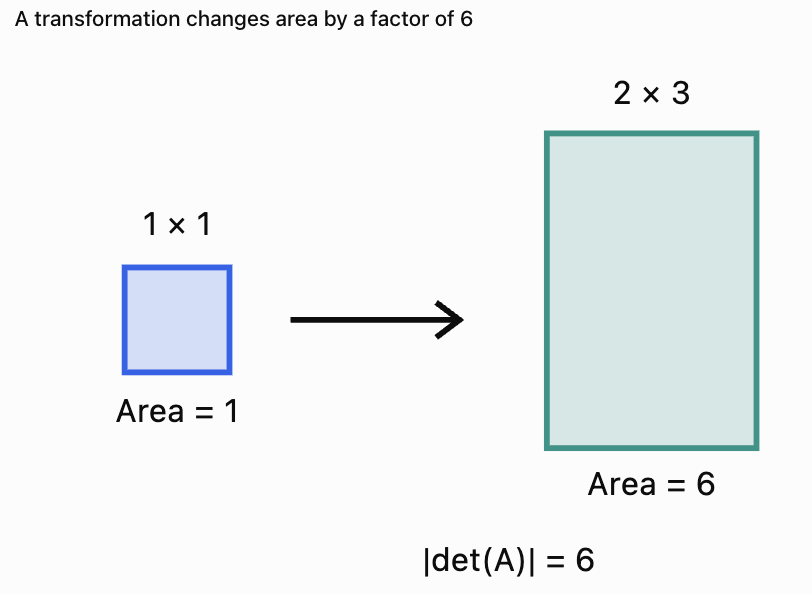
For a 2 × 2 matrix, the absolute value of the determinant represents the factor by which a linear transformation changes area.
For a 3 × 3 matrix, the absolute value of the determinant represents the factor by which a linear transformation changes volume.
Area scaling in two dimensions
Suppose:
This transformation:
-
Multiplies x-coordinates by 2.
-
Multiplies y-coordinates by 3.
The determinant is:
det(A) = 2(3) − 0(0)
det(A) = 6
Therefore, areas are multiplied by 6.
A square with area 1 becomes a rectangle with area 6.
Positive and negative determinants
A positive determinant means the transformation preserves orientation.
A negative determinant means the transformation reverses orientation.
For example, a reflection in the x-axis has matrix:
Its determinant is:
det(R) = 1(−1) − 0(0)
det(R) = −1
The area is unchanged because |−1| = 1.
However, orientation is reversed.
Zero determinant
If det(A) = 0, a transformation collapses space into a lower-dimensional set.
For example:
det(A) = 4 − 4 = 0
The transformation maps the entire plane onto a line.
Areas become zero.
This explains geometrically why the matrix cannot be inverted: different points can be mapped to the same location.
Determinants and the Area of a Parallelogram
Suppose two vectors are:
u = (a, c)
v = (b, d)
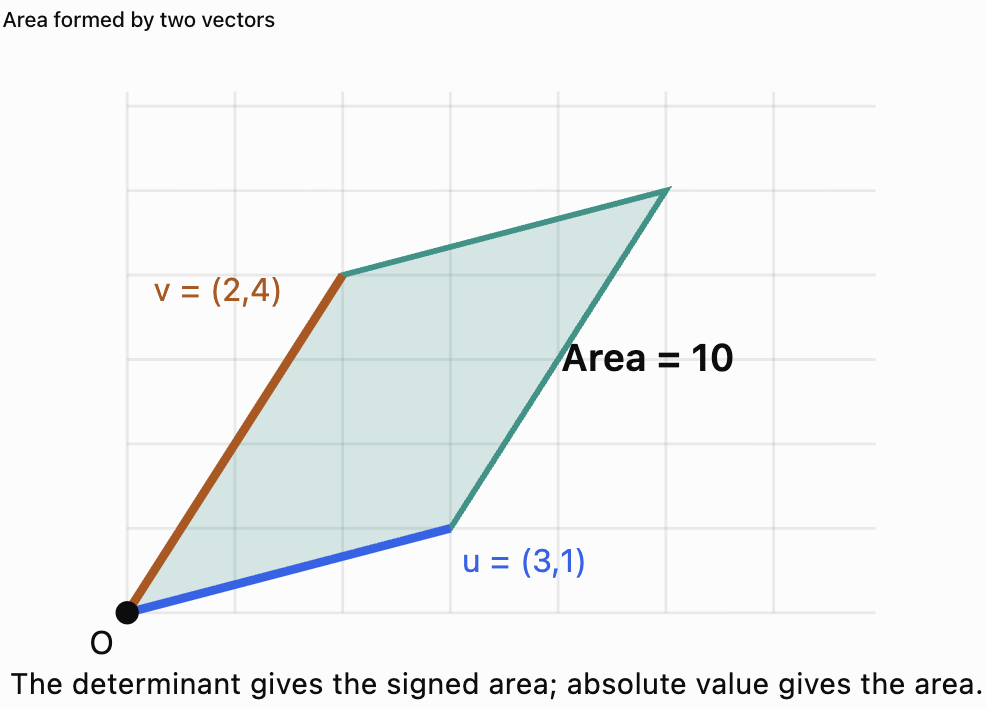
These vectors form adjacent sides of a parallelogram.
Its area is:
This is the absolute value of the determinant:
Worked Example 9: Parallelogram Area
Two vectors are:
u = (3, 1)
v = (2, 4)
Construct the matrix:
Calculate:
det(A) = 3(4) − 2(1)
= 12 − 2
= 10
Therefore:
Area = 10 square units
Determinants and the Area of a Triangle
A triangle formed by two vectors has half the area of the parallelogram formed by those vectors.
Therefore:
Worked Example 10: Triangle Area from Coordinates
Find the area of the triangle with vertices:
A(1, 2)
B(5, 3)
C(3, 7)
Step 1: Form two vectors from A.
AB = (5 − 1, 3 − 2)
AB = (4, 1)
AC = (3 − 1, 7 − 2)
AC = (2, 5)
Step 2: Construct the matrix.
Step 3: Calculate the determinant.
det(M) = 4(5) − 2(1)
= 20 − 2
= 18
Step 4: Divide by 2.
Area = 1/2 × |18|
Area = 9 square units
Coordinate formula
For vertices (x₁, y₁), (x₂, y₂), and (x₃, y₃):
Area = 1/2 |x₁(y₂ − y₃) + x₂(y₃ − y₁) + x₃(y₁ − y₂)|
This formula can also be written as a 3 × 3 determinant:
Determinants and Collinear Points
Three points are collinear if they lie on the same straight line.
A determinant can be used to test collinearity.
For points A(x₁, y₁), B(x₂, y₂), and C(x₃, y₃), calculate:
If D = 0, the three points are collinear.
Worked Example 11: Testing Collinearity
Determine whether the points:
A(1, 2)
B(3, 6)
C(5, 10)
are collinear.
Construct:
Expand along the first row:
D = 1(6 − 10) − 2(3 − 5) + 1(30 − 30)
= −4 − 2(−2) + 0
= −4 + 4
D = 0
Therefore, the points are collinear.
This agrees with the fact that all three points satisfy:
y = 2x
Determinants and Volume in Three Dimensions
A 3 × 3 determinant represents the signed volume scaling factor of a linear transformation in three-dimensional space.
If three vectors form the edges of a parallelepiped, its volume is the absolute value of their determinant.
Worked Example 12: Volume of a Parallelepiped
Consider three vectors:
u = (2, 0, 0)
v = (0, 3, 0)
w = (0, 0, 4)
Construct:
Since this is a diagonal matrix:
det(A) = 2 × 3 × 4
= 24
Therefore:
Volume = 24 cubic units
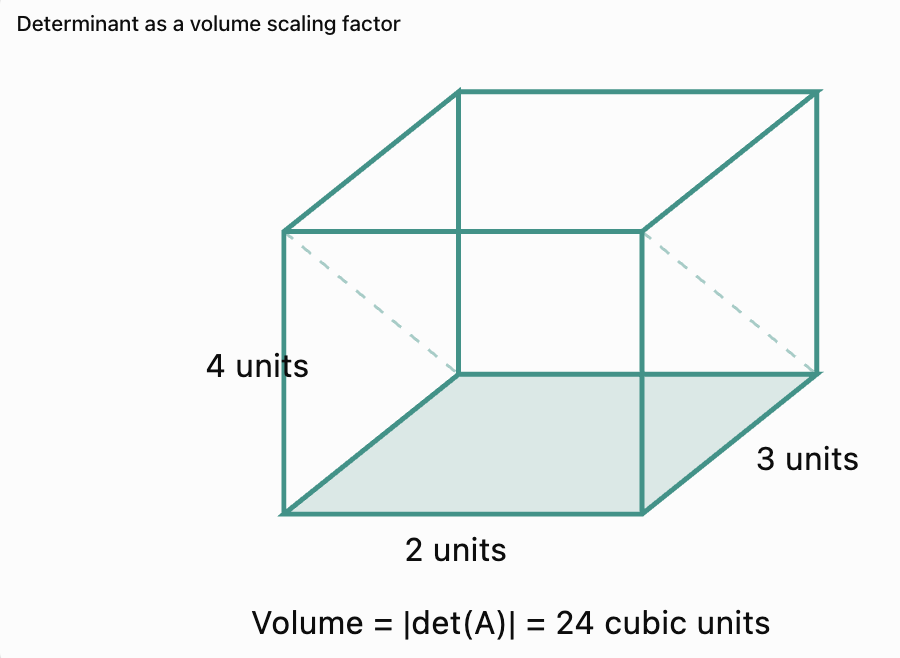
For a general parallelepiped, the vectors do not need to be perpendicular. The determinant still gives its signed volume.
Determinants and Systems of Linear Equations
Determinants can be used to determine whether a system of linear equations has a unique solution.
Consider:
ax + by = e
cx + dy = f
The coefficient matrix is:
If det(A) ≠ 0, the system has exactly one solution.
If det(A) = 0, the system does not have a unique solution. It may have no solutions or infinitely many solutions.
Cramer's Rule
For a system:
ax + by = e
cx + dy = f
Define:
D = ad − bc
Dₓ = ed − bf
Dᵧ = af − ec
If D ≠ 0:
Worked Example 13: Solving a System Using Determinants
Solve:
2x + 3y = 12
4x − y = 5
Step 1: Calculate D.
D = 2(−1) − 3(4)
= −2 − 12
= −14
Step 2: Calculate Dₓ.
Replace the x-coefficient column with the constants.
Dₓ = 12(−1) − 3(5)
= −12 − 15
= −27
Step 3: Calculate Dᵧ.
Replace the y-coefficient column with the constants.
Dᵧ = 2(5) − 12(4)
= 10 − 48
= −38
Step 4: Solve.
x = Dₓ/D = −27/−14
x = 27/14
y = Dᵧ/D = −38/−14
y = 19/7
Step 5: Verify.
First equation:
2(27/14) + 3(19/7)
= 27/7 + 57/7
= 84/7
= 12
Second equation:
4(27/14) − 19/7
= 54/7 − 19/7
= 35/7
= 5
Both equations are satisfied.
Solving Determinant Equations
Sometimes the determinant is known, but one matrix element is unknown.
Worked Example 14: Finding an Unknown Element
Suppose:
Find x.
Using the 2 × 2 determinant formula:
5x − 3(2) = 14
5x − 6 = 14
5x = 20
x = 4
Worked Example 15: Finding When a Matrix Is Singular
Determine the values of k for which:
is singular.
A matrix is singular when its determinant is zero.
Therefore:
det(A) = 0
k² − 2(8) = 0
k² − 16 = 0
Factor:
(k − 4)(k + 4) = 0
Therefore:
k = 4 or k = −4
For either value, the matrix has no inverse.
Real-World Applications of Determinants
Computer graphics
Determinants help determine how transformations scale areas and volumes, and whether they reverse orientation.
Robotics
Determinants help identify singular configurations in mathematical models of robot movement, where certain motions become difficult or impossible to control independently.
Engineering
Determinants help analyse linear systems describing forces, constraints, and structural relationships.
Surveying and geometry
Determinants allow areas of triangles and parallelograms to be calculated directly from coordinates.
Scientific modelling
Determinants help identify whether linear systems have unique solutions and whether transformations preserve independent directions.
Common Mistakes
Mistake 1: Calculating determinants for non-square matrices
Determinants are defined only for square matrices.
Mistake 2: Reversing the subtraction in a 2 × 2 determinant
The correct formula is:
ad − bc
not bc − ad.
Mistake 3: Forgetting the alternating signs in 3 × 3 expansion
The first-row cofactor signs are:
+ − +
Mistake 4: Confusing determinants with absolute values
A determinant may be negative.
Absolute value is used when calculating geometric area or volume.
Mistake 5: Assuming a zero determinant means every matrix element is zero
A matrix can contain many nonzero elements and still have determinant zero.
Mistake 6: Assuming every square matrix has an inverse
Only square matrices with nonzero determinants are invertible.
Mistake 7: Applying Sarrus' Rule to larger matrices
Sarrus' Rule applies specifically to 3 × 3 determinants.
Mistake 8: Multiplying every element by a scalar without accounting for matrix order
For an n × n matrix:
det(kA) = kⁿdet(A)
Mistake 9: Ignoring negative signs in cofactor expansion
Subtracting a negative minor produces a positive contribution.
Mistake 10: Confusing determinant and area
The determinant gives signed area scaling. Geometric area is always nonnegative.
Mistake 11: Using Cramer's Rule when the determinant is zero
Cramer's Rule requires a nonzero coefficient determinant.
Mistake 12: Assuming det(A) = 0 always means no solution
A linear system with determinant zero may have no solutions or infinitely many solutions.
Key Terms
-
Determinant: Scalar value calculated from a square matrix.
-
Square Matrix: Matrix with equal numbers of rows and columns.
-
Scalar: Single numerical value.
-
Minor: Determinant obtained by deleting a specified row and column.
-
Cofactor: Signed minor associated with a matrix element.
-
Cofactor Expansion: Method for calculating determinants using minors and cofactors.
-
Rule of Sarrus: Diagonal method for calculating 3 × 3 determinants.
-
Invertible Matrix: Square matrix with a multiplicative inverse.
-
Inverse Matrix: Matrix that produces the identity matrix when multiplied by the original matrix.
-
Singular Matrix: Square matrix with determinant zero.
-
Nonsingular Matrix: Square matrix with a nonzero determinant.
-
Identity Matrix: Square matrix with 1 on the main diagonal and 0 elsewhere.
-
Main Diagonal: Diagonal extending from the top-left to the bottom-right of a matrix.
-
Triangular Matrix: Square matrix with zeros above or below the main diagonal.
-
Linear Transformation: Mapping represented by multiplication by a matrix.
-
Orientation: Directional arrangement preserved or reversed by a transformation.
-
Area Scaling Factor: Absolute value of a 2 × 2 transformation determinant.
-
Volume Scaling Factor: Absolute value of a 3 × 3 transformation determinant.
-
Parallelogram: Quadrilateral with opposite sides parallel.
-
Parallelepiped: Three-dimensional solid with parallelogram faces.
-
Collinear Points: Points lying on the same straight line.
-
Linear Dependence: Relationship in which one vector can be expressed using others.
-
Cramer's Rule: Method for solving certain linear systems using determinants.
-
Coefficient Matrix: Matrix containing the coefficients of a linear system.
-
Unique Solution: Exactly one solution satisfying a system of equations.
-
Row Operation: Operation performed on rows of a matrix.
-
Transpose: Matrix obtained by interchanging rows and columns.
Key Takeaways
-
Determinants are scalar values associated with square matrices.
-
The determinant of a 2 × 2 matrix is ad − bc.
-
A 3 × 3 determinant can be calculated using cofactor expansion or Sarrus' Rule.
-
Cofactor expansion uses alternating positive and negative signs.
-
A determinant can be positive, negative, or zero.
-
A square matrix is invertible exactly when its determinant is nonzero.
-
A zero determinant indicates a singular matrix.
-
The determinant of a triangular matrix is the product of its diagonal elements.
-
Swapping two rows reverses the determinant's sign.
-
Proportional rows or columns produce a zero determinant.
-
For square matrices, det(AB) = det(A)det(B).
-
The absolute value of a 2 × 2 determinant gives an area scaling factor.
-
The absolute value of a 3 × 3 determinant gives a volume scaling factor.
-
Determinants can calculate areas of triangles and parallelograms.
-
Determinants can test whether three points are collinear.
-
Cramer's Rule uses determinants to solve systems with unique solutions.
-
Determinants connect algebra, geometry, transformations, and scientific applications.
Check Your Understanding
Questions
Question 1: Basic Determinant
Calculate:
Question 2: Negative Determinant
Calculate:
Question 3: Zero Determinant
Determine whether:
is invertible.
Question 4: 3 × 3 Determinant
Calculate:
Question 5: Triangular Matrix
Find the determinant of:
Question 6: Determinant Properties
If det(A) = 7, what happens to the determinant when two rows are swapped?
Question 7: Scalar Multiplication
If A is a 2 × 2 matrix and det(A) = 5, calculate det(3A).
Question 8: Invertibility
Determine whether:
has an inverse.
Question 9: Finding an Unknown
Solve:
Question 10: Singular Matrix
Find k if:
is singular.
Question 11: Parallelogram Area
Find the area of the parallelogram formed by:
u = (4, 1)
v = (2, 5)
Question 12: Triangle Area
Find the area of the triangle with vertices:
A(0, 0), B(6, 0), C(2, 4).
Question 13: Volume
Calculate the volume of the parallelepiped formed by the column vectors of:
Question 14: Cramer's Rule
Solve using determinants:
3x + 2y = 12
x − y = 1
Question 15: Integrated Determinant Challenge
Given:
a) Calculate det(A).
b) Determine whether A is invertible.
c) Explain the geometric meaning of the determinant.
d) Calculate det(2A).
Fully Worked Answers
Answer 1: Basic Determinant
det(A) = 3(5) − 2(4)
= 15 − 8
Answer: 7
Answer 2: Negative Determinant
det(A) = 1(2) − 6(3)
= 2 − 18
Answer: −16
Answer 3: Zero Determinant
det(A) = 2(10) − 4(5)
= 20 − 20
= 0
The determinant is zero.
Answer: The matrix is singular and not invertible.
Answer 4: 3 × 3 Determinant
Expand along the first row:
det(A) = 1(4 × 6 − 5 × 0) − 2(0 × 6 − 5 × 1) + 3(0 × 0 − 4 × 1)
= 1(24) − 2(−5) + 3(−4)
= 24 + 10 − 12
Answer: 22
Answer 5: Triangular Matrix
The matrix is upper triangular.
Multiply the diagonal elements:
det(A) = 3 × 4 × 6
Answer: 72
Answer 6: Determinant Properties
Swapping two rows changes the sign of the determinant.
Original determinant:
7
New determinant:
Answer: −7
Answer 7: Scalar Multiplication
For a 2 × 2 matrix:
det(kA) = k²det(A)
Therefore:
det(3A) = 3²(5)
= 9(5)
Answer: 45
Answer 8: Invertibility
det(B) = 4(5) − 3(2)
= 20 − 6
= 14
Since det(B) ≠ 0:
Answer: B is invertible.
Answer 9: Finding an Unknown
4x − 6 = 10
4x = 16
Answer: x = 4
Answer 10: Singular Matrix
A singular matrix has determinant zero.
6k − 12 = 0
6k = 12
Answer: k = 2
Answer 11: Parallelogram Area
Vectors:
u = (4, 1)
v = (2, 5)
Area = |4(5) − 2(1)|
= |20 − 2|
Answer: 18 square units
Answer 12: Triangle Area
Vertices:
A(0, 0)
B(6, 0)
C(2, 4)
Vectors:
AB = (6, 0)
AC = (2, 4)
Area = 1/2 |6(4) − 2(0)|
= 1/2 |24|
Answer: 12 square units
Answer 13: Volume
The matrix is diagonal.
det(A) = 2 × 5 × 3
= 30
Volume = |det(A)|
Answer: 30 cubic units
Answer 14: Cramer's Rule
Equations:
3x + 2y = 12
x − y = 1
Step 1: Calculate D.
D = 3(−1) − 2(1)
= −3 − 2
= −5
Step 2: Calculate Dₓ.
Dₓ = 12(−1) − 2(1)
= −14
Step 3: Calculate Dᵧ.
Dᵧ = 3(1) − 12(1)
= −9
Step 4: Solve.
x = Dₓ/D
= −14/−5
x = 14/5
y = Dᵧ/D
= −9/−5
y = 9/5
Verification:
3(14/5) + 2(9/5)
= 42/5 + 18/5
= 60/5 = 12
14/5 − 9/5 = 1
Both equations are satisfied.
Answer 15: Integrated Determinant Challenge
Given:
Part a: Calculate det(A).
Expand along the first row:
det(A) = 2(4 × 5 − 2 × 0) − 1(3 × 5 − 2 × 1) + 0
= 2(20) − (15 − 2)
= 40 − 13
det(A) = 27
Part b: Determine invertibility.
Since det(A) = 27 ≠ 0:
A is invertible.
Part c: Geometric interpretation.
The matrix represents a linear transformation in three-dimensional space.
Its determinant is 27.
Therefore, volumes are multiplied by:
|27| = 27
Because the determinant is positive, orientation is preserved.
Part d: Calculate det(2A).
For a 3 × 3 matrix:
det(kA) = k³det(A)
Therefore:
det(2A) = 2³(27)
= 8(27)
det(2A) = 216
Final Reflection
Determinants are much more than a calculation involving matrix elements.
They reveal fundamental properties of matrices and the transformations they represent.
A nonzero determinant tells us that a matrix is invertible and that the associated linear transformation does not collapse space into a lower dimension. A zero determinant indicates that some information is lost and the transformation cannot be reversed.
Geometrically, determinants connect matrix algebra to area, volume, orientation, and coordinate geometry. Algebraically, they provide tools for solving systems of equations and determining whether unique solutions exist.
By mastering 2 × 2 and 3 × 3 determinants, understanding their properties, and applying them to geometric and algebraic problems, we develop an important foundation for further study of linear algebra.
The central idea is that a determinant is a single number that reveals whether a matrix preserves independent dimensions, how it changes area or volume, and whether its transformation can be reversed.