Advanced Vector Geometry
2. Cross Product
Learning outcomes
- I can calculate the cross product of two vectors.
- I can determine vectors perpendicular to a plane.
- I can calculate areas using the cross product.
- I can determine orientation using the right-hand rule.
- I can solve three-dimensional vector problems.
Cross Product
Introduction to the Cross Product
Vectors are mathematical quantities that have both magnitude and direction. They are used to represent forces, velocities, displacements, rotations, and many other physical quantities.
When working with vectors in three dimensions, we often need to determine a direction that is perpendicular to two given vectors.
We may also need to calculate the area of a parallelogram, determine the orientation of a surface, or analyse rotational effects such as torque.
The cross product, also called the vector product, is a mathematical operation that allows us to solve these problems.
Unlike the dot product, which produces a scalar, the cross product of two three-dimensional vectors produces another vector.
The resulting vector:
-
Is perpendicular to both original vectors.
-
Has a magnitude related to the angle between the vectors.
-
Has a direction determined by the right-hand rule.
-
Can be used to calculate areas and surface orientations.
-
Is useful in physics, engineering, geometry, and computer graphics.
Understanding the cross product provides an important connection between vector algebra and three-dimensional geometry.
Understanding the Cross Product
The cross product of two vectors A and B is written:
A × B
The multiplication symbol × represents the cross product operation.
For three-dimensional vectors:
A = (Aₓ, Aᵧ, A_z)
B = (Bₓ, Bᵧ, B_z)
the result is another three-dimensional vector.
A × B = C
The vector C is perpendicular to both A and B.


Cross Product Versus Dot Product
Although both operations combine vectors, they produce different types of results.
|
Property |
Dot product |
Cross product |
|---|---|---|
|
Symbol |
A · B |
A × B |
|
Result |
Scalar |
Vector |
|
Geometric formula |
|A||B| cos θ |
|A||B| sin θ for magnitude |
|
Direction |
No direction |
Perpendicular to both vectors |
|
Zero result |
Perpendicular nonzero vectors |
Parallel vectors or a zero vector |
|
Common applications |
Work, angles, projections |
Torque, area, surface normals |
The cross product is especially useful when direction and orientation are important.
Calculating the Cross Product Using Components
For two vectors:
A = (Aₓ, Aᵧ, A_z)
B = (Bₓ, Bᵧ, B_z)
the cross product is calculated using:
A × B = (AᵧB_z − A_zBᵧ, A_zBₓ − AₓB_z, AₓBᵧ − AᵧBₓ)
This formula produces three components:
-
x-component: AᵧB_z − A_zBᵧ
-
y-component: A_zBₓ − AₓB_z
-
z-component: AₓBᵧ − AᵧBₓ
Each component is calculated by multiplying and subtracting selected components of the original vectors.
Worked Example: Calculating a Cross Product
Given:
A = (2, 3, 4)
B = (5, 1, 2)
Calculate A × B.
Step 1: Identify the components
Aₓ = 2, Aᵧ = 3, A_z = 4
Bₓ = 5, Bᵧ = 1, B_z = 2
Step 2: Calculate the x-component
Cₓ = AᵧB_z − A_zBᵧ
Cₓ = (3)(2) − (4)(1)
Cₓ = 6 − 4
Cₓ = 2
Step 3: Calculate the y-component
Cᵧ = A_zBₓ − AₓB_z
Cᵧ = (4)(5) − (2)(2)
Cᵧ = 20 − 4
Cᵧ = 16
Step 4: Calculate the z-component
C_z = AₓBᵧ − AᵧBₓ
C_z = (2)(1) − (3)(5)
C_z = 2 − 15
C_z = −13
Final Answer
A × B = (2, 16, −13)
The resulting vector is perpendicular to both A and B.
Verifying the Cross Product
We can verify that a cross product is correct by calculating its dot product with each original vector.
A vector perpendicular to another vector has a dot product of zero.
Therefore:
(A × B) · A = 0
and:
(A × B) · B = 0
Verification of the Previous Example
A = (2, 3, 4)
B = (5, 1, 2)
A × B = (2, 16, −13)
Check the dot product with A:
(2, 16, −13) · (2, 3, 4)
= (2)(2) + (16)(3) + (−13)(4)
= 4 + 48 − 52
= 0
Now check the dot product with B:
(2, 16, −13) · (5, 1, 2)
= (2)(5) + (16)(1) + (−13)(2)
= 10 + 16 − 26
= 0
Both dot products equal zero.
Therefore, the resulting vector is perpendicular to both original vectors.
Calculating the Cross Product Using a Determinant
The cross product can also be represented using a determinant.
Let:
i = (1, 0, 0)
j = (0, 1, 0)
k = (0, 0, 1)
These are the standard unit vectors along the x-, y-, and z-axes.
The cross product is represented by:
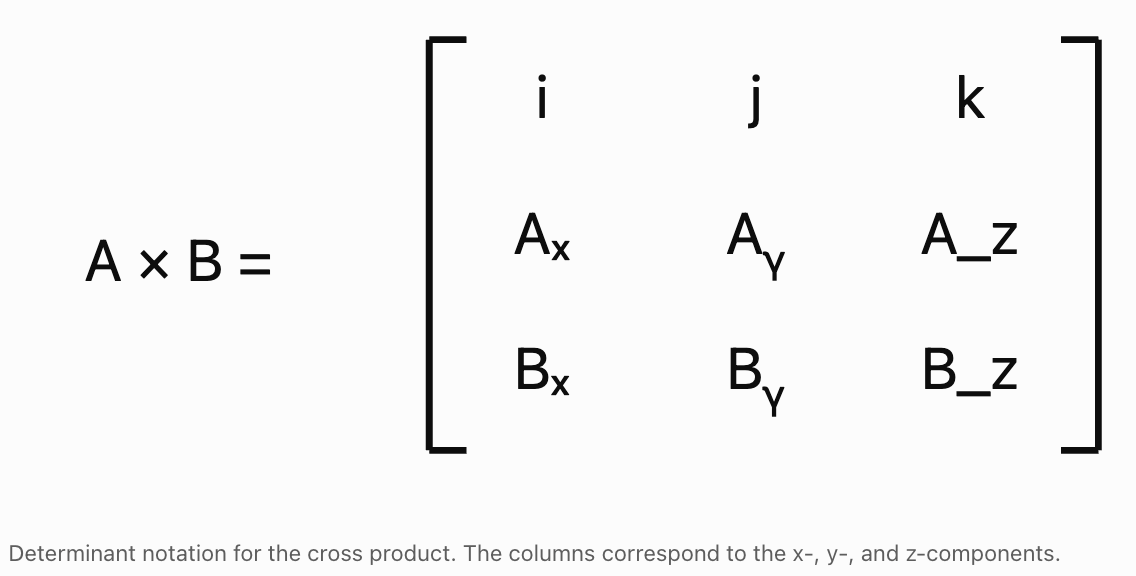
Expanding along the first row gives:
A × B = i(AᵧB_z − A_zBᵧ) − j(AₓB_z − A_zBₓ) + k(AₓBᵧ − AᵧBₓ)
The negative sign in the middle term is important.
Worked Example: Determinant Method
Given:
A = (1, 2, 3)
B = (4, 5, 6)
Calculate A × B.
Step 1: Calculate the i-component
i[(2)(6) − (3)(5)]
= i(12 − 15)
= −3i
Step 2: Calculate the j-component
−j[(1)(6) − (3)(4)]
= −j(6 − 12)
= +6j
Step 3: Calculate the k-component
k[(1)(5) − (2)(4)]
= k(5 − 8)
= −3k
Final Answer
A × B = −3i + 6j − 3k
In component form:
A × B = (−3, 6, −3)
Important Observation
The determinant method and component formula produce exactly the same result.
The determinant method can be especially useful when working with several three-dimensional vector calculations.
The Geometric Meaning of the Cross Product
The magnitude of the cross product is related to the magnitudes of the original vectors and the angle between them.
The formula is:
|A × B| = |A||B| sin θ
where:
-
|A × B| is the magnitude of the cross product.
-
|A| is the magnitude of vector A.
-
|B| is the magnitude of vector B.
-
θ is the angle between the vectors.
The angle θ is taken between 0° and 180°.
What Does the Formula Tell Us?
The magnitude depends on three factors:
-
The length of vector A.
-
The length of vector B.
-
The sine of the angle between them.
When the vectors are perpendicular, the magnitude of the cross product is greatest for fixed vector magnitudes.
When the vectors are parallel, the magnitude is zero.
How the Angle Affects the Cross Product
|
Angle θ |
sin θ |
Cross product magnitude |
|---|---|---|
|
0° |
0 |
Zero |
|
30° |
0.5 |
Half of |A||B| |
|
60° |
≈ 0.866 |
About 86.6% of |A||B| |
|
90° |
1 |
Maximum |
|
120° |
≈ 0.866 |
About 86.6% of |A||B| |
|
150° |
0.5 |
Half of |A||B| |
|
180° |
0 |
Zero |
Parallel Vectors
When θ = 0° or 180°:
sin θ = 0
Therefore:
|A × B| = 0
The cross product is the zero vector.
Perpendicular Vectors
When θ = 90°:
sin θ = 1
Therefore:
|A × B| = |A||B|
The magnitude is as large as possible for the given vector lengths.
Calculating Cross Product Magnitude
Worked Example: Perpendicular Vectors
Two perpendicular vectors have magnitudes:
|A| = 5
|B| = 8
Calculate the magnitude of their cross product.
Step 1: Write the formula
|A × B| = |A||B| sin θ
Step 2: Substitute
|A × B| = (5)(8) sin 90°
Step 3: Evaluate
sin 90° = 1
|A × B| = 40(1)
|A × B| = 40
Worked Example: Vectors at 30°
Two vectors have magnitudes:
|A| = 10
|B| = 6
The angle between them is 30°.
Calculate the magnitude of the cross product.
|A × B| = (10)(6) sin 30°
|A × B| = 60(0.5)
|A × B| = 30
Important Observation
The magnitude of the cross product is always non-negative.
The direction of the resulting vector is represented by its components, not by a negative magnitude.
The Right-Hand Rule
The direction of the cross product is determined by the right-hand rule.
The right-hand rule establishes which of the two possible perpendicular directions is correct.


Applying the Right-Hand Rule
-
Point the fingers of your right hand in the direction of vector A.
-
Curl your fingers toward vector B through the smaller angle between them.
-
Your thumb points in the direction of A × B.
The resulting vector is perpendicular to the plane containing A and B.
Important Principle
The order of the vectors matters.
A × B and B × A point in opposite directions.
Mathematically:
A × B = −(B × A)
This is called the anti-commutative property.
Worked Example: Right-Hand Rule with Unit Vectors
Consider the standard coordinate directions:
i = (1, 0, 0)
j = (0, 1, 0)
k = (0, 0, 1)
The cross products are:
i × j = k
j × k = i
k × i = j
Reversing the order changes the sign:
j × i = −k
k × j = −i
i × k = −j
Example
A = (1, 0, 0)
B = (0, 1, 0)
Calculate A × B.
Using the component formula:
A × B = (0, 0, 1)
Therefore:
A × B = k
The vector points in the positive z-direction.
Reversing the order:
B × A = (0, 0, −1)
Therefore:
B × A = −k
The direction is reversed.
Why the Right-Hand Rule Matters
The right-hand rule is used in:
-
Three-dimensional geometry.
-
Rotational mechanics.
-
Torque calculations.
-
Angular momentum.
-
Magnetic forces.
-
Surface orientation.
-
Computer graphics.
Finding a Vector Perpendicular to Two Vectors
One of the most important uses of the cross product is finding a vector perpendicular to two given vectors.
Worked Example
Given:
A = (2, 1, 0)
B = (1, 3, 2)
Find a vector perpendicular to both A and B.
Step 1: Calculate A × B
A × B = (AᵧB_z − A_zBᵧ, A_zBₓ − AₓB_z, AₓBᵧ − AᵧBₓ)
Step 2: Calculate the x-component
Cₓ = (1)(2) − (0)(3)
Cₓ = 2
Step 3: Calculate the y-component
Cᵧ = (0)(1) − (2)(2)
Cᵧ = −4
Step 4: Calculate the z-component
C_z = (2)(3) − (1)(1)
C_z = 6 − 1
C_z = 5
Final Answer
A × B = (2, −4, 5)
Verification
Check with A:
(2, −4, 5) · (2, 1, 0)
= 4 − 4 + 0
= 0
Check with B:
(2, −4, 5) · (1, 3, 2)
= 2 − 12 + 10
= 0
The resulting vector is perpendicular to both A and B.
Finding a Vector Perpendicular to a Plane
A plane is a flat two-dimensional surface extending through three-dimensional space.
A vector perpendicular to a plane is called a normal vector.
If two nonparallel vectors lie within a plane, their cross product produces a normal vector to that plane.
Geometric Interpretation
Suppose vectors A and B lie in the same plane.
Then:
N = A × B
is perpendicular to the plane.
The opposite vector:
−N = B × A
is also perpendicular to the plane.

Worked Example: Normal Vector to a Plane
A plane contains two direction vectors:
A = (1, 2, 0)
B = (3, 1, 4)
Find a normal vector.
Step 1: Calculate the cross product
N = A × B
Step 2: Calculate the x-component
Nₓ = (2)(4) − (0)(1)
Nₓ = 8
Step 3: Calculate the y-component
Nᵧ = (0)(3) − (1)(4)
Nᵧ = −4
Step 4: Calculate the z-component
N_z = (1)(1) − (2)(3)
N_z = 1 − 6
N_z = −5
Final Answer
N = (8, −4, −5)
This vector is perpendicular to the plane.
Any nonzero scalar multiple of N is also a normal vector.
For example:
(−8, 4, 5)
is another valid normal vector.
Finding the Equation of a Plane
The cross product can help determine the equation of a plane passing through three points.
A plane equation can be written:
ax + by + cz = d
The vector:
N = (a, b, c)
is perpendicular to the plane.
Worked Example: Plane Through Three Points
Find the equation of the plane passing through:
P = (1, 0, 0)
Q = (0, 1, 0)
R = (0, 0, 1)
Step 1: Find Two Direction Vectors
PQ = Q − P
PQ = (−1, 1, 0)
PR = R − P
PR = (−1, 0, 1)
Step 2: Calculate the Cross Product
N = PQ × PR
Nₓ = (1)(1) − (0)(0) = 1
Nᵧ = (0)(−1) − (−1)(1) = 1
N_z = (−1)(0) − (1)(−1) = 1
Therefore:
N = (1, 1, 1)
Step 3: Write the Plane Equation
Using the normal vector:
x + y + z = d
Step 4: Substitute a Known Point
Using P = (1, 0, 0):
1 + 0 + 0 = d
d = 1
Final Answer
x + y + z = 1
Verification
For Q = (0, 1, 0):
0 + 1 + 0 = 1
For R = (0, 0, 1):
0 + 0 + 1 = 1
All three points satisfy the equation.
Calculating Areas Using the Cross Product
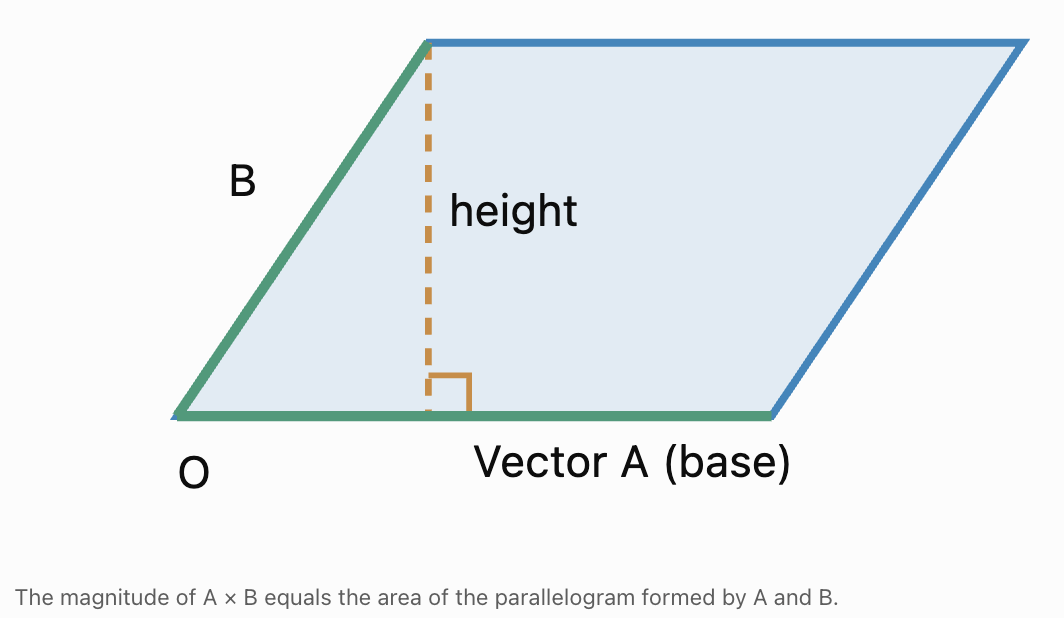
The magnitude of the cross product gives the area of a parallelogram formed by two vectors.
Area of parallelogram = |A × B|
This follows from the geometric formula:
|A × B| = |A||B| sin θ
For a parallelogram:
Area = base × perpendicular height
If |A| is the base, the perpendicular height is:
|B| sin θ
Therefore:
Area = |A||B| sin θ
Hence:
Area = |A × B|
Worked Example: Area of a Parallelogram
Given:
A = (3, 0, 0)
B = (0, 4, 0)
Find the area of the parallelogram formed by the vectors.
Step 1: Calculate the cross product
A × B = (0, 0, 12)
Step 2: Find the magnitude
|A × B| = √(0² + 0² + 12²)
|A × B| = √144
|A × B| = 12
Final Answer
Area = 12 square units
Verification
The vectors are perpendicular.
Therefore:
Area = base × height
Area = 3 × 4
Area = 12 square units
Both methods agree.
Worked Example: Area with Non-Perpendicular Vectors
Given:
A = (2, 1, 0)
B = (1, 3, 0)
Calculate the area of the parallelogram.
Step 1: Calculate the cross product
A × B = (0, 0, 5)
Step 2: Calculate the magnitude
|A × B| = √(0² + 0² + 5²)
|A × B| = 5
Final Answer
Area = 5 square units
Calculating the Area of a Triangle
A triangle formed by two vectors has half the area of the corresponding parallelogram.
Therefore:
Area of triangle = ½|A × B|
This formula is especially useful when the vertices of a triangle are given as coordinates in three-dimensional space.
Worked Example
Given:
A = (4, 0, 0)
B = (0, 3, 0)
Find the area of the triangle formed by these vectors and the origin.
Step 1: Calculate the cross product
A × B = (0, 0, 12)
Step 2: Find the magnitude
|A × B| = 12
Step 3: Calculate the triangle area
Area = ½(12)
Final Answer
Area = 6 square units
Verification
The triangle is right-angled.
Area = ½ × base × height
Area = ½ × 4 × 3
Area = 6 square units
Worked Example: Triangle in Three Dimensions
A triangle has vertices:
P = (1, 2, 3)
Q = (4, 2, 3)
R = (1, 6, 5)
Find its area.
Step 1: Construct Two Side Vectors
PQ = Q − P
PQ = (3, 0, 0)
PR = R − P
PR = (0, 4, 2)
Step 2: Calculate the Cross Product
PQ × PR = (0, −6, 12)
Step 3: Find the Magnitude
|PQ × PR| = √(0² + (−6)² + 12²)
= √(36 + 144)
= √180
= 6√5
Step 4: Calculate the Triangle Area
Area = ½(6√5)
Final Answer
Area = 3√5 square units
Approximately:
Area ≈ 6.71 square units
Important Observation
The cross product allows us to calculate the area of a triangle even when it does not lie in the xy-plane.
Finding the Angle Between Vectors Using the Cross Product
The magnitude formula can be rearranged:
|A × B| = |A||B| sin θ
Therefore:
sin θ = |A × B|/(|A||B|)
This can help determine the angle between vectors.
However, sine has the same value for an angle θ and its supplement 180° − θ.
Therefore, the cross product magnitude alone cannot always distinguish an acute angle from an obtuse angle.
The dot product can be used to resolve this ambiguity.
Worked Example
Given:
A = (1, 0, 0)
B = (1, 1, 0)
Find the angle between the vectors.
Step 1: Calculate the Cross Product
A × B = (0, 0, 1)
Therefore:
|A × B| = 1
Step 2: Calculate the Magnitudes
|A| = 1
|B| = √2
Step 3: Substitute
sin θ = 1/√2
sin θ ≈ 0.7071
Therefore, the angle is either:
45° or 135°
Step 4: Use the Dot Product
A · B = (1)(1) + (0)(1) + (0)(0)
A · B = 1
Since the dot product is positive, the angle is acute.
Final Answer
θ = 45°
Important Connection
The dot product and cross product provide complementary information:
-
The dot product helps determine the cosine of the angle.
-
The cross product magnitude helps determine the sine of the angle.
Together, they can determine the angle unambiguously for nonzero vectors.
Properties of the Cross Product
The cross product has several important algebraic properties.
Anti-Commutative Property
A × B = −(B × A)
Reversing the order reverses the direction.
Distributive Property
A × (B + C) = A × B + A × C
The cross product distributes over vector addition.
Scalar Multiplication
(kA) × B = k(A × B)
and:
A × (kB) = k(A × B)
where k is a scalar.
Cross Product of a Vector with Itself
A × A = (0, 0, 0)
The angle between a nonzero vector and itself is zero.
Since:
sin 0° = 0
the cross product has zero magnitude.
Cross Product of Parallel Vectors
If A and B are parallel:
A × B = (0, 0, 0)
Cross Product of Perpendicular Vectors
If A and B are perpendicular:
|A × B| = |A||B|
Important Limitation
The cross product is not generally associative.
In general:
A × (B × C) ≠ (A × B) × C
Parentheses matter when several cross products are involved.
Determining Whether Vectors Are Parallel
The cross product provides a useful test for parallel vectors.
Two nonzero vectors are parallel if and only if:
A × B = (0, 0, 0)
Worked Example
Given:
A = (2, 4, 6)
B = (1, 2, 3)
Determine whether the vectors are parallel.
Step 1: Calculate the Cross Product
A × B = (4(3) − 6(2), 6(1) − 2(3), 2(2) − 4(1))
A × B = (12 − 12, 6 − 6, 4 − 4)
A × B = (0, 0, 0)
Conclusion
The vectors are parallel.
Alternative Verification
B = ½A
Therefore, B is a scalar multiple of A.
This confirms that the vectors are parallel.
Real-World Application: Torque
Torque describes the turning effect of a force about a point or axis.
In three-dimensional physics, torque is calculated using the cross product:
τ = r × F
where:
-
τ is the torque vector.
-
r is the position vector from the pivot to the point where the force acts.
-
F is the applied force.
The magnitude is:
|τ| = |r||F| sin θ
where θ is the angle between r and F.
Worked Example: Turning a Wrench
A force of 40 N acts perpendicular to a wrench at a distance of 0.25 m from the pivot.
Calculate the torque magnitude.

Step 1: Identify the Values
|r| = 0.25 m
|F| = 40 N
θ = 90°
Step 2: Apply the Formula
|τ| = |r||F| sin θ
Step 3: Substitute
|τ| = (0.25)(40) sin 90°
Step 4: Calculate
|τ| = 10(1)
Final Answer
Torque magnitude = 10 N·m
Interpretation
The force produces a turning effect of 10 N·m about the pivot.
The torque vector points along the axis of rotation according to the right-hand rule.
Important Observation
A force applied directly toward the pivot produces no torque about that pivot because the angle between r and F is 0° or 180°.
Real-World Application: Surface Orientation in Computer Graphics
Three-dimensional computer graphics often represent objects using triangular surfaces.
To determine which direction a triangular surface faces, software can calculate a normal vector using the cross product.
Suppose a triangle has vertices:
P, Q, and R.
Construct:
PQ = Q − P
PR = R − P
Then:
N = PQ × PR
The vector N is perpendicular to the triangular surface.
Why Surface Normals Matter
Surface normals are used to:
-
Calculate lighting and shading.
-
Determine surface orientation.
-
Identify front-facing and back-facing polygons.
-
Model reflections.
-
Perform collision calculations.
-
Support three-dimensional rendering.

Important Observation
The order of the vertices matters.
If the vectors are reversed:
PR × PQ = −N
The normal vector points in the opposite direction.
This is important when deciding which side of a surface is considered the front.
Real-World Application: Angular Momentum
Angular momentum describes rotational motion.
For a particle, angular momentum about a chosen origin is:
L = r × p
where:
-
L is angular momentum.
-
r is the position vector.
-
p is linear momentum.
The magnitude is:
|L| = |r||p| sin θ
The direction follows the right-hand rule.
Example
A particle has:
r = (2, 0, 0) m
p = (0, 3, 0) kg·m/s
Calculate its angular momentum.
L = r × p
L = (0, 0, 6)
Final Answer
L = (0, 0, 6) kg·m²/s
The angular momentum vector points in the positive z-direction.
Real-World Application: Magnetic Force
The magnetic force on a moving charged particle can be calculated using a cross product:
F = q(v × B)
where:
-
F is the magnetic force.
-
q is the electric charge.
-
v is the velocity vector.
-
B is the magnetic field vector.
The magnetic force is perpendicular to both velocity and magnetic field when nonzero.
Important Observation
For a positive charge, the force direction follows the right-hand rule for v × B.
For a negative charge, the force points in the opposite direction.
The cross product therefore provides both the magnitude and direction needed to describe magnetic forces.
Solving Multi-Step Three-Dimensional Vector Problems
More advanced problems often combine cross products, dot products, vector magnitudes, and geometric reasoning.
Worked Example: Normal Vector and Triangle Area
Three points are given:
P = (0, 0, 0)
Q = (2, 1, 0)
R = (1, 3, 2)
Find:
-
A normal vector to the plane containing the points.
-
The area of triangle PQR.
Step 1: Construct Two Direction Vectors
PQ = (2, 1, 0)
PR = (1, 3, 2)
Step 2: Calculate the Cross Product
N = PQ × PR
Nₓ = (1)(2) − (0)(3) = 2
Nᵧ = (0)(1) − (2)(2) = −4
N_z = (2)(3) − (1)(1) = 5
Therefore:
N = (2, −4, 5)
Step 3: Calculate the Magnitude
|N| = √(2² + (−4)² + 5²)
|N| = √(4 + 16 + 25)
|N| = √45
|N| = 3√5
Step 4: Calculate the Triangle Area
Area = ½|N|
Area = 3√5/2
Final Answers
Normal vector = (2, −4, 5)
Triangle area = 3√5/2 square units
Approximately:
Area ≈ 3.35 square units
Verification
The normal vector must be perpendicular to both direction vectors.
N · PQ = (2)(2) + (−4)(1) + (5)(0)
= 4 − 4
= 0
N · PR = (2)(1) + (−4)(3) + (5)(2)
= 2 − 12 + 10
= 0
Both conditions are satisfied.
Choosing the Correct Cross Product Method
|
Problem |
Appropriate method |
|---|---|
|
Calculate a cross product |
Component formula or determinant |
|
Find a perpendicular vector |
A × B |
|
Find a plane normal |
Cross product of two nonparallel plane directions |
|
Calculate parallelogram area |
|A × B| |
|
Calculate triangle area |
½|A × B| |
|
Test whether nonzero vectors are parallel |
Check whether A × B = 0 |
|
Find cross product magnitude |
|A||B| sin θ |
|
Determine cross product direction |
Right-hand rule |
|
Calculate torque |
τ = r × F |
|
Calculate angular momentum |
L = r × p |
|
Calculate magnetic force |
F = q(v × B) |
General Problem-Solving Strategy
-
Identify the given vectors.
-
Determine whether they are expressed using components, magnitudes, or angles.
-
Identify what the problem asks for: a vector, magnitude, area, or orientation.
-
Select the appropriate cross product formula.
-
Calculate the components carefully.
-
Check the signs, especially the middle component.
-
Calculate the magnitude if required.
-
Apply the right-hand rule when direction matters.
-
Verify perpendicularity using dot products when appropriate.
-
Interpret the result in the original geometric or physical context.
Common Mistakes
Confusing the cross product with the dot product
The cross product produces a vector, while the dot product produces a scalar.
Using cosine instead of sine
The cross product magnitude uses sine.
Reversing the order of vectors
A × B and B × A point in opposite directions.
Forgetting the negative sign in determinant expansion
The middle term has a negative sign when expanding along the first row.
Making sign errors with negative components
Carefully evaluate each multiplication and subtraction.
Assuming the cross product lies in the same plane as the original vectors
The cross product is perpendicular to the plane containing the original vectors.
Confusing cross product magnitude with the cross product vector
The magnitude is a non-negative scalar, while the cross product has direction.
Assuming parallel vectors have a large cross product
Parallel vectors have a zero cross product.
Assuming perpendicular vectors have a zero cross product
Perpendicular nonzero vectors have the maximum possible cross product magnitude for their fixed lengths.
Forgetting to divide by two when calculating triangle area
The cross product magnitude gives parallelogram area, not triangle area.
Using the wrong side vectors for a triangle
Both side vectors should begin at the same vertex.
Assuming a zero cross product always means two distinct directions are parallel
A zero vector also produces a zero cross product with every vector.
Using the right-hand rule incorrectly
The order from the first vector to the second vector determines the direction.
Confusing surface normals with vectors lying in the plane
A normal vector is perpendicular to the plane.
Using sine alone to determine an angle without considering ambiguity
Sine cannot distinguish an angle from its supplement.
Failing to verify the result
A cross product should have zero dot product with both original vectors.
Key Terms
-
Vector: A quantity with magnitude and direction.
-
Scalar: A quantity described by magnitude alone.
-
Cross Product: An operation combining two three-dimensional vectors to produce a perpendicular vector.
-
Vector Product: Another name for the cross product.
-
Dot Product: An operation combining two vectors to produce a scalar.
-
Magnitude: The length or size of a vector.
-
Direction: The orientation in which a vector points.
-
Vector Component: The amount of a vector acting along a coordinate axis.
-
Three-Dimensional Vector: A vector with x-, y-, and z-components.
-
Unit Vector: A vector with magnitude 1.
-
Standard Basis Vectors: The unit vectors i, j, and k along the coordinate axes.
-
Right-Hand Rule: A method for determining the direction of a cross product.
-
Perpendicular Vectors: Nonzero vectors meeting at a 90° angle.
-
Orthogonal Vectors: Vectors whose dot product equals zero.
-
Parallel Vectors: Nonzero vectors that are scalar multiples of one another.
-
Zero Vector: A vector with all components equal to zero.
-
Normal Vector: A vector perpendicular to a surface or plane.
-
Plane: A flat two-dimensional surface extending through three-dimensional space.
-
Surface Orientation: The direction a surface faces in three-dimensional space.
-
Determinant: A scalar calculated from a square matrix, used in cross product calculations.
-
Anti-Commutative Property: The property that reversing the order of a cross product reverses its sign.
-
Distributive Property: A property allowing the cross product to be distributed across vector addition.
-
Parallelogram: A quadrilateral with two pairs of parallel opposite sides.
-
Area Vector: A vector perpendicular to a surface whose magnitude represents its area.
-
Triangle Area: Half the area of the parallelogram formed by two side vectors.
-
Sine: A trigonometric function used in calculating cross product magnitude.
-
Torque: The turning effect of a force about a point or axis.
-
Angular Momentum: A vector quantity describing rotational motion about a chosen origin.
-
Position Vector: A vector describing an object's location relative to an origin.
-
Linear Momentum: The product of mass and velocity.
-
Magnetic Force: A force experienced by a moving charge in a magnetic field.
-
Plane Equation: An algebraic equation describing a plane in three-dimensional space.
-
Vector Verification: Checking a calculated vector using known geometric or algebraic relationships.
Key Takeaways
-
The cross product combines two three-dimensional vectors to produce another vector.
-
The resulting vector is perpendicular to both original vectors.
-
The cross product can be calculated using vector components or a determinant.
-
The component formula is A × B = (AᵧB_z − A_zBᵧ, A_zBₓ − AₓB_z, AₓBᵧ − AᵧBₓ).
-
The magnitude of the cross product is |A × B| = |A||B| sin θ.
-
The right-hand rule determines the direction of the resulting vector.
-
Reversing the order of the vectors reverses the cross product direction.
-
The cross product is anti-commutative.
-
The cross product of parallel vectors is the zero vector.
-
Perpendicular nonzero vectors produce the greatest possible cross product magnitude for fixed magnitudes.
-
A cross product can be verified by taking its dot product with each original vector.
-
The cross product of two nonparallel vectors in a plane produces a normal vector.
-
Normal vectors can be used to determine equations of planes.
-
The magnitude of the cross product equals the area of the parallelogram formed by the original vectors.
-
Half the magnitude of the cross product gives the area of a triangle formed by the vectors.
-
The cross product can be used to calculate areas of triangles in three-dimensional space.
-
The dot product and cross product provide complementary information about vector angles.
-
The cross product is used to calculate torque and angular momentum.
-
Cross products are important in magnetic force calculations.
-
In computer graphics, cross products are used to calculate surface normals and orientations.
-
The central skill is using the cross product to calculate perpendicular vectors, determine orientation, calculate areas, and solve three-dimensional geometric and physical problems.
Check Your Understanding
Recall and Understanding
-
Define the cross product and explain how its result differs from the dot product.
-
State the component formula for the cross product of two three-dimensional vectors.
-
Explain the right-hand rule and why the order of vectors matters.
-
Describe the relationship between the magnitude of the cross product and the area of a parallelogram.
-
Explain why the cross product of two parallel vectors is the zero vector.
Application
-
Calculate A × B for A = (2, 3, 1) and B = (4, 1, 2).
-
Calculate A × B for A = (1, −2, 3) and B = (2, 4, −1).
-
Determine whether A = (2, 4, 6) and B = (1, 2, 3) are parallel using the cross product.
-
Find a vector perpendicular to both A = (1, 2, 0) and B = (3, 0, 1).
-
Two vectors have magnitudes 6 and 9 and form an angle of 30°. Calculate the magnitude of their cross product.
Analysis and Challenge
-
Find the area of the parallelogram formed by A = (3, 1, 0) and B = (1, 4, 0).
-
Find the area of the triangle with vertices P = (0, 0, 0), Q = (4, 0, 0), and R = (0, 3, 2).
-
Find a normal vector to the plane containing direction vectors A = (2, 1, 3) and B = (1, 4, 2).
-
A force of 60 N acts perpendicular to a wrench at a distance of 0.35 m from the pivot. Calculate the torque magnitude.
-
A plane passes through P = (1, 0, 0), Q = (0, 2, 0), and R = (0, 0, 3). Use the cross product to determine a normal vector and derive an equation of the plane.
Final Summary
The cross product is a fundamental operation in three-dimensional vector mathematics.
Unlike the dot product, which produces a scalar, the cross product produces a vector perpendicular to the two original vectors.
Its magnitude depends on the lengths of the original vectors and the sine of the angle between them, while its direction is determined by the right-hand rule.
The cross product can be calculated using vector components or determinant notation.
It provides a powerful method for finding normal vectors to planes, calculating the areas of parallelograms and triangles, and determining the orientation of surfaces.
It also has important applications in physics, engineering, computer graphics, and rotational mechanics.
The central principle is that the cross product connects vector magnitude, direction, and three-dimensional geometry, allowing us to determine perpendicular directions, calculate areas, and analyse orientation and rotation.