Exponential and Logarithmic Equations
4. Logarithmic Inequalities
Learning outcomes
- I can solve logarithmic inequalities.
- I can identify domain restrictions.
- I can interpret solution sets.
- I can verify logarithmic inequalities.
- I can solve contextual problems.
Logarithmic Inequalities
Introduction to Logarithmic Inequalities
A logarithmic inequality is an inequality in which the unknown variable appears inside a logarithmic expression.
For example:
log₂(x) > 3
This inequality asks:
"For which values of x is the logarithm of x to base 2 greater than 3?"
Since:
log₂(8) = 3
and log₂(x) increases as x increases, the solution is:
x > 8
Unlike logarithmic equations, which usually identify specific values, logarithmic inequalities identify entire intervals of values that satisfy a condition.
Solving logarithmic inequalities involves several important mathematical ideas:
-
Understanding whether a logarithmic function is increasing or decreasing.
-
Identifying domain restrictions.
-
Applying logarithmic properties correctly.
-
Converting logarithmic inequalities into algebraic inequalities.
-
Representing solution sets using interval notation.
-
Verifying solutions and rejecting invalid values.
-
Applying logarithmic inequalities to real-world situations.
Logarithmic inequalities are useful in chemistry, physics, finance, engineering, and environmental science, particularly when quantities are measured using logarithmic scales.


Reviewing Logarithmic Functions
A logarithmic function has the general form:
f(x) = logₐ(x)
where:
-
a is the base.
-
x is the argument.
-
a > 0.
-
a ≠ 1.
-
x > 0.
Logarithms are inverse functions of exponentials.
The relationship is:
logₐ(x) = y ⇔ aʸ = x
For example:
log₂(16) = 4
because:
2⁴ = 16
This relationship allows logarithmic inequalities to be converted into exponential or algebraic inequalities.
Increasing and Decreasing Logarithmic Functions
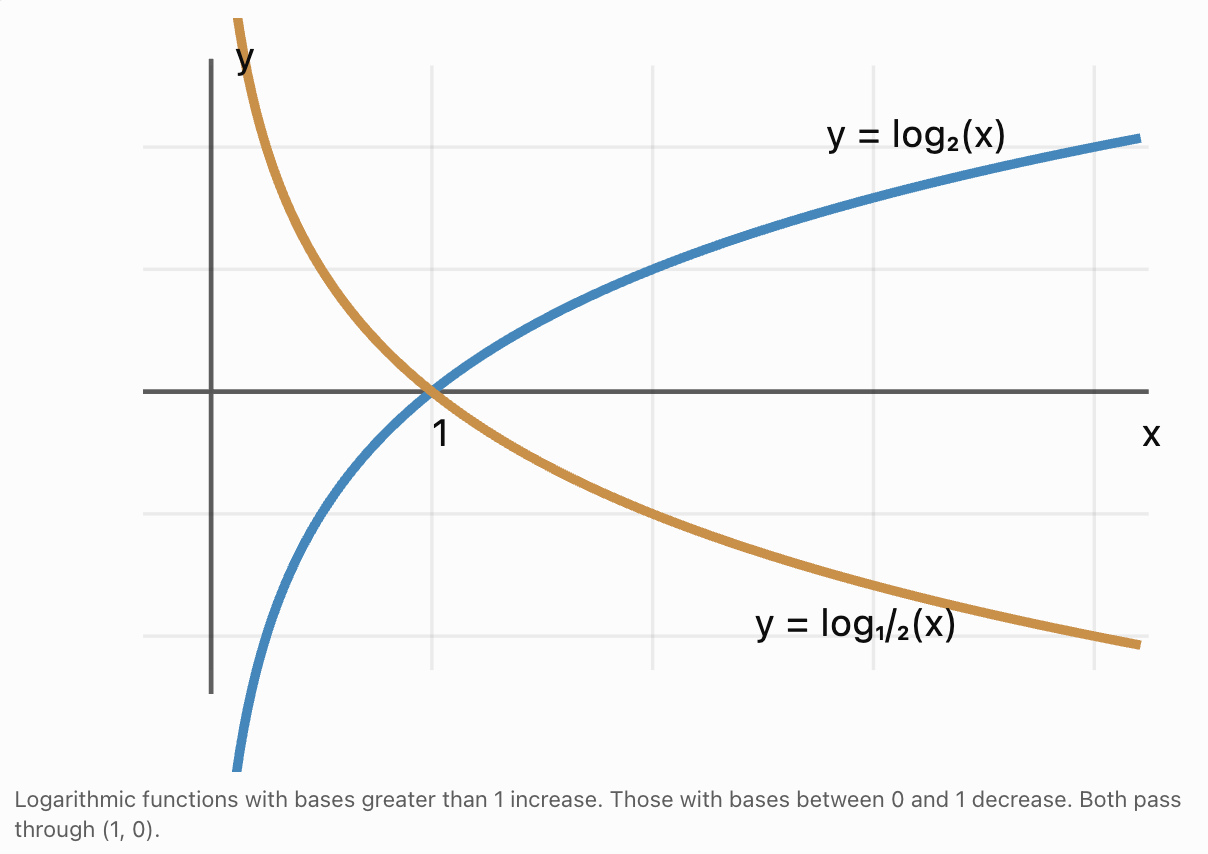
The direction of a logarithmic inequality depends on the base.
Bases Greater Than One
When:
a > 1
the logarithmic function is increasing.
Examples include:
-
log₂(x)
-
log₃(x)
-
log₁₀(x)
-
ln(x)
As x increases, the logarithmic value increases.
Bases Between Zero and One
When:
0 < a < 1
the logarithmic function is decreasing.
Examples include:
-
log₁/₂(x)
-
log₁/₃(x)
-
log₀.₈(x)
As x increases, the logarithmic value decreases.
Fundamental Rules for Logarithmic Inequalities
Rule for Bases Greater Than One
For positive M and N, when a > 1:
logₐ(M) > logₐ(N) ⇔ M > N
The inequality direction remains unchanged.
Similarly:
logₐ(M) ≤ logₐ(N) ⇔ M ≤ N
Rule for Bases Between Zero and One
For positive M and N, when 0 < a < 1:
logₐ(M) > logₐ(N) ⇔ M < N
The inequality direction reverses.
Similarly:
logₐ(M) ≤ logₐ(N) ⇔ M ≥ N
Why Does the Inequality Reverse?
Consider:
log₁/₂(2) = −1
and:
log₁/₂(4) = −2
Although:
4 > 2
we have:
−2 < −1
Therefore:
log₁/₂(4) < log₁/₂(2)
The logarithmic function decreases as its argument increases.
Domain Restrictions
One of the most important differences between ordinary algebraic inequalities and logarithmic inequalities is the restriction on logarithmic arguments.
The argument of every real logarithm must be strictly positive.
For:
log₂(x)
the domain is:
x > 0
For:
log₃(x − 4)
the domain is:
x > 4
For:
ln(7 − x)
the domain is:
x < 7
A proposed solution that violates any original logarithmic domain restriction must be rejected.
Finding Domain Restrictions
Example: Linear Argument
Find the domain of:
log₂(3x − 6)
Require:
3x − 6 > 0
3x > 6
x > 2
Example: Negative Coefficient
Find the domain of:
ln(10 − 2x)
Require:
10 − 2x > 0
−2x > −10
Divide by −2 and reverse the inequality:
x < 5
Example: Quadratic Argument
Find the domain of:
log₃(x² − 9)
Require:
x² − 9 > 0
Factorise:
(x − 3)(x + 3) > 0
The product is positive when:
x < −3
or:
x > 3
Therefore, the domain is:
(−∞, −3) ∪ (3, ∞)
Important Observation
Logarithmic domains are not always single intervals.
A logarithm with a quadratic or rational argument may have several disconnected parts of its domain.
Solving Basic Logarithmic Inequalities
The simplest logarithmic inequalities contain one logarithm compared with a constant.
Worked Example: Base Greater Than One
Solve:
log₂(x) > 4
Step 1: Identify the Domain
x > 0
Step 2: Convert to Exponential Form
Since the base is greater than 1:
x > 2⁴
Step 3: Simplify
x > 16
Step 4: Check the Domain
Every value greater than 16 is positive.
Final Answer
x > 16
Interval notation:
(16, ∞)
Verification
Choose x = 32:
log₂(32) = 5
5 > 4
True.
Choose x = 8:
log₂(8) = 3
3 > 4 is false.
The solution is consistent.
Solving Inclusive Logarithmic Inequalities
Worked Example
Solve:
log₃(x) ≤ 2
Step 1: Identify the Domain
x > 0
Step 2: Convert to Exponential Form
Since 3 > 1:
x ≤ 3²
Step 3: Simplify
x ≤ 9
Step 4: Combine with the Domain
The logarithm requires x > 0.
Therefore:
0 < x ≤ 9
Final Answer
(0, 9]
Important Observation
Although the algebra gives x ≤ 9, the logarithmic domain excludes zero and all negative values.
This is why domain restrictions must always be included in the final solution.
Solving Inequalities with Algebraic Arguments
Worked Example
Solve:
log₅(2x − 1) ≥ 2
Step 1: Find the Domain
2x − 1 > 0
x > 1/2
Step 2: Convert to Exponential Form
Since 5 > 1:
2x − 1 ≥ 5²
Step 3: Simplify
2x − 1 ≥ 25
2x ≥ 26
x ≥ 13
Step 4: Check the Domain
All values x ≥ 13 satisfy x > 1/2.
Final Answer
[13, ∞)
Solving Inequalities with Decreasing Logarithms
Worked Example
Solve:
log₁/₂(x) > 3
Step 1: Identify the Domain
x > 0
Step 2: Reverse the Inequality
Because the base is between zero and one:
x < (1/2)³
Step 3: Simplify
x < 1/8
Step 4: Combine with the Domain
0 < x < 1/8
Final Answer
(0, 1/8)
Verification
Choose x = 1/16:
log₁/₂(1/16) = 4
4 > 3
True.
Choose x = 1/4:
log₁/₂(1/4) = 2
2 > 3 is false.
Another Example with a Fractional Base
Solve:
log₁/₃(2x + 1) ≤ −2
Step 1: Identify the Domain
2x + 1 > 0
x > −1/2
Step 2: Reverse the Inequality
Because 0 < 1/3 < 1:
2x + 1 ≥ (1/3)⁻²
Step 3: Evaluate
(1/3)⁻² = 9
Therefore:
2x + 1 ≥ 9
2x ≥ 8
x ≥ 4
Step 4: Check the Domain
The solution satisfies x > −1/2.
Final Answer
[4, ∞)
Solving Logarithmic Inequalities with Logarithms on Both Sides
When two logarithms have the same base, their arguments can be compared directly, provided both arguments are positive.
Worked Example
Solve:
log₃(2x + 1) > log₃(x + 5)
Step 1: Identify Domain Restrictions
2x + 1 > 0
x > −1/2
Also:
x + 5 > 0
x > −5
Combined domain:
x > −1/2
Step 2: Compare Arguments
Since 3 > 1:
2x + 1 > x + 5
Step 3: Solve
x > 4
Step 4: Check the Domain
All values greater than 4 satisfy the original domain restrictions.
Final Answer
(4, ∞)
Comparing Logarithms with a Decreasing Base
Worked Example
Solve:
log₁/₂(x + 3) ≥ log₁/₂(2x − 1)
Step 1: Find the Domain
x + 3 > 0
x > −3
Also:
2x − 1 > 0
x > 1/2
Combined domain:
x > 1/2
Step 2: Reverse the Inequality
Since the base is between zero and one:
x + 3 ≤ 2x − 1
Step 3: Solve
4 ≤ x
x ≥ 4
Step 4: Check the Domain
All values x ≥ 4 are valid.
Final Answer
[4, ∞)
Solving Inequalities with Multiple Logarithms
Some logarithmic inequalities contain sums or differences of logarithmic expressions.
These can often be simplified using logarithmic properties.
Product Rule
logₐ(M) + logₐ(N) = logₐ(MN)
Quotient Rule
logₐ(M) − logₐ(N) = logₐ(M/N)
Power Rule
klogₐ(M) = logₐ(Mᵏ)
These rules must be applied while preserving the domain restrictions of the original expressions.
Using the Product Rule
Worked Example
Solve:
log₂(x) + log₂(x − 2) > 3
Step 1: Find the Domain
x > 0
x − 2 > 0
Therefore:
x > 2
Step 2: Combine Logarithms
log₂[x(x − 2)] > 3
Step 3: Convert to an Algebraic Inequality
Since 2 > 1:
x(x − 2) > 2³
x(x − 2) > 8
Step 4: Expand
x² − 2x > 8
x² − 2x − 8 > 0
Step 5: Factorise
(x − 4)(x + 2) > 0
Step 6: Solve the Quadratic Inequality
The product is positive when:
x < −2
or:
x > 4
Step 7: Apply the Domain
The original logarithms require x > 2.
Therefore, x < −2 is invalid.
Final Answer
x > 4
Interval notation:
(4, ∞)
Verification
Choose x = 6:
log₂(6) + log₂(4)
= log₂(24)
≈ 4.585
Since 4.585 > 3, the inequality is true.
Choose x = 3:
log₂(3) + log₂(1)
≈ 1.585
The inequality is false.
Using the Quotient Rule
Worked Example
Solve:
log₃(x + 4) − log₃(x − 2) ≥ 1
Step 1: Identify the Domain
x + 4 > 0
x − 2 > 0
Therefore:
x > 2
Step 2: Apply the Quotient Rule
log₃[(x + 4)/(x − 2)] ≥ 1
Step 3: Convert to an Algebraic Inequality
Since 3 > 1:
(x + 4)/(x − 2) ≥ 3
Step 4: Use the Domain
Because x > 2, the denominator x − 2 is positive.
We can multiply both sides without reversing the inequality:
x + 4 ≥ 3(x − 2)
Step 5: Expand
x + 4 ≥ 3x − 6
10 ≥ 2x
x ≤ 5
Step 6: Combine with the Domain
x > 2
and:
x ≤ 5
Final Answer
2 < x ≤ 5
Interval notation:
(2, 5]
Important Principle
When multiplying an inequality by an expression containing x, determine whether that expression is positive or negative.
The sign determines whether the inequality direction remains unchanged or reverses.
Using the Power Rule
Worked Example
Solve:
2log₂(x) ≤ 6
Step 1: Identify the Domain
x > 0
Step 2: Divide by 2
log₂(x) ≤ 3
Step 3: Convert to Exponential Form
x ≤ 2³
x ≤ 8
Step 4: Combine with the Domain
0 < x ≤ 8
Final Answer
(0, 8]
Logarithmic Inequalities with Quadratic Expressions
More complicated inequalities may produce quadratic expressions.
These require factoring or the quadratic formula, followed by sign analysis.
Worked Example
Solve:
log₂(x² − 5x + 6) > 1
Step 1: Identify the Domain
x² − 5x + 6 > 0
Factorise:
(x − 2)(x − 3) > 0
Therefore, the domain is:
x < 2 or x > 3
Step 2: Convert the Logarithmic Inequality
Since 2 > 1:
x² − 5x + 6 > 2¹
Step 3: Simplify
x² − 5x + 6 > 2
x² − 5x + 4 > 0
Step 4: Factorise
(x − 1)(x − 4) > 0
Step 5: Solve the Quadratic Inequality
The product is positive when:
x < 1
or:
x > 4
Step 6: Check the Domain
Both intervals lie within the original domain.
Final Answer
x < 1 or x > 4
Interval notation:
(−∞, 1) ∪ (4, ∞)
Interpretation
The inequality has two separate solution intervals.
This happens because the quadratic argument is large enough on both sides of its central region.
Sign Charts and Logarithmic Inequalities
Sign charts help identify intervals where polynomial or rational expressions are positive or negative.
Consider:
(x − 1)(x − 4) > 0
The critical values are:
x = 1
x = 4
|
Interval |
Sign of x − 1 |
Sign of x − 4 |
Product |
|---|---|---|---|
|
x < 1 |
Negative |
Negative |
Positive |
|
1 < x < 4 |
Positive |
Negative |
Negative |
|
x > 4 |
Positive |
Positive |
Positive |
The product is positive outside the two critical values.
Therefore:
x < 1 or x > 4
Sign charts are particularly useful when inequalities contain several factors.
Interpreting Solution Sets
A logarithmic inequality may have:
-
One bounded interval.
-
One unbounded interval.
-
Two or more separate intervals.
-
All values in its domain.
-
No real solutions.
The solution set must satisfy both the logarithmic comparison and all domain restrictions.
Interval Notation
|
Inequality |
Interval notation |
|---|---|
|
x > 3 |
(3, ∞) |
|
x ≥ 3 |
[3, ∞) |
|
x < 5 |
(−∞, 5) |
|
x ≤ 5 |
(−∞, 5] |
|
2 < x < 7 |
(2, 7) |
|
2 ≤ x ≤ 7 |
[2, 7] |
|
x < 1 or x > 4 |
(−∞, 1) ∪ (4, ∞) |
Open and Closed Boundaries
An open boundary excludes the endpoint.
A closed boundary includes the endpoint.
However, a logarithmic domain boundary is always excluded when the argument becomes zero.
For example:
log₂(x − 3) ≥ 0
requires x > 3.
The solution is:
x − 3 ≥ 1
x ≥ 4
Therefore:
[4, ∞)
The boundary x = 4 is included because the logarithm is defined there and the inequality permits equality.
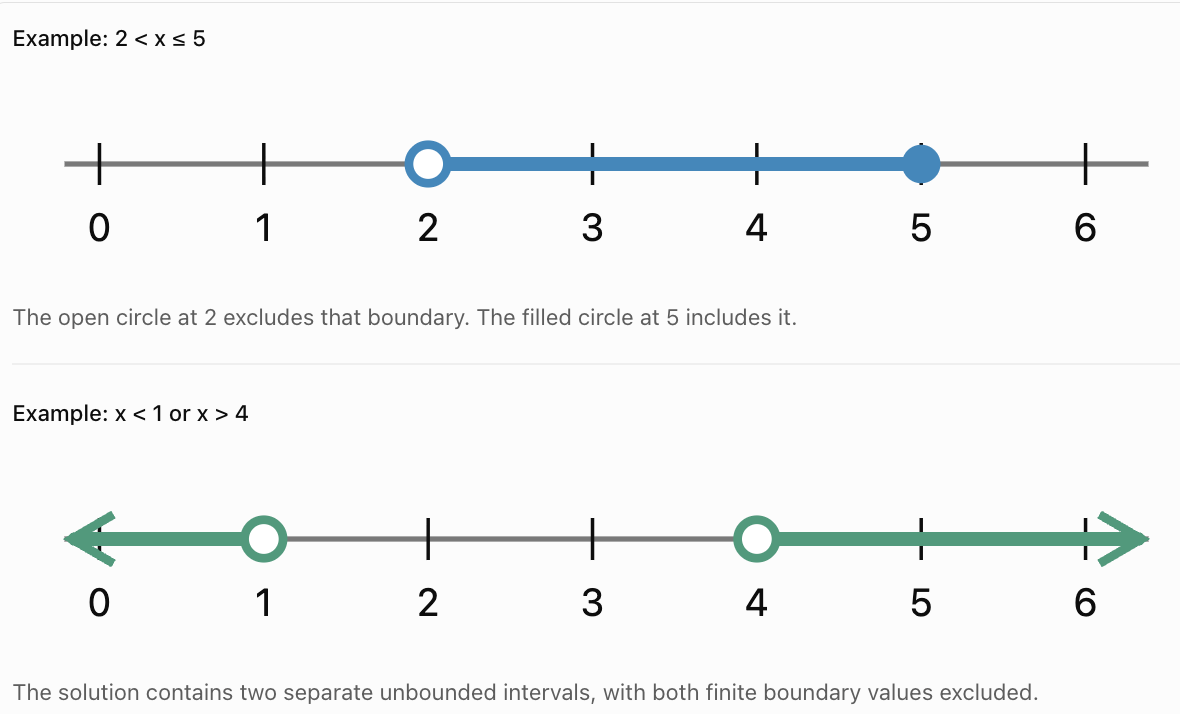
Representing Solutions on Number Lines
Graphical Solutions of Logarithmic Inequalities
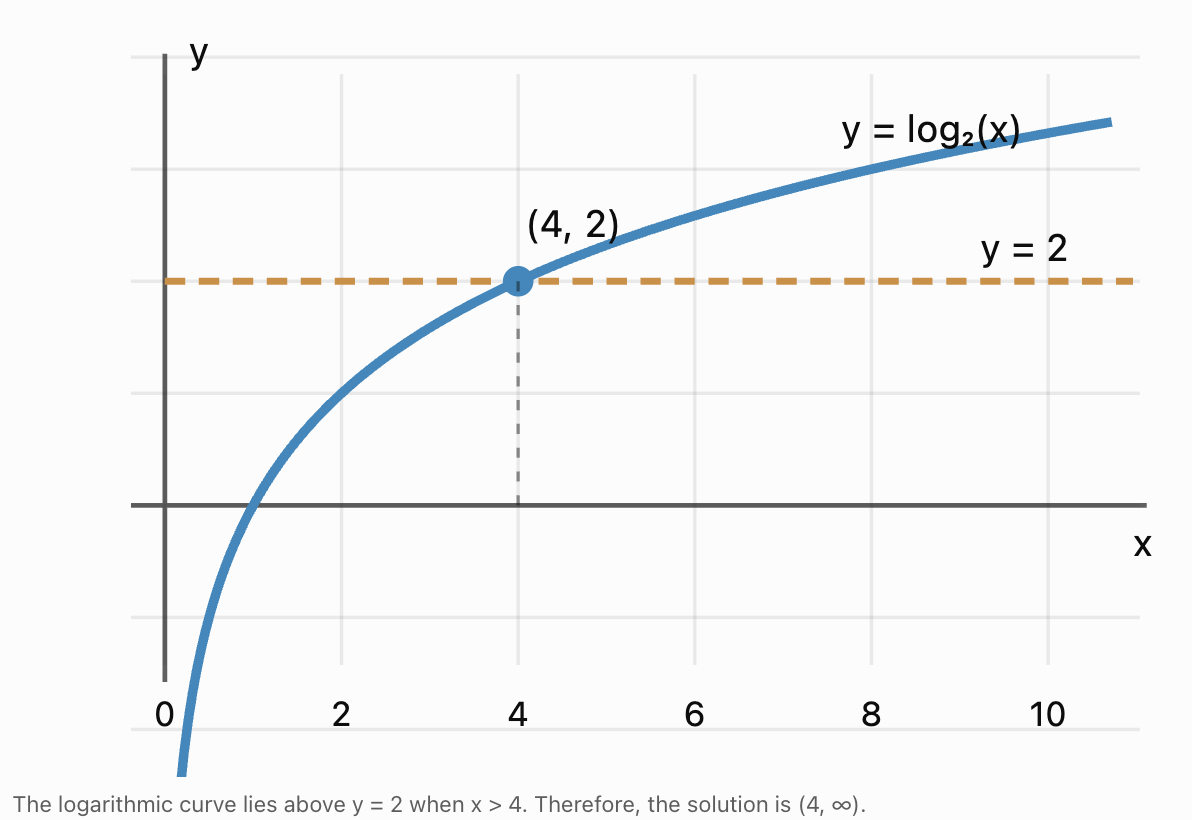
Logarithmic inequalities can also be solved by comparing graphs.
Consider:
log₂(x) > 2
Graph:
y = log₂(x)
and:
y = 2
The graphs intersect when:
log₂(x) = 2
Therefore:
x = 4
For x > 4, the logarithmic curve lies above the horizontal line.
Advantages of Graphical Methods
Graphs can help:
-
Identify solution intervals.
-
Estimate boundary values.
-
Show whether a function is increasing or decreasing.
-
Compare logarithmic expressions.
-
Identify multiple solution regions.
-
Verify algebraic answers.
Graphical methods are particularly useful when exact algebraic solutions are difficult.
Verifying Logarithmic Inequalities
Verification is essential because algebraic manipulation may produce intervals containing values outside the original logarithmic domain.
Verification Procedure
-
Identify the original domain restrictions.
-
Find the proposed solution intervals.
-
Check whether boundary values are included or excluded.
-
Choose test values inside each proposed interval.
-
Substitute the test values into the original inequality.
-
Choose test values outside the proposed intervals but within the domain.
-
Confirm that the inequality is false outside the solution set.
-
Use monotonicity or sign analysis to justify the full intervals.
Worked Example
Verify:
log₂(x − 1) ≥ 2
Step 1: Identify the Domain
x − 1 > 0
x > 1
Step 2: Solve
x − 1 ≥ 2²
x − 1 ≥ 4
x ≥ 5
Step 3: Check the Boundary
At x = 5:
log₂(4) = 2
Equality holds.
Step 4: Test a Value Inside the Solution
At x = 9:
log₂(8) = 3
3 ≥ 2
True.
Step 5: Test a Value Outside the Solution
At x = 3:
log₂(2) = 1
1 ≥ 2
False.
Final Answer
[5, ∞)
Because log₂(x − 1) is strictly increasing on its domain, the solution is confirmed.
Why Domain Checks Are Essential
Consider:
log₂(x) + log₂(x − 3) > 2
The original domain requires:
x > 3
Combining logarithms gives:
log₂[x(x − 3)] > 2
Therefore:
x(x − 3) > 4
Expanding:
x² − 3x − 4 > 0
Factorising:
(x − 4)(x + 1) > 0
The algebraic solution is:
x < −1 or x > 4
However, the original domain requires x > 3.
Therefore, the negative interval must be rejected.
Correct Final Answer
x > 4
This example demonstrates that algebraic solutions and logarithmic domain restrictions must always be considered together.
Practical Application: pH Inequalities
The pH scale is logarithmic.
The mathematical definition is:
pH = −log₁₀(a_H⁺)
where a_H⁺ is dimensionless hydrogen-ion activity.
For dilute aqueous solutions, hydrogen-ion activity is often approximated using concentration relative to 1 mol/L.
Worked Example
A laboratory process requires a solution with:
pH > 5
Determine the allowed hydrogen-ion activity.
Step 1: Write the Inequality
−log₁₀(a_H⁺) > 5
Step 2: Multiply by −1
Reverse the inequality:
log₁₀(a_H⁺) < −5
Step 3: Convert to Exponential Form
Since base 10 is increasing:
a_H⁺ < 10⁻⁵
Step 4: Include the Domain
Hydrogen-ion activity must be positive.
Therefore:
0 < a_H⁺ < 10⁻⁵
Interpretation
The solution must have a hydrogen-ion activity below 10⁻⁵ to meet the pH requirement.
For sufficiently dilute solutions, this corresponds approximately to a hydrogen-ion concentration below 10⁻⁵ mol/L.

Practical Application: Earthquake Magnitude
A simplified earthquake magnitude relationship is:
M = log₁₀(A/A₀)
where:
-
M is earthquake magnitude.
-
A is corrected seismic-wave amplitude.
-
A₀ is reference amplitude.
Actual magnitude calculations involve additional corrections, and modern seismology commonly uses moment magnitude.
Worked Example
A monitoring system identifies earthquakes with:
M ≥ 5
Determine the required corrected amplitude ratio.
Step 1: Write the Inequality
log₁₀(A/A₀) ≥ 5
Step 2: Convert to Exponential Form
A/A₀ ≥ 10⁵
Step 3: Simplify
A/A₀ ≥ 100000
Interpretation
In this simplified model, the corrected amplitude must be at least 100000 times the reference amplitude.

Practical Application: Sound Intensity
Sound intensity levels are measured in decibels.
The formula is:
L = 10log₁₀(I/I₀)
where:
-
L is intensity level in decibels.
-
I is measured sound intensity.
-
I₀ is reference intensity.
Worked Example
A laboratory requires a sound intensity level below 80 dB.
Find the maximum allowed intensity using:
I₀ = 10⁻¹² W/m²
Step 1: Write the Inequality
10log₁₀(I/I₀) < 80
Step 2: Divide by 10
log₁₀(I/I₀) < 8
Step 3: Convert to Exponential Form
I/I₀ < 10⁸
Step 4: Substitute the Reference Intensity
I < 10⁸ × 10⁻¹²
Step 5: Simplify
I < 10⁻⁴ W/m²
Interpretation
The sound intensity must remain below 0.0001 W/m² to satisfy the stated condition.
This is a mathematical threshold example, not a universal occupational noise-exposure limit.

Practical Application: Investment Growth
Logarithmic inequalities can be used to determine when an investment exceeds a financial target.
The compound interest model is:
A = P(1 + r)ᵗ
where:
-
A is the final amount.
-
P is the initial principal.
-
r is the annual interest rate.
-
t is time in years.
Worked Example
An investment of $6000 earns 5% annual interest.
When will it exceed $10000?
Step 1: Write the Inequality
6000(1.05)ᵗ > 10000
Step 2: Divide
1.05ᵗ > 5/3
Step 3: Take Natural Logarithms
t ln(1.05) > ln(5/3)
Step 4: Solve
Since ln(1.05) > 0:
t > ln(5/3)/ln(1.05)
Step 5: Calculate
t > 10.47 years
Interpretation
The investment exceeds $10000 after approximately 10.47 years under the exponential model.
If interest is credited annually, the account first exceeds the target after 11 complete years.
Although the original model is exponential, logarithmic inequalities provide the method for determining the time threshold.


A Systematic Method for Solving Logarithmic Inequalities
The following approach works for many logarithmic inequalities.
Step 1: Identify the Base
Determine whether the logarithmic function is increasing or decreasing.
-
Base greater than 1: increasing.
-
Base between zero and one: decreasing.
Step 2: Identify Domain Restrictions
Require every original logarithmic argument to be strictly positive.
Step 3: Simplify the Inequality
Use algebra and logarithmic properties where appropriate.
Step 4: Convert to an Algebraic Inequality
Remove logarithms by comparing arguments or converting to exponential form.
Remember to reverse the inequality for decreasing logarithmic functions.
Step 5: Solve the Algebraic Inequality
Use rearrangement, factoring, quadratic methods, or sign analysis.
Step 6: Intersect with the Domain
Keep only values satisfying every original domain restriction.
Step 7: Express the Solution Set
Use inequality notation, interval notation, or a number line.
Step 8: Verify
Test boundary values and representative points.
Step 9: Interpret
For practical problems, explain what the solution means in the original context.
Common Mistakes
Ignoring domain restrictions
Every original logarithmic argument must be positive.
Forgetting to reverse inequalities for decreasing logarithms
Bases between zero and one reverse the comparison between arguments.
Assuming all logarithmic functions increase
Some logarithmic functions decrease.
Including a logarithmic domain boundary
A logarithm is undefined when its argument equals zero.
Combining logarithms incorrectly
Logarithmic properties must be applied according to their correct rules.
Losing domain restrictions after combining logarithms
The combined expression may be defined for values that were invalid in the original equation.
Multiplying by an expression with an unknown sign
The sign must be determined before multiplying an inequality.
Solving a quadratic equation instead of a quadratic inequality
Critical points identify boundaries, but sign analysis determines the intervals.
Using incorrect interval brackets
Strict inequalities exclude equality boundaries.
Failing to intersect algebraic solutions with the domain
This may produce invalid intervals.
Assuming a single test value proves an entire interval
Verification should be supported by monotonicity or sign analysis.
Ignoring units and physical restrictions
Real-world quantities may require additional conditions such as positive concentration or nonnegative time.
Key Terms
-
Logarithmic Inequality: An inequality containing a logarithmic expression involving an unknown variable.
-
Logarithmic Function: A function that determines the exponent required to produce a given argument from a fixed base.
-
Base: The positive number, other than 1, used in a logarithm.
-
Argument: The expression inside a logarithm.
-
Domain: The set of input values for which a function is defined.
-
Domain Restriction: A condition limiting the allowable values of a variable.
-
Solution Set: The collection of values satisfying an inequality.
-
Increasing Function: A function whose output increases as its input increases.
-
Decreasing Function: A function whose output decreases as its input increases.
-
Monotonic Function: A function that consistently increases or decreases over an interval.
-
Strict Inequality: An inequality that excludes equality.
-
Inclusive Inequality: An inequality that includes equality.
-
Boundary Value: A value separating different solution regions.
-
Open Interval: An interval excluding its finite endpoints.
-
Closed Interval: An interval including its finite endpoints.
-
Interval Notation: A notation describing sets of real numbers using brackets and parentheses.
-
Union: A combination of two or more sets.
-
Intersection: The values shared by two or more sets.
-
Number Line: A visual representation of numerical values and intervals.
-
Product Rule: A logarithmic property that converts multiplication into addition.
-
Quotient Rule: A logarithmic property that converts division into subtraction.
-
Power Rule: A logarithmic property that converts exponents into multipliers.
-
Quadratic Inequality: An inequality involving a quadratic expression.
-
Factorisation: Rewriting an expression as a product of factors.
-
Sign Chart: A method used to determine where an expression is positive or negative.
-
Critical Value: A value where an expression becomes zero or changes sign behaviour.
-
Graphical Solution: A solution identified by comparing graphs.
-
Verification: Checking whether values satisfy the original inequality.
-
pH: A logarithmic measure related to hydrogen-ion activity.
-
Earthquake Magnitude: A measure of earthquake size based on seismic measurements.
-
Decibel: A logarithmic unit used to express ratios such as sound intensity.
-
Threshold: A boundary value used to determine whether a condition has been met.
-
Mathematical Model: A mathematical representation of a real-world system.
Key Takeaways
-
Logarithmic inequalities identify intervals of values satisfying logarithmic comparisons.
-
Every logarithmic argument must be strictly positive.
-
Domain restrictions must be identified before solving.
-
Logarithmic functions with bases greater than 1 are increasing.
-
For increasing logarithmic functions, comparing arguments preserves the inequality direction.
-
Logarithmic functions with bases between zero and one are decreasing.
-
For decreasing logarithmic functions, comparing arguments reverses the inequality direction.
-
Basic logarithmic inequalities can be converted into exponential or algebraic inequalities.
-
Logarithmic properties help simplify inequalities containing multiple logarithms.
-
Combining logarithms does not eliminate the original domain restrictions.
-
Quadratic and rational inequalities may arise when logarithmic expressions are simplified.
-
Sign charts help identify valid intervals for polynomial and rational inequalities.
-
The final solution must satisfy both the algebraic inequality and the original domain.
-
Solution sets may contain one interval, several intervals, all domain values, or no values.
-
Interval notation provides a concise representation of solution sets.
-
Number lines help distinguish included and excluded boundary values.
-
Graphical methods show where logarithmic functions lie above or below comparison functions.
-
Verification requires checking boundary conditions and representative values.
-
Logarithmic inequalities are useful for interpreting thresholds in chemistry, physics, engineering, and finance.
-
The most important principle is that logarithmic inequalities must be solved using both the behaviour of the logarithmic function and the restrictions on its arguments.
Check Your Understanding
Recall and Understanding
-
Explain what makes an inequality logarithmic.
-
State the domain restriction for log₂(x − 5).
-
Explain why logarithmic inequalities with bases between zero and one reverse their inequality direction.
-
Describe why a logarithmic domain boundary cannot be included in the solution set.
-
Explain how interval notation represents strict and inclusive inequalities.
Application
-
Solve log₂(x) > 5.
-
Solve log₃(2x − 1) ≤ 3.
-
Solve log₁/₂(x) ≥ 4.
-
Solve log₄(x + 3) > log₄(2x − 5).
-
Solve log₂(x) + log₂(x − 3) ≥ 2, stating the domain and solution interval.
Analysis and Challenge
-
Solve log₃(x + 5) − log₃(x − 1) > 1, checking all domain restrictions.
-
Solve log₂(x² − 4x + 3) ≥ 2 and express the solution using interval notation.
-
Solve log₁/₃(2x + 4) < log₁/₃(x + 7), showing how the decreasing base affects the inequality.
-
A laboratory requires a solution with pH greater than 6.2. Determine the permitted hydrogen-ion activity and explain the result.
-
A sound intensity level must remain below 75 dB. Using I₀ = 10⁻¹² W/m², determine the maximum permitted intensity and express the answer as an inequality.
Final Summary
Logarithmic inequalities are used to identify the values of a variable that satisfy comparisons involving logarithmic expressions.
The most important first step is identifying the domain restrictions, because every logarithmic argument must be positive.
When the logarithmic base is greater than 1, the function increases and inequalities can be converted into comparisons between arguments without changing direction.
When the base lies between zero and one, the function decreases and the inequality direction must reverse.
More complicated logarithmic inequalities may require logarithmic properties, factoring, quadratic inequalities, and sign analysis.
Solutions should be expressed clearly using interval notation or graphical representations and verified against the original inequality.
Logarithmic inequalities also have practical applications in pH measurements, earthquake magnitude comparisons, sound intensity thresholds, and financial modelling.
The central principle is that a correct logarithmic inequality solution must satisfy both the algebraic comparison and every domain restriction of the original logarithmic expressions.