Exponential Function

4. Exponential Growth and Decay

Learning outcomes
  • I can distinguish exponential growth from exponential decay.
  • I can model growth and decay using exponential equations.
  • I can determine growth and decay rates.
  • I can interpret exponential models.
  • I can solve practical growth and decay problems.

Exponential Growth and Decay

Many quantities in the real world change by the same percentage over equal periods of time. When this happens, the change can often be modelled using an exponential function.

Examples include:

  • populations increasing
  • money earning compound interest
  • bacteria reproducing
  • the value of some products decreasing
  • radioactive substances decaying
  • medicines being removed from the body

The key idea is that exponential change involves repeated multiplication, rather than repeated addition or subtraction.

https://images.openai.com/static-rsc-4/tYAPA3fDTp0HZHd59eOdxFciYsacg1TVDtKFi2zTabE0VPKKgXXypc9X8xGDKV5V-ZRJ8p1hAR8qIpKtHkRi6_5E1x37-nfOzzQZGgS7795JtMlqhv75hXkfZtAa1a85yWJJvMU56qCeLBQfCE1N_qgDPGz6ywY5c-Hy07pRk36lbomus0F85oeVzK4TFHcj?purpose=fullsize
 
https://images.openai.com/static-rsc-4/Z-W_kYPhRdLjgHUUEFZhymua8cfvyjeIyUAZ-4iRAyt524_FtnQgElcB1XVCb3ctRHXq-B-sR_PAc5PCVq2BJ8NqYysRuyApuGEZRlhn1NGcClhu2qLcsfKs2_Ln5tcaW5jJIM9KqQsqDUyh10GgOiz143OHpSsXazGp7FCI9UqKSf0mfWpq1Pf3KSl_X0R8?purpose=fullsize
 
https://images.openai.com/static-rsc-4/piGycJ9b3rpFRfOEE912z6amc0Zi64nODGvaWVbBELRksi84RSDyyCB-88Lc1lvEoawKcbmPSqfosLtgaJOEIYesRkjGXFhy_dfM3PJBJmE6DinV43UdZzTSIENoAb4H7BrKZP3ElAzddrx_r-nzOmFo3gB5MF19U3ON7HxxatI2sa5QSVv-PZrvGqENikH7?purpose=fullsize
 
6

Linear Change vs. Exponential Change

It is important to distinguish linear change from exponential change.

A linear relationship changes by the same amount during each interval.

For example:

100, 120, 140, 160, 180

The amount increases by 20 each time.

An exponential relationship changes by the same factor or percentage during each interval.

For example:

100, 120, 144, 172.8, 207.36

Each value is multiplied by:

1.20

This represents a 20% increase each time.

Compare

Type What stays constant? Example
Linear Amount added or subtracted +20 each year
Exponential Percentage or multiplication factor ×1.20 each year

This distinction is one of the most important ideas in exponential modelling.

Exponential Growth

Exponential growth occurs when a quantity increases by the same percentage over equal time intervals.

A common model is:

A = A₀(1 + r)ᵗ

where:

  • A = amount after time t
  • A₀ = initial amount
  • r = growth rate written as a decimal
  • t = number of time periods

The expression:

1 + r

is called the growth factor.

Example

A population begins at 2,000 and grows by 6% each year.

Initial amount:

A₀ = 2000

Growth rate:

r = 0.06

Growth factor:

1 + 0.06 = 1.06

Therefore:

A = 2000(1.06)ᵗ

This equation models the population after t years.

Converting Percentages to Decimals

Growth and decay rates must normally be written as decimals when substituted into exponential equations.

For example:

5% = 0.05

12% = 0.12

25% = 0.25

0.5% = 0.005

To convert a percentage to a decimal, divide by 100.

For example:

8% ÷ 100 = 0.08

Growth Factors

The growth factor tells us what number the quantity is multiplied by during each time interval.

For growth:

growth factor = 1 + r

Examples

Growth rate Growth factor
3% 1.03
8% 1.08
15% 1.15
25% 1.25
60% 1.60

If a quantity increases by 12% each year, it retains its original 100% and gains another 12%.

100% + 12% = 112%

112% = 1.12

So it is multiplied by 1.12 each year.

Worked Example: Population Growth

A town has a population of 15,000. Its population grows by 4% each year. Estimate the population after 6 years.

Use:

A = A₀(1 + r)ᵗ

Substitute:

A = 15000(1.04)⁶

A ≈ 18,980

So the predicted population after 6 years is approximately:

18,980 people

Notice that we do not simply calculate 4% of 15,000 and add that same amount six times. Each year's growth is based on the new population.

https://images.openai.com/static-rsc-4/6Q_UDHWaHentcAkZHRGyCZppFXmVom7vCrLc9xKzfx3xIzHm40nweB9XfFjv0qwAyptmHyxOJncgADZFOxM-IoqWewovazO_qObWFdvntJve1bbpRJdLJ7CocXB1jas6X4xV486fX5mn8Aqsc2aCUdnENzO4Z5tWD9lMzsE6yyb6xsKoB3nwZ_zhYkPiOtld?purpose=fullsize
 
https://images.openai.com/static-rsc-4/5Ts73zZFGB9Lxj3TJwgG7vgv0kMH8stvJJurbMWosDMztmFPsSHQsP8CVNnTuHxh_phjpXWLvm9ZXvujFQxIKA2lbT9udC0t9mcftdhmuXuJKKMvXJsF7OttdCaFDzjtJqDvGoqPz_MA-GKF4zeuri9hehYXPVg7QMHw3RVwVC3gh7cywVEL1FQTIR15cCXn?purpose=fullsize
 
https://images.openai.com/static-rsc-4/2D6jfx-wtmJAo3eYeFNG3dQelb7by4_34QCGLdXndupfDBHlbNPA6gl_SuR06Sr7S9SU6ezFXZ2a8nnbSVUYc8W6B0JPX5OYzFZbUwe0f7O2oSgCLvk3ctn-QlnrJvIDG8A68QsZ5R2Rilpn-1QBZvvLImUyWPTjGUX4gN1d5IYIWzMP6FG-GBGc5HNRd242?purpose=fullsize
 
6

Exponential Decay

Exponential decay occurs when a quantity decreases by the same percentage over equal time intervals.

A common model is:

A = A₀(1 − r)ᵗ

The expression:

1 − r

is called the decay factor.

Example

A machine is worth $20,000 and loses 15% of its value each year.

Initial value:

A₀ = 20000

Decay rate:

r = 0.15

Decay factor:

1 − 0.15 = 0.85

Therefore:

A = 20000(0.85)ᵗ

Each year, the machine retains 85% of its previous value.

Decay Factors

For exponential decay:

decay factor = 1 − r

Examples

Decay rate Decay factor
5% 0.95
10% 0.90
18% 0.82
25% 0.75
40% 0.60

A factor between 0 and 1 indicates exponential decay.

For example:

A = 500(0.72)ᵗ

Since:

0 < 0.72 < 1

the model represents decay.

The decay rate is:

1 − 0.72 = 0.28

Therefore:

decay rate = 28%

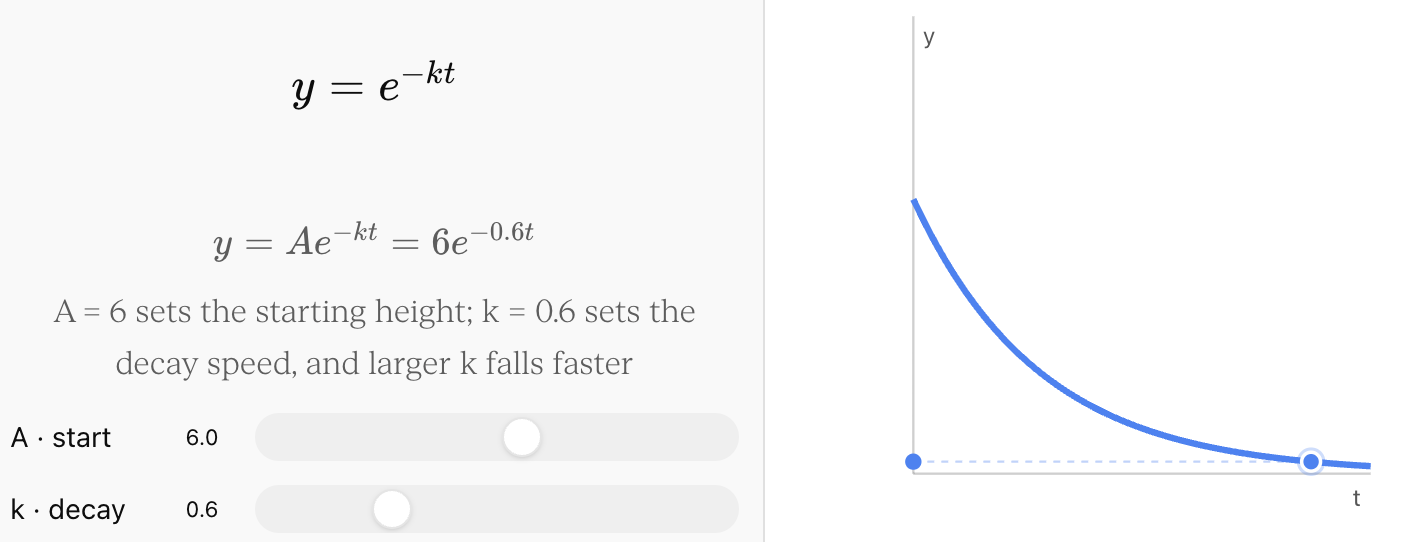
The decreasing behaviour of an exponential model can be explored directly here:
Worked Example: Depreciation

A laptop costs $1,800 and loses 20% of its value each year. Find its value after 3 years.

Initial value:

A₀ = 1800

Decay rate:

r = 0.20

Decay factor:

1 − 0.20 = 0.80

Model:

A = 1800(0.80)ᵗ

After 3 years:

A = 1800(0.80)³

A = 1800(0.512)

A = 921.60

The laptop's estimated value after three years is:

$921.60

Recognizing Growth and Decay from an Equation

Consider:

y = 500(1.07)ˣ

The base is:

1.07

Since:

1.07 > 1

the function represents exponential growth.

The growth rate is:

1.07 − 1 = 0.07

Therefore:

growth rate = 7%

Now consider:

y = 500(0.93)ˣ

Since:

0 < 0.93 < 1

the function represents exponential decay.

The decay rate is:

1 − 0.93 = 0.07

Therefore:

decay rate = 7%

Finding the Rate from the Growth Factor

If the exponential model is written as:

A = A₀bᵗ

then b is the growth or decay factor.

If:

b > 1

the function represents growth.

Growth rate:

r = b − 1

If:

0 < b < 1

the function represents decay.

Decay rate:

r = 1 − b

Example

Consider:

P = 4000(1.035)ᵗ

Growth rate:

1.035 − 1 = 0.035

0.035 × 100% = 3.5%

Example

Consider:

V = 25000(0.88)ᵗ

Decay rate:

1 − 0.88 = 0.12

0.12 × 100% = 12%

Finding an Exponential Model from Data

Suppose a bacteria population changes as follows:

Time (hours) Population
0 500
1 600
2 720
3 864

Find the ratio between consecutive values:

600 ÷ 500 = 1.2

720 ÷ 600 = 1.2

864 ÷ 720 = 1.2

The constant factor is 1.2.

This means the population increases by:

1.2 − 1 = 0.2

or:

20% per hour

The model is therefore:

P = 500(1.2)ᵗ

Identifying Decay from Data

Consider:

Time Amount
0 800
1 600
2 450
3 337.5

Calculate the ratio:

600 ÷ 800 = 0.75

450 ÷ 600 = 0.75

337.5 ÷ 450 = 0.75

The decay factor is:

0.75

Therefore, the decay rate is:

1 − 0.75 = 0.25

or:

25% per time period

The model is:

A = 800(0.75)ᵗ

Interpreting an Exponential Model

Consider:

P = 1200(1.08)ᵗ

We can interpret each part.

1200 is the initial amount.

1.08 is the growth factor.

0.08 = 8% is the growth rate.

t represents the number of time periods.

If t represents years, the model says:

The population starts at 1,200 and increases by 8% each year.

Interpreting the equation in context is just as important as performing the calculation.

Compound Interest

Compound interest is a common example of exponential growth.

If interest is compounded once per time period:

A = P(1 + r)ᵗ

where:

  • A = final amount
  • P = principal or starting amount
  • r = interest rate as a decimal
  • t = number of periods

Example

$3,000 is invested at 5% annual compound interest for 4 years.

A = 3000(1.05)⁴

A ≈ 3646.52

After four years, the investment is worth approximately:

$3,646.52

The interest earned is:

3646.52 − 3000 = $646.52

Repeated Growth

Exponential growth becomes increasingly rapid because each percentage increase applies to a larger quantity.

Suppose $1,000 grows by 10% each year.

After one year:

1000 × 1.10 = 1100

After two years:

1100 × 1.10 = 1210

After three years:

1210 × 1.10 = 1331

The increases are:

Year 1: +$100

Year 2: +$110

Year 3: +$121

The percentage increase stays constant, but the amount of the increase becomes larger.

Repeated Decay

The same principle works in reverse for exponential decay.

Suppose a quantity begins at 1,000 and decreases by 20% each year.

After one year:

1000 × 0.80 = 800

After two years:

800 × 0.80 = 640

After three years:

640 × 0.80 = 512

Notice that the amount lost becomes smaller:

First decrease: 200

Second decrease: 160

Third decrease: 128

The quantity loses 20% of its current value, not 20% of its original value each time.

https://images.openai.com/static-rsc-4/ypByQScVSTcqv8qwcRGgHLSBYhpZM5PtVdGY2R95Gr-8LEDAIJvPdGkHmbPo_SV7LQvPf3dICVx_pMw6jDG4bq_wiFUPbuOFSwzQk1ut4oFXHGiILx2lZ6f_By_anZGc3sLg5-9N35i_yB2DMknkOo6Ya99dbwV-3vnPyTLGLHB5dVu06EUNGgsCIFYsAGMt?purpose=fullsize
 
https://images.openai.com/static-rsc-4/PqjdCrTx7MYGYANjn-vK0CdGbj9003DDdRFM30_LaCiHG04l2XMbxAV05Qnz9wbjdDEdbZXgl-4GZbFUntHAVKNzkp_3nUWwInUQFS7gjj1-np4Wqfq14gvtkt_rL5R6W49ucf8h6KOt-q2JkJ92OLCRF4lvjP5kdJhuzC99uE4jspTP95oXQVhsX5oBe-To?purpose=fullsize
 
https://images.openai.com/static-rsc-4/UZcasq-T8tR1o-EWmJPlInyV1GJLaNU0bRoGNVZZPfUgHI0-pnEJQu3ifYT1ijcngLabyIJBt06OoDseTJocNPODOVpCFoNEuYLk0mEnCt8OjLuKBuqX2upI3-YXeHXjomkojZ38-Lh5iQ6qzO2nCDVrBBpaRqDAo4m6Qs1XoXfisZkePF8Pmbeka1qDHpHS?purpose=fullsize
 
5

Half-Life

Some decay processes are described using a half-life.

A half-life is the time required for half of a quantity to remain.

A simple half-life model is:

A = A₀(1/2)^(t/h)

where:

  • A₀ = initial amount
  • t = elapsed time
  • h = half-life

Example

A radioactive sample begins with 160 g and has a half-life of 5 years.

After 5 years:

160 → 80 g

After 10 years:

80 → 40 g

After 15 years:

40 → 20 g

The sample does not normally reach zero according to the mathematical model. It continues approaching zero.

Doubling Time

Growth processes can sometimes be described using a doubling time.

If a population doubles every 3 hours and begins with 200 organisms:

Time 0:

200

After 3 hours:

400

After 6 hours:

800

After 9 hours:

1600

A suitable model is:

P = 200 · 2^(t/3)

The exponent t/3 counts the number of doubling periods.

Solving Practical Problems

A useful process is:

Identify the initial amount.

Look for words such as "initially," "starts with," or "original value."

Identify whether the situation involves growth or decay.

Words such as "increases," "grows," or "appreciates" usually suggest growth.

Words such as "decreases," "loses," "decays," or "depreciates" usually suggest decay.

Convert the percentage to a decimal.

For example:

7% = 0.07

Find the growth or decay factor.

Growth:

1 + r

Decay:

1 − r

Write the model.

Then substitute the required time and calculate.

Worked Practical Problem

A wildlife population begins at 8,500 animals and decreases by 3% each year. Estimate the population after 8 years.

Initial population:

A₀ = 8500

Decay rate:

r = 0.03

Decay factor:

1 − 0.03 = 0.97

Model:

A = 8500(0.97)ᵗ

After 8 years:

A = 8500(0.97)⁸

A ≈ 6,662

So the model predicts approximately:

6,662 animals

Checking Whether an Answer Is Reasonable

Always interpret your answer in context.

If a quantity is experiencing growth, your final answer should generally be greater than the initial amount.

If a quantity is experiencing decay, your final answer should generally be less than the initial amount.

For example, if a $20,000 car depreciates by 15% each year and your calculation gives $28,000 after five years, something has gone wrong.

Reasonableness checks can catch calculator and equation errors.

Limitations of Exponential Models

Exponential models are useful, but real situations do not always continue exponentially forever.

A population cannot usually grow indefinitely because resources are limited.

A product may not lose the same percentage of its value every year.

Interest rates may change.

Environmental conditions can affect biological growth.

Therefore, an exponential equation is a model of reality rather than a guarantee of what will happen.

The further we predict beyond the available data, the more cautious we should be.

Common Mistakes

Using the percentage as the factor

A 6% growth rate does not mean multiplying by 0.06.

Correct:

growth factor = 1.06


Adding the same amount repeatedly

Exponential growth uses repeated multiplication, not repeated addition.


Using 1 + r for decay

For decay:

factor = 1 − r


Misreading a decay factor

If the factor is 0.82, the decay rate is not 82%.

The quantity retains 82%.

It loses:

100% − 82% = 18%


Forgetting to convert percentages

7% must be entered as:

0.07

not 7.


Using the original amount for every percentage change

Each new percentage change applies to the current amount.

Key Terms

Exponential growth — an increase in which a quantity grows by the same percentage or factor over equal intervals.

Exponential decay — a decrease in which a quantity falls by the same percentage or factor over equal intervals.

Initial value — the value of a quantity when t = 0.

Growth rate — the percentage by which a quantity increases during each time interval.

Decay rate — the percentage by which a quantity decreases during each time interval.

Growth factor — the multiplier 1 + r used in an exponential growth model.

Decay factor — the multiplier 1 − r used in an exponential decay model.

Compound interest — interest calculated on both the original principal and previously earned interest.

Depreciation — a decrease in the value of an asset over time.

Half-life — the time required for a decaying quantity to decrease to half its current value.

Doubling time — the time required for a growing quantity to become twice its current value.

Exponential model — an equation used to represent repeated proportional growth or decay.

Key Takeaways

  • Exponential change involves a constant percentage or multiplication factor, not a constant amount.
  • Growth factors are greater than 1.
  • Decay factors are between 0 and 1.
  • Exponential growth can be modelled using A = A₀(1 + r)ᵗ.
  • Exponential decay can be modelled using A = A₀(1 − r)ᵗ.
  • The initial value is the value when t = 0.
  • The growth or decay factor tells us how much of the previous value remains after each interval.
  • A factor of 1.08 represents 8% growth.
  • A factor of 0.92 represents 8% decay.
  • Compound interest, population growth, depreciation, and radioactive decay can often be modelled exponentially.
  • Exponential models should always be interpreted in the context of the real situation.

Check Your Understanding

  1. Explain the difference between linear growth and exponential growth.
  2. Is y = 500(1.12)ᵗ a growth or decay model? What is the rate?
  3. Is y = 800(0.94)ᵗ a growth or decay model? What is the rate?
  4. Write an exponential model for an initial population of 4,000 growing by 7% per year.
  5. Write an exponential model for a $25,000 vehicle depreciating by 18% per year.
  6. A population begins at 12,000 and grows by 5% each year. Calculate its population after 4 years.
  7. A computer worth $2,400 loses 25% of its value each year. Calculate its value after 3 years.
  8. An investment of $5,000 earns 6% compound interest annually. Determine its value after 5 years.
  9. A bacteria culture begins with 300 bacteria and doubles every 4 hours. How many bacteria would the model predict after 12 hours?
  10. A radioactive sample begins with 240 g and has a half-life of 6 years. How much remains after 18 years?
  11. A model is given by P = 750(1.035)ᵗ. Explain the meaning of 750, 1.035, and t.
  12. A quantity follows the pattern 1000, 850, 722.5, 614.125, .... Determine whether it represents exponential growth or decay, find the rate, and write an exponential model.