Applications of Probability and Combinatoric
5. Comprehensive Problem Solving
Learning outcomes
- I can solve complex multi-step probability and counting problems.
- I can combine multiple combinatorial techniques.
- I can select efficient solution strategies.
- I can justify mathematical reasoning.
- I can communicate complete mathematical solutions.
Comprehensive Problem Solving
Introduction to Comprehensive Problem Solving
Many probability and counting problems cannot be solved using a single formula. They require several mathematical ideas to be combined in a logical sequence.
For example:
-
How many passwords satisfy several restrictions?
-
What is the probability of drawing a particular combination of cards?
-
How many different committees can be formed when certain members must be included?
-
What is the probability that a manufactured system contains multiple defective components?
-
How many routes are possible through a network with restrictions?
-
How can we calculate probabilities when events are dependent?
These problems may involve permutations, combinations, conditional probability, probability distributions, complementary events, or several counting principles.
The most important skill is not memorizing more formulas. It is learning to recognize the structure of a problem, choose an efficient strategy, and communicate a complete mathematical solution.


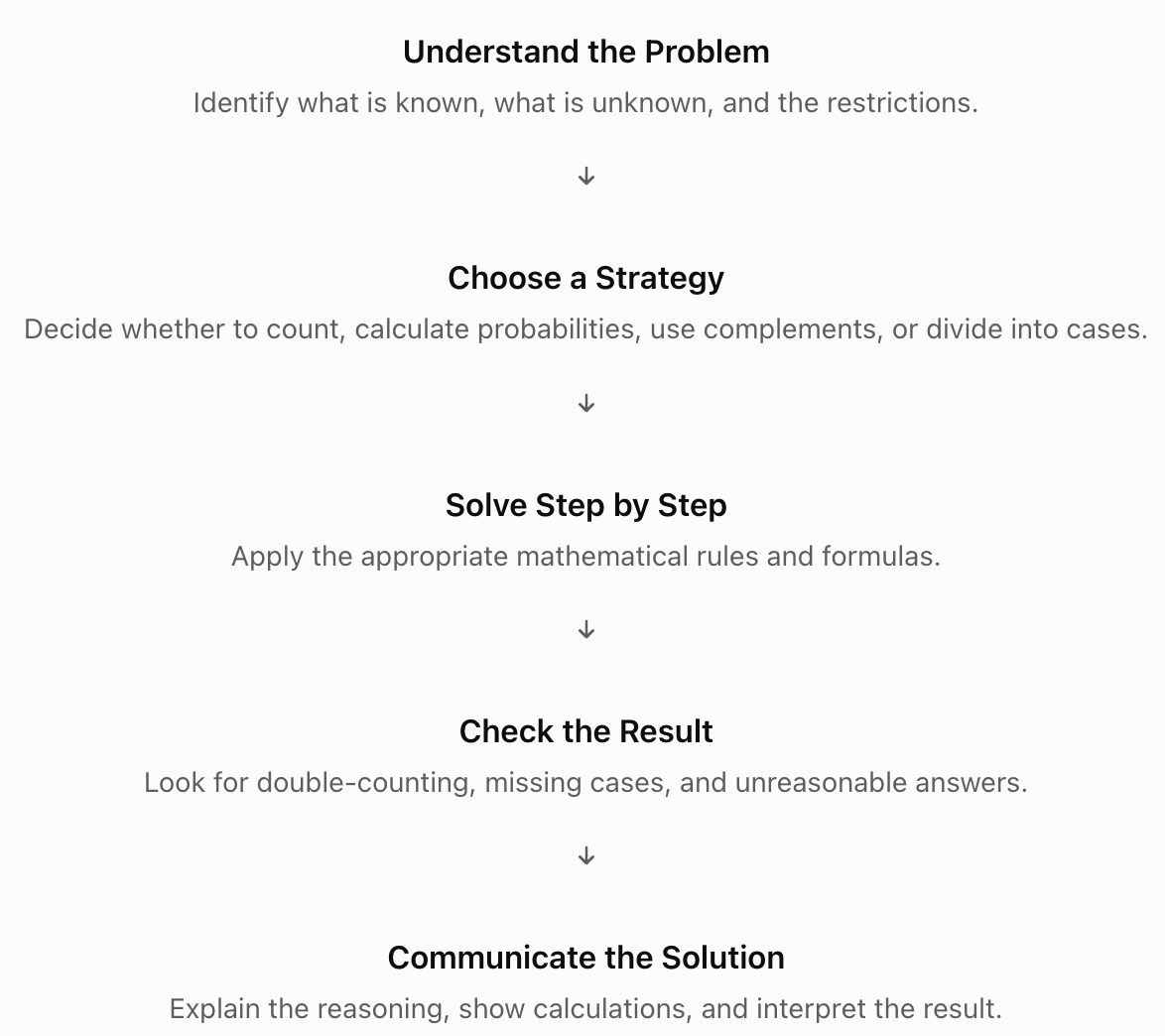
A Systematic Approach to Complex Problems
Complex problems become more manageable when they are divided into smaller steps.
A useful problem-solving process is:
Recognizing the Structure of a Counting Problem
Before choosing a formula, ask several important questions.
Does Order Matter?
If order matters, permutations or arrangements may be appropriate.
If order does not matter, combinations may be appropriate.
Is Repetition Allowed?
If objects can be selected repeatedly, the number of possibilities may be different from a problem involving selection without replacement.
Are There Restrictions?
Some arrangements may require:
-
Particular objects to appear together.
-
Certain objects to remain apart.
-
At least one object of a particular type.
-
Exactly a specified number of objects.
-
Certain positions to be fixed.
Are the Cases Mutually Exclusive?
If a problem is divided into cases, make sure that the cases do not overlap.
Can the Complement Be Counted More Easily?
Sometimes it is easier to count the outcomes that do not satisfy a condition and subtract them from the total.
Essential Counting Principles
Addition Principle
If two possibilities are mutually exclusive, the total number of choices is found by adding.
Total = a + b
Multiplication Principle
If a process involves successive choices, multiply the number of possibilities at each stage.
Total = n₁ × n₂ × ... × nₖ
Factorials
The number of ways to arrange n distinct objects is:
n! = n × (n − 1) × ... × 2 × 1
By definition:
0! = 1
Permutations
The number of ordered selections of r objects from n distinct objects without replacement is:
P(n,r) = n!/(n − r)!
Combinations
The number of unordered selections of r objects from n distinct objects without replacement is:
C(n,r) = n!/[r!(n − r)!]
Complement Rule
P(Aᶜ) = 1 − P(A)
For counting:
Favourable outcomes = Total outcomes − Unfavourable outcomes
Inclusion–Exclusion Principle
For two sets:
|A ∪ B| = |A| + |B| − |A ∩ B|
The overlap must be subtracted because it has been counted twice.
Worked Example: Passwords with Restrictions
A password contains six characters.
Each character may be an uppercase English letter or a digit.
The password must contain exactly two digits and four letters.
Repetition is allowed.
How many passwords are possible?
Step 1: Choose the Digit Positions
There are six positions.
We must choose exactly two positions for digits.
C(6,2) = 6!/(2!4!)
= 15
Step 2: Fill the Digit Positions
Each digit position has ten possibilities.
Number of digit arrangements:
10² = 100
Step 3: Fill the Letter Positions
Each letter position has 26 possibilities.
Number of letter arrangements:
26⁴ = 456,976
Step 4: Combine the Choices
Total passwords:
15 × 100 × 456,976
= 685,464,000
Interpretation
There are 685,464,000 possible passwords satisfying the restrictions.
This problem combines combinations with the multiplication principle.
The combination determines which positions contain digits, while multiplication counts the possible characters in those positions.
Worked Example: Arrangements with Objects Together
Seven different books are arranged on a shelf.
Three particular books must remain together.
How many arrangements are possible?
Step 1: Treat the Three Books as One Block
The three particular books form a single block.
Together with the remaining four books, there are five objects to arrange.
Number of arrangements:
5! = 120
Step 2: Arrange the Books Within the Block
The three books can be arranged internally in:
3! = 6
ways.
Step 3: Multiply
Total arrangements:
5! × 3!
= 120 × 6
= 720
Why This Strategy Works
The block method ensures that the three selected books remain together.
Every valid arrangement corresponds to exactly one arrangement of the five objects and one internal arrangement of the three books.

Worked Example: Objects That Must Not Be Together
Six different students stand in a line.
Two particular students must not stand next to each other.
How many arrangements are possible?
Step 1: Count All Arrangements
There are six students.
Total arrangements:
6! = 720
Step 2: Count Arrangements Where the Two Students Are Together
Treat the two students as one block.
There are five objects to arrange:
5! = 120
The two students can switch positions inside the block:
2! = 2
Arrangements together:
120 × 2 = 240
Step 3: Apply the Complement
Valid arrangements:
720 − 240
= 480
Why the Complement Is Efficient
Counting every possible arrangement where the two students are separated would require several cases.
Subtracting the arrangements where they are together is simpler.
Worked Example: Committees with Conditions
A class contains:
-
8 girls.
-
7 boys.
A committee of five students must contain at least three girls.
How many committees are possible?
Step 1: Identify the Cases
The committee may contain:
-
3 girls and 2 boys.
-
4 girls and 1 boy.
-
5 girls and 0 boys.
These cases are mutually exclusive.
Step 2: Count Each Case
Case A: 3 girls and 2 boys
C(8,3) × C(7,2)
= 56 × 21
= 1,176
Case B: 4 girls and 1 boy
C(8,4) × C(7,1)
= 70 × 7
= 490
Case C: 5 girls and 0 boys
C(8,5) × C(7,0)
= 56 × 1
= 56
Step 3: Add the Cases
Total committees:
1,176 + 490 + 56
= 1,722
Interpretation
There are 1,722 possible committees containing at least three girls.
This problem combines combinations, multiplication, and addition.
Solving Probability Problems Using Counting
When all outcomes are equally likely:
P(E) = Number of favourable outcomes / Total number of possible outcomes
Complex probability problems often require counting both the numerator and denominator.
Worked Example: Selecting Cards
A standard deck contains 52 cards.
Five cards are selected without replacement.
What is the probability that exactly three cards are hearts?
Step 1: Count All Possible Hands
Order does not matter.
Total hands:
C(52,5) = 2,598,960
Step 2: Count Favourable Hands
There are 13 hearts and 39 non-hearts.
Choose three hearts:
C(13,3) = 286
Choose two non-hearts:
C(39,2) = 741
Favourable hands:
286 × 741
= 211,926
Step 3: Calculate Probability
P(exactly 3 hearts) = 211926/2598960
≈ 0.08154
Interpretation
The probability is approximately 8.15%.
This is an example of a hypergeometric probability, because cards are selected without replacement from a finite population.

Combining Conditional Probability and Counting
Conditional probability is useful when additional information changes the sample space.
P(A | B) = P(A ∩ B)/P(B)
Worked Example: Two Cards
Two cards are drawn without replacement from a standard deck.
Given that the first card is a heart, find the probability that the second card is also a heart.
Step 1: Update the Remaining Cards
After one heart has been removed:
-
51 cards remain.
-
12 hearts remain.
Step 2: Calculate the Probability
P(second heart | first heart) = 12/51
= 4/17 ≈ 0.2353
Interpretation
The probability of the second card being a heart is approximately 23.53%.
This differs from the original probability of drawing a heart because the first card changes the remaining deck.
Combining Independent and Dependent Events
One of the most important decisions in probability problem solving is determining whether events are independent.
Independent Events
For independent events A and B:
P(A ∩ B) = P(A) × P(B)
Dependent Events
For dependent events:
P(A ∩ B) = P(A) × P(B | A)
Worked Example: Drawing Coloured Balls
A bag contains:
-
5 red balls.
-
4 blue balls.
-
3 green balls.
Two balls are selected without replacement.
Find the probability that the first is red and the second is blue.
Step 1: Calculate the First Probability
There are 12 balls.
P(first red) = 5/12
Step 2: Calculate the Conditional Probability
After a red ball is removed:
-
11 balls remain.
-
4 blue balls remain.
P(second blue | first red) = 4/11
Step 3: Multiply
P(red then blue) = 5/12 × 4/11
= 20/132
= 5/33 ≈ 0.1515
The probability is approximately 15.15%.
Solving Problems with Several Possible Orders
Suppose a bag contains:
-
5 red balls.
-
4 blue balls.
Two balls are selected without replacement.
Find the probability of selecting one red and one blue, in either order.
Step 1: Identify the Cases
Possible sequences:
-
Red then blue.
-
Blue then red.
These events are mutually exclusive.
Step 2: Calculate Each Probability
Red then blue:
P(RB) = 5/9 × 4/8
= 20/72
Blue then red:
P(BR) = 4/9 × 5/8
= 20/72
Step 3: Add
P(one of each) = 20/72 + 20/72
= 40/72
= 5/9 ≈ 0.5556
Alternative Method
Count unordered selections.
Favourable selections:
C(5,1) × C(4,1) = 20
Total selections:
C(9,2) = 36
Probability:
20/36 = 5/9
Both methods produce the same result.
This illustrates the value of selecting an efficient solution strategy.
Choosing Between Counting Methods
Different approaches may solve the same problem.
|
Problem characteristic |
Useful strategy |
|---|---|
|
Several successive choices |
Multiplication principle |
|
Mutually exclusive cases |
Addition principle |
|
Order matters |
Permutations |
|
Order does not matter |
Combinations |
|
Objects must remain together |
Block method |
|
Objects must not remain together |
Complement or gap method |
|
At least one success |
Complement rule |
|
Selection without replacement |
Conditional probability or hypergeometric model |
|
Fixed independent trials |
Binomial distribution |
|
Several overlapping conditions |
Inclusion–exclusion |
|
Complex sequential outcomes |
Tree diagram |
|
Large uncertain system |
Simulation |
The best strategy is usually the one that counts every valid outcome exactly once with the fewest unnecessary calculations.
Worked Example: Inclusion–Exclusion
A group contains 100 students.
-
60 study mathematics.
-
45 study physics.
-
25 study both mathematics and physics.
How many students study mathematics or physics?
Step 1: Add the Groups
60 + 45 = 105
Step 2: Correct the Double-Counting
The 25 students studying both subjects were counted twice.
Subtract the overlap:
105 − 25
= 80
Step 3: Interpret
80 students study mathematics or physics or both.
The number studying neither subject is:
100 − 80
= 20
General Formula
|A ∪ B| = |A| + |B| − |A ∩ B|
In probability:
P(A ∪ B) = P(A) + P(B) − P(A ∩ B)

Worked Example: Three Overlapping Sets
In a survey of 200 students:
-
110 study biology.
-
90 study chemistry.
-
80 study physics.
-
40 study biology and chemistry.
-
35 study biology and physics.
-
30 study chemistry and physics.
-
15 study all three.
Find the number studying at least one of these subjects.
Apply Inclusion–Exclusion
For three sets:
|A ∪ B ∪ C| = |A| + |B| + |C| − |A ∩ B| − |A ∩ C| − |B ∩ C| + |A ∩ B ∩ C|
Substitute:
= 110 + 90 + 80 − 40 − 35 − 30 + 15
= 280 − 105 + 15
= 190
Therefore, 190 students study at least one of the three subjects.
The number studying none is:
200 − 190
= 10
The final addition of the triple intersection corrects for subtracting that overlap too many times.
Worked Example: Binomial Probability
A basketball player has a 70% probability of making each free throw.
The player attempts eight independent shots.
Find the probability of making at least six shots.
Step 1: Identify the Model
The number of successes follows a binomial distribution:
X ~ B(8, 0.7)
Step 2: Identify the Required Outcomes
At least six successes means:
X = 6, 7, or 8
Therefore:
P(X ≥ 6) = P(X = 6) + P(X = 7) + P(X = 8)
Step 3: Apply the Formula
P(X = k) = C(n,k) × pᵏ × (1 − p)^(n−k)
For six successes:
P(X = 6) = C(8,6) × 0.7⁶ × 0.3²
≈ 0.2965
For seven successes:
P(X = 7) = C(8,7) × 0.7⁷ × 0.3
≈ 0.1977
For eight successes:
P(X = 8) = 0.7⁸
≈ 0.0576
Step 4: Add
P(X ≥ 6) ≈ 0.2965 + 0.1977 + 0.0576
≈ 0.5518
Interpretation
There is approximately a 55.18% probability that the player makes at least six of eight shots.
Worked Example: Using the Complement Efficiently
A machine has a 3% probability of producing a defective component.
Twenty components are produced independently.
Find the probability that at least one component is defective.
Direct Approach
We could calculate the probability of:
-
Exactly one defect.
-
Exactly two defects.
-
Exactly three defects.
-
Continuing up to twenty defects.
This would require many calculations.
Complement Approach
The complement of at least one defect is no defects.
P(no defects) = 0.97²⁰
Therefore:
P(at least one defect) = 1 − 0.97²⁰
≈ 1 − 0.5438
≈ 0.4562
Interpretation
There is approximately a 45.62% probability that at least one of the twenty components is defective.
The complement method is much more efficient than calculating twenty separate cases.
Worked Example: Combining Probability and Combinatorics
A class contains:
-
10 students who study physics.
-
8 students who study chemistry.
-
6 students who study biology.
Each student belongs to exactly one of these groups.
A committee of four students is selected randomly.
Find the probability that the committee contains exactly two physics students, one chemistry student, and one biology student.
Step 1: Count the Total Students
10 + 8 + 6 = 24
Step 2: Count All Committees
C(24,4)
= 10,626
Step 3: Count Favourable Committees
Choose two physics students:
C(10,2) = 45
Choose one chemistry student:
C(8,1) = 8
Choose one biology student:
C(6,1) = 6
Favourable committees:
45 × 8 × 6
= 2,160
Step 4: Calculate Probability
P = 2160/10626
≈ 0.2033
Interpretation
There is approximately a 20.33% probability that the committee has the required composition.
This problem combines combinations, multiplication, and probability.
Worked Example: Network Paths
A communication network contains four stages.
At each stage, a message can follow several possible routes:
-
Stage 1: 3 routes.
-
Stage 2: 2 routes.
-
Stage 3: 4 routes.
-
Stage 4: 2 routes.
Assume every combination of stage choices creates a distinct valid path.
Step 1: Apply the Multiplication Principle
Total routes:
3 × 2 × 4 × 2
= 48
Step 2: Introduce a Restriction
Suppose one of the three first-stage routes is unavailable.
The remaining choices are:
2 × 2 × 4 × 2
= 32
Step 3: Compare
Original routes = 48
Available routes = 32
Unavailable routes:
48 − 32
= 16
The network loses 16 possible routes.
Interpretation
This example shows how counting methods can be applied to engineering and computer networks.

Worked Example: Probability of a Reliable System
An engineering system contains three independent components.
Their probabilities of working are:
-
Component A: 0.95.
-
Component B: 0.90.
-
Component C: 0.98.
The system operates only if all three components work.
Step 1: Identify the Structure
The components form a series system.
Step 2: Multiply the Reliabilities
P(system works) = 0.95 × 0.90 × 0.98
= 0.8379
Step 3: Calculate Failure Probability
P(system fails) = 1 − 0.8379
= 0.1621
Interpretation
The system has an 83.79% probability of working and a 16.21% probability of failing during the specified period.
This problem combines independent events with the complement rule.
Worked Example: Multi-Stage Probability Tree
A company receives components from two suppliers.
Supplier A provides 70% of components.
Supplier B provides 30%.
The defect rates are:
-
Supplier A: 2%.
-
Supplier B: 5%.
A component is selected randomly.
Find the probability that it is defective.
Step 1: Identify the Possible Paths
A defective component can come from:
-
Supplier A and be defective.
-
Supplier B and be defective.
These paths are mutually exclusive.
Step 2: Calculate Each Path Probability
Supplier A and defective:
0.70 × 0.02 = 0.014
Supplier B and defective:
0.30 × 0.05 = 0.015
Step 3: Add the Paths
P(defective) = 0.014 + 0.015
= 0.029
Interpretation
There is a 2.9% probability that a randomly selected component is defective.
Extension: Bayes' Theorem
Given that a component is defective, what is the probability that it came from Supplier B?
P(B | D) = P(B ∩ D)/P(D)
= 0.015/0.029
≈ 0.5172
There is approximately a 51.72% probability that a defective component came from Supplier B.
Although Supplier B provides only 30% of components, its higher defect rate makes it responsible for a larger share of defects.
Efficient Problem-Solving Strategies
Complex problems often have several possible solution methods.
Choosing an efficient method can reduce calculation time and prevent errors.
Work Backward
If the final outcome is known, determine which earlier choices could produce it.
Use the Complement
Count the unwanted outcomes when they are easier to calculate.
Divide into Cases
Separate the problem into mutually exclusive categories.
Use Symmetry
Identify outcomes that have equal probabilities or equivalent arrangements.
Introduce Variables
Represent unknown quantities using algebra.
Use Tables
Organize complicated information systematically.
Draw Diagrams
Tree diagrams, Venn diagrams, and network diagrams can clarify relationships.
Check Small Cases
Test a counting formula using a smaller example where all possibilities can be listed.
Use Technology
Spreadsheets, calculators, and simulations can verify complicated results.
Recognizing Double-Counting
One of the most common errors in combinatorics is counting the same outcome more than once.
Example
Suppose a committee contains three students selected from ten.
If we calculate:
10 × 9 × 8 = 720
we have counted ordered selections.
However, committees do not have an order.
Each committee has been counted:
3! = 6
times.
Therefore:
720/6
= 120
This agrees with:
C(10,3) = 120
Important Principle
Before using permutations or combinations, determine whether different orders represent different outcomes.
Checking Whether an Answer Is Reasonable
A complete solution should include a reasonableness check.
Probability Checks
Every probability must satisfy:
0 ≤ P(E) ≤ 1
If a calculated probability is greater than 1 or negative, an error has occurred.
Counting Checks
The number of favourable outcomes cannot exceed the total number of outcomes.
Complement Checks
An event and its complement must have probabilities adding to 1.
Expected Value Checks
Expected value must lie between the minimum and maximum possible outcomes.
Approximation Checks
Compare results with estimates or simulations where appropriate.
Unit Checks
Ensure that numerical answers have the correct units.
For example:
-
Probability has no units.
-
Expected profit is measured in money.
-
Expected time is measured in units of time.
Communicating Complete Mathematical Solutions
A correct numerical answer is important, but a complete mathematical solution must also explain the reasoning.
A useful structure is:
Given: Identify the relevant information.
Required: State what must be found.
Method: Explain the mathematical strategy.
Calculation: Show the formula and substitution.
Result: Present the numerical answer.
Interpretation: Explain what the result means in context.
Example of a Complete Solution
Problem: A bag contains five red balls and three blue balls. Two balls are selected without replacement. Find the probability that both are red.
Given: Five red balls, three blue balls, eight balls total.
Required: Probability of selecting two red balls.
Method: Use conditional probability because the selections are without replacement.
Calculation:
P(both red) = 5/8 × 4/7
= 20/56
= 5/14
Result:
P(both red) ≈ 0.3571
Interpretation: There is approximately a 35.71% probability that both selected balls are red.
This explanation communicates the method and its justification, not just the answer.
Using Technology to Verify Solutions
Technology can be valuable for checking complex probability calculations.
Spreadsheets
Spreadsheets can calculate:
-
Factorials.
-
Permutations.
-
Combinations.
-
Binomial probabilities.
-
Expected values.
-
Simulated probabilities.
Calculators
Scientific calculators often contain functions such as:
-
nPr.
-
nCr.
-
Factorial.
-
Binomial probability.
-
Statistical distributions.
Computer Simulations
Simulations can estimate probabilities by repeating random experiments.
For example, a simulation of selecting five cards from a deck can estimate the probability of obtaining exactly three hearts.
Important Limitation
Simulation provides approximate results.
A simulated estimate may differ slightly from the theoretical probability because of random variation.
Technology should support mathematical reasoning rather than replace it.

Common Mistakes
Choosing permutations when combinations are required
Always determine whether order matters.
Ignoring restrictions
Conditions such as exactly, at least, at most, together, or apart must be incorporated into the calculation.
Double-counting outcomes
Ensure that every valid outcome is counted exactly once.
Forgetting dependent probabilities
When objects are selected without replacement, probabilities change after each selection.
Using the multiplication principle incorrectly
The number of choices at each stage may depend on previous choices.
Adding overlapping cases without correcting for overlap
Use inclusion–exclusion when cases are not mutually exclusive.
Ignoring the complement rule
Some problems are much easier when solved by counting the opposite event.
Using an inappropriate probability distribution
Check whether the assumptions of the distribution are satisfied.
Confusing at least with exactly
At least three includes three, four, five, and so on.
Failing to simplify a complex problem
Break multi-step problems into smaller calculations.
Reporting only a numerical answer
A complete mathematical solution should explain the strategy, calculations, and interpretation.
Failing to check the final result
Probability answers must lie between 0 and 1, and counting results must be consistent with the total number of outcomes.
Key Terms
-
Comprehensive Problem Solving: Solving complex problems by combining mathematical methods and logical reasoning.
-
Combinatorics: The mathematical study of counting, arranging, and selecting objects.
-
Addition Principle: A counting rule for mutually exclusive alternatives.
-
Multiplication Principle: A counting rule for successive choices.
-
Factorial: The product of all positive integers up to a specified positive integer.
-
Permutation: An arrangement in which order matters.
-
Combination: A selection in which order does not matter.
-
Restriction: A condition limiting which outcomes are permitted.
-
Block Method: A counting technique that treats objects required to remain together as one unit.
-
Complement Rule: A method for calculating an event using the probability of its opposite.
-
Inclusion–Exclusion Principle: A method for counting overlapping sets without double-counting.
-
Sample Space: The set of all possible outcomes of a random experiment.
-
Favourable Outcome: An outcome satisfying the conditions of an event.
-
Mutually Exclusive Events: Events that cannot occur simultaneously.
-
Independent Events: Events where one outcome does not affect the probability of another.
-
Dependent Events: Events where one outcome changes the probability of another.
-
Conditional Probability: The probability of an event given that another event has occurred.
-
Binomial Distribution: A probability model for the number of successes in a fixed number of independent trials.
-
Hypergeometric Distribution: A probability model for successes in selections without replacement from a finite population.
-
Tree Diagram: A diagram representing sequential outcomes and their probabilities.
-
Venn Diagram: A diagram showing relationships between sets.
-
Probability Model: A mathematical representation of uncertain outcomes and their probabilities.
-
Expected Value: The probability-weighted average of possible numerical outcomes.
-
Double-Counting: Counting the same outcome more than once.
-
Case Analysis: Dividing a problem into separate categories that can be solved individually.
-
Symmetry: A mathematical property in which different arrangements or outcomes have equivalent structures.
-
Simulation: A method of imitating random experiments to estimate probabilities.
-
Reasonableness Check: Evaluating whether a calculated answer is consistent with the problem.
-
Mathematical Justification: An explanation showing why a mathematical method or conclusion is valid.
-
Mathematical Communication: Presenting mathematical ideas, calculations, and conclusions clearly.
Key Takeaways
-
Complex probability and counting problems often require several mathematical techniques to be combined.
-
Understanding the problem is the first step toward choosing an efficient strategy.
-
The addition principle is useful for mutually exclusive cases.
-
The multiplication principle is useful for successive choices.
-
Permutations are used when order matters.
-
Combinations are used when order does not matter.
-
Restrictions must be incorporated carefully into counting calculations.
-
The block method is useful when particular objects must remain together.
-
Complementary counting is often efficient for problems involving restrictions or at least one occurrence.
-
Inclusion–exclusion prevents double-counting when sets overlap.
-
Conditional probability is important when events are dependent.
-
Binomial distributions model fixed numbers of independent trials.
-
Hypergeometric models are useful for selections without replacement.
-
Tree diagrams help organize sequential probability problems.
-
Case analysis allows complicated problems to be divided into manageable parts.
-
Symmetry can simplify counting and probability calculations.
-
Technology can verify results through calculation and simulation.
-
Every probability should lie between 0 and 1.
-
A complete mathematical solution should include the method, calculations, result, and interpretation.
-
Efficient problem solving requires both mathematical knowledge and strategic reasoning.
Check Your Understanding
Recall and Understanding
-
Explain the difference between permutations and combinations.
-
Describe when the multiplication principle should be used.
-
Explain why the complement rule is useful in complex probability problems.
-
Define double-counting and explain how it can affect a solution.
-
Describe the steps required to communicate a complete mathematical solution.
Application
-
A password contains eight characters, consisting of exactly three digits and five uppercase letters. Repetition is allowed. How many passwords are possible?
-
Eight different books are arranged on a shelf. Three particular books must remain together. Calculate the number of possible arrangements.
-
A committee of five students is selected from nine girls and seven boys. How many committees contain exactly three girls and two boys?
-
Five cards are drawn from a standard deck. Calculate the probability that exactly two cards are aces.
-
A bag contains six red balls and four blue balls. Three balls are selected without replacement. Calculate the probability that exactly two are red.
Analysis and Challenge
-
A class contains 12 students studying mathematics, 10 studying physics, and 8 studying chemistry. Each student belongs to exactly one group. A committee of five students is selected randomly. Calculate the probability that the committee contains two mathematics students, two physics students, and one chemistry student.
-
Ten different people stand in a line. Two particular people must not stand next to each other. Calculate the number of possible arrangements and explain why the complement method is efficient.
-
A factory receives 60% of components from Supplier A and 40% from Supplier B. Supplier A has a 3% defect rate, while Supplier B has a 7% defect rate. Calculate the probability that a randomly selected component is defective. Then calculate the probability that a defective component came from Supplier B.
-
A basketball player makes each free throw independently with probability 0.8. The player attempts ten shots. Calculate the probability of making at least eight shots. Explain why a binomial model is appropriate.
-
Design and solve a complex probability problem that combines at least three mathematical techniques, such as combinations, conditional probability, complements, or inclusion–exclusion. Present a complete solution with a clear justification and interpretation.
Final Summary
Comprehensive problem solving brings together the major ideas of probability and combinatorics.
Complex problems often involve multiple stages, restrictions, dependent events, or overlapping cases.
Successful solutions require identifying the structure of the problem, selecting suitable mathematical techniques, and applying them in a logical order.
Counting principles, permutations, combinations, conditional probability, probability distributions, and complementary methods provide a powerful collection of problem-solving tools.
Efficient strategies reduce unnecessary calculations and help prevent errors such as double-counting.
Mathematical communication is equally important. A complete solution should show not only the numerical result but also the reasoning that explains why the method is valid.
The central principle is that strong mathematical problem solving combines accurate calculations, efficient strategies, logical justification, and clear communication.