Foundations of Probability
3. Probability Rules
Learning outcomes
- I can apply the addition rule for probability.
- I can apply the multiplication rule for probability.
- I can calculate probabilities involving complements.
- I can distinguish mutually exclusive events.
- I can solve multi-step probability problems.
Probability Rules
Probability rules allow us to calculate the likelihood of more complicated events without always listing every possible outcome. They are especially useful when a problem contains words such as or, and, not, at least, or both.
The most important rules in this topic are:
- the addition rule for events involving OR
- the multiplication rule for events involving AND
- the complement rule for events involving NOT
- rules for recognizing mutually exclusive and independent events
Choosing the correct rule depends on understanding what the problem is asking.


Probability Is Between 0 and 1
Every probability must satisfy:
0 ≤ P(A) ≤ 1
A probability of:
0 means the event is impossible.
1 means the event is certain.
Values between 0 and 1 represent different degrees of likelihood.
For example:
P(A) = 0.75
means that event A has a 75% probability of occurring.
The Addition Rule: OR
The addition rule is used when we want the probability that:
A OR B occurs
In probability notation, "A or B" is written:
A ∪ B
The symbol ∪ means union.
For two events that may overlap:
P(A ∪ B) = P(A) + P(B) − P(A ∩ B)
The intersection:
A ∩ B
represents outcomes that belong to both A and B.
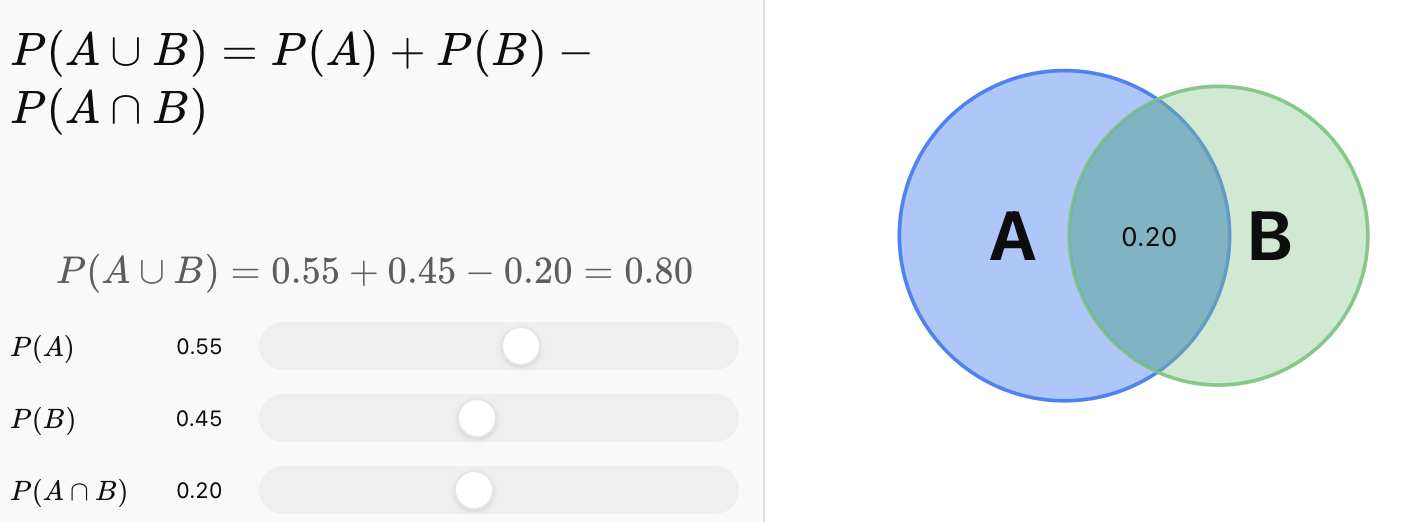
Why Do We Subtract the Intersection?
Suppose:
P(A) = 0.55
P(B) = 0.45
P(A ∩ B) = 0.20
If we simply add:
0.55 + 0.45 = 1.00
we have counted the intersection twice.
Therefore:
P(A ∪ B)
= 0.55 + 0.45 − 0.20
= 0.80
So there is an 80% probability that A or B or both occur.
Understanding OR
In probability, OR usually includes both.
If we ask for:
A or B
we usually mean:
- A occurs
- B occurs
- both A and B occur
This is called an inclusive OR.
For example, if A means "plays football" and B means "plays basketball," then A ∪ B includes students who play both sports.
Worked Example: Addition Rule
In a class:
P(student studies Biology) = 0.60
P(student studies Chemistry) = 0.45
P(student studies both) = 0.25
Find the probability that a randomly selected student studies Biology or Chemistry.
Use:
P(B ∪ C)
= P(B) + P(C) − P(B ∩ C)
= 0.60 + 0.45 − 0.25
= 0.80
Therefore, the probability is:
80%
Mutually Exclusive Events
Two events are mutually exclusive if they cannot occur at the same time.
For example, when rolling one die:
A = roll a 2
B = roll a 5
A single roll cannot be both 2 and 5.
Therefore:
P(A ∩ B) = 0
For mutually exclusive events, the addition rule simplifies to:
P(A ∪ B) = P(A) + P(B)


Example: Mutually Exclusive Events
Roll a fair six-sided die.
Find the probability of rolling:
2 or 5
P(2) = 1/6
P(5) = 1/6
Since the events cannot occur together:
P(2 or 5)
= 1/6 + 1/6
= 2/6
= 1/3
Events That Are Not Mutually Exclusive
Suppose:
A = roll an even number
B = roll a number greater than 3
For a standard die:
A = {2, 4, 6}
B = {4, 5, 6}
The events overlap:
A ∩ B = {4, 6}
Therefore, they are not mutually exclusive.
We cannot simply add their probabilities because outcomes 4 and 6 would be counted twice.
Worked Example: Overlapping Events
Using the previous example:
P(A) = 3/6
P(B) = 3/6
P(A ∩ B) = 2/6
Therefore:
P(A ∪ B)
= 3/6 + 3/6 − 2/6
= 4/6
= 2/3
We can check this directly:
A ∪ B = {2, 4, 5, 6}
Four of the six outcomes satisfy the condition.
The Multiplication Rule: AND
The multiplication rule is used when we want the probability that:
A AND B occur
This is written:
P(A ∩ B)
For independent events:
P(A ∩ B) = P(A) × P(B)
The word AND is often a clue that multiplication may be required.
However, we must first determine whether the events are independent.
Independent Events
Two events are independent when the occurrence of one event does not change the probability of the other.
For example:
- toss a coin
- roll a die
The result of the coin does not affect the die.
Suppose we want:
heads AND a 6
P(H) = 1/2
P(6) = 1/6
Therefore:
P(H and 6)
= 1/2 × 1/6
= 1/12


Example: Two Coin Tosses
A fair coin is tossed twice.
Find the probability of:
heads AND heads
Each toss is independent.
P(H on first toss) = 1/2
P(H on second toss) = 1/2
Therefore:
P(HH)
= 1/2 × 1/2
= 1/4
The complete sample space confirms this:
S = {HH, HT, TH, TT}
Only one of four outcomes is HH.
Example: Three Coin Tosses
Find the probability of obtaining three heads in a row.
P(HHH)
= 1/2 × 1/2 × 1/2
= 1/8
The multiplication rule can therefore be extended across several independent stages.
Dependent Events
Events are dependent when one event changes the probability of another.
A common example is drawing objects without replacement.
Suppose a bag contains:
3 red marbles
2 blue marbles
There are 5 marbles altogether.
A marble is selected and not replaced.
The probability of selecting red first is:
3/5
If a red marble is selected, only:
2 red marbles
remain among:
4 total marbles.
Therefore:
P(second red | first red) = 2/4
The second probability has changed.
The events are dependent.
Conditional Probability
The notation:
P(B | A)
means:
the probability of B given that A has already occurred
For dependent events, the multiplication rule becomes:
P(A ∩ B) = P(A) × P(B | A)
This is the general multiplication rule.
The vertical bar | can be read as:
"given"
Worked Example: Without Replacement
A bag contains:
5 red marbles
3 blue marbles
Two marbles are selected without replacement.
Find the probability that both are red.
First red:
P(R₁) = 5/8
After one red marble has been removed:
4 red marbles remain
7 total marbles remain
Therefore:
P(R₂ | R₁) = 4/7
Multiply:
P(RR)
= 5/8 × 4/7
= 20/56
= 5/14
With Replacement
Now suppose the first marble is returned to the bag before the second marble is selected.
The probabilities do not change.
P(first red) = 5/8
P(second red) = 5/8
Therefore:
P(RR)
= 5/8 × 5/8
= 25/64
With replacement often makes repeated selections independent.
Without replacement usually makes them dependent.


Independent Does Not Mean Mutually Exclusive
These two ideas are often confused.
Mutually Exclusive
The events cannot happen together.
Independent
One event does not affect the probability of the other.
These are very different ideas.
For example, on a single die roll:
A = roll an even number
B = roll an odd number
These events are mutually exclusive.
If A happens, B definitely cannot happen.
Therefore, knowing A occurred dramatically changes the probability of B.
So the events are not independent.
Testing for Independence
Two events A and B are independent if:
P(A ∩ B) = P(A) × P(B)
For example:
P(A) = 0.5
P(B) = 0.4
If:
P(A ∩ B) = 0.2
then:
P(A) × P(B)
= 0.5 × 0.4
= 0.2
Therefore, A and B are independent.
The Complement Rule
The complement of event A means that A does not occur.
It can be written:
Aᶜ
Since either A occurs or it does not:
P(A) + P(Aᶜ) = 1
Therefore:
P(Aᶜ) = 1 − P(A)
For example:
P(rain) = 0.30
Then:
P(no rain)
= 1 − 0.30
= 0.70


Why Complements Are So Useful
Complements are particularly useful when a question asks for:
at least one
Sometimes calculating every successful possibility is difficult.
Instead:
P(at least one) = 1 − P(none)
This can turn a complicated calculation into a simple one.
Worked Example: At Least One Head
A fair coin is tossed three times.
Find the probability of obtaining at least one head.
We could count:
- exactly one head
- exactly two heads
- exactly three heads
But it is easier to find the complement.
The complement of:
"at least one head"
is:
"no heads"
which means:
TTT
Probability:
P(TTT)
= 1/2 × 1/2 × 1/2
= 1/8
Therefore:
P(at least one H)
= 1 − 1/8
= 7/8
Another At-Least-One Example
Suppose the probability that a machine produces a defective item is:
0.04
Assume successive items are independent.
What is the probability that at least one of three items is defective?
It is easier to calculate:
P(no defective items)
Probability one item is not defective:
1 − 0.04 = 0.96
For three items:
P(none defective)
= 0.96³
= 0.884736
Therefore:
P(at least one defective)
= 1 − 0.884736
= 0.115264
≈ 0.115
or approximately:
11.5%
Probability Trees
Tree diagrams are extremely useful for multi-step probability problems.
Each branch represents a possible outcome.
To use a probability tree:
Multiply along branches.
Add between appropriate final branches.
This connects the multiplication and addition rules.


Worked Tree Example
Suppose:
P(rain) = 0.30
P(no rain) = 0.70
If it rains:
P(bus late | rain) = 0.40
If it does not rain:
P(bus late | no rain) = 0.10
We want the probability that the bus is late.
There are two ways this can happen:
rain AND late
or:
no rain AND late
First path:
P(rain and late)
= 0.30 × 0.40
= 0.12
Second path:
P(no rain and late)
= 0.70 × 0.10
= 0.07
Now add:
P(late)
= 0.12 + 0.07
= 0.19
So the probability that the bus is late is:
19%
Multiply Along, Add Across
A useful probability-tree rule is:
AND → multiply
OR → add
For a path:
A AND B
multiply the branch probabilities.
For several separate paths that satisfy the event:
Path 1 OR Path 2
add their probabilities.
This is not a substitute for understanding the rules, but it is a useful problem-solving reminder.
Example: Two Dice
Two fair six-sided dice are rolled.
Find the probability of rolling:
a 6 on the first die AND an even number on the second die
P(first die = 6) = 1/6
P(second die even) = 3/6 = 1/2
The rolls are independent.
Therefore:
P(6 and even)
= 1/6 × 1/2
= 1/12
Addition and Multiplication Together
Many probability problems require more than one rule.
Suppose two fair coins are tossed.
Find the probability of getting:
exactly one head
This can occur in two ways:
HT
or:
TH
Calculate each path:
P(HT)
= 1/2 × 1/2
= 1/4
P(TH)
= 1/2 × 1/2
= 1/4
Now add:
P(exactly one H)
= 1/4 + 1/4
= 1/2
We multiplied within each path and added the successful paths.
A More Complex Example
A bag contains:
4 red marbles
3 blue marbles
Two marbles are drawn without replacement.
Find the probability that the marbles are different colours.
There are two possible paths:
red then blue
or:
blue then red
Red then Blue
P(RB)
= 4/7 × 3/6
= 12/42
= 2/7
Blue then Red
P(BR)
= 3/7 × 4/6
= 12/42
= 2/7
Now add:
P(different colours)
= 2/7 + 2/7
= 4/7
Another Method Using the Complement
For the same bag, we could calculate:
P(different colours)
= 1 − P(same colour)
Same colour means:
RR or BB
P(RR)
= 4/7 × 3/6
= 2/7
P(BB)
= 3/7 × 2/6
= 1/7
Therefore:
P(same)
= 2/7 + 1/7
= 3/7
So:
P(different)
= 1 − 3/7
= 4/7
Different approaches can lead to the same result.
Cards and Probability
A standard deck contains:
52 cards
with:
- 4 suits
- 13 cards per suit
- 26 red cards
- 26 black cards
- 4 aces
Suppose one card is selected.
Probability of an ace:
4/52 = 1/13
Probability of a red card:
26/52 = 1/2
Some card events overlap.
For example, there are two red aces.
So:
P(ace or red)
= P(ace) + P(red) − P(red ace)
= 4/52 + 26/52 − 2/52
= 28/52
= 7/13
Cards Without Replacement
Suppose two cards are drawn without replacement.
Find the probability that both are aces.
First ace:
P(A₁) = 4/52
Second ace given first ace:
P(A₂ | A₁) = 3/51
Therefore:
P(two aces)
= 4/52 × 3/51
= 12/2652
= 1/221
The probability changes after the first card because it is not replaced.
At Least One Using Complements
Suppose two cards are drawn with replacement.
Find the probability of drawing at least one ace.
Probability of not drawing an ace:
P(not ace)
= 48/52
= 12/13
Probability of no aces in two independent draws:
P(no aces)
= 12/13 × 12/13
= 144/169
Therefore:
P(at least one ace)
= 1 − 144/169
= 25/169
The complement method avoids separately calculating:
- exactly one ace
- exactly two aces
Conditional Probability
Conditional probability asks how probability changes when we already know something.
Suppose:
P(A ∩ B) = 0.18
and:
P(A) = 0.30
Then:
P(B | A) = P(A ∩ B)/P(A)
Therefore:
P(B | A)
= 0.18/0.30
= 0.60
Knowing that A occurred changes the sample space we are considering.
Example: Students
Suppose a school survey finds:
60 students study Chemistry.
24 of those Chemistry students also study Physics.
If we know that a randomly selected student studies Chemistry, what is the probability that the student also studies Physics?
P(Physics | Chemistry)
= 24/60
= 0.40
or:
40%
The condition "studies Chemistry" restricts the group we are considering.
Reading Probability Language
Probability problems often contain clues.
| Language | Likely Operation |
|---|---|
| A or B | Addition / union |
| A and B | Multiplication / intersection |
| both | Intersection |
| neither | Complement / intersection reasoning |
| not A | Complement |
| at least one | Often complement |
| given that | Conditional probability |
| without replacement | Usually dependent |
| with replacement | Often independent |
| mutually exclusive | No intersection |
These clues are useful, but always think about the situation before selecting a rule.
Multi-Step Probability Strategy
For a complicated problem, use the following approach.
Identify the Events
Clearly define A, B, and any other events.
Translate the Language
Ask whether the question involves:
- AND
- OR
- NOT
- GIVEN
- AT LEAST
Check Relationships
Determine whether events are:
- mutually exclusive
- overlapping
- independent
- dependent
Choose a Representation
Consider using:
- a sample space
- a Venn diagram
- a probability tree
- a table
Apply the Rules
Use addition, multiplication, conditional probability, or complements as needed.
Check the Answer
The final probability must satisfy:
0 ≤ P ≤ 1
Real-World Probability Rules
Probability rules are used far beyond dice and cards.
They are important in:
Medicine
Estimating the probability of diseases, test outcomes, or treatment responses.
Engineering
Calculating the probability that components or systems fail.
Weather
Combining probabilities of different weather conditions.
Insurance
Estimating the probability of claims and financial risk.
Manufacturing
Predicting defective products and quality-control outcomes.
Genetics
Calculating probabilities of inherited traits.
Computing
Analysing algorithms, networks, reliability, and artificial intelligence.
Finance
Evaluating uncertainty and investment risk.
Example: System Reliability
Suppose two independent components must both work for a machine to operate.
Component A works with probability:
0.98
Component B works with probability:
0.95
For the system to work:
A AND B must work.
Therefore:
P(system works)
= 0.98 × 0.95
= 0.931
So the system has a:
93.1%
probability of operating successfully.
Its failure probability is:
1 − 0.931
= 0.069
or:
6.9%
Example: Redundant Systems
Suppose two independent backup systems each have a failure probability of:
0.05
The overall system fails only if:
both systems fail
Therefore:
P(both fail)
= 0.05 × 0.05
= 0.0025
So:
P(at least one works)
= 1 − 0.0025
= 0.9975
or:
99.75%
This shows why backup systems can greatly improve reliability.


Common Mistakes
Adding probabilities when the problem says AND
AND often requires multiplication.
Multiplying probabilities when the problem says OR
OR often requires addition.
Forgetting the intersection in the addition rule
For overlapping events, simply adding P(A) and P(B) double-counts the overlap.
Assuming events are mutually exclusive
Check whether they can happen together.
Confusing mutually exclusive and independent
Mutually exclusive means:
cannot occur together
Independent means:
one does not affect the other
Using the simple multiplication rule for dependent events
When events are dependent, probabilities change after earlier outcomes.
Forgetting whether an object is replaced
"With replacement" and "without replacement" can produce different probabilities.
Forgetting the complement
"At least one" problems are often much easier using:
1 − P(none)
Adding probabilities along a tree branch
Probabilities along a path are multiplied.
Multiplying different successful paths
Alternative successful paths are generally added.
Forgetting to adjust totals without replacement
If an object is removed, the number of remaining objects decreases.
Giving a probability greater than 1
This always indicates an error.
Rounding too early
Keep accurate values until the final step.
Key Terms
Addition rule — A rule for finding the probability that one event or another occurs.
Multiplication rule — A rule for finding the probability that events occur together.
Union — The event A or B or both, written A ∪ B.
Intersection — The event A and B, written A ∩ B.
Complement — The event that A does not occur, written Aᶜ.
Complement rule — The relationship P(Aᶜ) = 1 − P(A).
Mutually exclusive events — Events that cannot occur simultaneously.
Overlapping events — Events that share one or more possible outcomes.
Independent events — Events for which the occurrence of one does not change the probability of the other.
Dependent events — Events for which one event changes the probability of another.
Conditional probability — The probability of an event given that another event has occurred.
P(B | A) — The probability of B given A.
With replacement — Returning a selected object before making another selection.
Without replacement — Not returning a selected object before another selection.
Probability tree — A branching diagram showing possible sequences and their probabilities.
Branch probability — The probability associated with one branch of a probability tree.
Sample space — The complete set of possible outcomes.
Event — A set of outcomes satisfying a specified condition.
Intersection probability — The probability that two events both occur.
At least one — One or more occurrences of an event.
At most — No more than a stated number.
Certain event — An event with probability 1.
Impossible event — An event with probability 0.
Reliability — The probability that a system or component performs successfully.
Inclusive OR — An OR statement that includes the possibility that both events occur.
Key Takeaways
- Probability rules allow complicated events to be analysed efficiently.
- Every probability must lie between 0 and 1.
- OR usually indicates the addition rule.
- AND usually indicates the multiplication rule.
- For overlapping events, the addition rule subtracts the intersection so it is not counted twice.
- Mutually exclusive events cannot occur together.
- For mutually exclusive events, the intersection probability is zero.
- Independent events do not affect one another's probabilities.
- Dependent events do affect one another's probabilities.
- Independent and mutually exclusive do not mean the same thing.
- For independent events, probabilities can be multiplied directly.
- For dependent events, use conditional probabilities.
- P(B | A) means the probability of B given that A has occurred.
- Drawing without replacement usually creates dependent events.
- Drawing with replacement often produces independent events.
- The complement rule is:
P(Aᶜ) = 1 − P(A)
- "At least one" problems are often easiest using:
P(at least one) = 1 − P(none)
- Probability trees are useful for multi-stage problems.
- On a probability tree:
multiply along a path
and:
add appropriate alternative paths
- Multi-step problems may require several probability rules.
- A sample space, tree diagram, table, or Venn diagram can help organize complicated problems.
- Probability rules are widely used in medicine, engineering, insurance, genetics, manufacturing, finance, computing, and risk analysis.
A useful decision process is:
OR → Think Addition
AND → Think Multiplication
NOT → Think Complement
GIVEN → Think Conditional Probability
AT LEAST ONE → Consider the Complement