Applications of Advanced Trigonometry
3. Vector Applications
Learning outcomes
- I can resolve vectors using trigonometry.
- I can analyse vector quantities geometrically.
- I can solve navigation problems.
- I can apply trigonometry to force systems.
- I can connect vectors with trigonometric methods.
Vector Applications
Introduction to Vector Applications
Vectors are mathematical quantities that have both magnitude and direction. They are essential in physics, engineering, navigation, robotics, and many other areas of mathematics and science.
Trigonometry provides powerful methods for working with vectors because it allows us to calculate their horizontal and vertical components, combine vectors, and determine unknown magnitudes and directions.
For example, trigonometry can help answer questions such as:
-
How can a force acting at an angle be separated into horizontal and vertical components?
-
How far north and east has an aircraft travelled?
-
What is the resultant force when several forces act on an object?
-
How can the direction of a displacement be calculated?
-
How does wind affect the motion of an aircraft?
-
How can vectors be used to analyse structures and mechanical systems?
Vector methods allow us to replace complicated directional problems with manageable mathematical calculations.


Scalars and Vectors
Physical quantities can be classified as scalars or vectors.
Scalar Quantities
A scalar has magnitude only.
Examples include:
-
Mass.
-
Time.
-
Temperature.
-
Distance.
-
Speed.
-
Energy.
A scalar can be described completely using a numerical value and an appropriate unit.
Vector Quantities
A vector has both magnitude and direction.
Examples include:
-
Displacement.
-
Velocity.
-
Acceleration.
-
Force.
-
Momentum.
-
Weight.
For example:
A speed of 20 m/s is a scalar.
A velocity of 20 m/s east is a vector.
Comparison
|
Scalar |
Vector |
|---|---|
|
Magnitude only |
Magnitude and direction |
|
Added using ordinary arithmetic |
Added using vector methods |
|
Example: 5 km |
Example: 5 km north |
|
Example: 10 m/s speed |
Example: 10 m/s east velocity |
|
Example: 50 N is a force magnitude |
Example: 50 N upward is a force vector |
Representing Vectors
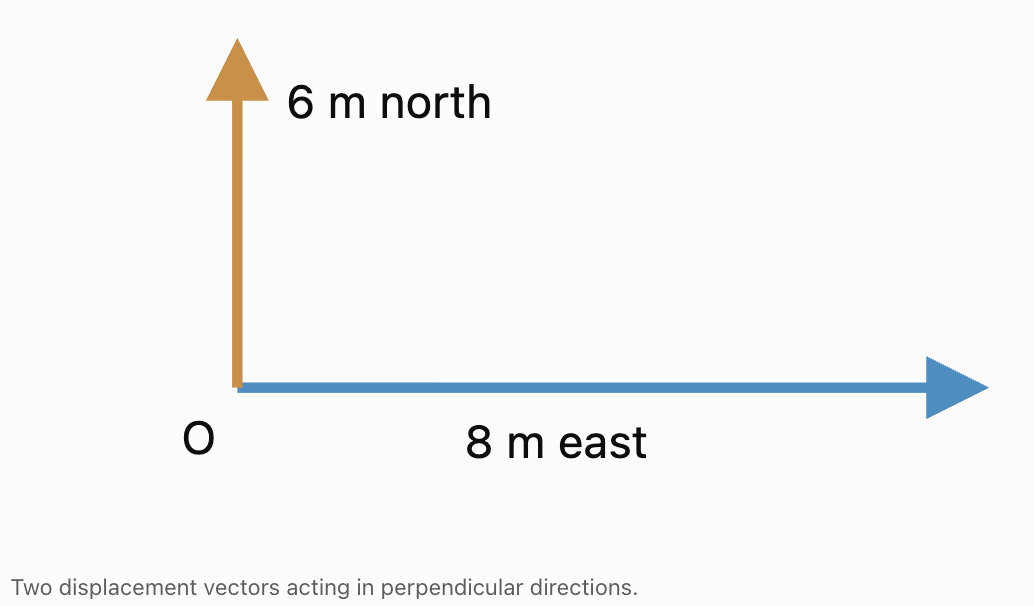
Vectors are commonly represented using arrows.
The length of the arrow represents magnitude.
The direction of the arrow represents the direction of the vector.
A vector may be represented using a capital letter, such as A, B, or R.
Its magnitude is written:
|A|
Here, A represents the vector, while |A| represents its magnitude.
This notation avoids the unusual combining characters that sometimes display incorrectly when copied into Moodle.
Example
A displacement of 8 m east can be represented by an arrow pointing to the right.
A displacement of 6 m north can be represented by an arrow pointing upward.
When vectors are drawn to scale, their lengths are proportional to their magnitudes.
Cartesian Components of Vectors
A vector in two dimensions can be separated into two perpendicular components.
These are usually:
-
Horizontal component, Aₓ.
-
Vertical component, Aᵧ.
The components describe how much of the vector acts in each direction.
Resolving a Vector
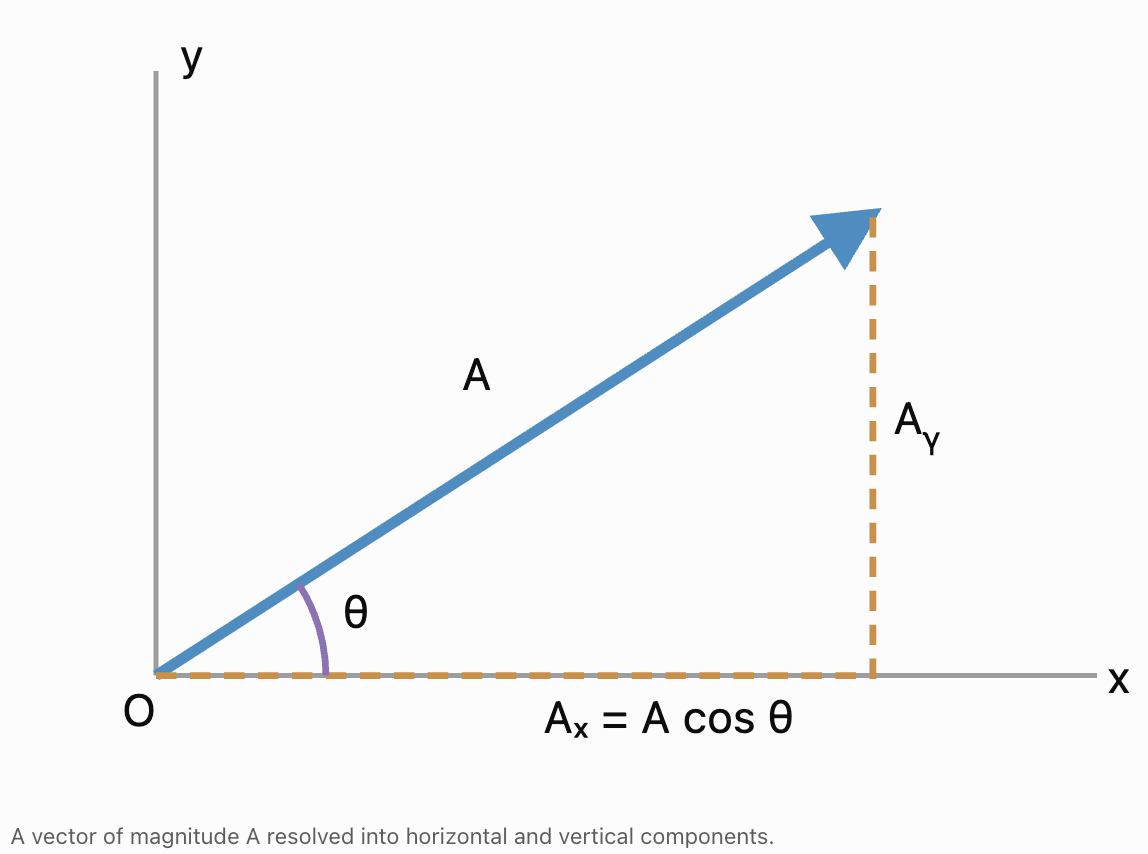
Suppose a vector has magnitude A and makes an angle θ with the positive x-axis.
Its components are:
Aₓ = A cos θ
Aᵧ = A sin θ
These equations come from right-triangle trigonometry.
Why Cosine and Sine?
For a right triangle:
cos θ = Adjacent/Hypotenuse
sin θ = Opposite/Hypotenuse
The vector magnitude is the hypotenuse.
The horizontal component is adjacent to θ.
The vertical component is opposite θ.
Therefore:
Aₓ = A cos θ
Aᵧ = A sin θ
Visualizing Vector Resolution
Worked Example: Resolving a Displacement Vector
A student walks 20 m at an angle of 30° north of east.
Calculate the horizontal and vertical components of the displacement.
Step 1: Identify the Information
Magnitude:
A = 20 m
Angle:
θ = 30°
Step 2: Calculate the Horizontal Component
Aₓ = A cos θ
= 20 cos 30°
= 20 × 0.866
Aₓ ≈ 17.32 m east
Step 3: Calculate the Vertical Component
Aᵧ = A sin θ
= 20 sin 30°
= 20 × 0.5
Aᵧ = 10.0 m north
Interpretation
The displacement is equivalent to travelling approximately 17.32 m east and 10.0 m north.
These perpendicular components combine to produce the original 20 m displacement.
Vector Components in Different Quadrants
The signs of vector components depend on direction.
Using the standard Cartesian coordinate system:
|
Quadrant |
Horizontal component |
Vertical component |
|---|---|---|
|
I |
Positive |
Positive |
|
II |
Negative |
Positive |
|
III |
Negative |
Negative |
|
IV |
Positive |
Negative |
Example
A vector of magnitude 15 N acts at 150° counterclockwise from the positive x-axis.
Horizontal component:
Fₓ = 15 cos 150°
Fₓ ≈ −12.99 N
Vertical component:
Fᵧ = 15 sin 150°
Fᵧ = 7.50 N
The force acts to the left and upward.
Important Principle
A negative component does not mean the vector has a negative magnitude.
It indicates direction relative to the chosen coordinate axes.
Calculating Vector Magnitude from Components
If the horizontal and vertical components are known, the magnitude can be calculated using the Pythagorean theorem.
|A| = √(Aₓ² + Aᵧ²)
Worked Example
A displacement vector has components:
Aₓ = 12 m
Aᵧ = 5 m
Calculate the magnitude.
|A| = √(12² + 5²)
= √(144 + 25)
= √169
|A| = 13 m
Calculating Vector Direction
The direction of a vector can be found using the tangent ratio.
tan θ = Aᵧ/Aₓ
Therefore:
θ = tan⁻¹(Aᵧ/Aₓ)
However, the signs of the components must be considered to identify the correct quadrant.
A calculator's inverse tangent may return an angle that does not directly represent the required direction.
Worked Example
A vector has components:
Aₓ = 8 m
Aᵧ = 6 m
Calculate its direction.
tan θ = 6/8
= 0.75
θ = tan⁻¹(0.75)
θ ≈ 36.87°
Both components are positive, so the vector lies in Quadrant I.
The direction is:
36.87° north of east
Calculator Note
When available, the function atan2(Aᵧ,Aₓ) is useful because it accounts for the signs of both components.
Adding Vectors Geometrically
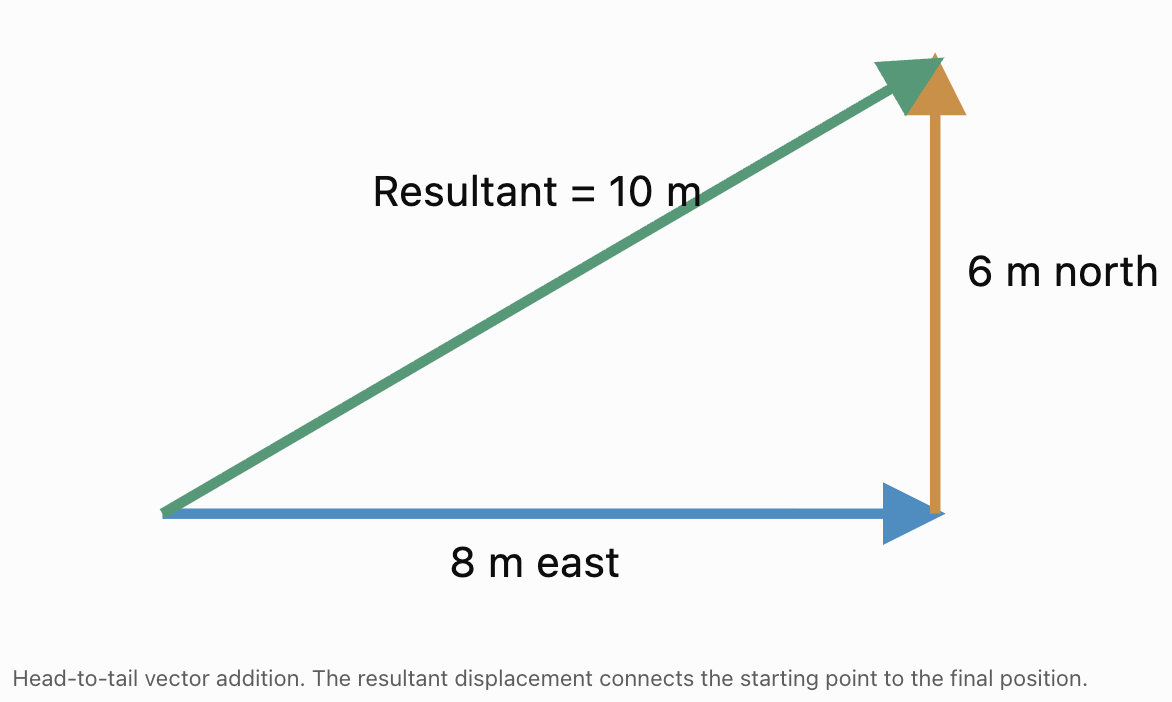
Vectors can be added using the head-to-tail method.
To add vectors A and B:
-
Draw A.
-
Place the tail of B at the head of A.
-
Draw the resultant from the tail of A to the head of B.
The resultant vector is:
R = A + B
Example
A person walks:
8 m east
followed by:
6 m north
The resultant displacement is the diagonal of a right triangle.
Magnitude:
R = √(8² + 6²)
= √100
R = 10 m
Direction:
θ = tan⁻¹(6/8)
θ ≈ 36.87° north of east
Adding Vectors Using Components
When several vectors act at different angles, resolving them into components is often the most efficient method.
For multiple vectors:
Rₓ = ΣAₓ
Rᵧ = ΣAᵧ
Then:
R = √(Rₓ² + Rᵧ²)
The direction can be calculated using:
θ = tan⁻¹(Rᵧ/Rₓ)
with the appropriate quadrant adjustment.
General Procedure
-
Choose positive x- and y-directions.
-
Resolve every vector into components.
-
Add the horizontal components.
-
Add the vertical components.
-
Calculate the resultant magnitude.
-
Calculate the direction.
-
Interpret the result in context.
Worked Example: Three Forces Acting on an Object
Three forces act on an object:
-
F₁ = 20 N east.
-
F₂ = 15 N north.
-
F₃ = 10 N west.
Calculate the resultant force.
Step 1: Resolve Horizontal Forces
Take east as positive.
F₁ₓ = +20 N
F₃ₓ = −10 N
Total horizontal force:
Rₓ = 20 − 10
Rₓ = 10 N
Step 2: Resolve Vertical Forces
F₂ᵧ = +15 N
Therefore:
Rᵧ = 15 N
Step 3: Calculate Magnitude
R = √(10² + 15²)
= √325
R ≈ 18.03 N
Step 4: Calculate Direction
θ = tan⁻¹(15/10)
θ ≈ 56.31°
Final Answer
Resultant force ≈ 18.03 N at 56.31° north of east.
Worked Example: Forces at Different Angles
Three forces act on an object:
-
F₁ = 50 N at 30° above the positive x-axis.
-
F₂ = 40 N at 120° counterclockwise from the positive x-axis.
-
F₃ = 30 N directly downward.
Find the resultant force.
Step 1: Resolve F₁
F₁ₓ = 50 cos 30°
F₁ₓ ≈ 43.30 N
F₁ᵧ = 50 sin 30°
F₁ᵧ = 25.00 N
Step 2: Resolve F₂
F₂ₓ = 40 cos 120°
F₂ₓ = −20.00 N
F₂ᵧ = 40 sin 120°
F₂ᵧ ≈ 34.64 N
Step 3: Resolve F₃
F₃ₓ = 0 N
F₃ᵧ = −30 N
Step 4: Add Components
Rₓ = 43.30 − 20.00 + 0
Rₓ ≈ 23.30 N
Rᵧ = 25.00 + 34.64 − 30.00
Rᵧ ≈ 29.64 N
Step 5: Calculate Magnitude
R = √(23.30² + 29.64²)
R ≈ 37.70 N
Step 6: Calculate Direction
θ = tan⁻¹(29.64/23.30)
θ ≈ 51.8°
Final Answer
The resultant force is approximately 37.70 N at 51.8° above the positive x-axis.
Vector Subtraction
Vector subtraction can be interpreted as adding the opposite vector.
A − B = A + (−B)
The opposite vector has the same magnitude but points in the opposite direction.
Example
A = (8, 5)
B = (3, 7)
Subtract the components:
A − B = (8 − 3, 5 − 7)
A − B = (5, −2)
Magnitude:
|A − B| = √(5² + (−2)²)
= √29
≈ 5.39 units
The resultant points right and downward.
Navigation Using Vectors
Navigation problems frequently involve displacement, velocity, and direction.
A common navigation convention uses bearings.
A bearing is measured clockwise from north.
Examples include:
-
North = 000°.
-
East = 090°.
-
South = 180°.
-
West = 270°.
For a displacement of magnitude d and bearing β:
Eastward component = d sin β
Northward component = d cos β
These formulas differ from the standard x-axis convention because bearings are measured from north rather than east.

Worked Example: Navigation with Bearings
A boat travels 12 km on a bearing of 060°.
Calculate its eastward and northward displacements.
Eastward Component
E = 12 sin 60°
= 12 × 0.866
E ≈ 10.39 km
Northward Component
N = 12 cos 60°
= 12 × 0.5
N = 6.00 km
Interpretation
The boat travels approximately 10.39 km east and 6.00 km north.
Multi-Stage Navigation Problems
A ship travels:
-
20 km east.
-
15 km north.
-
10 km west.
Find its resultant displacement.
Horizontal Displacement
E = 20 − 10
E = 10 km
Vertical Displacement
N = 15 km
Magnitude
R = √(10² + 15²)
R ≈ 18.03 km
Bearing
The angle east of north is:
β = tan⁻¹(10/15)
β ≈ 33.69°
Final Answer
Resultant displacement ≈ 18.03 km on a bearing of 034°.
Aircraft Navigation and Wind Velocity
Aircraft navigation provides an important example of vector addition.
An aircraft's velocity relative to the ground is the sum of:
-
Aircraft velocity relative to the air.
-
Wind velocity relative to the ground.
v_ground = v_aircraft + v_wind
Here, each symbol represents a vector quantity.
Worked Example
An aircraft flies due north at 200 km/h relative to the air.
A wind blows due east at 50 km/h.
Calculate the aircraft's ground speed and direction.
Step 1: Identify Components
Eastward velocity:
vₓ = 50 km/h
Northward velocity:
vᵧ = 200 km/h
Step 2: Calculate Ground Speed
v = √(50² + 200²)
= √42,500
v ≈ 206.16 km/h
Step 3: Calculate Direction
Angle east of north:
θ = tan⁻¹(50/200)
θ ≈ 14.04°
Final Answer
The aircraft travels at approximately:
206.16 km/h on a bearing of 014°.
Interpretation
The wind causes the aircraft to drift east of its intended northerly direction.

River Crossing Problems
A boat crossing a river experiences two velocity components:
-
Velocity relative to the water.
-
River current velocity.
Worked Example
A boat moves north across a river at 4 m/s relative to the water.
The river current flows east at 3 m/s.
Calculate the boat's resultant velocity.
Magnitude
v = √(4² + 3²)
v = 5 m/s
Direction
θ = tan⁻¹(3/4)
θ ≈ 36.87° east of north
Interpretation
The boat travels diagonally downstream rather than directly across the river.
If the river is 120 m wide, the crossing time is:
t = 120/4
t = 30 s
The downstream drift is:
d = 3 × 30
d = 90 m
The boat lands 90 m downstream from the point directly opposite its starting position.
Force Equilibrium
An object is in translational equilibrium when the resultant force is zero.
ΣFₓ = 0
ΣFᵧ = 0
This means the object has zero acceleration.
It may be stationary or moving at constant velocity.
Example: Hanging Sign
A sign is supported by two identical cables.
Each cable makes an angle of 30° above the horizontal.
The sign has a weight of 200 N.
Find the tension in each cable.
Step 1: Identify Vertical Components
Each cable provides an upward component:
T sin 30°
The two vertical components balance the weight.
2T sin 30° = 200
Step 2: Solve
2T × 0.5 = 200
T = 200
T = 200 N
Interpretation
Each cable has a tension of 200 N.
The horizontal components cancel because the cables are symmetrical.

Forces on an Inclined Plane
Vectors are especially useful for analysing forces on sloping surfaces.
Consider an object of mass m resting on an incline at angle θ.
Its weight is:
W = mg
The weight can be resolved into components:
Parallel to the slope:
W_parallel = mg sin θ
Perpendicular to the slope:
W_perpendicular = mg cos θ
Worked Example
A 10 kg box rests on a frictionless slope inclined at 25°.
Take:
g = 9.81 m/s²
Weight
W = 10 × 9.81
W = 98.1 N
Parallel Component
W_parallel = 98.1 sin 25°
≈ 41.46 N
Perpendicular Component
W_perpendicular = 98.1 cos 25°
≈ 88.91 N
Interpretation
The component of weight acting down the slope is approximately 41.46 N.
The perpendicular component is approximately 88.91 N.
If the box remains in contact with the frictionless slope and there is no acceleration perpendicular to it, the normal force is 88.91 N.

Resultant of Two Vectors Using the Cosine Rule
When two vectors are not perpendicular, the cosine rule can be used.
If vectors A and B have magnitudes A and B and an angle θ between them, the magnitude of their sum is:
R = √(A² + B² + 2AB cos θ)
Worked Example
Two forces act on an object:
F₁ = 40 N
F₂ = 30 N
The angle between them is 60°.
Calculate the resultant magnitude.
R = √(40² + 30² + 2 × 40 × 30 × cos 60°)
= √(1600 + 900 + 1200)
= √3700
R ≈ 60.83 N
Interpretation
The resultant is greater than either individual force but less than their combined magnitudes of 70 N.
The angle between the forces determines how strongly they reinforce each other.
Using the Sine Rule with Vectors
The sine rule can be used when a vector triangle contains known angles and side lengths.
For a triangle:
a/sin A = b/sin B = c/sin C
Example
Two displacement vectors form a triangle.
Suppose one side has length 12 km and is opposite an angle of 40°.
Another side is opposite an angle of 65°.
Find its length.
Using the sine rule:
b/sin 65° = 12/sin 40°
Therefore:
b = 12 sin 65°/sin 40°
b ≈ 16.92 km
This method is useful when vector directions are known but components are not the simplest approach.
Unit Vectors
A unit vector has magnitude 1.
In two-dimensional Cartesian coordinates:
-
i represents one unit in the positive x-direction.
-
j represents one unit in the positive y-direction.
Using unit-vector notation, a vector can be written:
A = Aₓi + Aᵧj
In this notation, i and j are unit vectors, not ordinary scalar variables.
Example
A force has components:
Fₓ = 12 N
Fᵧ = −5 N
In unit-vector form:
F = 12i − 5j N
Its magnitude is:
|F| = √(12² + (−5)²)
|F| = 13 N
Unit-vector notation makes vector addition straightforward.
Three-Dimensional Vectors
Vectors can also be represented in three dimensions.
A vector has components:
Aₓ, Aᵧ, A_z
Its magnitude is:
|A| = √(Aₓ² + Aᵧ² + A_z²)
Example
A displacement vector has components:
Aₓ = 3 m
Aᵧ = 4 m
A_z = 12 m
Magnitude:
|A| = √(3² + 4² + 12²)
= √169
|A| = 13 m
Applications
Three-dimensional vector calculations are important in:
-
Aircraft navigation.
-
Robotics.
-
Satellite motion.
-
Structural engineering.
-
Computer graphics.
-
Electromagnetic fields.
Dot Product and Trigonometry
The dot product connects vectors with the cosine of the angle between them.
For vectors A and B:
A · B = |A||B| cos θ
In component form:
A · B = AₓBₓ + AᵧBᵧ
For three-dimensional vectors, add A_zB_z.
Finding the Angle Between Vectors
Rearranging:
cos θ = (A · B)/(|A||B|)
Worked Example
A = (3, 4)
B = (5, 0)
Calculate the angle between the vectors.
Dot product:
A · B = 3 × 5 + 4 × 0
= 15
Magnitudes:
|A| = 5
|B| = 5
Therefore:
cos θ = 15/(5 × 5)
= 0.6
θ = cos⁻¹(0.6)
θ ≈ 53.13°
Work Done by a Force
The dot product has an important physical application in calculating work.
W = F · d
Therefore:
W = Fd cos θ
where:
-
W = work done.
-
F = force magnitude.
-
d = displacement magnitude.
-
θ = angle between force and displacement.
Worked Example
A person pulls a box with a force of 100 N at an angle of 30° above the horizontal.
The box moves 5 m horizontally.
Calculate the work done by the pulling force.
W = Fd cos θ
= 100 × 5 × cos 30°
= 500 × 0.866
W ≈ 433 J
Interpretation
Only the component of the force parallel to the displacement contributes to the work done.
The perpendicular component does no work during the horizontal displacement.
Vector Applications in Engineering
Vectors are essential for representing forces, velocities, accelerations, and displacements in engineering systems.
Structural Engineering
Engineers resolve forces to determine the loads acting on beams, cables, and supports.
Mechanical Engineering
Vectors describe the motion of machine components and the forces acting on them.
Aerospace Engineering
Aircraft motion depends on airspeed, wind velocity, thrust, lift, drag, and weight.
Civil Engineering
Vectors are used to analyse bridges, buildings, cranes, and other structures.
Robotics
Robotic systems use vector calculations to determine position, movement, and force.
Electrical Engineering
Alternating electrical quantities can be represented using phasors, which are rotating-vector representations of sinusoidal signals.


Choosing an Efficient Vector Method
Different vector problems require different strategies.
|
Problem type |
Recommended method |
|---|---|
|
Two perpendicular vectors |
Pythagorean theorem and tangent |
|
Vector with known magnitude and angle |
Sine and cosine components |
|
Several vectors at different angles |
Component method |
|
Two vectors with known included angle |
Cosine rule |
|
Vector triangle with known angles |
Sine rule |
|
Navigation with bearings |
North–east components |
|
Forces in equilibrium |
ΣFₓ = 0 and ΣFᵧ = 0 |
|
Work done by angled force |
Dot product |
|
Three-dimensional displacement |
3D component magnitude |
|
Angle between two vectors |
Dot product and inverse cosine |
The component method is often the most flexible because it can handle many vectors simultaneously.
Common Mistakes
Confusing scalar and vector quantities
Vectors require both magnitude and direction.
Using sine and cosine incorrectly
The correct formula depends on which axis the angle is measured from.
Ignoring negative components
Negative signs indicate direction and must be included when adding vectors.
Confusing magnitude with components
A vector's magnitude is not generally equal to either component.
Adding vector magnitudes directly
Magnitudes can only be added directly when the vectors act in the same direction.
Ignoring quadrant information
Inverse tangent calculations may require quadrant adjustments.
Confusing bearings with standard mathematical angles
Bearings are measured clockwise from north, while standard mathematical angles are measured counterclockwise from the positive x-axis.
Treating directional quantities as scalars
Forces, velocities, and displacements must be combined using vector methods.
Using the wrong angle in the cosine rule
The formula for the magnitude of a vector sum uses the angle between the two vectors.
Forgetting units
Force, velocity, and displacement have different units.
Ignoring physical context
A mathematically correct resultant must still be interpreted according to the real situation.
Key Terms
-
Scalar: A quantity with magnitude only.
-
Vector: A quantity with magnitude and direction.
-
Magnitude: The size or length of a vector.
-
Direction: The orientation in which a vector acts.
-
Displacement: A vector describing change in position.
-
Velocity: The rate of change of displacement.
-
Acceleration: The rate of change of velocity.
-
Force: A vector quantity describing an interaction capable of changing motion.
-
Vector Component: The contribution of a vector along a specified axis.
-
Horizontal Component: The component of a vector along the x-axis.
-
Vertical Component: The component of a vector along the y-axis.
-
Vector Resolution: Separating a vector into perpendicular components.
-
Resultant Vector: A single vector representing the sum of two or more vectors.
-
Vector Addition: Combining vectors to determine their resultant.
-
Vector Subtraction: Adding the opposite of a vector.
-
Head-to-Tail Method: A graphical method of vector addition.
-
Parallelogram Method: A graphical method for adding two vectors from a common starting point.
-
Cartesian Coordinates: A coordinate system using perpendicular axes.
-
Quadrant: One of four regions formed by the x- and y-axes.
-
Bearing: A direction measured clockwise from north.
-
Trigonometric Ratio: A relationship between angles and side lengths in a right triangle.
-
Sine Rule: A relationship between triangle side lengths and opposite angles.
-
Cosine Rule: A relationship used to calculate unknown sides or angles in triangles.
-
Equilibrium: A condition in which the resultant force is zero.
-
Normal Force: A contact force perpendicular to a surface.
-
Inclined Plane: A sloping surface used in force analysis.
-
Unit Vector: A vector with magnitude 1.
-
Unit-Vector Notation: Representing vectors using coordinate-direction unit vectors.
-
Dot Product: A scalar operation involving vector magnitudes and the cosine of the angle between them.
-
Work Done: Energy transferred by a force acting through a displacement.
-
Three-Dimensional Vector: A vector with components along three perpendicular axes.
-
Relative Velocity: The velocity of one object measured relative to another reference frame.
-
Force System: A collection of forces acting on an object or structure.
Key Takeaways
-
Trigonometry provides essential methods for analysing vectors in mathematics, physics, and engineering.
-
Scalars have magnitude only, while vectors have magnitude and direction.
-
Vectors can be represented graphically using arrows.
-
A vector can be resolved into horizontal and vertical components.
-
The standard component formulas are Aₓ = A cos θ and Aᵧ = A sin θ when θ is measured from the positive x-axis.
-
Component signs depend on the direction of the vector.
-
The Pythagorean theorem can be used to calculate a vector's magnitude from perpendicular components.
-
Inverse tangent can be used to calculate direction, provided the correct quadrant is identified.
-
Vectors can be added geometrically using the head-to-tail method.
-
The component method is particularly useful when several vectors act at different angles.
-
Vector subtraction is equivalent to adding the opposite vector.
-
Navigation problems use vectors to calculate displacement, speed, and direction.
-
Bearings are measured clockwise from north.
-
Wind and water currents affect motion through vector addition.
-
An object is in translational equilibrium when the resultant force is zero.
-
Forces on inclined planes can be resolved into parallel and perpendicular components.
-
The cosine rule is useful for calculating resultants when vectors are not perpendicular.
-
The sine rule can be used to solve vector triangles.
-
Unit-vector notation provides a compact way to represent vectors.
-
Three-dimensional vector methods extend component calculations into space.
-
The dot product connects vector calculations with trigonometric relationships.
-
Work done depends on the component of force parallel to displacement.
-
Vector methods are essential in navigation, structural engineering, mechanics, robotics, and aerospace systems.
Check Your Understanding
Recall and Understanding
-
Explain the difference between a scalar and a vector.
-
Describe how a vector can be resolved into horizontal and vertical components.
-
Explain why negative vector components are important.
-
Describe the difference between bearings and standard mathematical angles.
-
Explain why vectors are useful in engineering and navigation.
Application
-
A force of 80 N acts at 40° above the horizontal. Calculate its horizontal and vertical components.
-
A displacement vector has components of 15 m east and 20 m north. Calculate its magnitude and direction.
-
Two forces act on an object: 25 N east and 18 N north. Calculate the resultant force.
-
A boat travels 30 km on a bearing of 120°. Calculate its eastward and northward displacement components.
-
A 12 kg box rests on a frictionless slope inclined at 35°. Calculate the components of its weight parallel and perpendicular to the slope.
Analysis and Challenge
-
Three forces act on an object: 60 N at 20° above the positive x-axis, 45 N at 135° counterclockwise from the positive x-axis, and 30 N directly downward. Calculate the resultant magnitude and direction.
-
An aircraft flies due north at 250 km/h relative to the air. A wind blows east at 70 km/h. Calculate the aircraft's ground speed and bearing.
-
A boat can travel at 5 m/s relative to still water. A river flows east at 2 m/s and is 150 m wide. If the boat points directly north, calculate its resultant speed, crossing time, and downstream displacement.
-
A sign weighing 500 N is supported by two cables. One cable makes an angle of 40° above the horizontal to the left, while the other makes an angle of 55° above the horizontal to the right. Calculate the tension in each cable using horizontal and vertical equilibrium.
-
Two vectors are A = (4, 7) and B = (−3, 5). Calculate their sum, difference, magnitudes, and the angle between them using the dot product.
Final Summary
Vector applications demonstrate how trigonometry can be used to analyse quantities with both magnitude and direction.
Sine and cosine functions allow vectors to be resolved into perpendicular components, while the Pythagorean theorem and inverse trigonometric functions allow magnitudes and directions to be reconstructed.
Vector addition and subtraction provide methods for analysing displacement, velocity, acceleration, and forces.
Navigation problems illustrate how directional motion can be combined, particularly when wind or water currents affect movement.
Force systems demonstrate how vector components are used to calculate resultants and determine equilibrium.
The sine rule, cosine rule, and dot product extend vector calculations to more complex geometric and physical situations.
These methods are widely used in engineering, physics, robotics, navigation, and computer modelling.
The central principle is that trigonometry transforms directional quantities into mathematical components that can be calculated, combined, and interpreted to solve real-world problems.