Applications of Advanced Trigonometry
2. Rotational Motion
Learning outcomes
- I can analyse circular motion using trigonometry.
- I can model angular displacement and velocity.
- I can solve rotational mechanics problems.
- I can interpret periodic motion graphically.
- I can apply trigonometry to engineering contexts.
Rotational Motion
Introduction to Rotational Motion
Rotational motion occurs when an object turns around a fixed point or axis. It is found throughout nature, science, and engineering, from spinning wheels and rotating turbines to planetary orbits and industrial machinery.
Many rotating systems move in repeating cycles, making trigonometric functions especially useful for describing their motion.
By using angles, radians, sine, cosine, and mathematical relationships between linear and angular quantities, we can analyse how rotating objects move and how forces affect their motion.
Rotational motion helps answer questions such as:
-
How far does a wheel rotate in a given time?
-
How fast is a point on the edge of a spinning disk moving?
-
How does angular velocity relate to linear speed?
-
Why do objects moving in circles accelerate even when their speed is constant?
-
How can sine and cosine describe the position of a rotating object?
-
How do engineers calculate the forces and torques acting on rotating machinery?


Understanding Circular and Rotational Motion
Circular motion occurs when an object follows a circular path around a centre.
Rotational motion describes an object turning around an axis.
These concepts are closely related but are not identical.
For example, a spinning wheel undergoes rotational motion, while a point on its rim undergoes circular motion.
Important Features
-
Axis of rotation: The line around which an object rotates.
-
Radius (r): The distance from the axis to a point on the rotating object.
-
Angular displacement (θ): The angle through which an object rotates.
-
Angular velocity (ω): The rate of change of angular displacement.
-
Angular acceleration (α): The rate of change of angular velocity.
-
Tangential velocity (v): The linear velocity of a point moving around a circular path.
In a rigid rotating object, all points share the same angular displacement and angular velocity, but points farther from the axis have greater tangential speeds.
Measuring Angles in Radians
Radians are the standard angular units used in rotational mechanics.
One radian is the angle subtended at the centre of a circle by an arc equal in length to the radius.
The relationship between arc length and angle is:
s = rθ
where:
-
s = arc length.
-
r = radius.
-
θ = angular displacement in radians.
Rearranging:
θ = s/r
Degrees and Radians
A complete revolution is:
360° = 2π radians
Therefore:
180° = π radians
To convert degrees to radians:
Radians = Degrees × π/180
To convert radians to degrees:
Degrees = Radians × 180/π
Common Angular Measurements
|
Degrees |
Radians |
Fraction of a revolution |
|---|---|---|
|
0° |
0 |
0 |
|
45° |
π/4 |
1/8 |
|
90° |
π/2 |
1/4 |
|
120° |
2π/3 |
1/3 |
|
180° |
π |
1/2 |
|
270° |
3π/2 |
3/4 |
|
360° |
2π |
1 |
Radians are particularly important because the standard equations of rotational mechanics assume angular measurements are expressed in radians.
Angular Displacement
Angular displacement is the change in angular position of an object.
It is represented by θ or Δθ.
Δθ = θ_final − θ_initial
Angular displacement has direction.
By convention:
-
Counterclockwise rotation is positive.
-
Clockwise rotation is negative.
Worked Example
A wheel rotates counterclockwise through 150°.
Convert this angular displacement into radians.
θ = 150 × π/180
θ = 5π/6 radians
Approximately:
θ ≈ 2.62 rad
Multiple Revolutions
A wheel completes four full revolutions.
Angular displacement:
θ = 4 × 2π
θ = 8π rad
Approximately:
θ ≈ 25.13 rad
Angular displacement can be greater than 2π radians because an object may complete multiple revolutions.
Arc Length and Rotational Motion
When an object rotates, a point at distance r from the axis travels along a circular arc.
The distance travelled along the arc is:
s = rθ
This equation applies when θ is measured in radians.
Worked Example
A wheel has a radius of 0.40 m.
It rotates through an angle of 3 radians.
Calculate the distance travelled by a point on its rim.
s = rθ
= 0.40 × 3
s = 1.20 m
Engineering Connection
Arc length calculations are used in:
-
Wheel rotation.
-
Belt and pulley systems.
-
Gear mechanisms.
-
Robotic joints.
-
Conveyor systems.
-
Rotating machine components.

Angular Velocity
Angular velocity measures the rate of change of angular displacement.
Average angular velocity is:
ω_avg = Δθ/Δt
where:
-
ω = angular velocity in rad/s.
-
Δθ = angular displacement in radians.
-
Δt = elapsed time in seconds.
For constant angular velocity:
θ = θ₀ + ωt
where θ₀ is the initial angular position.
Worked Example
A rotating disk turns through 12π radians in six seconds.
Calculate its average angular velocity.
ω_avg = 12π/6
ω_avg = 2π rad/s
Approximately:
ω_avg ≈ 6.28 rad/s
Interpretation
The disk completes one revolution each second.
Frequency, Period, and Angular Velocity
Rotating objects often undergo periodic motion.
The period (T) is the time required for one complete revolution.
The frequency (f) is the number of revolutions per second.
Their relationships are:
f = 1/T
T = 1/f
Angular velocity for uniform circular motion is:
ω = 2πf
or:
ω = 2π/T
Worked Example
A motor rotates at 5 revolutions per second.
Calculate its angular velocity.
ω = 2π × 5
ω = 10π rad/s
Approximately:
ω ≈ 31.42 rad/s
The period is:
T = 1/5
T = 0.20 s
Revolutions per Minute
Rotating machinery is often rated in revolutions per minute (rpm).
To convert rpm into revolutions per second:
f = rpm/60
Angular velocity is then:
ω = 2π × rpm/60
Worked Example
An electric motor rotates at 1,800 rpm.
Calculate its angular velocity.
Frequency:
f = 1800/60
f = 30 Hz
Angular velocity:
ω = 2π × 30
ω = 60π rad/s
Approximately:
ω ≈ 188.50 rad/s
Practical Importance
Engineers use rpm to describe the operation of:
-
Electric motors.
-
Vehicle engines.
-
Turbines.
-
Fans.
-
Drilling machines.
-
Centrifuges.
Tangential Speed
Although all points on a rigid rotating object share the same angular velocity, their linear speeds depend on their distance from the axis.
The relationship is:
v = r|ω|
where:
-
v = tangential speed.
-
r = distance from the axis.
-
ω = angular velocity.
Worked Example
A wheel has a radius of 0.50 m and rotates at 8 rad/s.
Calculate the tangential speed of a point on its rim.
v = rω
= 0.50 × 8
v = 4.0 m/s
Comparing Different Radii
Suppose two points lie on the same rotating disk.
Point A is 0.20 m from the centre.
Point B is 0.50 m from the centre.
The disk rotates at 10 rad/s.
For Point A:
v_A = 0.20 × 10
v_A = 2.0 m/s
For Point B:
v_B = 0.50 × 10
v_B = 5.0 m/s
Point B moves faster because it is farther from the axis.
Trigonometry and Circular Position
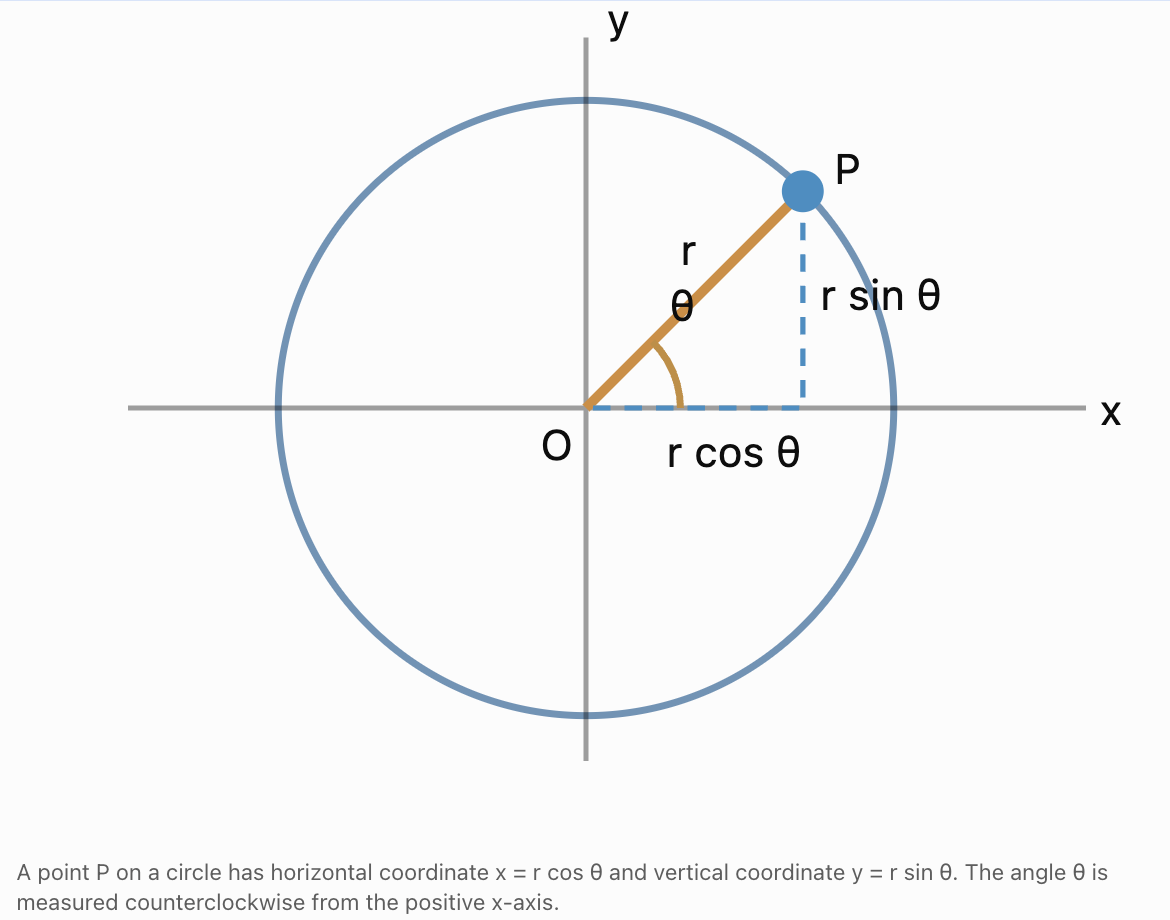
Trigonometric functions can describe the position of an object moving around a circle.
Consider an object moving around a circle of radius r, centred at the origin.
If its angular position is θ, its Cartesian coordinates are:
x = r cos θ
y = r sin θ
These equations follow directly from right-triangle trigonometry.
Circular Motion with Time
For constant angular velocity:
θ = ωt + φ
where φ is the initial angle.
Substituting:
x(t) = r cos(ωt + φ)
y(t) = r sin(ωt + φ)
These equations describe the horizontal and vertical positions of a point moving in uniform circular motion.
Worked Example: Position on a Rotating Wheel
A wheel has a radius of 2 m.
A point on the rim is located at an angle of 60° above the positive horizontal axis.
Find its horizontal and vertical coordinates relative to the centre.
Horizontal Position
x = r cos θ
= 2 cos 60°
= 2 × 0.5
x = 1.0 m
Vertical Position
y = r sin θ
= 2 sin 60°
= 2 × √3/2
y = √3 m ≈ 1.73 m
Interpretation
The point is 1.0 m to the right and approximately 1.73 m above the centre.
Rotational Motion and Sinusoidal Graphs
The horizontal and vertical coordinates of a rotating point vary sinusoidally with time.
For uniform circular motion:
x(t) = r cos(ωt + φ)
y(t) = r sin(ωt + φ)
These functions have:
-
Amplitude = r.
-
Period = 2π/|ω|.
-
Frequency = |ω|/(2π).
Graphical Interpretation
The horizontal position follows a cosine curve.
The vertical position follows a sine curve.
The two oscillations differ in phase by π/2 radians, or 90°.
This explains why circular motion is closely connected to simple harmonic motion.
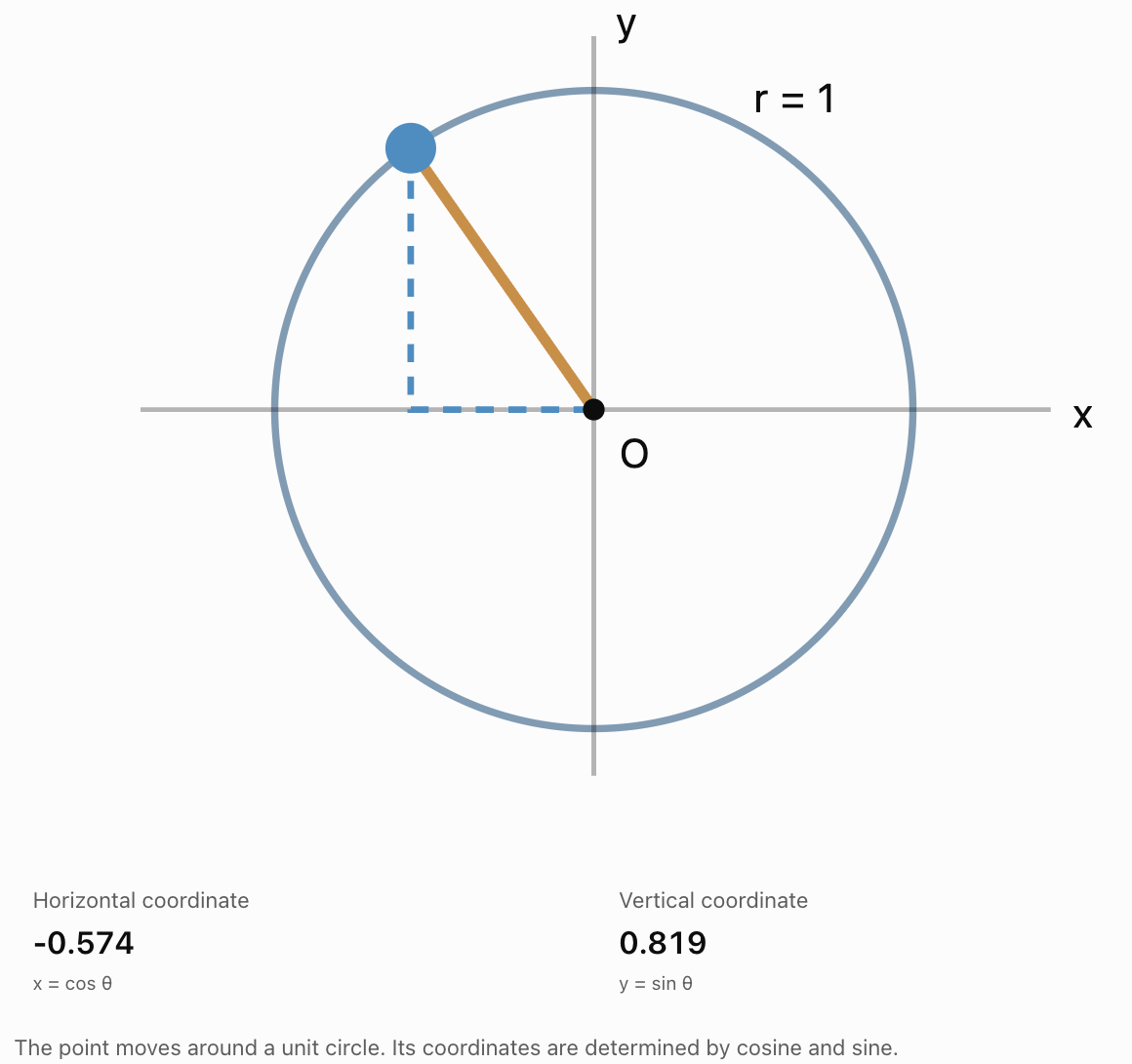
Interactive Rotational Motion Model
Adjust the angle to see how the horizontal and vertical coordinates change.
Velocity Components in Circular Motion
The velocity of an object moving in a circle is tangent to the circular path.
For counterclockwise uniform circular motion:
x(t) = r cos(ωt + φ)
y(t) = r sin(ωt + φ)
Differentiating with respect to time gives:
vₓ = −rω sin(ωt + φ)
vᵧ = rω cos(ωt + φ)
The magnitude of the velocity is:
v = √(vₓ² + vᵧ²)
Substituting:
v = r|ω|√(sin²θ + cos²θ)
Since:
sin²θ + cos²θ = 1
then:
v = r|ω|
Important Observation
The speed remains constant in uniform circular motion, but the direction of velocity changes continuously.
Therefore, the object is accelerating.
Centripetal Acceleration
An object moving in a circular path experiences acceleration directed toward the centre.
This is called centripetal acceleration.
Its magnitude is:
a_c = v²/r
Using v = r|ω|:
a_c = rω²
where:
-
a_c = centripetal acceleration.
-
v = tangential speed.
-
r = radius.
-
ω = angular velocity.
Worked Example
A car travels around a circular track of radius 50 m at a constant speed of 20 m/s.
Calculate its centripetal acceleration.
a_c = v²/r
= 20²/50
= 400/50
a_c = 8.0 m/s²
Interpretation
The car experiences an acceleration of 8.0 m/s² toward the centre of the circular track.
Even though its speed is constant, its velocity changes because its direction changes.

Centripetal Force
Newton's Second Law states:
F_net = ma
For circular motion, the net inward force is:
F_c = mv²/r
or:
F_c = mrω²
This inward net force is called the centripetal force.
Important Distinction
Centripetal force is not a separate type of physical force.
It is the name given to the resultant force directed toward the centre of a circular path.
It may be provided by:
-
Friction.
-
Tension.
-
Gravity.
-
Normal force.
-
A combination of forces.
Worked Example
A 2 kg object moves in a circle of radius 1.5 m at a speed of 6 m/s.
Calculate the required centripetal force.
F_c = mv²/r
= 2 × 6²/1.5
= 72/1.5
F_c = 48 N
The net inward force must be 48 N.
Angular Acceleration
Angular velocity may change over time.
Angular acceleration is the rate of change of angular velocity.
Average angular acceleration is:
α_avg = Δω/Δt
where:
-
α = angular acceleration in rad/s².
-
Δω = change in angular velocity.
-
Δt = time interval.
Worked Example
A motor increases its angular velocity from 10 rad/s to 50 rad/s in eight seconds.
Calculate its average angular acceleration.
α = (50 − 10)/8
= 40/8
α = 5 rad/s²
Interpretation
The motor's angular velocity increases by 5 rad/s every second on average.
Equations of Rotational Kinematics
For constant angular acceleration, rotational motion follows equations similar to linear kinematics.
|
Linear motion |
Rotational motion |
|---|---|
|
v = u + at |
ω = ω₀ + αt |
|
s = ut + 1/2 at² |
Δθ = ω₀t + 1/2 αt² |
|
v² = u² + 2as |
ω² = ω₀² + 2αΔθ |
|
s = (u + v)t/2 |
Δθ = (ω₀ + ω)t/2 |
where:
-
ω₀ = initial angular velocity.
-
ω = final angular velocity.
-
α = constant angular acceleration.
-
Δθ = angular displacement.
-
t = time.
These equations are useful for rotating systems that speed up or slow down uniformly.
Worked Example: Accelerating Wheel
A wheel starts from rest and accelerates uniformly at 4 rad/s² for five seconds.
Calculate its final angular velocity and angular displacement.
Final Angular Velocity
ω = ω₀ + αt
= 0 + 4 × 5
ω = 20 rad/s
Angular Displacement
Δθ = ω₀t + 1/2 αt²
= 0 + 1/2 × 4 × 5²
= 2 × 25
Δθ = 50 rad
Number of Revolutions
N = Δθ/(2π)
= 50/(2π)
N ≈ 7.96 revolutions
The wheel completes approximately 7.96 revolutions while accelerating.
Tangential and Radial Acceleration
When angular velocity changes, a rotating point may experience two perpendicular acceleration components.
Tangential Acceleration
Tangential acceleration changes the speed.
a_t = rα
Radial Acceleration
Radial or centripetal acceleration changes the direction of velocity.
a_c = rω²
Total Acceleration
Since the two components are perpendicular:
a_total = √(a_t² + a_c²)
Worked Example
A rotating disk has:
r = 0.40 m
ω = 6 rad/s
α = 3 rad/s²
Tangential acceleration:
a_t = 0.40 × 3
a_t = 1.2 m/s²
Centripetal acceleration:
a_c = 0.40 × 6²
a_c = 14.4 m/s²
Total acceleration:
a_total = √(1.2² + 14.4²)
a_total ≈ 14.45 m/s²
The acceleration is dominated by the centripetal component.
Torque and Rotational Forces
Torque is the turning effect of a force about an axis.
The magnitude of torque is:
τ = rF sin θ
where:
-
τ = torque in newton-metres (N·m).
-
r = distance from the axis to the point where the force acts.
-
F = force magnitude.
-
θ = angle between the position vector and force.
Maximum Torque
Torque is greatest when the force acts perpendicular to the position vector.
When θ = 90°:
sin 90° = 1
Therefore:
τ_max = rF
Zero Torque
When the force acts directly toward or away from the axis:
θ = 0° or 180°
sin θ = 0
Therefore:
τ = 0
This explains why pushing directly toward a door hinge produces little turning effect.

Worked Example: Torque at an Angle
A mechanic applies a force of 80 N to a wrench.
The force is applied 0.30 m from the bolt at an angle of 60° to the wrench.
Calculate the torque magnitude.
τ = rF sin θ
= 0.30 × 80 × sin 60°
= 24 × 0.866
τ ≈ 20.8 N·m
Interpretation
The turning effect is approximately 20.8 N·m.
If the force were applied perpendicular to the wrench, the torque would be:
τ = 0.30 × 80
= 24 N·m
The perpendicular force produces greater torque.
Moment of Inertia
In linear motion, mass measures resistance to acceleration.
In rotational motion, moment of inertia measures resistance to angular acceleration about a particular axis.
It is represented by I.
For a collection of point masses:
I = Σmr²
where r is the perpendicular distance of each mass from the rotation axis.
Common Moments of Inertia
|
Object |
Moment of inertia about specified axis |
|---|---|
|
Point mass |
I = mr² |
|
Thin hoop, central perpendicular axis |
I = mr² |
|
Solid disk, central perpendicular axis |
I = 1/2 mr² |
|
Solid sphere, diameter |
I = 2/5 mr² |
|
Thin rod, axis through centre perpendicular to rod |
I = 1/12 mL² |
Important Principle
Mass located farther from the axis contributes more to moment of inertia.
This is why the distribution of mass matters in rotational mechanics.
Newton's Second Law for Rotation
For a rigid body rotating about a fixed axis:
τ_net = Iα
where:
-
τ_net = net external torque about the axis.
-
I = moment of inertia about that axis.
-
α = angular acceleration.
This is the rotational equivalent of:
F_net = ma
Worked Example
A solid disk has:
Mass = 4 kg
Radius = 0.50 m
A net torque of 2 N·m acts about its central axis.
Find its angular acceleration.
Step 1: Calculate Moment of Inertia
I = 1/2 mr²
= 1/2 × 4 × 0.50²
I = 0.50 kg·m²
Step 2: Calculate Angular Acceleration
α = τ_net/I
= 2/0.50
α = 4 rad/s²
The disk accelerates at 4 rad/s².
Rotational Kinetic Energy
A rotating object possesses kinetic energy.
The rotational kinetic energy is:
E_rot = 1/2 Iω²
Worked Example
A flywheel has a moment of inertia of 3 kg·m² and rotates at 10 rad/s.
Calculate its rotational kinetic energy.
E_rot = 1/2 × 3 × 10²
= 1.5 × 100
E_rot = 150 J
Engineering Applications
Rotational kinetic energy is important in:
-
Flywheels.
-
Vehicle wheels.
-
Turbines.
-
Rotating motors.
-
Energy-storage systems.

Angular Momentum
Angular momentum describes the rotational motion of a body.
For a rigid body rotating about a fixed principal axis:
L = Iω
where:
-
L = angular momentum.
-
I = moment of inertia.
-
ω = angular velocity.
If the net external torque is zero, angular momentum is conserved.
I₁ω₁ = I₂ω₂
Example: Figure Skater
A figure skater spins with arms extended.
When the skater pulls their arms inward, the moment of inertia decreases.
If external torque is negligible, angular velocity increases to conserve angular momentum.
This explains why a skater spins faster when pulling their arms close to the body.

Rolling Motion
A wheel rolling without slipping combines translational and rotational motion.
For pure rolling:
v = rω
where v is the speed of the wheel's centre.
For acceleration:
a = rα
These relationships apply when there is no slipping between the wheel and the surface.
Worked Example
A bicycle wheel has a radius of 0.35 m.
The bicycle moves at 7 m/s without slipping.
Calculate the wheel's angular velocity.
ω = v/r
= 7/0.35
ω = 20 rad/s
Number of Revolutions
The wheel's circumference is:
C = 2πr
= 2π × 0.35
≈ 2.20 m
If the bicycle travels 100 m:
N = 100/(2π × 0.35)
N ≈ 45.5 revolutions
Gear Ratios
Gears transfer rotational motion and torque between connected shafts.
For two meshing gears with no slipping at the contact point, the tangential speeds are equal.
r₁|ω₁| = r₂|ω₂|
Therefore:
|ω₂|/|ω₁| = r₁/r₂
For gears with the same tooth spacing, the ratio can also be expressed using the numbers of teeth.
|ω₂|/|ω₁| = N₁/N₂
where N₁ and N₂ are the tooth counts.
Worked Example
Gear A has 20 teeth and rotates at 600 rpm.
Gear B has 60 teeth.
Calculate Gear B's rotational speed.
ω_B = 600 × 20/60
= 200 rpm
Interpretation
The larger gear rotates more slowly.
For ideal gears, the reduction in angular speed corresponds to an increase in available torque.
Two externally meshing gears rotate in opposite directions.

Engineering Application: Ferris Wheel Motion
A Ferris wheel provides an example of circular motion modelled using trigonometry.
Suppose a Ferris wheel has:
-
Radius = 15 m.
-
Centre height = 18 m.
-
Period = 60 s.
A passenger begins at the lowest point.
Step 1: Determine Angular Velocity
ω = 2π/T
= 2π/60
ω = π/30 rad/s
Step 2: Construct the Height Function
Because the passenger starts at the bottom:
h(t) = 18 − 15 cos(πt/30)
where h is measured in metres.
Step 3: Calculate the Starting Height
At t = 0:
h(0) = 18 − 15 cos 0
= 18 − 15
h(0) = 3 m
Step 4: Calculate Height After 15 Seconds
h(15) = 18 − 15 cos(π/2)
= 18 − 0
h(15) = 18 m
Step 5: Calculate Height After 30 Seconds
h(30) = 18 − 15 cos π
= 18 + 15
h(30) = 33 m
Interpretation
The passenger begins 3 m above the ground, reaches the centre height after 15 seconds, and reaches the highest point after 30 seconds.
The model repeats every 60 seconds.
Graphing Periodic Rotational Motion
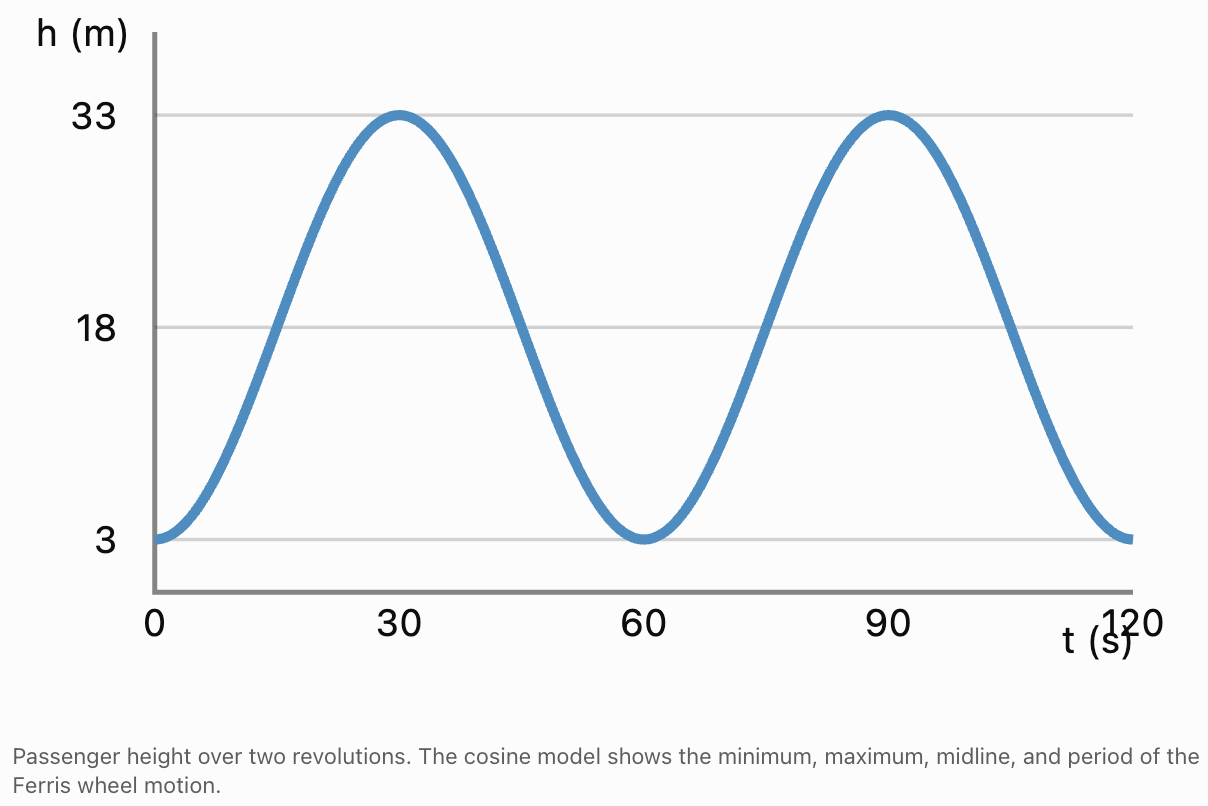
The Ferris wheel height model is:
h(t) = 18 − 15 cos(πt/30)
Its important features are:
- Midline = 18 m.
- Amplitude = 15 m.
- Period = 60 s.
- Minimum height = 3 m.
- Maximum height = 33 m.
Interpreting Rotational Motion Graphs
Rotational motion can be represented using several types of graphs.
Angular Displacement–Time Graph
The gradient represents angular velocity.
For constant angular velocity, the graph is a straight line.
Angular Velocity–Time Graph
The gradient represents angular acceleration.
The signed area under the graph represents angular displacement.
Angular Acceleration–Time Graph
The signed area under the graph represents the change in angular velocity.
Sinusoidal Position–Time Graph
The graph of a rotating point's horizontal or vertical coordinate is sinusoidal during uniform circular motion.
Its amplitude corresponds to the radius, while its period corresponds to the time for one revolution.
Practical Application: Wind Turbines
Wind turbines convert energy from moving air into rotational mechanical energy and then electrical energy.
Suppose a wind turbine blade extends 40 m from the rotation axis and rotates at 15 rpm.
Angular Velocity
f = 15/60
= 0.25 Hz
ω = 2π × 0.25
ω ≈ 1.57 rad/s
Blade-Tip Speed
v = rω
= 40 × 1.57
v ≈ 62.8 m/s
Interpretation
Although the turbine completes only 15 revolutions per minute, the blade tip moves at approximately 62.8 m/s.
This demonstrates why engineers must consider radius as well as angular velocity when analysing rotating machinery.
Practical Application: Vehicle Wheels
Vehicle wheels convert rotational motion into forward motion.
For rolling without slipping:
v = rω
A vehicle travelling at 25 m/s has wheels with radius 0.32 m.
Angular velocity:
ω = 25/0.32
ω ≈ 78.13 rad/s
Convert to rpm:
rpm = ω × 60/(2π)
rpm ≈ 746
The wheels rotate approximately 746 times per minute.
Practical Application: Robotic Arms
Robotic arms often contain rotating joints.
The position of the end of a single rigid arm of length L can be described using:
x = L cos θ
y = L sin θ
For a two-link robotic arm operating in a plane:
x = L₁ cos θ₁ + L₂ cos(θ₁ + θ₂)
y = L₁ sin θ₁ + L₂ sin(θ₁ + θ₂)
where:
-
L₁ and L₂ are the lengths of the arm segments.
-
θ₁ is the angle of the first segment.
-
θ₂ is the angle of the second segment relative to the first.
These equations are examples of forward kinematics.
They allow engineers to calculate the position of a robotic tool from the joint angles.

Common Mistakes
Using degrees in equations that require radians
Rotational mechanics formulas such as s = rθ and v = rω require angles in radians.
Confusing angular velocity with tangential speed
Angular velocity is measured in rad/s, while tangential speed is measured in m/s.
Assuming all points on a rotating disk have the same linear speed
Points farther from the axis move faster.
Confusing angular displacement with the number of revolutions
One revolution equals 2π radians.
Assuming constant speed means zero acceleration
Uniform circular motion involves centripetal acceleration because velocity changes direction.
Treating centripetal force as an additional physical force
Centripetal force is the net inward force supplied by real forces.
Confusing tangential and centripetal acceleration
Tangential acceleration changes speed, while centripetal acceleration changes velocity direction.
Using the wrong angle in torque calculations
The torque formula uses the angle between the position vector and applied force.
Ignoring the distribution of mass
Moment of inertia depends on both mass and its distance from the rotation axis.
Assuming all rotational motion has constant angular acceleration
The standard rotational kinematics equations require constant angular acceleration.
Ignoring the direction of rotation
Clockwise and counterclockwise motion have opposite signs under the usual convention.
Applying rolling equations when slipping occurs
The relationship v = rω for a wheel's centre requires rolling without slipping.
Key Terms
-
Rotational Motion: Motion involving an object turning around an axis.
-
Circular Motion: Motion along a circular path.
-
Axis of Rotation: The line about which an object rotates.
-
Radius: The distance from the centre or axis to a point on a circular path.
-
Radian: An angular unit defined by the ratio of arc length to radius.
-
Angular Position: The orientation of a rotating object relative to a reference direction.
-
Angular Displacement: The change in angular position.
-
Arc Length: The distance measured along a circular path.
-
Angular Velocity: The rate of change of angular displacement.
-
Angular Speed: The magnitude of angular velocity.
-
Angular Acceleration: The rate of change of angular velocity.
-
Tangential Velocity: The linear velocity of an object moving along a circular path.
-
Tangential Acceleration: Acceleration that changes the magnitude of tangential velocity.
-
Centripetal Acceleration: Acceleration directed toward the centre of a circular path.
-
Centripetal Force: The net inward force required for circular motion.
-
Uniform Circular Motion: Circular motion with constant speed.
-
Period: The time required for one complete revolution.
-
Frequency: The number of revolutions or cycles per second.
-
Revolutions per Minute (rpm): The number of complete rotations in one minute.
-
Sinusoidal Function: A function described by sine or cosine.
-
Amplitude: The maximum displacement from a sinusoidal function's midline.
-
Phase Angle: An angular quantity describing position within a repeating cycle.
-
Torque: The turning effect of a force about an axis.
-
Moment Arm: The perpendicular distance from an axis to a force's line of action.
-
Moment of Inertia: A measure of resistance to angular acceleration about an axis.
-
Rotational Kinetic Energy: Energy associated with rotational motion.
-
Angular Momentum: A quantity describing rotational motion that is conserved when net external torque is zero.
-
Rolling Without Slipping: Motion in which a rolling object's contact point is instantaneously at rest relative to the surface.
-
Gear Ratio: A relationship between the rotational speeds or tooth counts of connected gears.
-
Forward Kinematics: Calculating the position and orientation of a mechanism from its joint coordinates.
-
Periodic Motion: Motion that repeats at regular time intervals.
Key Takeaways
-
Trigonometry provides a mathematical foundation for analysing circular and rotational motion.
-
Angular displacement measures the angle through which an object rotates.
-
Radians are the standard angular units used in rotational mechanics.
-
Arc length and angular displacement are related by s = rθ.
-
Angular velocity measures the rate of change of angular position.
-
Frequency, period, and angular velocity are related by ω = 2πf = 2π/T for uniform circular motion.
-
Tangential speed depends on radius and angular velocity.
-
The position of a point moving in a circle can be modelled using sine and cosine functions.
-
Horizontal and vertical circular-motion coordinates vary sinusoidally with time.
-
Uniform circular motion involves centripetal acceleration even when speed remains constant.
-
Centripetal acceleration is directed toward the centre of the circular path.
-
Centripetal force is the net inward force required to maintain circular motion.
-
Angular acceleration describes changes in angular velocity.
-
Constant-angular-acceleration equations are analogous to linear kinematics equations.
-
Torque depends on force, distance from the axis, and the angle of application.
-
Moment of inertia depends on how mass is distributed relative to the rotation axis.
-
Newton's Second Law for fixed-axis rotation is τ_net = Iα.
-
Rotating objects possess rotational kinetic energy.
-
Angular momentum is conserved when net external torque is zero.
-
Rolling motion connects translational and rotational quantities.
-
Gear systems use rotational relationships to change angular speed and torque.
-
Ferris wheels, turbines, vehicle wheels, and robotic arms can all be analysed using trigonometric models.
Check Your Understanding
Recall and Understanding
-
Explain the difference between circular motion and rotational motion.
-
Define angular displacement, angular velocity, and angular acceleration.
-
Explain why radians are used in rotational mechanics.
-
Describe the relationship between angular velocity and tangential speed.
-
Explain why an object moving in a circle at constant speed still experiences acceleration.
Application
-
A wheel rotates through 720°. Calculate its angular displacement in radians.
-
A motor rotates at 2,400 rpm. Calculate its frequency in hertz and angular velocity in rad/s.
-
A wheel with radius 0.45 m rotates at 12 rad/s. Calculate the tangential speed of a point on its rim.
-
A 3 kg object moves in a circular path of radius 2 m at a speed of 8 m/s. Calculate its centripetal acceleration and the required centripetal force.
-
A force of 120 N is applied to a wrench 0.25 m from the rotation axis at an angle of 45°. Calculate the torque magnitude.
Analysis and Challenge
-
A disk starts from rest and accelerates uniformly at 6 rad/s² for eight seconds. Calculate its final angular velocity, angular displacement, and number of revolutions.
-
A Ferris wheel has a radius of 12 m and its centre is 15 m above the ground. It completes one revolution every 40 seconds. A passenger begins at the lowest point. Construct a trigonometric model for the passenger's height and calculate the height after 10, 20, and 30 seconds.
-
A solid disk has a mass of 5 kg and a radius of 0.40 m. A net torque of 4 N·m acts about its central axis. Calculate its moment of inertia and angular acceleration.
-
Two meshing gears have 24 and 72 teeth. The smaller gear rotates at 900 rpm. Calculate the rotational speed of the larger gear and explain how the gear arrangement affects speed and torque.
-
A robotic arm consists of two segments with lengths 1.5 m and 1.0 m. The first segment is positioned at 30° above the horizontal, and the second segment is rotated a further 45° relative to the first. Calculate the horizontal and vertical coordinates of the end of the robotic arm.
Final Summary
Rotational motion connects geometry, trigonometry, mechanics, and engineering.
Angular displacement, angular velocity, and angular acceleration describe how objects rotate, while radians provide a natural mathematical measure of angular motion.
Sine and cosine functions allow the position of a rotating point to be expressed in terms of time and angle.
Tangential velocity connects rotational motion to linear motion, while centripetal acceleration explains why objects moving in circles experience acceleration even when their speed is constant.
Torque, moment of inertia, and angular momentum extend rotational analysis to forces, energy, and the dynamics of rigid bodies.
These principles have practical applications in motors, turbines, wheels, gears, robotic arms, and many other engineering systems.
The central principle is that trigonometry allows rotational motion to be represented mathematically, while the laws of mechanics explain how forces and energy determine the behaviour of rotating systems.