Non-Right Triangles
3. Area of Triangles
Learning outcomes
- I can calculate triangle area using trigonometry.
- I can determine unknown measurements before calculating area.
- I can compare different methods for finding area.
- I can solve practical area problems.
- I can justify my solutions.
Introduction
Imagine that an architect is designing a triangular glass window, a farmer is measuring a triangular field, or an engineer is calculating the surface area of a triangular support structure.
In each situation, knowing the area of the triangle is essential. The area tells us how much surface is enclosed within its three sides.
You may already know the familiar formula:
Area = ½ × base × perpendicular height
However, what happens when the perpendicular height is unknown?
What if we only know two sides and the angle between them? Or what if we know all three sides but none of the angles?
Fortunately, trigonometry provides several powerful methods for calculating the area of a triangle without directly measuring its height.
In this lesson, we will explore how to calculate triangle areas using sine, determine missing measurements before calculating area, compare different methods, solve practical measurement problems, and justify our solutions mathematically.
Understanding the Area of a Triangle
The area of a triangle is the amount of two-dimensional space enclosed by its three sides.
Area is measured in square units, such as:
-
Square millimetres (mm²)
-
Square centimetres (cm²)
-
Square metres (m²)
-
Square kilometres (km²)
The basic area formula uses the length of a base and its perpendicular height.
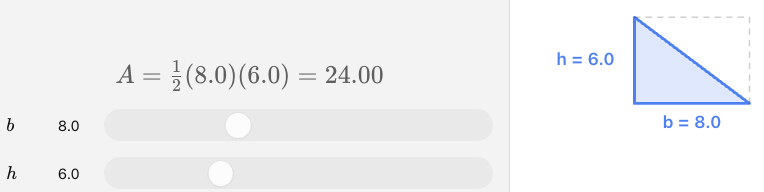
The perpendicular height is the shortest distance from the opposite vertex to the line containing the base.
It must form a 90° angle with that line.
For example, a triangle with a base of 12 cm and a perpendicular height of 7 cm has area:
Area = ½ × 12 × 7
Area = 42 cm²
This formula works for every triangle, including acute, right, and obtuse triangles.
Why Is the Formula One-Half?
A triangle can be paired with an identical copy to form a parallelogram.
The parallelogram has area:
Area = base × height
Each triangle occupies half of that parallelogram.
Therefore:
Area of triangle = ½ × base × height
This geometric relationship is the foundation for the trigonometric area formulas we will develop.
Triangle Notation
In triangle ABC:
-
a is the side opposite angle A.
-
b is the side opposite angle B.
-
c is the side opposite angle C.
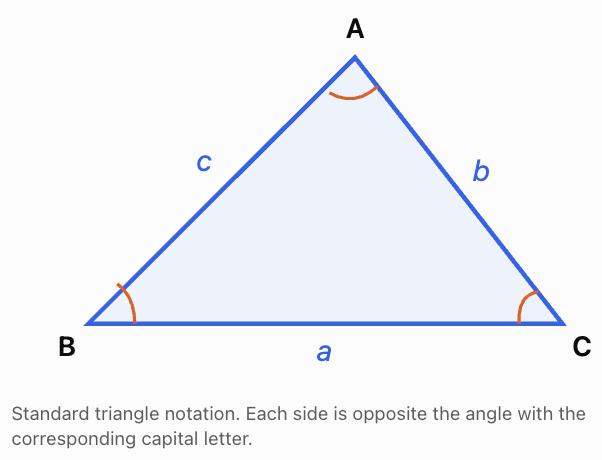
Correctly matching sides and angles is essential when using trigonometric formulas.
Learning Target 1: Calculating Triangle Area Using Trigonometry
When we know two sides of a triangle and the angle between them, we can calculate its area without first determining the perpendicular height numerically.
This is called the sine area formula.
The Sine Area Formula
For triangle ABC:
Area = ½bc sin A
We can also write:
Area = ½ac sin B
or
Area = ½ab sin C
All three formulas give the same area.
The important rule is:
Use two sides and the angle included between them.
Deriving the Sine Area Formula
Consider a triangle with sides b and c meeting at angle A.
Draw a perpendicular height, h, to the line containing side c.
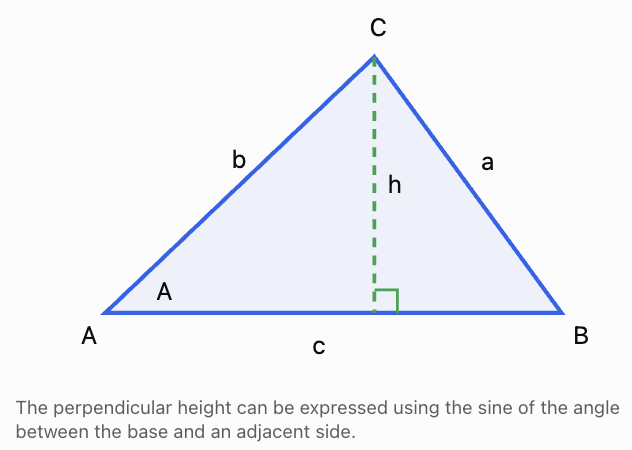
From the right triangle:
sin A = h / b
Therefore:
h = b sin A
The basic area formula is:
Area = ½ × base × height
Using c as the base:
Area = ½ × c × h
Substitute h = b sin A:
Area = ½ × c × b sin A
Therefore:
Area = ½bc sin A
This derivation explains why the sine of the included angle appears in the formula.
For an obtuse included angle, the same formula works because the altitude lies outside the triangle and sin(180° − A) = sin A.
Worked Example 1: Two Sides and an Included Angle
A triangle has:
-
b = 8 cm
-
c = 12 cm
-
A = 40°
Calculate its area.
Step 1: Choose the formula.
Area = ½bc sin A
Step 2: Substitute.
Area = ½ × 8 × 12 × sin 40°
Step 3: Simplify.
Area = 48 × sin 40°
Area ≈ 48 × 0.6428
Area ≈ 30.85 cm²
The area is approximately 30.85 square centimetres.
Worked Example 2: An Obtuse Triangle
A triangle has:
-
a = 10 m
-
b = 15 m
-
C = 120°
Calculate the area.
Area = ½ab sin C
Area = ½ × 10 × 15 × sin 120°
Area = 75 × 0.8660
Area ≈ 64.95 m²
Notice that sin 120° = sin 60°.
The sine area formula works for obtuse triangles just as it does for acute triangles.
Worked Example 3: An Equilateral Triangle
An equilateral triangle has side length 10 cm.
Find its area using trigonometry.
Every interior angle of an equilateral triangle is 60°.
Area = ½ab sin C
Area = ½ × 10 × 10 × sin 60°
Area = 50 × √3/2
Area = 25√3
Area ≈ 43.30 cm²
This leads to the general formula for an equilateral triangle of side length s:
Area = (√3/4)s²
This is a useful special result derived directly from the sine area formula.
How the Included Angle Affects Area
Suppose two sides remain fixed at 10 cm and 12 cm.
The area depends on the included angle:
Area = 60 sin θ
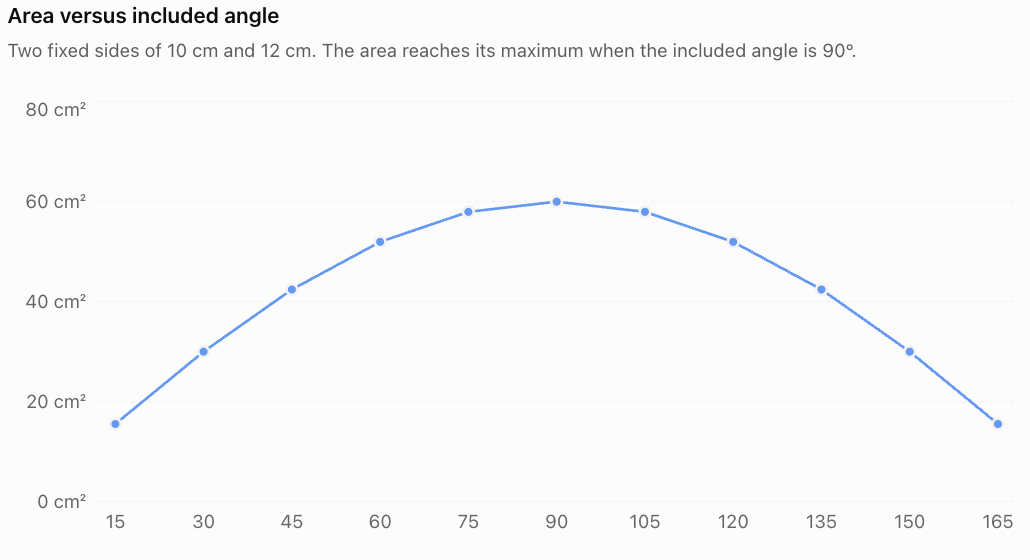
The area increases as the included angle approaches 90°, then decreases as the angle approaches 180°.
This happens because:
sin 90° = 1
which is the maximum possible value of sine.
Therefore, for two fixed side lengths, the maximum area occurs when the included angle is 90°.
This is an important result in geometric design and optimization.
Learning Target 2: Determining Unknown Measurements Before Calculating Area
In many triangle problems, the information needed for an area formula is not given directly.
We may first need to calculate:
-
A missing angle using the angle sum of a triangle.
-
An unknown side using the Law of Sines.
-
An unknown side or angle using the Law of Cosines.
-
A perpendicular height using trigonometric ratios.
This requires combining several mathematical techniques.
Worked Example 4: Finding a Missing Angle First
Triangle ABC has:
-
A = 45°
-
B = 70°
-
a = 12 cm
-
c = 15 cm
Calculate its area.
Step 1: Find angle C.
C = 180° − 45° − 70°
C = 65°
Step 2: Identify the included angle between sides a and c.
Sides a and c meet at angle B.
Therefore, we can use:
Area = ½ac sin B
Step 3: Substitute.
Area = ½ × 12 × 15 × sin 70°
Area = 90 × sin 70°
Area ≈ 84.57 cm²
Although we calculated C, it was not actually necessary for finding the area. Recognizing that B is already the included angle between the known sides is a more efficient approach.
This illustrates an important problem-solving skill: calculate only the missing information that is genuinely needed.
Worked Example 5: Using the Law of Sines First
Triangle ABC has:
-
A = 40°
-
B = 75°
-
a = 10 cm
Calculate its area.
We know only one side, so we must calculate another side before using the sine area formula.
Step 1: Find angle C.
C = 180° − 40° − 75°
C = 65°
Step 2: Find side b using the Law of Sines.
a / sin A = b / sin B
10 / sin 40° = b / sin 75°
b = 10 sin 75° / sin 40°
b ≈ 15.03 cm
Step 3: Calculate the area.
Sides a and b meet at angle C.
Area = ½ab sin C
Area = ½ × 10 × (10 sin 75° / sin 40°) × sin 65°
Area ≈ 68.08 cm²
We retained the unrounded value of b during the calculation to minimize rounding error.
Worked Example 6: Using the Law of Cosines First
A triangle has side lengths:
-
a = 7 cm
-
b = 9 cm
-
c = 12 cm
Calculate its area using trigonometry.
All three sides are known, but none of the angles is given.
Step 1: Calculate angle C using the Law of Cosines.
c² = a² + b² − 2ab cos C
Rearrange:
cos C = (a² + b² − c²) / (2ab)
Substitute:
cos C = (49 + 81 − 144) / 126
cos C = −14 / 126
cos C = −1/9
C ≈ 96.38°
Step 2: Use the sine area formula.
Area = ½ab sin C
Area = ½ × 7 × 9 × sin 96.38°
Area ≈ 31.30 cm²
The triangle is obtuse, but the sine area formula still gives a positive area.
Worked Example 7: Finding a Height Using Trigonometry
A triangular field has a base of 80 m.
An adjacent side is 65 m long and makes an angle of 52° with the base.
Calculate the area.
Step 1: Calculate the perpendicular height.
sin 52° = h / 65
h = 65 sin 52°
h ≈ 51.22 m
Step 2: Use the basic area formula.
Area = ½ × 80 × h
Area = ½ × 80 × 65 sin 52°
Area ≈ 2048.83 m²
We could also calculate this directly using:
Area = ½ × 80 × 65 × sin 52°
Both approaches are equivalent.
A Useful Formula for ASA and AAS Problems
Sometimes we know one side and two angles.
Rather than repeatedly calculating missing sides, we can derive a direct area formula.
Starting with:
Area = ½bc sin A
From the Law of Sines:
b = a sin B / sin A
c = a sin C / sin A
Substitute:
Area = ½ × (a sin B / sin A) × (a sin C / sin A) × sin A
Simplify:
Area = a² sin B sin C / (2 sin A)
Similarly:
Area = b² sin A sin C / (2 sin B)
Area = c² sin A sin B / (2 sin C)
These formulas are useful when one side and all three angles are known.
Learning Target 3: Comparing Different Methods for Finding Area
There is no single best formula for every triangle.
An efficient mathematician chooses the method that uses the available information with the fewest unnecessary calculations.
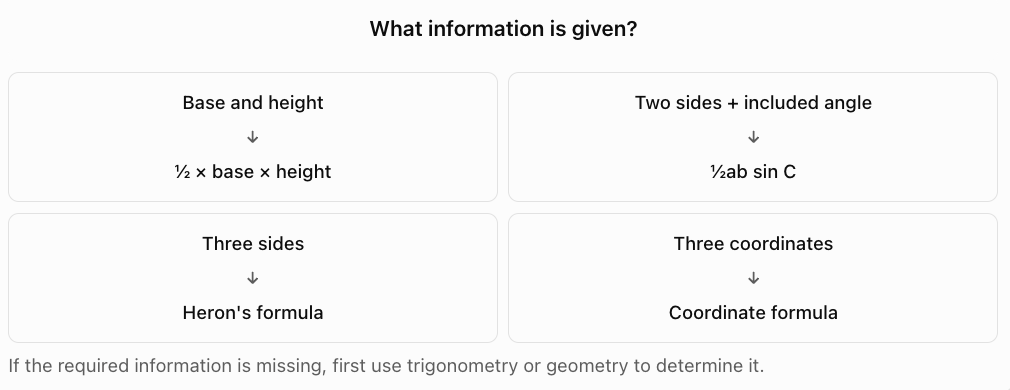
Four Important Area Methods
|
Method |
Formula |
Information needed |
|---|---|---|
|
Base and height |
Area = ½bh |
Base and perpendicular height |
|
Sine area formula |
Area = ½ab sin C |
Two sides and included angle |
|
Heron's formula |
Area = √[s(s−a)(s−b)(s−c)] |
Three sides |
|
Coordinate formula |
Area = ½|x₁(y₂−y₃) + x₂(y₃−y₁) + x₃(y₁−y₂)| |
Three vertex coordinates |
In Heron's formula:
s = (a + b + c) / 2
The value s is called the semiperimeter.
Heron's Formula
Heron's formula allows us to calculate the area of a triangle using only its three side lengths.
It is particularly useful for SSS problems because no angle calculation is required.
Area = √[s(s−a)(s−b)(s−c)]
where:
s = (a + b + c) / 2
Worked Example 8: Finding Area Using Heron's Formula
A triangle has sides:
a = 13 cm, b = 14 cm, c = 15 cm
Step 1: Calculate the semiperimeter.
s = (13 + 14 + 15) / 2
s = 21 cm
Step 2: Apply Heron's formula.
Area = √[21(21−13)(21−14)(21−15)]
Area = √(21 × 8 × 7 × 6)
Area = √7056
Area = 84 cm²
This is an exact answer.
Worked Example 9: Comparing Heron's Formula and Trigonometry
Use both methods to calculate the area of a triangle with sides 5 cm, 6 cm, and 7 cm.
Method 1: Heron's Formula
s = (5 + 6 + 7) / 2 = 9 cm
Area = √[9(9−5)(9−6)(9−7)]
Area = √(9 × 4 × 3 × 2)
Area = √216
Area = 6√6
Area ≈ 14.70 cm²
Method 2: Law of Cosines and Sine Area Formula
Let a = 5, b = 6, and c = 7.
First find C:
cos C = (5² + 6² − 7²) / (2 × 5 × 6)
cos C = (25 + 36 − 49) / 60
cos C = 0.2
C ≈ 78.46°
Now calculate area:
Area = ½ × 5 × 6 × sin 78.46°
Area ≈ 14.70 cm²
Both methods produce the same result.
Which method is better?
For this particular SSS problem, Heron's formula is more efficient because it avoids calculating an angle.
However, the trigonometric method is valuable because it connects triangle area with the Law of Cosines.
Area from Coordinates
When a triangle is given on a coordinate plane, its area can be calculated directly from the coordinates of its vertices.
Suppose:
A = (1, 2)
B = (7, 2)
C = (4, 6)
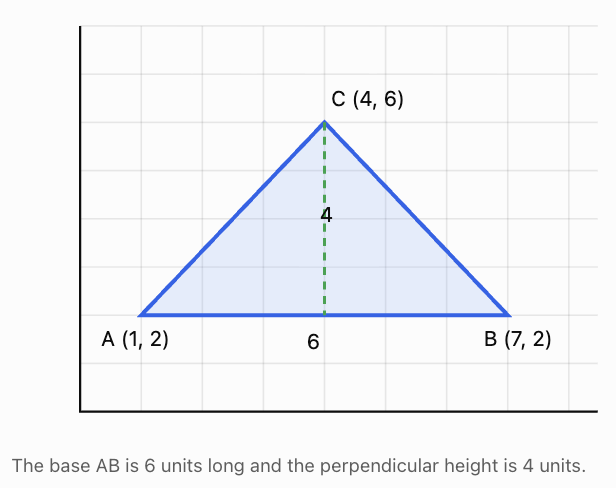
The base is:
7 − 1 = 6 units
The height is:
6 − 2 = 4 units
Area = ½ × 6 × 4
Area = 12 square units
Using the coordinate formula:
Area = ½|1(2−6) + 7(6−2) + 4(2−2)|
Area = ½|−4 + 28 + 0|
Area = 12 square units
The coordinate method is especially useful when the triangle is tilted and its base or height is not immediately obvious.
Choosing the Most Efficient Method
Learning Target 4: Solving Practical Area Problems
Triangle area calculations are used in surveying, architecture, construction, engineering, land management, and design.
Real-world problems often require us to interpret measurements, select an appropriate formula, and convert units.
Application 1: Measuring a Triangular Field
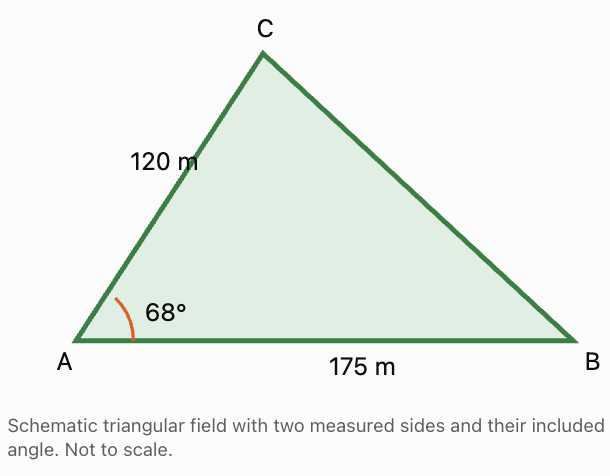
A farmer owns a triangular field.
Two sides measure 120 m and 175 m, and the included angle is 68°.
Calculate the area of the field.
Step 1: Identify the formula.
Area = ½ab sin C
Step 2: Substitute.
Area = ½ × 120 × 175 × sin 68°
Area = 10,500 × sin 68°
Area ≈ 9,735.43 m²
Step 3: Convert to hectares.
1 hectare = 10,000 m²
Area ≈ 9,735.43 / 10,000
Area ≈ 0.974 hectares
This is useful when estimating the amount of seed, fertilizer, or irrigation needed for the field.
Application 2: Designing a Triangular Glass Window
An architect designs a triangular glass window with two sides measuring 2.4 m and 3.1 m.
The angle between the sides is 55°.
Calculate the area of glass required.
Area = ½ × 2.4 × 3.1 × sin 55°
Area = 3.72 × sin 55°
Area ≈ 3.05 m²
Suppose the glass costs $85 per square metre.
Estimated material cost:
Cost = 3.047... × 85
Cost ≈ $259.03
The actual purchase cost may be higher because cutting, waste, installation, and framing are not included.
Application 3: A Triangular Roof Panel
A triangular roof panel has sides of 5 m, 7 m, and 9 m.
Calculate its area.
Since all three sides are known, Heron's formula is appropriate.
s = (5 + 7 + 9) / 2
s = 10.5 m
Area = √[10.5(10.5−5)(10.5−7)(10.5−9)]
Area = √(10.5 × 5.5 × 3.5 × 1.5)
Area ≈ 17.41 m²
If roof covering is sold in panels covering 2 m² each:
17.41 / 2 ≈ 8.71
The minimum theoretical number of panels is 9.
In practice, additional panels may be required because of cutting and waste.
Application 4: A Triangular Sail
A sailboat has a triangular sail.
Two edges of the sail measure 6 m and 8 m, and the angle between them is 70°.
Calculate the sail area.
Area = ½ × 6 × 8 × sin 70°
Area = 24 × sin 70°
Area ≈ 22.55 m²
The sail area influences the amount of wind force the sail can experience, although the actual force also depends on wind speed, sail shape, orientation, and aerodynamic conditions.
Application 5: Land Surveying with Coordinates
A surveyor records the following positions in metres:
A = (0, 0)
B = (80, 20)
C = (30, 90)
Find the area enclosed by the three points.
Using the coordinate formula:
Area = ½|x₁(y₂−y₃) + x₂(y₃−y₁) + x₃(y₁−y₂)|
Substitute:
Area = ½|0(20−90) + 80(90−0) + 30(0−20)|
Area = ½|0 + 7200 − 600|
Area = ½ × 6600
Area = 3300 m²
This method is particularly useful for mapping irregular parcels of land using GPS or surveying coordinates.
Application 6: Finding the Maximum Area of a Triangular Design
An engineer has two support beams measuring 8 m and 12 m.
The angle between them can be adjusted.
What is the maximum possible triangular area?
Area = ½ × 8 × 12 × sin θ
Area = 48 sin θ
Since the maximum value of sin θ is 1:
Maximum area = 48 × 1
Maximum area = 48 m²
This occurs when:
θ = 90°
The result demonstrates an important optimization principle: when two side lengths are fixed, their included angle should be 90° to maximize the triangle's area.
Learning Target 5: Justifying Triangle Area Solutions
A complete mathematical solution should do more than provide a numerical answer.
It should explain:
-
Why a particular formula is appropriate.
-
How the known measurements relate to the formula.
-
Why the calculated area is reasonable.
-
Whether the answer has the correct units.
-
Whether the result can be verified independently.
Method 1: Explain Why the Formula Applies
Suppose a triangle has two sides of 9 cm and 14 cm, with an included angle of 65°.
The sine area formula is appropriate because we know two sides and the angle between them.
Area = ½ × 9 × 14 × sin 65°
Area ≈ 57.10 cm²
A complete justification might state:
"The sine area formula is appropriate because two sides and their included angle are known. The calculated area is positive and is expressed in square centimetres."
Method 2: Check the Maximum Possible Area
For two fixed sides a and b:
Area = ½ab sin C
Because:
0 < sin C ≤ 1 for 0° < C < 180°
the area must satisfy:
0 < Area ≤ ½ab
For sides of 9 cm and 14 cm:
Maximum area = ½ × 9 × 14
Maximum area = 63 cm²
Our calculated area of 57.10 cm² is below the maximum, so it passes this check.
If a calculation produced 80 cm², we would know immediately that an error had occurred.
Method 3: Verify Using Another Formula
Consider a triangle with sides 13 cm, 14 cm, and 15 cm.
Using Heron's formula, we found:
Area = 84 cm²
We can verify this using trigonometry.
First calculate the angle C opposite the 15 cm side:
cos C = (13² + 14² − 15²) / (2 × 13 × 14)
cos C = (169 + 196 − 225) / 364
cos C = 140 / 364 = 5/13
Therefore:
sin C = √[1 − (5/13)²]
sin C = 12/13
Now calculate area:
Area = ½ × 13 × 14 × (12/13)
Area = 84 cm²
Both methods agree exactly.
This provides strong verification.
Method 4: Check Units
If the side lengths are measured in metres, the area must be measured in square metres.
For example:
Area = ½ × 5 m × 8 m × sin 40°
Area ≈ 12.86 m²
The sine function has no units, so multiplying two lengths produces squared units.
An answer of 12.86 m would be incorrect because metres measure length, not area.
Method 5: Evaluate the Context
Suppose a triangular garden has two sides of 4 m and 6 m.
A student calculates an area of 25 m².
The maximum possible area is:
½ × 4 × 6 = 12 m²
Therefore, 25 m² is impossible.
The answer should be rejected even before checking the detailed calculation.
This demonstrates why mathematical reasoning and estimation are important parts of problem-solving.
Common Mistakes
Mistake 1: Using an Angle That Is Not Included
Incorrect:
Area = ½ab sin A
when A is not the angle between sides a and b.
Correct:
Area = ½ab sin C
The angle must be between the two selected sides.
Mistake 2: Forgetting the Factor of One-Half
Incorrect:
Area = ab sin C
Correct:
Area = ½ab sin C
Forgetting ½ doubles the answer.
Mistake 3: Using a Sloping Side as the Perpendicular Height
The height must be perpendicular to the base.
If a sloping side makes an angle θ with the base, the height may be calculated using:
h = side × sin θ
Mistake 4: Using Heron's Formula Without Calculating the Semiperimeter
Heron's formula uses:
s = (a + b + c) / 2
It does not use the full perimeter.
Mistake 5: Using the Wrong Calculator Mode
When angles are measured in degrees, the calculator must be in degree mode.
For example:
sin 30° = 0.5
Mistake 6: Giving Area in Linear Units
Incorrect:
Area = 45 cm
Correct:
Area = 45 cm²
Area always requires square units.
Mistake 7: Rounding Intermediate Values Too Early
If you first calculate an unknown side or angle, retain the unrounded value when using it to find the area.
Rounding intermediate values can introduce unnecessary errors.
Mistake 8: Assuming Every Triangle Requires Trigonometry
If the base and perpendicular height are already known, use:
Area = ½bh
There is no need to calculate an angle.
The most efficient method is usually the one that uses the given information directly.
Key Terms
-
Area: The amount of two-dimensional space enclosed by a shape.
-
Base: A selected side of a triangle used when calculating its area.
-
Perpendicular height: The shortest distance from a vertex to the line containing the opposite side.
-
Included angle: The angle between two specified sides.
-
Sine area formula: A trigonometric formula for finding area using two sides and their included angle.
-
Heron's formula: A formula for finding the area of a triangle using its three side lengths.
-
Semiperimeter: Half the perimeter of a triangle.
-
Law of Sines: A relationship connecting the sides of a triangle with the sines of their opposite angles.
-
Law of Cosines: A relationship connecting the sides of a triangle and the cosine of an included angle.
-
Coordinate area formula: A method for calculating area from the coordinates of three vertices.
-
Optimization: The process of finding a maximum or minimum value under given conditions.
-
Verification: Checking whether a mathematical result satisfies the original information and constraints.
-
Square units: Units used to measure area, such as cm² or m².
-
Triangulation: A measurement technique that uses triangles to determine unknown distances or positions.
Key Takeaways
-
The basic triangle area formula is Area = ½bh.
-
The sine area formula is Area = ½ab sin C, where C is the included angle.
-
The sine area formula works for acute, right, and obtuse triangles.
-
Missing sides or angles can be calculated using the Law of Sines or Law of Cosines before finding area.
-
Heron's formula calculates area directly from three side lengths.
-
Coordinate geometry provides another method when the vertices are known.
-
Choosing an efficient method depends on the given measurements.
-
For two fixed side lengths, the maximum area occurs when the included angle is 90°.
-
Area must always be expressed in square units.
-
A strong mathematical solution includes appropriate formulas, accurate calculations, clear reasoning, and verification.
Check Your Understanding
These questions assess all five learning targets, including calculating areas, finding missing measurements, comparing methods, solving practical problems, and justifying answers.
Part A: Calculating Area Using Trigonometry
Question 1
A triangle has two sides measuring 8 cm and 11 cm. The included angle is 50°.
Calculate its area to two decimal places.
Question 2
A triangle has sides a = 12 m and b = 15 m, with included angle C = 120°.
Calculate its area and explain why the formula works for an obtuse triangle.
Part B: Determining Missing Measurements
Question 3
Triangle ABC has:
A = 40°, B = 60°, a = 10 cm
Calculate the area of the triangle.
Question 4
A triangle has side lengths 6 cm, 8 cm, and 10 cm.
Use the Law of Cosines to determine the largest angle, then calculate the area.
Part C: Comparing Methods
Question 5
Choose the most efficient method for each situation.
a) Base = 12 cm, perpendicular height = 7 cm
b) Two sides of 9 cm and 13 cm, included angle = 45°
c) Three sides of 8 cm, 10 cm, and 12 cm
d) Vertices at (1, 1), (7, 1), and (4, 5)
Explain each choice.
Part D: Practical Applications
Question 6
A triangular garden has two sides measuring 18 m and 24 m, with an included angle of 65°.
Calculate the area of the garden.
Question 7
A triangular metal plate has sides measuring 5 m, 7 m, and 8 m.
Calculate its area using Heron's formula.
Question 8
An architect designs a triangular window with two sides of 2 m and 3 m.
What is the maximum possible area of the window? At what included angle does this occur?
Part E: Justification and Reasoning
Question 9
A student calculates the area of a triangle with two sides of 6 cm and 10 cm as 40 cm².
Explain why this answer must be incorrect, regardless of the included angle.
Question 10
A triangle has sides of 13 cm, 14 cm, and 15 cm.
Calculate its area using Heron's formula and explain how you could verify the result using trigonometry.
Check Your Understanding — Fully Worked Answers
Answer 1
Area = ½ab sin C
Area = ½ × 8 × 11 × sin 50°
Area = 44 sin 50°
Area ≈ 33.71 cm²
Answer 2
Area = ½ × 12 × 15 × sin 120°
Area = 90 × sin 120°
Area ≈ 77.94 m²
The formula works because the sine of an obtuse angle between 90° and 180° is positive. The perpendicular height is related to the supplementary acute angle, which has the same sine.
Answer 3
Given:
A = 40°, B = 60°, a = 10 cm
Step 1: Find angle C.
C = 180° − 40° − 60° = 80°
Step 2: Find side b.
b = 10 sin 60° / sin 40°
b ≈ 13.47 cm
Step 3: Find the area.
Area = ½ab sin C
Area = ½ × 10 × (10 sin 60° / sin 40°) × sin 80°
Area ≈ 66.34 cm²
Answer 4
Given sides 6 cm, 8 cm, and 10 cm.
Let C be the angle opposite the longest side.
cos C = (6² + 8² − 10²) / (2 × 6 × 8)
cos C = (36 + 64 − 100) / 96
cos C = 0
Therefore:
C = 90°
Area = ½ × 6 × 8 × sin 90°
Area = 24 cm²
Answer 5
a) Base and height formula, because both required measurements are known.
b) Sine area formula, because two sides and their included angle are known.
c) Heron's formula, because all three sides are known.
d) Coordinate formula, because the three vertices are known. In this particular case, the base-height formula is also straightforward.
Answer 6
Area = ½ × 18 × 24 × sin 65°
Area = 216 sin 65°
Area ≈ 195.76 m²
Answer 7
Given:
a = 5 m, b = 7 m, c = 8 m
Semiperimeter:
s = (5 + 7 + 8) / 2 = 10 m
Heron's formula:
Area = √[10(10−5)(10−7)(10−8)]
Area = √(10 × 5 × 3 × 2)
Area = √300
Area ≈ 17.32 m²
Answer 8
Area = ½ × 2 × 3 × sin θ
Area = 3 sin θ
The maximum value of sine is 1, which occurs at θ = 90°.
Maximum area = 3 m²
Included angle = 90°
Answer 9
The maximum possible area is:
Area(max) = ½ × 6 × 10
Area(max) = 30 cm²
Since 40 cm² exceeds the maximum possible area, the student's result is impossible.
The area cannot exceed 30 cm².
Answer 10
Given:
a = 13 cm, b = 14 cm, c = 15 cm
Semiperimeter:
s = (13 + 14 + 15) / 2
s = 21 cm
Heron's formula:
Area = √[21(21−13)(21−14)(21−15)]
Area = √(21 × 8 × 7 × 6)
Area = 84 cm²
To verify, calculate the included angle between the 13 cm and 14 cm sides using the Law of Cosines, then substitute into:
Area = ½ × 13 × 14 × sin C
This also gives 84 cm².
Final Challenge: Designing a Triangular Recreation Area
A town plans to construct a triangular recreation area with sides measuring:
-
80 m
-
110 m
-
130 m
The town needs to determine the total area before estimating landscaping costs.
Calculate:
-
The area using Heron's formula.
-
The angle between the 80 m and 110 m sides.
-
The area again using the sine area formula.
-
The landscaping cost if the price is $12 per square metre.
-
Explain why the two area calculations agree.
Fully Worked Solution
Step 1: Calculate the semiperimeter.
s = (80 + 110 + 130) / 2
s = 160 m
Step 2: Apply Heron's formula.
Area = √[160(160−80)(160−110)(160−130)]
Area = √(160 × 80 × 50 × 30)
Area = √19,200,000
Area ≈ 4381.78 m²
Step 3: Calculate the included angle.
Let θ be the angle between the 80 m and 110 m sides.
Using the Law of Cosines:
cos θ = (80² + 110² − 130²) / (2 × 80 × 110)
cos θ = (6400 + 12100 − 16900) / 17600
cos θ = 1600 / 17600
cos θ = 1/11
θ ≈ 84.78°
Step 4: Verify using the sine area formula.
Area = ½ × 80 × 110 × sin θ
Using cos θ = 1/11:
sin θ = √(1 − 1/121)
sin θ = √120/11
Therefore:
Area = 4400 × √120/11
Area = 400√120
Area ≈ 4381.78 m²
The two methods agree.
Step 5: Calculate the landscaping cost.
Cost = Area × $12
Cost = 4381.780... × 12
Cost ≈ $52,581.36
Final Results
|
Measurement |
Result |
|---|---|
|
Semiperimeter |
160 m |
|
Included angle |
84.78° |
|
Area using Heron's formula |
4381.78 m² |
|
Area using trigonometry |
4381.78 m² |
|
Estimated landscaping cost |
$52,581.36 |
The two area calculations agree because both formulas describe the same geometric property of the triangle, using different measurements.
This provides an independent verification of the solution.
Conclusion
Calculating the area of a triangle is much more than substituting values into a single formula.
By combining geometry and trigonometry, we can determine triangle areas from a variety of measurements, even when the perpendicular height is unknown.
The sine area formula is especially useful when two sides and their included angle are known. The Law of Sines and Law of Cosines allow us to calculate missing measurements, while Heron's formula and coordinate geometry provide alternative methods.
Knowing which method to choose is an important part of mathematical problem-solving. Efficient solutions use the available information directly and avoid unnecessary calculations.
Equally important is the ability to justify and verify results. Comparing methods, checking units, and evaluating whether an answer is reasonable help us develop mathematical confidence.
The ability to calculate and justify triangle areas is essential in surveying, architecture, construction, engineering, land management, and many other practical applications of mathematics.