Non-Right Triangles
2. The Law of Cosines
Learning outcomes
- I can apply the Law of Cosines to determine unknown sides.
- I can apply the Law of Cosines to determine unknown angles.
- I can identify when the Law of Cosines should be used.
- I can solve practical measurement problems.
- I can verify my solutions.
Introduction
Imagine two roads leaving the same intersection in different directions. One road extends 8 km, and the other extends 12 km. The angle between them is 65°.
How far apart are the endpoints of these roads?
We cannot simply add or subtract the distances because the roads form an angle. We also cannot use the Pythagorean theorem directly because the angle is not 90°.
Instead, we can use a powerful trigonometric relationship called the Law of Cosines.
The Law of Cosines allows us to calculate unknown sides and angles in triangles, including triangles that do not contain a right angle. It is especially useful in navigation, surveying, engineering, construction, physics, and geometry.
In this lesson, we will learn how to calculate missing sides, determine unknown angles, select the correct trigonometric method, solve practical measurement problems, and verify that our answers are correct.
Understanding the Law of Cosines
The Law of Cosines is a relationship between the three sides of a triangle and the cosine of one of its angles.
Consider triangle ABC.
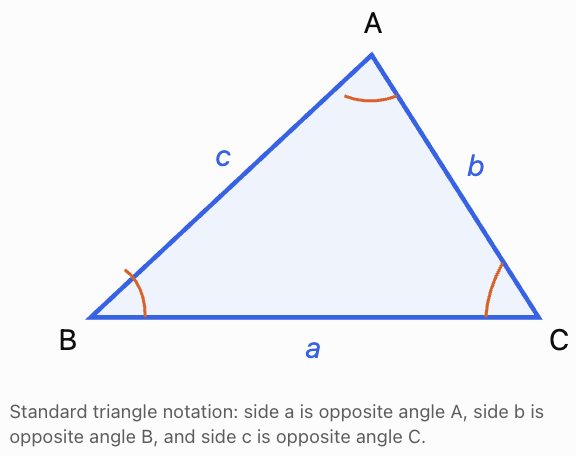
The Law of Cosines can be written in three equivalent forms:
To find side a:
a² = b² + c² − 2bc cos A
To find side b:
b² = a² + c² − 2ac cos B
To find side c:
c² = a² + b² − 2ab cos C
Each formula follows the same pattern:
(Opposite side)² = (first adjacent side)² + (second adjacent side)² − 2 × (adjacent sides) × cos(included angle)
The included angle is the angle between the two known sides.
Exploring How the Law of Cosines Works
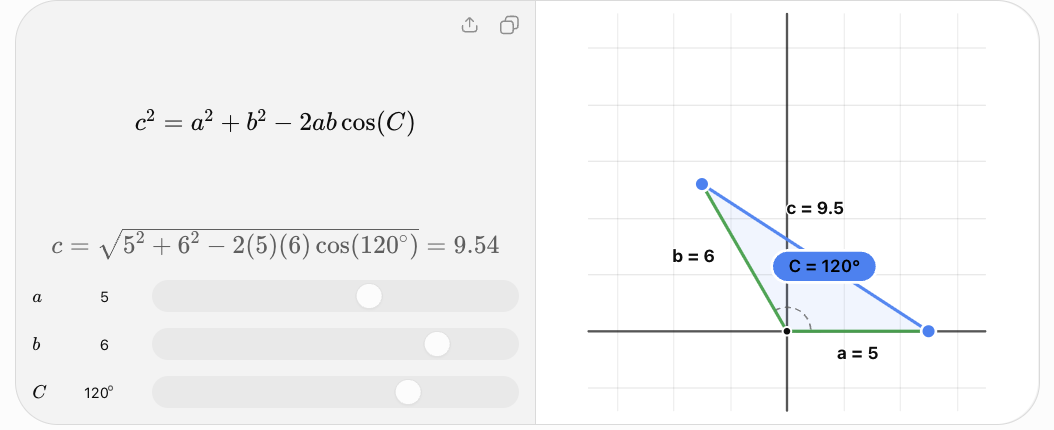
Change the side lengths and the included angle in the interactive triangle. Observe how the opposite side changes.
In particular:
-
Increasing the included angle while keeping the adjacent sides fixed increases the opposite side.
-
Decreasing the included angle decreases the opposite side.
-
When the included angle is 90°, the Law of Cosines becomes the Pythagorean theorem.
Connection to the Pythagorean Theorem
For a right triangle:
c² = a² + b²
The Law of Cosines gives:
c² = a² + b² − 2ab cos C
If C = 90°:
cos 90° = 0
Therefore:
c² = a² + b² − 2ab(0)
c² = a² + b²
This shows that the Pythagorean theorem is a special case of the Law of Cosines.
The Law of Cosines extends the Pythagorean theorem to triangles with acute or obtuse angles.
Why Does the Law of Cosines Work?
We can derive the formula using the Pythagorean theorem.
Consider a triangle with sides a, b, and c, where angle C lies between sides a and b.
Draw a perpendicular from the opposite vertex to the line containing side a.
For an acute angle C, the horizontal projection of side b is:
x = b cos C
The vertical height is:
h = b sin C
The remaining horizontal distance is:
a − b cos C
Using the Pythagorean theorem:
c² = (a − b cos C)² + (b sin C)²
Expand the squared expression:
c² = a² − 2ab cos C + b² cos² C + b² sin² C
Factor the final two terms:
c² = a² − 2ab cos C + b²(cos² C + sin² C)
Recall the identity:
cos² C + sin² C = 1
Therefore:
c² = a² − 2ab cos C + b²
Rearranging:
c² = a² + b² − 2ab cos C
The same coordinate argument works for obtuse angles because cosine becomes negative and the horizontal projection is signed.
This derivation demonstrates that the Law of Cosines follows directly from the Pythagorean theorem and basic trigonometric identities.
Learning Target 1: Determining Unknown Sides
The Law of Cosines is particularly useful when we know two sides of a triangle and the angle between them.
This is called the Side-Angle-Side (SAS) case.
Steps for Finding an Unknown Side
-
Draw and label the triangle.
-
Identify the two known sides and their included angle.
-
Select the correct version of the Law of Cosines.
-
Substitute the known values.
-
Calculate the squared unknown side.
-
Take the positive square root.
-
Check whether the result is reasonable.
Worked Example 1: Finding a Missing Side
Triangle ABC has:
-
a = 7 cm
-
b = 10 cm
-
C = 60°
Find side c.
Step 1: Write the formula.
c² = a² + b² − 2ab cos C
Step 2: Substitute.
c² = 7² + 10² − 2(7)(10)cos 60°
Step 3: Simplify.
c² = 49 + 100 − 140(0.5)
c² = 149 − 70
c² = 79
Step 4: Take the square root.
c = √79
c ≈ 8.89 cm
Verification: The side length lies between the difference and sum of the other two sides:
3 < 8.89 < 17
The triangle is possible.
Worked Example 2: An Obtuse Triangle
A triangle has:
-
a = 9 m
-
b = 12 m
-
C = 120°
Find side c.
c² = a² + b² − 2ab cos C
c² = 9² + 12² − 2(9)(12)cos 120°
Since cos 120° = −0.5:
c² = 81 + 144 − 216(−0.5)
c² = 225 + 108
c² = 333
c = √333
c ≈ 18.25 m
Notice that the side opposite the obtuse angle is the longest side.
This makes sense because the largest angle in a triangle must be opposite the longest side.
Worked Example 3: Comparing Different Included Angles
Suppose two sides of a triangle are fixed at 6 cm and 9 cm.
How does the third side change as the included angle increases?
|
Included angle C |
Calculation |
Side c |
|---|---|---|
|
30° |
√(36 + 81 − 108 cos 30°) |
4.84 cm |
|
60° |
√(36 + 81 − 108 cos 60°) |
7.94 cm |
|
90° |
√117 |
10.82 cm |
|
120° |
√(36 + 81 − 108 cos 120°) |
13.08 cm |
|
150° |
√(36 + 81 − 108 cos 150°) |
14.51 cm |
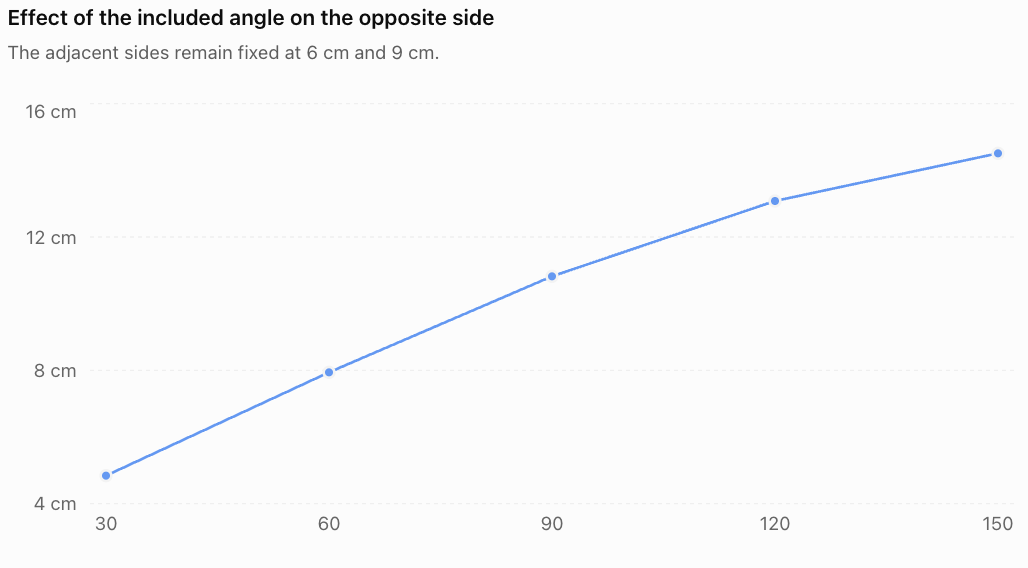
As the included angle increases, the opposite side becomes longer.
This is an important geometric relationship and a useful way to check answers.
Learning Target 2: Determining Unknown Angles
The Law of Cosines can also be used to calculate angles when all three side lengths are known.
This is called the Side-Side-Side (SSS) case.
To calculate an angle, we must first rearrange the formula.
Starting with:
a² = b² + c² − 2bc cos A
Move terms:
2bc cos A = b² + c² − a²
Divide by 2bc:
cos A = (b² + c² − a²) / (2bc)
Use inverse cosine:
A = cos⁻¹[(b² + c² − a²) / (2bc)]
Similarly:
B = cos⁻¹[(a² + c² − b²) / (2ac)]
C = cos⁻¹[(a² + b² − c²) / (2ab)]
Worked Example 4: Finding an Angle from Three Sides
A triangle has:
-
a = 8 cm
-
b = 11 cm
-
c = 13 cm
Find angle C.
Step 1: Write the rearranged formula.
cos C = (a² + b² − c²) / (2ab)
Step 2: Substitute.
cos C = (8² + 11² − 13²) / (2 × 8 × 11)
Step 3: Simplify.
cos C = (64 + 121 − 169) / 176
cos C = 16 / 176
cos C ≈ 0.09091
Step 4: Use inverse cosine.
C = cos⁻¹(0.09091)
C ≈ 84.78°
This is an acute angle, consistent with the fact that 13² is slightly less than 8² + 11².
Worked Example 5: Finding All Three Angles
A triangle has side lengths:
a = 5 cm, b = 7 cm, c = 9 cm
Find all three angles.
Step 1: Find angle A.
cos A = (7² + 9² − 5²) / (2 × 7 × 9)
cos A = (49 + 81 − 25) / 126
cos A = 105 / 126
A ≈ 33.56°
Step 2: Find angle B.
cos B = (5² + 9² − 7²) / (2 × 5 × 9)
cos B = (25 + 81 − 49) / 90
cos B = 57 / 90
B ≈ 50.70°
Step 3: Find angle C.
C = 180° − A − B
C ≈ 180° − 33.56° − 50.70°
C ≈ 95.74°
Final answers:
-
A ≈ 33.56°
-
B ≈ 50.70°
-
C ≈ 95.74°
Check:
33.56° + 50.70° + 95.74° = 180°
The longest side, c = 9 cm, is opposite the largest angle, C.
Worked Example 6: Classifying a Triangle Using Side Lengths
A triangle has side lengths:
6 cm, 8 cm, and 11 cm.
Determine whether it is acute, right, or obtuse.
The longest side is 11 cm.
Compare:
11² = 121
6² + 8² = 36 + 64 = 100
Since:
121 > 100
the triangle is obtuse.
We can calculate the largest angle:
cos C = (6² + 8² − 11²) / (2 × 6 × 8)
cos C = −21 / 96
C ≈ 102.64°
Answer: The triangle is obtuse, with its largest angle approximately 102.64°.
This gives a useful classification rule, provided the side lengths form a valid triangle:
-
Longest side squared < sum of the other two squares: acute triangle.
-
Longest side squared = sum of the other two squares: right triangle.
-
Longest side squared > sum of the other two squares: obtuse triangle.
Learning Target 3: Identifying When to Use the Law of Cosines
Choosing the correct trigonometric method is an essential mathematical skill.
Not every triangle problem should be solved using the same formula. The most efficient method depends on which sides and angles are known.
Comparing the Law of Sines and Law of Cosines
|
Given information |
Recommended method |
Reason |
|---|---|---|
|
SAS |
Law of Cosines |
Two sides and their included angle are known |
|
SSS |
Law of Cosines |
All three sides are known |
|
ASA |
Law of Sines |
Two angles and the included side are known |
|
AAS |
Law of Sines |
Two angles and a non-included side are known |
|
SSA |
Law of Sines |
An opposite angle-side pair is known; check ambiguity |
The Law of Cosines can sometimes be used after applying the Law of Sines, and vice versa.
For example, in an SAS triangle, we might use the Law of Cosines to calculate the third side, then use the Law of Sines to calculate an angle.
Decision Guide
What measurements are given?
SAS or SSS
Law of Cosines
Find a side or angle
ASA, AAS or SSA
Law of Sines
Check SSA ambiguity
Worked Example 7: Selecting the Correct Method
For each triangle, decide which method should be used first.
Triangle A
a = 8 cm, b = 11 cm, C = 45°
We know two sides and the included angle.
This is SAS.
Use the Law of Cosines.
Triangle B
A = 40°, B = 75°, a = 12 cm
We know two angles and a side.
This is AAS.
Use the Law of Sines.
Triangle C
a = 7 cm, b = 9 cm, c = 13 cm
We know all three sides.
This is SSS.
Use the Law of Cosines.
Triangle D
A = 35°, a = 8 cm, b = 10 cm
We know two sides and a non-included angle.
This is SSA.
Use the Law of Sines and check for multiple solutions.
Worked Example 8: Using Both Laws to Solve a Triangle
A triangle has:
a = 9 cm, b = 13 cm, C = 55°
Find the remaining side and angles.
Step 1: Find side c using the Law of Cosines.
c² = 9² + 13² − 2(9)(13)cos 55°
c² ≈ 115.77
c ≈ 10.76 cm
Step 2: Find angle A using the Law of Sines.
sin A / 9 = sin 55° / 10.76
sin A ≈ 0.685
A ≈ 43.24°
Step 3: Find angle B.
B = 180° − 55° − 43.24°
B ≈ 81.76°
Final answers:
-
a = 9 cm
-
b = 13 cm
-
c ≈ 10.76 cm
-
A ≈ 43.24°
-
B ≈ 81.76°
-
C = 55°
Since side b is the longest, angle B should be the largest. Our answer is consistent.
There is no second triangle here because the original SAS information uniquely determines the triangle.
Learning Target 4: Solving Practical Measurement Problems
The Law of Cosines is particularly useful when distances and directions are known but a direct measurement is difficult.
Application 1: Navigation — Two Ships
Two ships leave the same harbour.
-
Ship A travels 15 km.
-
Ship B travels 20 km.
-
The angle between their routes is 65°.
How far apart are the ships?
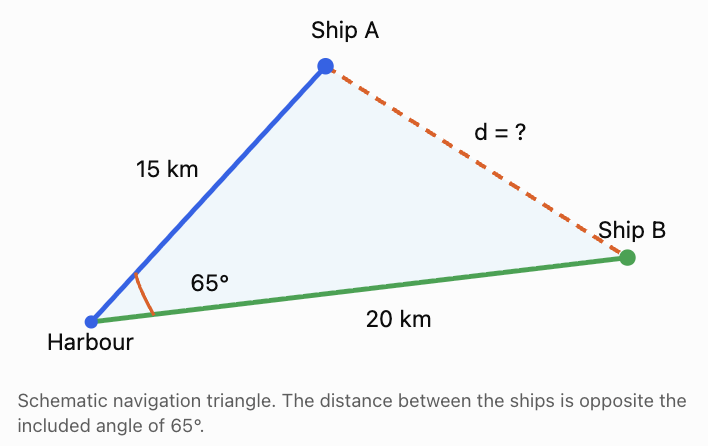
Step 1: Identify the known measurements.
We have two sides and the included angle (SAS).
Step 2: Apply the Law of Cosines.
d² = 15² + 20² − 2(15)(20)cos 65°
d² = 225 + 400 − 600 cos 65°
d² ≈ 371.43
Step 3: Calculate the distance.
d = √371.43
d ≈ 19.27 km
The ships are approximately 19.27 km apart.
Application 2: Surveying — Distance Between Two Landmarks
A surveyor stands at point P and observes two landmarks, A and B.
The measurements are:
-
PA = 120 m
-
PB = 175 m
-
Angle APB = 78°
Calculate the distance between the landmarks.
Step 1: Write the formula.
AB² = PA² + PB² − 2(PA)(PB)cos 78°
Step 2: Substitute.
AB² = 120² + 175² − 2(120)(175)cos 78°
AB² = 14,400 + 30,625 − 42,000 cos 78°
AB² ≈ 36,292.71
Step 3: Calculate AB.
AB = √36,292.71
AB ≈ 190.51 m
The landmarks are approximately 190.51 m apart.
This technique is useful when obstacles prevent a direct measurement between landmarks.
Application 3: Construction — A Roof Support
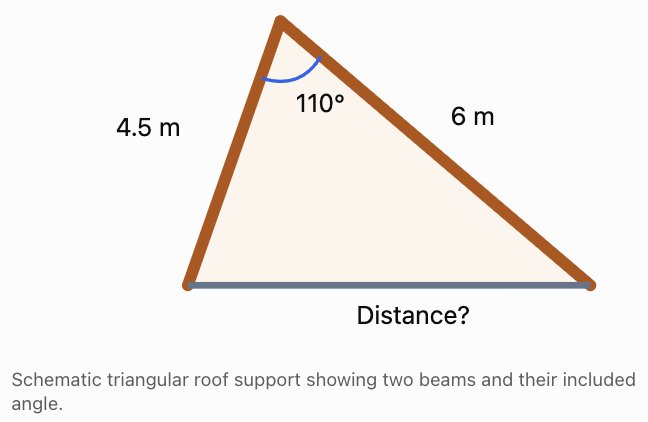
Two structural beams meet at an angle of 110°.
One beam is 4.5 m long and the other is 6 m long.
Calculate the distance between their free ends.
Using the Law of Cosines:
d² = 4.5² + 6² − 2(4.5)(6)cos 110°
d² = 20.25 + 36 − 54 cos 110°
d² ≈ 74.72
d ≈ 8.64 m
Answer: The free ends are approximately 8.64 m apart.
This information can be used when determining the length of a connecting support.
Application 4: Physics — Resultant Forces
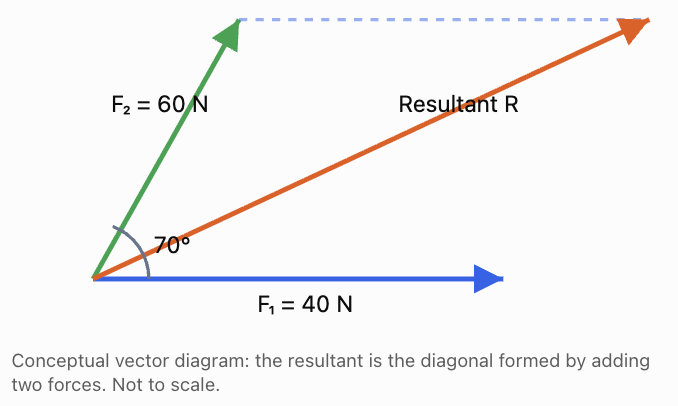
The Law of Cosines can also be used to calculate the magnitude of a resultant force.
Suppose two forces act on an object:
-
F₁ = 40 N
-
F₂ = 60 N
-
Angle between the forces = 70°
We want to calculate the magnitude of their resultant.
For two vectors added tail-to-tail, the resultant magnitude is:
R² = F₁² + F₂² + 2F₁F₂ cos θ
Notice the plus sign.
This happens because the interior angle opposite the resultant in the head-to-tail triangle is 180° − θ, and cos(180° − θ) = −cos θ.
Substitute:
R² = 40² + 60² + 2(40)(60)cos 70°
R² = 1600 + 3600 + 4800 cos 70°
R² ≈ 6841.70
R = √6841.70
R ≈ 82.71 N
This application demonstrates that the geometry of triangles is closely connected to vector addition in physics.
Application 5: A Drone Flight
A drone travels 3 km east and then 4 km in a direction 50° north of east.
Calculate its straight-line displacement from its starting point.
The angle between the two displacement vectors is 50°.
Using the vector-resultant form:
d² = 3² + 4² + 2(3)(4)cos 50°
d² = 9 + 16 + 24 cos 50°
d² ≈ 40.43
d ≈ 6.36 km
Answer: The drone is approximately 6.36 km from its starting point.
The total distance travelled is:
3 + 4 = 7 km
However, the magnitude of the displacement is only approximately 6.36 km.
This highlights the difference between distance and displacement.
Learning Target 5: Verifying Solutions
Solving a triangle is not complete until we have checked that the result is mathematically valid and reasonable.
The Law of Cosines provides several ways to verify calculations.
Method 1: Check the Triangle Inequality
The sum of any two sides must be greater than the third side.
For example, consider a triangle with sides:
a = 7 cm, b = 10 cm, c = 14 cm
Check:
7 + 10 > 14
7 + 14 > 10
10 + 14 > 7
All three inequalities are satisfied.
The side lengths can form a triangle.
However, consider:
a = 3 cm, b = 5 cm, c = 9 cm
Since:
3 + 5 < 9
the triangle is impossible.
Always check that the given measurements describe a valid triangle before attempting to calculate its angles.
Method 2: Check the Angle Sum
Every triangle must satisfy:
A + B + C = 180°
Suppose we calculate:
A = 45.2°
B = 63.7°
C = 71.1°
Check:
45.2° + 63.7° + 71.1° = 180°
The angles are consistent.
Method 3: Compare Sides and Angles
The longest side must be opposite the largest angle.
For example:
|
Side |
Length |
Opposite angle |
|---|---|---|
|
a |
6 cm |
30° |
|
b |
10 cm |
60° |
|
c |
12 cm |
90° |
The ordering is consistent: larger angles are opposite longer sides.
However, these particular side lengths and angles are not an exact matching triangle. This comparison checks the ordering only, not the complete numerical solution.
Method 4: Substitute into the Original Formula
Consider a triangle with:
a = 7 cm, b = 10 cm, C = 60°
We previously calculated:
c = √79 ≈ 8.89 cm
Substitute the exact result:
c² = 7² + 10² − 2(7)(10)cos 60°
c² = 49 + 100 − 70
c² = 79
Since c = √79, both sides agree exactly.
The solution is verified.
Method 5: Check Whether the Angle Is Reasonable
The sign of cosine provides a useful test.
|
Angle type |
Cosine value |
|---|---|
|
Acute (0°–90°) |
Positive |
|
Right (90°) |
Zero |
|
Obtuse (90°–180°) |
Negative |
Suppose a calculation gives:
cos C = −0.4
Then angle C must be obtuse.
C = cos⁻¹(−0.4)
C ≈ 113.58°
An answer of 66.42° would be incorrect because it is acute and has a positive cosine.
Worked Example 9: Finding and Verifying an Angle
A triangle has:
a = 6 cm, b = 8 cm, c = 11 cm
Calculate angle C and verify that the result is reasonable.
Step 1: Use the Law of Cosines.
cos C = (a² + b² − c²) / (2ab)
cos C = (36 + 64 − 121) / 96
cos C = −21 / 96
cos C = −0.21875
Step 2: Find the angle.
C = cos⁻¹(−0.21875)
C ≈ 102.64°
Step 3: Verify using side lengths.
The longest side is c = 11 cm.
Therefore, angle C must be the largest angle.
Since C is obtuse, the other two angles must be acute.
This is consistent.
Step 4: Verify using the squared side lengths.
11² = 121
6² + 8² = 100
Since 121 > 100, the triangle must be obtuse.
Our calculated angle of approximately 102.64° confirms this.
Common Mistakes
Mistake 1: Using the Wrong Angle
Incorrect:
c² = a² + b² − 2ab cos A
Correct:
c² = a² + b² − 2ab cos C
The angle in the formula must be opposite the unknown side and between the two known sides.
Mistake 2: Forgetting the Square Root
If:
c² = 144
then:
c = 12
not 144.
When calculating a side length, take the positive square root at the end.
Mistake 3: Incorrectly Rearranging the Formula
Starting with:
a² = b² + c² − 2bc cos A
The correct rearrangement is:
cos A = (b² + c² − a²) / (2bc)
Be careful with the negative sign when moving terms.
Mistake 4: Using the Wrong Calculator Mode
If an angle is measured in degrees, the calculator must be in degree mode.
For example:
cos 60° = 0.5
Using radian mode will produce an incorrect result for an input of 60.
Mistake 5: Using the Law of Sines for SAS
If two sides and their included angle are known, there is no immediately available opposite side-angle pair.
The Law of Cosines is normally the most efficient first method.
Mistake 6: Confusing Vector Addition with Triangle Side Calculations
For the interior angle C of a triangle:
c² = a² + b² − 2ab cos C
For the magnitude of the resultant of two vectors separated by an angle θ:
R² = a² + b² + 2ab cos θ
The formulas describe related geometric situations but use different angle conventions.
Mistake 7: Rounding Too Early
If a calculation produces:
c² = 127.638492
keep the full calculator value before taking the square root.
Round only the final answer to the required accuracy.
Key Terms
-
Law of Cosines: A trigonometric relationship connecting the three sides of a triangle and the cosine of an angle.
-
Included angle: The angle located between two specified sides.
-
Opposite side: The side directly across from an angle.
-
SAS (Side-Angle-Side): Two sides and the angle between them are known.
-
SSS (Side-Side-Side): All three sides of a triangle are known.
-
Cosine: A trigonometric function used to relate angles and side lengths.
-
Inverse cosine: The operation used to determine an angle from its cosine value.
-
Acute triangle: A triangle in which all three angles are less than 90°.
-
Right triangle: A triangle containing one angle of exactly 90°.
-
Obtuse triangle: A triangle containing one angle greater than 90°.
-
Pythagorean theorem: A relationship between the sides of a right triangle.
-
Triangle inequality: The rule that the sum of any two sides must exceed the third side.
-
Resultant vector: A single vector representing the combined effect of two or more vectors.
-
Triangulation: A measurement technique using known distances and angles to determine unknown positions or distances.
-
Verification: The process of checking whether a calculated solution satisfies the original conditions.
Key Takeaways
-
The Law of Cosines works for acute, right, and obtuse triangles.
-
It is particularly useful for SAS and SSS problems.
-
To find a missing side, use the two known sides and their included angle.
-
To find a missing angle, rearrange the formula and use inverse cosine.
-
The Law of Cosines becomes the Pythagorean theorem when the included angle is 90°.
-
The Law of Sines is generally preferred for ASA, AAS, and SSA problems.
-
The Law of Cosines is useful in surveying, navigation, engineering, construction, and physics.
-
Always check the triangle inequality, angle sum, side-angle relationships, and original equation.
-
Keep full precision during calculations and round only final answers.
-
A complete mathematical solution includes correct calculations, units, and verification.
Check Your Understanding
These questions assess all five learning targets.
Part A: Finding Unknown Sides
Question 1
A triangle has:
a = 8 cm, b = 12 cm, C = 50°
Calculate side c to two decimal places.
Question 2
Two sides of a triangle measure 15 m and 20 m. The included angle is 120°.
Find the third side.
Part B: Finding Unknown Angles
Question 3
A triangle has:
a = 7 cm, b = 9 cm, c = 11 cm
Calculate angle C.
Question 4
A triangle has sides of 5 cm, 8 cm, and 10 cm.
Calculate the largest angle and classify the triangle.
Part C: Selecting the Correct Method
Question 5
Choose the most appropriate method for each triangle.
a) A = 40°, B = 70°, a = 9 cm
b) a = 6 cm, b = 10 cm, C = 55°
c) a = 7 cm, b = 8 cm, c = 12 cm
d) A = 35°, a = 8 cm, b = 11 cm
Part D: Practical Applications
Question 6
Two roads leave an intersection at an angle of 75°.
A vehicle travels 10 km along one road, and another vehicle travels 14 km along the other.
Calculate the straight-line distance between the vehicles.
Question 7
Two forces of 30 N and 45 N act on an object at an angle of 60° to each other.
Calculate the magnitude of the resultant force.
Part E: Verification and Reasoning
Question 8
A student claims that a triangle with sides of 4 cm, 7 cm, and 12 cm has an angle of 110°.
Explain why the triangle is impossible.
Question 9
A triangle has sides:
a = 9 cm, b = 12 cm, c = 15 cm
Use the Law of Cosines to calculate angle C and explain why the result is reasonable.
Question 10: Integrated Challenge
A surveyor stands at point P and measures distances to two buildings.
-
PA = 180 m
-
PB = 240 m
-
Angle APB = 68°
Calculate:
a) The distance AB between the buildings.
b) Angle PAB.
c) Angle PBA.
d) Verify that the three angles add to 180°.
Check Your Understanding — Fully Worked Answers
Answer 1
Given:
a = 8 cm, b = 12 cm, C = 50°
c² = a² + b² − 2ab cos C
c² = 8² + 12² − 2(8)(12)cos 50°
c² = 64 + 144 − 192 cos 50°
c² ≈ 84.58
c ≈ 9.20 cm
Answer: c ≈ 9.20 cm
Answer 2
Given:
a = 15 m, b = 20 m, C = 120°
c² = 15² + 20² − 2(15)(20)cos 120°
c² = 225 + 400 − 600(−0.5)
c² = 925
c = √925
Answer: c ≈ 30.41 m
The result is reasonable because the side opposite the obtuse angle must be the longest.
Answer 3
Given:
a = 7 cm, b = 9 cm, c = 11 cm
cos C = (a² + b² − c²) / (2ab)
cos C = (49 + 81 − 121) / 126
cos C = 9 / 126
C = cos⁻¹(9 / 126)
Answer: C ≈ 85.90°
Answer 4
The longest side is 10 cm, so the largest angle lies opposite it.
cos C = (5² + 8² − 10²) / (2 × 5 × 8)
cos C = (25 + 64 − 100) / 80
cos C = −11 / 80
C = cos⁻¹(−0.1375)
Answer: C ≈ 97.90°
Since C > 90°, the triangle is obtuse.
Answer 5
a) AAS → Law of Sines
b) SAS → Law of Cosines
c) SSS → Law of Cosines
d) SSA → Law of Sines, with an ambiguous-case check
Answer 6
Given:
a = 10 km, b = 14 km, C = 75°
d² = 10² + 14² − 2(10)(14)cos 75°
d² = 100 + 196 − 280 cos 75°
d² ≈ 223.53
d = √223.53
Answer: d ≈ 14.95 km
Answer 7
For vector addition:
R² = F₁² + F₂² + 2F₁F₂ cos θ
R² = 30² + 45² + 2(30)(45)cos 60°
R² = 900 + 2025 + 1350
R² = 4275
R = √4275
Answer: R ≈ 65.38 N
Answer 8
The triangle inequality states that the sum of any two sides must exceed the third.
However:
4 + 7 = 11
11 < 12
Therefore, the three sides cannot form a triangle.
Answer: The triangle is impossible, so the claimed angle cannot be valid.
Answer 9
Given:
a = 9 cm, b = 12 cm, c = 15 cm
cos C = (9² + 12² − 15²) / (2 × 9 × 12)
cos C = (81 + 144 − 225) / 216
cos C = 0
C = cos⁻¹(0)
C = 90°
Verification:
9² + 12² = 81 + 144 = 225
15² = 225
The triangle satisfies the Pythagorean theorem.
Answer: Angle C is 90°, and the triangle is right-angled.
Answer 10
Given:
PA = 180 m, PB = 240 m, angle P = 68°
Part a: Calculate AB.
AB² = 180² + 240² − 2(180)(240)cos 68°
AB² = 32,400 + 57,600 − 86,400 cos 68°
AB² ≈ 57,634.0
AB ≈ 240.07 m
Part b: Calculate angle PAB.
Using the Law of Cosines:
cos A = (180² + AB² − 240²) / (2 × 180 × AB)
Substituting the unrounded value of AB:
A ≈ 68.02°
Part c: Calculate angle PBA.
B = 180° − 68° − 68.02°
B ≈ 43.98°
Part d: Verify.
68° + 68.02° + 43.98° = 180°
The largest side is approximately AB = 240.07 m, opposite angle P = 68°, which is slightly larger than angle A.
The solution is consistent.
Final answers:
-
AB ≈ 240.07 m
-
Angle PAB ≈ 68.02°
-
Angle PBA ≈ 43.98°
Final Challenge: Designing a Triangular Park
A city is designing a triangular public park.
Two paths extend from a common entrance:
-
Path 1 is 85 m long.
-
Path 2 is 110 m long.
-
The angle between them is 105°.
The city wants to build a third path connecting the endpoints.
Calculate:
-
The required length of the connecting path.
-
The two remaining interior angles.
-
The perimeter of the park.
-
Whether the solution is geometrically reasonable.
Fully Worked Solution
Step 1: Calculate the connecting path.
Let the connecting path be c.
c² = 85² + 110² − 2(85)(110)cos 105°
c² = 7225 + 12100 − 18700 cos 105°
c² ≈ 24,164.92
c ≈ 155.45 m
Step 2: Find the angle opposite the 85 m side.
Using the Law of Sines:
sin A / 85 = sin 105° / 155.45
sin A ≈ 0.5282
A ≈ 31.89°
Step 3: Find the final angle.
B = 180° − 105° − 31.89°
B ≈ 43.11°
Step 4: Calculate the perimeter.
P = 85 + 110 + 155.45
P ≈ 350.45 m
Step 5: Verify.
Angle sum:
105° + 31.89° + 43.11° = 180°
Side-angle comparison:
-
105° is opposite 155.45 m, the longest side.
-
43.11° is opposite 110 m.
-
31.89° is opposite 85 m, the shortest side.
Triangle inequality:
85 + 110 > 155.45
All checks are satisfied.
Final answers:
-
Connecting path ≈ 155.45 m
-
Remaining angles ≈ 31.89° and 43.11°
-
Perimeter ≈ 350.45 m
Conclusion
The Law of Cosines is a powerful extension of the Pythagorean theorem that allows us to solve triangles without requiring a right angle.
By mastering the formula, we can determine unknown sides from SAS information, calculate unknown angles from SSS information, and select the most efficient method for a given triangle.
The Law of Cosines is not only a theoretical mathematical relationship. It has practical applications in navigation, engineering, surveying, construction, and physics.
Equally important is the ability to verify solutions. Checking angle sums, triangle inequalities, side-angle relationships, and the original formula helps ensure that our answers are accurate and meaningful.
Together, the Law of Sines and Law of Cosines provide the foundation for solving almost any triangle when sufficient measurements are known.