Foundations of Trigonometry
4. Solving Right Triangles
Learning outcomes
- I can determine all unknown sides and angles of a right triangle.
- I can select appropriate trigonometric methods.
- I can verify the reasonableness of solutions.
- I can solve multi-step triangle problems.
- I can communicate complete mathematical solutions.


What Does It Mean to Solve a Right Triangle?
To solve a triangle means to determine every unknown side length and every unknown angle.
Every triangle has:
- three sides
- three interior angles
A right triangle already contains one known angle:
90°
Therefore, solving a right triangle usually means finding:
- any unknown side lengths
- the two acute angles
A complete solution gives enough information to describe the entire triangle.
The Parts of a Right Triangle
A right triangle contains one 90° angle.
Relative to one of the other angles, the sides are called:
- opposite
- adjacent
- hypotenuse
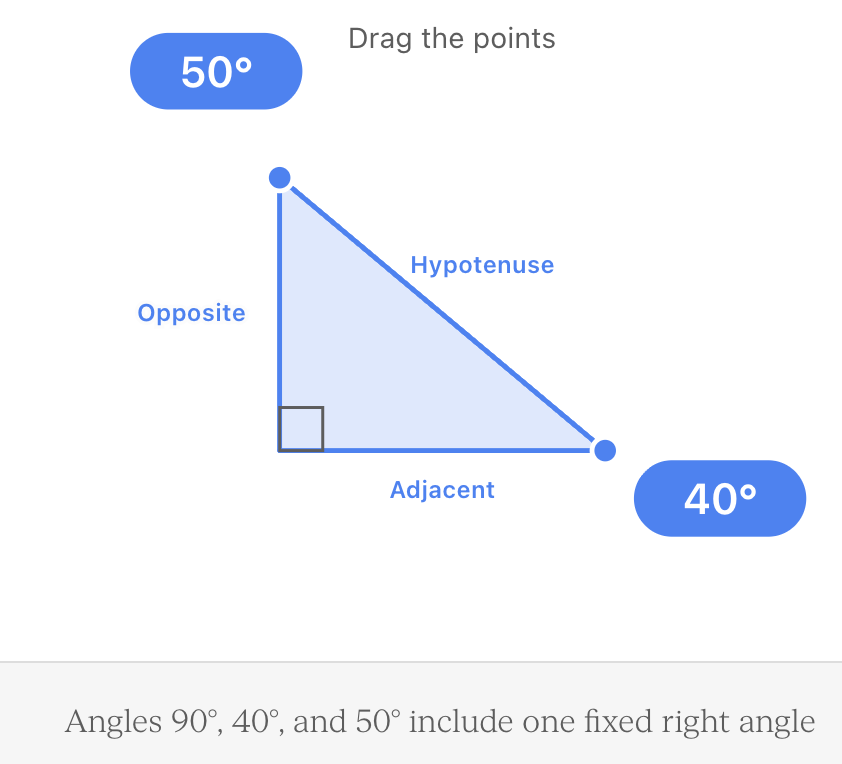
The hypotenuse is always opposite the 90° angle and is always the longest side.
The terms opposite and adjacent depend on which acute angle is being considered.
Information Needed to Solve a Right Triangle
To solve a right triangle, you normally need at least two additional pieces of information besides the 90° angle.
For example:
- two sides
- one side and one acute angle
From these measurements, the remaining sides and angles can usually be calculated.
The Main Tools
Several mathematical tools can be used when solving right triangles:
Pythagorean Theorem
Used when two sides are known and the third side is required.
Sine
Used with the opposite side and hypotenuse.
Cosine
Used with the adjacent side and hypotenuse.
Tangent
Used with the opposite and adjacent sides.
Inverse trigonometric functions
Used when side lengths are known and an angle must be found.
Angle sum
Used to find the remaining acute angle.
The important skill is deciding which tool is most efficient for the information available.
The Pythagorean Theorem
When two sides of a right triangle are known, the third can often be calculated using the Pythagorean theorem.
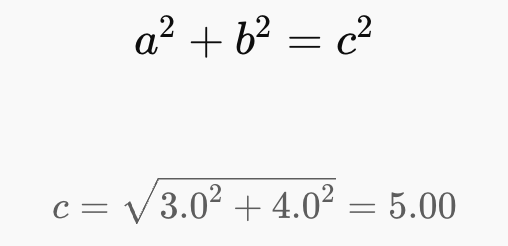
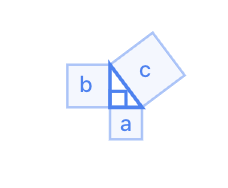
Here:
a and b are the shorter sides.
c is the hypotenuse.
Example 1: Finding the Hypotenuse
Suppose the shorter sides are:
a = 6 cm
b = 8 cm
Then:
c² = 6² + 8²
c² = 36 + 64
c² = 100
c = √100
c = 10 cm
The hypotenuse is 10 cm.
This is the well-known 6–8–10 right triangle.
Finding a Shorter Side
If the hypotenuse and one shorter side are known, rearrange the Pythagorean theorem.
Suppose:
c = 13 cm
a = 5 cm
Find b.
5² + b² = 13²
25 + b² = 169
b² = 144
b = 12 cm
The missing side is 12 cm.
SOH CAH TOA
When an angle and at least one side are involved, trigonometric ratios are often useful.
SOH
sin θ = opposite ÷ hypotenuse
CAH
cos θ = adjacent ÷ hypotenuse
TOA
tan θ = opposite ÷ adjacent
Remember:
SOH – CAH – TOA


Selecting the Correct Trigonometric Method
Ask:
Which sides do I know or need?
If the problem involves:
Opposite + Hypotenuse → sine
Adjacent + Hypotenuse → cosine
Opposite + Adjacent → tangent
Do not select a trig function based on habit.
Select it based on the sides involved.
Example 2: Finding a Side Using Sine
A right triangle has:
Angle = 35°
Hypotenuse = 12 cm
Find the side opposite the 35° angle.
Use sine:
sin 35° = opposite ÷ 12
Let the opposite side be x.
sin 35° = x ÷ 12
x = 12 sin 35°
x ≈ 6.88 cm
The opposite side is approximately 6.88 cm.
Example 3: Finding a Side Using Cosine
A right triangle has:
Angle = 42°
Hypotenuse = 18 m
Find the adjacent side.
cos 42° = adjacent ÷ 18
Let the adjacent side be x.
cos 42° = x ÷ 18
x = 18 cos 42°
x ≈ 13.38 m
The adjacent side is approximately 13.4 m.
Example 4: Finding a Side Using Tangent
A right triangle has:
Angle = 28°
Adjacent side = 15 cm
Find the opposite side.
tan 28° = opposite ÷ 15
Let the opposite side be x.
tan 28° = x ÷ 15
x = 15 tan 28°
x ≈ 7.98 cm
The opposite side is approximately 7.98 cm.
Finding Angles
When side lengths are known but an angle is unknown, use an inverse trigonometric function.
These are:
sin⁻¹
cos⁻¹
tan⁻¹
These functions allow us to work backward from a side ratio to an angle.
Example 5: Finding an Angle Using Tangent
Suppose:
Opposite = 7 cm
Adjacent = 10 cm
Find θ.
tan θ = 7 ÷ 10
tan θ = 0.7
θ = tan⁻¹(0.7)
θ ≈ 35.0°
θ ≈ 35.0°
Example 6: Finding an Angle Using Sine
Suppose:
Opposite = 9 m
Hypotenuse = 15 m
sin θ = 9 ÷ 15
sin θ = 0.6
θ = sin⁻¹(0.6)
θ ≈ 36.9°
θ ≈ 36.9°
Example 7: Finding an Angle Using Cosine
Suppose:
Adjacent = 12 cm
Hypotenuse = 20 cm
cos θ = 12 ÷ 20
cos θ = 0.6
θ = cos⁻¹(0.6)
θ ≈ 53.1°
θ ≈ 53.1°
Finding the Remaining Angle
The angles inside every triangle add to:
180°
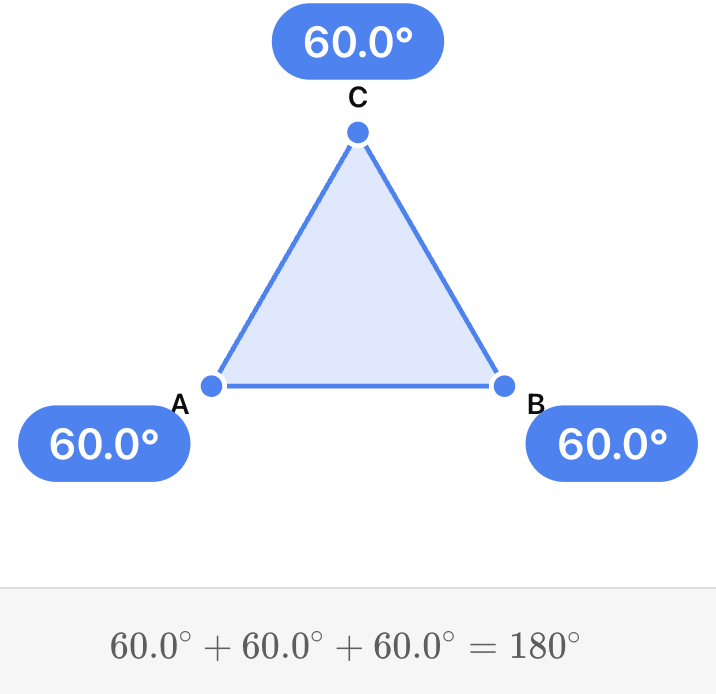
In a right triangle, one angle is already 90°.
Therefore, the two remaining angles must add to:
90°
If one acute angle is θ and the other is φ:
θ + φ = 90°
So:
φ = 90° − θ
Example 8: Finding the Remaining Angle
Suppose one acute angle is:
37°
Then the other is:
90° − 37°
= 53°
The remaining angle is 53°.
This is usually faster than using another trigonometric calculation.
Complementary Angles
The two acute angles of a right triangle are complementary.
That means their sum is:
90°
For example:
20° + 70° = 90°
35° + 55° = 90°
48° + 42° = 90°
This provides an important way to check your answers.
Solving an Entire Triangle
Consider a right triangle with:
One acute angle = 32°
Hypotenuse = 15 cm
We want to determine:
- opposite side
- adjacent side
- remaining angle
This requires several steps.
Step 1: Find the Opposite Side
sin 32° = opposite ÷ 15
Opposite = 15 sin 32°
Opposite ≈ 7.95 cm
Step 2: Find the Adjacent Side
cos 32° = adjacent ÷ 15
Adjacent = 15 cos 32°
Adjacent ≈ 12.72 cm
Step 3: Find the Remaining Angle
Remaining angle:
90° − 32°
= 58°
Therefore the complete triangle contains:
Angles: 90°, 32°, 58°
Sides: 15 cm, 12.72 cm, 7.95 cm
The triangle is now solved.
There Is Often More Than One Method
Suppose you know:
Hypotenuse = 15 cm
Opposite = 9 cm
You could find the remaining shorter side using the Pythagorean theorem.
Or you could:
- calculate an angle using inverse sine
- use cosine or tangent to find the missing side
Both approaches can work.
Usually, choose the method that:
- uses the fewest steps
- uses the original information
- avoids unnecessary rounding
Example 9: Solving from Two Sides
Suppose:
Opposite = 9 cm
Adjacent = 12 cm
Find all remaining measurements.
First find the hypotenuse:
c² = 9² + 12²
c² = 81 + 144
c² = 225
c = 15 cm
Now find one angle:
tan θ = 9 ÷ 12
θ = tan⁻¹(9 ÷ 12)
θ ≈ 36.9°
Find the other angle:
90° − 36.9°
= 53.1°
Complete solution:
Sides: 9 cm, 12 cm, 15 cm
Angles: 36.9°, 53.1°, 90°
Example 10: Solving from a Side and an Angle
A right triangle has:
Adjacent side = 20 m
Angle = 41°
Find the opposite side, hypotenuse, and remaining angle.
Opposite Side
tan 41° = opposite ÷ 20
Opposite = 20 tan 41°
Opposite ≈ 17.39 m
Hypotenuse
cos 41° = 20 ÷ hypotenuse
Hypotenuse = 20 ÷ cos 41°
Hypotenuse ≈ 26.50 m
Remaining Angle
90° − 41° = 49°
Complete solution:
Adjacent = 20 m
Opposite ≈ 17.39 m
Hypotenuse ≈ 26.50 m
Angles = 41°, 49°, 90°
Multi-Step Triangle Problems
Some problems require information from one calculation before the next calculation can be completed.
For example:
- Find a missing side using trigonometry.
- Use that side in a second triangle.
- Find another distance.
- Interpret the final result.


Breaking a complicated diagram into smaller right triangles can make the problem much easier.
Example 11: Two Connected Triangles
A support structure contains two right triangles.
The first triangle has:
Angle = 30°
Adjacent side = 8 m
First find its vertical height:
tan 30° = h ÷ 8
h = 8 tan 30°
h ≈ 4.62 m
That height may then become a known side in another triangle.
If the second triangle has:
Opposite = 4.62 m
Angle = 40°
then:
tan 40° = 4.62 ÷ x
x = 4.62 ÷ tan 40°
x ≈ 5.51 m
The result from the first triangle became information needed for the second.
Draw Before You Calculate
For complicated problems, start with a diagram.
A useful diagram should show:
- right angles
- known angles
- known side lengths
- unknown quantities
- labels for important points
Do not worry if the diagram is not perfectly to scale.
Its purpose is to organize the mathematical information.
Mark the Reference Angle
Before labeling:
opposite
and:
adjacent
identify the angle you are working with.
The same side can be opposite one acute angle and adjacent to the other.


The hypotenuse, however, is always the same side.
A Decision Strategy
When solving a right triangle, ask:
Do I know two sides?
If yes, consider:
- Pythagorean theorem for the third side
- inverse trig for an angle
Do I know one side and one acute angle?
If yes, use:
- sine
- cosine
- tangent
depending on the sides involved.
Do I already know one acute angle?
Find the other using:
90° − known angle
This simple decision process can reduce unnecessary calculations.
Use Original Information When Possible
Suppose you calculate:
x ≈ 7.3 cm
and then use 7.3 cm in another calculation.
The actual calculator value may have been:
7.347829...
Using the rounded value introduces additional rounding error.
Whenever possible:
- use original measurements
- keep full calculator values during working
- round only the final answers
Verifying Your Solution
A complete triangle solution should be checked.
Several methods are available.
Check 1: Angle Sum
Your angles should add to:
180°
For a right triangle:
90° + angle A + angle B = 180°
Therefore:
angle A + angle B = 90°
If you obtain:
90°, 42°, and 58°
then:
90 + 42 + 58 = 190°
Something is wrong.
Check 2: Hypotenuse Must Be Longest
Suppose your calculated sides are:
6 cm
8 cm
7 cm
and you have identified 7 cm as the hypotenuse.
This cannot be correct.
The hypotenuse must be the longest side.
Check 3: Pythagorean Theorem
Suppose your calculated sides are approximately:
5 cm
12 cm
13 cm
Check:
5² + 12²
= 25 + 144
= 169
13² = 169
The sides satisfy the Pythagorean theorem.
This supports the solution.
Check 4: Use a Different Trigonometric Ratio
Suppose:
Opposite = 6 cm
Adjacent = 8 cm
Hypotenuse = 10 cm
For angle θ:
sin θ = 6/10
and:
tan θ = 6/8
Both calculations should produce the same angle, allowing for rounding.
This provides an independent check.
Check 5: Compare Angles and Sides
Larger angles should be opposite longer sides.
Suppose one angle is:
65°
and another is:
25°
The side opposite 65° should be longer than the side opposite 25°.


If your answer contradicts this relationship, check your work.
Check 6: Estimate Before Calculating
Suppose:
Angle = 45°
Adjacent side = 10 cm
At 45°, the two shorter sides of a right triangle are equal.
Therefore, the opposite side should be approximately:
10 cm
If your calculator gives:
1.0 cm
or:
100 cm
you should immediately suspect an error.
Special Right Triangle: 45°–45°–90°
A right triangle with one angle of 45° must have:
45°, 45°, 90°
The two shorter sides are equal.
If each shorter side is:
x
then the hypotenuse is:
x√2
For example:
Short sides = 5 cm and 5 cm
Hypotenuse:
5√2 ≈ 7.07 cm
Special Right Triangle: 30°–60°–90°
Another useful right triangle has angles:
30°, 60°, 90°
Its side ratio is:
1 : √3 : 2
where:
- shortest side is opposite 30°
- longer leg is opposite 60°
- hypotenuse is opposite 90°


Recognizing these patterns can sometimes make calculations faster.
Communicating a Complete Solution
A strong mathematical solution should show enough information that another person can follow your reasoning.
For example:
Given:
θ = 38°
Adjacent = 12.0 m
Find: Opposite side.
Method:
tan θ = opposite ÷ adjacent
tan 38° = x ÷ 12.0
x = 12.0 tan 38°
x ≈ 9.38 m
Answer:
The opposite side is approximately 9.38 m.
This is clearer than writing only:
9.38
Include Units
If the sides represent lengths, include appropriate units.
Examples:
8.4 cm
12.7 m
3.2 km
Angles should include:
°
For example:
θ = 37.5°
Units help communicate what the answer represents.
Use Appropriate Precision
Suppose the measurements are given as:
12.0 m
and:
35°
It would usually be unreasonable to report:
8.402574931 m
A more appropriate answer might be:
8.4 m
or:
8.40 m
depending on the context and expected precision.
Worked Example: Complete Triangle
A right triangle has:
Hypotenuse = 18 cm
Angle A = 37°
Find:
- side opposite A
- side adjacent to A
- angle B
Opposite Side
sin 37° = opposite ÷ 18
Opposite = 18 sin 37°
Opposite ≈ 10.83 cm
Adjacent Side
cos 37° = adjacent ÷ 18
Adjacent = 18 cos 37°
Adjacent ≈ 14.38 cm
Remaining Angle
B = 90° − 37°
B = 53°
Complete solution:
Sides ≈ 10.83 cm, 14.38 cm, 18 cm
Angles = 37°, 53°, 90°
Worked Example: Two Known Legs
A right triangle has shorter sides:
16 m
and:
30 m
Find all remaining information.
Hypotenuse
c² = 16² + 30²
c² = 256 + 900
c² = 1156
c = 34 m
First Angle
Let θ be opposite the 16 m side.
tan θ = 16 ÷ 30
θ = tan⁻¹(16/30)
θ ≈ 28.1°
Second Angle
90° − 28.1°
= 61.9°
Complete solution:
Sides = 16 m, 30 m, 34 m
Angles ≈ 28.1°, 61.9°, 90°
Worked Example: Hypotenuse and One Leg
Suppose:
Hypotenuse = 25 cm
One leg = 15 cm
Find the missing side and angles.
Missing Side
15² + b² = 25²
225 + b² = 625
b² = 400
b = 20 cm
Angle Opposite the 15 cm Side
sin θ = 15 ÷ 25
θ = sin⁻¹(0.6)
θ ≈ 36.9°
Remaining Angle
90° − 36.9°
= 53.1°
Complete solution:
Sides = 15 cm, 20 cm, 25 cm
Angles ≈ 36.9°, 53.1°, 90°
Worked Example: One Side and One Angle
Suppose:
Angle A = 63°
Adjacent side = 7.5 m
Find the opposite side, hypotenuse, and remaining angle.
Opposite
tan 63° = opposite ÷ 7.5
Opposite = 7.5 tan 63°
Opposite ≈ 14.72 m
Hypotenuse
cos 63° = 7.5 ÷ hypotenuse
Hypotenuse = 7.5 ÷ cos 63°
Hypotenuse ≈ 16.52 m
Remaining Angle
90° − 63°
= 27°
Complete solution:
Sides ≈ 7.5 m, 14.72 m, 16.52 m
Angles = 27°, 63°, 90°
Multi-Step Example: Support Cable
A vertical pole is supported by a cable.
The cable is:
18 m long
and makes an angle of:
55°
with the ground.
Find:
- the height where the cable attaches to the pole
- the horizontal distance from the pole to the cable anchor


Height
sin 55° = height ÷ 18
height = 18 sin 55°
height ≈ 14.74 m
Horizontal Distance
cos 55° = distance ÷ 18
distance = 18 cos 55°
distance ≈ 10.32 m
The cable attaches approximately 14.74 m above the ground and is anchored approximately 10.32 m horizontally from the pole.
Multi-Step Example: Roof
One half of a symmetrical roof forms a right triangle.
Horizontal run = 5.5 m
Roof angle = 32°
Find:
- the vertical rise
- the sloping roof length
Rise
tan 32° = rise ÷ 5.5
rise = 5.5 tan 32°
rise ≈ 3.44 m
Roof Length
cos 32° = 5.5 ÷ roof length
Roof length = 5.5 ÷ cos 32°
roof length ≈ 6.49 m
The roof rises approximately 3.44 m and has a sloping length of approximately 6.49 m.
Multi-Step Example: Ladder
A 7 m ladder leans against a wall.
Its base is:
2.5 m
from the wall.
Find:
- the height reached
- the angle the ladder makes with the ground
Height
h² + 2.5² = 7²
h² = 49 − 6.25
h² = 42.75
h ≈ 6.54 m
Angle
cos θ = 2.5 ÷ 7
θ = cos⁻¹(2.5/7)
θ ≈ 69.1°
The ladder reaches approximately 6.54 m up the wall and makes an angle of approximately 69.1° with the ground.
Multi-Step Problems with Shared Sides
Some diagrams contain several right triangles that share a side.
A useful strategy is:
Triangle 1 → calculate shared side → Triangle 2 → calculate final unknown
Do not try to solve the entire diagram in one step.


Identify one triangle containing enough information to begin.
Then use its result in the next triangle.
Choosing the Most Efficient Method
Suppose two sides are known.
You could sometimes use several methods.
For example:
Legs = 8 cm and 15 cm
To find the hypotenuse, the most direct method is:
Pythagorean theorem
rather than finding an angle first and then using sine or cosine.
Efficient mathematical reasoning means choosing a method that minimizes unnecessary steps.
Avoiding Unnecessary Calculations
Suppose one acute angle is:
24°
You do not need trigonometry to find the other acute angle.
Simply calculate:
90° − 24°
= 66°
Use the simplest valid method.
Common Mistake: Using the Wrong Angle
Suppose the side you call "opposite" is actually opposite the other acute angle.
Your trig equation will be incorrect.
Always mark the angle you are working from before labeling O and A.
Common Mistake: Treating the Hypotenuse as Adjacent
The hypotenuse touches both acute angles, but it is never called the adjacent side in SOH–CAH–TOA.
The adjacent side means the shorter side beside the reference angle.
Common Mistake: Forgetting Inverse Trig
If you know:
tan θ = 0.75
you cannot simply write:
θ = 0.75°
Instead:
θ = tan⁻¹(0.75)
θ ≈ 36.9°
Common Mistake: Using Inverse Trig to Find a Side
Inverse trig functions are primarily used to determine angles.
If you know:
θ = 40°
Adjacent = 12 m
and need the opposite side, use:
tan 40° = opposite ÷ 12
not inverse tangent.
Common Mistake: Calculator Mode
If angles are given in degrees, your calculator should normally be in:
DEG
not:
RAD
A calculator in the wrong mode can produce completely different answers.
Common Mistake: Rounding Too Early
Suppose an intermediate result is:
13.728419...
Do not immediately round it to:
14
if it will be used in another calculation.
Keep the calculator value and round the final answer.
This reduces accumulated rounding error.
Common Mistake: Incomplete Answers
If the question says:
Solve the triangle
finding only one missing side is not enough.
You should determine:
- all three sides
- all three angles
and present them clearly.
A Reliable Solving Strategy
When asked to solve a right triangle:
Step 1: Draw or inspect the triangle.
Step 2: Identify the 90° angle.
Step 3: Identify the hypotenuse.
Step 4: Record all known sides and angles.
Step 5: Decide which unknown should be found first.
Step 6: Select Pythagoras, sine, cosine, tangent, or inverse trig.
Step 7: Write the equation.
Step 8: Substitute known values.
Step 9: Solve without excessive intermediate rounding.
Step 10: Find the remaining measurements.
Step 11: Verify the solution.
Step 12: Present all sides, angles, units, and appropriate rounding.
A Triangle-Solving Decision Guide
Two sides known?
→ Use Pythagorean theorem for the third side.
→ Use inverse trig for an angle.
→ Use 90° minus that angle for the final angle.
One side + one acute angle known?
→ Use SOH–CAH–TOA to calculate missing sides.
→ Use 90° minus the known acute angle for the remaining angle.
Two acute angles known?
→ Their values alone determine the shape but not the size of the triangle.
At least one side length is required to determine actual side lengths.
Verifying a Complete Solution
Suppose you obtain:
Sides:
8.0 cm, 15.0 cm, 17.0 cm
Angles:
28.1°, 61.9°, 90°
Check the angles:
28.1 + 61.9 + 90 = 180°
Check the sides:
8² + 15² = 64 + 225
= 289
17² = 289
The solution passes both checks.
Communicating Mathematical Reasoning
A complete solution should normally contain:
Diagram or labels
Show what each value represents.
Formula or ratio
For example:
tan θ = O/A
Substitution
tan θ = 8/15
Calculation
θ = tan⁻¹(8/15)
θ ≈ 28.1°
Final statement
The angle is approximately 28.1°.
This allows another person to understand and verify your reasoning.
Real-World Interpretation
Right triangles appear in many situations involving:
- ramps
- roofs
- ladders
- roads
- bridges
- navigation
- surveying
- support cables
- heights
- distances
- slopes


In real-world problems, the final answer should describe what the calculated value actually represents.
Instead of:
x = 12.6
write:
The support cable is approximately 12.6 m long.
Did You Know?
Right triangle trigonometry provides several independent ways to check a solution.
If you know all three sides, you can:
- check them with the Pythagorean theorem
- calculate an angle using sine
- calculate the same angle using cosine
- calculate it again using tangent
All of these methods should produce consistent results, allowing for rounding.
This is an important mathematical habit:
Do not only calculate an answer — look for evidence that the answer makes sense.
Key Terms
- Right triangle: Triangle containing one 90° angle.
- Hypotenuse: Longest side of a right triangle, opposite the right angle.
- Opposite side: Side across from the reference angle.
- Adjacent side: Non-hypotenuse side beside the reference angle.
- Sine: Ratio of opposite side to hypotenuse.
- Cosine: Ratio of adjacent side to hypotenuse.
- Tangent: Ratio of opposite side to adjacent side.
- Inverse sine: Function used to determine an angle from a sine ratio.
- Inverse cosine: Function used to determine an angle from a cosine ratio.
- Inverse tangent: Function used to determine an angle from a tangent ratio.
- Pythagorean theorem: Relationship between the three sides of a right triangle.
- Complementary angles: Two angles whose measures total 90°.
- Reference angle: Acute angle used when identifying opposite and adjacent sides.
- Solve a triangle: Determine all unknown sides and angles.
- Multi-step problem: Problem requiring more than one mathematical calculation or relationship.
- Verification: Process of checking whether a solution is mathematically reasonable and consistent.
Key Relationships
For right triangles:
a² + b² = c²
where c is the hypotenuse.
Trigonometric ratios:
sin θ = opposite ÷ hypotenuse
cos θ = adjacent ÷ hypotenuse
tan θ = opposite ÷ adjacent
Inverse trigonometry:
θ = sin⁻¹(O/H)
θ = cos⁻¹(A/H)
θ = tan⁻¹(O/A)
Acute-angle relationship:
Angle A + Angle B = 90°
Whole triangle:
Angle A + Angle B + 90° = 180°
Key Takeaways
- Solving a right triangle means determining all unknown sides and angles.
- A right triangle already contains one 90° angle.
- The two acute angles of a right triangle are complementary.
- The Pythagorean theorem can find a missing side when two sides are known.
- Sine relates the opposite side and hypotenuse.
- Cosine relates the adjacent side and hypotenuse.
- Tangent relates the opposite and adjacent sides.
- Inverse trigonometric functions are used to calculate unknown angles from side ratios.
- SOH–CAH–TOA helps identify the appropriate trigonometric ratio.
- Opposite and adjacent sides depend on the chosen reference angle.
- The hypotenuse is always opposite the right angle and is always the longest side.
- When two sides are known, Pythagoras and inverse trigonometry can usually solve the triangle.
- When one side and one acute angle are known, trigonometric ratios can usually solve the triangle.
- Knowing only the angles determines the shape of a triangle but not its actual size.
- Multi-step problems should be divided into smaller calculations.
- In compound diagrams, one calculated side may become a known side in another triangle.
- Original information should be used whenever possible to reduce rounding error.
- Intermediate values should not be rounded excessively.
- Solutions can be checked using angle sums, the Pythagorean theorem, alternative trig ratios, and estimation.
- The two acute angles should always add to 90°.
- The hypotenuse must always be the longest side.
- Larger angles should be opposite longer sides.
- Efficient problem solving means selecting the simplest appropriate method.
- Complete mathematical solutions should show the method, substitution, calculation, units, and final answer.
- A numerical result should be interpreted in the context of the problem.
- Good mathematics includes both solving and verifying the solution.