Solving Polynomial Equations
3. The Fundamental Theorem of Algebra
Learning outcomes
- I can state the Fundamental Theorem of Algebra.
- I can determine the maximum number of roots of a polynomial.
- I can distinguish between real and complex roots.
- I can interpret complex solutions.
- I can relate roots to polynomial degree.
The Fundamental Theorem of Algebra
Introduction
The Fundamental Theorem of Algebra is one of the most important results in mathematics. It establishes a connection between the degree of a polynomial and the number of roots that polynomial possesses.
For example, consider:
P(x) = x² − 5x + 6
This quadratic polynomial can be factored:
P(x) = (x − 2)(x − 3)
Its roots are:
x = 2 and x = 3
There are exactly two roots, matching the polynomial's degree of 2.
Now consider:
P(x) = x² + 4
Setting the polynomial equal to zero gives:
x² + 4 = 0
x² = −4
There are no real numbers whose square is negative.
However, using complex numbers, the equation has two solutions:
x = 2i and x = −2i
The Fundamental Theorem of Algebra explains why both polynomials have exactly two complex roots when multiplicities are counted, even though the number of real roots differs.
This theorem provides the foundation for understanding polynomial equations, complex numbers, factoring, and the relationship between algebraic expressions and their graphs.


What Is the Fundamental Theorem of Algebra?
The Fundamental Theorem of Algebra states:
Every nonconstant polynomial with complex coefficients has at least one complex root.
An equivalent and especially useful form is:
Every polynomial of degree n has exactly n complex roots when repeated roots are counted according to their multiplicities.
This applies to all nonconstant polynomials, including those with real coefficients.
Examples
|
Polynomial |
Degree |
Number of complex roots, counting multiplicity |
|---|---|---|
|
x − 5 |
1 |
1 |
|
x² − 9 |
2 |
2 |
|
x³ − 8 |
3 |
3 |
|
x⁴ + 1 |
4 |
4 |
|
x⁵ − 3x + 2 |
5 |
5 |
|
x⁶ + 4x² − 1 |
6 |
6 |
The theorem guarantees the total number of complex roots, counting multiplicity.
It does not guarantee that all roots are real or that all roots are different.
Understanding Polynomial Degree
The degree of a polynomial is the highest exponent of the variable with a nonzero coefficient.
A polynomial has the general form:
P(x) = aₙxⁿ + aₙ₋₁xⁿ⁻¹ + ... + a₁x + a₀
where aₙ ≠ 0.
The degree is n.
Example
Consider:
P(x) = 4x⁵ − 3x³ + 2x² − 7
The highest exponent is 5.
Therefore:
Degree = 5
According to the Fundamental Theorem of Algebra, this polynomial has exactly five complex roots when multiplicities are counted.
Another Example
P(x) = 3x⁴ − 8x² + 6x − 1
The highest exponent is 4.
Therefore:
Degree = 4
The polynomial has four complex roots, counting multiplicity.
Important Distinction
The degree tells us the total number of complex roots, counting multiplicity, but not necessarily the number of distinct real solutions.
A fifth-degree polynomial might have only one distinct real root.
A fourth-degree polynomial might have no real roots at all.
What Is a Root of a Polynomial?
A root of a polynomial is a value of x that makes the polynomial equal to zero.
If:
P(a) = 0
then a is a root of P(x).
Example
Consider:
P(x) = x² − 7x + 12
Factor:
P(x) = (x − 3)(x − 4)
Set equal to zero:
(x − 3)(x − 4) = 0
Therefore:
x = 3 or x = 4
Verification
P(3) = 9 − 21 + 12 = 0
P(4) = 16 − 28 + 12 = 0
Both values are roots.
Roots, Zeros, and Solutions
These terms are closely related:
-
Root: A value satisfying a polynomial equation.
-
Zero: A value that makes a polynomial function equal zero.
-
Solution: A value satisfying the equation.
-
x-intercept: A point where the graph of a real-valued function meets the x-axis.
For real polynomial roots, the x-intercepts have coordinates (a, 0).
Complex roots that are not real do not appear as x-intercepts on the ordinary Cartesian graph.
Real Numbers and Complex Numbers
To understand the Fundamental Theorem of Algebra, we must distinguish between real and complex numbers.
Real Numbers
Real numbers include:
-
Positive and negative integers.
-
Fractions.
-
Rational numbers.
-
Irrational numbers.
-
Zero.
Examples:
−5, 0, 2, 3/4, √2, π
Real numbers can be represented on a number line.
Complex Numbers
Complex numbers have the form:
z = a + bi
where:
-
a is the real part.
-
b is the imaginary part.
-
i is the imaginary unit.
The imaginary unit is defined by:
i² = −1
Therefore:
√(−1) = i
Examples of complex numbers include:
-
3 + 2i
-
−4 + i
-
5 − 3i
-
2i
-
−7
Every real number is also a complex number with imaginary part zero.
For example:
5 = 5 + 0i
Thus, the real numbers form a subset of the complex numbers.
Understanding the Imaginary Unit
The imaginary unit allows us to solve equations that have no real solutions.
Recall:
i² = −1
Higher powers of i follow a repeating pattern.
|
Power |
Value |
|---|---|
|
i¹ |
i |
|
i² |
−1 |
|
i³ |
−i |
|
i⁴ |
1 |
|
i⁵ |
i |
|
i⁶ |
−1 |
|
i⁷ |
−i |
|
i⁸ |
1 |
The pattern repeats every four powers.
Worked Example
Simplify:
i¹⁰
Since:
i⁸ = 1
we can write:
i¹⁰ = i⁸ × i²
= 1 × (−1)
= −1
Another Example
Simplify:
i¹⁵
Since:
i¹² = 1
i¹⁵ = i¹² × i³
= 1 × (−i)
= −i
Understanding the powers of i helps when working with complex polynomial roots.
Solving Equations with Complex Roots
Worked Example
Solve:
x² + 9 = 0
Step 1: Isolate x²
x² = −9
Step 2: Use the Imaginary Unit
x = ±√(−9)
x = ±3√(−1)
Final Answer
x = 3i or x = −3i
Verification
For x = 3i:
(3i)² + 9
= 9i² + 9
= −9 + 9
= 0
For x = −3i:
(−3i)² + 9
= 9i² + 9
= −9 + 9
= 0
Both complex roots satisfy the equation.
Connection to the Fundamental Theorem of Algebra
The polynomial has degree 2.
It has exactly two complex roots.
Neither root is real.
Solving Quadratic Equations with Complex Solutions
The quadratic formula can produce complex solutions when the discriminant is negative.
For:
ax² + bx + c = 0
the quadratic formula is:
x = (−b ± √(b² − 4ac))/(2a)
The discriminant is:
Δ = b² − 4ac
Worked Example
Solve:
x² − 4x + 13 = 0
Identify:
a = 1
b = −4
c = 13
Calculate the discriminant:
Δ = (−4)² − 4(1)(13)
= 16 − 52
= −36
Apply the quadratic formula:
x = (4 ± √(−36))/2
x = (4 ± 6i)/2
Final Answer
x = 2 + 3i or x = 2 − 3i
These are two distinct complex roots.

The Complex Plane
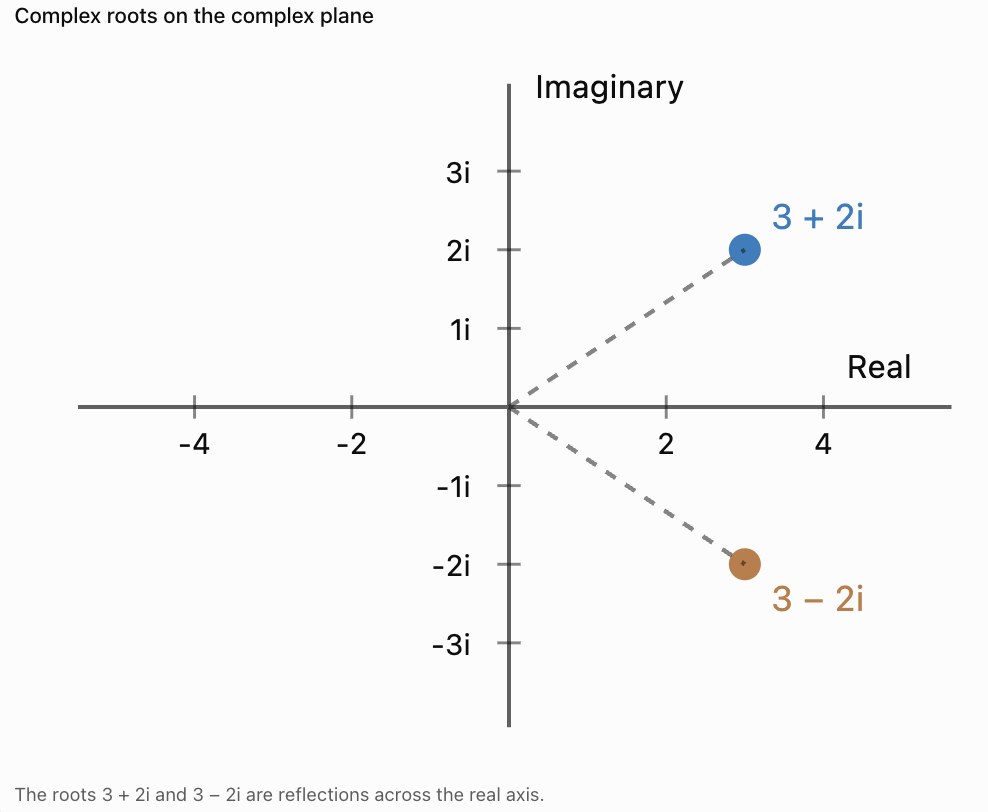
Complex numbers can be represented geometrically on a complex plane, also called an Argand diagram.
The horizontal axis represents the real part.
The vertical axis represents the imaginary part.
For a complex number:
z = a + bi
the point is plotted at:
(a, b)
Example
Consider:
z = 3 + 2i
Its real part is 3.
Its imaginary part is 2.
Therefore, it is represented by the point:
(3, 2)
Similarly:
z = 3 − 2i
is represented by:
(3, −2)
Important Observation
Complex conjugates have the same real part and opposite imaginary parts.
They appear symmetrically above and below the real axis.
Complex Conjugate Roots
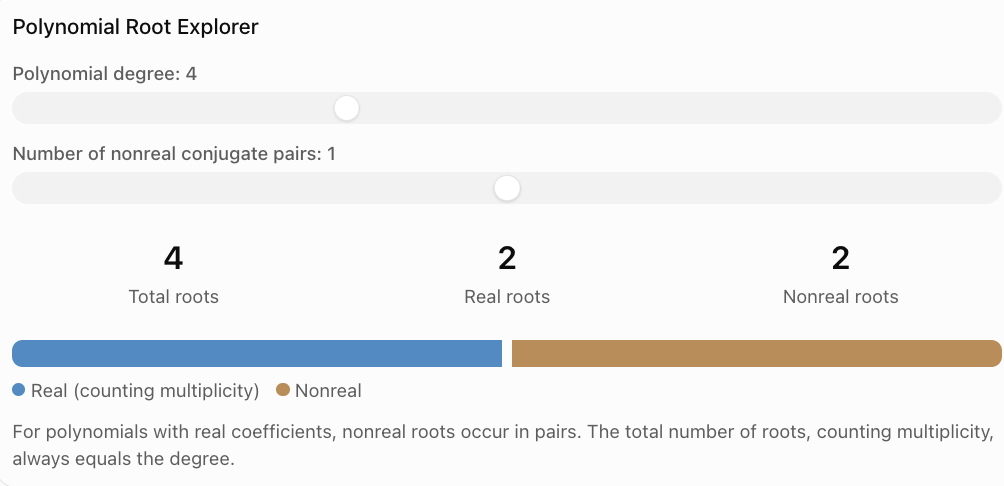
For polynomials with real coefficients, nonreal complex roots always occur in conjugate pairs.
If:
a + bi
is a root, then:
a − bi
must also be a root, provided b ≠ 0.
This is called the Complex Conjugate Root Theorem.
Example
Suppose:
P(x) = x² − 6x + 13
The roots are:
x = 3 + 2i
x = 3 − 2i
The roots form a conjugate pair.
Why Does This Happen?
Consider the factors:
[x − (3 + 2i)][x − (3 − 2i)]
Rewrite:
[(x − 3) − 2i][(x − 3) + 2i]
Apply the difference-of-squares identity:
(x − 3)² − (2i)²
Since:
(2i)² = −4
we obtain:
(x − 3)² + 4
Expand:
x² − 6x + 9 + 4
= x² − 6x + 13
The imaginary terms cancel, producing a polynomial with real coefficients.
Important Restriction
The conjugate-pair rule is guaranteed for polynomials with real coefficients.
It is not generally true for polynomials with arbitrary complex coefficients.
Finding Missing Complex Roots
Worked Example
A cubic polynomial with real coefficients has roots:
2 + i
and:
−3
Find the remaining root.
Step 1: Apply the Conjugate Root Theorem
Because 2 + i is a root and the coefficients are real:
2 − i must also be a root.
Step 2: Count the Roots
The roots are:
2 + i
2 − i
−3
There are three roots.
Final Answer
The missing root is 2 − i.
This accounts for all three roots of the cubic polynomial.
Constructing Polynomials from Complex Roots
We can construct a polynomial when its roots are known.
Worked Example
Construct a quadratic polynomial with real coefficients and roots:
2 + 3i and 2 − 3i
Step 1: Write the Factors
P(x) = [x − (2 + 3i)][x − (2 − 3i)]
Step 2: Simplify
P(x) = [(x − 2) − 3i][(x − 2) + 3i]
Apply the difference-of-squares identity:
P(x) = (x − 2)² − (3i)²
Since:
(3i)² = −9
P(x) = (x − 2)² + 9
Step 3: Expand
P(x) = x² − 4x + 4 + 9
Final Answer
P(x) = x² − 4x + 13
This polynomial has exactly the two required complex roots.
Repeated Roots and Multiplicity
The Fundamental Theorem of Algebra counts repeated roots according to their multiplicities.
A repeated root occurs when the same factor appears more than once.
Example
Consider:
P(x) = (x − 2)³(x + 1)²
The roots are:
x = 2, multiplicity 3
x = −1, multiplicity 2
There are only two distinct roots.
However, the total number of roots counting multiplicity is:
3 + 2 = 5
The polynomial has degree 5.
This agrees with the Fundamental Theorem of Algebra.
Another Example
Consider:
P(x) = (x² + 4)²
The roots of x² + 4 are:
x = 2i and x = −2i
Because the factor is squared, each root has multiplicity 2.
Therefore:
-
x = 2i, multiplicity 2.
-
x = −2i, multiplicity 2.
The polynomial has four roots counting multiplicity, matching its degree of 4.
Distinct Roots Versus Total Roots
It is important to distinguish between the number of distinct roots and the number of roots counted with multiplicity.
Example
Consider:
P(x) = (x − 1)²(x + 3)³(x² + 4)
The polynomial has degree:
2 + 3 + 2 = 7
Its roots are:
-
x = 1, multiplicity 2.
-
x = −3, multiplicity 3.
-
x = 2i, multiplicity 1.
-
x = −2i, multiplicity 1.
Summary
|
Type |
Number |
|---|---|
|
Degree |
7 |
|
Distinct real roots |
2 |
|
Distinct nonreal roots |
2 |
|
Total distinct complex roots |
4 |
|
Roots counting multiplicity |
7 |
The total multiplicity is:
2 + 3 + 1 + 1 = 7
The Fundamental Theorem of Algebra is satisfied.
The Factorization Form of the Fundamental Theorem
The Fundamental Theorem of Algebra guarantees that every nonconstant polynomial can be factored completely into linear factors over the complex numbers.
For a polynomial of degree n:
P(x) = a(x − r₁)(x − r₂)...(x − rₙ)
where:
-
a is the leading coefficient.
-
r₁, r₂, ..., rₙ are complex roots.
-
Repeated roots appear more than once.
Example
Consider:
P(x) = x³ − 4x
Factor:
P(x) = x(x² − 4)
P(x) = x(x − 2)(x + 2)
The roots are:
0, 2, −2
Therefore:
P(x) = (x − 0)(x − 2)(x + 2)
All three roots are real.
Another Example
Consider:
P(x) = x³ + 4x
Factor:
P(x) = x(x² + 4)
Over the complex numbers:
x² + 4 = (x − 2i)(x + 2i)
Therefore:
P(x) = x(x − 2i)(x + 2i)
The three roots are:
0, 2i, −2i
The polynomial has one real root and two nonreal complex roots.
Factoring Over the Real and Complex Numbers
A polynomial may factor differently depending on the number system being used.
Example
Consider:
x² + 9
Over the real numbers, it cannot be factored into linear factors.
Over the complex numbers:
x² + 9 = (x − 3i)(x + 3i)
Another Example
Consider:
x⁴ − 16
Over the real numbers:
x⁴ − 16 = (x² − 4)(x² + 4)
= (x − 2)(x + 2)(x² + 4)
Over the complex numbers:
x⁴ − 16 = (x − 2)(x + 2)(x − 2i)(x + 2i)
All four roots are now visible.
Important Conclusion
Every nonconstant polynomial can be completely factored into linear factors over the complex numbers.
Over the real numbers, some irreducible quadratic factors may remain.
The Fundamental Theorem and Polynomial Graphs
For a polynomial function with real coefficients, real roots correspond to x-intercepts.
Nonreal complex roots do not appear as x-intercepts on the ordinary real-coordinate graph.
Example
Consider:
P(x) = x² + 4
The roots are:
x = ±2i
Neither root is real.
The graph:
y = x² + 4
is a parabola entirely above the x-axis.
Therefore, it has no x-intercepts.

Another Example
Consider:
P(x) = x³ + 4x
Factor:
P(x) = x(x² + 4)
The roots are:
0, 2i, −2i
Only x = 0 is real.
Therefore, the graph has exactly one x-intercept:
(0, 0)

Key Relationship
The degree determines the total number of complex roots, counting multiplicity.
The graph shows only the real roots as x-intercepts.
How Many Real Roots Are Possible?
The Fundamental Theorem of Algebra guarantees n complex roots counting multiplicity, but the number of real roots varies.
For polynomials with real coefficients, nonreal roots occur in conjugate pairs.
This places restrictions on the number of real roots, counting multiplicity.
Examples
|
Degree |
Possible numbers of real roots, counting multiplicity |
|---|---|
|
2 |
0 or 2 |
|
3 |
1 or 3 |
|
4 |
0, 2, or 4 |
|
5 |
1, 3, or 5 |
|
6 |
0, 2, 4, or 6 |
These counts include repeated real roots according to their multiplicities.
The number of distinct real roots may be smaller.
For example:
(x − 2)⁴ = 0
has four real roots counting multiplicity, but only one distinct real root.
Why Odd-Degree Polynomials Have Real Roots
Consider a polynomial of odd degree with real coefficients.
Its ends move in opposite vertical directions.
For example:
P(x) = x³ + 2x + 5
As x becomes very large and positive:
P(x) becomes very large and positive.
As x becomes very large and negative:
P(x) becomes very large and negative.
Because polynomial functions are continuous, the graph must cross the x-axis somewhere between these regions.
Therefore, the polynomial has at least one real root.
This is consistent with the Fundamental Theorem of Algebra and the conjugate-pair property.
Even-Degree Polynomials
Even-degree polynomials may have both ends rising or both ends falling.
They do not necessarily cross the x-axis.
For example:
P(x) = x⁴ + 1
Since x⁴ ≥ 0 for every real x:
x⁴ + 1 > 0
Therefore, there are no real roots.
Using the Theorem to Find Missing Roots
Worked Example
A fourth-degree polynomial with real coefficients has the roots:
3, −2, and 1 + 4i
Find the fourth root.
Step 1: Apply the Conjugate Root Theorem
Because 1 + 4i is a root:
1 − 4i must also be a root.
Step 2: Count the Roots
The roots are:
3
−2
1 + 4i
1 − 4i
There are four roots, matching the degree.
Final Answer
The missing root is 1 − 4i.
Constructing a Cubic Polynomial from Its Roots
Worked Example
Construct a cubic polynomial with real coefficients and roots:
−2, 1 + i, and 1 − i
Step 1: Write the Factors
P(x) = (x + 2)[x − (1 + i)][x − (1 − i)]
Step 2: Multiply the Complex Factors
[x − (1 + i)][x − (1 − i)]
= [(x − 1) − i][(x − 1) + i]
= (x − 1)² − i²
Since i² = −1:
= (x − 1)² + 1
= x² − 2x + 2
Step 3: Multiply by the Real Factor
P(x) = (x + 2)(x² − 2x + 2)
Expand:
= x³ − 2x² + 2x + 2x² − 4x + 4
Final Answer
P(x) = x³ − 2x + 4
This cubic has one real root and two nonreal complex roots.
Exploring Roots and Polynomial Degree
Use the controls to explore how real and nonreal roots contribute to the total number of roots of a polynomial.
Interpreting Complex Solutions
Complex roots are mathematically meaningful even when they do not correspond to ordinary x-intercepts.
They appear in many areas of mathematics, science, and engineering.
Electrical Engineering
Complex numbers are used to represent alternating-current voltage and current.
They simplify calculations involving resistance, capacitance, inductance, and phase differences.

Vibrations and Oscillations
Complex roots appear when analysing systems that vibrate or oscillate.
For example, complex roots of characteristic equations can describe oscillation frequency and damping in differential-equation models.
Control Systems
Engineers use complex roots to study whether systems are stable.
The location of roots in the complex plane can indicate whether a system's response decays, grows, or oscillates.
Signal Processing
Complex numbers are fundamental to Fourier analysis and the mathematical representation of waves.
They help describe the amplitude and phase of signals.
Important Interpretation
A nonreal complex root does not mean that a physical measurement such as length or time is imaginary.
Instead, complex numbers often form part of a mathematical representation that produces meaningful real-world predictions.
Common Mistakes
Assuming every polynomial has only real roots
The Fundamental Theorem of Algebra guarantees complex roots, not necessarily real roots.
Confusing degree with the number of distinct roots
A fourth-degree polynomial may have only one distinct root if that root has multiplicity 4.
Forgetting to count multiplicities
For:
(x − 2)³ = 0
the root x = 2 has multiplicity 3.
Forgetting complex conjugate pairs
For a polynomial with real coefficients, if 2 + 3i is a root, then 2 − 3i is also a root.
Assuming complex roots appear as x-intercepts
Only real roots appear as x-intercepts on an ordinary Cartesian graph.
Incorrectly simplifying square roots of negative numbers
For example:
√(−25) = 5i
not −5.
Confusing i with −1
The imaginary unit satisfies:
i² = −1
but i itself is not equal to −1.
Assuming the conjugate rule applies to every polynomial
The conjugate-pair rule requires real coefficients.
Ignoring repeated complex roots
Complex roots can also have multiplicity greater than one.
Claiming the theorem provides a method for finding roots
The theorem guarantees that roots exist, but does not directly provide a general procedure for calculating them.
Key Terms
-
Fundamental Theorem of Algebra: Theorem stating that every nonconstant polynomial has a complex root, and that a degree-n polynomial has n complex roots counting multiplicity.
-
Polynomial: Algebraic expression containing nonnegative integer powers of a variable.
-
Degree: Highest exponent with a nonzero coefficient.
-
Root: Value that makes a polynomial equal zero.
-
Zero: Input value at which a polynomial function equals zero.
-
Real Number: Number represented on the real number line.
-
Complex Number: Number of the form a + bi.
-
Imaginary Unit: Number i satisfying i² = −1.
-
Real Part: The a in a + bi.
-
Imaginary Part: The b in a + bi.
-
Complex Plane: Coordinate plane used to represent complex numbers.
-
Argand Diagram: Another name for the complex plane.
-
Complex Conjugate: Number obtained by changing the sign of the imaginary part.
-
Conjugate Root Theorem: For polynomials with real coefficients, nonreal roots occur in conjugate pairs.
-
Distinct Roots: Roots with different values.
-
Repeated Root: Root appearing more than once in a factorization.
-
Multiplicity: Number of times a root occurs.
-
Linear Factor: Factor of degree 1.
-
Factorization: Expressing a polynomial as a product of factors.
-
Quadratic Formula: Formula used to solve quadratic equations.
-
Discriminant: Expression b² − 4ac that helps classify quadratic roots.
-
x-Intercept: Point where a real-valued graph meets the x-axis.
-
End Behaviour: Behaviour of a graph as x approaches positive or negative infinity.
-
Nonreal Root: Complex root with a nonzero imaginary part.
Key Takeaways
-
The Fundamental Theorem of Algebra guarantees that every nonconstant polynomial has at least one complex root.
-
A polynomial of degree n has exactly n complex roots when multiplicities are counted.
-
The number of distinct roots may be smaller than the degree.
-
Complex numbers have the form a + bi, where i² = −1.
-
Real numbers are included within the complex number system.
-
Some polynomial equations have no real roots but still have complex roots.
-
For polynomials with real coefficients, nonreal roots occur in conjugate pairs.
-
Repeated roots must be counted according to their multiplicities.
-
Every polynomial can be completely factored into linear factors over the complex numbers.
-
Real roots correspond to x-intercepts on the ordinary graph.
-
Nonreal roots do not appear as x-intercepts on the real-coordinate graph.
-
Odd-degree polynomials with real coefficients always have at least one real root.
-
Even-degree polynomials may have no real roots.
-
Complex roots are useful in electrical engineering, signal processing, and oscillation analysis.
-
The theorem guarantees the existence and total number of roots but does not directly calculate them.
Check Your Understanding
Fundamental Theorem of Algebra
-
State the Fundamental Theorem of Algebra.
-
How many complex roots does a fifth-degree polynomial have, counting multiplicity?
-
What is the maximum number of distinct real roots of a quartic polynomial?
-
Can a cubic polynomial with real coefficients have no real roots?
-
Can a quartic polynomial have no real roots?
Complex Numbers
-
Simplify i².
-
Simplify i⁷.
-
Solve x² + 16 = 0.
-
Solve x² − 6x + 13 = 0.
-
Identify the real and imaginary parts of 4 − 7i.
Conjugate Roots
-
If 3 + 2i is a root of a polynomial with real coefficients, what other root must exist?
-
If −1 + 5i is a root of a real-coefficient cubic, what other nonreal root must exist?
-
Construct a quadratic polynomial with roots 2 + i and 2 − i.
-
Explain why nonreal roots occur in conjugate pairs for polynomials with real coefficients.
-
Can a polynomial with real coefficients have exactly one nonreal root of multiplicity 1?
Roots and Degree
-
Determine the roots of x³ + 4x = 0.
-
Determine the roots of x⁴ − 16 = 0 over the complex numbers.
-
State the roots and multiplicities of (x − 2)³(x + 1)² = 0.
-
How many roots, counting multiplicity, does (x² + 9)³ = 0 have?
-
Explain why a polynomial may have fewer distinct roots than its degree.
Answer Key
|
Question |
Answer |
|---|---|
|
1 |
Every nonconstant polynomial has a complex root; a degree-n polynomial has n complex roots counting multiplicity |
|
2 |
5 |
|
3 |
4 |
|
4 |
No |
|
5 |
Yes |
|
6 |
−1 |
|
7 |
−i |
|
8 |
x = ±4i |
|
9 |
x = 3 ± 2i |
|
10 |
Real part = 4; imaginary part = −7 |
|
11 |
3 − 2i |
|
12 |
−1 − 5i |
|
13 |
x² − 4x + 5 |
|
14 |
Conjugate factors combine to produce real coefficients |
|
15 |
No |
|
16 |
x = 0, ±2i |
|
17 |
x = ±2, ±2i |
|
18 |
x = 2, multiplicity 3; x = −1, multiplicity 2 |
|
19 |
6 roots counting multiplicity: ±3i, each multiplicity 3 |
|
20 |
Some roots may be repeated |
Extended Challenge
Understanding Polynomial Degree
-
Determine the total number of complex roots of a polynomial of degree 7.
-
Explain why a fifth-degree polynomial with real coefficients must have at least one real root.
-
Determine the possible numbers of real roots, counting multiplicity, for a sixth-degree polynomial with real coefficients.
-
Construct a fourth-degree polynomial with no real roots.
-
Construct a fourth-degree polynomial with exactly one distinct real root.
Complex Roots
-
Solve x² + 25 = 0.
-
Solve x² − 4x + 20 = 0.
-
Solve x² + 2x + 10 = 0.
-
Determine the complex roots of x⁴ + 5x² + 4 = 0.
-
Find all complex roots of x³ − 8 = 0.
Conjugate Roots
-
A cubic polynomial with real coefficients has roots 4 and 2 + 3i. Find the third root.
-
A quartic polynomial with real coefficients has roots −2, 5, and 1 − 4i. Find the fourth root.
-
Construct a quadratic polynomial with roots 3 ± 2i.
-
Construct a cubic polynomial with roots −1 and 2 ± i.
-
Explain why a real-coefficient polynomial cannot have exactly three nonreal roots counting multiplicity.
Multiplicity
-
Determine the roots and multiplicities of (x − 4)⁴ = 0.
-
Determine the roots and multiplicities of (x² + 1)² = 0.
-
Determine the roots and multiplicities of (x − 3)²(x² + 4) = 0.
-
Construct a fifth-degree polynomial with exactly two distinct roots.
-
Explain how multiplicity affects the number of distinct roots.
Applications and Reasoning
-
Explain why complex roots are useful in electrical engineering.
-
Describe the relationship between complex roots and the complex plane.
-
Explain why nonreal roots do not appear as x-intercepts.
-
Compare factoring over the real numbers with factoring over the complex numbers.
-
Explain why the Fundamental Theorem of Algebra is important even when a polynomial's roots cannot be found exactly using elementary methods.
Final Challenge: Investigating a Fourth-Degree Polynomial
Consider:
P(x) = x⁴ − 4x³ + 9x² − 16x + 20
Complete the investigation.
-
Identify the degree of the polynomial.
-
State the total number of complex roots counting multiplicity.
-
Evaluate P(2).
-
Determine whether x − 2 is a factor.
-
Use synthetic division to divide P(x) by x − 2.
-
Write the resulting cubic polynomial.
-
Test x = 2 again as a possible root of the cubic.
-
Use synthetic division a second time.
-
Write the resulting quadratic polynomial.
-
Solve the quadratic equation over the complex numbers.
-
Write the complete factorization over the complex numbers.
-
Identify all distinct roots.
-
State the multiplicity of each root.
-
Verify the roots by substitution or factorization.
-
Determine which roots are real.
-
Determine which roots are nonreal.
-
Explain how the complex roots relate to the Conjugate Root Theorem.
-
Determine the x-intercepts of the graph.
-
Explain why the graph does not show every complex root as an x-intercept.
-
Explain how the Fundamental Theorem of Algebra is demonstrated by this polynomial.
Further Investigation: Constructing a Polynomial
Construct a polynomial with real coefficients that satisfies these conditions:
-
Degree 6.
-
A real root at x = 2 with multiplicity 2.
-
A real root at x = −1 with multiplicity 2.
-
A complex root at x = 3 + i.
Then:
-
Determine the remaining root.
-
Write the complete factored form.
-
Explain why the remaining root must exist.
-
Determine the total number of roots counting multiplicity.
-
Identify the number of distinct real roots.
-
Identify the number of distinct nonreal roots.
-
Multiply the complex conjugate factors to obtain a real quadratic factor.
-
Express the polynomial as a product of real linear and quadratic factors.
-
Expand the polynomial into standard form.
-
Explain how the result demonstrates the Fundamental Theorem of Algebra.