Algebra of Polynomial Functions
4. Dividing Polynomials
Learning outcomes
- I can divide polynomials by monomials.
- I can divide polynomials using long division.
- I can divide polynomials using synthetic division.
- I can interpret quotients and remainders.
- I can verify polynomial division results.
Dividing Polynomials
Introduction
Polynomial division is the process of dividing one polynomial by another polynomial.
It extends the same principles used in ordinary numerical division.
For example:
12 ÷ 3 = 4
Similarly:
12x³ ÷ 3x = 4x²
Polynomial division is useful for simplifying algebraic expressions, solving polynomial equations, finding factors, and investigating polynomial functions.
There are three important methods:
-
Division by a monomial: Divide each term separately.
-
Polynomial long division: A systematic method that works with any nonzero polynomial divisor.
-
Synthetic division: A shortcut commonly used when dividing by a linear expression of the form x − c.
Polynomial division may produce a quotient and a remainder.
The fundamental relationship is:
Dividend = Divisor × Quotient + Remainder
This relationship also provides a reliable way to check answers.


Review: Division of Powers
Before dividing polynomials, we need to understand how exponents behave during division.
Quotient of Powers Rule
When dividing powers with the same nonzero base, subtract their exponents.
xᵃ ÷ xᵇ = xᵃ⁻ᵇ
For example:
x⁵ ÷ x² = x³
x⁷ ÷ x³ = x⁴
x⁶ ÷ x = x⁵
This rule follows from cancelling common factors.
Dividing Coefficients
When terms contain numerical coefficients, divide the coefficients separately.
Worked Example
Simplify:
18x⁵ ÷ 6x²
Divide the coefficients:
18 ÷ 6 = 3
Subtract the exponents:
x⁵ ÷ x² = x³
Therefore:
18x⁵ ÷ 6x² = 3x³
This simplification assumes x ≠ 0, as required by the original divisor.
Another Example
Simplify:
−24a⁶b⁴ ÷ 8a²b
Coefficients:
−24 ÷ 8 = −3
Variables:
a⁶ ÷ a² = a⁴
b⁴ ÷ b = b³
Therefore:
−24a⁶b⁴ ÷ 8a²b = −3a⁴b³
Dividing a Polynomial by a Monomial
A monomial is a polynomial containing only one term.
To divide a polynomial by a monomial, divide every term of the polynomial by the monomial.
The general rule is:
(a + b + c)/d = a/d + b/d + c/d
provided d ≠ 0.
Worked Example
Simplify:
(12x² + 18x)/6x
Divide each term:
12x² ÷ 6x = 2x
18x ÷ 6x = 3
Therefore:
(12x² + 18x)/6x = 2x + 3
The original expression requires x ≠ 0.
Verification
Multiply the quotient by the divisor:
6x(2x + 3)
= 12x² + 18x
The original dividend is recovered.
Dividing Polynomials with Several Terms
Worked Example
Simplify:
(15x³ − 10x² + 5x)/5x
Divide each term:
15x³ ÷ 5x = 3x²
−10x² ÷ 5x = −2x
5x ÷ 5x = 1
Therefore:
(15x³ − 10x² + 5x)/5x = 3x² − 2x + 1
Worked Example with Multiple Variables
Simplify:
(18a⁴b² − 12a³b³ + 6a²b)/6a²b
First term:
18a⁴b² ÷ 6a²b = 3a²b
Second term:
−12a³b³ ÷ 6a²b = −2ab²
Third term:
6a²b ÷ 6a²b = 1
Therefore:
3a²b − 2ab² + 1
The original divisor requires a ≠ 0 and b ≠ 0.
When Division Does Not Produce a Polynomial
Not every division by a monomial produces another polynomial.
Consider:
(6x² + 9x + 3)/3x
Divide each term:
6x² ÷ 3x = 2x
9x ÷ 3x = 3
3 ÷ 3x = 1/x
Therefore:
2x + 3 + 1/x
The result is not a polynomial because it contains a negative power of x when written as x⁻¹.
Important Observation
A polynomial divided by a monomial does not always simplify to another polynomial.
However, polynomial long division can still express the result using a polynomial quotient and remainder.
Understanding Polynomial Division
In numerical division:
17 ÷ 5 = 3 remainder 2
This means:
17 = 5(3) + 2
Polynomial division follows the same structure.
General Relationship
P(x) = D(x)Q(x) + R(x)
Where:
-
P(x) = dividend
-
D(x) = divisor
-
Q(x) = quotient
-
R(x) = remainder
For polynomial division, the remainder must have a degree lower than the degree of the divisor, unless the remainder is zero.
Example
Suppose:
P(x) = x² + 5x + 7
D(x) = x + 2
Dividing gives:
Q(x) = x + 3
R(x) = 1
Check:
(x + 2)(x + 3) + 1
= x² + 5x + 6 + 1
= x² + 5x + 7
Therefore:
x² + 5x + 7 = (x + 2)(x + 3) + 1
Polynomial Long Division
Polynomial long division is a systematic method for dividing one polynomial by another.
It is similar to long division with whole numbers.
General Steps
-
Arrange the dividend and divisor in descending powers.
-
Divide the leading term of the dividend by the leading term of the divisor.
-
Write the result as the next term of the quotient.
-
Multiply the divisor by that quotient term.
-
Subtract the resulting polynomial.
-
Bring down any remaining terms.
-
Repeat until the remainder has a lower degree than the divisor.
Long Division with No Remainder
Worked Example
Divide:
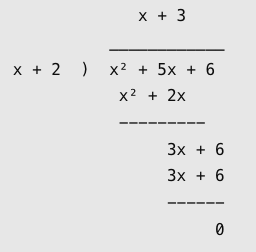
(x² + 5x + 6) ÷ (x + 2)
Step 1: Divide the Leading Terms
x² ÷ x = x
Write x as the first term of the quotient.
Step 2: Multiply
x(x + 2) = x² + 2x
Step 3: Subtract
(x² + 5x + 6) − (x² + 2x)
= 3x + 6
Step 4: Divide Again
3x ÷ x = 3
Write +3 in the quotient.
Step 5: Multiply
3(x + 2) = 3x + 6
Step 6: Subtract
(3x + 6) − (3x + 6) = 0
The remainder is zero.
Quotient = x + 3
Remainder = 0
Therefore:
(x² + 5x + 6)/(x + 2) = x + 3, for x ≠ −2.
Long Division Layout

Long Division with a Remainder
Worked Example
Divide:
(x² + 4x + 7) ÷ (x + 2)
Step 1: Divide the Leading Terms
x² ÷ x = x
Step 2: Multiply
x(x + 2) = x² + 2x
Step 3: Subtract
(x² + 4x + 7) − (x² + 2x)
= 2x + 7
Step 4: Divide Again
2x ÷ x = 2
Step 5: Multiply
2(x + 2) = 2x + 4
Step 6: Subtract
(2x + 7) − (2x + 4)
= 3
The remainder is 3.
Therefore:
Quotient = x + 2
Remainder = 3
The division can be written as:
(x² + 4x + 7)/(x + 2) = x + 2 + 3/(x + 2)
where x ≠ −2.
Verification
(x + 2)(x + 2) + 3
= x² + 4x + 4 + 3
= x² + 4x + 7
Correct.
Dividing Cubic Polynomials
Long division can also be used with higher-degree polynomials.
Worked Example
Divide:
(x³ + 4x² + x − 6) ÷ (x + 2)
Step 1
x³ ÷ x = x²
Multiply:
x²(x + 2) = x³ + 2x²
Subtract:
(x³ + 4x² + x − 6) − (x³ + 2x²)
= 2x² + x − 6
Step 2
2x² ÷ x = 2x
Multiply:
2x(x + 2) = 2x² + 4x
Subtract:
(2x² + x − 6) − (2x² + 4x)
= −3x − 6
Step 3
−3x ÷ x = −3
Multiply:
−3(x + 2) = −3x − 6
Subtract:
(−3x − 6) − (−3x − 6) = 0
Therefore:
Quotient = x² + 2x − 3
Remainder = 0
The factorization is:
x³ + 4x² + x − 6 = (x + 2)(x² + 2x − 3)
Dividing by Quadratic Polynomials
Long division also works when the divisor is quadratic.
Worked Example
Divide:
(x³ + 2x² + 3x + 4) ÷ (x² + x + 1)
Step 1
Divide the leading terms:
x³ ÷ x² = x
Multiply:
x(x² + x + 1) = x³ + x² + x
Subtract:
(x³ + 2x² + 3x + 4) − (x³ + x² + x)
= x² + 2x + 4
Step 2
Divide:
x² ÷ x² = 1
Multiply:
x² + x + 1
Subtract:
(x² + 2x + 4) − (x² + x + 1)
= x + 3
The remainder has degree 1, which is lower than the divisor's degree of 2.
Therefore, stop.
Quotient = x + 1
Remainder = x + 3
The result is:
(x³ + 2x² + 3x + 4)/(x² + x + 1) = x + 1 + (x + 3)/(x² + x + 1)
Missing Terms in Polynomial Long Division
Sometimes a polynomial does not contain every power of x.
Missing terms should be represented using zero coefficients.
Example
Divide:
(x³ + 5x − 6) ÷ (x − 1)
Rewrite the dividend:
x³ + 0x² + 5x − 6
The missing x² term has coefficient zero.
Long Division
Divide x³ by x:
x²
Multiply:
x²(x − 1) = x³ − x²
Subtract:
x² + 5x − 6
Next:
x² ÷ x = x
Multiply:
x(x − 1) = x² − x
Subtract:
6x − 6
Next:
6x ÷ x = 6
Multiply:
6(x − 1) = 6x − 6
Subtract:
0
Therefore:
Quotient = x² + x + 6
Remainder = 0
Important Reminder
Missing terms can easily cause errors in long division.
Writing zero coefficients helps keep powers aligned correctly.
Synthetic Division
Synthetic division is a shortened method of polynomial division that uses only the coefficients of the polynomial.
In its standard form, it is used when dividing by a linear expression:
x − c
where c is a constant.
For example:
-
Dividing by x − 2 uses c = 2.
-
Dividing by x + 3 uses c = −3.
-
Dividing by x − 5 uses c = 5.
Synthetic division is usually faster than long division because it avoids repeatedly writing variables and powers.
The Basic Procedure
-
Write the value of c from the divisor x − c.
-
Write the coefficients of the dividend in descending order.
-
Bring down the first coefficient.
-
Multiply it by c.
-
Add the result to the next coefficient.
-
Repeat multiplication and addition until the last coefficient is reached.
-
Interpret the final number as the remainder.
The remaining numbers give the coefficients of the quotient.
Synthetic Division with No Remainder
Worked Example
Divide:
(x² + 5x + 6) ÷ (x + 2)
Step 1: Identify c
The divisor is:
x + 2 = x − (−2)
Therefore:
c = −2
Step 2: Write the Coefficients
The dividend is:
x² + 5x + 6
Coefficients:
1, 5, 6
Step 3: Perform Synthetic Division
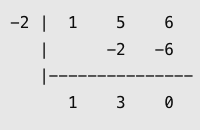
The first coefficient, 1, is brought down.
Multiply:
−2 × 1 = −2
Add:
5 + (−2) = 3
Multiply:
−2 × 3 = −6
Add:
6 + (−6) = 0
Step 4: Interpret the Result
The original dividend has degree 2.
The quotient has degree 1.
The quotient coefficients are:
1, 3
Therefore:
Quotient = x + 3
Remainder = 0
The result agrees with long division.
Synthetic Division with a Remainder
Worked Example
Divide:
(2x³ + 3x² − 5x + 7) ÷ (x − 2)
Step 1: Identify c
c = 2
Step 2: Write the Coefficients
2, 3, −5, 7
Step 3: Perform Synthetic Division
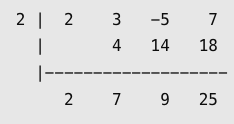
Follow the steps:
Bring down 2.
2 × 2 = 4
3 + 4 = 7
7 × 2 = 14
−5 + 14 = 9
9 × 2 = 18
7 + 18 = 25
Step 4: Interpret
The quotient coefficients are:
2, 7, 9
The quotient is:
Q(x) = 2x² + 7x + 9
The remainder is:
R = 25
Therefore:
(2x³ + 3x² − 5x + 7)/(x − 2) = 2x² + 7x + 9 + 25/(x − 2)
for x ≠ 2.
Verification
Multiply the divisor and quotient:
(x − 2)(2x² + 7x + 9)
= 2x³ + 7x² + 9x − 4x² − 14x − 18
= 2x³ + 3x² − 5x − 18
Add the remainder:
2x³ + 3x² − 5x − 18 + 25
= 2x³ + 3x² − 5x + 7
The original dividend is recovered.
Synthetic Division with Missing Terms
Missing terms must be represented by zero coefficients.
Worked Example
Divide:
(x⁴ − 3x² + 2x − 8) ÷ (x + 2)
The dividend has no x³ term.
Rewrite:
x⁴ + 0x³ − 3x² + 2x − 8
The divisor is x + 2, so:
c = −2
Set up:
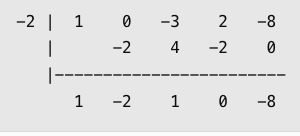
The quotient coefficients are:
1, −2, 1, 0
Therefore:
Q(x) = x³ − 2x² + x
The remainder is:
R = −8
Final Result
(x⁴ − 3x² + 2x − 8)/(x + 2) = x³ − 2x² + x − 8/(x + 2)
where x ≠ −2.
Important Reminder
If a power is missing, include a zero in its position.
Otherwise, every coefficient after the missing term may be interpreted incorrectly.
Comparing Long Division and Synthetic Division
|
Feature |
Long division |
Synthetic division |
|---|---|---|
|
Uses polynomial terms |
Yes |
Usually coefficients only |
|
Works with linear divisors |
Yes |
Yes, in standard form x − c |
|
Works with quadratic divisors |
Yes |
Not with the basic method |
|
Handles missing terms |
Yes |
Yes, using zero coefficients |
|
Produces a quotient |
Yes |
Yes |
|
Produces a remainder |
Yes |
Yes |
|
Often faster for x − c |
No |
Yes |
When Should You Use Each Method?
Use long division when:
-
The divisor has degree 2 or higher.
-
You want a general method that works with any polynomial divisor.
-
You need to see the subtraction and multiplication steps explicitly.
Use synthetic division when:
-
The divisor is x − c.
-
You want a quicker calculation.
-
You need to test whether x − c is a factor.
For divisors such as 2x − 3, the standard synthetic method requires an adjustment. Long division is a reliable choice.
Dividing by a Linear Expression with a Leading Coefficient
Consider:
(2x² + 7x + 3) ÷ (2x + 1)
We can use long division.
Step 1
2x² ÷ 2x = x
Multiply:
x(2x + 1) = 2x² + x
Subtract:
(2x² + 7x + 3) − (2x² + x)
= 6x + 3
Step 2
6x ÷ 2x = 3
Multiply:
3(2x + 1) = 6x + 3
Subtract:
0
Therefore:
Quotient = x + 3
Remainder = 0
Using a Modified Synthetic Approach
The divisor can also be written as:
2x + 1 = 2(x + 1/2)
We can synthetically divide by x + 1/2, using c = −1/2.
This produces:
2x + 6
Because the original divisor is twice x + 1/2, divide this quotient by 2:
(2x + 6)/2 = x + 3
The remainder remains zero.
This method works, but the adjustment must not be forgotten.
The Remainder Theorem
The Remainder Theorem connects polynomial division with function evaluation.
It states:
When a polynomial P(x) is divided by x − c, the remainder is:
R = P(c)
This means we can find the remainder without performing long division.
Worked Example
Find the remainder when:
P(x) = x³ − 4x + 7
is divided by:
x − 2
The divisor has c = 2.
Evaluate:
P(2) = 2³ − 4(2) + 7
= 8 − 8 + 7
Remainder = 7
Another Example
Find the remainder when:
P(x) = 2x³ + 5x² − x + 4
is divided by:
x + 1
Here:
c = −1
Evaluate:
P(−1) = 2(−1)³ + 5(−1)² − (−1) + 4
= −2 + 5 + 1 + 4
Remainder = 8
Why Does This Work?
Polynomial division gives:
P(x) = (x − c)Q(x) + R
Substitute x = c:
P(c) = (c − c)Q(c) + R
P(c) = 0 + R
Therefore:
P(c) = R
The Factor Theorem
The Factor Theorem is closely related to the Remainder Theorem.
It states:
x − c is a factor of P(x) if and only if P(c) = 0.
If the remainder is zero, the division is exact.
Worked Example
Determine whether x − 3 is a factor of:
P(x) = x² − 5x + 6
Evaluate:
P(3) = 3² − 5(3) + 6
= 9 − 15 + 6
= 0
Because the remainder is zero:
x − 3 is a factor.
We can verify by factoring:
x² − 5x + 6 = (x − 2)(x − 3)
Another Example
Is x + 2 a factor of:
P(x) = x³ + 3x² − 4x + 5?
Evaluate P(−2):
P(−2) = (−2)³ + 3(−2)² − 4(−2) + 5
= −8 + 12 + 8 + 5
= 17
Because P(−2) ≠ 0:
x + 2 is not a factor.
Using Synthetic Division to Factor Polynomials
Synthetic division can help factor higher-degree polynomials after one factor has been identified.
Worked Example
Factor:
P(x) = x³ − 6x² + 11x − 6
Test x = 1:
P(1) = 1 − 6 + 11 − 6 = 0
Therefore, x − 1 is a factor.
Use synthetic division:
The quotient is:
x² − 5x + 6
Factor the quotient:
x² − 5x + 6 = (x − 2)(x − 3)
Therefore:
P(x) = (x − 1)(x − 2)(x − 3)
Interpretation
The polynomial has three zeros:
x = 1
x = 2
x = 3
Synthetic division helps us move from a cubic polynomial to a simpler quadratic polynomial.

Interpreting Quotients and Remainders
The quotient tells us how many times the divisor fits into the dividend in an algebraic sense.
The remainder describes the part left over after the polynomial quotient has been removed.
For example:
x² + 5x + 7 = (x + 2)(x + 3) + 1
This tells us:
-
Dividend: x² + 5x + 7
-
Divisor: x + 2
-
Quotient: x + 3
-
Remainder: 1
The quotient is not the complete rational expression when the remainder is nonzero.
We must write:
(x² + 5x + 7)/(x + 2) = x + 3 + 1/(x + 2)
Degree of the Remainder
The remainder must have a degree lower than the divisor.
Examples:
-
Dividing by a linear polynomial produces a constant remainder or zero.
-
Dividing by a quadratic polynomial can produce a linear remainder, a constant remainder, or zero.
-
Dividing by a cubic polynomial can produce a quadratic remainder or one of lower degree.
This condition tells us when polynomial division is complete.
Polynomial Division and Rational Expressions
Polynomial division is especially useful when the numerator of a rational expression has degree greater than or equal to the denominator.
Consider:
(x² + 3x + 5)/(x + 1)
Long division gives:
Quotient = x + 2
Remainder = 3
Therefore:
(x² + 3x + 5)/(x + 1) = x + 2 + 3/(x + 1)
where x ≠ −1.
This form separates the polynomial part from the remaining fraction.
It is useful in advanced algebra, calculus, and the study of rational functions.
Understanding Polynomial Division Through Area
Multiplication and division are inverse operations.
For example, if a rectangle has area:
A = x² + 5x + 6
and one side has length:
x + 2
we can determine the other side by division:
(x² + 5x + 6) ÷ (x + 2)
The quotient is:
x + 3
Therefore, the rectangle's dimensions are:
x + 2
and:
x + 3
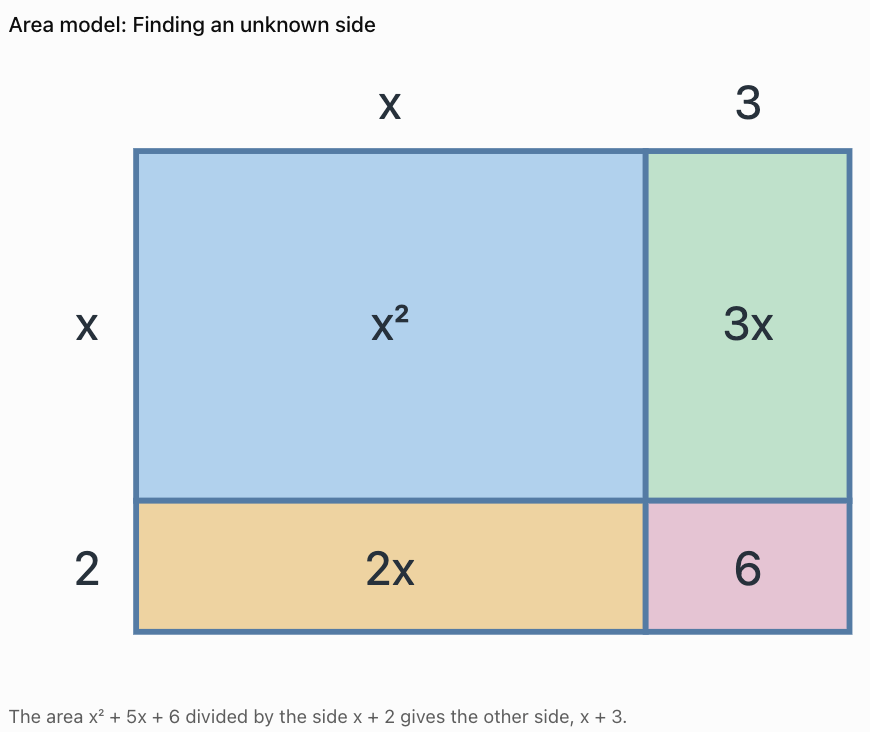
Polynomial division can therefore be understood as finding an unknown factor in a product.
Verifying Polynomial Division
Every polynomial division result can be checked using:
Dividend = Divisor × Quotient + Remainder
This is called the division algorithm for polynomials.
Worked Example
Verify the division:
(2x³ + 5x² − x + 4) ÷ (x + 3)
Suppose the quotient is:
Q(x) = 2x² − x + 2
and the remainder is:
R = −2
Check by multiplying:
(x + 3)(2x² − x + 2)
Distribute x:
2x³ − x² + 2x
Distribute 3:
6x² − 3x + 6
Combine:
2x³ + 5x² − x + 6
Add the remainder:
2x³ + 5x² − x + 6 − 2
= 2x³ + 5x² − x + 4
The original dividend is recovered.
The division is correct.
A Second Check Using the Remainder Theorem
Because the divisor is x + 3, evaluate the dividend at x = −3.
P(−3) = 2(−3)³ + 5(−3)² − (−3) + 4
= −54 + 45 + 3 + 4
= −2
This agrees with the remainder.
Using both checks can help detect calculation errors.
Real-World Application: Finding an Unknown Dimension
Suppose a rectangular storage area has an area of:
A = 2x² + 9x + 10
One side has length:
x + 2
Find the other side.
Use polynomial division:
(2x² + 9x + 10) ÷ (x + 2)
Step 1
2x² ÷ x = 2x
Multiply:
2x(x + 2) = 2x² + 4x
Subtract:
5x + 10
Step 2
5x ÷ x = 5
Multiply:
5(x + 2) = 5x + 10
Subtract:
0
Therefore:
Other side = 2x + 5
Verification
(x + 2)(2x + 5)
= 2x² + 9x + 10
The area expression is recovered.
If x = 3 metres:
First side = 5 m
Second side = 11 m
Area = 5 × 11
Area = 55 m²
Real-World Application: Production and Packaging
Suppose a manufacturer models the total material required for a production process using:
M(x) = 3x² + 14x + 8
The material required per package is represented by:
D(x) = x + 4
To find the polynomial quotient, divide:
(3x² + 14x + 8) ÷ (x + 4)
Long Division
3x² ÷ x = 3x
Multiply:
3x(x + 4) = 3x² + 12x
Subtract:
2x + 8
Divide:
2x ÷ x = 2
Multiply:
2(x + 4) = 2x + 8
Subtract:
0
Therefore:
Q(x) = 3x + 2
Interpretation
Within this algebraic model, the total material expression is exactly the product:
M(x) = (x + 4)(3x + 2)
The quotient represents the corresponding number of packages algebraically, provided the model's units and assumptions support that interpretation.
Common Mistakes
Subtracting exponents incorrectly
Incorrect:
x⁶ ÷ x² = x³
Correct:
x⁶ ÷ x² = x⁴
Dividing only the first term by a monomial
Incorrect:
(6x² + 9x)/3x = 2x + 9x
Correct:
(6x² + 9x)/3x = 2x + 3
Forgetting missing terms
For synthetic division of x³ + 4x − 7, use coefficients:
1, 0, 4, −7
Using the wrong sign in synthetic division
For x + 3, use c = −3, not 3.
Forgetting to subtract the entire polynomial during long division
Every term in the polynomial being subtracted must change sign.
Stopping long division too early
Continue until the remainder has a lower degree than the divisor.
Treating the remainder as part of the quotient
If the quotient is x + 2 and the remainder is 3, the rational expression is:
x + 2 + 3/(x + 1)
not x + 5.
Ignoring the remainder
A nonzero remainder must be included in the final division result.
Forgetting domain restrictions
The divisor cannot equal zero.
For example:
(x² − 4)/(x − 2) = x + 2
only when x ≠ 2.
Using basic synthetic division with an unsuitable divisor
The standard shortcut is designed for x − c. For other divisors, use long division or an appropriately modified method.
Failing to verify
Always check:
Divisor × Quotient + Remainder = Dividend
Key Terms
-
Polynomial Division: Process of dividing one polynomial by another.
-
Dividend: Polynomial being divided.
-
Divisor: Polynomial by which another polynomial is divided.
-
Quotient: Polynomial result of the division algorithm.
-
Remainder: Polynomial left after division, with degree lower than the divisor.
-
Monomial: Polynomial containing one term.
-
Leading Term: Term with the highest power in a polynomial.
-
Leading Coefficient: Coefficient of the leading term.
-
Degree: Highest exponent in a nonzero polynomial in one variable.
-
Quotient of Powers Rule: Rule for subtracting exponents when dividing powers with the same nonzero base.
-
Long Division: Systematic polynomial division using repeated multiplication and subtraction.
-
Synthetic Division: Shortcut using coefficients when dividing by a suitable linear polynomial.
-
Zero Coefficient: Coefficient used to represent a missing power.
-
Division Algorithm: Relationship P(x) = D(x)Q(x) + R(x).
-
Remainder Theorem: When dividing P(x) by x − c, the remainder equals P(c).
-
Factor Theorem: x − c is a factor of P(x) exactly when P(c) = 0.
-
Exact Division: Division producing a zero remainder.
-
Rational Expression: Quotient of two polynomials with a nonzero denominator.
-
Domain Restriction: Value excluded because it makes the original denominator zero.
-
Verification: Checking a division result using multiplication and addition.
-
Zero of a Polynomial: Value of x that makes the polynomial equal zero.
Key Takeaways
-
Polynomial division extends ordinary numerical division.
-
When dividing powers with the same base, subtract their exponents.
-
Dividing a polynomial by a monomial requires dividing every term.
-
Polynomial division produces a quotient and a remainder.
-
The degree of a nonzero remainder must be lower than the degree of the divisor.
-
Long division works with any nonzero polynomial divisor.
-
Synthetic division is a shortcut for divisors of the form x − c.
-
Missing powers must be represented by zero coefficients.
-
For a divisor x + a, synthetic division uses c = −a.
-
The Remainder Theorem allows us to calculate remainders by substitution.
-
The Factor Theorem helps identify factors of polynomials.
-
A zero remainder means the divisor is a factor of the dividend.
-
Polynomial division can help factor higher-degree polynomials.
-
A nonzero remainder must be included in the final rational expression.
-
Every division result can be verified using the division algorithm.
Check Your Understanding
Dividing by Monomials
Simplify each expression.
-
12x⁴ ÷ 3x²
-
−20a⁵ ÷ 5a²
-
(15x³ + 10x²)/5x
-
(18x⁴ − 12x³ + 6x²)/6x²
Polynomial Long Division
Find the quotient and remainder.
-
(x² + 7x + 12) ÷ (x + 3)
-
(x² + 5x + 9) ÷ (x + 2)
-
(2x² + 9x + 7) ÷ (x + 1)
-
(x³ + 3x² + 2x) ÷ (x + 1)
-
(x³ + 2x² + 5x + 4) ÷ (x² + 1)
-
(2x³ + 5x² + 4x + 3) ÷ (x² + 2x + 1)
Synthetic Division
Use synthetic division to find the quotient and remainder.
-
(x² − 5x + 6) ÷ (x − 2)
-
(x³ − 4x² + x + 6) ÷ (x − 3)
-
(2x³ + 3x² − 5x + 7) ÷ (x + 1)
-
(x⁴ − 5x² + 4) ÷ (x − 2)
-
(3x³ − 2x² + 5x − 1) ÷ (x + 2)
Remainders and Verification
-
Find the remainder when x² + 4x + 7 is divided by x − 2.
-
Determine whether x − 3 is a factor of x² − 7x + 12.
-
Determine whether x + 2 is a factor of x³ + 2x² − 4x − 8.
-
Explain how to verify a polynomial division result.
-
Explain why the remainder must have a lower degree than the divisor.
Answer Key
|
Question |
Answer |
|---|---|
|
1 |
4x² |
|
2 |
−4a³ |
|
3 |
3x² + 2x |
|
4 |
3x² − 2x + 1 |
|
5 |
Q = x + 4, R = 0 |
|
6 |
Q = x + 3, R = 3 |
|
7 |
Q = 2x + 7, R = 0 |
|
8 |
Q = x² + 2x, R = 0 |
|
9 |
Q = x + 2, R = 4x + 2 |
|
10 |
Q = 2x + 1, R = 2 |
|
11 |
Q = x − 3, R = 0 |
|
12 |
Q = x² − x − 2, R = 0 |
|
13 |
Q = 2x² + x − 6, R = 13 |
|
14 |
Q = x³ + 2x² − x − 2, R = 0 |
|
15 |
Q = 3x² − 8x + 21, R = −43 |
|
16 |
19 |
|
17 |
Yes; P(3) = 0 |
|
18 |
Yes; P(−2) = 0 |
|
19 |
Check that divisor × quotient + remainder equals the dividend |
|
20 |
Otherwise, division can continue by cancelling another leading term |
For Questions 1–4, retain the domain restrictions imposed by the original divisors.
Extended Challenge
Dividing by Monomials
-
(24x⁶ − 18x⁴ + 12x²)/6x²
-
(30a⁵b³ − 20a³b² + 10a²b)/5a²b
-
(−16x⁵ + 24x³ − 8x²)/(−8x²)
-
(12x⁴ + 9x² + 3)/3x
-
Explain why dividing a polynomial by a monomial does not always produce another polynomial.
Polynomial Long Division
Find the quotient and remainder.
-
(x³ + 5x² + 8x + 4) ÷ (x + 1)
-
(2x³ − 3x² + 4x − 5) ÷ (x − 2)
-
(x⁴ − 3x² + 2x − 8) ÷ (x + 2)
-
(3x⁴ + 2x³ − 5x² + x + 7) ÷ (x² + 1)
-
(2x⁴ − x³ + 3x² − 4x + 5) ÷ (x² − x + 2)
Synthetic Division
-
(x³ − 7x + 6) ÷ (x − 1)
-
(2x⁴ − 3x³ + 5x − 8) ÷ (x + 2)
-
(3x³ + 4x² − 7x + 2) ÷ (x − 1)
-
(x⁵ − 4x³ + 3x² − 2) ÷ (x + 1)
-
(4x⁴ − 5x³ + 2x² − 7x + 9) ÷ (x − 3)
Remainder and Factor Theorems
-
Find the remainder when 2x³ − 5x² + 4x − 7 is divided by x − 2.
-
Determine whether x + 3 is a factor of x³ + 2x² − 5x + 6.
-
Determine whether x − 4 is a factor of x³ − 6x² + 8x.
-
Find a value of k so that x − 2 is a factor of x³ + kx² − 4x + 8.
-
Explain how synthetic division and the Factor Theorem can work together to factor a cubic polynomial.
Advanced Applications
-
Divide x⁴ − 1 by x² − 1.
-
Divide 2x⁵ + 3x³ − x + 4 by x² + x + 1.
-
Find the quotient and remainder when x⁵ − 3x⁴ + 2x² − 7 is divided by x − 3.
-
Use synthetic division to factor x³ − 4x² + x + 6 completely.
-
Construct a cubic polynomial that gives quotient x² + 2x − 3 and remainder 5 when divided by x + 2.
Final Challenge: Investigating Polynomial Division
A polynomial is defined by:
P(x) = x³ − 4x² − x + 4
Complete the investigation.
-
Identify the degree of P(x).
-
Evaluate P(1).
-
Use the Remainder Theorem to determine the remainder when P(x) is divided by x − 1.
-
Determine whether x − 1 is a factor.
-
Divide P(x) by x − 1 using long division.
-
Repeat the division using synthetic division.
-
Compare the quotients obtained by both methods.
-
Verify the division using multiplication.
-
Factor the resulting quadratic quotient.
-
Write P(x) as a product of linear factors.
-
Identify all zeros of P(x).
-
Explain how these zeros relate to the x-intercepts of its graph.
-
Determine the remainder when P(x) is divided by x + 2.
-
Verify that remainder using substitution.
-
Explain why synthetic division is efficient for linear divisors.
-
Describe a situation in which long division would be preferable.
-
Explain the meaning of a zero remainder.
-
Explain why a nonzero remainder prevents the divisor from being a factor.
-
Write a general statement describing the relationship between polynomial division and factoring.
-
Summarise how long division, synthetic division, and the Remainder Theorem are connected.
Further Investigation: Creating Your Own Polynomial
Choose three different integer values for a, b, and c.
Construct:
P(x) = (x − a)(x − b)(x − c)
Expand the expression to obtain a cubic polynomial.
Then:
-
Divide P(x) by x − a using synthetic division.
-
Divide P(x) by x − b using long division.
-
Use the Remainder Theorem to determine the remainder when dividing by x − c.
-
Verify each result.
-
Explain why all three divisions produce a zero remainder.
-
Change one coefficient of your expanded polynomial and investigate how the remainders change.
This investigation demonstrates how polynomial multiplication, factoring, and division are closely related operations.