Solving Quadratic Equations
1. Solving by Factoring
Learning outcomes
- I can factor simple quadratic expressions.
- I can apply the Zero Product Property.
- I can solve quadratic equations by factoring.
- I can verify my solutions.
- I can recognise when factoring is appropriate.
Solving by Factoring
What Does It Mean to Solve a Quadratic Equation?
A quadratic equation is an equation that can be written in the form:
ax² + bx + c = 0
where a ≠ 0.
To solve a quadratic equation means to find the value or values of x that make the equation true.
For example:
x² − 5x + 6 = 0
has two solutions:
x = 2
and:
x = 3
One of the most efficient ways to find these solutions is factoring.
Expressions vs Equations
It is important to distinguish between a quadratic expression and a quadratic equation.
An expression:
x² − 5x + 6
can be factored.
An equation:
x² − 5x + 6 = 0
can be solved.
Factoring the expression gives:
(x − 2)(x − 3)
Solving the equation gives:
x = 2 or x = 3
Factoring is therefore often a step used to solve a quadratic equation.
Factoring Simple Quadratics
Consider:
x² + 7x + 12
To factor this expression, find two numbers that:
- multiply to 12
- add to 7
The numbers are:
3 and 4
Therefore:
x² + 7x + 12 = (x + 3)(x + 4)
The Sum-and-Product Method
For a quadratic:
x² + bx + c
look for two numbers that:
multiply to c
and:
add to b
For example:
x² + 9x + 20
We need two numbers that:
multiply to 20
and add to 9.
The numbers are:
4 and 5
Therefore:
x² + 9x + 20 = (x + 4)(x + 5)
Factoring with Negative Numbers
Consider:
x² − 7x + 12
We need two numbers that:
multiply to +12
and add to −7.
The numbers are:
−3 and −4
Therefore:
x² − 7x + 12 = (x − 3)(x − 4)
When the Constant Is Negative
Consider:
x² + 2x − 15
We need two numbers that:
multiply to −15
and add to 2.
The numbers are:
5 and −3
Therefore:
x² + 2x − 15 = (x + 5)(x − 3)
When the constant is negative, the two factors will have opposite signs.
Sign Patterns
For:
x² + bx + c
some useful patterns are:
| Sign of c | Sign of b | Likely Factor Signs |
|---|---|---|
| positive | positive | both positive |
| positive | negative | both negative |
| negative | positive or negative | opposite signs |
For example:
x² + 8x + 15
becomes:
(x + 3)(x + 5)
while:
x² − 8x + 15
becomes:
(x − 3)(x − 5)
Checking Your Factoring
Always check factoring by expanding.
Suppose:
x² − 7x + 12 = (x − 3)(x − 4)
Expand the right side:
(x − 3)(x − 4)
= x² − 4x − 3x + 12
= x² − 7x + 12
The expressions match, so the factorization is correct.
Factoring Out a Common Factor
Before factoring a trinomial, always check whether all terms have a common factor.
Consider:
2x² − 10x + 12
All terms are divisible by 2.
Factor out 2:
2(x² − 5x + 6)
Now factor the quadratic:
2(x − 2)(x − 3)
Factoring out the greatest common factor first usually makes the remaining expression easier to work with.
Factoring When There Is a Common Variable
Consider:
x² − 6x
Both terms contain x.
Factor out x:
x(x − 6)
If the equation is:
x² − 6x = 0
then:
x(x − 6) = 0
This can now be solved using the Zero Product Property.
The Zero Product Property
The key idea behind solving by factoring is the Zero Product Property.
If:
A × B = 0
then:
A = 0
or:
B = 0
Why?
A product can equal zero only if at least one of its factors equals zero.
For example:
7 × 0 = 0
and:
0 × 12 = 0
But two nonzero numbers cannot multiply to give zero.
Applying the Zero Product Property
Suppose:
(x − 2)(x − 5) = 0
The Zero Product Property tells us:
x − 2 = 0
or:
x − 5 = 0
Solve each equation:
x = 2
or:
x = 5
Therefore, the quadratic equation has two solutions:
x = 2, 5
Solving a Quadratic by Factoring
Consider:
x² − 7x + 12 = 0
Factor:
(x − 3)(x − 4) = 0
Apply the Zero Product Property:
x − 3 = 0
or:
x − 4 = 0
Therefore:
x = 3
or:
x = 4
Solutions:
x = 3, 4
A Reliable Solving Strategy
When solving a quadratic by factoring:
Put the equation equal to zero
Write it in the form:
ax² + bx + c = 0
Factor completely
Rewrite the quadratic as a product.
Apply the Zero Product Property
Set each factor equal to zero.
Solve each equation
Find the possible values of x.
Verify
Substitute the solutions into the original equation.
This process works because factoring turns one quadratic equation into simpler linear equations.
Why the Equation Must Equal Zero
The Zero Product Property works when the product equals zero.
Consider:
(x − 2)(x − 5) = 12
You cannot say:
x − 2 = 12
or:
x − 5 = 12
The Zero Product Property does not apply.
Instead, the equation should first be rearranged into a form equal to zero before factoring.
This is one of the most important rules when solving by factoring.
Example: Rearranging First
Solve:
x² + 3x = 10
The equation is not equal to zero.
Move 10 to the left:
x² + 3x − 10 = 0
Factor:
(x + 5)(x − 2) = 0
Apply the Zero Product Property:
x + 5 = 0
or:
x − 2 = 0
Therefore:
x = −5
or:
x = 2
Another Rearranging Example
Solve:
x² = 7x − 10
Move everything to one side:
x² − 7x + 10 = 0
Factor:
(x − 2)(x − 5) = 0
Therefore:
x = 2 or x = 5
Solving When There Is a Common Factor
Solve:
3x² − 12x = 0
Factor out the greatest common factor:
3x(x − 4) = 0
The constant factor 3 cannot equal zero, so:
x = 0
or:
x − 4 = 0
Therefore:
x = 0 or x = 4
Do Not Lose the x = 0 Solution
Consider:
x² − 5x = 0
A common mistake is to divide both sides by x:
x − 5 = 0
This gives:
x = 5
But this loses another solution.
Instead, factor:
x(x − 5) = 0
Therefore:
x = 0
or:
x = 5
So the correct solutions are:
x = 0, 5
Dividing by a variable can accidentally remove a valid solution when that variable might equal zero.
Solving When a Is Not 1
Consider:
2x² + 7x + 3 = 0
Factor:
(2x + 1)(x + 3) = 0
Apply the Zero Product Property:
2x + 1 = 0
or:
x + 3 = 0
Solve:
2x = −1
x = −1/2
and:
x = −3
Therefore:
x = −1/2, −3
Another Example with a Leading Coefficient
Solve:
3x² − 11x − 4 = 0
Factor:
(3x + 1)(x − 4) = 0
Check:
3x² − 12x + x − 4
= 3x² − 11x − 4
Now solve:
3x + 1 = 0
x = −1/3
or:
x − 4 = 0
x = 4
Solutions:
x = −1/3, 4
Difference of Squares
Some quadratics have a special factoring pattern.
a² − b² = (a − b)(a + b)
For example:
x² − 25
is:
x² − 5²
Therefore:
x² − 25 = (x − 5)(x + 5)
If:
x² − 25 = 0
then:
(x − 5)(x + 5) = 0
So:
x = 5 or x = −5
Another Difference-of-Squares Example
Solve:
4x² − 49 = 0
Recognize:
4x² = (2x)²
49 = 7²
Therefore:
(2x − 7)(2x + 7) = 0
So:
2x − 7 = 0
or:
2x + 7 = 0
Therefore:
x = 7/2
or:
x = −7/2
Perfect-Square Trinomials
Some quadratics factor into two identical factors.
For example:
x² − 6x + 9
factors as:
(x − 3)(x − 3)
or:
(x − 3)²
If:
(x − 3)² = 0
then:
x = 3
There is only one distinct solution.
This is called a repeated root or double root.
Two Roots, One Root, or No Easy Factors
A quadratic equation can have:
- two distinct real solutions
- one repeated real solution
- no real solutions
Factoring is especially convenient when the factors can be found easily.
For example:
x² − 5x + 6 = 0
factors easily.
But:
x² + x − 1 = 0
does not factor neatly using integers.
Another solving method may therefore be more efficient.
When Is Factoring Appropriate?
Factoring is a good choice when:
- the quadratic is already in factored form
- there is an obvious common factor
- the trinomial factors using simple integers
- the expression is a difference of squares
- the expression is a perfect-square trinomial
- the problem asks specifically for factoring
- exact roots can be obtained easily from the factors
When Might Another Method Be Better?
Factoring may not be the most efficient method when:
- factors are difficult to identify
- roots are irrational
- the quadratic does not factor over the real numbers
- coefficients make factoring complicated
Other methods include:
- graphing
- completing the square
- using the quadratic formula
Choosing an appropriate method is part of solving quadratic equations efficiently.
Factoring and Graphs
Consider:
y = (x − 2)(x − 6)
The roots are:
x = 2 and x = 6
These solutions correspond to the x-intercepts:
(2, 0) and (6, 0)
So solving:
x² − 8x + 12 = 0
is equivalent to asking:
Where does the graph of y = x² − 8x + 12 cross the x-axis?
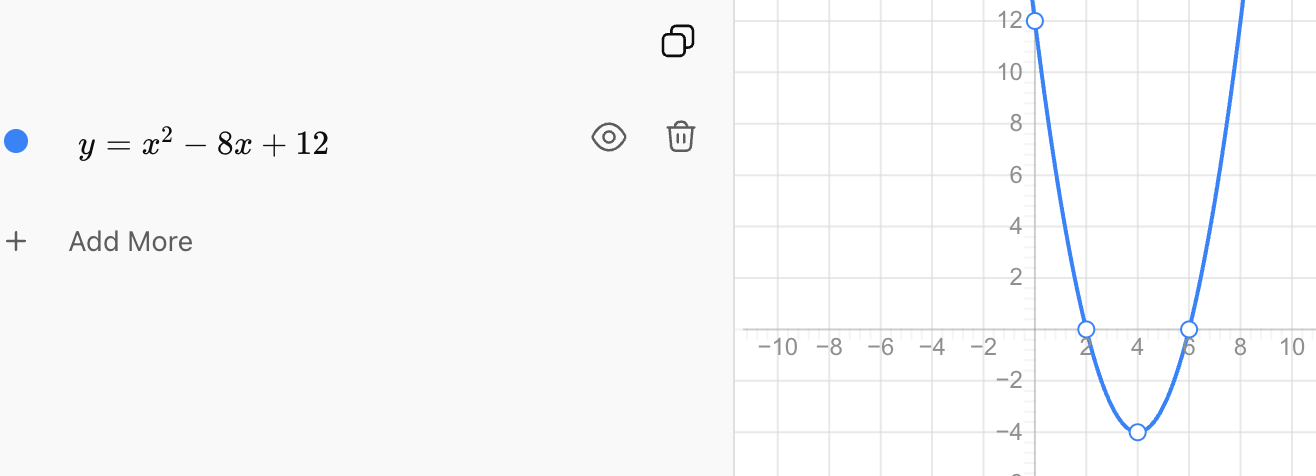
Factoring connects algebraic solutions directly to graphical features.
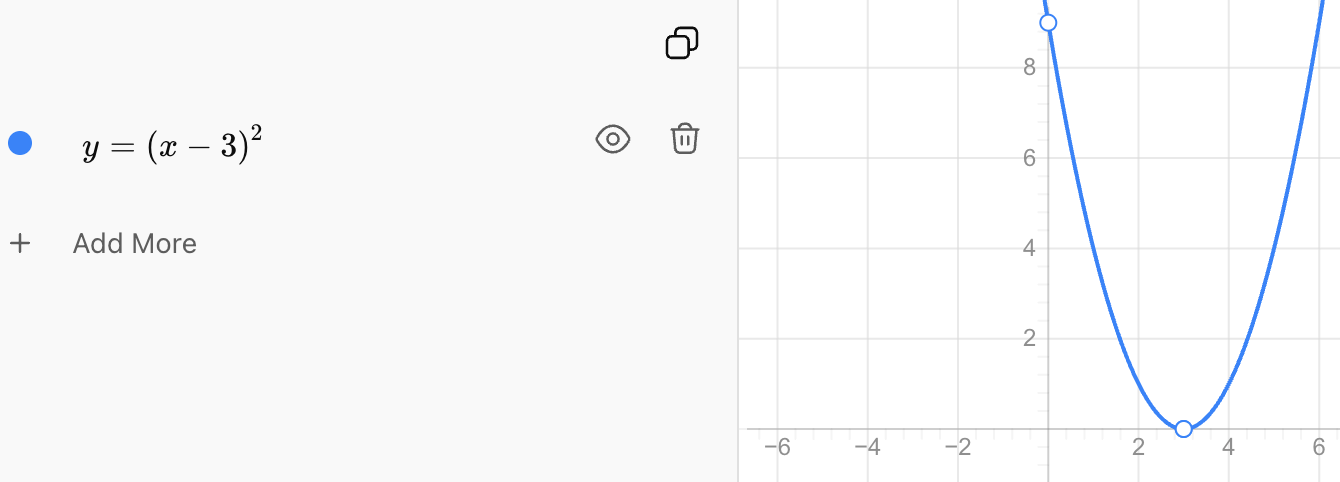
Repeated Roots on a Graph
Consider:
x² − 6x + 9 = 0
Factor:
(x − 3)² = 0
Solution:
x = 3
The corresponding function is:
y = (x − 3)²