Forms of Quadratic Equations

2. Vertex Form

Learning outcomes
  • I can identify the vertex from vertex form.
  • I can determine the axis of symmetry.
  • I can describe graph transformations using vertex form.
  • I can sketch graphs directly from vertex form.
  • I can compare vertex form with standard form.

Vertex Form

What Is Vertex Form?

A quadratic function can be written in several forms. One of the most useful is vertex form:

y = a(x − h)² + k

Vertex form is especially useful because the vertex and axis of symmetry can be identified directly from the equation.

In:

y = a(x − h)² + k

  • a controls the direction and vertical stretch or compression of the parabola
  • h gives the x-coordinate of the vertex
  • k gives the y-coordinate of the vertex

Therefore, the vertex is:

(h, k)


The Parent Quadratic Function

The simplest quadratic function is:

y = x²

Its graph is a parabola.
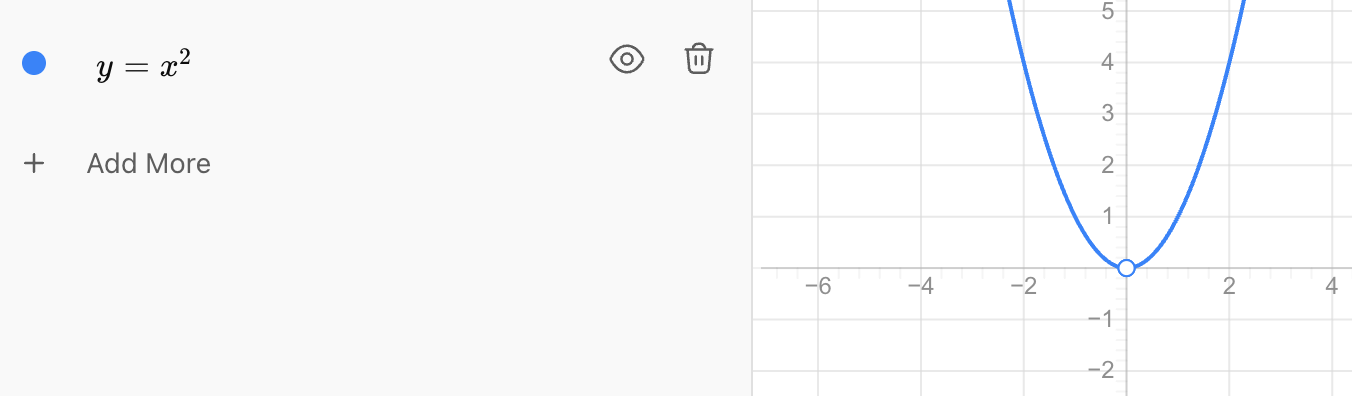
For y = x²:

  • vertex = (0, 0)
  • axis of symmetry = x = 0
  • parabola opens upward
  • a = 1

Vertex form describes transformations of this basic parabola.


Identifying the Vertex

Consider:

y = (x − 3)² + 2

Compare it with:

y = a(x − h)² + k

We can identify:

a = 1

h = 3

k = 2

Therefore:

vertex = (3, 2)
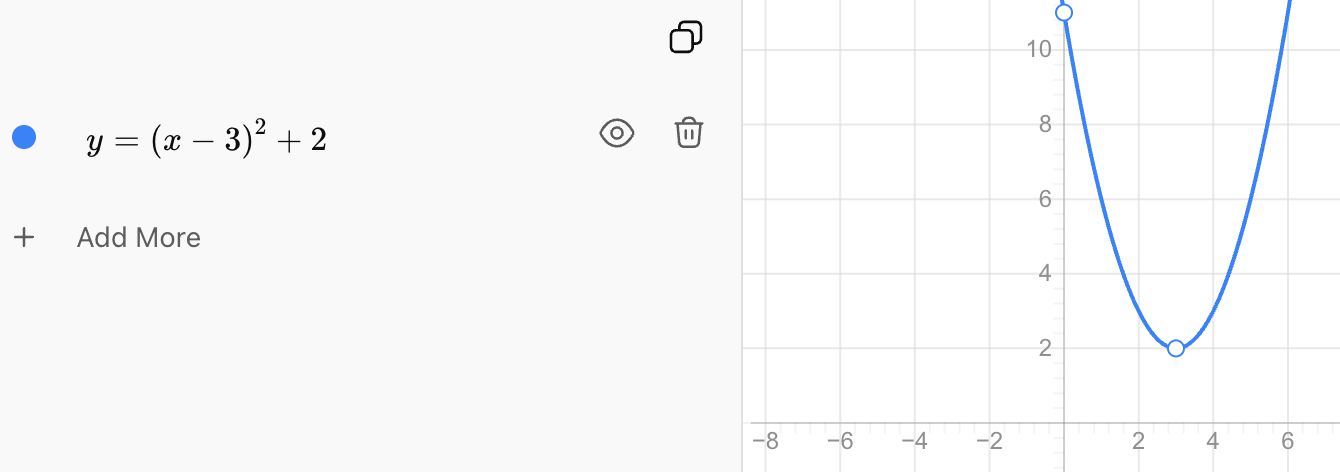
The parabola has moved:

  • 3 units right
  • 2 units up

compared with y = x².


Watch the Sign of h

The sign inside the brackets can be confusing.

Remember:

y = a(x − h)² + k

The x-coordinate of the vertex is h, not simply the number you see after x.

For example:

y = (x − 5)² + 3

Vertex:

(5, 3)

But:

y = (x + 5)² + 3

can be written as:

y = (x − (−5))² + 3

so the vertex is:

(−5, 3)

The horizontal shift appears to have the opposite sign from the sign inside the brackets.


More Examples of Identifying the Vertex

Equation h k Vertex
y = (x − 4)² + 7 4 7 (4, 7)
y = (x + 2)² + 5 −2 5 (−2, 5)
y = 3(x − 1)² − 6 1 −6 (1, −6)
y = −2(x + 4)² − 3 −4 −3 (−4, −3)
y = ½(x − 8)² 8 0 (8, 0)

The value of a does not change the location of the vertex.


Axis of Symmetry

Every parabola has an axis of symmetry.

This is a vertical line passing through the vertex that divides the parabola into two mirror-image halves.

For:

y = a(x − h)² + k

the axis of symmetry is:

x = h

So if the vertex is:

(3, 2)

the axis of symmetry is:

x = 3


Example: Finding the Axis of Symmetry

Consider:

y = 2(x + 4)² − 1

The vertex is:

(−4, −1)

Therefore, the axis of symmetry is:

x = −4

Notice that the axis of symmetry depends only on the x-coordinate of the vertex.


Transformations from y = x²

Vertex form makes transformations easy to identify.

Starting with:

y = x²

the function:

y = a(x − h)² + k

can involve:

  • horizontal translation
  • vertical translation
  • reflection
  • vertical stretch
  • vertical compression
https://images.openai.com/static-rsc-4/4FTprfhfsteFVn-WzHoNhPVwVZAajbpsmFyPLM23t7v5HNEZPRK6WG31V9y94gz9IliNwmVrXNu9EB08gAUlwtYwnpzaOAEMk4mDQjEe2DctqYCLzmO4sl2crKSEBFtvUWtyqvDiBdrREqIP2Hav_OmAYMZYbnJ-yp_0LQrSBV8jN23efj9B6Be3phD9IeBq?purpose=fullsize
 
https://images.openai.com/static-rsc-4/Fr4Dxek1wFfj00crd6592fDCl7GfWyUmrzumuaVe-snd0jlG0SiaqvqxT3KtjDecqa9yIAIXqdRnweo0VR8ZjsVnDykJXQarTem1NHPr_RYotBusbMoBEjhN8Kq9qtC_vyyQWkYZ4XaVIoenLlBs2zPF1l5EduDlyuB2dS8LEZEfqMGNlYUK1FaV85aYyXZq?purpose=fullsize
 
https://images.openai.com/static-rsc-4/R_ncFrlyLxbQKeV0HB8wRR95acswxs3KkmMxZeFdFY15jzYA4F7-NaFZigpnkpgaTpNlMyOOwwdEwAQk8IW_8e3CkMztVdYf0ElCRE6vVeyjaCjGCylLuBUtCGmxAflNjmCPWRITxj4lPUGV4E9UU5zphDV9S-9L1lWq8xPwkitzxkjOsf0A2jcqkwfrTFXw?purpose=fullsize
 
6

Horizontal Translation

The value h controls horizontal movement.

If h > 0

The graph moves right.

Example:

y = (x − 4)²

moves 4 units right.

If h < 0

The graph moves left.

Example:

y = (x + 4)²

moves 4 units left.

Remember that:

x + 4 = x − (−4)

so h = −4.


Vertical Translation

The value k controls vertical movement.

If k > 0

The graph moves up.

Example:

y = x² + 5

moves 5 units upward.

If k < 0

The graph moves down.

Example:

y = x² − 5

moves 5 units downward.

Unlike the horizontal translation, the vertical translation uses the sign exactly as it appears.


The Role of a

The value of a affects the shape and direction of the parabola.

In:

y = a(x − h)² + k

the value of a determines:

  • whether the parabola opens upward or downward
  • whether it is vertically stretched or compressed

Positive and Negative Values of a

If:

a > 0

the parabola opens upward.

If:

a < 0

the parabola opens downward.

Compare:

y = x²

and:

y = −x²
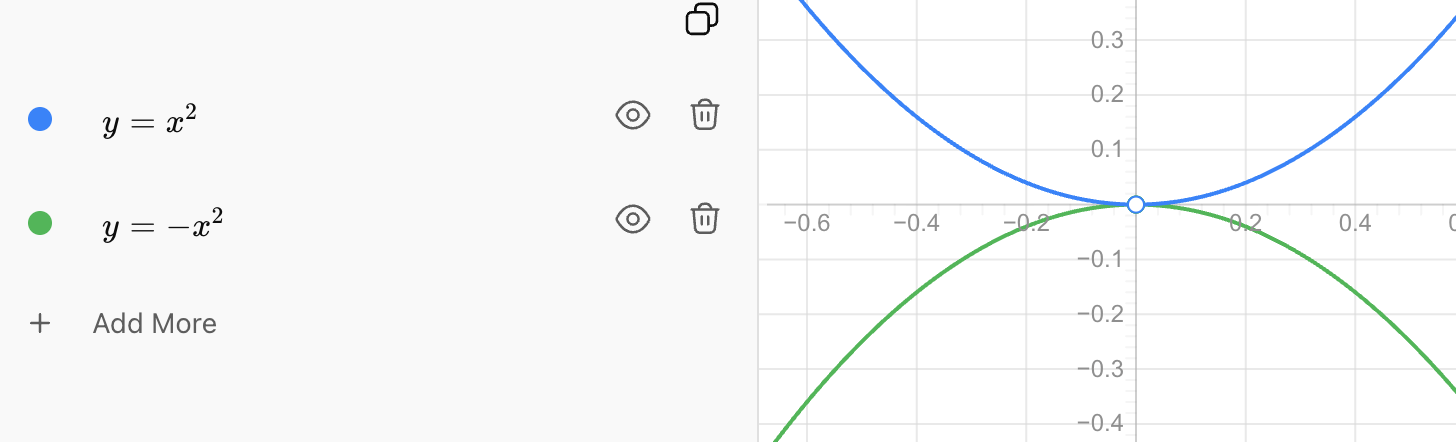
The negative sign reflects the parabola across the x-axis.


Vertical Stretch

If:

|a| > 1

the parabola is vertically stretched compared with y = x².

It appears narrower.

For example:

y = 3x²

has a vertical stretch factor of 3.

Compare:

y = x²

y = 3x²

For the same x-value, the y-value of 3x² is three times as far from the vertex level.


Vertical Compression

If:

0 < |a| < 1

the parabola is vertically compressed.

It appears wider.

For example:

y = ½x²

is vertically compressed by a factor of ½.

So:

  • |a| > 1 → narrower
  • |a| = 1 → basic width
  • 0 < |a| < 1 → wider

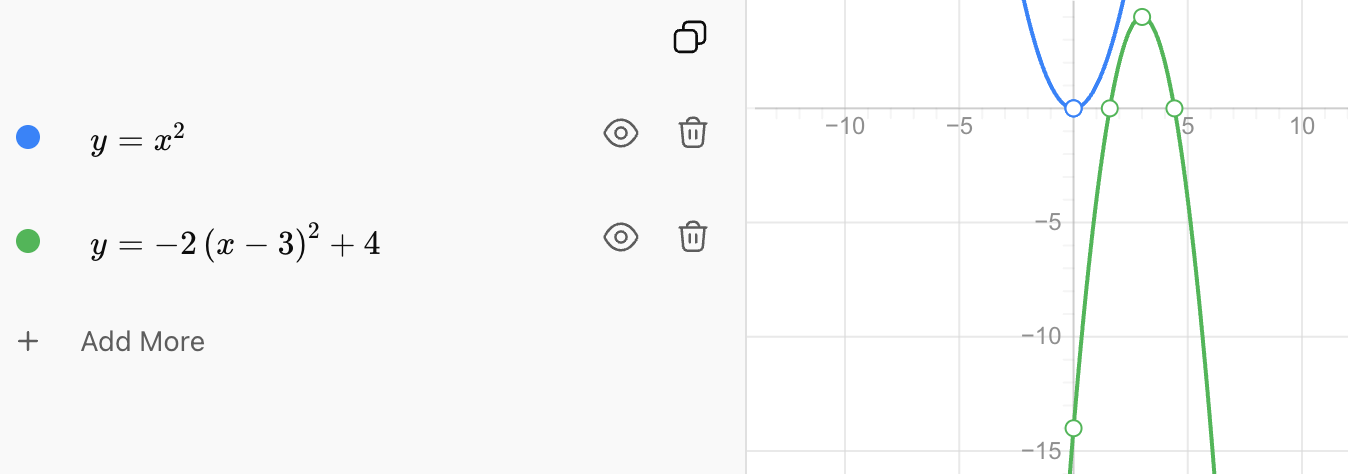
Putting the Transformations Together

Consider:

y = −2(x − 3)² + 4

From the equation:

a = −2

h = 3

k = 4

Therefore:

  • vertex = (3, 4)
  • axis of symmetry = x = 3
  • shift right 3
  • shift up 4
  • reflection across the x-axis
  • vertical stretch by factor 2
  • parabola opens downward

This demonstrates why vertex form is so useful: a great deal of information about the graph can be read directly from the equation.


Sketching from Vertex Form

Suppose we want to sketch:

y = (x − 2)² − 3

Identify the vertex

h = 2

k = −3

Vertex:

(2, −3)

Draw the axis of symmetry

x = 2

Determine the direction

a = 1

Therefore, the parabola opens upward.

Find nearby points

Choose values on either side of x = 2.

For x = 1:

y = (1 − 2)² − 3

y = 1 − 3

y = −2

So one point is:

(1, −2)

By symmetry:

(3, −2)

is also on the graph.


Using the Step Pattern

For the basic parabola:

y = x²

starting from the vertex, a useful pattern is:

  • across 1 → up 1
  • across another 1 → up 3 more
  • across another 1 → up 5 more

This produces the familiar:

1, 3, 5 pattern

The corresponding heights from the vertex are:

  • 1² = 1
  • 2² = 4
  • 3² = 9

For:

y = a(x − h)² + k

these vertical changes are multiplied by a.


Example Using the Step Pattern

Consider:

y = 2(x − 1)² + 3

Vertex:

(1, 3)

Since a = 2, multiply the basic vertical changes by 2.

From the vertex:

  • across 1 → up 2
  • across another 1 → up 6 more
  • across another 1 → up 10 more

The parabola is narrower than y = x².


Sketching a Downward Parabola

Consider:

y = −(x + 2)² + 4

Vertex:

(−2, 4)

Axis of symmetry:

x = −2

Because:

a = −1

the parabola opens downward.
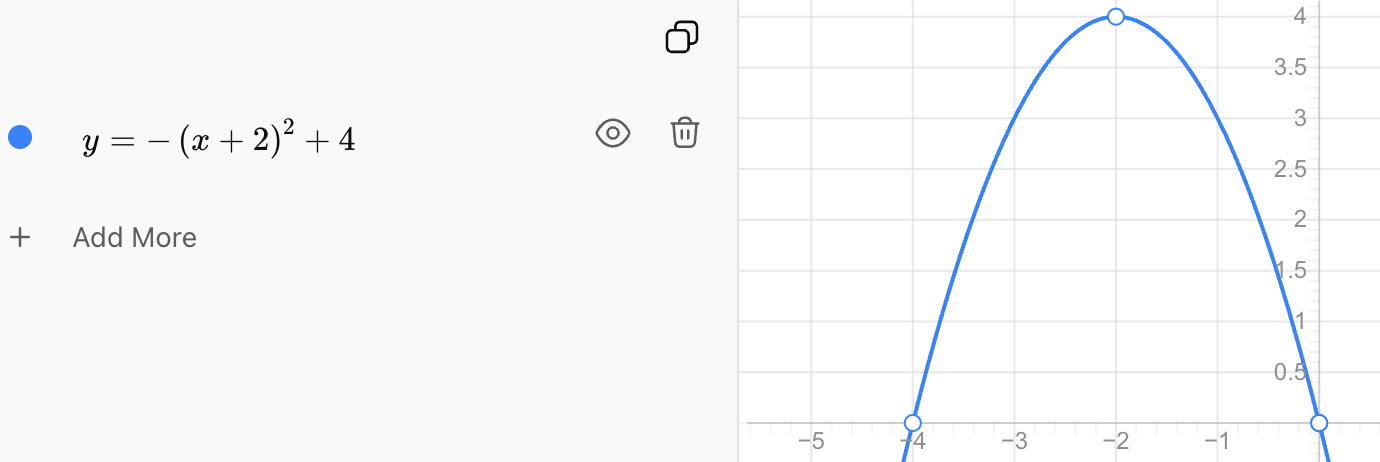
Starting at the vertex:

  • move 1 left/right → down 1
  • move 2 left/right → down 4
  • move 3 left/right → down 9

The symmetry makes sketching the graph much faster.


Maximum and Minimum Values

The vertex also tells us the maximum or minimum value of the quadratic.

If:

a > 0

the parabola opens upward.

The vertex represents a minimum.

If:

a < 0

the parabola opens downward.

The vertex represents a maximum.


Example: Finding the Minimum

Consider:

y = 4(x − 6)² − 7

Since:

a = 4 > 0

the parabola opens upward.

Vertex:

(6, −7)

Therefore:

minimum value of y = −7

This occurs when:

x = 6


Example: Finding the Maximum

Consider:

y = −3(x + 2)² + 8

Since:

a = −3 < 0

the parabola opens downward.

Vertex:

(−2, 8)

Therefore:

maximum value of y = 8

This occurs when:

x = −2


Domain and Range

Every quadratic function has a domain of:

all real numbers

because any real number can be substituted for x.

The range depends on the vertex and whether the parabola opens upward or downward.

For:

y = a(x − h)² + k

if a > 0:

y ≥ k

If a < 0:

y ≤ k


Example: Domain and Range

Consider:

y = 2(x − 3)² − 5

The parabola opens upward.

Vertex:

(3, −5)

Therefore:

Domain:

all real numbers

Range:

y ≥ −5


Standard Form

Another common way to write a quadratic is standard form:

y = ax² + bx + c

For example:

y = x² − 6x + 11

Standard form makes some information easy to identify.

For example:

  • a tells us the direction and vertical stretch/compression
  • c gives the y-intercept

But the vertex is not immediately visible.


Vertex Form vs Standard Form

Compare:

Vertex form

y = (x − 3)² + 2

with:

Standard form

y = x² − 6x + 11

These are actually the same quadratic function.

Expand the vertex form:

y = (x − 3)² + 2

y = x² − 6x + 9 + 2

y = x² − 6x + 11


Comparing the Information

Feature Vertex Form Standard Form
General form y = a(x − h)² + k y = ax² + bx + c
Vertex Easy to identify Requires calculation
Axis of symmetry Easy to identify Requires calculation
Transformations Easy to identify Less obvious
y-intercept Requires substitution Easy: (0, c)
Direction of opening Given by a Given by a
Width/stretch Given by a Given by a

Neither form is always better.

The most useful form depends on what information you need.


Converting Vertex Form to Standard Form

Consider:

y = 2(x − 3)² + 5

Expand the square:

(x − 3)² = x² − 6x + 9

Substitute:

y = 2(x² − 6x + 9) + 5

Distribute:

y = 2x² − 12x + 18 + 5

Therefore:

y = 2x² − 12x + 23

Vertex form:

y = 2(x − 3)² + 5

Standard form:

y = 2x² − 12x + 23

Both equations describe exactly the same parabola.


Finding the Vertex from Standard Form

For:

y = ax² + bx + c

the x-coordinate of the vertex can be found using:

x = −b/(2a)

Then substitute this x-value into the equation to find y.

For example:

y = x² − 6x + 11

Here:

a = 1

b = −6

So:

x = −(−6)/(2 × 1)

x = 3

Substitute x = 3:

y = 3² − 6(3) + 11

y = 9 − 18 + 11

y = 2

Therefore:

vertex = (3, 2)

This agrees with the vertex form:

y = (x − 3)² + 2


Why Vertex Form Is Useful

Vertex form is especially useful when:

  • sketching a parabola
  • identifying maximum or minimum values
  • finding the axis of symmetry
  • describing transformations
  • modeling situations involving maximum or minimum values

For example, the height of a thrown object could be modeled by:

h = −5(t − 2)² + 25

The vertex is:

(2, 25)

This tells us immediately that the maximum height is:

25

and it occurs at:

t = 2


Real-World Interpretation

Suppose the height of a ball is modeled by:

h = −4(t − 3)² + 40

where:

  • h = height in metres
  • t = time in seconds

The vertex is:

(3, 40)

Since a < 0, the parabola opens downward.

Therefore:

  • maximum height = 40 m
  • maximum occurs at 3 s

Vertex form makes this information immediately visible.

https://images.openai.com/static-rsc-4/pAQF6iuZqpF38e7nHOIn31sm_9dztQvljoofbR2yytCCho2VUVGnXm1NF96jWf7MvcksfZnpTHNcNK5XHQ1yNS9XzOozah1uBo7dlkP7Q0DNNj6JfHmUzDzaTMkXuEtKIRtOy5U_34tg1TYnhbp53dB90D1rO1PwBZwZBi7lxDDwY2J9gJo3kTCKFay_C9zB?purpose=fullsize
 
https://images.openai.com/static-rsc-4/biqZyrJYDcOaIlBcaTlYVkJ2OWuqxMOlswrgJ0l9-MsQHxIAmDD51cXQZoW1wqdByihZjAGWjocmF4XS8EZJqq-_j5AvX5ICkU9MQoCyM-fX_8-czLA_ZKIDNu-EPWHwT-XaE8a7b5SPsAgr_VnrnyaqdaY4MzDf912CGXJ71JI03FRmhD_jo8Hl_uTBrAjh?purpose=fullsize
 
https://images.openai.com/static-rsc-4/pyQFD9mBQDsOLnEGxEQk25I803cW7vkI4jEQNQyD_o1m9C-QOkMtp7PwJf_5DMYsc4wUir9nhtbDN1n-nD3H73-ctSsi3XQ0vADYi7hJ8czCy94e_siSaoMF4ZixJVgV_0GjRebD4wrDsG_KoxGXuZneL5cDZiBu0kUMTwdhlJFKOgpiaNxqLgigE0goCdDv?purpose=fullsize
 
7

Reading Vertex Form Quickly

For:

y = a(x − h)² + k

ask four questions:

What is h?
This gives the horizontal position of the vertex.

What is k?
This gives the vertical position of the vertex.

What is the sign of a?
This tells whether the parabola opens up or down.

What is |a|?
This tells whether the parabola is narrower or wider than y = x².

For example:

y = −½(x + 4)² + 7

gives:

  • h = −4
  • k = 7
  • vertex = (−4, 7)
  • axis = x = −4
  • opens downward
  • vertically compressed by factor ½
  • wider than y = x²

Common Mistakes

Mistake: The vertex of y = (x − 4)² + 3 is (−4, 3).
The correct vertex is (4, 3).

Mistake: The vertex of y = (x + 4)² + 3 is (4, 3).
The correct vertex is (−4, 3).

Mistake: The axis of symmetry is y = h.
The axis of symmetry is the vertical line x = h.

Mistake: A negative a moves the graph downward.
A negative a reflects the parabola so it opens downward. The value k controls vertical translation.

Mistake: A large |a| makes the parabola wider.
A larger |a| produces a narrower parabola.

Mistake: Vertex form and standard form represent different types of functions.
They are different ways of writing quadratic functions and can represent exactly the same parabola.


Key Terms

Quadratic function — function that can be written in the form y = ax² + bx + c, where a ≠ 0.

Parabola — U-shaped or inverted-U-shaped graph of a quadratic function.

Vertex form — quadratic form y = a(x − h)² + k.

Vertex — turning point of a parabola, located at (h, k) in vertex form.

Axis of symmetry — vertical line x = h that divides a parabola into mirror-image halves.

Translation — movement of a graph without changing its basic shape.

Horizontal translation — movement of a graph left or right.

Vertical translation — movement of a graph up or down.

Reflection — transformation that flips a graph.

Vertical stretch — transformation produced when |a| > 1.

Vertical compression — transformation produced when 0 < |a| < 1.

Standard form — quadratic form y = ax² + bx + c.

Maximum — greatest y-value of a downward-opening parabola.

Minimum — smallest y-value of an upward-opening parabola.


Key Takeaways

  • Vertex form is y = a(x − h)² + k.
  • The vertex can be read directly as (h, k).
  • The axis of symmetry is x = h.
  • The sign inside the brackets must be interpreted carefully.
  • (x − 4) gives h = 4.
  • (x + 4) gives h = −4.
  • The value h controls horizontal translation.
  • The value k controls vertical translation.
  • If a > 0, the parabola opens upward.
  • If a < 0, the parabola opens downward.
  • If |a| > 1, the parabola is narrower than y = x².
  • If 0 < |a| < 1, the parabola is wider than y = x².
  • An upward-opening parabola has a minimum at its vertex.
  • A downward-opening parabola has a maximum at its vertex.
  • Vertex form is particularly useful for sketching graphs and identifying transformations.
  • Standard form is y = ax² + bx + c.
  • Standard form makes the y-intercept easy to identify, while vertex form makes the vertex and axis of symmetry easy to identify.
  • Vertex form and standard form can describe exactly the same quadratic function.

Check Your Understanding

  1. Identify the vertex of y = (x − 5)² + 2.
  2. Identify the vertex of y = (x + 3)² − 7.
  3. Determine the axis of symmetry of y = 4(x − 6)² + 1.
  4. Describe the transformations from y = x² to y = (x − 4)² + 5.
  5. Describe the transformations from y = x² to y = −2(x + 3)² − 1.
  6. Does y = −3(x − 2)² + 8 have a maximum or minimum? Give its value.
  7. Does y = ½(x + 5)² − 4 appear wider or narrower than y = x²?
  8. Sketch y = (x − 2)² − 3 using its vertex, axis of symmetry and several symmetric points.
  9. Determine the vertex and axis of symmetry of y = −(x + 4)² + 6.
  10. Write the range of y = 2(x − 3)² − 7.
  11. Expand y = (x − 4)² + 2 into standard form.
  12. Expand y = 3(x + 2)² − 5 into standard form.
  13. Compare the information that can be identified immediately from vertex form and standard form.
  14. A projectile is modeled by h = −5(t − 3)² + 45. What is its maximum height, and when does it occur?